Blog

  • FDA authorizes Pfizer vaccine for younger children

    FDA authorizes Pfizer vaccine for younger children

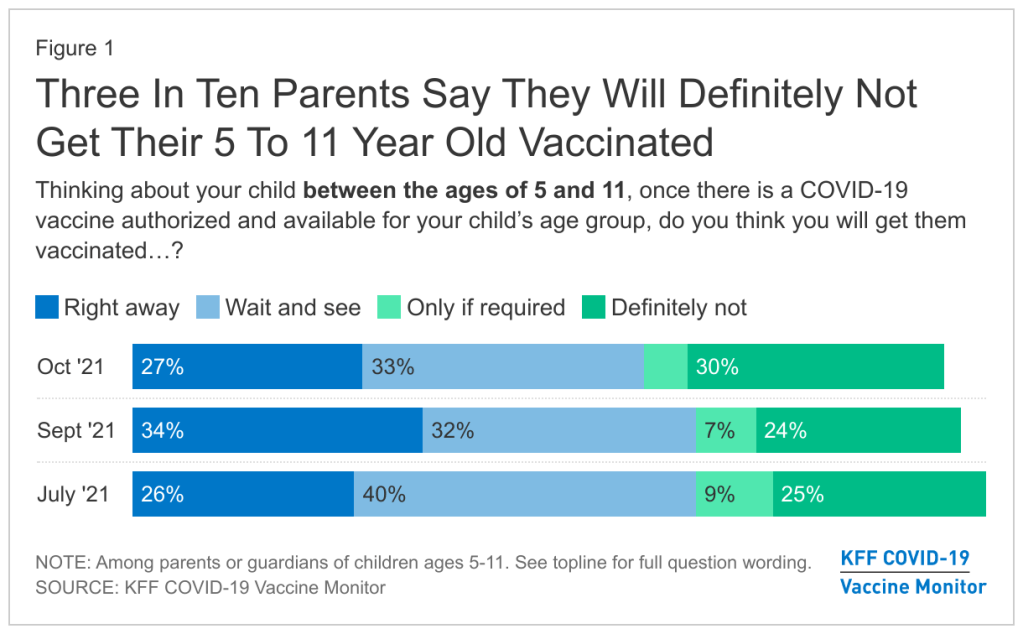
    The Pfizer vaccine will likely be available to children ages 5 to 11 next week, but many parents are hesitant about getting their kids vaccinated. Chart via the KFF COVID-19 Vaccine Monitor.

    Last week, the Food and Drug Administration (FDA) recommended Pfizer’s COVID-19 vaccine for children ages 5 to 11, under an Emergency Use Authorization. The agency’s vaccine advisory committee met on Tuesday to discuss Pfizer’s application and voted overwhelmingly in favor; the FDA followed this up with an EUA announcement on Friday.

    This coming week, the process continues: CDC’s own vaccine advisory committee will discuss and vote on vaccinating kids in the 5-11 age group, and then the agency will make an official decision. If all goes well—and all is expected to go well—younger kids will be able to get their vaccines in time for Thanksgiving.

    Many of the parents I know have been eagerly awaiting this authorization, but the sentiment is far from universal. COVID-19 vaccinations for kids are incredibly controversial, more so than vaccinations for adults. The public comment section of the FDA advisory committee meeting—in which basically anyone can apply to share their thoughts—was full of anti-vaxxers, many of them sharing misinformation. Even some experts on the FDA advisory committee were not fully convinced that vaccines are needed for all young kids, though all but one eventually voted in favor.

    Now, let me be clear: there are definite benefits to vaccinating younger children. While kids are less likely to have severe COVID-19 cases than adults, the disease has still been devastating for many children. Almost 100 kids in the 5 to 11 age range have died of COVID-19, making this disease one of the top 10 causes of death for this group over the past year and a half.

    Plus, children who get infected with the coronavirus are at risk for Long COVID and MIS-C, two conditions with long-lasting ramifications. There have been about 5,200 MIS-C cases thus far—and the majority of these cases have occurred in Black and Hispanic/Latino children. Minority children are also at much higher risk for COVID-19 hospitalization. 

    Vaccination can prevent children from severe ramifications of a potential COVID-19 case, as well as from the mild infections that lead to missed school and other disruptions. But the FDA committee had to carefully weigh this benefit against potential side effects from vaccination, namely myocarditis—a type of heart inflammation.

    The U.S. system for tracking vaccine side effects has identified a small number of myocarditis cases in children ages 12 to 15 after their second shots of Pfizer or Moderna vaccines. For the meeting this past Tuesday, the FDA presented some models weighing potential myocarditis cases in young kids against vaccination benefits; the models showed that, in almost every scenario, the number of severe COVID-19 cases prevented by vaccination is higher than the myocarditis cases.

    It’s worth noting: in Pfizer’s clinical trial for the 5 to 11 age group, no child had a severe adverse reaction to the vaccine. But the Pfizer researchers did observe five medical events that were unrelated to vaccination—including one kid who swallowed a penny.

    Some of the FDA advisory committee members suggested that perhaps vaccines would be most beneficial for children with underlying medical conditions, who are more susceptible to severe COVID-19. But the committee ultimately voted in favor of vaccines for all kids in the 5 to 11 age group, allowing parents to consult their pediatricians and pursue vaccination if they deem it necessary.

    Polling data suggest that many parents don’t currently deem it necessary, though. The latest survey from the Kaiser Family Foundation found that just 27% of parents with kids in the 5 to 11 age range plan to get their kids vaccinated immediately, once shots are available. 33% intend to “wait and see,” 5% will only pursue vaccination if it’s required by the child’s school, and 30% say “definitely not.”

    Public health experts, pediatricians, and others in the science communication world have a lot of work ahead of us to convey the importance of vaccinating kids—and dispel misinformation.

    Note: this post relies heavily on STAT News’s liveblog of the FDA committee meeting.
    More vaccine coverage

  • Unpacking Delta AY.4.2: Are we prepared for the next variant?

    Unpacking Delta AY.4.2: Are we prepared for the next variant?

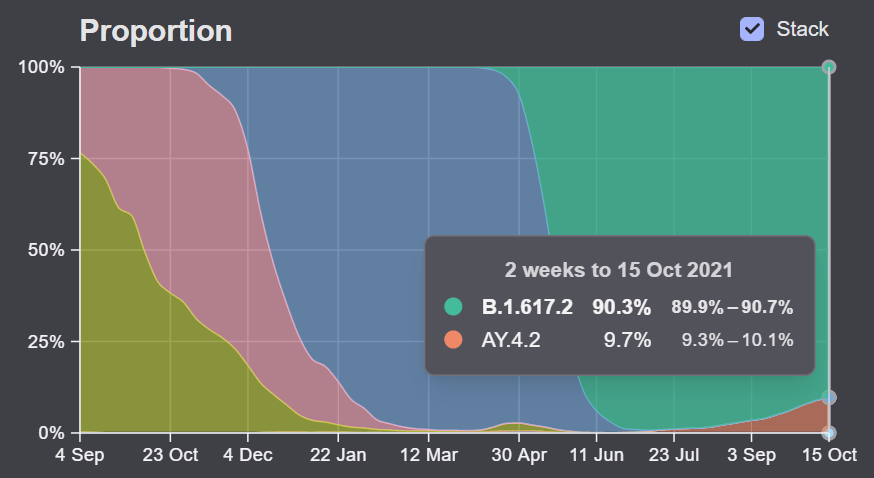
    AY.4.2, an offshoot of the Delta variant, now comprises about 10% of new COVID-19 cases in the U.K. Chart via U.K. COVID–19 Genomic Surveillance.

    Recently, a new offshoot of the Delta variant has been gaining ground in the U.K. It’s called AY.4.2, and it appears to be slightly more transmissible than Delta itself. While experts say this variant doesn’t differ enough from Delta to pose a serious concern, I think it’s worth exploring what we know about it so far—and what this means for the future of coronavirus mutation.

    How was AY.4.2 identified?

    The U.K. national health agency first found AY.4.2 in July 2021, and has watched it slowly spread through the country since then. The agency formally designated this variant as a Variant Under Investigation (VUI) on October 22; at this point, about 15,000 cases had been identified across the country.

    It’s worth noting here that the U.K.’s genomic surveillance system is incredibly comprehensive—considered to be the best in the world. The country sequences over 20,000 coronavirus samples a week; it’s consistently sequenced a large share of its COVID-19 cases since the beginning of 2021. And, since the country’s public health system integrates COVID-19 testing records with hospitalization records, primary care records, and other data, U.K. researchers are able to analyze other aspects of a variant’s performance, such as its ability to cause breakthrough cases or more severe disease.

    As STAT News’ Andrew Joseph explains in a recent story about this variant:

    It’s perhaps not a surprise that the U.K. noticed AY.4.2 so quickly. The country has an incredible sequencing system in place to monitor genetic changes in the virus, and researchers there have been among the global leaders in characterizing different mutations and forms of the virus. It’s possible that other Delta sublineages have similar growth rates to AY.4.2, but they’re in parts of the world where it will take longer for scientists to detect.

    How does AY.4.2 differ from OG Delta?

    AY.4.2 is transmissible enough that it is slowly pushing out the original Delta in some parts of the U.K. In late June, it comprised 0.1% of new U.K. COVID-19 cases; in late August, it was at 3.5%; and now it’s at 11.3%, as of the most recent data (the week ending October 24).

    “It’s a slow burner,” wrote U.K. epidemiologist Meaghan Kill in a Twitter thread last week. “But Delta is already *so* transmissible, it’s notable that AY.4.2 is increasing in that context.”

    Kill and other scientists estimate that AY.4.2 is between 10% and 15% more transmissible than Delta. That’s a small enough difference that scientists are not panicking about this variant, in the same way that epidemiologists sounded the alarm when Delta itself was first identified in India earlier in 2021. (For context: Delta is 60% to 80% more transmissible than the Alpha variant.)

    Still, AY.4.2 is worth watching as a signal of Delta’s continued ability to mutate and spread more readily. As Joseph points out in his STAT article, some experts hypothesized that Delta might be so contagious, the coronavirus basically could not mutate further in that direction. AY.4.2 suggests that we haven’t hit that upper limit yet.

    Is AY.4.2 more likely to cause breakthrough cases?

    This is one piece of good news that came out in the U.K. health agency’s most recent variant report, released this past Friday: AY.4.2 is not more likely to cause a breakthrough case than the original Delta variant. (Not thus far, anyway.) This is true for both symptomatic and asymptomatic infections, as well as different ages and vaccine types.

    The AY.4.2 data in this U.K. report are based on a relatively small sample size—about 13,000 people infected with AY.4.2, compared to over 350,000 people infected with the original Delta variant. Still, it’s good news that the variant appears to simply be more transmissible, not more able to break through vaccine-induced immunity or cause severe disease.

    “More likely (I believe) is a slightly increased biological transmissibility,” Meaghan Kill wrote in a Twitter thread about this news. “Growth rate & secondary attack rates are refreshed with new data and findings remain the same as last week.” She predicts that AY.4.2 may be able to replace the original Delta by summer 2022.

    How much is AY.4.2 spreading in the U.S.?

    AY.4.2 has been identified in over 30 countries, including the U.S. But here, OG Delta continues to dominate; this variant has been causing over 99% of new cases in the U.S. for well over a month, with a couple of other Delta sub-lineages (AY.1 and AY.2) briefly popping up without getting competitive. AY.4.2 is not yet accounted for on the CDC’s variant tracker, but other estimates indicate that it’s causing under 1% of new cases in the U.S.

    “We have on occasion identified the sublineage here in the United States, but not with recent increased frequency or clustering to date,” CDC Director Dr. Rochelle Walensky said at a recent COVID-19 briefing, according to STAT.

    Are we prepared for a surge of AY.4.2—or another coronavirus variant?

    The U.S. does not have a great track record for dealing with COVID-19 surges—whether that’s New York City in spring 2020 or Delta hotspots in the South this past summer. We’re doing more genomic sequencing than we were at the start of 2021, which helps with identifying potentially-concerning variants, but sequencing still tends to be clustered in particular areas with high research budgets (NYC, Seattle, etc.). And even when our sequencing system picks up signals of a new variant, we do not have a clear playbook—or easily-utilized resources—to act on the warning.  

    To illustrate this point, I’d like to share a major project of mine that was published this past week: an investigation of the Delta surge in Southwest Missouri this summer. This project was a collaboration between the Documenting COVID-19 project at the Brown Institute for Media Innovation and MuckRock (where I’ve been working part-time for a few weeks now), and the Missouri Independent, a nonprofit news outlet that covers Missouri state government, politics, and policy.

    Missouri Independent reporter Tessa Weinberg and I went through hundreds of emails, internal reports, and other documents obtained through public records requests. We found that, even though Missouri had ample warnings about Delta—wastewater surveillance picked up the variant in May, and hospitals noticed increasing breakthrough cases in June—the Springfield area was completely overwhelmed by the virus. Infighting and mistrust between state and local officials also hindered the region’s response to the Delta surge.

    Our major findings (copied from the article) include:

    Springfield hospital and health department leaders urged the state to take advantage of additional genomic sequencing assistance to address unanswered questions about the variant’s spread. The state declined, forcing Springfield officials to seek additional data on their own.

    After days of preparation for an overflow hospital for COVID patients requested by Springfield officials, local leaders decided to forego the plan after the window of need had passed — setting off dueling narratives over the reason why in public while state officials seethed in private.

    When local officials pleaded for more support in addressing the Delta surge, state officials questioned the value of directing more resources to the area and even wondered whether the overflow hospital request was fueled by motivations to “pay for an expansion of their private hospital.”

    You can read the full story here (at the Missouri Independent) or here (on MuckRock’s website). Find the documents that we used here.

    And read my Twitter thread with more highlights here:


    More variant reporting

  • National numbers, October 31

    National numbers, October 31

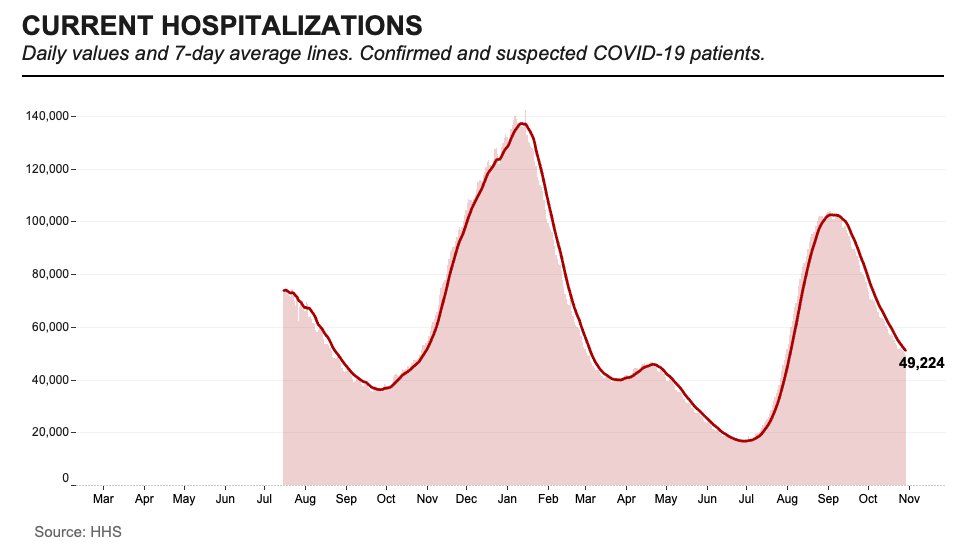
    Nationwide COVID-19 hospitalizations have fallen below 50,000 for the first time since July. Chart via Conor Kelly, posted on Twitter on October 30.

    In the past week (October 23 through 29), the U.S. reported about 480,000 new cases, according to the CDC.* This amounts to:

    • An average of 69,000 new cases each day
    • 147 total new cases for every 100,000 Americans
    • 7% fewer new cases than last week (October 16-22)

    Last week, America also saw:

    • 38,000 new COVID-19 patients admitted to hospitals (12 for every 100,000 people)
    • 8,000 new COVID-19 deaths (2.4 for every 100,000 people)
    • 100% of new cases are Delta-caused (as of October 23)
    • An average of 900,000 vaccinations per day (including booster shots; per Bloomberg)

    *Note: we are back to our usual schedule (utilizing data as of Friday) after last week’s hiccup.

    Nationally, new COVID-19 cases continue to drop—though the decrease is slowing a bit from previous weeks. The number of new cases fell by about 7% this week, after falling by about 12% for the two weeks prior.

    Still, a downward trend is a positive trend. The U.S. now has fewer than 50,000 COVID-19 patients in hospitals nationwide, for the first time since July—before the Delta surge started. The number of new deaths is also slowly falling, though the country is still seeing over 1,000 people die from COVID-19 each day.

    The country’s current hotspots continue to be the same group of colder-weather states I called out last week: Alaska, Montana, Wyoming, North Dakota, and Idaho. All five have recorded over 400 new cases for every 100,000 people in the last week, per the latest Community Profile Report, with Alaska at the top (657 cases per 100,000).

    It’s hard to say whether these high numbers are a product of cold weather driving people inside, low vaccination rates—all five states have about half or less of their populations fully vaccinated—or both. Continuing trends in these states may provide an indicator of how other parts of the country may fare this winter.

    Meanwhile, more states are seeing their COVID-19 numbers drop below “high transmission” levels, including Louisiana, D.C., Georgia, Maryland, Texas, and New Jersey. In New Orleans, a Delta epicenter in the summer, case numbers are low enough that the mayor has loosened the city’s mask mandate and other COVID-19 restrictions.

    Vaccinations are up nationally, but booster shots—not previously unvaccinated Americans getting their first doses—are comprising the bulk of the trend. Yesterday, out of 1.6 million doses reported by the CDC, a record one million were booster shots. Just 361,000 were new first doses.

  • Featured sources, October 24

    • More booster shot data from the CDC: The CDC has added more data on additional vaccine doses to its COVID-19 dashboard. Specifically, we can now analyze booster shots by state: raw numbers, share of the fully vaccinated population with a booster, and limited age data (18+, 50+, 65+). If anyone from the CDC is reading this: I would love to see some race/ethnicity data next!
    • Racial and ethnic disparities in COVID-19 hospitalization: A new CDC study published this week in JAMA Open Network presents analysis of data from COVID-NET, the national agency’s surveillance system for COVID-19 hospitalizations. The study, like other research on this topic, found that non-white Americans were far more likely to be hospitalized with COVID-19 or die from the disease in the first year of the pandemic than their white neighbors. Supplemental tables for the study include breakdowns of COVID-19 hospitalizations by different demographic groups, by underlying medical conditions, and over time.
    • The COVID States Project: In this polling project, researchers surveyed people in all 50 U.S. states to ask whether they approve of the president and of their governors. The survey is jointly run by researchers at Harvard, Northeastern, Northwestern, and Rutgers Universities. This latest report, released in October, includes executive approval data stratified by political party and vaccination status.
    • COVID-19, compared to other leading causes of death: COVID-19 was the number two cause of death in the U.S. in September 2021—after heart disease—according to this report from the Peterson Center on Healthcare and the Kaiser Family Foundation. The report compares COVID-19 to other top causes of death in the country, including data over time and by age group.

  • Malnutrition, other gastrointestinal issues are common in Long COVID

    Did you know that diarrhea, nausea, and vomiting are all common COVID-19 symptoms? I knew they were included on the CDC’s list of symptoms, but I didn’t realize how often these symptoms occur—or how nasty they can get—until I reported this story for Gothamist, a news site run by New York City’s public radio station.

    The story focuses on a recent paper from Northwell Health, a hospital system in NYC. Northwell clinicians investigated rates of gastrointestinal symptoms (or, symptoms in the digestive system) among their COVID-19 patients. Out of 17,500 patients, over 3,200 had gastrointestinal symptoms—almost 20% of the group. These symptoms included diarrhea caused by intestinal infection, bleeding in the GI tract, and malnutrition.

    For several hundred patients, the researchers were able to track their GI symptoms for six months after they left the hospital. This led to another concerning discovery: at the six-month mark, more than half of the patients who’d suffered malnutrition in the hospital were still experiencing this symptom. Same thing for the patients who’d suffered chronic weight loss.

    In reporting this story, I also talked to Lauren Nichols—a Long COVID patient and advocate with Body Politic. She’s been facing COVID-related GI symptoms for eighteen months, ranging from intensive diarrhea in spring 2020 to an inability to gain weight and, now, potential autoimmune issues. Many other Long COVID patients have experienced these symptoms, according to a large survey of patients.

    As I wrote a couple of weeks ago, Long COVID provides a great argument in favor of getting vaccinated. This disease isn’t just a run-of-the-mill cough, or flu—it can truly mess up people’s lives in the long term.

  • Booster shots exacerbate global vaccine inequity

    At the end of last week’s post on booster shots, I wrote that these additional doses take up airtime in expert discussions and in the media, distracting from discussions of what it will take to vaccinate the world.

    But these shots do more harm than just taking over the media cycle. When the U.S. and other wealthy nations decide to give many residents third doses, they jump the vaccine supply line again—leaving low-income nations to wait even longer for first doses.

    I explained how this process works in a new article for Popular Science. Essentially, the big vaccine manufacturers (Pfizer, Moderna, Johnson & Johnson, etc.) have created artificial scarcity of vaccine doses, by insisting on controlling every single dose of their products—rather than sharing the vaccine technology with other manufacturers around the world.

    Then, out of this limited supply of doses, the big companies sell to wealthy nations first. The wealthy nations are “easier markets to service,” WHO spokesperson Margaret Harris told me, since they can pay more money and have logistical systems in place already to deliver the vaccine doses.

    If a wealthy nation wants boosters, it’s in the vaccine companies’ best interests to sell them boosters—before sending primary series doses to other parts of the world. Or, as South Africa-based vaccine advocate Fatima Hassan put it: “Supplies that are currently available are diverted” for boosters. “Just to serve preferred customers in the richer North.”

    The FDA and CDC authorized booster shots for Moderna, Johnson & Johnson, and mix-and-match regimens this week. Advisory committee discussions did not mention that, worldwide, three in five healthcare workers are not fully vaccinated.

    More international data

    • The challenges of routine COVID-19 testing in schools

      The challenges of routine COVID-19 testing in schools

      At this point in the pandemic, we know that routine COVID-19 testing can be a key tactic for reducing transmission in communal settings. If you identify cases as soon as they occur through asymptomatic testing, you can quickly isolate those cases and quarantine their contacts—preventing the cases from turning into outbreaks. This strategy works everywhere from kindergarten classrooms to the NBA.

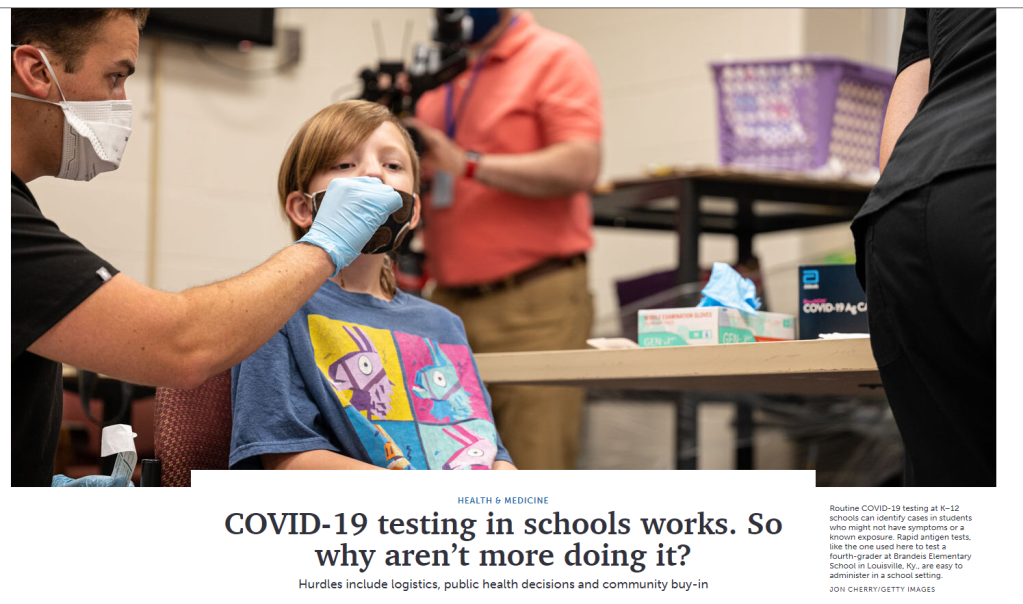
      Despite the clear evidence that testing works, high case numbers in children in recent months, and millions of dollars in federal funding, many K-12 schools across the U.S. still aren’t doing any COVID-19 testing. Why not? I explain the hurdles in a story for Science News.

      I found five major challenges:

      • Without clear guidance from public health officials, school leaders may struggle to make crucial decisions about testing logistics (such as which tests to use, how often to test, and who will do the testing).
      • One logistical decision can be particularly tough: what happens when a student or staff member tests positive?
      • Obtaining COVID-19 tests themselves can be a struggle in this era of endless supply chain shortages, if schools are not getting tests directly from state health agencies.
      • Schools must gain consent from their students’ families for COVID-19 testing, which can be logistically complicated and require a lot of communication.
      • Testing, like all COVID-19 safety measures, has become polarized—and can come with both political and personal baggage for families. 

      You can read the full story for more details. But here, I wanted to share some notes from a section that was cut out of the article: one focusing on data. As longtime COVID-19 Data Dispatch readers know, I love to call out the lack of data on COVID-19 cases, tests, and other metrics in school settings.

      Through reporting this article, I also learned that simply reporting testing numbers can be a major barrier for schools. In most cases, schools are required to submit all their test results to their state or local health departments; this type of health data reporting is not something that schools are cut out to do.

      “Reporting test results to the appropriate public health authorities was something that school administrators, frankly, were not used to doing, and didn’t really know how to do,” Divya Vohra, an epidemiologist at the research organization Mathematica who studies testing programs, told me. Such reporting might require schools to set up an electronic records system like those used by hospitals, or it might require school nurses to manually enter data for every student.

      Ideally, a school district would partner with “a vendor that comes in, reports the data for you to the state, and then also feeds that data into a dashboard” which school administrators can use in making decisions, said Leah Perkinson, testing program coordinator at the Rockefeller Foundation. But this type of partnership may be hard to come by, especially if schools are attempting to set up testing without support from their state health or education agencies.

      As I’ve pointed out in the past, there is no national dataset of COVID-19 tests conducted in K-12 schools. New York is the only state reporting these data, along with some large districts such as Los Angeles Unified. Due to a lack of interest in K-12 testing prior to this fall, Perkinson says, “it wasn’t apparent that we need to build a centralized data reporting repository.” Now, many schools that might consider setting up a testing program are flying blind, without clear success stories to follow.

      In addition, when the schools with testing programs in place do not actively monitor their own test results, they may miss out on valuable information, Alyssa Bilinski, a biostatistician at Brown’s School of Public Health, told me. Many districts rely on community COVID-19 metrics, such as the case rate in a county.

      But “schools can vary a lot from the overall average, because kids can be really different from adults,” Bilinski said. “It’s a much more precise indicator if we have data for a particular school community.” (For more reading on this topic, I recommend Bilinski’s recent opinion piece in STAT News!)

      More K-12 school stories

    • National numbers, October 24

      National numbers, October 24

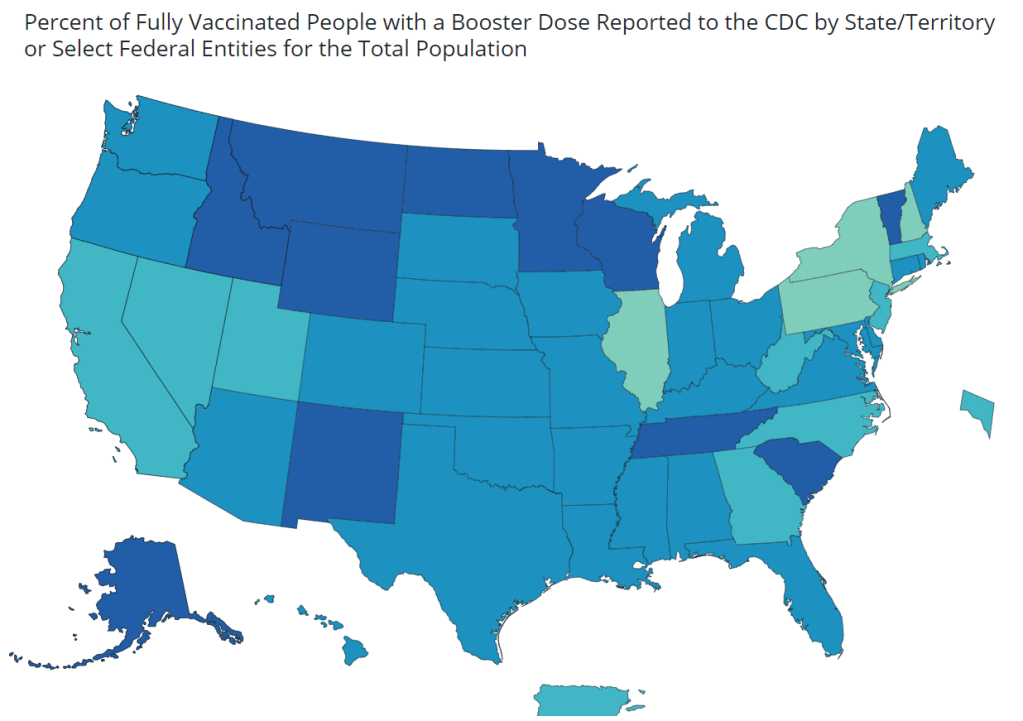
      As of October 22, the CDC is reporting booster doses administered by state. Darker blue corresponds to a higher share of the fully vaccinated population in the state that has received a booster; lighter blue/green corresponds to a lower share of the population.

      In the past week (October 15 through 21), the U.S. reported about 510,000 new cases, according to the CDC.* This amounts to:

      • An average of 73,000 new cases each day
      • 156 total new cases for every 100,000 Americans
      • 14% fewer new cases than last week (October 9-15)

      Last week, America also saw:

      • 42,000 new COVID-19 patients admitted to hospitals (13 for every 100,000 people)
      • 9,000 new COVID-19 deaths (2.7 for every 100,000 people)
      • 100% of new cases are Delta-caused (as of October 16)
      • An average of 800,000 vaccinations per day (including booster shots; per Bloomberg)

      *Note: This week’s update relies on data as of Thursday, October 21. I usually use Friday data (via the COVID Data Tracker Weekly Review), but was unable to do so this week because I headed offline for a hiking trip before the Friday data were posted. We’ll be back to the usual sourcing next week!

      Nationwide, COVID-19 cases continue to go down—slowly but surely. We’re now seeing roughly 70,000 new cases a day, comparable to case counts when the Delta surge started to really pick up at the end of July. It’s worth noting, though, that this is still higher than the peaks of both the spring and summer 2020 surges.

      At the state level, more parts of the country are approaching lower coronavirus transmission levels. As of Thursday, eight jurisdictions have dropped below 100 new cases per 100,000 people in the past week. From lowest case counts to highest, these are: California, Hawaii, Florida, Louisiana, Washington D.C., New Jersey, Maryland, and Mississippi.

      Alaska, Montana, and Wyoming remain the states with the highest COVID-19 rates, followed by Idaho and North Dakota. These states are all in northern parts of the U.S.—and their recent case increases have coincided with cold weather—the Washington Post and other outlets have noted. Other states may see similar COVID-19 upticks as it becomes too cold to socialize outdoors.

      Booster shots continue to inflate vaccination numbers, as these third doses comprise between one-third and one-half of doses administered in the U.S. each day. Over 11 million people have already received a booster dose—more than the total doses administered in a number of low-income countries.

    • Sources and updates, October 17

      • COVID-19 cases, deaths, hospitalizations by vaccination status: The latest addition to the CDC’s COVID-19 dashboard, this week, is a set of two pages that break out case, death, and hospitalization rates by vaccination status. The page with case and death rates draws on CDC monitoring programs, and may not be entirely representative of data for the entire U.S. The page with hospitalization rates draws on COVID-NET, a network of over 250 hospitals in 14 states.
      • Hospitalization data will shift back to the CDC: Bloomberg reported this week that the Biden administration will bring the HHS Protect system, which tracks hospitalization data, under the auspices of the CDC. Hospitalization data moved from CDC responsibility to HHS responsibility in summer 2020—a move covered extensively by the COVID-19 Data Dispatch. At the time, this change drew criticism, though the HHS Protect system developed into a highly reliable data source. It is unclear how a move back to the CDC may impact hospitalization tracking.
      • Mask Diplomacy in Latin America During the COVID-19 Pandemic: This dataset, compiled by political scientists Diego Telias and Francisco Urdinez, includes over 500 donations of COVID-19 supplies—face masks, respirators, tests, and more. The data underlie a preprint posted online in August 2020 discussing China’s diplomacy in Latin America and the Caribbean. (h/t Data Is Plural.)

    • Another COVID-19 endgame take

      Trevor Bedford, computational virologist at the Fred Hutchinson Cancer Research Center—and widely regarded expert on coronavirus variants—wrote a useful Twitter thread this week. In the thread, Bedford provides his take on the “COVID-19 endgame.” In other words, what will happen once the virus reaches endemic levels? (Endemic here meaning, the virus is still circulating but it’s not infecting enough people to cause major concern.)

      First of all, COVID-19 will become endemic in different places at different times, Bedford says. In the U.S., where over half the population is vaccinated, we’re closer to endemicity than other nations. 

      Then, endemicity itself will be a push-and-pull between two things: vaccination levels and the virus’ ability to spread through the population. The Delta variant—which is much more contagious than the original coronavirus—will need to be countered by a lot of vaccination. Bedford also suggests that immunity (from vaccination and prior infection) will likely drop at least somewhat from one year to the next, like what we see now for the flu.

      The U.S. will likely still see a lot of COVID-19 infections each year, Bedford says. They’ll likely be more common during a specific “season,” like how our flu season takes place in the fall and winter. Most infections will be “relatively mild,” he says, but with enough virus transmission, some people will get seriously ill.

      Overall, Bedford suggests that COVID-19 will become similar to the flu—not comparable to cancer or heart disease, he says, but “still a substantial public health burden.” And his estimates of annual deaths do not mention Long COVID, another dimension of the potential health burden that yearly COVID-19 outbreaks may cause.

      (We know that vaccination reduces Long COVID risk, but a lot of other information about this condition remains unknown.)