Blog

  • Public health data in the US is “incredibly fragmented”: Zoe McLaren on booster shots and more

    Public health data in the US is “incredibly fragmented”: Zoe McLaren on booster shots and more

    This week, I had a new story published at the data journalism site FiveThirtyEight. The story explores the U.S.’s failure to comprehensively track breakthrough cases, and how that failure has led officials to look towards data from other countries with better tracking systems (eg. Israel and the U.K.) as they make decisions about booster shots.

    In the piece, I argue that a lack of data on which Americans are most at risk of breakthrough cases—and therefore most in need of booster shots—has contributed to the confusion surrounding these additional doses. Frequent COVID-19 Data Dispatch readers might recognize that argument from this CDD post, published at the end of September.

    Of course, an article for FiveThirtyEight is able to go further than a blog post. For this article, I expanded upon my own understanding of the U.S.’s public health data disadvantages by talking to experts from different parts of the COVID-19 data ecosystem.

    At the CDD today, I’d like to share one of those interviews. I spoke to Zoe McLaren, a health economist at the University of Maryland Baltimore County, about how the U.S. public health data system compares to other countries, as well as how data (or the lack of data) contribute to health policies. If you have been confused about your booster shot eligibility, I highly recommend giving the whole interview a read. The interview has been lightly edited and condensed for clarity.


    Betsy Ladyzhets: I’m writing about this question of vaccine effectiveness data and breakthrough case data in the U.S., and how our data systems and sort-of by extension public health systems compare to other countries. So, I wanted to start by asking you, what is your view of the state of this data topic in the U.S.? Do you think we can answer key questions? Or what information might we be missing?

    Zoe McLaren: It’s the age-old problem of data sources. A lot of cases are not going to be reported at all. And then even the ones that are reported may not be connected to demographic data, for example, or even whether the people are vaccinated or not. Whereas other countries like Israel, and the U.K., your positive COVID test goes into your electronic health record that also has all the other information. 

    And Medicare patients, they have that whole [records] system. There will be information [in the system] about whether they got vaccinated, as well as whether they have a positive test. So that data will be in there. But for other people, it may or may not be in an electronic health record. And then of course, there’s multiple different electronic health record systems that can’t be integrated easily. So you don’t get the full picture.

    But it’s all about sample selection. Not everyone [who actually has COVID] is ending up in the data, which messes up both your numerator and denominator when you’re looking at rates.

    BL: Could you say more about how our system in the U.S. is different from places like Israel and the U.K., where they have that kind of national health record system?

    ZM: When the government is providing health insurance, then all of your records and the [medical] payments that happen, there’s a record of them… And then, because it’s a national system, it’s already harmonized, and everyone’s in the same system. So it’s really easy to pull a dataset out of that and analyze it.

    Whereas in the US, everything is incredibly fragmented. The data, and the systems and everything is very fragmented. The electronic health systems don’t merge together easily at all. And so you get a very fragmented view of what’s going on in the country.

    BL: Right, that makes sense. Yesterday, I was talking to a researcher at the New York State Health Department who did a study where they matched up the New York State vaccination records with testing records and hospitalization records, and were able to do an analysis of vaccine effectiveness. And he said, basically, the more specific, you tried to go with an analysis, the harder it is to match up the records correctly, and that kind of thing.

    ZM: Exactly. It’s easy to match on things like age, sex, race, since everybody has them. But then, the different data fields are gonna have different formats and be much harder to merge together.

    BL: So what can we do to improve this? I know Medicare for All is one option— 

    ZM: Medicare for All, end of story, end of article. It would solve so many problems.

    It’s tricky, though, because there isn’t a simple fix. All of these health systems have their own electronic health records, and integrating them is really costly and hard to do, and who is going to pay for that? There’s also additional privacy concerns about integrating things, in terms of protecting privacy and confidentiality. So, that’s really tricky.

    The way that we get around that, in general, is to have reporting requirements. Like with COVID tests, [providers are] required to report to the CDC or the HHS… Still, that’s also costly and time consuming. But that is kind-of the best thing that we can do right now, is have the different [public health] entities produce reports on a regular basis and send that to a centralized location. And the reports are supposed to be produced in a way that they are harmonized, they’re easy to put together from all the different systems.

    The problem with the different systems not integrating is, it requires everyone to basically fill out the equivalent of a form and send it in—listing individual patient information, or at the state level, individual county information. An example of that is the COVID data. All of the COVID data gets reported up to the national level [by state and county health departments]… 

    But the reporting often gives you the numerators, when you need to figure out the denominators. Because you would want to know, for example, we want to know what proportion of breakthrough cases end up hospitalized. But if only the hospitalized people end up in the data, and a lot of breakthrough cases go either undetected or never tested, or they do an at-home test and there’s no record of that positive case in the system, then your denominator is—there’s a problem with your denominator. That’s a problem with sample selection, you get people that are self-selecting into the numerator [by testing positive], but also self-selecting into the denominator [by getting a test to begin with].

    BL: Yeah, that makes sense. I know you said it would be pretty complicated to basically force different public health departments—to standardize them so that they’re all reporting in the same way. Is there more that researchers in the US could be doing in the short-term to either improve data collection or use what we have to answer questions like, what occupations might confer higher risk of a breakthrough case? 

    ZM: This is a coordination problem. Because in general, we all have an incentive to contribute to having a better understanding of breakthrough cases. But the trick is that, unless the national government or the CDC takes the role of saying what the [data] format’s gonna look like…

    Part of the problem is that there’s an effort involved [in collecting these data] and people don’t want to put in the effort. But if they do want to put in the effort, then you still have a coordination problem, because who gonna to be deciding what format we’re using?

    BL: Or like, what the data definitions are.

    ZM: Exactly. Like, do you report the month and the day of the vaccination dose, or just the month of the dose? Things like that where it doesn’t seem like a big deal, but it does matter for research purposes. If you look, for example, at the Census, or any of the national surveys, like the Current Population Survey or the National Labor Force Survey where we get unemployment numbers, there are big committees that figure out which questions we’re asking and how we ask them. So, if the CDC just says, like, “This is the dataset we’re building,” then everyone [local agencies] will be like, “Okay, we’re gonna send our reports in that way.” 

    Part of [the challenge] is that it takes effort to produce the data, and part of it is somebody needs to coordinate. And usually that would be something the CDC would do, saying, “This is the data that needs to be reported to us,” and everybody reports to them. But they could be doing more, they could be asking for more detailed information—for example, data based on vaccination status, because that information will be important for understanding the progression of the pandemic.

    BL: Yeah. I volunteered for the COVID Tracking Project for a while, and one of the most tedious things that we had to do there was figuring out different definitions for like, what states were considering a case or a test, or whatever else. So that definitely makes sense to me.

    ZM: Exactly. And the COVID Tracking Project filled a gap. Nobody was doing that [collecting data from the states], so the COVID Tracking Project did that… But it’s tricky, because a lot of the stuff that seems like splitting hairs [on definitions] really does make a difference when you’re doing your analysis.

    BL: I also wanted to ask you about what the implications are of this lack of standardized data in the U.S., and the lack of information that we have—largely around vaccinations, but I think there are other areas as well where we’re missing information. So I’m trying to figure out, for this story, how data gaps might contribute to the confusion that people feel when they watch health agencies make decisions. Like watching all the back and forth on booster shots, or thinking about Long COVID, other things like that.

    ZM: Well, we talk about evidence-based medicine, and we also care about evidence-based policy. And so it means that when the quality of data is poor, the quality of our policy is going to be worse. So it really is in everybody’s best interest to have high-quality data, because that is the bedrock of producing high quality policy.

    BL: Right. So if we don’t know, for example, if people who live and work in certain situations are more likely to have a breakthrough case, then we can’t necessarily tell them—we can’t necessarily say, “These specific occupations should go get booster shots.” And then we just say, “Everyone can go get a booster shot.”

    ZM: It means that we’re flying blind. And the problem of flying blind is twofold. One is that you can end up making poor decisions, the wrong decisions, because you don’t have the data. And then the other problem is that you end up making decisions that, in economics, we call it “inefficient.” I think about [these decisions] as, you end up with “one size fits all.” 

    If we have really high quality data, then we’re able to create different policies for different types of people, and that helps minimize any of the downsides. But the less data we have, the more we have to rely on “one size fits all.” And of course, if “one size fits all,” it’s going to be too much for some people and too little for others. Data would help improve that.

    BL: How do you think that this kind of “one size fits all” contributes to how individual people might be confused or might not be sure how to kind of interpret the policies for their own situations?

    ZM: I think in a “one size fits all,” people get very frustrated because they see in their own lives, both the uncertainty and how that can be stressful—and also the waste. The situations where they fall under one policy, but they have enough information to know that that policy doesn’t necessarily apply to them. It does undermine confidence in policymaking. People get frustrated with “one size fits all,” because it seems wasteful.

    Though sometimes the “one size fits all” is still optimal, it’s better than the alternative. For example, the recommendation of “one size fits all” wearing masks tends to trump the “one size fits all” of not wearing masks. But there’s waste. There are situations where we end up wearing masks where they wouldn’t necessarily be needed. And vice versa.

    BL: Yeah. That makes me think of friends I have who are eligible to get booster shots because of medical conditions, but they’re sort-of thinking, “I wish the shots could go to another country where they need vaccinations more.” And that’s not something individuals have any control over, but it’s frustrating.

    ZM: Part of it is, with the booster shots, is the guidelines that say people who have higher occupational exposure to risk [are eligible] without specifying exactly who that is. That is one way that we allow some leeway. So it’s not a “one size fits all” where nobody gets it, because there’s actually people who qualify under higher occupational exposure. But we also don’t want to have a “one size fits all” where we tell everyone they need it, because we do want to be sending doses abroad as well.

    So that’s a situation where we know that a “one size fits all” is not perfect. And so we create a, like, “use your judgement, talk to your doctor” kind-of thing that tries to help people self-select into the right groups… There are likely a lot of people who do have higher exposure and should be getting it, but don’t think the benefit applies to them.

    Editor’s note: According to one analysis, about 89% of U.S. adults will qualify for a booster shot after enough time has passed from their primary vaccine series. And, according to the October COVID-19 Vaccine Monitor report, four in ten vaccinated adults were unsure whether they qualified.

    BL: I also wanted to ask, you mentioned rapid tests—those don’t necessarily get reported. Are there other other things that you think pose data gaps in the U.S. public health system?

    ZM: With rapid tests, the actual tests are not getting reported. But the important thing is, people are getting tested. I mean, the reason we want good data quality is to reduce cases, and we wouldn’t want to limit access to rapid tests in order to collect data, because it’s much easier to prevent the cases by allowing people to get tested in their homes.

    But yeah, just the fact that there’s no centralized database for analysis [is a gap]. I mean, if you look at the U.K., and Israel, they have these great studies, because they’re able to just download, like, the entire population into a dataset. And it has all the information they need, like demographic factors. The fact that the U.S. has made so much of its national policy based on Israeli data, this shows how far behind we are with having our own data to answer these questions.

    BL: Yeah. I know, it’s something like half or a third of cases in the U.S., the CDC doesn’t have race and ethnicity information for [editor’s note: it’s 35%], and other stuff like that. It’s wild.

    ZM: Yeah… And one of the things about reporting is that every additional piece of data you want is very costly. And so you have to be very judicious about [collecting new values].

    BL: Well, those were all my questions. Is there anything I didn’t ask you that you think would be important for me to know for this story?

    ZM: Just that data is helpful for planning now, and helpful for the future. If we can improve our data systems now—it’s part of being prepared for the next pandemic.
    More vaccine reporting

  • National numbers, November 14

    National numbers, November 14

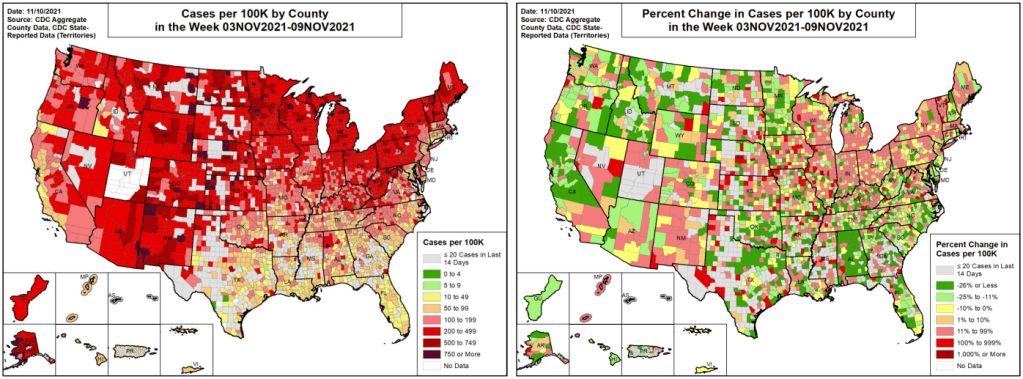
    Many Northern states are seeing cases increase right now as Southern states have lower transmission levels. Charts from the November 10 Community Profile Report.

    In the past week (November 6 through 12), the U.S. reported about 510,000 new cases, according to the CDC. This amounts to:

    • An average of 73,000 new cases each day
    • 156 total new cases for every 100,000 Americans
    • 3% more new cases than last week (October 30-November 5)

    Last week, America also saw:

    • 36,000 new COVID-19 patients admitted to hospitals (11 for every 100,000 people)
    • 7,000 new COVID-19 deaths (2.1 for every 100,000 people)
    • 100% of new cases are Delta-caused (as of November 6)
    • An average of 1.4 million vaccinations per day (including booster shots; per Bloomberg)

    It may be happening slowly, but the U.S. is clearly at the start of a winter COVID-19 surge. The number of newly reported cases rose this week for the first time since early September, while the number of COVID-19 patients in hospitals has plateaued.

    Delta is still causing practically 100% of COVID-19 cases in the country, so a new variant is probably not to blame for this potential surge. Instead, it’s a consequence of the cold weather, combined with less-stringent safety behaviors among many Americans as we approach the holiday season. One epidemiologist told NBC that a surge may be “inevitable” at this time of year.

    In line with COVID-19’s cold-weather advantage, many Northern states are seeing cases increase right now as Southern states—which were hit harder by the summer Delta surge—have lower transmission levels. Alaska, North Dakota, New Mexico, Montana, and Wyoming had the highest case rates last week, per the latest Community Profile Report.

    Cases are also rapidly increasing in Maine, Vermont, Minnesota, Michigan, Colorado, and other chillier states. At Vermont’s St. Michael’s College, Halloween parties were a major source of new COVID-19 cases—even though 98% of people on campus are vaccinated, according to local outlet WCAX3.

    Still, it’s important to point out here that the U.S. is in a far better spot now than we were at this time last year. As Dr. Ashish Jha pointed out on Twitter recently, we have winter coming and the vast majority of schools in the country are open, but cases are flat rather than rising sharply as they did last November.

    Of course, we have vaccines to thank for this improved position. More than two-thirds of the U.S. population has received at least one vaccine dose; as of this week, that number includes over one million children under age 12, according to the CDC. Vaccinating more children and other people who are currently unvaccinated, booster shots for seniors, and continued use of masks and testing can help keep case numbers (relatively) low as we head into the coldest months.

  • COVID source callout: Illinois, where’s your vaccination data?

    COVID source callout: Illinois, where’s your vaccination data?

    As I updated my vaccine data source annotations this weekend, I found that the state of Illinois has overhauled its COVID-19 dashboard. The dashboard now highlights a few key metrics tied to Illinois’ reopening status on its home page (new hospital admissions, available ICU beds, etc.), while a menu at the side of the dashboard links out to pages on several other COVID-19 topics, along with a data portal.

    I like the new organization. Illinois has had a pretty cluttered dashboard for a while, and it’s much easier to navigate through the new version. But there’s one big problem: in this reorganization, Illinois seems to have taken down the vast majority of its vaccination data.

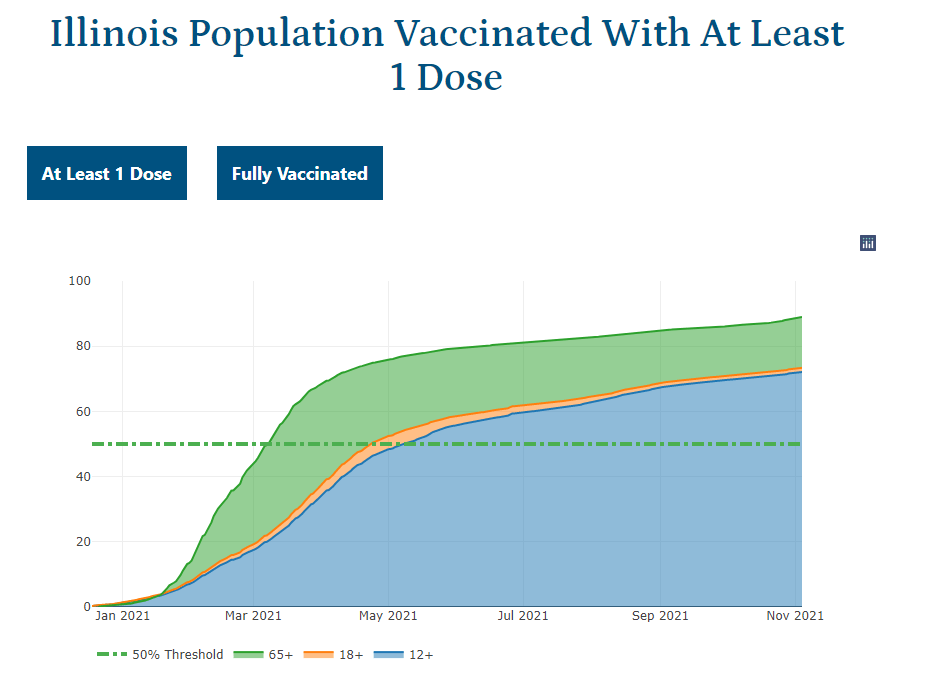
    The new dashboard includes one vaccination chart on its homepage: vaccinations among Illinois residents over time (at least one dose and fully vaccinated). You can download vaccination data by county through the dashboard’s data portal section. And there are vaccination charts included in both the “long-term care data” and “school and youth data” pages.

    The vaccination chart on Illinois’ COVID-19 dashboard homepage. Screenshot taken on November 7.

    But Illinois used to report a lot more metrics, including vaccination coverage by different age ranges, dose inventory, and breakthrough hospitalizations and deaths. Illinois was one of the first states to report breakthrough cases of any kind, and (as far as I am aware), it was the only state to publicly report a count of “unusable vaccine doses,” those doses that went to waste due to defects or other issues.

    What happened to these vaccine metrics? Will the Illinois health department put them back in a future dashboard update? If any local reporters from the state are reading this, I would love to know more about what’s going on here.

  • Featured sources, November 7

    • School Learning Modalities (HHS): Is that… could it be… comprehensive K-12 school COVID-19 data from the federal government?! Indeed: after over a year of calling out the government’s lack of data on this crucial topic, I was delighted to see the Department of Health and Human Services add a new dashboard to its COVID-19 data hub this week. The dashboard, produced in a collaboration between the CDC and the Department of Education, provides weekly updates on the learning status of school districts: in-person, hybrid, or remote. As of November 6, the dashboard included data for about 89% of students in 62% of districts. Next up, can we get some school case data?
    • When To Test (NIH): Earlier this year, the National Institutes of Health (NIH) supported production of an online tool aimed at helping schools, businesses, and other organizations develop routine COVID-19 testing programs. The tool, called When To Test, was updated this week with a new calculator aimed at individuals. Input some COVID-19 information (such as your location, vaccination status, and daily contacts), and the tool will help you determine whether to get tested. It could be useful for planning holiday gatherings!
    • COVID-19 Diagnostics Commons (ASU): Here’s another testing source, from Arizona State University. ASU researchers built a database of over 2,500 COVID-19 testing technologies that are available or going through the regulatory approval process around the world. You can search through the tests by regulatory status, diagnostic target, accuracy levels, and more.
    • Directory of federal government prime contractors: All businesses that contract with the federal government have until January 4, 2022 to ensure that all of their employees are vaccinated against COVID-19. This directory, from the U.S. Small Business Association, provides a comprehensive list of those contractors. You can see business names, what they do for the government, and more. (h/t Al Tompkins’ Covering COVID-19 newsletter.)

  • First COVID-19 antiviral pill gains authorization

    This week, an antiviral pill for COVID-19 was authorized in the U.K. The drug, made by American pharmaceutical company Merck, is the first COVID-19 treatment in pill form to gain approval by any regulatory agency.

    Some scientists have called this pill a “game-changer,” and for good reason. In Merck’s clinical trial, the drug approximately halved COVID-19 patients’ risk of hospitalization or death, compared to a placebo. The pill is designed for—and was tested on—adults who are particularly vulnerable to the virus, including seniors and those with preexisting conditions such as diabetes and heart disease.

    The pill, formally called molnupiravir, works by interfering with the coronavirus’ ability to replicate itself, stopping it from reaching further into the body and causing severe symptoms. (This STAT News article includes a video that explains the process in more detail.) Adults who show mild or moderate COVID-19 symptoms can take the pill soon after they realize they’re infected, in order to improve their chances of recovery without a hospital stay.

    In Merck’s clinical trial, patients started taking the pill five days after they began to experience COVID-19 symptoms. Each patient took four capsules, twice a day, for five days—adding up to 40 pills for a single patient.

    The U.K. government has bought almost 500,000 courses of molnupiravir. The U.S. government has brought about 1.7 million courses, and our FDA is slated to consider the pill for emergency use authorization later this month. Several other countries including France, Australia, Malaysia, and Singapore also have contracts in place to purchase the pills.

    But unlike other COVID-19 treatments and vaccines, molnupiravir may be more broadly available to people who don’t live in wealthy nations. Last week, Merck announced that it signed a voluntary licensing agreement with the Medicines Patent Pool, a public health organization backed by the United Nations that increases treatment access in over 100 low- and middle-income countries. As a result, a number of companies besides Merck will be able to manufacture and distribute their own versions of molnupiravir.

    Still, some global health advocates have criticized Merck for making a deal with the Medicines Patent Pool rather than the World Health Organization’s COVID-19 Technology Access Pool, which would provide access to a broader group of countries. The current deal leaves out some middle-income countries that are particularly poised to manufacture versions of molnupiravir, including countries like Brazil and Peru that have seen high COVID-19 death tolls.

    In short, Merck’s efforts to make its COVID-19 drug widely available are much better than anything we’ve seen from the major vaccine companies. But this is still far from the most equitable scenario.

  • Booster shot data slowly makes it onto state dashboards, but demographic information is lacking

    Booster shot data slowly makes it onto state dashboards, but demographic information is lacking

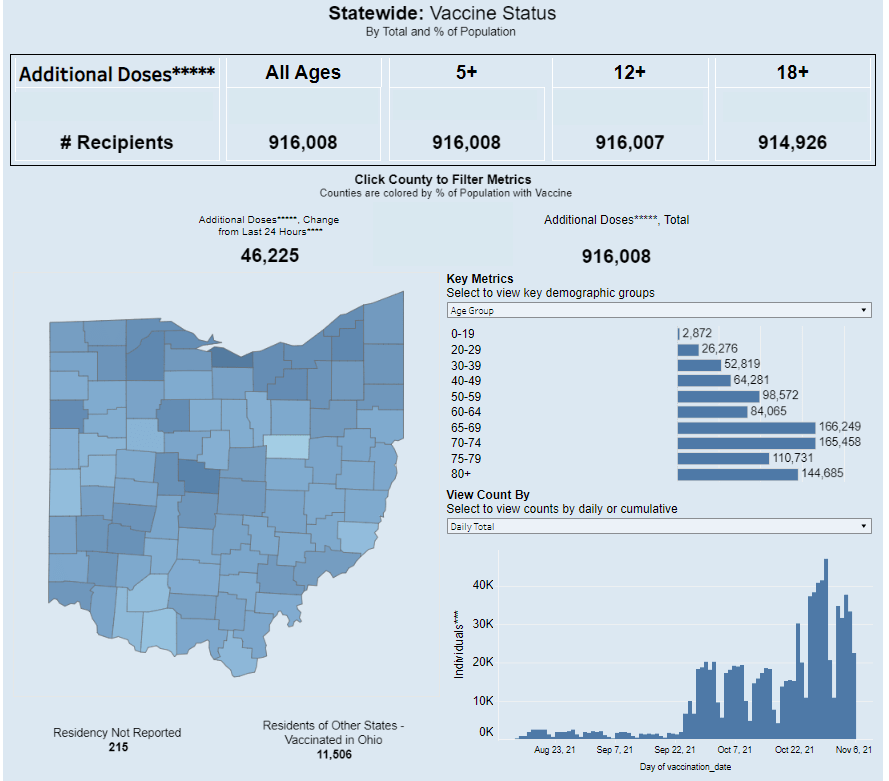
    Ohio is one of just eight states reporting demographic data for booster shots administered in the state. Screenshot taken on November 7.

    It’s now been over a month since the FDA and the CDC authorized third doses of Pfizer’s COVID-19 vaccine for a large swath of the U.S. population, and a couple of weeks since the agencies did the same thing for additional doses of Moderna and Johnson & Johnson’s vaccines. In that time, over 20 million Americans have received their boosters.

    This weekend, I set out to see what data are now available on these booster shots. I updated my vaccination data in the U.S. resource page, which includes detailed annotations on every state’s vaccine reporting along with several national and international sources.

    The majority of states (and national dashboards) are now including booster shots in their vaccine reporting, I found. But in most cases, the reporting stops at just one statistic: the total number of residents who have received an additional dose. A few states are reporting time series information—i.e. booster shots administered by day—and a few are reporting demographics—i.e. booster shot recipients by age, gender, race, and ethnicity—but these metrics are lacking across most dashboards.

    Demographic information, particularly race and ethnicity, should be a priority for booster shot data, as it should be for numerous other COVID-19 metrics. At the beginning of the U.S.’s vaccine rollout, Black and Hispanic/Latino Americans lagged behind white Americans in getting their shots, but limited data hindered the public health system’s ability to respond to this trend. (Now, the trends have evened out somewhat, though Black vaccination rates still lag white rates in some states.)

    Will we see the same pattern with booster shots? Considering the immense confusion that has surrounded America’s booster shot rollout in the last couple of months, it would not be surprising if disadvantaged communities are less likely to know about their potential need for a booster, or where and how to get those shots.

    But so far, we don’t have enough data to tell us whether this pattern is playing out. The CDC has yet to report booster shot data by race or ethnicity, though the agency is now reporting some figures by age and by state. Note: the CDC still has yet to report detailed vaccination data by race and ethnicity, period; the agency just reports national figures, nothing by state or other smaller geographies.

    At the state level, just eight states are reporting booster shots by race and ethnicity. 13 states are reporting some kind of time series (boosters administered by day or week), and three are reporting doses administered by vaccine manufacturer.

    Here are all the states that I found reporting booster shot data, with links to their dashboards:

    • Arkansas: Reporting total boosters only.
    • California: Total boosters only.
    • Colorado: Reporting demographics; age, race/ethnicity, and sex.
    • DC: Total boosters for DC and non-DC residents.
    • Delaware: Reporting demographics; age, race/ethnicity, and sex.
    • Florida: Total boosters only.
    • Indiana: Total boosters and doses administered by day.
    • Kansas: Total boosters and doses administered by day.
    • Louisiana: Total boosters only.
    • Massachusetts: Total boosters and doses administered by day.
    • Maryland: Reporting demographics; age, race/ethnicity, and sex.
    • Michigan: Reporting demographics (age, race/ethnicity, and sex) as well as doses administered by week and by manufacturer.
    • Minnesota: Total boosters only.
    • Missouri: Total boosters and doses administered by day.
    • Mississippi: Reporting demographics (age and race/ethnicity) as well as doses administered by facility type (total and for the prior week).
    • North Dakota: Total boosters and doses administered by day.
    • New Jersey: Reporting demographics (age, race/ethnicity, and sex) as well as doses administered by day and by manufacturer.
    • New Mexico: Total boosters only.
    • Ohio: Reporting demographics (age, race/ethnicity, and sex) as well as doses administered by day and by county.
    • Oklahoma: Total boosters only.
    • Oregon: Total boosters, doses administered by day and by county.
    • Pennsylvania: Total boosters and doses administered by day.
    • Rhode Island: Boosters administered by day only.
    • South Carolina: Boosters administered by day only.
    • South Dakota: Total boosters, doses administered by week and by county.
    • Texas: Total boosters only.
    • Virginia: Reporting demographics; age, race/ethnicity, and sex.
    • Vermont: Total boosters only.
    • Wyoming: Total boosters and doses administered by manufacturer.

    Local reporters: If your state is reporting demographic data, I recommend taking a look at those numbers. How does the population receiving booster shots compare to the overall population of your state, or to the population that’s received one or two doses? And if your state is not reporting demographic data (or any booster data at all), ask your public health department for these numbers!

    You can see my vaccine annotations page for more information on all of these state dashboards. And if there are any states or metrics I missed, please let me know! Comment here or email me at betsy@coviddatadispatch.com.

    More vaccine reporting

  • Send me your holiday COVID-19 questions

    It’s been about one year since I wrote the post, “Your Thanksgiving could be a superspreading event.” This post, inspired by a question I received from a reader, explained that a superspreading event occurs when one person infects many others with the coronavirus in a short period of time. I also went over how we identify these events and where they tend to occur—typically in crowded, indoor, poorly ventilated settings where people are packed together for long periods of time.

    I ended the post by arguing that Thanksgiving celebrations, along with transportation and other activities along the way to those celebrations, could potentially become superspreading events. This year, the risk of spreading COVID-19 at a holiday gathering is still present—but for many gatherings, it’s much more manageable thanks to vaccines.

    If you’re planning a holiday gathering this year, here are a couple of resources I’d recommend:

    • Upcoming holiday season (Your Local Epidemiologist): In this post, Dr. Katelyn Jetelina goes through a couple of different potential scenarios for holiday gatherings based on vaccine levels. If everyone is fully vaccinated, she writes, “approach the celebration like we did before the pandemic.” If not, more safety layers—such as encouraging new vaccinations, testing, and ventilation—may be useful.  
    • Preparing for the holidays? Don’t forget rapid tests for COVID-19 (Harvard Health Publishing): This article, by Dr. Robert Shmerling, focuses more on the role of COVID-19 tests; Shmerling suggests that holiday hosts may offer rapid tests as guests arrive, or require a PCR test as a prerequesite to the gathering. He acknowledges, however, that rapid tests are currently pricey in the U.S. and come with other caveats.
    • What 5 health experts advise for holiday travel this year (Washington Post): For the unvaccinated, “your recommendations are identical to what they were last year,” Ohio State University’s Iahn Gonsenhauser told WaPo. But for the vaccinated, travel and gatherings are safer; the experts quoted in this article recommend asking about the vaccination status of other holiday guests, packing rapid tests, and making a backup plan in case someone tests positive.

    But even the best resources cannot cover every possible scenario. So, I’d like to open this up for reader questions: What do you want to know about COVID-19 as we head into the 2021 holiday season?

    To send me a question, simply comment below. You can also email me (betsy@coviddatadispatch.com) or hit me up on Twitter or Facebook.

  • National numbers, November 7

    National numbers, November 7

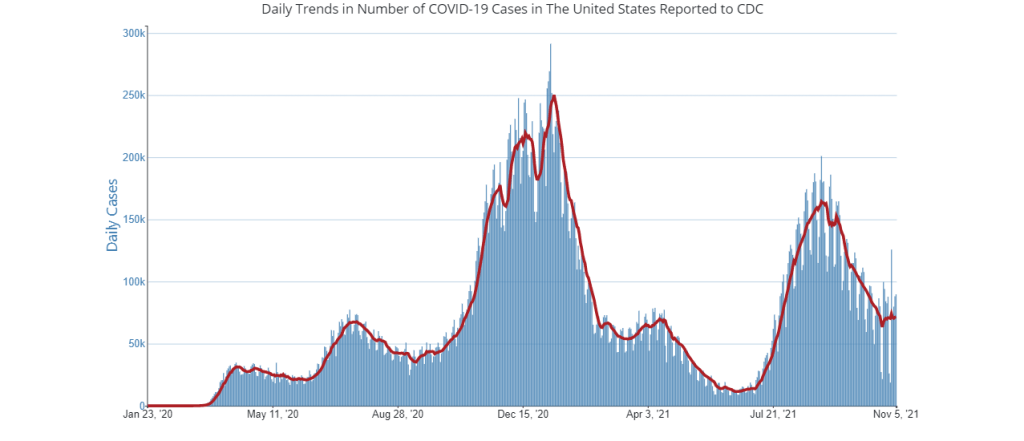
    U.S. COVID-19 cases are in a clear plateau. Chart via the CDC, downloaded on November 7.

    In the past week (October 30 through November 5), the U.S. reported about 490,000 new cases, according to the CDC. This amounts to:

    • An average of 70,000 new cases each day
    • 150 total new cases for every 100,000 Americans
    • 1% fewer new cases than last week (October 23-29)

    Last week, America also saw:

    • 36,000 new COVID-19 patients admitted to hospitals (11 for every 100,000 people)
    • 8,000 new COVID-19 deaths (2.4 for every 100,000 people)
    • 99% of new cases are Delta-caused (as of October 30)
    • An average of 1.8 million vaccinations per day (including booster shots; per Bloomberg)

    At the national level, new COVID-19 cases seem to have entered a plateau. The U.S. has reported about 70,000 new cases a day for the past three weeks; while hospitalization and death numbers continue to go down, those drops are rather slight compared to what we saw earlier this fall.

    Cold-weather states continue to see the highest case rates: Alaska, Montana, North Dakota, and Wyoming are at the top this week, with over 400 new cases for every 100,000 people as of the latest Community Profile Report.

    New Hampshire is now a concerning hotspot as well—the state saw almost a 200% increase in cases from last week to this week. Colorado, Minnesota, New Mexico, and Michigan are also reporting significant increases.

    Throughout the pandemic, trends in the U.S. have often followed trends in Europe, with this country seeing new surges a few weeks after they happen across the Atlantic. And right now, Europe is “at the epicentre” of the pandemic, according to the World Health Organization. Russia and Germany have recently recorded record cases, while other European countries are reinstating safety restrictions. 

    This week, the world marked five million COVID-19 deaths, while the U.S. marked 750,000. Both numbers are almost certainly undercounts, due to under-testing, limited medical record-keeping in some places, and other issues. In the U.S., over 1,000 people continue to die each day despite widely available vaccines.

    Vaccination numbers are going up, though—driven largely by booster shots and by shots for the 5 to 11 age group, now officially eligible. The federal vaccines.gov site has been updated to include vaccination sites for these kids.

    But as we celebrate kids getting vaccinated, it’s important to recognize the global inequities at play here:

  • COVID source callout:  Vaccination rates by Zodiac sign

    COVID source callout: Vaccination rates by Zodiac sign

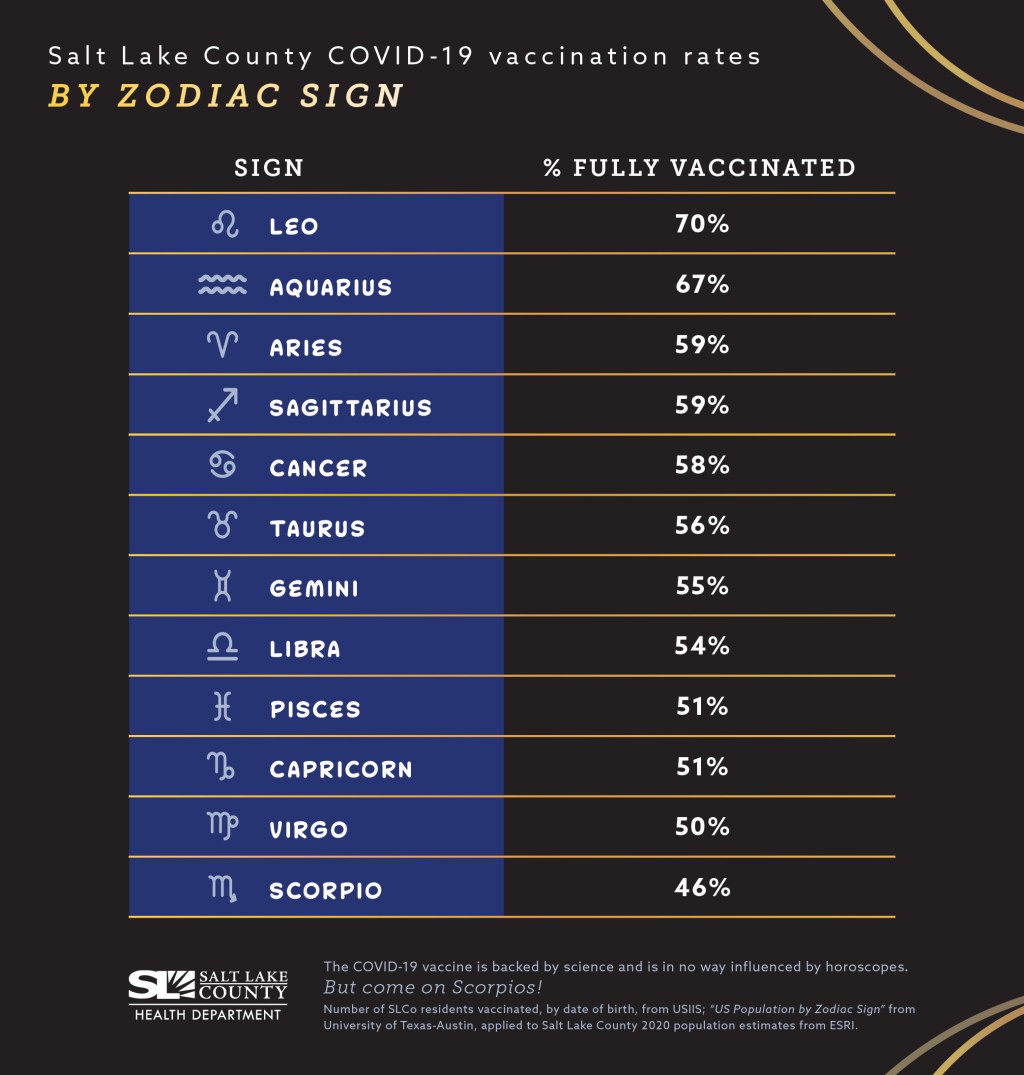
    In last week’s newsletter, I gave a shout-out to the Salt Lake County Health Department, which posted this novel vaccination data on Twitter:

    The post drew a lot of attention in the COVID-19 data world, including with readers of the COVID-19 Data Dispatch. (Shout-out to the reader who sent me some bonus analysis of vaccinations by Zodiac element!) Unfortunately, additional research into the Salt Lake County Health Department’s data has shown me that the agency’s analysis might not be particularly robust—and I feel it is my journalistic duty to share this with you.

    Here’s the deal. In order to calculate vaccination rates by Zodiac sign, you need two things: vaccinations organized by birthday (your numerator), and the overall population organized by birthday (your denominator). Health departments can easily access the numerator, as it is standard for people to provide their birthdays along with other basic demographic information when they get vaccinated.

    But the denominator is trickier. The average U.S. public health department doesn’t have access to the birthdays of every resident in its jurisdiction; some information might be available from a large hospital system or primary care network, but it wouldn’t be comprehensive. So, for an analysis like the Salt Lake County agency’s, a researcher needs to find a substitute.

    In this case, the researchers used estimates of Zodiac sign representation in the entire U.S. population, apparently calculated in 2012. Not only are these numbers based on birthdays across the entire country (which could be pretty different from the birthdays in one Utah county!), they’re almost ten years old. There’s a lot of distance between these estimates and vaccination numbers among a 2021 Salt Lake City population.

    The public health workers acknowledged that their analysis is “not super scientific” in interviews with the Salt Lake Tribune. Still, the widely-shared Twitter post itself could do with a few more caveats, in my opinion.

    For more on the issues with the Salt Lake County department’s analysis, see this Substack post by Christopher Ingraham.

  • Sources and updates, October 31

    A lot of COVID-19 data sources caught my eye this week!

    • More booster data from the CDC: This week, the CDC added both booster shot trends by day and booster shots by primary series type to its COVID Data Tracker. For booster shot trends, click “People Receiving a Booster Dose” on the Trends page, and for primary series data, scroll down to “Covid-19 Booster Dose Type by Primary Series Type” on the Vaccination Totals page. So far, it looks like a lot of Johnson & Johnson recipients are opting for mRNA boosters.
    • KFF’s latest Vaccine Monitor update: The Kaiser Family Foundation has released the latest edition of its monthly vaccine poll, the COVID-19 Vaccine Monitor. This month’s edition focuses on vaccinations for children ages 5 to 11, in line with the recent discussions around shots for this age group, but it also includes other polling on general vaccination demographics, boosters, mandates, and more.
    • Under-testing in U.S. prisons and jails: A new report from the UCLA Law COVID Behind Bars Data Project explores how insufficient COVID-19 testing of incarcerated people in the U.S. contributes to skewed case rates. Even in the states that have tested their incarcerated populations the most, this report shows, that testing is still far less frequent than testing for other congregate living facilities, like nursing homes.
    • Impact of School Opening on SARS-CoV-2 Transmission: A group of scientists (including school data expert Emily Oster) recently published a new paper in Nature examining how school reopening models—remote, hybrid, or in-person—contribute to community transmission. In most parts of the country, reopening model did not have a significant impact on transmission, they found; the South was an exception. The authors shared the data underlying their paper, with some information from Burbio and the CDC removed due to requirements from those organizations.
    • Reporting recipe for breakthrough case data: Dillon Bergin, my colleague at the Documenting COVID-19 project, wrote this reporting recipe, which guides local newsrooms through acquiring data on and covering breakthrough cases in their areas. The recipe accompanies a recent story that Dillon wrote, in collaboration with the Las Vegas Review-Journal, on breakthrough cases by occupation in Las Vegas. (Unsurprisingly, healthcare workers and casino workers were likely to have breakthrough cases, the Las Vegas data show.)
    • Polling on small businesses and vaccine mandates: Here’s another vaccine survey released this week, this one from the U.S. Chamber of Commerce. The agency asked small businesses about their positions on vaccine mandates, as well as hiring challenges and other issues. 64% of small business owners support “businesses in their area requiring vaccines for their employees,” the survey found.