Blog

  • Pandemic preparedness: Improving our data surveillance and communication

    Pandemic preparedness: Improving our data surveillance and communication

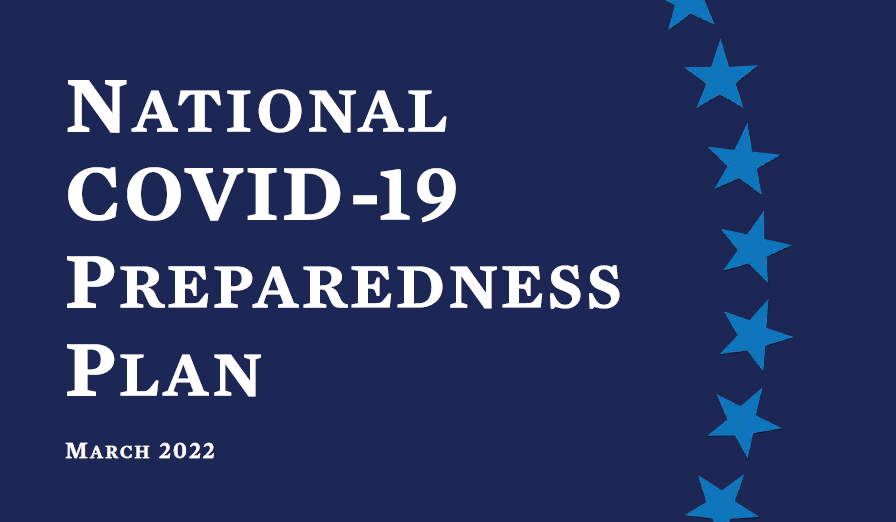
    Screenshot of the new Biden COVID-19 plan.

    As COVID-19 safety measures are lifted and agencies move to an endemic view of the virus, I’m thinking about my shifting role as a COVID-19 reporter. To me, this beat is becoming less about reporting on specific hotspots or control measures and more about preparedness: what the U.S. learned from the last two years, and what lessons we can take forward—not just for the future COVID-19 surges that are almost certainly coming, but also for future infectious disease outbreaks.

    To that end, I was glad to see the Biden administration release a new COVID-19 plan focused on exactly this topic: preparedness for new surges, new variants, and new infectious diseases beyond this current pandemic.

    From the plan’s executive summary:

    Make no mistake, President Biden will not accept just “living with COVID” any more than we accept “living with” cancer, Alzheimer’s, or AIDS. We will continue our work to stop the spread of the virus, blunt its impact on those who get infected, and deploy new treatments to dramatically reduce the occurrence of severe COVID-19 disease and deaths.

    The Biden plan was released last week, in time with the president’s State of the Union address. I read through it this morning, looking for goals and actions connected to data collection and reporting.

    Here are a few items that stuck out to me, either things that the Biden administration is already doing or should be doing: 

    • Improving surveillance to identify new variants: The U.S. significantly improved its variant sequencing capacity in 2021, multiplying the number of cases sequenced by more than tenfold from the beginning to the end of the year. But the new Biden plan promises to take these improvements further, by adding more capacity for sequencing at state and local levels—and, crucially, “strengthening data infrastructure and interoperability so that more jurisdictions can link case surveillance and hospital data to vaccine data.” In plain language, that means: making it easier to track breakthrough cases (which I have argued is a key data problem in the U.S.).
    • Expanding wastewater surveillance: As I’ve written before, in the current national wastewater surveillance network, some states are very well-represented with over 50 collection sites; while other states are not included in the data at all. The Biden administration is committed to bring more local health agencies and research institutions into the surveillance network, thus expanding our national capacity to get early warnings about surges.
    • Standardizing state and local data systems: I’ve written numerous times that the U.S. suffers from a lack of standardization among its 50 different states and hundreds of local health agencies. According to the new plan, the Biden administration plans to facilitate data sharing, aggregating, and analyzing data across state and local agencies—including wastewater monitoring and other potential methods of surveillance that would provide early warnings of new surges. This would be huge if it actually happens.
    • Modernize the public health data infrastructure: One thing that could help health agencies better coordinate and share data: modernizing their data systems. That means phasing out fax machines and mail-in reports (which, yes, some health departments still use) and investing in new electronic health record technologies, while hiring public health workers who can manage such systems.
    • Use a new variant playbook to evaluate new virus strains: Also in the realm of variant preparedness, the Biden administration has developed a new “COVID-19 Variant Playbook” that may be used to quickly determine how a new variant impacts disease severity, transmissibility, vaccine effectiveness, and other factors. The new playbook may be used to quickly update vaccines, tests, and treatments if needed, by working in partnership with health systems and research institutions.
    • Collecting demographic data on vaccinations and treatments: The Biden plan boasts that, “Hispanic, Black, and Asian adults are now vaccinated at the same rates as White adults.” However, CDC data shows that this trend does not hold true for booster shots: eligible white Americans are more likely to be boosted than those in other racial and ethnic groups. The administration will need to continue collecting demographic data to identify and address gaps among vaccinations and treatments; indeed, the Biden plan discusses continued efforts to improve health equity data.
    • Tracking health outcomes for people in high-risk settings: Along with its health equity focus, the Biden plan discusses a need to better track and report on health outcomes in nursing homes, other long-term care facilities, and other congregate settings like correctional facilities and homeless shelters. Congregate facilities continue to be major COVID-19 hotspots whenever there’s a new outbreak, so improving health standards in these settings should be a major priority.
    • Studying and combatting vaccine misinformation, vaccine safety: The new plan acknowledges the impact of misinformation on vaccine uptake in the U.S., and commits the Biden administration to addressing this trend. This includes a Request for Information that will be issued by the Surgeon General’s office, asking researchers to share their work on misinformation. Meanwhile, the administration will also continue monitoring vaccine safety and reporting these data to the public.
    • Test to Treat: One widely publicized aspect of the Biden plan is an initiative called “Test to Treat,” which would allow people to get tested for COVID-19 at pharmacies, health clinics, long-term care facilities, and other locations—then, if they test positive, immediately receive treatment in the form of antiviral pills. If this initiative is widely funded and adopted, the Biden administration should require all participating health providers to share testing and treatment data. This would allow researchers to evaluate whether this testing and treatment rollout has been equitable across different parts of the country and minority groups.
    • Website for community risk levels and public health guidance: The Biden plan includes the launch of a government website “that allows Americans to easily find public health guidance based on the COVID-19 risk in their local area and access tools to protect themselves.” The CDC COVID-19 dashboard was recently redesigned to highlight the agency’s new Community Level guidance, which is likely connected to this goal. Still, the CDC dashboard leaves much to be desired when it comes to comprehensive information and accessibility, compared to other trackers.
    • A new logistics and operational hub at HHS: In the last two years, the Department of Health and Human Services (HHS) built up an office for coordinating the development, production, and delivery of COVID-19 vaccines and treatments. The new Biden plan announced that this office will become a permanent part of the agency, and may be used for future disease outbreaks. At the same time, the Biden administration has added at-home tests, antiviral pills, and masks to America’s national stockpile for future surges; and it is supporting investments in laboratory capacity for PCR testing.
    • Tracking Long COVID: Biden’s plan also highlights Long COVID, promoting the need for government efforts to “detect, prevent, and treat” this prolonged condition. The plan mentions NIH’s RECOVER initiative to study Long COVID, discusses funding new care centers for patients, and proposes a new National Research Action Plan on Long COVID that will bring together the HHS, VA, Department of Defense, and other agencies. Still, the plan doesn’t discuss actual, financial support for patients who have been out of work for up to two years.
    • Supporting health and well-being among healthcare workers: The new Biden plan acknowledges major burnout among healthcare workers, and proposes a new grant program to fund mental health resources, support groups, and other systems of combatting this issue. Surveying healthcare workers and developing systematic solutions to the challenges they face could be a major aspect of preparing for future disease outbreaks. The Biden plan also mentions investing in recruitment and pipeline programs to support diversity, equity, and inclusion among health workers.
    • More international collaboration: The new Biden plan also focuses on international aid—delivering vaccine donations to low-income nations—and collaboration—improving communication with the WHO and other global organizations that conduct disease surveillance. This improved communication may be especially key for identifying and studying new variants in a global pandemic surveillance system.

    This week, a group of experts—including some who have advised the Biden administration— followed up on the Biden plan with their own plan, called “A Roadmap for Living with COVID.” The Roadmap plan also emphasizes data collection and reporting, with a whole section on health data infrastructure; here, the authors emphasize establishing centralized public health data platforms, linking disparate data types, designing data infrastructure with a focus on health equity, and improving public access to data.

    Both the Biden administration’s plan and the Roadmap plan give me hope that U.S. experts and leaders are thinking seriously about preparedness. However, simply releasing a plan is only the first step to making meaningful changes in the U.S. healthcare system. Many aspects of the Biden plan involve funding from Congress… and Congress is pretty unwilling to invest in COVID-19 preparedness right now. Just this week, a $15 billion funding plan collapsed in the legislature after the Biden administration already made major concessions.

    Readers, I recommend calling your Congressional representatives and urging them to support COVID-19 preparedness funding. You can also look into similar measures in your state, city, or other locality. We need to improve our data in order to be prepared for future disease outbreaks, COVID-19 and beyond.
    More national data

  • National numbers, March 13

    National numbers, March 13

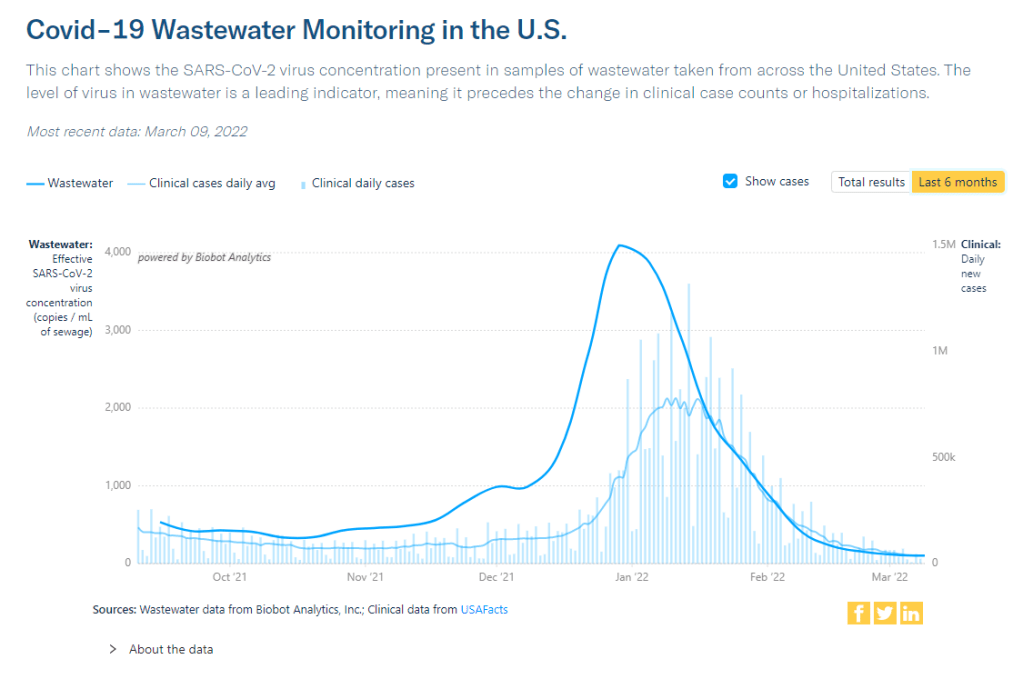
    Wastewater surveillance in the U.S. shows that we are currently in a plateau. Chart from Biobot, retrieved March 12.

    In the past week (March 5 through 11), the U.S. reported about 260,000 new COVID-19 cases, according to the CDC. This amounts to:

    • An average of 37,000 new cases each day
    • 79 total new cases for every 100,000 Americans
    • 29% fewer new cases than last week (February 26-March 4)

    In the past week, the U.S. also reported about 22,000 new COVID-19 patients admitted to hospitals. This amounts to:

    • An average of 3,100 new admissions each day
    • 6.6 total admissions for every 100,000 Americans
    • 28% fewer new admissions than last week

    Additionally, the U.S. reported:

    • 8,200 new COVID-19 deaths (2.5 for every 100,000 people)
    • 100% of new cases are Omicron-caused; 12% BA.2-caused (as of March 5)
    • An average of 100,000 vaccinations per day (per Bloomberg)

    Note: I’m shifting the format of these National Numbers posts to focus more on hospitalizations and wastewater, as case data become both less reliable and less available in many parts of the U.S.

    Overall, new COVID-19 cases are continuing to fall across the U.S. The country reported about 37,000 new cases a day last week, according to the CDC, compared to ten times that number in early February.

    Case numbers have become less reliable lately as testing sites close and people are redirected to use at-home rapid tests, which are generally not reported. Still, we’re seeing a similar trend in new COVID-19 patients admitted to hospitals: both new cases and new admissions dropped almost 30% last week from the week prior.

    Additionally, wastewater levels are decreasing or plateauing across the country, according to the Biobot tracker, which compiles trends from over 90 locations. The CDC wastewater surveillance tracker is showing similar overall trends as well.

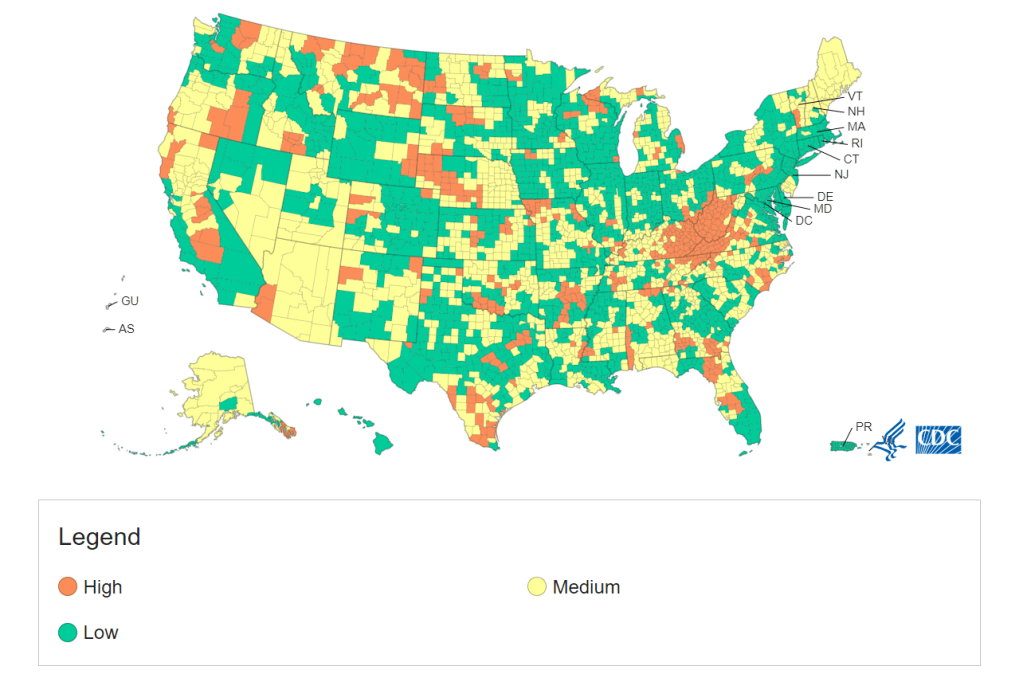
    More than 98% of the U.S. population now lives in a location with a low or medium COVID-19 Community Level, according to the CDC. But a few places did see case increases last week: these include Nebraska, Kentucky, Alaska, and Delaware, according to the March 10 Community Profile Report.

    BA.2, the Omicron sister variant that is even more transmissible than the original version of this strain, is slowly gaining ground in the U.S.: it’s gone from causing an estimated 1% of cases in the first week of February to 12% in the first week of March, according to the CDC’s modeling.

    It hasn’t impacted case trends here yet, but deserves close attention in the coming weeks and months. Gothamist has a helpful article about BA.2’s potential impact in New York, where the variant’s prevalence in wastewater is doubling statewide every two weeks.

    Meanwhile, several European countries—including the U.K., Germany, the Netherlands, and others—reported case increases this week. This is likely due to ending pandemic safety measures, Omicron gaining its second wind, or some combination of the two; regardless, it doesn’t bode well for the U.S., which is also ending pretty much all pandemic safety measures.

  • Sources and updates, March 6

    A couple of data sources, a couple of data-related updates:

    • State plans for utilizing COVID-19 relief funding: The federal Office of Elementary and Secondary Education has posted every state’s plan for utilizing ESSER funding, a $13-billion fund set aside to help schools address the impact of COVID-19. Money can be utilized for academic assistance, improving ventilation in schools, testing, and more. State plans were due to the federal government last June, though some materials are still pending on the website.
    • New GAO report on Long COVID: Between 8 and 23 million Americans may have developed Long COVID in the last two years—and an estimated one million are out of work because of this condition—according to a new report from the U.S. Government Accountability Office. The report discusses medical and economic impacts of Long COVID, including current efforts by the federal government to study the condition.
    • KFF COVID-19 Vaccine Monitor update: This week, the Kaiser Family Foundation published a new report detailing America’s sentiments on COVID-19 vaccines and other pandemic issues. Key findings include: COVID-19 vaccine uptake “remains relatively unchanged since January” for both adults and children; a majority of parents with children under five say they “don’t have enough information” about vaccines for that age group; and “most adults believe that the worst of the COVID-19 pandemic is over but there are disagreements about what returning to normal means and when it should happen.”
    • Vaccination disparities between urban and rural counties: Here’s a CDC MMWR study that caught my eye this week: researchers compared vaccination rates in urban and rural U.S. counties, finding that the rate of people in urban counties who have received at least one dose (75.4%) is much higher than the rate in rural counties (58.5%). Moreover, the gap between urban and rural counties has more than doubled between April 2021 and January 2022, the researchers found.
    • CDC updates seroprevalence data: The CDC recently updated a dashboard showing data from seroprevalence surveys, which use information from labs across the country to estimate how many Americans have resolving or recent coronavirus infections. (This does not include vaccinations, unlike other seroprevalence estimates.) According to this new update, about 43% of the country had antibodies from a recent infection as of late January. In some parts of the country that were harder-hit by Omicron, the esimate is over 50%.

  • Russia’s invasion of Ukraine has COVID-19 impacts

    Russia’s invasion of Ukraine has COVID-19 impacts

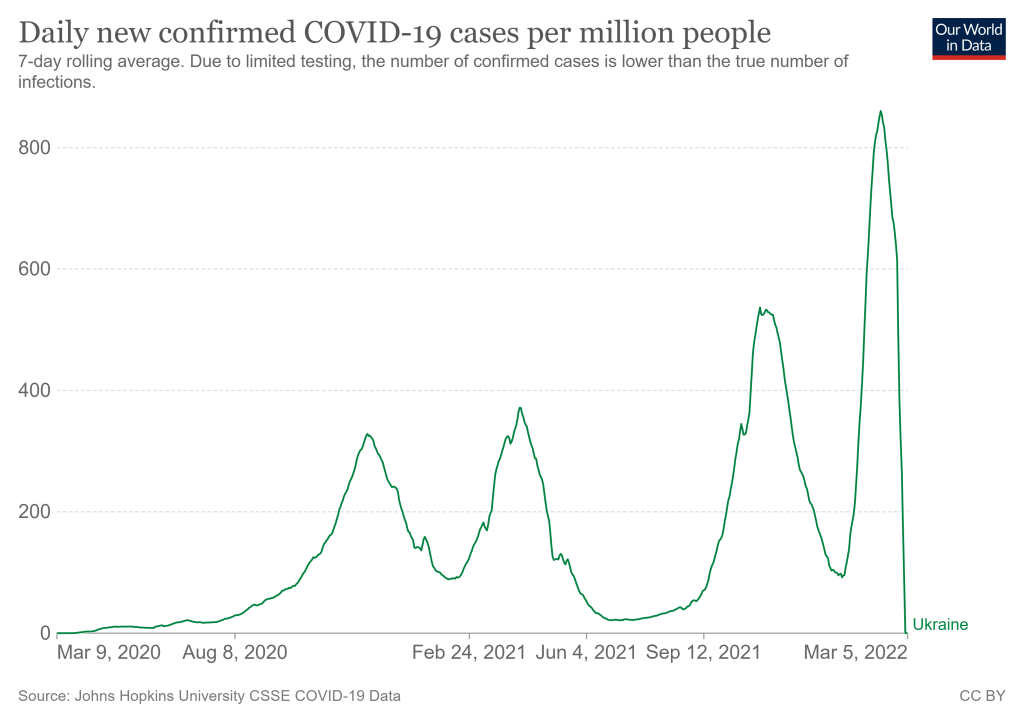
    While Ukraine’s COVID-19 cases appear to have gone down in recent days, the country is (obviously) not prioritizing COVID-19 reporting during an invasion. Chart via Our World in Data.

    When Russian troops began attacking Ukraine, the country was just recovering from its worst COVID-19 surge of the pandemic. To state the terrifying obvious: war makes it much harder to control a pandemic.

    Here are a few reports on this situation from the past week:

    • The New York Times describes Ukraine’s ability to control COVID-19 as “another casualty of Russia’s invasion.” Reporter Adeel Hassan discusses the challenges of controlling disease spread when people are crowding together in shelters, fleeing to refugee camps, and often unable to access masks or other supplies. The crisis in Ukraine will also impact COVID-19 in nearby countries tasked with caring for refugees, Hassan writes.
    • In addition to COVID-19, Ukraine “has been trying to control a polio outbreak since October,” reports Dana Varinsky at NBC News. About 13% of Ukrainian children under age six had not received their polio shots as of 2020, and are vulnerable to a re-emergence of this disease. Global health experts are highly concerned about the potential impacts of both COVID-19 and polio on Ukraine and neighboring countries.
    • While data on Ukraine’s cases show a decrease in recent weeks, these numbers are pretty unreliable. Our World in Data reports a steep decline from 860 new cases per million on February 12 to zero new cases in the last couple of days. This is unsurprising for a country with pressing issues to deal with than data reporting. “These numbers are going to have to be taken with some sort of salt, understanding it may be underreported, or in many ways not reported at all,” public health expert Sonny Patel told NBC.
    • Meanwhile in the U.S., hospitals are considering a potential increase in Russian cyber threats, POLITICO reports. Earlier in March, the U.S. Cybersecurity and Infrastructure Security Agency issued a warning to hospitals and other healthcare organizations saying they should prepare for Russian cyberattacks. “No “specific or credible” threats have been made yet, but health care organizations are concerned, given Russia’s cyber warfare history,” according to reporter Ben Leonard. (The full story is paywalled, but a summary is available in POLITICO’s newsletter.)

    Over the past year, we’ve seen more and more examples of COVID-19 surges intersecting with other disasters. This includes violence in Palestine last summer, as well as hurricanes, wildfires, and the Texas winter storm here in the U.S. To me, these horrible convergences make it clear that healthcare systems in the U.S. and around the world need a lot more investment to be resilient in these times of crisis.

  • Contracted staffing issues in Missouri reveal broader crisis in hospitals

    Contracted staffing issues in Missouri reveal broader crisis in hospitals

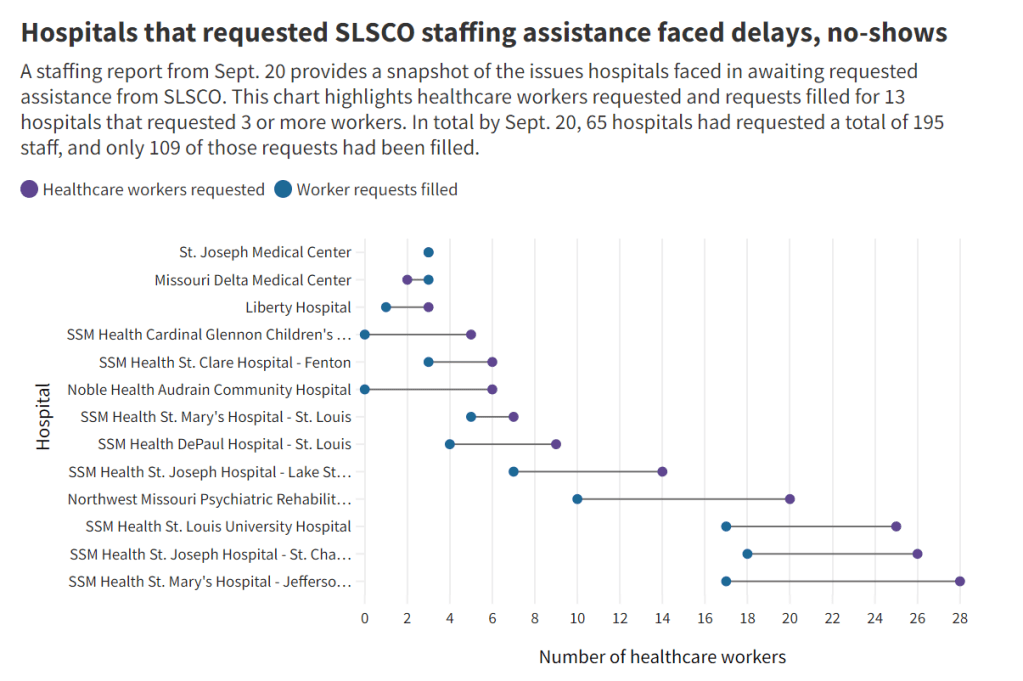
    Chart from the Missouri Independent story.

    Early this week, I had a big story published in The Missouri Independent, as part of the Documenting COVID-19 project’s ongoing collaboration with that nonprofit newsroom. This piece goes in-depth on the Missouri health department’s contract with SLSCO, a Texas-based construction company that expanded to provide healthcare support during the pandemic.

    While this was a local story, to me, the piece provides important insights about the type of support that is actually needed in U.S. hospitals right now: not temporary assistance, but long-term, structural change.

    The Missouri agency hired SLSCO to provide two services, with a total contract of $30 million:

    • Provide staffing support (nurses, technicians, etc.) to hospitals across the state struggling in the wake of the Delta surge.
    • Set up, staff, and operate six monoclonal antibody infusion sites where Missourians infected with the coronavirus could easily access the treatment.

    SLSCO made lofty promises to the Missouri health department, citing its ability to quickly send hundreds of workers to facilities that required assistance. But in fact, the hospital staffing assistance was marred by delays, no-shows, and high rates.

    Here are a few paragraphs from the story:

    Fewer hospitals signed on to receive staff than the Department of Health and Senior Services anticipated. Within the first few weeks, some hospitals faced no-shows, while the company’s hourly rates — up to $215 an hour for some nurses and $550 an hour for doctors — were too high for other hospitals to afford after state funds ran out, according to emails obtained by The Independent and the Documenting COVID-19 project through records requests. (Copies of SLS’ contract and emails between state agencies can be found here.)

    “153 staff requested and only 10 deployed,” wrote Alex Tuttle, the governor’s legislative budget director, after receiving a staffing report early in the contract period. “Am I reading that right?”

    From mid-August through November, just 206 staff were ultimately sent to 53 hospitals, said Lisa Cox, a spokeswoman for DHSS. The healthcare support had left by the time omicron hit in the winter.

    The monoclonal antibody infusion sites were more successful; in fact, the Missouri health department ended up redirecting funding from the staffing support to the infusion sites. The six sites served a total of 3,688 patients over a two-month period.

    However, the sites could have served a lot more patients: these clinics could have treated up to 136 patients each day but peaked at about 90, with numbers often much lower, according to my analysis of data from the health department. Due to these low numbers, the state of Missouri ended up spending more than $5,600 for each patient. One monoclonal antibody expert I talked to for the piece called this an “exorbitant” cost.

    Now, I don’t mean to hate on monoclonal antibody treatments here—these drugs are truly a great way to boost the immune systems of COVID-19 patients who may be at higher risk for severe symptoms. Maggie Schaffer, a case management nurse who helped set up one of the infusion sites, told me that people who had this treatment typically are “feeling like a whole new person” within a day or two.

    However, the treatments are very expensive and inefficient; one patient’s infusion appointment can take hours. The drugs themselves cost around $2,100 per dose, about 100 times as much as one vaccine. Health departments and facilities that offer monoclonal antibodies need to focus on getting the word out to patients so that these expensive supplies aren’t wasted.

    At the same time, temporary healthcare staff can be great to help a facility out a surge—but they are not a long-term solution. In particular, nurses at a hospital may be frustrated by watching new staff come in from out of town and receive much higher pay rates; the “traveling nurse phenomenon,” as this is called, may contribute to burnout and staff leaving to go become traveling workers themselves.

    What do hospitals actually need to do to address their staffing crisis? Here are a few ideas from Tener Veenema, a nursing expert focused on health systems a professor of nursing who researches health systems and emergency preparedness at Johns Hopkins’ Bloomberg School of Public Health:

    • Higher pay and assistance with education bills.
    • Regulations on things like work hours, the number of patients one nurse can be responsible for at once.
    • Mental health assistance that nurses are actually given time and space to access.

    I’ll end the post with this quote from Veenema, which is also the last line of the story:

    “If we don’t fix the toxic work environment, this issue of mandatory overtime, inadequate staffing levels, lack of time to access mental health resources,” Veenema said, “then you’re simply shooting more new nurses out of the cannon, but into the lake where they’re going to drown.”

  • National numbers, March 6

    National numbers, March 6

    About 90% of the U.S. population now lives in a medium- or low-level COVID-19 “Community Level,” according to the CDC.

    In the past week (February 26 through March 4), the U.S. reported about 371,000 new COVID-19 cases, according to the CDC. This amounts to:

    • An average of 53,000 new cases each day
    • 113 total new cases for every 100,000 Americans
    • 29% fewer new cases than last week (February 19-25)

    Last week, America also saw:

    • 30,000 new COVID-19 patients admitted to hospitals (9 for every 100,000 people)
    • 11,000 new COVID-19 deaths (3.3 for every 100,000 people)
    • 100% of new cases are Omicron-caused (as of February 26)
    • An average of 140,000 vaccinations per day (per Bloomberg)

    New COVID-19 cases continue falling in the U.S. as the Omicron wave fizzles out. This week, the CDC reported an average of 53,000 new cases a day—less than one-tenth the cases reported at the peak of this surge.

    Hospitalization metrics also continue falling. About 30,000 new COVID-19 patients were admitted to U.S. hospitals this week, compared to almost 150,000 at the peak of the surge. According to the Hospital Circuit Breaker dashboard, only two states are currently at or over hospital capacity: Nebraska and Vermont.

    We’re now in the second week of the CDC’s new “Community Level” guidance for safety precautions tied to regional COVID-19 metrics. As of this week, “more than 90% of the U.S. population is in a location with low or medium COVID-19 Community Level,” according to the agency.

    Of course, the agency’s old guidance—still available on its COVID-19 dashboard—is less generous. According to these metrics, almost half of the country is still seeing “high community transmission,” with more than 100 new cases per 100,000 people in the last week. Remember, even though case numbers are much lower now than they were in early January, the Omicron surge warped our whole sense of COVID-19 proportion.

    Meanwhile, some parts of the country where Omicron arrived and peaked earlier are now in distinct plateaus. This includes Washington, D.C. and New York City; in NYC, case rates have actually started ticking back up very slightly in the last week.

    I personally trust NYC case numbers more than that metric in other places because the city still has widely available public testing. But as other cities and states close testing sites and redirect people to at-home tests, case numbers will continue becoming less reliable over the coming weeks. So, I am thinking about shifting these national updates to focus more on other metrics, like hospitalizations and wastewater.

    Readers, what do you think? Any recommendations for metrics you’d like to read more about here? Comment below or email me and let me know.

  • COVID source shout-out: Hawaii

    As state leaders drop COVID-19 safety measures right and left, I wanted to give a shout-out to Hawaii: the one state that has kept its indoor mask mandate in place during this time. Gov. David Ige currently intends to keep the measure in place despite the CDC’s new guidance, according to local reports.

    Hawaii faces unique challenges during COVID-19 surges, since its island location makes it difficult for healthcare staff support to come in—or for patients to be transferred out of the state. These challenges have previously led Gov. Ige to call for tourists to avoid traveling to Hawaii, and to me, seem like good motivation for this state to keep cases low.

    Hawaii also has the second-lowest COVID-19 death rate, after Vermont—likely in part because of the state’s mask requirement and other safety measures.

  • Featured sources, February 27

    • CDC Museum COVID-19 Timeline: I recently learned that the CDC museum, which is part of the Smithsonian, has produced a detailed timeline of the COVID-19 pandemic in the U.S. It starts with the first cluster of COVID-19 patients in Wuhan, China, then include milestones in cases, treatments and vaccines, guidance changes, and more. The timeline currently ends in late 2021.
    • COVID-19 Data Dispatch resources: In absence of other outside sources this week, I wanted to send a reminder that the COVID-19 Data Dispatch maintains detailed annotations describing how states report vaccination data and COVID-19 cases in K-12 schools. Both sets of annotations are overdue for updates, which I’m planning to do in the next week!

  • Five more things, February 27

    Five additional news items from this week:

    • The CDC is not publicly releasing a lot of its COVID-19 data. Last weekend, New York Times reporter Apoorva Mandavilli broke the news that the CDC has withheld a lot of its COVID-19 data from the public, including information on breakthrough cases, demographic data, and wastewater data. This news was honestly not surprising to me because it follows a pattern: the CDC doesn’t like to share information unless it can control the interpretations. But I appreciated the conversation brought on by this article, with public health experts saying they’d rather have imperfect data than a complete data void. (I agree!)
    • BA.2 is definitely more transmissible than the original Omicron strain, but it does not appear to be significantly more severe or more capable of evading vaccines. Two recent posts, one in the New York Times COVID-19 updates page and one from Your Local Epidemiologist, share some updates on what scientists have learned about BA.2 in the past couple of weeks. In the U.S. and other countries with BA.2, this sublineage doesn’t seem to be causing a major rise in cases—at least so far.
    • New CDC study shows the utility of rapid testing out of isolation. More than half of patients infected with the coronavirus tested positive on rapid antigen tests between five and nine days after their initial diagnosis or symptom onset, a new CDC report found. The report includes over 700 patients at a rural healthcare network in Alaska. These findings suggest that rapid testing out of isolation is a good way to avoid transmitting the virus to others, if one has the tests available.
    • January saw record-high coronavirus infections in hospitals. POLITICO reporters analyzed hospitalization data from the Department of Health and Human Services (HHS), finding that: “More than 3,000 hospitalized patients each week in January had caught Covid sometime during their stay, more than any point of the pandemic.” This high number demonstrates Omicron’s high capacity to infect other people.
    • Hong Kong’s surge shows the value of vaccinations. Hong Kong has been a global leader in keeping COVID-19 cases low throughout the pandemic, yet Omicron has tested this territory’s strategy—causing record cases and overwhelming hospitals. One major issue for Hong Kong has been low vaccination rates, particularly among the elderly, as people did not see the need to get vaccinated when cases in the territory were practically nonexistent.
  • The COVID-19 Data Dispatch at NICAR 2022

    The COVID-19 Data Dispatch at NICAR 2022

    This time next week, I’ll be at NICAR 2022—the Investigative Reporters and Editors’ annual data journalism conference. And I do mean “at”: though the conference this year will be held in a hybrid format with both in-person and virtual options, I’ve chosen to travel for the in-person sessions in Atlanta, Georgia.

    It will be my first in-person conference and my second time traveling via airplane since February 2020. While I’m nervous about the travel and the gathering, I feel confident in the conference’s COVID-19 protocols (requiring full vaccination and boosters, plus indoor masking), in low transmission levels at both my origin and destination, and in my own ability to wear high-quality masks and utilize rapid tests as I go. (I wrote about precautions that I took on my first pandemic-era airplane trip in a post last summer.)

    I chose to attend NICAR in-person to better take advantage of data journalism skills sessions—and, of course, in-person networking! If you’re planning to attend and would like to meet up, please reach out: email me, hit me up on Twitter, etc.

    Also, for folks attending in-person or tuning in virtually, I’m excited to share that I’ll be a panelist at a conference session discussing the use of data for solutions journalism. The session’s moderator is Matt Kauffman, who leads data reporting at the Solutions Journalism Network. Dedicated readers might remember that the Solutions Journalism Network supported my Opening project last summer; I’ll be discussing my work on that project (which provided lessons from public schools that safely reopened during the 2020-2021 school year) and other solutions-related reporting at this session.

    The session is scheduled for next Saturday, March 5, from 3:45 to 5 PM Eastern time, and will be livestreamed for virtual attendees. Here’s the full description:

    Solutions journalism is rigorous, evidence-based reporting on responses to social problems. And data make for a great partner in solutions reporting, because when the impact of a response can be measured in numbers, it’s easy to discover the places that stand out and are worth a deeper look.

    This session will explore the use of “positive deviants” – outliers in data that might point to a place or a program that has found a better way: the school district that cut the achievement gap by implementing specific policies; the state that applied new protocols in hospitals that significantly reduced the number of women who die in childbirth; the neighborhoods that have reversed environmental injustices and greatly improved urban tree canopy. Stories like these attract readers and viewers, who are increasingly turned off by news coverage focused exclusively on failure.

    Adding a solutions lens to traditional investigative reporting leads to better accountability journalism, and data can play a key role in that. This session will present an overview of solutions journalism and positive deviance, followed by tips from a reporter explaining how they used data in pursuit of a timely and critical solutions story: identifying school districts around the country that found ways to safely reopen schools during the pandemic.

    I hope to see you there!