Category: Source spotlight

  • COVID source callout: CDC ends its data newsletter

    This past Friday, the CDC’s COVID-19 data team announced that its newsletter, the COVID Data Tracker Weekly Review, will send its final issue on Friday, May 12. That’s the day after the federal public health emergency for COVID-19 ends.

    For the last two years, the Weekly Review newsletter has been a great source of accessible updates on the state of COVID-19 in the U.S.; it includes summary statistics on cases, hospitalizations, vaccinations, variants, wastewater surveillance, and deaths. I’ve frequently referenced the newsletter in my own National Numbers updates, and have pointed other journalists to it.

    But this newsletter hasn’t been as reliable as one might expect from the CDC. Its writers have frequently taken the week off for federal holidays, even when the holiday falls on a Monday—and the newsletter is sent on Fridays. In recent months, the CDC has only compiled this newsletter every other week, making the “weekly review” title a misnomer. And now, the CDC has announced there will be only three more issues: sent on March 31, April 14, and May 12. (Seems like the newsletter is briefly shifting to a monthly schedule before it ends?)

    While the CDC will continue to regularly update its main COVID-19 dashboard and other data sources, the agency’s failure to maintain even a fairly basic update newsletter really speaks to its deprioritization of COVID-19. It honestly boggles the mind that I, a freelance journalist writing about COVID-19 data in her spare time, send updates with more continuity than the entire national public health agency.

    Yet somehow, here we are! This newsletter may see continued shifts to its format, but it isn’t going anywhere.

  • COVID source shout-out: A win for CDC FOIAs

    American Oversight, a nonprofit watchdog organization that shares government information through public records requests, recently reached a settlement in a lawsuit with the CDC. The settlement’s terms will make it easier for anyone requesting CDC documents to get results.

    Early in the pandemic, American Oversight filed a number of FOIA (Freedom of Information Act) requests to the CDC about the agency’s COVID-19 response. Some of those requests were rejected for being “overly broad,” which demonstrated “significant problems with the agency’s FOIA practices” and led to American Oversight filing a lawsuit in May 2020, the organization explains in a recent blog post.

    The CDC and American Oversight have now reached a settlement about this records lawsuit—and its terms require the agency to instruct all CDC FOIA officers to be more considerate of “broad” requests. Rather than issuing blanket rejections, FOIA officers should look closely at request descriptions and consult with their supervisors “to ensure all angles of the request have been considered,” according to an email that CDC leadership has sent to staff, in consultation with American Oversight.

    This settlement could have huge ramifications for other people requesting records from the CDC (including yours truly) as journalists and researchers continue to investigate how the U.S. handled COVID-19. Thank you to American Oversight for pushing on transparency!

  • COVID source shout-out: Remembering the COVID Tracking Project

    This Tuesday, March 7, will mark two years since the COVID Tracking Project stopped collecting data. For readers who might not know, I was a long-time volunteer for the Project; my early newsletters referenced it so frequently that I added a disclaimer to my “About” page clarifying that the COVID-19 Data Dispatch is a separate, personal endeavor.

    I got to catch up with a few fellow COVID Tracking Project alums at the NICAR conference this past weekend, which led me to some reflection on the care and comradery that shaped CTP. The Project was a massive effort to provide U.S. COVID-19 data that would help people understand pandemic trends during a confusing, scary time. But it was also a place of collective learning, innovation, friendship, and so many Slack threads.

    To quote from the post I wrote about CTP on the day of our final data entry shifts:

    I have seen the Project as another form of mutual aid. I’ve given countless hours to CTP over the past year in the form of data entry shifts, analysis, writing, and custom emojis—but those hours have also been given back to me, in everything from Tableau tricks to playlist recommendations. My fellow volunteers, the vast majority of whom I’ve never met in person, are my neighbors. We live in the same spreadsheets and Slack channels; we see the world in the same way.

    That final day of data collection feels like it was just yesterday, and also like more than two years have passed. Sometimes, I miss those earlier days of the pandemic, when covering COVID-19 felt like an “all hands on deck” top priority. The beat is lonelier these days, of course. (And I probably don’t have to tell you how few people were wearing masks at NICAR, even among those who used to report on COVID-19.)

    Even so, CTP was a model for a newer, better, more collaborative form of data journalism. I hope the COVID-19 Data Dispatch can remain a vestige of those efforts, for as long as it’s necessary.

  • COVID source callout: What, exactly, are the Bachelor’s COVID-19 safety protocols?

    COVID source callout: What, exactly, are the Bachelor’s COVID-19 safety protocols?

    Twitter user @tay_kass captioned this image, “the moment Zach realized he had COVID.” I don’t disagree!

    This week, the Bachelor tested positive for COVID-19. As both an avid watcher of the franchise and a COVID-19 reporter, I was immediately curious to see how the production would handle this. Unfortunately, the show was pretty sparse on safety details.

    Now, I understand why Bachelor producers and the higher-ups at ABC may not want to spend much of their episode time on the logistics of PCR tests or contestant quarantines. But I think they missed an opportunity here to show the viewers exactly what goes into COVID-19 safety on a high-budget TV show like the Bachelor.

    Film and TV sets tend to have rigorous safety protocols (with regular testing, masking for production teams, etc.), and could serve as models for other settings. The Bachelor could have shown millions of viewers what that looks like; instead, the lead’s COVID-19 case is mostly framed as a bummer for the women who were supposed to go on dates with him.

    With that in mind, here are a few things we know (and don’t know) about how the Bachelor handled this COVID-19 case, based on the episode itself and this interview on Entertainment Weekly:

    • Show lead Zach Shallcross isolated in his hotel room after testing positive. He’d already skipped a group date earlier in the day when he started to experience symptoms, but it’s unclear if he was actually isolating at that point (there might have been a camera person or two in his hotel room?).
    • All of the contestants get tested on a daily basis. Unclear if these are PCR or at-home/rapid tests, though my guess is PCR given that the production apparently had to wait some time for Zach’s test results after he started to not feel well.
    • The day before he tested positive, Zach went on a one-on-one date with contestant Gabi Elnicki. According to the EW interview, Gabi was “tested multiple times” immediately following Zach’s positive test, and got her own hotel room. This doesn’t appear to have been a full quarantine, though.
    • The other contestants seemed to have gotten lucky, to a certain extent, because Zach’s COVID-19 case occurred right after travel to London—so no other contestants had been exposed to him.
    • Zach’s symptoms were fairly mild, to the point that the production held a remote cocktail party and rose ceremony with him in his hotel room (i.e. he talked to contestants and then identified those who will stay for the next week over Zoom).
    • In next week’s episode, Zach will go on more dates, per the EW interview, so I assume he will have “recovered” enough to leave isolation. Will that mean his symptoms resolving, a negative rapid test, or just waiting a few days? It’s currently unclear.
    • The entire cast and crew of the Bachelor was fully vaccinated. Of course, this doesn’t prevent infection or transmission, but it could’ve played some role in keeping this one case from becoming an outbreak. It also seems like crew members are usually masked on set, though I could just be extrapolating based on a few shots we’ve seen of producers.

    As you can see, there are a lot of gaps in what we know about COVID-19 safety measures on the Bachelor… and I doubt those gaps will be filled, given what the production seems to prioritize in its airtime. If any editors reading this want to give me an assignment to investigate further, I am available.

  • COVID source shout-out: Mandate Masks NY

    Political leaders in New York State recently ended a policy requiring masks in healthcare settings. This is obviously a big issue for high-risk New Yorkers, many of whom have spoken out on social media about wanting to attend important doctors’ appointments without risking COVID-19.

    In response to the change, local advocacy organization Mandate Masks NY has compiled a list of hospitals and healthcare centers in New York that are still maintaining mask requirements independently of the state policy. You can find the list here; and the organization has compiled several other lists of businesses requiring masks, available on their website.

    As a former COVID Tracking Project volunteer, I’m always glad to see volunteer efforts producing important databases that wouldn’t otherwise be available. Also: it looks like the Mandate Masks NY Twitter account was suspended this weekend—if you know anything about that, please reach out!

  • COVID source shout-out: Biobot continues its contract with the CDC

    Leading wastewater surveillance company Biobot Analytics announced this week that it will continue to work with the CDC’s National Wastewater Surveillance System (NWSS) through July 2023.

    Biobot provides wastewater testing and analysis for more than 400 sites in the NWSS network, accounting for about one-third of the system’s total 1,200 sites. The CDC/Biobot arrangement basically makes it easy for these wastewater treatment plants to participate in COVID-19 and mpox testing, since sites can send in samples without spending the time and resources needed to build up their own testing programs.

    I was glad to see this news, as the continued contract will mean no interruptions in CDC NWSS data for at least another six months. Long-time readers might remember that there were major wastewater data gaps last spring, when the CDC switched contractors from LuminUltra to Biobot.

    Of course, six months is far from the long-term investment that the U.S. should be making in wastewater surveillance… but that’s a topic for another week.

  • Two major COVID-19 trackers stop data collection

    Two major COVID-19 trackers stop data collection

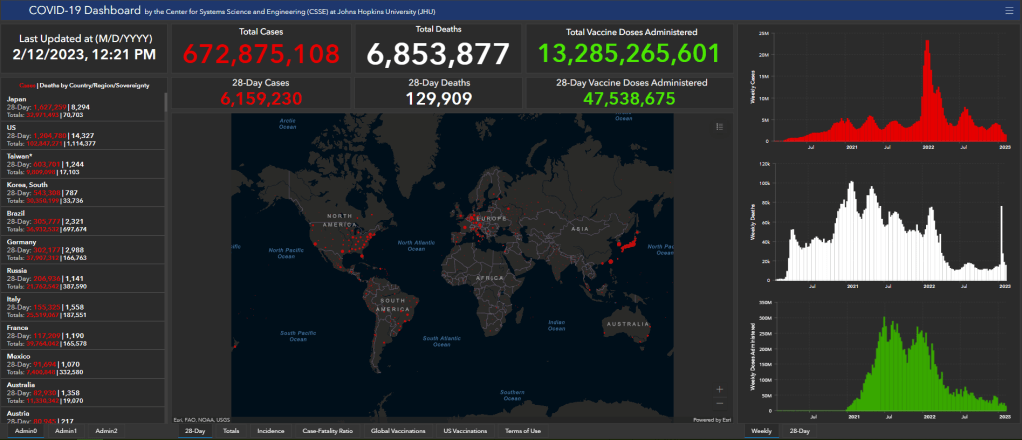
    The Johns Hopkins COVID-19 dashboard, one of the most popular data sources of the pandemic, will shut down in March.

    This week, two major COVID-19 tracking efforts announced that they will stop collecting data. While the decisions make sense in light of reduced data availability these days, this news still feels like a signal that fewer institutions want to spend time and resources on pandemic tracking.

    The Johns Hopkins global dashboard and broader Coronavirus Resource Center is one of those shutting down. Its team plans to stop data collection and reporting on March 10, 2023. Johns Hopkins’ project was one of the very first COVID-19 trackers to come online in early 2020, filling a void when the CDC and other government agencies failed to provide the frequent, user-friendly updates people wanted.

    Lauren Gardner, a Johns Hopkins professor who helped run the project, told NPR that its end is “bittersweet” but that “it’s an appropriate time to move on.” Other countries, as well as individual states and counties in the U.S. that the project used as data sources, are now updating their COVID-19 numbers less frequently and less reliably.

    These reduced state and local updates are also one reason why the New York Times’ COVID-19 tracker will shut down, according to an update posted to the project’s GitHub repository this week. “As case and death reporting at the local level has become less frequent and comprehensive, the daily data we have been able to gather has become less useful for indicating real-time trends about the virus,” wrote NYT graphics editor Wilson Andrews.

    The NYT’s COVID-19 dashboard will still get updated, according to Andrews’ GitHub note, but it will rely on the CDC and other federal data sources rather than compiling its own data. Andrews shared several key links where readers can find federal data, including the CDC’s main dashboard, the White House Community Profile Reports, and data pulled from death certificates. (H/t to Nicki Camberg for flagging the NYT announcement!)

    It’s worth noting here that the COVID Tracking Project—for which I served as a volunteer—similarly pointed users to federal data sources when it shut down, nearly two years ago. Data from the CDC and HHS have improved significantly throughout the pandemic, to a point that these sources are likely more reliable than adding up numbers from individual states and localities. But federal data still suffer from case undercounting, lack of standardization (for some metrics), and other issues.

    For my own updates at the COVID-19 Data Dispatch, I mostly use CDC data, along with wastewater surveillance data from a couple of outside sources (Biobot, WastewaterSCAN). So I get why places like Johns Hopkins and the NYT would want to point people to these sources, rather than spending time collecting their own data.

    Even so, this feels like the end of an era for pandemic tracking: two giants of the field are shutting down. The announcements seem to suggest that people are no longer interested in learning about COVID-19 spread in their communities—even though, I can tell you from writing this newsletter, the audience is very much still present, and the work is very much still necessary.

    And in case it needs to be said: the COVID-19 Data Dispatch isn’t going anywhere.

  • COVID source shout-out: More wastewater dashboards

    COVID source shout-out: More wastewater dashboards

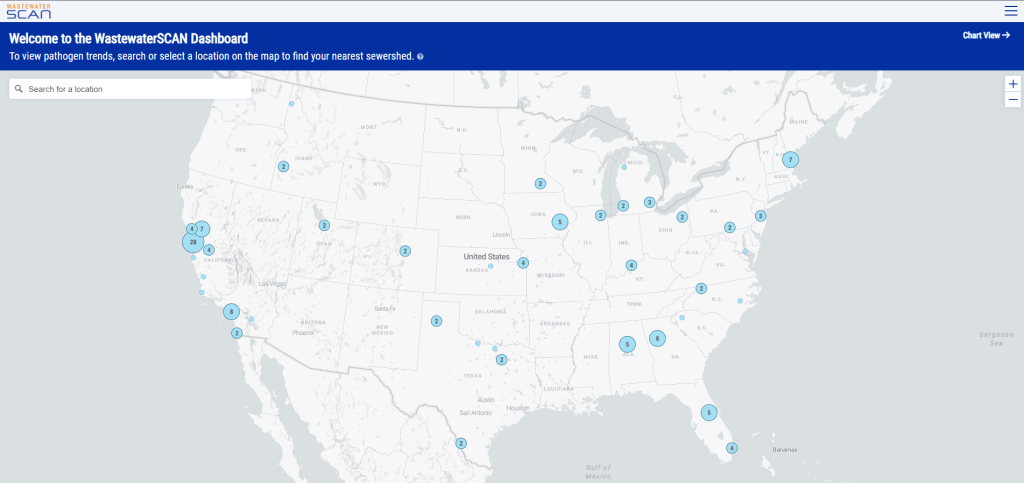
    WastewaterSCAN’s new dashboard showcases the project’s testing sites across the country.

    A reader recently reached out to let me know that my COVID-19 wastewater surveillance data page was missing a state dashboard: this dashboard, run by the Washington state Department of Health.

    Washington’s dashboard includes coronavirus concentration levels over time from a selection of wastewater treatment plants in the state, with data going back to early 2022. It also includes some helpful notes about how to interpret wastewater data and maps showing the service areas for each treatment plant.

    I also recently learned that WastewaterSCAN has released a new, upgraded dashboard to share its surveillance data. WastewaterSCAN is a project started by researchers at Stanford and Emory universities (with a focus on sites in California) that has since expanded across the country. The new dashboard makes it easier for users to find SCAN testing sites in their areas and answer specific questions with the data.

    As official case numbers become less and less reliable, I’m glad to see public agencies and research efforts step up to make wastewater surveillance more accessible. Both the Washington dashboard and new WastewaterSCAN link are now included on my wastewater data resource page.

  • COVID source shout-out: Safety protocols at Davos

    COVID source shout-out: Safety protocols at Davos

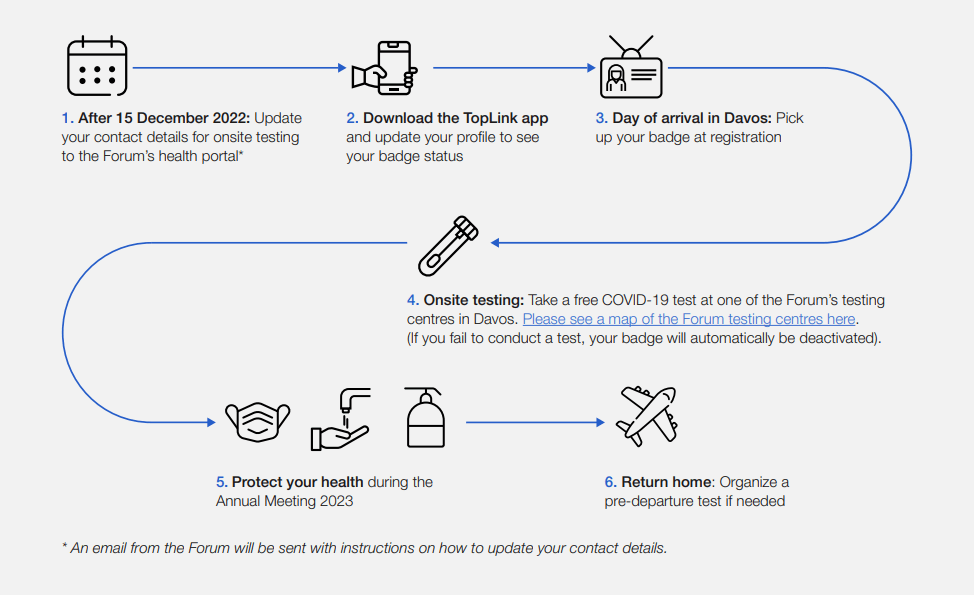
    Diagram from the Davos Health and Safety Measures info.

    This week, thousands of top political and business leaders gathered in Davos, Switzerland for the World Economic Forum—one of the highest-profile mass events in the world. And the forum, colloquially called Davos after its location, had excellent COVID-19 safety protocols.

    The protocols included: PCR tests required onsite (and event badges linked to negative results), masks recommended and available throughout the meeting venue, state-of-the-art ventilation systems, and far-UVC light. Only the best safety measures for the world’s elite, right? Even as many of those elites claim the pandemic is “over”?

    News of the Davos COVID-19 protocols has led to media commentary and a Twitter hashtag, #DavosSafe, as public health experts point out that high-quality testing, ventilation, and other measures should not just be for billionaires.

    Rather than get angry about the inequities here, I’d like to use Davos as a reminder that many disease mitigation strategies don’t have to be expensive or restricted. Individuals can wear masks, build Corsi-Rosenthal boxes, test before gatherings, and take other relatively cheap measures to cut down on disease spread.

    To quote from Julia Doubleday in her Substack, The Gauntlet:

    We deserve better. We deserve to be #DavosSafe as the hashtag going around on twitter puts it. Your children deserve to be treated with the care that world leaders are treating each other. Your family deserves to be protected from the disease which is still- unlike the flu- the third leading cause of death in the US. We don’t deserve to be shoved back into poorly ventilated workplaces while our politicians and press assure us that only crazy people would demand to breathe clean air.

  • COVID source shout-out: Illinois’ new wastewater dashboard

    COVID source shout-out: Illinois’ new wastewater dashboard

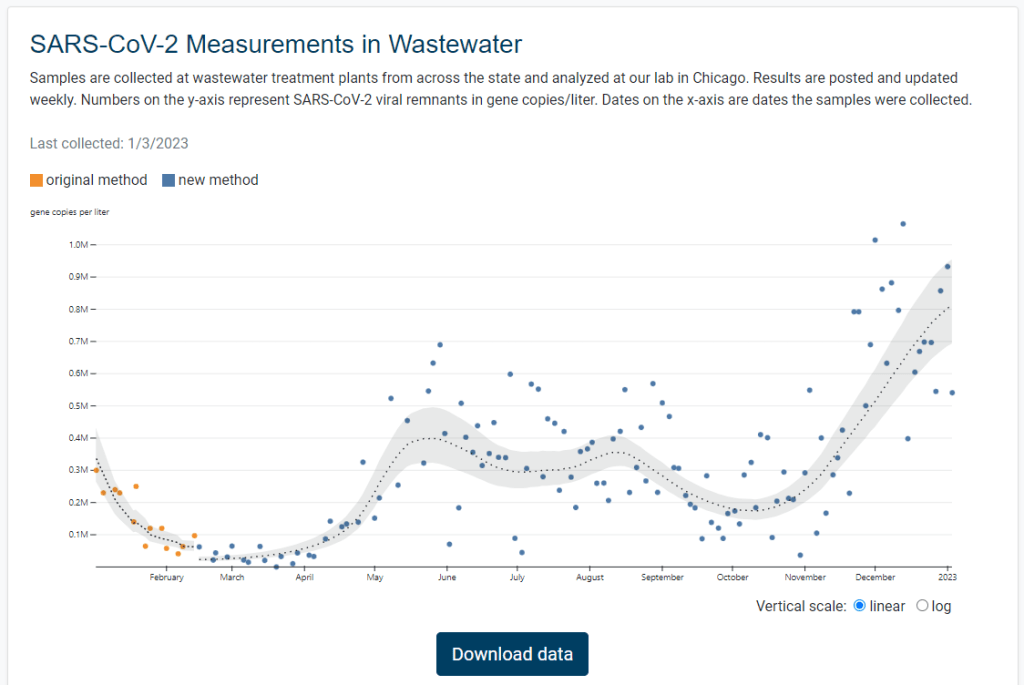
    Screenshot from the new Illinois dashboard, showing COVID-19 trends at a testing site in greater Chicago.

    Illinois is the latest state to get its own dashboard for COVID-19 wastewater surveillance, with a new website that launched earlier this week. It includes data for 75 sites across the state.

    The new dashboard—like the state’s wastewater surveillance program itself—is a collaboration between the Illinois Department of Public Health and the Discovery Partners Institute, a research center at the University of Illinois. Illinois’ agency received more than $6.5 million in federal grants to fund wastewater testing, according to local TV station WTTW.

    I poked around a bit on the new dashboard, and I’m a fan: it includes a map of sampling locations, charts showing COVID-19 trends over time, easily-downloadable data, and ample information on how to interpret results. Nice work, Illinois!

    For wastewater surveillance data near you, check out the COVID-19 Data Dispatch resource page—which is due for an update, likely next week.