Tag: vaccine distribution

  • Only 19 states report vaccinations by race/ethnicity

    Only 19 states report vaccinations by race/ethnicity

    Every week, I come into your inbox and I say, the vaccine rollout is going badly.  And you’re probably like, yeah, Betsy, I know, it’s on the news every single day.

    You probably don’t need me to tell you about the announcement this past Tuesday, from Health and Human Services Secretary Alex Azar, telling states to stop saving their second doses and start prioritizing all adults over the age of 65… or the Washington Post scoop this past Friday, revealing that states couldn’t actually vaccinate more people because the federal vaccine reserve was already used up. (I salute all the policy reporters following this madness. Seriously.)

    So instead, today, I’m focusing on a vaccination issue that hasn’t gotten as much press: who is actually getting vaccinated? On the national level, we largely can’t answer this question, thanks to a lack of demographic data.

    While the CDC’s vaccination tracker has seen some upgrades recently (such as the inclusion of people receiving two doses and downloadable data), it does not report any information on the race, ethnicity, age, gender, or occupation of those Americans who have gotten shots. And the data aren’t much better at the state level, according to recent analysis from the COVID Tracking Project

    The COVID Tracking Project analysis discusses 17 states which report race and/or ethnicity data for vaccine recipients. Since the post was published, two more states—Missouri and West Virginia—have started reporting such data. Still, just reporting these data isn’t sufficient. Alice Goldfarb, Kara Schechtman, Charlotte Minsky, and other Project volunteers who compiled detailed annotations on the vaccine metrics reported by each state found that, even when states do report demographic data, each state uses vastly different categories, making it difficult to compare or combine this state-level information into a useful national dataset.

    See the CDD’s updated annotations on both state and national vaccine data sources here.

    Using the limited data that are available, though, we can still see that the vaccination effort thus far is incredibly inequitable—despite government promises to prioritize vulnerable populations.

    White Americans are getting vaccinated at much higher rates than Black Americans, according to a Kaiser Health News analysis of state data published yesterday. Reporters Hannah Recht and Lauren Weber discuss access issues and mistrust of the healthcare system—tied to systematic racism against Black Americans seeking healthcare—as reasons why Black Americans may be left behind.

    But the disparities so far, at a stage of the vaccine rollout that has largely prioritized healthcare workers, means that both national and local public health agencies have a lot of work to do:

    “My concern now is if we don’t vaccinate the population that’s highest-risk, we’re going to see even more disproportional deaths in Black and brown communities,” said Dr. Fola May, a UCLA physician and health equity researcher. “It breaks my heart.”

    In New York—a state which finally released a vaccine dashboard today, but is not yet reporting demographic data—vaccination trends by hospital suggest a similar pattern. The hospitals with the highest shares of vaccinated workers are, by and large, private hospitals located in Manhattan. The hospitals with fewer vaccinated workers, on the other hand, include those located in Harlem, Brooklyn, and other working-class neighborhoods.

    Data are also lacking for long-term care facilities. The CDC reports total vaccine doses administered in these facilities (which include nursing homes, assisted living facilities, and other care homes). But a national total is unhelpful in analyzing where states have been most successful at getting vaccines to this high-priority population. A COVID Tracking Project analysis, published on Thursday, found vaccine data for LTCs in only seven states. South Carolina is the only state releasing detailed data on individual facilities.

    Meanwhile, CVS has published a state-by-state dataset of LTC vaccinations administered by this pharmacy chain. The COVID Tracking Project reports that Walgreens may release a similar dataset. It seems pretty wild that independent pharmacy chains are reporting more detailed vaccine data than the federal government itself—until you remember, well, how data reporting has gone this entire pandemic.

    Vaccination data, right now, are about as messy as testing data were back in spring 2020. Every state is doing its own thing, and the federal government has yet to provide sufficiently detailed information for meaningful analysis. Readers: I urge you to push for better vaccine demographic data, both in your own region and nationally.

    A few more vaccine data updates:

    • Sources and updates, November 12
      Sources and updates for the week of November 12 include new vaccination data, a rapid test receiving FDA approval, treatment guidelines, and more.
    • How is the CDC tracking the latest round of COVID-19 vaccines?
      Following the end of the federal public health emergency in May, the CDC has lost its authority to collect vaccination data from all state and local health agencies that keep immunization records. As a result, the CDC is no longer providing comprehensive vaccination numbers on its COVID-19 dashboards. But we still have some information about this year’s vaccination campaign, thanks to continued CDC efforts as well as reporting by other health agencies and research organizations.
    • Sources and updates, October 8
      Sources and updates for the week of October 8 include new papers about booster shot uptake, at-home tests, and Long COVID symptoms.
    • COVID source shout-out: Novavax’s booster is now available
      This week, the FDA authorized Novavax’s updated COVID-19 vaccine. Here’s why some people are excited to get Novavax’s vaccine this fall, as opposed to Pfizer’s or Moderna’s.
  • Schools are reopening (again), but we still can’t track them

    Schools are reopening (again), but we still can’t track them

    !function(){“use strict”;window.addEventListener(“message”,(function(a){if(void 0!==a.data[“datawrapper-height”])for(var e in a.data[“datawrapper-height”]){var t=document.getElementById(“datawrapper-chart-“+e)||document.querySelector(“iframe[src*=’”+e+”‘]”);t&&(t.style.height=a.data[“datawrapper-height”][e]+”px”)}}))}();

    K-12 schools across the country are open for the spring semester, even as America faces serious outbreaks in almost every state and a more contagious strain—more contagious for both children and adults—begins to spread. At the national level, we are still overwhelmingly unable to track how the virus is spreading in these settings.

    Perhaps the most newsworthy opening this week was in Chicago, where students returned to classrooms for the first time since last March. Chicago’s teachers union has waged an ongoing battle with Mayor Lori Lightfoot and district CEO Janice Jackson, whom teachers claim have not resolved ongoing safety issues in school buildings. The district is screening staff through optional rapid tests once a month; about 1,200 tests have been reported so far, including three positive results. Four Chicago students and 34 other staff members reported COVID-19 cases this week.

    Meanwhile, President-elect Joe Biden announced a $175 billion plan aimed at getting students back to in-person learning. The plan includes $35 billion for higher education and $130 billion for public K-12 schools, with a focus on increasing testing, PPE for students and teachers, ventilation, and other safety measures for which educators have been calling since last spring.

    Biden hopes to open “the majority of K-8 schools,” according to Education Week’s Evie Blad. A recent report by the CDC suggests that in-person learning for these younger students, when implemented safely, is not likely to seed an outbreak in the wider community. (College-aged students in the 18-24 range are more likely to cause such outbreaks.)

    The report says: “CDC recommends that K–12 schools be the last settings to close after all other mitigation measures have been employed and the first to reopen when they can do so safely.”

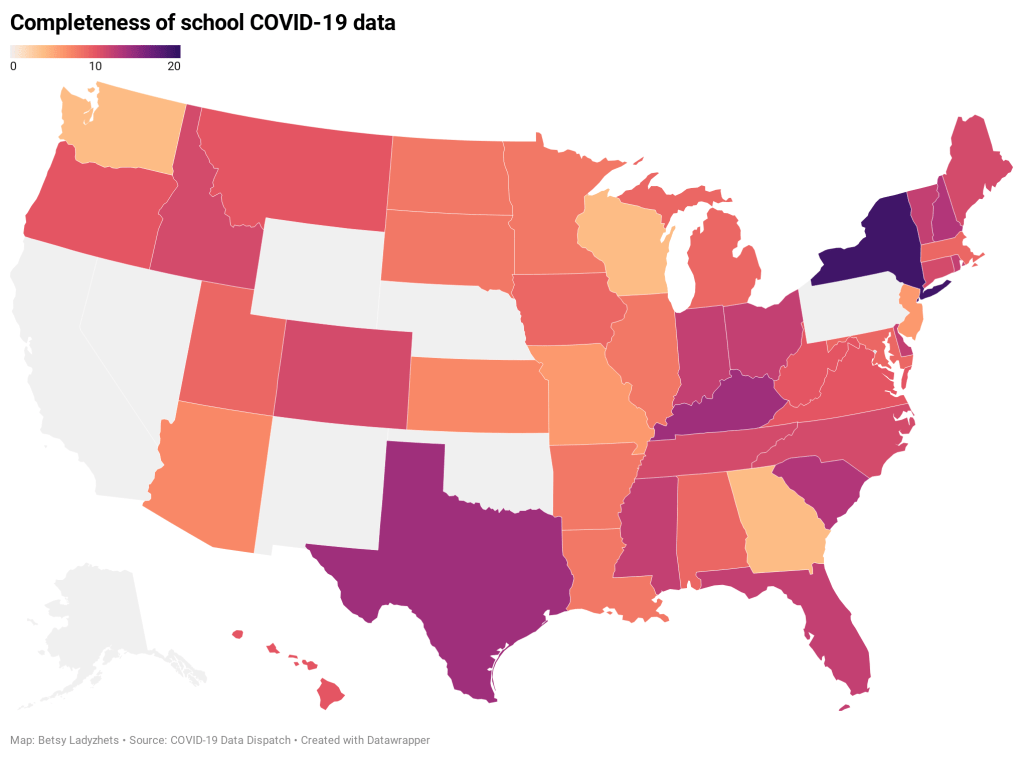
    But, as Blad points out, it will be difficult to track the impact that more school reopening would have on broader communities, as data on COVID-19 cases in schools are still limited and fractured. There is still no federal dataset on COVID-19 in American public schools. State datasets are fully unstandardized; and most states only report case counts, making it difficult to actually analyze how school outbreaks compare across schools.

    As of our most recent K-12 state annotation update, only Delaware, New York, and Texas are providing enrollment numbers, and only New York is providing testing numbers.  (Thank you to intern Sarah Braner for doing the update this week!)

    In last week’s recommended reading section, I featured an op ed in Nature by school data leader Emily Oster calling on President-elect Biden to develop a unified, national system for tracking COVID-19 in schools. I wanted to highlight it again this week because I absolutely agree with Oster here. As important as her and others’ compilation efforts have been in filling the school data gap, no outside dashboard can replace the work of the federal government:

    We need to be able to identify the virus spreading in schools and work out what went wrong. The data we do have suggest that outbreaks in schools are not common, but they do happen. We need a way to find them systematically.

    As far as I can tell, there is no mention of data-gathering in Biden’s K-12 COVID-19 plan.

    And here’s one more school-related metric we should be tracking: teachers are starting to get vaccinated. According to a recent Kaiser Family Foundation analysis of state vaccination priority groups, 31 states have put K-12 and childcare personnel in their Phase 1 group. In Utah, teachers and childcare workers are even included in Phase 1A. California and New York, two of the biggest states, started vaccinating teachers this past week.

    (If you want a heartwarming read this long weekend, I recommend this piece from THE CITY that profiles NYC teachers and other essential workers getting vaccinated in the middle of the night.)

    But most states are barely reporting basic demographic data for their vaccinations, much less telling the public the occupations of those who have gotten shots. Without knowing how many teachers have been vaccinated, it will be difficult to factor these inoculations into reopening decisions—or determine how vaccination impacts future school outbreaks.

  • Vaccine confusion abounds—and this is the easy stage

    Vaccine confusion abounds—and this is the easy stage

    !function(){“use strict”;window.addEventListener(“message”,(function(a){if(void 0!==a.data[“datawrapper-height”])for(var e in a.data[“datawrapper-height”]){var t=document.getElementById(“datawrapper-chart-“+e)||document.querySelector(“iframe[src*=’”+e+”‘]”);t&&(t.style.height=a.data[“datawrapper-height”][e]+”px”)}}))}();

    It’s been one month since the Pfizer/BioNTech vaccine was authorized for use in the U.S. Since then, about 22 million Pfizer and Moderna doses have been distributed—and at least 6.7 million of those have actually made it into people’s arms, according to the CDC. (The CDC is not yet tracking second doses.)

    Despite the federal government’s intense push to get vaccines through safety trials, that “last mile” step—from the Pfizer and Moderna factories to people’s arms—has been under-planned and underfunded. In the past month, we’ve been shocked by news stories ranging from a Wisconsin medical employee “intentionally removing” doses from a refrigerator to a local journalist in Florida individually helping over 150 seniors register for vaccination appointments. 

    State public health departments, already overwhelmed from ten months of running every other aspect of pandemic response, needed more money and resources to simultaneously coordinate millions of vaccinations and communicate their importance. The needed money didn’t come until this month, and recommendations from the federal government have left a lot of room for interpretation—leaving state and local health agencies scrambling.

    And this first month was supposed to be the easy part! As The Atlantic’s Sarah Zhang explains, early U.S. vaccination efforts were aimed at easy-to-reach people: those in hospitals, nursing homes, and other long-term care facilities. In these locations, it’s easy to quickly identify the most vulnerable patients and get them registered for vaccination appointments. The next groups of eligible Americans will not be so easy to reach. Doctors’ offices, pharmacies, and many other businesses will need to figure out vaccine logistics while also ramping up campaigns to convince people to even get vaccinated in the first place.

    (For a plain-language explanation of this issue that you can send to confused friends and relatives, I highly recommend the latest episode of the Sawbones podcast with Dr. Sydnee McElroy and Justin McElroy.)

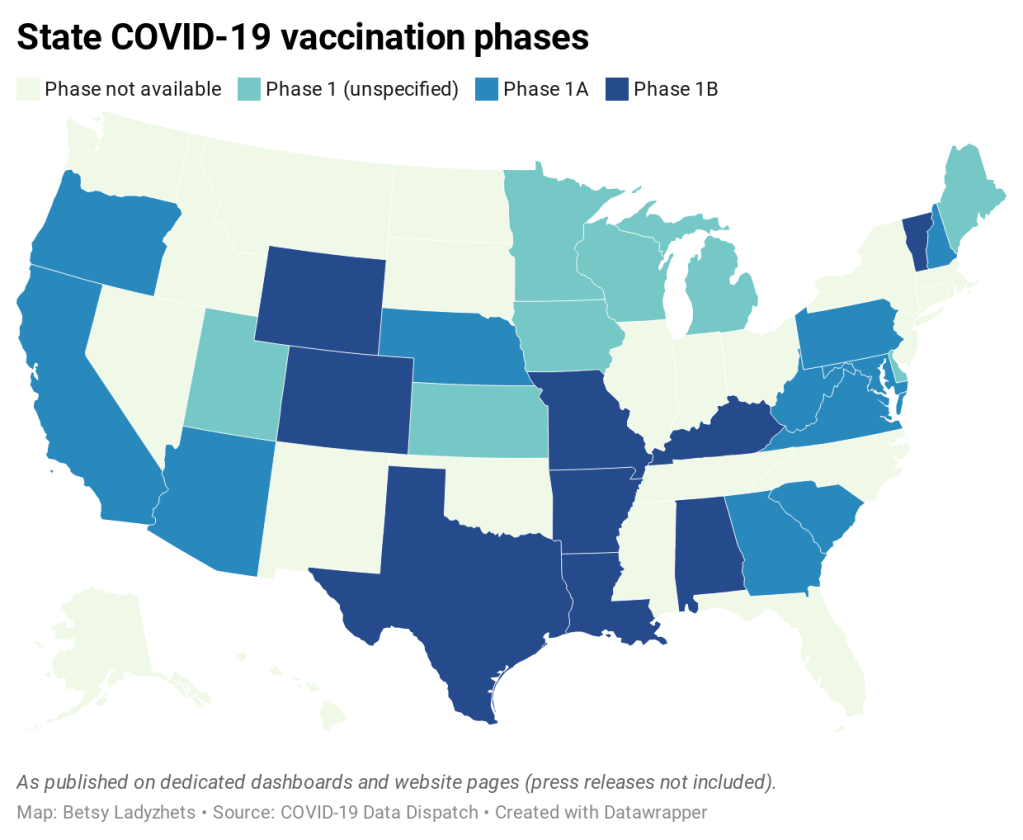
    When I updated my vaccine data annotations yesterday, I added notes on how the vaccine rollout is progressing in each state. For the 38 states (and D.C.) now reporting vaccinations, you’ll find two new fields: the state’s vaccination phase (1A, 1B, etc.; 31 states are reporting this) and any prominently featured information on how residents can get vaccinated, such as a registration portal or contact information for local public health departments (at least 12 states are doing this).

    Please note that, while most states do not yet have state-wide vaccine registration portals, many local public health departments are setting up such portals at the regional and county level. I highly recommend searching for your local public health agency to see what they have available. Also, New Mexico, which has a registration portal but no vaccine data dashboard, is not included in the annotations.

    State data availability (as of Jan. 9)

    • 39 jurisdictions are reporting some form of COVID-19 vaccination data on a dedicated page or dashboard
    • 16 states are reporting race and ethnicity of vaccinated residents
    • 20 states are reporting age of vaccinated residents
    • 17 states are reporting gender or sex of vaccinated residents
    • 20 states are reporting vaccinations by county or a similar local jurisdiction
    • 31 states are reporting their vaccination phase (1A, 1B, etc.)
    • 12 states are prominently featuring information on how residents can get vaccinated, such as a registration portal or contact information for local public health departments

    More vaccine data news

    • Jurisdictions with new vaccine dashboards or pages include: Arkansas, Arizona, California, Washington D.C., Kansas, Nebraska, and South Carolina.
    • The CDC’s vaccination data are now available for download, via a table beneath the interactive dashboard. The agency updated its state-by-state data every weekday this past week—an improvement from the past two holiday weeks. A time series isn’t yet available, though.
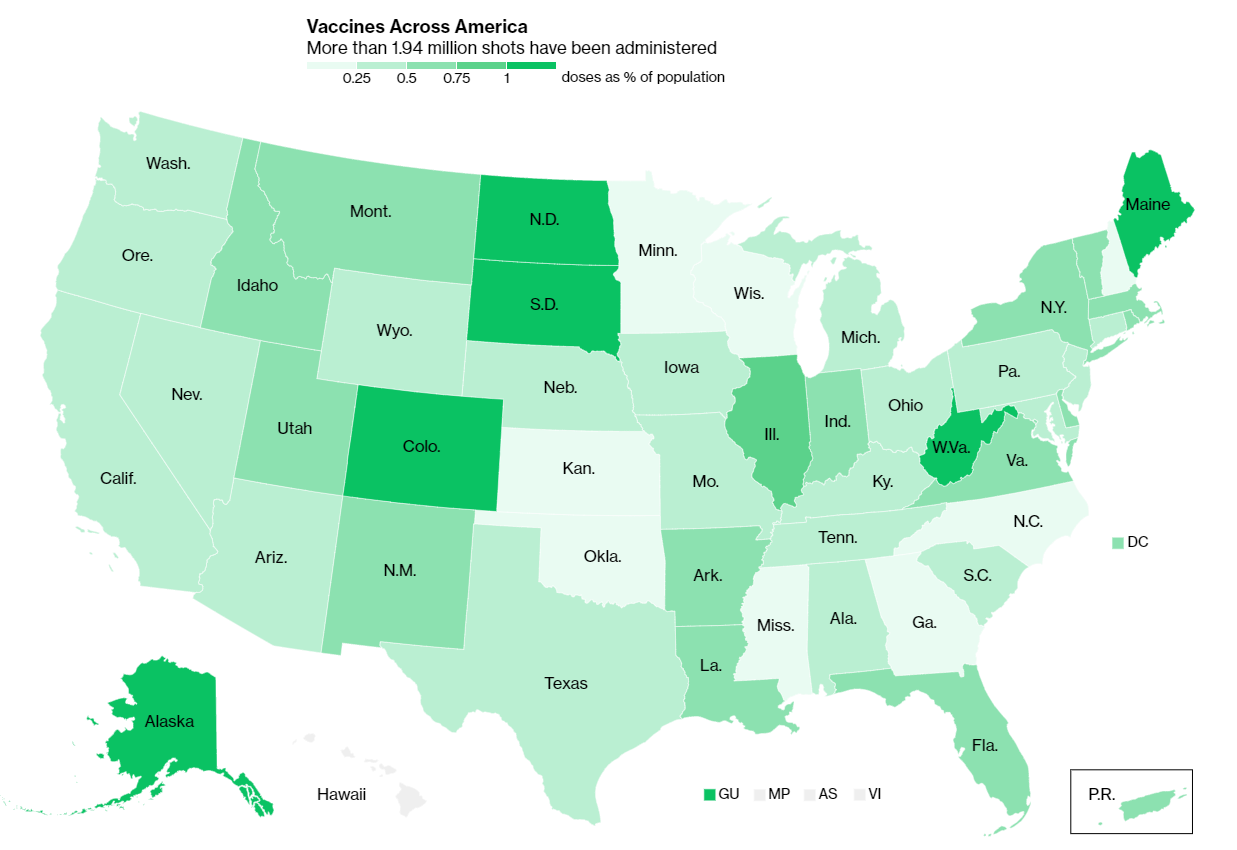
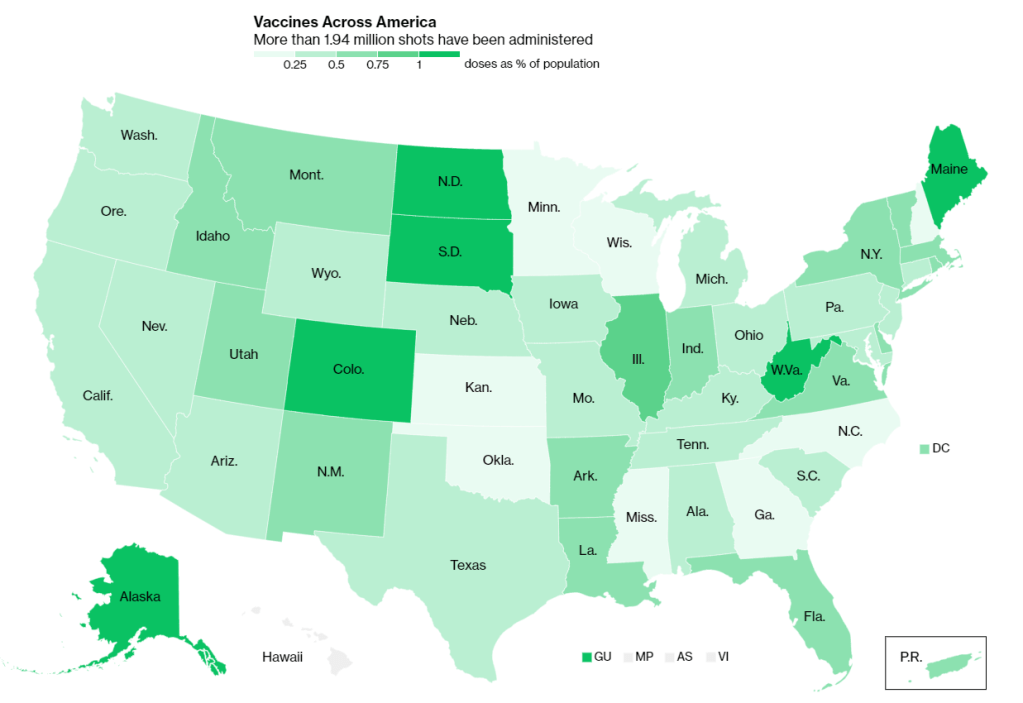
    • Bloomberg’s vaccine tracker now has time series for both individual states and several countries which have begun administering vaccines. The states currently leading the pack for vaccinations per capita in the U.S. are West Virginia, the Dakotas, and Maine.
    • KFF has updated its COVID-19 Vaccination Monitor with polling data on vaccine hesitancy in rural America. Compared to urban and suburban residents, the foundation found, rural residents are significantly more hesitant. 31% of the rural residents sampled said they would “definitely get” a vaccine, compared to over 40% in other categories. Rural residents are also more likely to say they’re “not worried” that they or someone in their family will get sick with COVID-19.
    • NPR’s Selena Simmons-Duffin and Pien Huang surveyed experts to determine several major ways the U.S. could “jump start its sluggish vaccine rollout.” These include: more money for state and local health departments, more vaccine types (hopefully some easier-to-transport brands), massive administration sites, more regular supplies from the federal government, and public awareness campaigns.
    • The Trump administration is speeding up at least one thing: a plan to help pharmacies administer COVID-19 vaccines. According to POLITICO’s Rachel Roubein, almost 40,000 pharmacies are involved in the federal program, including those part of the Costco, Rite Aid, and Walmart chains. Pharmacies which are already used to administering flu vaccines each year—and already have huge patient databases—are strong candidates for the next phase of vaccine rollout.  
    • After some classic infighting from Governor Andrew Cuomo and Mayor Bill de Blasio, New York state is moving to Phase 1B—meaning seniors and essential workers will start to see vaccinations. However, as City Councilmember Mark Levine pointed out on Twitter, the city has: “One website for H+H sites, another for DOHMH sites, another for Costco. For community clinics, 7 have their own different websites, 4 require calling, and 1 is by email.” (I want to get vaccinated at Costco, personally, if the opportunity arises.)
    • A Twitter thread from KFF Senior Vice President Jen Kates points out more of the methods states and counties are using to get residents signed up for vaccination appointments. They range from the expected online portals to SurveyMonkey and Eventbrite.

    Related posts

    • Sources and updates, November 12
      Sources and updates for the week of November 12 include new vaccination data, a rapid test receiving FDA approval, treatment guidelines, and more.
    • How is the CDC tracking the latest round of COVID-19 vaccines?
      Following the end of the federal public health emergency in May, the CDC has lost its authority to collect vaccination data from all state and local health agencies that keep immunization records. As a result, the CDC is no longer providing comprehensive vaccination numbers on its COVID-19 dashboards. But we still have some information about this year’s vaccination campaign, thanks to continued CDC efforts as well as reporting by other health agencies and research organizations.
    • Sources and updates, October 8
      Sources and updates for the week of October 8 include new papers about booster shot uptake, at-home tests, and Long COVID symptoms.
    • COVID source shout-out: Novavax’s booster is now available
      This week, the FDA authorized Novavax’s updated COVID-19 vaccine. Here’s why some people are excited to get Novavax’s vaccine this fall, as opposed to Pfizer’s or Moderna’s.
  • Vaccination data update, Jan. 3

    Despite the holidays, several more states began reporting vaccination data in the past week. The Centers for Disease Control and Prevention (CDC) also made a huge update: this national dashboard is now posting vaccination counts at the state level.

    Here are the notable updates:

    • I launched a vaccination data page on the CDD site which includes annotations on ten major national sources and every state’s vaccination reporting. I’ll be updating it weekly—the most recent update was yesterday.
    • Five states have started regularly reporting vaccination data since December 27: Alabama, Alaska, Indiana, Mississippi, and Wisconsin. 32 total states are now reporting these data; 15 states are reporting race and ethnicity of vaccinated residents. See more details on the resource page.
    • On December 30, the CDC started reporting state-level vaccination data on its national COVID-19 dashboard. For every state, the CDC is reporting total vaccine doses distributed and total people who have received their first dose. The dashboard also includes national counts—both for the U.S. as a whole and for long-term care facilities. Data are not yet available for download. According to the most recent update (yesterday, January 2), 4.2 million Americans have received their first dose.
    • Drew Armstrong, the Bloomberg reporter who runs the publication’s vaccination dashboard, posted a vaccine data user guide on Twitter. While the Tweet thread primarily describes the methodology and design choices behind Bloomberg’s dashboard, it also provides useful context for vaccination data overall. Two notable details: all vaccination data lag (the CDC’s data lag by about 50 hours, according to Armstrong), and Bloomberg is working on making the underlying data behind their dashboard public.
    • Benjy Renton halted updates for the “Doses Administered” tracker on his Vaccine Allocation Dashboard. As the CDC is now providing standardized state counts—and Renton is a one-person tracking operation—he’s switching to focus on analyzing vaccination trends and accessibility.  
    • Distribution delays: Operation Warp Speed promised that, if the Pfizer and Moderna vaccines received Emergency Use Authorization from the FDA, 20 million Americans would get vaccine doses by the end of 2020. That clearly didn’t happen. What went wrong? To answer that question, I recommend two articles: this STAT News story and this CNN story. Both articles suggest that a lag in data reporting may be one reason why the current vaccination counts look so low. Still, there’s a big difference between 4.2 million and 20 million.
    • Vaccination and the new COVID-19 strain: As the B.1.1.7 coronavirus variant, identified in the U.K., becomes an increasingly ominous threat to America’s COVID-19 containment, vaccination becomes increasingly urgent. Zeynep Tufekci’s latest piece in The Atlantic explains the issue. One piece that stuck out to me: the U.S. doesn’t have good genomic surveillance—or, a system to systematically sequence the virus genomes for people infected with SARS-CoV-2—which makes us less equipped to see where the new strain is actually spreading. As Tufekci puts it: “we are flying without a map.”
    • One dose or two? Scientists and public health leaders have been debating changing our vaccination protocol. Should the U.S. stick to the script, so to speak, and reserve enough vaccine doses that everyone who receives one dose can receive a second in the prescribed time window? Or should we give as many people first doses as we can, accepting that some may not get a second dose for months—or at all? (The U.K. opted for the latter earlier this week.) University of Washington professor Carl Bergstrom has compiled some Twitter threads that explain the debate. Dr. Fauci said on Friday that the U.S. will stick to the official two-dose regimen, but the scientific discourse will likely continue.

    Related posts

    • Sources and updates, November 12
      Sources and updates for the week of November 12 include new vaccination data, a rapid test receiving FDA approval, treatment guidelines, and more.
    • How is the CDC tracking the latest round of COVID-19 vaccines?
      Following the end of the federal public health emergency in May, the CDC has lost its authority to collect vaccination data from all state and local health agencies that keep immunization records. As a result, the CDC is no longer providing comprehensive vaccination numbers on its COVID-19 dashboards. But we still have some information about this year’s vaccination campaign, thanks to continued CDC efforts as well as reporting by other health agencies and research organizations.
    • Sources and updates, October 8
      Sources and updates for the week of October 8 include new papers about booster shot uptake, at-home tests, and Long COVID symptoms.
    • COVID source shout-out: Novavax’s booster is now available
      This week, the FDA authorized Novavax’s updated COVID-19 vaccine. Here’s why some people are excited to get Novavax’s vaccine this fall, as opposed to Pfizer’s or Moderna’s.
  • CDC now reporting a vaccination count (and other updates)

    CDC now reporting a vaccination count (and other updates)

    Screenshot of Bloomberg’s COVID-19 Vaccine Tracker, taken on December 26.

    Despite the holiday, many jurisdictions have begun reporting COVID-19 vaccination data since my last issue. Here are the major updates:

    • CDC added vaccinations to its dashboard: Mere hours after I published last week’s newsletter questioning when the federal government would release a national count of how many Americans had been vaccinated, the CDC began posting just that. The CDC COVID Data Tracker now includes both a count of how many vaccine doses have been distributed and a count of how many people have received their first dose—1.9 million as of Saturday, December 26. The count includes both Pfizer and Moderna’s vaccines, and incorporates reporting from states, local public health agencies, and federal entities including the Bureau of Prisons, Veterans Administration, and Indian Health Services. More detailed geographic and demographic data are not yet available from the CDC.
    • 27 states are now reporting COVID-19 vaccination data: While the COVID Tracking Project is not tracking vaccinations, the Project is keeping a running list of states that are reporting vaccine-related metrics. As of December 25, 27 states are reporting vaccine doses administered or another similar metric. Of the states reporting vaccinations, nine are reporting race and ethnicity of the residents vaccinated—that’s a huge jump from last Sunday, when only Florida was reporting this information. In other demographic metrics: 14 states are reporting age of those vaccinated, 10 are reporting sex or gender, and 14 are reporting county.
    • How the COVID Tracking Project hopes vaccines will be tracked: In addition to its state dashboard annotations, the Project released a blog post last week detailing key information that Project leads believe should be prioritized by state and federal public health departments, as well as what states are reporting so far. Key metrics include: the number of people fully vaccinated (not just the number of doses administered), demographic data reported in absolute numbers (not percentages), county-level data, and data on vaccinations in long-term care facilities.
    • New Mexico will notify residents when they qualify for vaccination: This past Wednesday, the New Mexico Department of Health launched a website where state residents can sign up to learn when they will be eligible to receive a COVID-19 vaccine. The sign-up form is currently somewhat confusing to use, as a new user must click “Schedule a New Appointment” to put in their contact details—even if they aren’t eligible for vaccination yet. Still, this effort to provide transparency about vaccination progress on such an individual level is unique among states thus far.
    • Our World in Data is tracking COVID-19 vaccinations worldwide: As of December 26, the open-source data repository Our World in Data is compiling vaccination counts from 10 countries: the U.S., the U.K., China, Russia, Israel, Canada, Bahrain, Chile, Mexico, and Costa Rica. So far, the U.S. has administered the most doses at 1.9 million, while Bahrain has administered the most doses when adjusted for population, at 3 doses for every 100 people.
    • Initial COVID-19 vaccine data in North Carolina reveals racial disparities: Samantha Kummerer, reporter for ABC11 in Raleigh-Durham, North Carolina, used the state’s early demographic data to draw attention to healthcare disparity. “When compared to the overall population of North Carolina, both Black and Latino communities are severely underrepresented in COVID-19 vaccination data,” Kummerer writes. She goes on to explain that these data reflect the hospital workforce in North Carolina, which was the first group to be vaccinated—and which is overwhelmingly white. This story reflects why it is so important for states to be transparent about their vaccination demographics, even at such an early stage of vaccine deployment.

    Join the COVID Data Dispatch community

  • 15 states are reporting COVID-19 vaccination data—federal government lags behind

    15 states are reporting COVID-19 vaccination data—federal government lags behind

    !function(){“use strict”;window.addEventListener(“message”,(function(a){if(void 0!==a.data[“datawrapper-height”])for(var e in a.data[“datawrapper-height”]){var t=document.getElementById(“datawrapper-chart-“+e)||document.querySelector(“iframe[src*=’”+e+”‘]”);t&&(t.style.height=a.data[“datawrapper-height”][e]+”px”)}}))}();

    Back in September, I read the Interim COVID-19 Vaccination Playbook released by the Centers for Disease Control and Prevention—the first national plan for how vaccination was supposed to proceed. Here’s an excerpt from my newsletter issue covering this playbook:

    Once COVID-19 vaccination begins, the CDC will report national vaccination data on a dashboard similar to the agency’s existing flu vaccination dashboard. According to the playbook, this dashboard will include estimates of the critical populations that will be prioritized for vaccination, locations of CDC-approved vaccine providers and their available supplies, and counts of how many vaccines have been administered.

    This past week, the first COVID-19 vaccine doses were administered to frontline healthcare workers across the country. The FDA issued Emergency Use Authorization to a second vaccine. But I haven’t seen a vaccination dashboard from the CDC; the closest we’ve come so far is a dataset listing initial allocations of Pfizer doses for every state. This federal agency is lagging behind several states that are making their vaccination counts public, as well as journalists who have already begun to compile the limited information that’s available.

    Here’s how the reporting of vaccination data is supposed to work. When someone goes in to get their COVID-19 shot, the provider of that shot will enter their name and other personal information to a state registry called an Immunization Information System, or IIS. Vaccine providers that issue shots and send data may include hospitals, clinics, pharmacies, pop-up vaccination sites, and any other institution that is giving shots.

    Most states and several large cities, like New York City, have these immunization registries; New Hampshire is still getting its registry ready to track COVID-19 vaccines. The registries stay private, with data only available for the people who ship, administer, and manage vaccines. A data system called the IZ gateway will help different state immunization systems link up with each other and with the CDC, which has asked all states to formally agree to share their data with this federal agency. (The CDC has asked states to share a pretty extensive list of data points for each vaccine patient, including names and addresses, which some states are not willing to send.)

    The CDC has also developed a system to help vaccine providers manage supplies and patients, a public-facing website that will help Americans see where they can get vaccinated, and a new software that will pull all vaccine-related information into one place for Operation Warp Speed officials to use. Finally, an HHS data system called the Vaccine Adverse Event Reporting System will collect information on patient reactions to the vaccines, such as headaches and fatigue—both of which are expected reactions to the Pfizer and Moderna vaccines.

    For more detail on these data systems, see this article by USA TODAY’s Aleszu Bajak and Janet Loehrke, which I drew upon to write this part of the newsletter.

    Theoretically, the CDC should have precise counts of how many people have received vaccine doses in every state, as well as personal identifying information for all of those people. So far, however, it appears that many states are beginning to make these data public, while the federal government has yet to release national numbers.

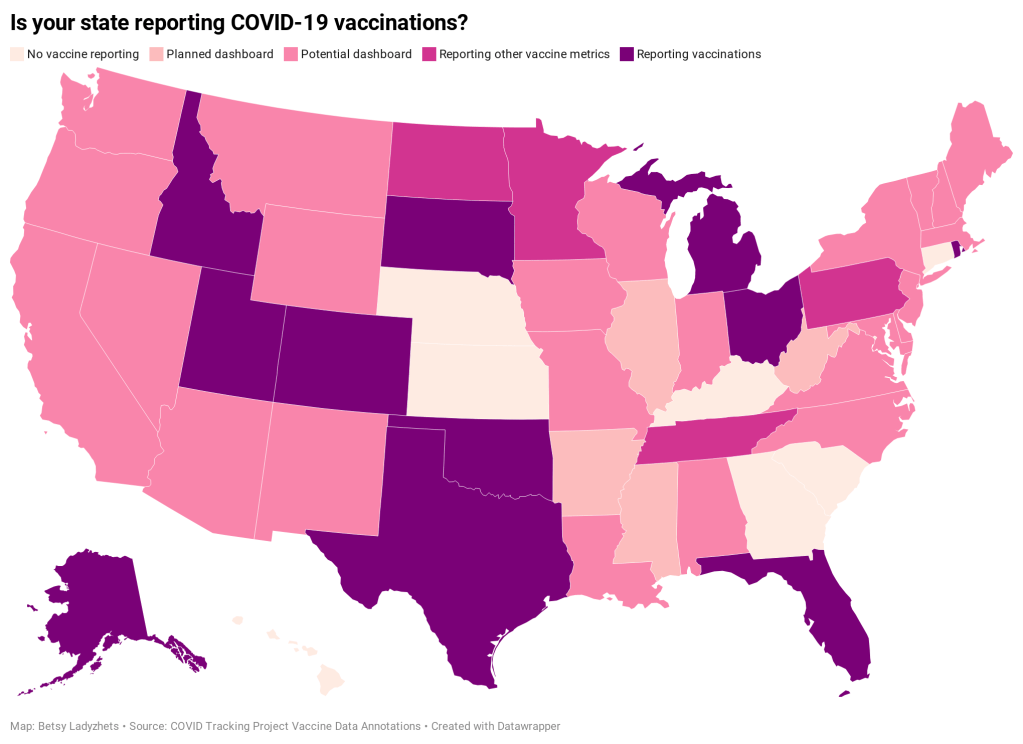
    According to ongoing analysis by the COVID Tracking Project, 15 states are reporting some form of vaccination data as of December 19. Here’s the breakdown:

    • Five states have added a count of vaccine doses administered as a single metric on their dashboards: Alaska, Colorado, Idaho, Oklahoma, and Rhode Island.
    • Two states have added vaccination-specific pages to their dashboards: South Dakota and Utah.
    • Three states have built entirely new dashboards for vaccination: Michigan, Ohio, and Texas.
    • Florida is releasing daily vaccination reports.
    • Four states are reporting vaccine-related metrics (such as counts of approved providers and doses delivered) that don’t yet include actual counts of the doses administered: Minnesota, Pennsylvania, North Dakota, and Tennessee.
    • Five states are reporting some form of demographic data: Michigan reports vaccinations by age; Texas reports by county; Utah reports by local health jurisdiction; Ohio reports by age and county; South Dakota reports by age, gender, and county; and Florida reports by race, age, gender, and county.

    For links to all of these states’ dashboards and reports, see the COVID Tracking Project’s annotations.

    Florida is the only state to report vaccination counts broken down by race so far, though the state has not yet reported such counts for different ethnicities. Public health experts have widely agreed that people of color—especially Black Americans, Native Americans, and Hispanic/Latino Americans—should be prioritized in COVID-19 vaccination because these communities have been disproportionately impacted by the pandemic. But without knowing vaccination rates in these vulnerable communities, it will be impossible to determine whether they are receiving the medical treatment they deserve.

    A recent article by ProPublica’s Caroline Chen, Ryan Gabrielson, and Topher Sanders calls attention to the lack of standardization that currently exists for state collection of race and ethnicity data:

    In state vaccination registries, race and ethnicity fields are simply considered “nice to have,” explained Mitchel Rothholz, chief of governance and state affiliates for the American Pharmacists Association. While other fields are mandatory, such as the patient’s contact information and date of birth, leaving race and ethnicity blank “won’t keep a provider from submitting the data if they don’t have it.”

    In other words, if a Black woman gets the Moderna vaccine at a Walgreens in Brooklyn, she could feel uncomfortable disclosing her race on the pharmacy’s form—and little action would be taken to explain to her why such disclosure is important and how her information would be used. The “race” checkbox on her form would be left blank. She would likely go uncounted by researchers and journalists trying to hold the government accountable to its promises of equity.

    The federal government should be both more rigorous in requiring race and ethnicity data and more transparent in disclosing these data—but I’d take a simple, national count of how many people in America have received COVID-19 shots to start. Recent data releases from the HHS have made me pretty optimistic about the federal public health agency’s ability to be transparent (see: the next two sections of this issue.) But the lack of a federal dataset so far means that key COVID-19 information is once again scattered.

    In a Poynter webinar last week, Al Thompkins asked a panel of top infectious disease experts—including scientists on both the FDA’s and the CDC’s vaccine advisory panels—a simple question: Will the public be able to see counts of how many people are getting vaccinated? None of those experts had a clear answer. There may be a dashboard in the works behind the scenes of which the panelists hadn’t been informed, but their responses still did not inspire confidence.

    Of course, journalists are once again stepping in to cobble together vaccination counts from all the public sources they can find. Bloomberg has counted 211,000 Pfizer doses in the U.S., as of December 19, by compiling numbers from state websites, press conferences, and interviews. The New York Times has surveyed state public health departments. Benjy Renton continues to update a Tableau dashboard that compares planned Pfizer and Moderna shipments to state populations.

    And the Kaiser Family Foundation released its COVID-19 Vaccine Monitor, an ongoing project to track public perception of and experiences with vaccination. The latest survey from this monitor shows that 71% of Americans would “definitely or probably” get a vaccine for COVID-19 if it was determined to be safe and freely available.

    This week, as I’ve seen the vaccination numbers—and the photos of frontline healthcare workers getting these well-deserved shots—I’ve felt something strange. Something hopeful. For the first time since March, I’m looking at numbers that I actually want to see go up. Now, if we could just get more comprehensive numbers, and get them more standardized, and get them reported with a priority on racial justice…

  • Vaccines are shipping out, but is the U.S. ready to track them?

    Vaccines are shipping out, but is the U.S. ready to track them?

    This past Friday, the Food & Drug Administration (FDA) officially issued Emergency Use Authorization for America’s first COVID-19 vaccine. This is a monumental achievement. One year ago, no Americans had even heard of the novel coronavirus; now, the federal government is beginning to ship out vaccine doses for our frontline healthcare workers.

    But as excitement builds, so do concerns about the nation’s capacity to deploy vaccine doses to all who need them. The Atlantic’s Sarah Zhang wrote this week that we are entering a phase of “vaccine purgatory,” in which a myriad of challenges could delay the country’s path to herd immunity. Already, four states are claiming that they will be unable to start administering vaccinations until January, while several other states have deferred the decision about who gets a shot first to healthcare providers. While the CDC has issued guidances, many logistics are left up to states—the same type of fractured system which has prevented America from getting its testing under control.

    True to my beat, I am most concerned about vaccine data. Earlier this week, the New York Times’s Sheryl Gay Stolberg reported that some states are refusing to report vaccination data to the CDC.

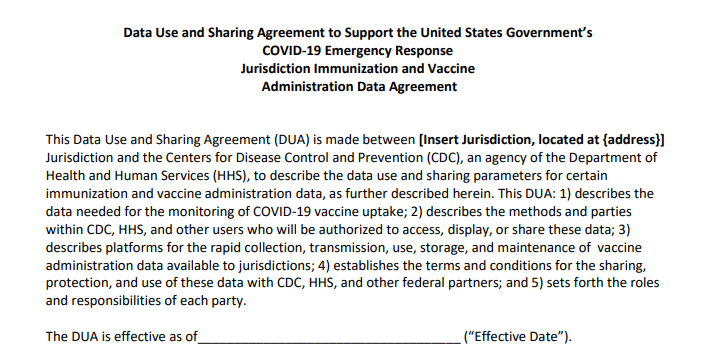
    Historically, each state has tracked vaccinations independently, through Immunization Information Systems (or IIS). While the CDC does report some national immunization information, such as its flu vaccination dashboard, this information typically comes from outside surveys and is not reported in real-time. Of course, this won’t do for COVID-19. To build up a national system, the CDC has asked every state to sign a Data Use and Sharing Agreement promising to send vaccination counts and associated demographic data to the CDC.

    It seems simple, right? But according to Stolberg’s reporting, the CDC has asked states to send personal information—such as names, birth dates, ethnicities, and home addresses—for each vaccine recipient. While demographic information should be tracked for COVID-19 vaccines in order to monitor equity in distribution, there is no need for the CDC to collect such specific information as names or home addresses. In fact, such a practice both discourages people from getting vaccinated and discourages states from cooperating with the federal public health agency.

    Stolberg quotes an official from Minnesota who is concerned about privacy:

    In Minnesota, officials are refusing to report any identifying details to the C.D.C., but they will submit “de-identified doses-administered data” on a daily basis once the vaccine campaigns begin.

    “This is a new activity for us, as we don’t typically report this level of detail on this frequency to the federal government,” Doug Schultz, a spokesman for the Minnesota Department of Health, said in an email. He added, “We will not be reporting name, ZIP code, race, ethnicity or address.”

    States which refuse to send personal data to the federal government may still report anonymous demographic information, such as the races and ethnicities of individuals who get vaccinated, on state-level dashboards. But it seems increasingly likely that vaccination data will face the same challenges as testing data: with every state deciding on a different reporting practice, it could be difficult to standardize and answer basic questions at the national level.

    Other vaccine data news and resources from this week:

  • Vaccine news: data and concerns on early distribution

    Vaccine news: data and concerns on early distribution

    Everyone in the science communication world is talking about COVID-19 vaccines right now. I’ve attended three vaccine webinars in the past week alone.

    We’re all gearing up for next Thursday, when the FDA’s Vaccines and Related Biological Products Advisory Committee will meet to discuss Emergency Use Authorization (EUA) for Pfizer and BioNTech’s vaccine. If the vaccine is authorized for distribution, doses will go out to every state within days. Meanwhile, Moderna’s vaccine continues to demonstrate promising results. Moderna has also applied for EUA; FDA’s committee will meet to discuss this candidate on December 17.

    Here are a few major data sources and issues that I’ll be watching as these vaccine candidates progress:

    • The CDC has recommended that the first available vaccine doses go to healthcare workers and residents of long-term care facilities (nursing homes, assisted living facilities, etc.) The agency did not specify how state and local governments should prioritize among these groups.
    • How many people are actually in those high-priority groups in each state? To answer that question, see the Vaccine Allocation Planner for COVID-19, a new data tool from the Surgo Foundation, Ariadne Labs, and other collaborators. For each state, the tool uses population estimates from the Census, the CDC, and other sources to show how many healthcare workers, first responders, teachers, people with severe health conditions, and other high-risk individuals will need to be vaccinated. The tool is automatically set to calculate each state’s available doses as a population-adjusted share of 10 million, but users can adjust it to see how different scenarios may play out.
    • How many vaccine doses are actually going to each state? To answer this question, see the new COVID-19 Vaccine Allocation Dashboard from Benjy Renton. Renton is compiling information from local news sources on dose distributions from Pfizer and Moderna’s early shipments. Remember that both of these vaccines require two doses per person. In Texas, for example, the first Pfizer shipment of 224,250 doses will allow about 11 in every 1,000 Texas to get vaccinated.
    • How will vaccination be tracked? The CDC has promised to set up a national dashboard similar to its flu registry, but until then, we must rely once again on state data. This CDC list of state immunization registries should be a useful starting point for any local reporters hoping to get a jump start on vaccine data. You’d better believe that I will be spending a lot of time with these registries in future issues.
    • The Kaiser Family Foundation is setting up a new dashboard to track public opinion on COVID-19 vaccines. This initiative, called the COVID Vaccine Monitor, will compile the results of regular focus groups and surveys on whether Americans plan to get vaccinated and why. The dashboard is not live yet, but you can learn more about it and hear past KFF findings in the foundation’s December 3 briefing. One notable statistic: 67% of Black adults are “not too confident” or “not at all confident” that vaccines will be distributed fairly, as of a KFF poll conducted in August-September.
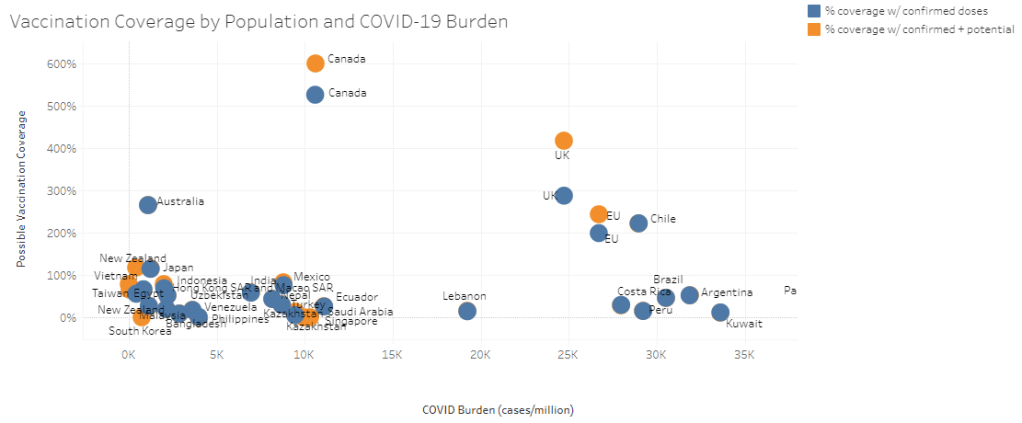
    • For vaccine coverage outside the U.S., see this map of procurement data from the Launch & Scale Speedometer. This research group from the Duke Global Health Innovation Center has compiled the total vaccine doses purchased by over 30 nations. The dashboard also estimates the share of each nation’s population it could be able to cover with advanced vaccine purchases. Canada is highest on the scale at 601%; the nation’s extra doses will likely be donated to other countries.
    • STAT’s Helen Branswell has written a comprehensive feature on the vaccine-related challenges that lie ahead. Some of the big challenges: coordinating a speedy early rollout, overcoming vaccine distrust, distributing vaccine doses equitably, protecting vulnerable populations (such as pregnant women and children) on whom vaccine candidates have not yet been tested, and continuing to study additional vaccines once the first candidates to win EUA are rolled out.

    What questions do you have around COVID-19 vaccines?

    It’s time for our next brief reader survey, and this time, I want to hear your vaccine concerns. As this continues to be a major coverage topic for me, I’d like to be sure I’m prioritizing the needs of my readers in choosing specific vaccine-related issues and data sources to investigate.

    This is a one-question survey. A few reader responses (from those who indicate they’re comfortable with it) will be shared next week.

  • Who should get the first vaccine doses?

    Who should get the first vaccine doses?

    With this past Monday’s announcement from the University of Oxford and the pharmaceutical company AstraZeneca, three COVID-19 vaccine candidates have now demonstrated clinical trial results which could land them Emergency Use Authorization from the Food & Drug Administration (EUA from the FDA, for short). Pfizer, the first vaccine manufacturer to release its trial results, applied for EUA on November 20. The FDA advisory committee will meet on December 10 to review this application, and vaccines could start shipping out as early as December 12.

    These dates are incredibly exciting—December 12 is only three weeks away. But that first vaccine shipment will likely include 50 million doses, at most. Since two doses are required for a patient to be protected against COVID-19, this means up to 25 million people will be able to get vaccinated. That represents just 7.6% of the country’s population. So, who will get vaccinated first?

    As per usual in America’s fractured pandemic response, the answer to this question will largely depend on state and local public health authorities. Still, national guidances and data on health disparity allow us to see who should get the vaccine first—and evaluate our local public health authorities when the doses start rolling out.

    Earlier this week, the Advisory Committee on Immunization Practices (ACIP) released a report which aims to help local authorities make these decisions. The ACIP is a group of medical and public health experts affiliated with the Centers for Disease Control and Prevention (CDC), which develops recommendations on how vaccines should be used among U.S. residents. The committee has been considering COVID-19 vaccine ethics since April, through a Work Group which conducted literature reviews and presented its findings to the rest of the team.

    The ACIP recommends that four ethical principles guide COVID-19 vaccine distribution:

    1. Maximize benefits and minimize harms. The first people to get vaccinated should be those who, when they are healthy, are better able to protect the health of others in their community. This includes healthcare workers, other essential workers, and people with preexisting health conditions who would likely need to be hospitalized if they became sick with COVID-19.
    2. Promote justice. Americans of all backgrounds and communities should have an equal opportunity to be vaccinated. The ACIP recommends that public health authorities work with external partners and community representatives to help make vaccines available (and attractive) to everyone—both when vaccine supply is limited and when everyone is able to get inoculated.
    3. Mitigate health inequities. People of color, especially Black Americans, Native Americans, and Native Hawaiians/Pacific Islanders, have been disproportionately impacted by COVID-19 in the U.S. The legacy of systemic racism in this nation’s healthcare system and economy, as well as disparities in testing availability and care, have contributed to these inequitable outcomes. Vaccine distribution must directly address such inequities by prioritizing racial and ethnic minorities, low-income communities, rural communities, and other marginalized groups.
    4. Promote transparency. All the decisions that public health authorities make about who gets the vaccine, when, and how must be communicated clearly to the public. Furthermore, communities should be invited to participate in the decision-making process whenever possible. This kind of transparency helps promote trust in both the vaccines and the people who administer them.

    The ACIP’s recommendations are also laid out more practically in two tables at the end of the report. The first table poses essential questions for public health authorities to consider for each ethical principle, while the second applies these principles to four key groups who will be prioritized in the first round of vaccinations: healthcare workers, other essential workers, adults with high-risk medical conditions, and adults over the age of 65.

    Dr. Uché Blackstock, the founder of Advancing Health Equitycritiqued the recommendations on Twitter for failing to specifically call out the role of systemic racism in shaping how COVID-19 has impacted Black communities. Still, these principles are a good start in providing us reporters and community members with a framework for watching how our public health authorities distribute vaccines.

    The federal government will simply be sending vaccine doses to states based on their overall populations rather than taking the ACIP’s recommendations, according to NPR’s Pien Huang. So, it will be entirely up to states and more local public health departments to prioritize justice, equity, and transparency. What tools should public health departments use in order to apply these principles?

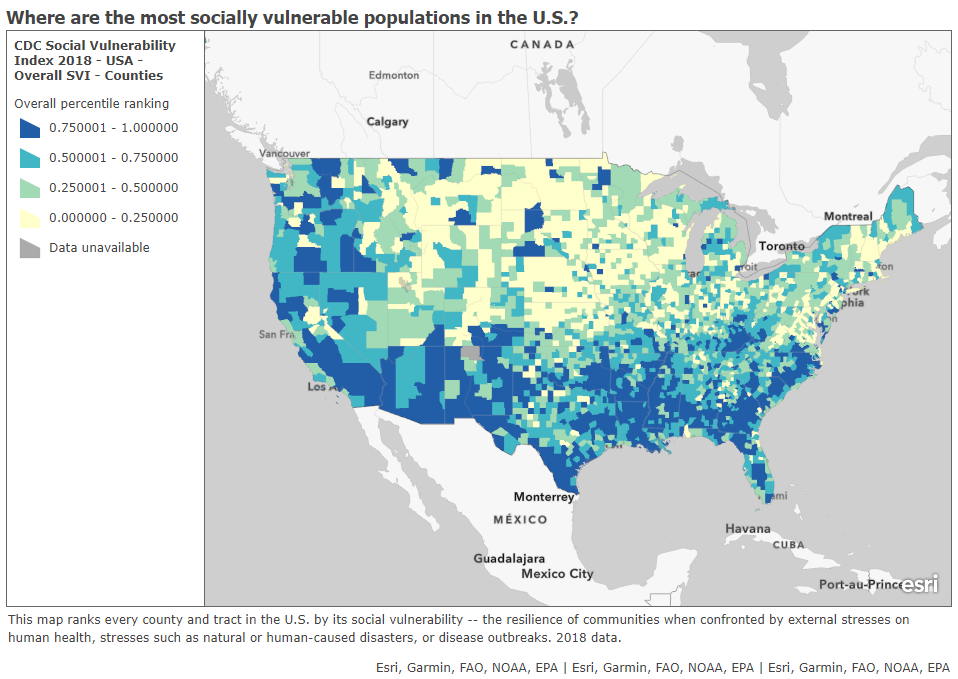
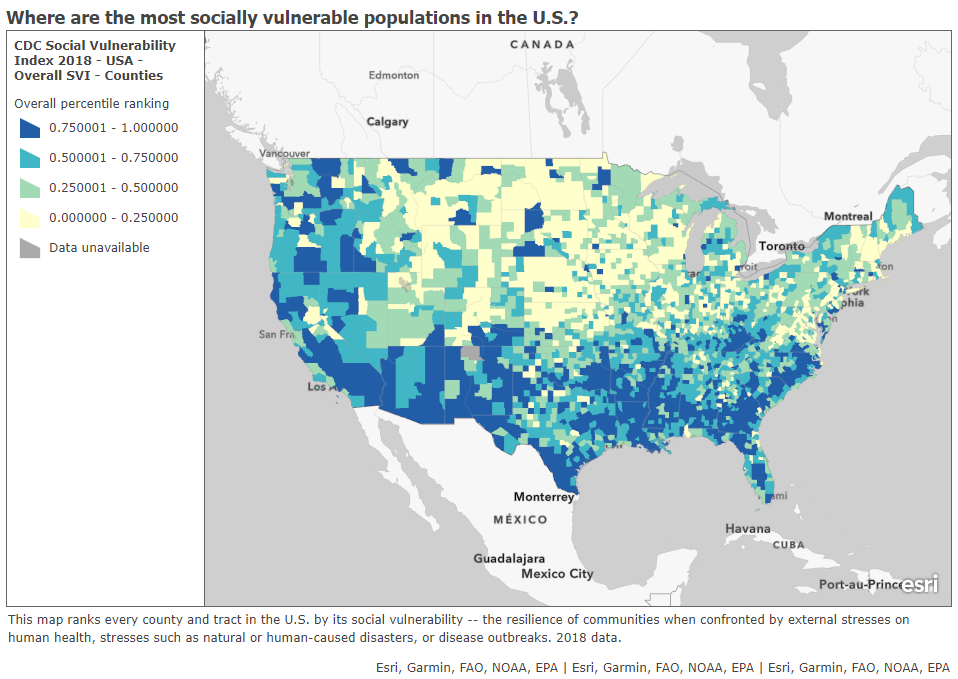
    In a webinar last week on vaccine distribution, STAT News reporter Nicholas St. Fleur suggested turning to the CDC’s Social Vulnerability Index. Social vulnerability, as the CDC defines it, measures a community’s ability to recover from events that are hazardous to human health. These events can include tornados, chemical spills, and—of course—pandemics. CDC researchers have calculated the social vulnerability of every Census tract in the U.S. based on 15 social, economic, and environmental factors such as poverty, lack of vehicle access, and crowded housing.

    The most recent update of this index was released in March 2020 based on analysis of 2018 Census data. Here’s what it looks like, mapped by Esri’s Urban Observatory:

    The CDC’s Census tract-level Social Vulnerability Index, as mapped by Esri’s Urban Observatory. Communities colored in dark blue are more vulnerable to hazardous health events.

    Here’s the interactive map, and here’s the CDC page where you can download all the underlying data for this index. I highly recommend zooming in to your state and looking at which areas are ranked most highly—if COVID-19 vaccines are distributed equitably, these are the communities that should get priority.

    St. Fleur also recommends checking out how your state, city, or county defines essential workers, as these distinctions may vary from region to region. In New York, for example, essential workers include teachers, pharmacists, and grocery store workers. In Texas, essential workers include law enforcement and the Texas Forest Service. The Kaiser Family Foundation report which I featured in last week’s issue compiles links to draft COVID-19 vaccination plans for every state, some of which include these definitions.

    I anticipate that vaccine distribution and reporting will continue to be a major topic for this newsletter in the coming months. Questions and topic suggestions are always welcome; you can drop me a line at betsyladyzhets@gmail.com, on Twitter, or in the comments.

  • Featured sources, Nov. 22

    These sources, along with all others featured in previous weeks, are included in the COVID-19 Data Dispatch resource list.

    • State COVID-19 vaccine plans: A new report from the Kaiser Family Foundation explores how state public health departments are planning to distribute COVID-19 vaccines once they become available. The report includes common themes and concerns across all 50 state plans, as well as links to the plans themselves. One insight that stuck out to me: “Just over half (25 of 47, or 53% ) of state plans report having immunization registries/database systems in place that are described as being (at least fairly) comprehensive and reliable; in the other state plans that information is unclear.”
    • COVID-19 Testing Communications Toolkit: The Brown School of Public Health has compiled a resource to help public health communicators encourage COVID-19 testing. The toolkit includes evidence-based tutorials, handouts, and an image library, all of which are free for public use.
    • COVID-19 and Impacted Communities: A Media Communications Guide: This is another communications tool from the New York COVID-19 Working Group. The guide includes best practices for explaining key terms, advice on framing stories, and how to avoid stereotypical narratives about minority communities.
    • SARS-CoV-2 and COVID-19 Data Hub: Erin Sanders, a nurse practitioner and contact tracer, has compiled a list of data sources on the novel coronavirus. The list includes clinical data, transmission data, and genomic data, among other medical and epidemiological topics.