Tag: vaccine communication

  • The US missed Biden’s July 4 goal: How did your community do?

    The US missed Biden’s July 4 goal: How did your community do?

    The U.S. missed President Biden’s big vaccination goal: 70% of adults vaccinated with at least one dose by July 4. As of July 3, we are at 67% of adults with one dose, and 58% fully vaccinated.

    I did a data-driven look at the vaccination goal this week in a story for the Daily Mail. The story focuses on which parts of the country have met the goal—and which areas fell short. Those under-vaccinated areas are highly vulnerable to the Delta variant (B.1.617.2), which is now spreading rapidly in many of those pockets. Reminder: the Delta variant is much more transmissible than even the Alpha variant (B.1.1.7), and its presence is doubling in the U.S. every two weeks.

    There are over 1,000 counties in the U.S. with one-dose vaccination rates under 30%, CDC Director Dr. Walensky said at a press briefing last week. The U.S. has about 3,100 counties in total.

    Is your county one of them? Check it out on this interactive map, reflecting data as of July 1:

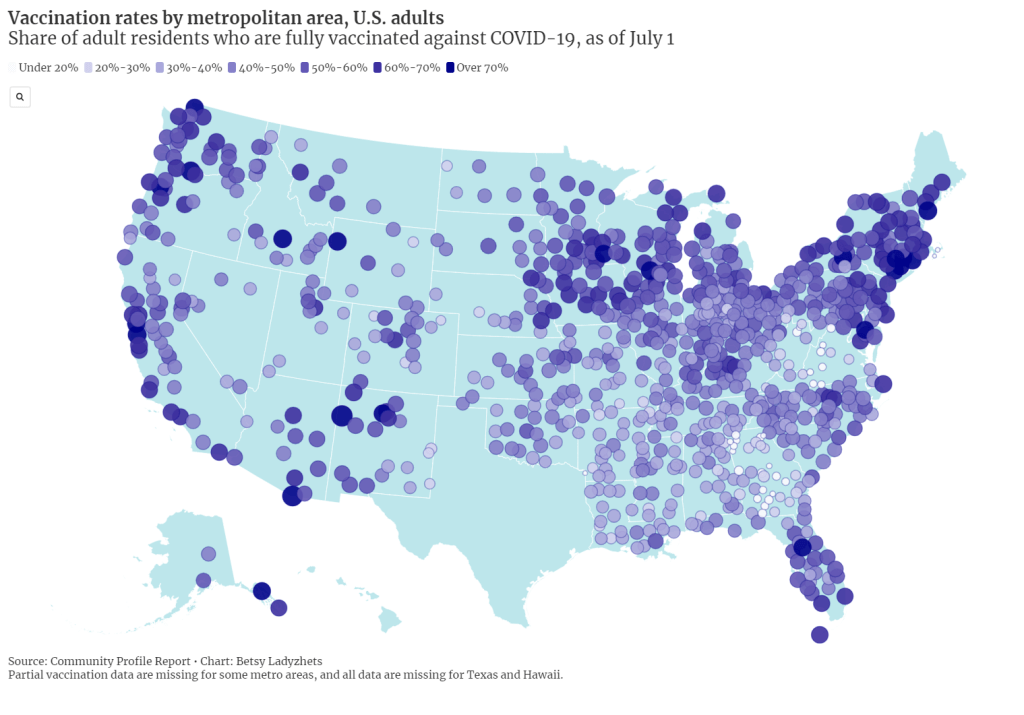
    I also made a map showing vaccination rates by metropolitan area. You can clearly see clusters of high vaccination in the Northeast and on the West coast, while parts of the South and Midwest are under-vaccinated. Note that Texas is missing in both this dataset and the county-level data due to issues in the state’s reporting to the CDC.

    For my Daily Mail story, I also asked two of the COVID-19 science communicators I most admire to explain the significance of that missed 70% goal. I talked to Dr. Uché Blackstock, physician and founder of the organization Advancing Health Equity, and Dr. Katelyn Jetelina, epidemiologist at the University of Texas and writer of the Your Local Epidemiologist newsletter.

    Here are both of their takes on the missed goal:

    So, we didn’t meet the 70% goal. It means that we fell short. It also means that we just don’t have enough people vaccinated, not even close, to reach herd immunity.

    To me, as an epidemiologist, someone in the field and also someone within a community, it means that we have reached—or are about to reach—saturation [of the vaccine market]. We need to start becoming very innovative about how to address vaccine hesitancy, as well as how to address vaccine equity.

    That’s really going to be the next phase of public health approaches. And then, how do we go about doing this… You know, we’re well beyond billboards now. We really need to mobilize a grassroots movement. We need to listen about concerns, we need to educate about these concerns.

    And then, we need to make vaccines more accessible. Especially among pediatrics, where—pediatrician offices can’t store the vaccine. So we have to go to schools and really engage with families in a “nontraditional sense.”

    Dr. Katelyn Jetelina

    This 70%, especially for one dose, is sort of an arbitrary number, because we know that being fully vaccinated is what’s needed to fully protect you against variants. I think it was obviously wise and aspirational to have a goal. But at this point, because we’re basically seeing the number of people vaccinated decreasing weekly, and substantially since last April… I think we need to change our perspective.

    We had the early adopters who came in droves to get vaccinated. We’re not going to see the same numbers anytime soon. And so, I think that this idea of having a goal, while it’s aspirational, I think that we have to put that aside and think more realistically about the challenges we’re dealing with.

    And the challenges we’re dealing with are actually quite complicated… There are still access issues, although I do think the Biden administration is doing—at least trying to do a substantial job in knocking down those barriers. They’re providing transportation, childcare, increasing the access points for getting vaccinations, encouraging small businesses to offer their workers paid sick leave to get vaccinated and to recover from the vaccine.

    But I think this other issue that we’re seeing among people who are not vaccinated, it varies depending on the population, the geographical area. We know rural populations are less likely [to get vaccinated]. And we know that, among the “wait and see” group, about half of those are people of color.

    I hate to blame it on this so-called “vaccine hesitancy” because I don’t think it’s that simple. I do think, though, that there is a significant distrust of government, there is distrust of the healthcare system, and there is a lot of misinformation out there about the vaccines. All of these are essentially creating the perfect storm that is preventing us from getting to this aspirational [70%] number.

    But here, we’re at this point where it’s a race against the variants, and I think that we just have to get as many people vaccinated as possible. I know that sounds incredibly vague, but that really is the goal.

    Dr. Uché Blackstock

    I made a third chart for today’s issue, visualizing vaccination rates by state from March through June. It really shows how vaccine enthusiasm has leveled off, just about everywhere in the country—but the plateaus started earlier in many of those states that have lower rates now. 

    I typically try to avoid anything approaching medical advice in the COVID-19 Data Dispatch, as I am a journalist with just an undergraduate biology degree and a couple of years of science reporting experience. But this week, it feels appropriate to wholeheartedly, unambiguously encourage vaccination.

    I know the audience for a publication like this one skews towards people who probably have their shots already. Rather, I want to encourage you to find those people in your community who aren’t yet vaccinated, and help them take that step.

    Recent research suggests that lotteries and other large-scale incentives do not significantly encourage vaccination; instead, we need small-scale incentives. One-on-one conversations with people, opportunities for concerns to be voiced and addressed, appointments that can be tailored to the individual’s needs. Anything that you can do to play a role in these initiatives, please get out there and do it.

    Of course, if you (or your friends/family/community members/etc.!) have questions about vaccines, or anything else COVID-19 related, you know where to find me. Inquiries welcome at betsy@coviddatadispatch.com

    More vaccine reporting

    • Sources and updates, November 12
      Sources and updates for the week of November 12 include new vaccination data, a rapid test receiving FDA approval, treatment guidelines, and more.
    • How is the CDC tracking the latest round of COVID-19 vaccines?
      Following the end of the federal public health emergency in May, the CDC has lost its authority to collect vaccination data from all state and local health agencies that keep immunization records. As a result, the CDC is no longer providing comprehensive vaccination numbers on its COVID-19 dashboards. But we still have some information about this year’s vaccination campaign, thanks to continued CDC efforts as well as reporting by other health agencies and research organizations.
    • Sources and updates, October 8
      Sources and updates for the week of October 8 include new papers about booster shot uptake, at-home tests, and Long COVID symptoms.
    • COVID source shout-out: Novavax’s booster is now available
      This week, the FDA authorized Novavax’s updated COVID-19 vaccine. Here’s why some people are excited to get Novavax’s vaccine this fall, as opposed to Pfizer’s or Moderna’s.
    • COVID-19 vaccine issues: Stories from COVID-19 Data Dispatch readers across the U.S.
      Last week, I asked you, COVID-19 Data Dispatch readers, to send me your stories of challenges you experienced when trying to get this fall’s COVID-19 vaccines. I received 35 responses from readers across the country, demonstrating issues with insurance coverage, pharmacy logistics, and more.
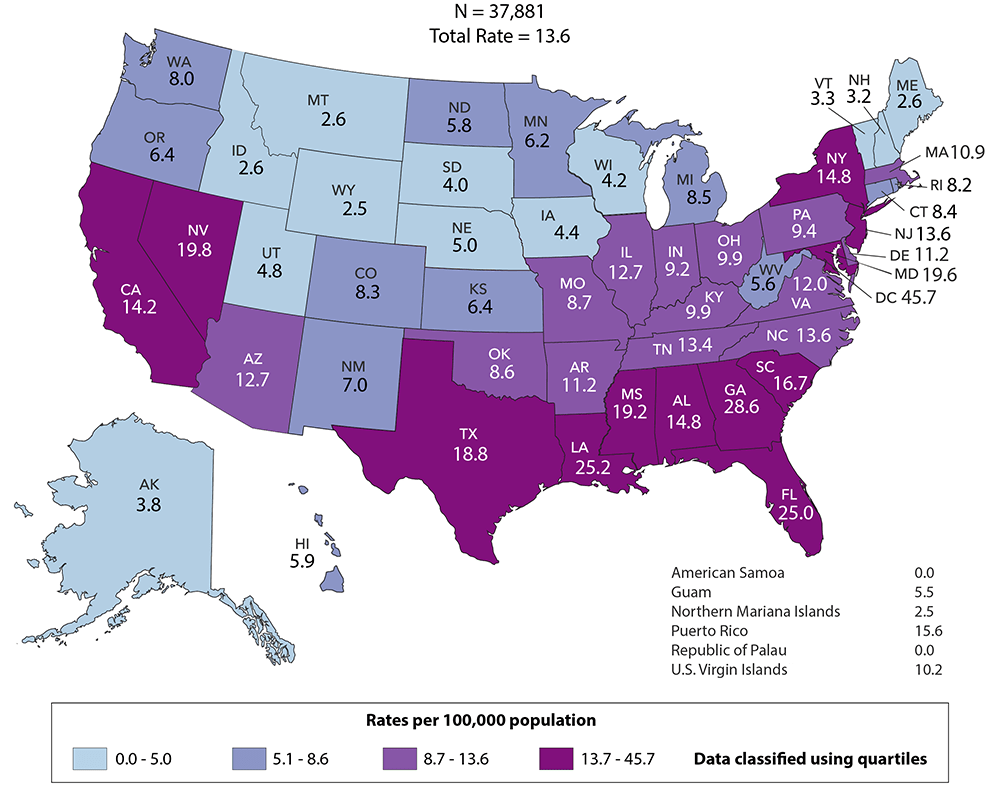
  • Lessons for COVID-19 from the HIV/AIDS pandemic

    Lessons for COVID-19 from the HIV/AIDS pandemic

    In the U.S., southern states have the highest numbers of HIV-positive residents. Chart via the CDC.

    This is the last week of Pride Month for 2021, and it’s also officially Pride weekend in NYC, where I live. (As the newsletter goes out, I’ll likely be marching with the Stonewall Protests, a group that advocates for Black trans women.)

    So, it felt appropriate for me to take this issue to highlight a couple of lessons that the U.S. response to COVID-19 has taken from our response to another pandemic—one that is still ongoing.

    HIV, the virus that causes AIDS, infects over one million new people every year. The HHS estimates that there were about 38 million people living with this virus around the world in 2020, including 1.2 million in the U.S. While many of us might associate HIV/AIDS with American outbreaks in the 1980s and 90s, it continues to disproportionately impact people of color and queer people in the U.S. and globally.

    In the U.S., the South has higher HIV infection rates than any other part of the country. Black Americans are diagnosed with the virus at rates almost ten times higher than white Americans, according to CDC data from 2014 to 2018. At a global scale, the virus disproportionately impacts African nations; Swaziland has the highest infection rate, at 27%.

    Treatments do exist for HIV, a virus that attacks the body’s immune system, and AIDS, the immunodeficiency condition that this virus causes. The most common treatment is antiretroviral therapy (or ART), which allows people with HIV infections to live long, healthy lives and avoid transmitting the virus to sexual partners. The HHS estimates that about 16% of the global population with HIV (or about 6 million people) does not know they’re infected, and still needs access to tests and treatment.

    This is a pandemic that demands continued focus even after urgency around COVID-19 wanes. But the responses to HIV/AIDS—both scientific and political—can show us how an understanding of intersectionality and local community focus may contribute to pandemic response.

    Understanding disparities and comorbidities

    People living with HIV are more vulnerable to severe COVID-19. One study of HIV patients in New York state found that, if diagnosed with COVID-19, these patients were more likely to go to the hospital and more likely to die from the disease compared to non-HIV patients.

    An HIV diagnosis, like a case of diabetes or asthma, is a disease that hits people of color harder and may contribute to their worse COVID-19 rates. Public health efforts around COVID-19 can learn from clinicians focused on HIV/AIDS, who are already used to connecting with vulnerable communities and understanding the intersectional socioeconomic factors that contribute to their health.

    It takes a long time to learn disease origins

    This page on the evolution of HIV may give you an idea of the many steps that typically go into finding a disease’s source. When the page was first written, in 2008, scientists had found ties between the virus and chimpanzees in west-central Africa, but they didn’t know all the details of its first jump to humans. News updates in 2010, 2015, and 2020 provide more information, reflecting updates in scientific knowledge: newer research suggests that the virus spread to humans in the early 20th century and went undetected for decades.

    These updates remind us that scientists cannot pinpoint biological disease origins overnight. Scientists are still working to understand the evolution of HIV, decades after we first became aware of the disease. There are other outbreaks, not as old as HIV but older than COVID-19, that we still don’t understand:

    Regulatory pathways need to prioritize patients

    In the 1980s, AIDS activists led by the AIDS Coalition to Unleash Power (or ACTUP) protested the FDA and other public health officials. They saw the agency’s drug approval process as a barrier, keeping them from accessing potentially life-saving treatments; while small numbers of patients received new drugs in clinical trials, the vast majority of HIV-positive Americans had to wait for data to come out. Even Dr. Anthony Fauci was involved: AIDS activist Larry Kramer called him a killer and an idiot in a 1988 letter. Fauci later credited Kramer with pushing for change in the medical establishment.

    As a result, we can thank those AIDS activists who advocated for processes that allow faster drug development and patient treatment in times of crisis. This includes faster vaccine trials and the hundreds of Emergency Use Authorizations provided to COVID-19 tests and treatments over the past year.

    Neighborhood-level healthcare provides critical services

    People living with HIV in the U.S. often were not able to access support from the government or healthcare insurance, especially earlier in the 1980s. As a result, many queer communities organized locally to provide their own support. Neighborhoods like the Castro district in San Francisco and Greenwich Village in New York saw healthcare clinics, free testing, information-sharing about virus prevention, and more. These local institutions built trust in their communities.

    Such trust was also key in the COVID-19 pandemic, when government agencies from the federal to the county level weren’t ready to serve their residents. In an article for The Conversation, Daniel Baldwin Hess and Alex Bitterman describe how some of the same community groups that started to provide HIV testing decades ago added COVID-19 testing to their repertoire this year:

    For example, in New York, the Erie County Department of Health requested that Evergreen Health – an LGBTQ community group originally established in the 1980s as a volunteer effort to fight HIV – assume responsibility for HIV testing during the COVID-19 pandemic so that the county government could focus on COVID-19 testing. Evergreen also opened a drive-though COVID-19 testing center in the spring of 2020 – four decades after it had introduced HIV testing to the Buffalo region.

    These local institutions have also helped build vaccine trust and administer doses.

    Finally, there’s one lesson we may take from COVID-19 back to the continued fight against HIV/AIDS: mRNA vaccines! Moderna is currently partnering with International AIDS Vaccine Initiative to develop a potential mRNA vaccine for HIV.

  • COVID source shout-out: Goodnight Turbovax

    COVID source shout-out: Goodnight Turbovax

    So long, farewell, I hope we never have to meet again: the sun is setting for the incredibly hardworking bot Turbovax.info. (As of May 15 it is still operational, and it is not clear when the bot will be retired for good.) New York City has opened more walk-in vaccine centers and as more people get vaccinated, and the bot’s creator, Huge Ma, tweeted that “It’s been a real honor to serve all of you but the need for TurboVax has come and gone.” The site has seen decreasing traffic since at least mid-April, as Ma tweeted on April 15 that there had been a 70% drop in bot traffic from the week before.

    The bot (and its creator) became somewhat of a local legend when vaccine appointments in NYC were harder to find than an under-$900k Brooklyn brownstone. They drew attention from outlets ranging from The Guardian to The New York Times to a particularly notable profile of Ma in The Cut—making “Vax Daddy” (or “Vaddy”) a household name for many engrossed in COVID-19 news. Mayoral candidate Andrew Yang has even courted Ma’s endorsement. (To date, he has not endorsed a candidate, though he has endorsed more protected bike lanes.)

    Ma has used his platform to advocate for AAPI folks and to denounce anti-Asian racism. On February 27, he suspended the bot as a form of protest as anti-Asian hate crimes rose across the country. (It was restored on March 1.) His continuing advocacy and fundraising for Welcome to Chinatown, a nonprofit providing resources for small businesses in the Chinatown area of Manhattan, has raised $200,000, according to his Twitter.

    We here at the CDD salute Ma’s incredible work, and personally, I’m particularly grateful for Turbovax for getting one of my friends vaccinated, posting really cute pictures of his cat MaoMao, and getting Bowen Yang back on Twitter for a brief spell. And amidst the sentimentality, there’s a smidge of good news: while the actual bot is being retired, Ma will still be tweeting from the @Turbovax account “bc it’s fun.”

  • The data behind the CDC’s new mask guidance

    The data behind the CDC’s new mask guidance

    This past Thursday, the CDC announced that, if you are fully vaccinated, the pandemic is basically over for you.

    The announcement surprised everyone—from my parents to COVID-19 scientists—because it appeared to come out of nowhere. Before this week, the CDC’s most recent guidance revisions included an acknowledgment that surface transmission of the coronavirus is very rare and a recommendation that masks might not be necessary outside; both of these conclusions were already well-known in the scientific community. In fact, STAT published an article last week in which Nicholas Florko suggests that the CDC’s COVID-19 messaging has been “overly cautious” and perhaps even “irrelevant for most Americans.”

    So, what led to the announcement on Thursday? The rest of this post will go over the CDC’s evidence for its guidance, taking the epidemiological perspective. Also, as two-thirds of Americans aren’t yet fully vaccinated, I’ll touch on another COVID-19 truism that has garnered some confusion lately: yes, you are significantly safer outside than you are inside.

    CDC graphic on COVID-19 safety, updated with the new mask guidance on Thursday.

    (I need to acknowledge, though, that a. there are certainly outside political and economic forces at play here, and b. the public health perspective on this guidance is far more complicated. For one perspective on the public health side, I recommend this Twitter thread by virologist Angela Rasmussen.)

    Our first category of evidence: the mRNA vaccines work really well. It’s no surprise that the Pfizer and Moderna vaccines are both exceptionally capable of protecting people against the coronavirus, but a couple of recent studies really hammer this home:

    • In this recent study from Israel, the Pfizer vaccine demonstrated 97% effectiveness against symptomatic cases and 86% effectiveness against asymptomatic cases among about 6,700 healthcare workers who were regularly tested for COVID-19.
    • According to this MMWR report from the CDC, the Pfizer and Moderna vaccines were 94% effective in preventing COVID-19 hospitalization for fully vaccinated seniors (over age 65), demonstrating how well the vaccines protect against severe disease. Plus, the vaccines were 64% effective in preventing hospitalization for partially vaccinated seniors.
    • Another MMWR report, released this past Friday, demonstrates that the mRNA vaccines were 94% effective at preventing symptomatic COVID-19 in U.S. healthcare workers. A single shot of Pfizer or Moderna ws 82% effective at preventing symptomatic COVID-19.
    • A study from the Cleveland Clinic, a medical research center based in Cleveland, Ohio, studied COVID-19 cases among its caregivers after vaccines were made available; the Clinic found that a whopping 99.7% of those workers who tested positive for COVID-19 had not been fully vaccinated. Only 0.3% were breakthrough cases. Meanwhile, 99.75% of COVID-19 patients that the Clinic treated during the study’s time frame were not fully vaccinated.
    • According to the CDC’s breakthrough case data, out of about 122 million fully vaccinated Americans, less than 1,400 people have been hospitalized or have died due to COVID-19. That’s 0.001%. (The CDC’s breakthrough reporting focuses on severe outcomes rather than cases, as these cases may be difficult to systematically identify outside of studies.)

    Second evidence category: the vaccines work against variants.

    • It’s important to note here that, when I say “vaccines work,” it’s not an all or nothing situation. A vaccine might protect you against severe COVID-19 disease or death (the primary goal), but not against an asymptomatic case that allows you to transmit the virus to someone else.
    • All the COVID-19 vaccines currently on the market protect us against severe COVID-19 disease and death—whether you’re infected with an older version of the coronavirus or with a variant. 
    • For a couple of the variants, that protection might not be quite as secure. Studies on B.1.351 (the variant first identified in South Africa), P.1 (identified in Brazil), and B.1.617 (identified in India) have all demonstrated lower vaccine effectiveness. But again, lower effectiveness here still means protection for the majority of people who get vaccinated.
    • And one big advantage of mRNA vaccine technology is, the Pfizer and Moderna vaccines may easily be adjusted to protect against particularly concerning variants. Moderna recently reported promising data for two booster shots designed to protect specifically against B.1.351 and P.1.
    • If you’d like a more detailed rundown of the vaccine v. variants battle, check out this article by STAT’s Andrew Joseph.

    Third evidence category: U.S. cases are way down.

    • As I noted in today’s National Numbers post: cases have dropped by 50% in the last month. And beyond that, cases have dropped from a peak of 250,000 new cases per day in January to under 40,000 new cases per day now.
    • During this time frame, most states did not impose lockdowns or other restrictions on the level of what we saw in spring 2020. So, these drops can primarily be attributed to the vaccines.
    • We still do not have much evidence showing how well the vaccines protect against asymptomatic transmission and infection, but the evidence we have so far is promising, as Apoorva Mandavilli explains in the New York Times. (One major study investigating this question in college students is currently underway.)
    • Still, the massive case drops—occurring even as B.1.1.7 and other more contagious variants spread through the country—indicate that the vaccines must be doing some work to stall coronavirus spread from one person to another. This supports the CDC’s argument that vaccinated Americans can take off their masks in public without worrying about spreading a latent coronavirus to someone else.

    Fourth evidence category: outdoor transmission is incredibly low.

    • Earlier this week, the New York Times’ David Leonhardt provided a compelling argument for why, though the CDC said “less than 10%” of COVID-19 transmission occurs outside, the true number is actually much lower. In fact, fewer than 1% (and possibly even fewer than 0.1%) of COVID-19 cases happen due to someone getting infected outside.
    • As I’ve previously reported, there is not a single recorded superspreading event that took place solely outside. This includes the large Black Lives Matter protests last summer. (A few superspreading events have both outdoor and indoor components.)
    • A new study from researchers at Drexel University specifically examined COVID-19 transmission in parks, and found no correlation between the number of people using a park and the number of COVID-19 cases in the surrounding ZIP code. The research suggests that you should feel safe at your local park, even if it seems a bit more crowded and less mask-adherent than it did a few months ago. I spoke to Franco Montalto and Bita Alizadehtazi, two authors on this study, who emphasized that “it’s important to get outside,” take advantage of the green infrastructure in your neighborhood, and feel safe while doing so.

    This evidence brings us to what The Atlantic’s Drew Thompson calls the “Two Commandments of COVID-19”:

    1. COVID-19 is an indoor aerosol disease.

    2. Vaccination protects you; more vaccinations protect everyone.

    Speaking just for myself: I am fully vaccinated, but I fully intend to keep wearing a mask in stores, on the subway, and even outside when I’m in a large crowd of people. This is partially because my state still has a mask mandate in place, but also because there are still a lot of people in my community who aren’t yet vaccinated—and I don’t want to pose a risk to them, no matter how small that risk may be. (In Brooklyn, where I live, 41% of the population has had at least one dose and 33% are fully vaccinated, according to city data.)

    Suffice it to say, the CDC makes recommendations about COVID-19 safety. It doesn’t issue requirements. I made a personal masking decision for myself, based on the community where I live; I hope this article helped you understand the science behind the guidance change so that you can do the same. And if you have questions—my inbox is always open.

    More vaccine coverage

    • Sources and updates, November 12
      Sources and updates for the week of November 12 include new vaccination data, a rapid test receiving FDA approval, treatment guidelines, and more.
    • How is the CDC tracking the latest round of COVID-19 vaccines?
      Following the end of the federal public health emergency in May, the CDC has lost its authority to collect vaccination data from all state and local health agencies that keep immunization records. As a result, the CDC is no longer providing comprehensive vaccination numbers on its COVID-19 dashboards. But we still have some information about this year’s vaccination campaign, thanks to continued CDC efforts as well as reporting by other health agencies and research organizations.
    • Sources and updates, October 8
      Sources and updates for the week of October 8 include new papers about booster shot uptake, at-home tests, and Long COVID symptoms.
    • COVID source shout-out: Novavax’s booster is now available
      This week, the FDA authorized Novavax’s updated COVID-19 vaccine. Here’s why some people are excited to get Novavax’s vaccine this fall, as opposed to Pfizer’s or Moderna’s.
    • COVID-19 vaccine issues: Stories from COVID-19 Data Dispatch readers across the U.S.
      Last week, I asked you, COVID-19 Data Dispatch readers, to send me your stories of challenges you experienced when trying to get this fall’s COVID-19 vaccines. I received 35 responses from readers across the country, demonstrating issues with insurance coverage, pharmacy logistics, and more.
  • COVID source shout-out: TUSHY

    COVID source shout-out: TUSHY

    TUSHY is a bidet company. It’s gotten a lot of traction during the pandemic, as Americans suddenly working from home decided to upgrade their bathroom experiences. (This group includes me and my roommates.)

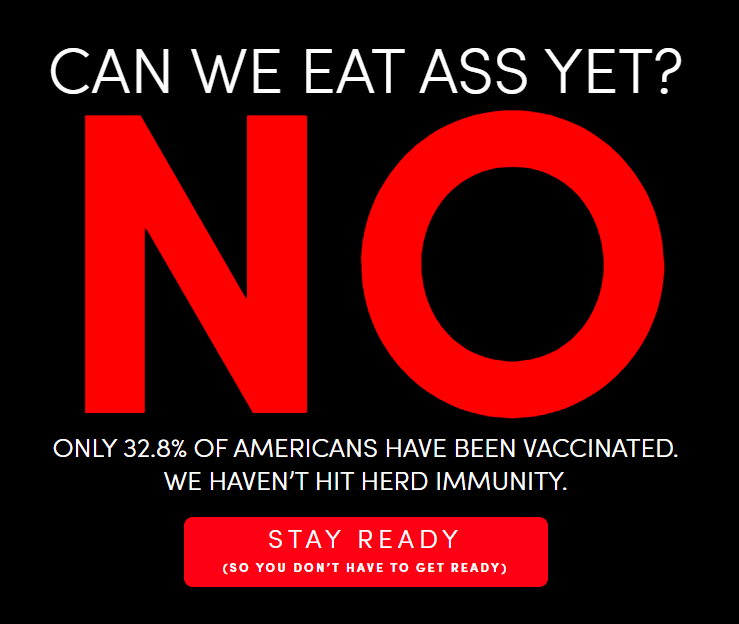
    Now, you might ask: Betsy, why are you featuring a bidet company as a COVID-19 data source? Because a special page on TUSHY’s website is reporting the share of Americans who have been fully vaccinated, with a (NSFW) framing: “Can We Eat Ass Yet?”

    The current answer is no—only 33% of the U.S. population has been fully vaccinated, according to this page. TUSHY staff are updating the page every weekday using CDC data.

    “The idea for “CanWeEatAssYet.com was born when COVID was blowing up in NYC,” says TUSHY’s founder Miki Agrawal. “NYC government sent out a message to all New Yorkers to not eat ass because it could spread COVID… and we wanted to create a funny site a la “IsMercuryInRetrograde.com” with a YES / NO answer specifically for eating ass, because with TUSHY bidet, we support clean ass and wanted to let people know when it was safe to partake in the activity.”

    That bright red “NO” may be switched to “YES” when 70% of the U.S. population has been fully vaccinated, but Agrawal says the team will “keep checking with the CDC regularly” to determine the perfect “ass-eating immunity” threshold. Now that’s creative science communication.

    Editor’s note: This is not sponsored content, I just think the page is really funny—and TUSHY’s marketing team was kind enough to reply to my email on short notice. Also, H/T Garbage Day.

  • How to talk about breakthrough cases

    How to talk about breakthrough cases

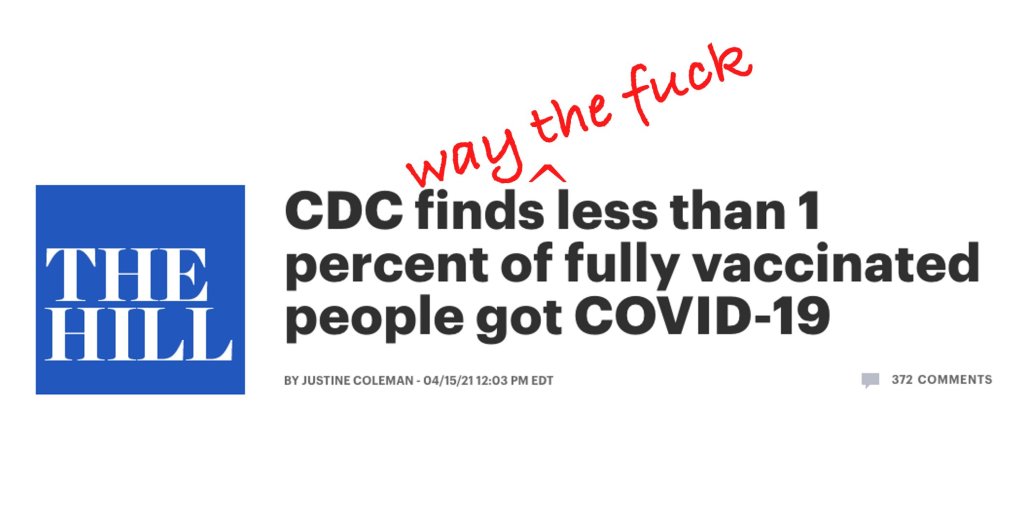
    This week, The Hill posted an article with a rather misleading headline: “CDC finds less than 1 percent of fully vaccinated people got COVID-19.” If you actually click into the piece, you’ll find that the precise number is less than 0.008%. Less than 0.0005% have been hospitalized and less than 0.0001% have died.

    This headline reflects a common issue with vaccine reporting that I’ve seen in the past few weeks. A lot of journalists, especially those who aren’t familiar with the science/health beat, may be inclined to publish news of breakthrough cases as surprising or monumental. In fact, these cases—referring to a COVID-19 infection that occurs after someone has been fully vaccinated—are entirely normal, yet incredibly rare.

    No vaccine is perfect. Even the Pfizer and Moderna vaccines, which both demonstrated 95% efficacy in their late-stage clinical trials and over 90% effectiveness in the real world, are not perfect. Scientists still expect a few COVID-19 infections to slip through the immune system defenses built up by these vaccines and cause illness in a small number of patients.

    And it really is a small number: 129 million Americans have received at least one dose of a COVID-19 vaccine as of yesterday, per the CDC, and 82 million have been fully vaccinated. The agency has only documented 5,800 breakthrough cases. Less than 0.008% of those people who have been fully vaccinated. That’s the equivalent of one-quarter of a seat in Queens’ Citi Field baseball stadium (which seats about 42,000).

    So, if you’re a journalist reporting on this issue—whether it’s nationally or in your community—it’s important to stress that denominator. 82 million fully vaccinated, 5,800 breakthrough cases. Emphasizing the difference in magnitude between these numbers can show readers that, while they should still maintain some caution after getting vaccinated, the vaccines are overwhelmingly safe and effective.

    Small as the breakthrough case numbers are, though, it is important that we still talk about them. A new article by ProPublica’s Caroline Chen discusses how a failure to collect data on breakthrough cases is making it harder for COVID-19 researchers to understand what causes them. Specifically: we should be sequencing the genomes of the coronavirus strains that caused these cases, and by and large, we aren’t.

    Chen describes how many state health departments aren’t getting breakthrough case samples to sequence, whether that’s due to testing labs failing to store the test samples or cases being identified through rapid tests, which do not have established pipelines. Plus, in some cases, we aren’t even recording whether the patients went to the hospital or died—key data points in the U.S.’s continued vaccine monitoring.

    I definitely recommend you read the full piece, but here’s a section that will give you the big idea:

    In many instances, patients’ samples are not sequenced to find out if a variant might have been involved; some labs are throwing out test samples before an analysis can be done; hospitals and clinics aren’t always collecting new samples to analyze them. That means that for so many people, nobody will ever know if a variant was involved, leaving public health officials without data to be able to examine the extent to which variants are contributing to breakthrough cases.

    “It’s alarming that we can’t sequence more of the virus than we’re able to now — that’s something we need to resolve,” said Brian Castrucci, chief executive officer at the de Beaumont Foundation, a health philanthropy. “The more we know, the better we can react. We want to know the information so that we can make the right policy and health decisions.”

    While the CDC has an info page on breakthrough cases, no data on these cases are available on the agency’s COVID-19 dashboard. Reporters need to walk a delicate line on this issue: pursue the data, but report it in a careful, conscientious way that appropriately puts the tiny breakthrough case numbers in context.

    More vaccine news

    • Sources and updates, November 12
      Sources and updates for the week of November 12 include new vaccination data, a rapid test receiving FDA approval, treatment guidelines, and more.
    • How is the CDC tracking the latest round of COVID-19 vaccines?
      Following the end of the federal public health emergency in May, the CDC has lost its authority to collect vaccination data from all state and local health agencies that keep immunization records. As a result, the CDC is no longer providing comprehensive vaccination numbers on its COVID-19 dashboards. But we still have some information about this year’s vaccination campaign, thanks to continued CDC efforts as well as reporting by other health agencies and research organizations.
    • Sources and updates, October 8
      Sources and updates for the week of October 8 include new papers about booster shot uptake, at-home tests, and Long COVID symptoms.
    • COVID source shout-out: Novavax’s booster is now available
      This week, the FDA authorized Novavax’s updated COVID-19 vaccine. Here’s why some people are excited to get Novavax’s vaccine this fall, as opposed to Pfizer’s or Moderna’s.
  • Pfizer for the whole pfamily

    Good news for people with kids: this week, Pfizer and BioNTech released results for their trial involving adolescents aged 12-15. In the trial, no participants who received the vaccine contracted symptomatic COVID-19 out of a total of 2,260 participants, marking an efficacy rate of 100%. (Remember in December the efficacy rate was 95% for adults.) 18 participants in the placebo group did get symptomatic COVID-19. Additionally, Dr. Fauci said in the April 2 White House COVID-19 briefing that, by the end of the year, there should be enough data to safely vaccinate children of any age. 

    The results are, obviously, fantastic. But there was a wrinkle in reporting said results; one that pointed to the dangers of communicating science via press release. Originally, as Dr. Natalie Dean pointed out on Twitter, there was some confusion over whether there were no cases in the vaccinated group at all, or whether there were just no symptomatic cases:

    This is pretty important as infections in this group tend to be asymptomatic. Apoorva Mandavilli, who broke the Pfizer story for the New York Times, clarified that she had been told that there were in fact no infections:

    Until someone pointed out that STAT had clarified that there were no symptomatic infections: 

    Mandavilli decided to triple check, and turns out:

    Basically, someone at Pfizer messed up and incorrectly said that there had been no infections in the vaccine group at all when they really meant that there were no symptomatic infections. It doesn’t look like they regularly tested participants who had gotten the vaccine vs participants who got the placebo. This sounds like splitting hairs, but precision matters when communicating the results of highly anticipated trials. “No infections” and “no symptomatic cases” are different results. It’s a blow to Pfizer’s credibility in their press releases, and it was probably at least really annoying for Mandavilli. 

    In the meantime, Johnson & Johnson has also begun a trial in adolescents, so hopefully whoever is running PR for them saw this Twitter thread (or is reading this article 👀) and will know to be more careful than the Pfizer guy was. 

    But for now, we can rejoice in what is still very promising data. You get a Pfizer! And you get a Pfizer! How about a Pfizer for the little one? EVERYBODY GETS A PFIZER! (Well, when it gets actually authorized for that age group.)

    Related posts

    • Sources and updates, November 12
      Sources and updates for the week of November 12 include new vaccination data, a rapid test receiving FDA approval, treatment guidelines, and more.
    • How is the CDC tracking the latest round of COVID-19 vaccines?
      Following the end of the federal public health emergency in May, the CDC has lost its authority to collect vaccination data from all state and local health agencies that keep immunization records. As a result, the CDC is no longer providing comprehensive vaccination numbers on its COVID-19 dashboards. But we still have some information about this year’s vaccination campaign, thanks to continued CDC efforts as well as reporting by other health agencies and research organizations.
    • Sources and updates, October 8
      Sources and updates for the week of October 8 include new papers about booster shot uptake, at-home tests, and Long COVID symptoms.
    • COVID source shout-out: Novavax’s booster is now available
      This week, the FDA authorized Novavax’s updated COVID-19 vaccine. Here’s why some people are excited to get Novavax’s vaccine this fall, as opposed to Pfizer’s or Moderna’s.
  • How to talk about COVID-19 vaccines

    How to talk about COVID-19 vaccines

    I wrote a tipsheet on covering COVID-19 vaccines for The Open Notebook. If you aren’t familiar with it, The Open Notebook is a nonprofit publication that acts as a living manual for science, health, and environmental writers by providing them with tools, resources, and behind-the-scenes looks into how stars in the field do their work.

    My new piece provides tools and resources specifically for writers on the vaccine beat—both those who have been covering the pandemic for months and those who are now incorporating vaccine news into other aspects of their reporting. It’s kind-of sequel to a tipsheet that Scientific American EIC Laura Helmuth wrote back in March, when the pandemic was first exploding into the historic news story it is now. I interviewed several experienced COVID-19 reporters, and gathered their advice on navigating all the complications of vaccine communication. I also compiled a list of resources on COVID-19 vaccines (including a few data sources which COVID-19 Data Dispatch readers will recognize).

    While the tipsheet is geared towards journalists, much of the advice I gathered also applies more broadly to anyone simply talking about vaccines—whether you’re walking your dad through his vaccination appointment or navigating a friend’s mistrust of the medical system.

    Here are a couple of tips that I found particularly valuable. If they resonate with you, too—or if you have other suggestions to share—please let me know! You can reply to this email, leave a comment on the CDD website, or hit us up on Twitter.

    • Put your numbers in context. When explaining the results of a vaccine trial or discussing dose administration numbers, pick your figures carefully and compare them to something a reader will understand. The best comparison is usually a human one: What does the number mean for an individual person and their community? One example that freelance journalist Maryn McKenna offers: If you’re saying that Operation Warp Speed has contracted 185 million vaccine doses, remind readers that there are about 255 million adults over 18 in the U.S., and the current vaccines on the market require two doses each.
    • Get specific about immunity. One challenge of explaining how vaccines work, Sarah Zhang says, is conveying the different levels of immunity that they provide. “Biologically, immunity is not all or nothing,” she explains. Tell your readers what it means to be protected from symptoms, from infection, from transmission, from mild versus severe illness, from one variant more than another.
    • Assign responsibility precisely. Since everyone is watching the vaccine rollout, Drew Armstrong says, journalists can “assume that there’s a deep interest in real and specific problems.” In other words: dig into the details. When you talk to a politician or public health official in your region, tell them exactly what the gap is in your knowledge, and demand that they give you specific answers. Such reporting can allow reporters to identify root problems rather than, say, allowing the governor of New York and the mayor of New York City to blame each other when doses in the city run out.
    • Remember that some vaccine mistrust is reasonable. Nicholas St. Fleur and McKenna note that some groups that have been hit hardest by COVID-19, such as racial minorities and low-income communities, are also likely to have bad experiences with the U.S. medical system—in many cases, bad experiences that took place during the pandemic itself. “If you’re going to bring up the statistics [on hesitancy], then make sure your next sentence brings up the history,” St. Fleur says. This history includes the oft-cited Tuskegee Syphilis Study, yes, but it also includes the lives of people in the U.S. who have been unable to access the testing and treatment they needed in the past year due to racism that is still systemic in the healthcare system.
    • Stay calm and keep your work in perspective. Just as vaccination—and the COVID-19 pandemic at large—is a deeply personal topic for many readers, it is a personal topic for many writers. But as communicators of science and health knowledge, we must remember the broader purpose of our work. We can’t let our own emotions drive our reporting. “The facts can be scary and dramatic enough—you don’t need to do more than that,” Armstrong says. André Biernath echoes that sentiment: “Breathe deeply, before you write something that could have a huge impact on public health.”

    Read the full tipsheet here. It was also translated into Spanish by Rodrigo Pérez Ortega and Debbie Ponchner—you can read the translation here!