Tag: source shout-out

  • Shout-out: Provincetown’s COVID-19 policies

    This past week, my girlfriend and I had a very unseasonal beach vacation in Provincetown, an LGBTQ+ community that sits on the very edge of Cape Cod, Massachusetts. You might remember the town for its Delta outbreak last summer: hundreds of vaccinated visitors and residents got infected during a popular partying week.

    Of course, the town was much quieter in February than it had been last July. But I was glad to see that Provincetown currently has a mask mandate for indoor businesses and vaccination requirement for indoor dining, instated in late December. The town has also distributed free rapid tests to residents.

    Thank you for a lovely week, Provincetown!

  • COVID source shout-out: The CDD book

    COVID source shout-out: The CDD book

    My girlfriend, Laura, is unbelievably good at gift-giving. Like, really, world-class every time, for everyone. But this year, she went above and beyond in her gift for me: she made the COVID-19 Data Dispatch into a book!

    The book is 464 pages, including most of my posts from the first year of this newsletter and blog project—spanning July 2020 through July 2021. It’s got everything from case charts, to complaints about the CDC, to pictures of Dr. Anthony Fauci. Laura works as a production editor and designer at a publishing house, and I will be forever honored that she spent even more hours in InDesign to make this for me.

    (Please note that this book is not commercially available, because we would need to clear a lot of copyright things with a lot of people. But if, for some reason, you would like a non-commercial copy, email me and we can figure something out!)

  • COVID source shout-out: Collecting Omicron data

    As the world waits for more information on Omicron, I’d like to give a shout-out to the scientists collecting data on this novel variant and sharing it with the public. As of today, over 500 Omicron sequences have been posted to the genome sharing site GISAID.

    If you’d like to keep up with the new sequences, there are three sources I recommend:

    • GISAID, an international organization working to quickly share data on coronavirus and flu virus strains.
    • Nextstrain, an open-source pathogen tracking platform supported by the Fred Hutchinson Cancer Research Center and other institutions.
    • CoVariants, a platform visualizing coronavirus variant data, run by Dr. Emma Hodcroft at the University of Bern with support from other scientists.

  • COVID source shout-out: Community Profile Reports

    We’re now approaching almost a year since the Department of Health and Human Services (HHS) first started publicly releasing Community Profile Reports, massive documents containing COVID-19 data at the state, county, and metro area levels.

    These reports were originally compiled internally, starting in spring 2020, for meetings of Trump’s White House Coronavirus Task Force. Reporters such as Liz Essley Whyte at the Center for Public Integrity were able to obtain some of the documents, but they remained a mostly-secret trove of data until the HHS started publishing them publicly in late December.

    At the time, I wrote that I was excited about the public release because these reports contain a wealth of information in one place—including contextual data (such as population-adjusted case numbers and demographic information) and rankings for policy-makers built right into the Excel spreadsheets.

    Since then, I’ve relied on Community Profile Reports for weekly data updates in this newsletter, along with numerous other stories. While their update schedule has not remained regular, the reports continue to be a one-stop shop for everything from vaccination rates to hospitalization metrics.

    So, this Thanksgiving weekend, I’m thankful for the Community Profile Reports. According to the HHS site, they’ve been downloaded almost 100,000 times, and probably a solid 300 of those are me.

  • (COVID) source shout-out: Data Is Plural

    This week, I want to give a shout-out to Data Is Plural: a newsletter by Jeremy Singer-Vine, the data editor at BuzzFeed News. Every Wednesday, Singer-Vine sends out links to and notes on a few interesting datasets, ranging from toxic pollution to movie script analysis.

    While this is not a COVID-specific source, the newsletter has frequently featured COVID-related datasets in the past two years—and I have occasionally pulled from it for my own featured sources section. I definitely recommend signing up for it, if you aren’t on the list already.

    Also, I got to hear Singer-Vine talk about his data editing philosophy at a training session yesterday, which was pretty cool. It was the first and only time I’ve ever heard someone read a Borges short story during a journalism webinar.

  • COVID source shout-out: K-12 data in Utah

    COVID source shout-out: K-12 data in Utah

    Utah has expanded its K-12 COVID-19 reporting.

    This week, I updated the COVID-19 Data Dispatch page detailing how every state is (or isn’t) reporting COVID-19 cases in schools. I was glad to see that several states have resumed data reporting on this important topic after a summer break, though some haven’t resumed yet. (Looking at you, New York.)

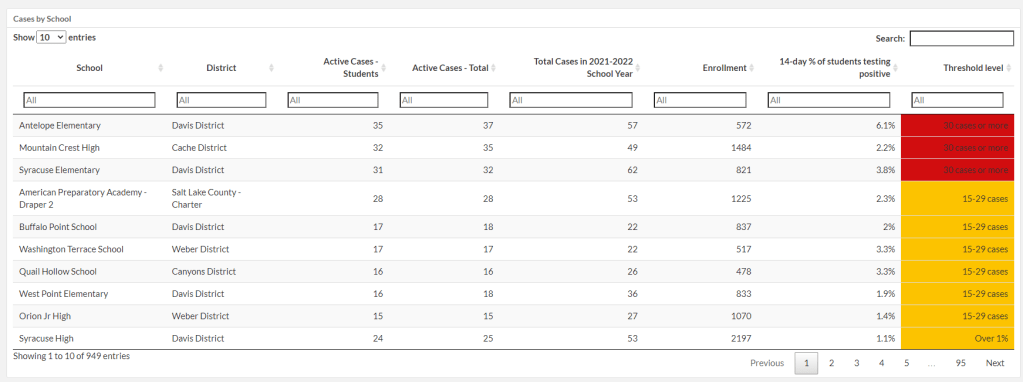
    I want to give a special shout-out to Utah, which has expanded its K-12 data since spring 2021. This state is now the fourth to report in-person enrollment in schools (after New York, Texas, and Delaware). Utah is also reporting school-specific test positivity rates, providing the share of students who have tested positive in the past two weeks.

    It’s not surprising that Utah would expand its school data reporting, because this state is currently pioneering a program called Test to Stay. Schools are required to offer testing to all students when an outbreak occurs, in partnership with their local health departments.

  • COVID source shout-out: FERN’s mapping project shuts down

    COVID source shout-out: FERN’s mapping project shuts down

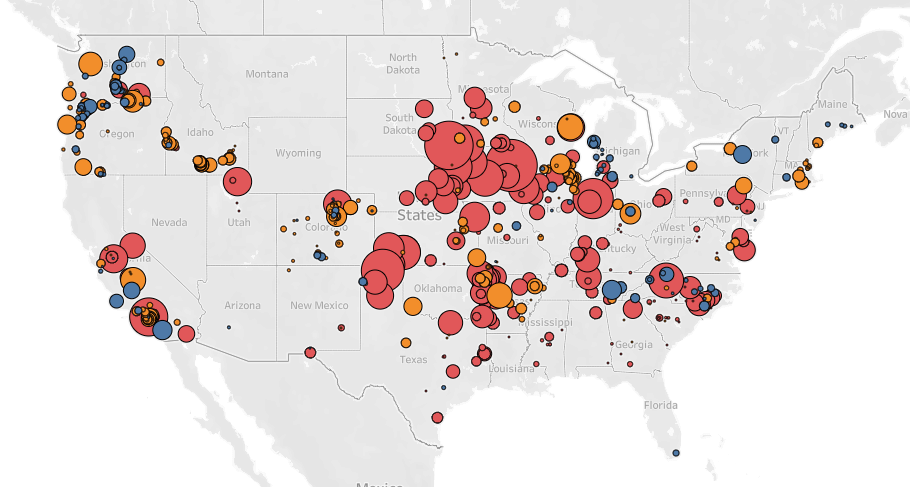
    Screenshot of the COVID-19 food system outbreak map, taken on September 4.

    In April 2020, Leah Douglas started tracking COVID-19 outbreaks at meatpacking plants, food processing facilities, and farms. Douglas is a reporter at the Food & Environment Reporting Network (FERN); she shared her findings through an interactive dashboard on the FERN website while also writing stories to illuminate the numbers.

    On September 2, Douglas announced that the project is shutting down—after counting almost 100,000 COVID-19 cases and 466 deaths among workers in the U.S. food system.

    “Initially, I imagined the project would produce a one-time visualization of the spread of the virus at food manufacturing plants last spring,” Douglas writes in a post announcing the project’s end.  “But it quickly became clear that the scope of worker illness, and the lack of information disclosure from companies and public health authorities, necessitated deeper investigation.”

    Douglas explains that, while the project was challenged from the start by a lack of data from food companies and public health agencies alike, data have become even scarcer in recent months. “There likely hasn’t been another surge like the one witnessed at meatpacking plants in the spring of 2020, but data constraints mean that the true toll of the pandemic on food system workers is unknown,” she says.

    Douglas’ project was cited by major news outlets, appeared on TV shows, used by research organizations, and utilized by policymakers to draw attention to COVID-19 outbreaks in the food system. It was also listed as one of the COVID-19 Data Dispatch’s best COVID-19 data stories of 2020.

    Here at the CDD, we thank Leah Douglas for her months of hard work on this incredibly important issue—and wish her the best in her new position at Reuters.


  • Source shout-out: Centers for Medicare & Medicaid Services

    Source shout-out: Centers for Medicare & Medicaid Services

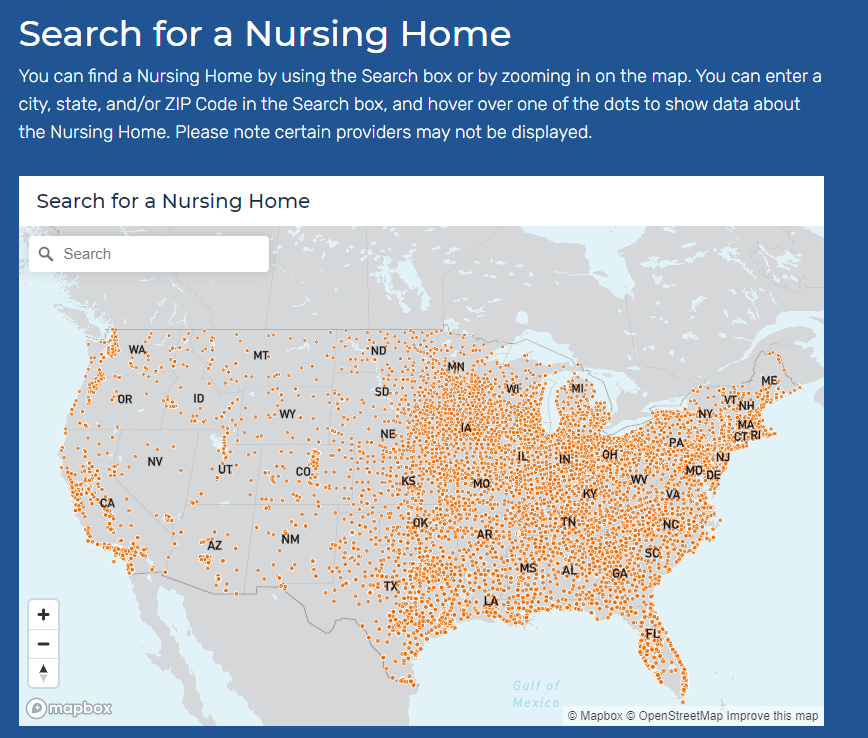
    CMS now allows users to search directly for COVID-19 data on specific nursing homes. Screenshot taken on August 15.

    A recent issue of Al Tompkins’ newsletter led me to check out the Centers for Medicare & Medicaid Services (CMS) COVID-19 data page for the first time in a few months. And it has gotten a serious renovation during that time.

    Among many other responsibilities, CMS oversees the nation’s nursing homes—providing funding, monitoring quality standards, and more. As a result, CMS has tracked COVID-19 cases and deaths in nursing homes throughout the pandemic, along with tracking how well nursing homes adhere to standards such as PPE use and regular testing.

    The agency’s public data COVID-19 in nursing homes used to be displayed as a very basic page with links out to spreadsheet downloads. In fact, back in September 2020, I called out the website for its poor data accessibility, explaining that the site was set up in a manner challenging for screenreaders.

    Now, the site includes a customized data explorer, easy-to-read overarching statistics, and an API that developers can use to readily access nursing home data. Perhaps most useful for the average reader (and for local journalists) is a data visualization section. Users can search an interactive map for nursing homes in their area, then view those facilities’ COVID-19 stats. The section also includes maps displaying nursing home COVID-19 cases, deaths, and vaccinations by state.

    In short, CMS’s COVID-19 data are now both easier to access (from the journalist’s or researcher’s perspective) and easier to explore right on the agency’s website. Thank you, CMS developers!

  • COVID source shout-out: Hawaii schools reporting

    COVID source shout-out: Hawaii schools reporting

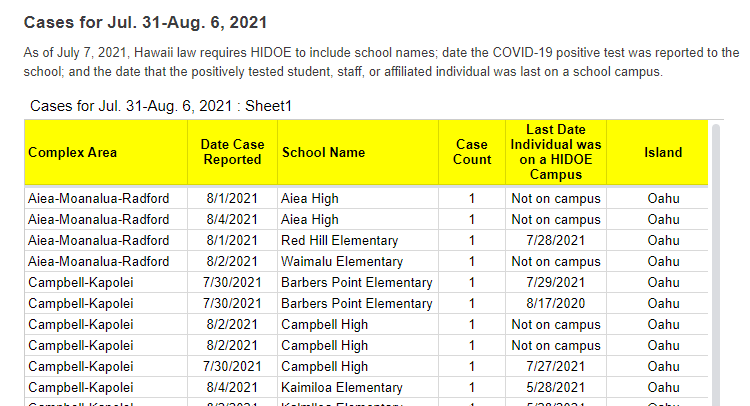
    A snippet of Hawaii’s new-and-improved school COVID-19 case reporting. Screenshot taken on August 8.

    As noted in our “Opening” project intro, many states have paused their school COVID-19 case reporting for the summer—and a few have stopped reporting school cases entirely. Hawaii appears to be an exception: this state actually improved its reporting for the new school year.

    Where the state previously just reported total cases for each island (or county) of Hawaii, it’s now reporting cases by individual school. Hawaii also reports the date a case was reported and the last date that the COVID-positive individual was on campus.

    It’s still not perfect; ideally, Hawaii would also give us in-person enrollment or other numbers to contextualize these cases. But it’s a big improvement, useful for both Hawaii public school families and researchers like yours truly. Thanks Hawaii!

  • COVID source shout-out: Transparency in Utah

    COVID source shout-out: Transparency in Utah

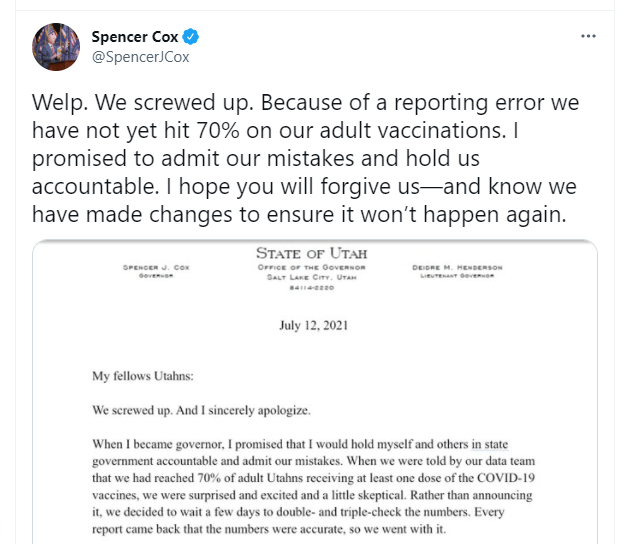
    Utah hasn’t hit 70% adult vaccinations yet—but a recent data error led state officials to erroneously announce the benchmark had been hit. Spencer Cox, Utah’s governor, posted an apology on Twitter that drew attention for his commitment to transparency and accountability.

    “My fellow Utahns,” the statement opens, “We screwed up. And I sincerely apologize.” Cox goes on to explain the data error, affirm the state health agency’s commitment to accurate numbers, and emphasize the need for easily-accessible vaccinations.

    The data error arose from the challenge of matching state and federal data. In Utah, like in every other state, a small number of vaccine doses are administered under the federal government’s purview via the federal-pharmacy chain partnership, the Department of Defense, Indian Health Services, and other agencies. When Utah officials added the federal doses to state numbers, they initially found that 70% of adults had received at least one shot—the true number is just over 67%, Cox said. 

    Also, while poking around Utah’s COVID-19 website to better understand the data error, I found that the state has some great vaccine promotions going. These include the option to request a free mobile vaccination clinic in your community and this truly incredible “Vaccine Mythbusters” video. With the help of these initiatives, Utah is sure to hit 70% soon.