Tag: CDC

  • Federal data updates, Nov. 22

    America’s federal public health agencies are busy in the lead-up to Thanksgiving, as are the researchers and volunteer networks filling those agencies’ information gaps. Here are three major updates:

    • CDC’s COVID Data Tracker now reports more county-level data: Since it was first published in the spring, the CDC’s COVID-19 data dashboard has included cases and deaths by U.S. county, relying upon data compiled by USA Facts and verified by the agency. As of yesterday, the county dashboard now also reports total PCR tests and test positivity. Testing data have previously been available directly from the HHS (state-level) and the Center for Medicare & Medicaid Services (county-level), but the CDC dashboard is far more accessible. Users can select a specific county and see a variety of trends in cases, tests, and deaths. The data from this dashboard aren’t yet available for download; I’ll report back if this changes.
    • Pharmacies will be able to distribute COVID-19 vaccinesLast week, the HHS announced that the agency has set up partnerships with both national pharmacy chains and networks representing smaller pharmacies in order to broadly distribute COVID-19 vaccines as they become available. (Pfizer applied for Emergency Use Authorization this past Friday.) According to the HHS, these partnerships cover “approximately 60 percent of pharmacies throughout the 50 states, the District of Columbia, Puerto Rico, and the U.S. Virgin Islands.” The press release does not mention how these pharmacies will be plugged into their respective state vaccine registries.
    • How state COVID-19 dashboards are faringAlthough many states are reporting more COVID-19 data than they were last spring, their dashboards are overall still not conveying some key metrics, according to a new report from Resolve to Save Lives. This research group, a nongovernmental initiative run by the global health organization Vital Strategies, first reviewed state dashboards in July. (See my first issue for more details.) The new report—along with an interactive map—reflects improvements that states have made since the summer while highlighting what crucial public health information is still missing. Case investigation and contact tracing are two key areas where “data… remained largely unavailable.”
  • CDC’s failure to resist political takeover

    This past week, two outlets published major investigations of the Centers for Disease Control & Prevention (CDC). The first story, by Science’s Charles Piller, focuses on White House Coronavirus Task Force Coordinator Dr. Deborah Birx and her role in the hospitalization data switch from the CDC to the Department of Health and Human Services (HHS). The second story, by ProPublica’s James Bandler, Patricia Callahan, Sebastian Rotella, and Kristen Berg, provides a broader view of internal CDC dynamics and challenges since the start of the pandemic.

    These stories do not focus on data specifically, but I wanted to foreground them this week as crucial insights into how the work of science and public health experts is endangered when powerful leaders prioritize their own narratives. Both stories describe how Dr. Birx disrespected and overrode CDC experts. She wanted data from every hospital in the country, every day, and failed to understand why the CDC could not deliver. The ProPublica story quotes an anonymous CDC scientist:

    Birx expected “every hospital to report every piece of data every day, which is in complete defiance of statistics,” a CDC data scientist said. “We have 60% [of hospitals] reporting, which was certainly good enough for us to have reliable estimates. If we got to 80%, even better. A hundred percent is unnecessary, unrealistic, but that’s part of Birx’s dogma.”

    As I explained in this newsletter’s very first issue, in July, the CDC’s hospital data reporting system was undercut in favor of a new system, built by the software company TeleTracking and managed by the HHS. Hospitals were told to stop reporting to the CDC’s system and start using TeleTracking instead. The two features published this week tie that data switch inexorably to Dr. Birx’s frustration with the CDC and her demand for more frequent data at any cost.

    Public health experts across the country worried that already-overworked hospital staff would face significant challenges in switching to a new data system, from navigating bureaucracy to, in some cases, manually entering numbers into a form with 91 categories. Initial data reported by the new HHS system in July were fraught with errors—such as a report of 118% hospital beds occupied in Rhode Island—and inconsistencies when compared to the hospital data reported out by state public health departments. I co-wrote an analysis of these issues for the COVID Tracking Project.

    But at least, I thought at the time, the HHS system was getting more complete data. The HHS system quickly increased the number of hospitals reporting to the federal government by about 1,500, and by October 6, Dr. Birx bragged at a press briefing that 98% of hospitals were reporting at least weekly. As Piller’s story in Science describes, however, such claims fail to mention that the bar for a hospital to be included in that 98% is very low:

    At a 6 October press briefing, Birx said 98% of hospitals were reporting at least weekly and 86% daily. In its reply to Science, HHS pegged the daily number at 95%. To achieve that, the bar for “compliance” was set very low, as a single data item during the prior week. A 23 September CDC report, obtained by Science, shows that as of that date only about 24% of hospitals reported all requested data, including protective equipment supplies in hand. In five states or territories, not a single hospital provided complete data.

    Piller goes on to describe how HHS’s TeleTracking data system allows errors—such as typos entered by overworked hospital staff—to “flow into [the] system” and then (theoretically) be fixed later. This method further makes HHS’s data untrustworthy for the public health researchers using it to track the pandemic. The agency is working on improvements, certainly, and public callouts of the hospital capacity numbers have slowed since TeleTracking’s rollout in July. Still, the initial political media storm created by this hospitalization data switch, combined with the details about the switch revealed by these two new features, has led me to be much warier of future data releases by both the HHS and the CDC than I was before 2020.

    Just as the White House boasted, “Our staffers get tested every day,” in response to critiques of President Trump’s flaunting of public health measures, the head of the White House Coronavirus Task Force wanted to boast, “We collect data every day,” in response to critiques of the country’s overburdened healthcare system. But testing and collecting data should both be only small parts of the national response to COVID-19. When scientists see their expertise ignored in favor of recommendations that will fit a chosen political narrative, public trust is lost in the very institutions they represent. And rebuilding that trust will take a long time.

  • Issue #10: reflecting and looking forward

    Issue #10: reflecting and looking forward

    Candid of me reading Hank Green’s new book (very good), beneath some fall foliage. It sure is great to go outside!

    I like to answer questions. I’m pretty good at explaining complicated topics, and when I don’t know the answer to something, I can help someone find it. These days, that tendency manifests in everyday conversations, whether it’s with my friend from high school or a Brooklyn dad whose campsite shares a firepit with my Airbnb. I make sure the person I’m talking to knows that I’m a science journalist, and I invite them to ask me their COVID-19 questions. I do my best to be clear about where I have expertise and where I don’t, and I try to point them to sources that will fill in my gaps.

    I want this newsletter to feel like one of those conversations. I started it when hospitalization data switched from the auspices of the Centers for Disease Control and Prevention (CDC) to the Department of Health and Human Services (HHS), and I realized how intensely political agendas were twisting public understanding of data in this pandemic. I wanted to answer my friends’ and family members’ questions, and I wanted to do it in a way that could also become a resource for other journalists.

    This is the newsletter’s tenth week. As I took a couple of days off to unplug, it seemed a fitting time to reflect on the project’s goals and on how I’d like to move forward.

    What should data reporting look like in a pandemic?

    This is a question I got over the weekend. How, exactly, have the CDC and the HHS failed in their data reporting since the novel coronavirus hit America back in January?

    The most important quality for a data source is transparency. Any figure will only be a one-dimensional reflection of reality; it’s impossible for figures to be fully accurate. But it is possible for sources to make public all of the decisions leading to those figures. Where did you get the data?  Whom did you survey?  Whom didn’t you survey?  What program did you use to compile the data, to clean it, to analyze it?  How did you decide which numbers to make public?  What equations did you use to arrive at your averages, your trendlines, your predictions?  And so on and so forth. Reliable data sources make information public, they make representatives of the analysis team available for questions, and they make announcements when a mistake has been identified.

    Transparency is especially important for COVID-19 data, as infection numbers drive everything from which states’ residents are required to quarantine for two weeks when they travel, to how many ICU beds at a local hospital must be ready for patients. Journalists like me need to know what data the government is using to make decisions and where those numbers are coming from so that we can hold the government accountable; but beyond that, readers like you need to know exactly what is happening in your communities and how you can mitigate your own personal risk levels.

    In my ideal data reporting scenario, representatives from the CDC or another HHS agency would be extremely public about all the COVID-19 data they’re collecting. It would publish these data in a public portal, yes, but this would be the bare minimum. This agency would publish a detailed methodology explaining how data are collected from labs, hospitals, and other clinical sites, and it would publish a detailed data dictionary written in easily accessible language.

    And, most importantly, the agency would hold regular public briefings. I’m envisioning something like Governor Cuomo’s PowerPoints, but led by the actual public health experts, and with substantial time for Q&A. Agency staff should also be available to answer questions from the public and direct them to resources, such as the CDC’s pages on childcare during COVID-19 or their local registry of test sites. Finally, it should go without saying that, in my ideal scenario, every state and local government would follow the same definitions and methodology for reporting data.

    Why am I doing this newsletter?

    The CDC now publishes a national dataset of COVID-19 cases and deaths, and the HHS publishes a national dataset of PCR tests. Did you know about them?  Have you seen any public briefings led by health experts about these data?  Even as I wrote up this description, I realized how deeply our federal government has failed at even the basics of data transparency.

    Neither the CDC nor HHS even published any testing data until MayMeanwhile, state and local public health agencies are largely left to their own devices, with some common definitions but few widely enforced standards. Florida publishes massive PDF reports, which fail to include the details of their calculations. Texas dropped a significant number of tests in August without clear explanation. Many states fail to report antigen test counts, leaving us with a black hole in national testing data.

    Research efforts and volunteer projects, such as Johns Hopkins’ COVID-19 Tracker and the COVID Tracking Project, have stepped in to fill the gap left by federal public health agencies. The COVID Tracking Project, for example, puts out daily tweets and weekly blog posts reporting on the state of COVID-19 in the U.S. I’m proud to be a small part of this vital communication effort, but I have to acknowledge that the Project does a tiny fraction of the work that an agency like the CDC would be able to mount.

    Personally, I feel a responsibility to learn everything I can about COVID-19 data, and share it with an audience that can help hold me accountable to my work. So, there it is: this newsletter exists to fill a communication gap. I want to tell you what state and federal agencies are doing—or aren’t doing—to provide data on how COVID-19 is impacting Americans. And I want to help you attain some data literacy along the way. I don’t have fancy PowerPoints like Cuomo or fancy graphics like the COVID Tracking Project (though my Tableau skills are improving!). But I can ask questions, and I can answer them. I hope you’re reading this because you find that useful, and I hope this project can become more useful as it grows.

    What’s next?

    America is moving into what may be a long winter, with schools open and the seasonal flu incoming. (If you haven’t yet, this is your reminder: get your flu shot!)  I’m in no position to hypothesize about second waves or vaccine deployment, but I do believe this pandemic will not go away any time soon.

    With that in mind, I’d like to settle in this newsletter for the long haul. And I can’t do it alone. In the coming months, I want this project to become more reader-focused. Here are a couple of ideas I have about how to make that happen; please reach out if you have others!

    • Reader-driven topics: Thus far, the subjects of this newsletter have been driven by whatever I am excited and/or angry about in a given week. I would like to broaden this to also include news items, data sources, and other topics that come from you.
    • Answering your questions: Is there a COVID-19 metric that you’ve seen in news articles, but aren’t sure you understand?  Is there a data collection process that you’d like to know more about?  Is there a seemingly-simple thing about the virus that you’ve been afraid to ask anywhere else?  Send me your COVID-19 questions, data or otherwise, and I will do my best to answer.
    • Collecting data sources: In the first nine weeks of this project, I’ve featured a lot of data sources, and the number will only grow as I continue. It might be helpful if I put all those sources together into one public spreadsheet to make a master resource, huh?  (I am a little embarrassed that I didn’t think of this one sooner.)  I’ll work on this spreadsheet, and share it with you all next week.
    • Events??  One of my goals with this project is data literacy, and I’d like to make that work a little more hands-on. I’m thinking about potential online workshops and collaborations with other organizations. I’m also looking into potential funding options for such events; there will hopefully be more news to come on this front in the coming weeks.
  • The vaccines are coming

    The vaccines are coming

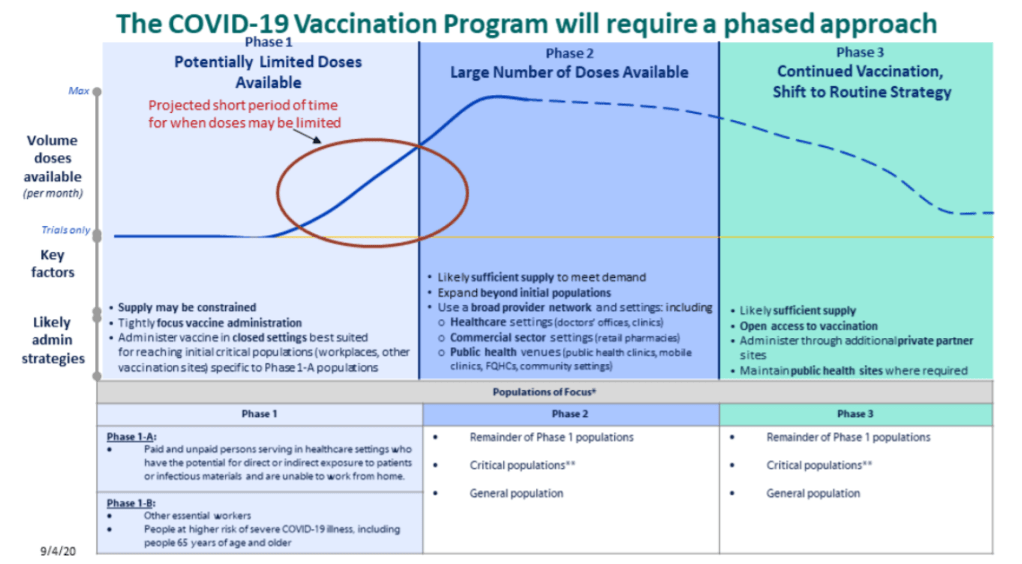
    Graphic of questionable quality via the CDC’s COVID-19 Vaccination Program Interim Playbook.

    If the title of this week’s newsletter sounds ominous, that’s because this situation feels ominous. While many scientific experts have pushed back against President Trump’s claims that a vaccine for the novel coronavirus will be available this October, state public health agencies have been instructed to prepare for vaccine distribution starting in November or December.

    Of course, the possibility of a COVID-19 vaccine before the end of 2020 is promising. The sooner healthcare workers and other essential workers can be inoculated, the better protected our healthcare system will be against future outbreaks. (And eventually, maybe, regular people like me will be able to attend concerts and fly out of the country again.) But considering the Center for Disease Control and Prevention (CDC)’s many missteps in both distributing and tracking COVID-19 tests this spring, I have a wealth of concerns about this federal agency’s ability to implement a national vaccination program.

    I’m far from the only person thinking about this. The release of the CDC’s interim playbook for vaccine distribution this past Wednesday, along with President Trump’s public contradiction of the vaccination timeline described by CDC Director Dr. Robert Redfield, has sparked conversations on whether America could have a vaccine ready this fall and, if we do, what it would take to safely distribute this technology to the people who need it most.

    In this issue, I will offer my takeaways on what the CDC’s playbook means for COVID-19 vaccination data, and a few key elements that I would like to see prioritized when public health agencies begin reporting on vaccinations.

    Data takeaways from the CDC playbook

    I’m not going to try to summarize the whole playbook here, because a. other journalists have already done a great job of this, and b. it would take up the whole newsletter. Here, I’m focusing specifically on what the CDC has told us about what vaccination data will be collected and how they will be reported.

    • We do not yet know which vaccines will be available, nor do we know vaccine volumes, timing, efficacy, or storage and handling requirements. It seems clear, however, that we should prepare for not just one COVID-19 vaccine but several, used in conjunction based on which vaccines are most readily available for a particular jurisdiction.
    • Vaccination will occur in three stages (as pictured in the above graphic). First, limited doses will go to critical populations, such as healthcare workers, other essential workers, and the medically vulnerable. Second, more doses will go to the remainder of those critical populations, and vaccine availability will open up to the general public. Finally, anyone who wants a vaccine will be able to get one.
    • “Critical populations,” as described by the CDC, basically include all groups who have been demonstrably more vulnerable to either contracting the virus or having a more severe case of COVID-19. The list ranges from healthcare workers, to racial and ethnic minorities, to long-term care facility residents, to people experiencing homelessness, to people who are under- or uninsured.
    • The vaccine will be free to all recipients.
    • Vaccine providers will include hospitals and pharmacies in the first phase, then should be expanded to clinics, workplaces, schools, community organizations, congregate living facilities, and more.
    • Most of the COVID-19 vaccines that may come on the market will require two doses, separated by 21 or 28 days. For each recipient, both doses will need to come from the same manufacturer.
    • Along with the vaccines themselves, the CDC will send supply kits to vaccine providers. The kits will include medical equipment, PPE, and—most notably for me—vaccination report cards. Medical staff are instructed to fill out these cards with a patient’s vaccine manufacturer, the date of their first dose, and the date by which they will need to complete their second dose. Staff and data systems should be prepared for patients to receive their two doses at two different locations.
    • All vaccine providers will be required to report data to the CDC on a daily basis. When someone gets a vaccine, their information will need to be reported within 24 hours. Reports will go to the CDC’s Immunization Information System (IIS).
    • The CDC has a long list of data fields that must be reported for every vaccination patient. You can read the full list here; I was glad to see that demographic fields such as race, ethnicity, and gender are included.
    • The CDC has set up a data transferring system, called the Immunization Gateway (or IZ Gateway), which vaccine providers can use to send their daily data reports. Can is the operative word here; as long as providers are sending in daily reports, they are permitted to use other systems. (Context: the IZ Gateway is an all-new system which some local public health agencies see as redundant to their existing vaccine trackers, POLITICO reported earlier this week.)
    • One resource linked in the playbook is a Data Quality Blueprint for immunization information systems. The blueprint prioritizes making vaccination information available, complete, valid, and timely.
    • Vaccine providers are also required to report “adverse events following immunization” or poor patient outcomes that occur after a vaccine is administered. These outcomes can be directly connected to the vaccine or unrelated; tracking them helps vaccine manufacturers detect new adverse consequences and keep an eye on existing side effects. Vaccine providers are required to report these adverse events to the Vaccine Adverse Event Reporting System (VAERS), which, for some reason, is separate from the CDC’s primary IIS.
    • Once COVID-19 vaccination begins, the CDC will report national vaccination data on a dashboard similar to the agency’s existing flu vaccination dashboard. According to the playbook, this dashboard will include estimates of the critical populations that will be prioritized for vaccination, locations of CDC-approved vaccine providers and their available supplies, and counts of how many vaccines have been administered.

    I have to clarify, though: all of the guidelines set up in the CDC’s playbook reflect what should happen when vaccines are implemented. It remains to be seen whether already underfunded and understaffed public health agencies, hospitals, and health clinics will be able to store, handle, and distribute multiple vaccine types at once, to say nothing of adapting to another new federal data system.

    My COVID-19 vaccination data wishlist

    This second section is inspired by an opinion piece in STAT, in which physicians and public health experts Luciana Borio and Jesse L. Goodman outline three necessary conditions for effective vaccine distribution. They argue that confidence around FDA decisions, robust safety monitoring, and equitable distribution of vaccines are all key to getting this country inoculated.

    The piece got me thinking: what would be my necessary conditions for effective vaccine data reporting? Here’s what I came up with; it amounts to a wishlist for available data at the federal, state, and local levels.

    • Unified data definitions, established well before the first reported vaccination. Counts of people who are now inoculated should be reported in the same way in every state, county, and city. Counts of people who have received only one dose, as well as those who have experienced adverse effects, should similarly be reported consistently.
    • No lumping of different vaccine types. Several vaccines will likely come on the market around the same time, and each one will have its own storage needs, procedures, and potential effects. While cumulative counts of how many people in a community have been vaccinated may be useful to track overall inoculation, it will be important for public health researchers and reporters to see exactly which vaccine types are being used where, and in what quantities.
    • Demographic data. When the COVID Racial Data Tracker began collecting data in April, only 10 states were reporting some form of COVID-19 race and ethnicity data. North Dakota, the last state to begin reporting such data, did not do so until August. Now that the scale of COVID-19’s disproportionate impact on racial and ethnic minorities is well documented, such a delay in demographic data reporting for vaccination would be unacceptable. The CDC and local public health agencies will reportedly prioritize minority communities in vaccination, and they must report demographic data so that reporters like myself can hold them accountable to that priority.
    • Vaccination counts for congregate facilities. The CDC specifically acknowledges that congregate facilities, from nursing homes to university dorms to homeless shelters, must be vaccination priorities. Just as we need demographic data to keep track of how minority communities are receiving vaccines, we need data on congregate facilities. And such data should be consistently reported from the first phase of vaccination, not added to dashboards sporadically and unevenly, as data on long-term care facilities have been reported so far.
    • Easily accessible resources on where to get vaccinated. The CDC’s vaccination dashboard will reportedly include locations of CDC-approved vaccine providers. But will it include each provider’s open hours? Whether the provider requires advance appointments or allows walk-ins? Whether the provider has bilingual staff? How many vaccines are available daily or weekly at the site? To be complete, a database of vaccine providers needs to answer all the questions that an average American would have about the vaccination experience. And such a database needs to be publicized widely, from Dr. Redfield all the way to local mayors and school principals.
  • No, hospitalization data isn’t switching back to the CDC

    I mean, it is. But not right now. Or is it?

    Last Thursday, the Wall Street Journal published an article headlined, “Troubled COVID-19 Data System Returning to CDC.” At first glance, the article reports that the tracking of COVID-19 hospitalization data is returning to the CDC’s charge after numerous concerns were raised about data accuracy and integrity under Department of Health and Human Services (HHS) control.

    Readers, I cannot lie: when I first saw this headline, I lay down on the floor of my apartment and cursed for several minutes. Why would they change it back, I thought. The HHS is already collecting data from more hospitals than the CDC did. It made sense with remdisivir distribution. Why make everyone go through another system switch.

    And then I got up, sent some incredulous messages in the COVID Tracking Project Slack server, and actually read the full article. What is actually happening, according to WSJ reporter Robbie Whelam, is this: the CDC is developing a new data system which will be more efficient for both hospitals and data users. After the new system is complete, the CDC will once again collect and report hospitalization data.

    “CDC is working with us right now to build a revolutionary new data system so it can be moved back to the CDC, and they can have that regular accountability with hospitals relevant to treatment and PPE,” Dr. Birx said, referring to personal protective equipment used by doctors and nurses.

    The article, however, fails to report any meaningful details about this new CDC data system. What is the proposed timeline for the system? What makes it “revolutionary?” Who is developing it? What new metrics will it collect? How will it address challenges that hospitals with fewer staff or lower technological capacity currently face in making daily reports? I could go on, but you get the idea.

    Also, there’s this insight, from POLITICO reporter Dan Diamond:

    Within a few hours, the WSJ had changed their headline to “COVID-19 Data Will Once Again Be Collected by CDC, in Policy Reversal.”

    It continues to be unclear when or how the HHS-back-to-CDC hospitalization data switch will occur, if it does occur. As COVID-19 Tracking Project lead Erin Kissane points out, federal IT development happens very slowly. It will likely be months before definitive information is available on the CDC’s new database.

    Meanwhile, the HHS is proceeding with its own new data system effort: an overhaul called the Modernizing Public Health Reporting and Surveillance projectPOLITICO reported this past Wednesday. The project plans to improve data technology and data quality at state and local public health departments over the next several years. It’s an ambitious initiative, considering that HHS is still working on fixing its hospital reporting:

    HHS says that 85 percent of the nation’s hospitals report daily — a mark that is improving, and that includes more metrics the government uses to allocate scarce resources during the pandemic, like the drug remdesivir. But federal officials say they receive only half of the required clinical information on average, a gap that could distort the scope of the pandemic and obscure who’s getting sick where.

    I may be optimistic, but I’m hoping that at least one of these new data systems will be ready to go before the next pandemic hits.

  • “Is Dr. Anthony Fauci on Cameo?”

    “Is Dr. Anthony Fauci on Cameo?”

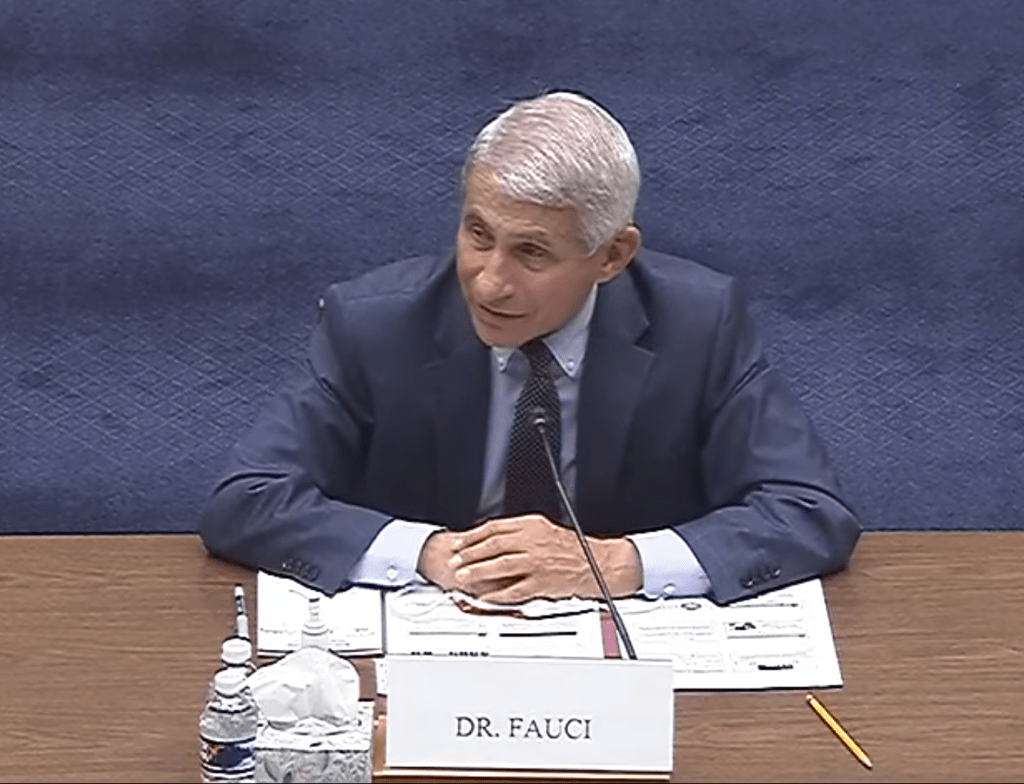
    NIAID Director Dr. Anthony Fauci testifies before House Select Subcommittee on the Coronavirus Crisis on July 31. Screenshot retrieved from the hearing’s livestream.

    In the most recent episode of comedy podcast My Brother, My Brother and Me (approx. timestamp 23:50), youngest brother Griffin McElroy solemnly asks, “Is Dr. Anthony Fauci on Cameo?”

    McElroy’s question, asked in the context of a rather silly and unscientific discussion on contaminated basketballs, refers to a video-sharing service in which fans can pay celebrities to send personalized messages. Dr. Fauci is, of course, not on Cameo. But he did make a public appearance this past Friday: he testified before the House Subcommittee on the Coronavirus Crisis. This was Dr. Fauci’s first Congressional appearance in several weeks; Democrats have claimed that the White House blocked him from testifying earlier in the summer.

    Dr. Fauci was joined on the witness stand by Centers for Disease Control and Prevention (CDC) Director Dr. Robert Redfield and Assistant Secretary for Health Admiral Brett Giroir, who leads policy development at the Department of Health and Human Services (HHS). All three witnesses answered questions about their respective departments, covering COVID-19-related topics from test wait times to the public health implications of Black Lives Matter protests.

    For comprehensive coverage of the hearing, you can read my Tweet thread for Stacker:

    But here, I will focus on five major takeaways for the COVID-19 data world.

    First: the results of scientific studies on the pandemic are publicly shared. In his opening statement, Dr. Fauci cited four top priorities for the National Institute of Allergy and Infectious Diseases (NIAID): improving scientific knowledge of how the novel coronavirus works, developing tests that can diagnose the disease, characterizing and testing methods of treating patients, and developing and testing vaccines. The Congressmembers on the House subcommittee were particularly interested in this last priority; Dr. Fauci reassured several legislators that taking vaccine development at “warp speed” will not come at the cost of safety.

    Rep. Jackie Walorski, a Republican from Indiana, was especially concerned about Chinese interference in vaccine development. She repeatedly asked Dr. Fauci if he believed China was “hacking” American vaccine research, and if he believed this was a threat to the progress of such work. Dr. Fauci replied that all clinical results from NIAID work are shared publicly through the usual scientific process, to invite feedback from the greater medical community.

    Clinical studies in particular are listed in a National Institutes of Health (NIH) database called ClinicalTrials.gov. On this site, any user can easily search for studies relating to COVID-19; there are2,844 listed at the time I send this newsletter256 of these studies are marked as “completed,” and two of those have results posted. I see no reason to doubt that, if Rep. Walorski were to visit this database in the coming months, she would find the results of vaccine trials here as well.

    Dr. Fauci also publicized the COVID-19 Prevention Network, a website on which Americans can volunteer for vaccine trials. According to Dr. Fauci, 250,000 individuals had registered by the time of the hearing.

    Second: nursing homes are getting COVID-19 antigen tests, big time. Dr. Redfield, Admiral Giroir, and several of the House representatives at the hearing highlighted a recent initiative by HHS to distribute rapid diagnostic COVID-19 tests to nursing homes in hotspot areas. In his opening remarks, Dr. Redfield stated that, by the end of this week, federal health agencies will have delivered “nearly one million point-of-care test kits to 1,019 of the highest risk nursing homes, with 664 nursing homes scheduled for next week.”

    The tests being distributed identify antigens, protein fragments on the surface of the novel coronavirus. Like polymerase chain reaction (PCR) tests, antigen tests determine if a patient is infected at the time they are tested; unlike PCR tests, they may be produced and distributed cheaply, and return results in minutes. Antigen tests have lower sensitivity, however, meaning that they may miss identifying patients who are in fact infected.

    The antigen test distribution initiative is great news for the nursing homes across the country that will be able to test and treat their residents more quickly. But from a data perspective, it poses one major question: how will the results of these tests be reported? While antigen tests may be diagnostic, their results should not be lumped in with PCR test results because they have a different accuracy level and serve a different purpose in the pandemic.

    The Nursing Home COVID-19 Public File, a national dataset run by the Center for Medicare and Medicaid Services, reports “confirmed” and “suspected” COVID-19 cases in the nation’s nursing homes. The dataset does not specify what types of tests were used to identify these cases, or the total tests conducted in each home. Similarly, state-reported datasets on COVID-19 in nursing homes typically report only cases and deaths, not testing numbers. And, as of the most recent COVID Tracking Project analysis, the only state currently reporting antigen tests in an official capacity is Kentucky. But more states may be including antigen test numbers in their counts of “confirmed cases” or “molecular tests,” as several states lumped PCR and serology tests this past spring. As hundreds of nursing homes across the country begin to use the antigen tests so graciously distributed by the federal government, we must carefully watch to identify where those numbers show up.

    Third: Admiral Giroir doesn’t know what data his agency publishes.

    If you watch just five minutes from Friday’s hearing, I highly recommend the five minutes in which Rep. Nydia Velázquez (a Democrat from New York) interrogates Admiral Giroir about COVID-19 test wait times. Here’s my transcript of a key moment in the conversation:

    Rep. Velázquez: Dr. Redfield, I’d like to turn to you. Does the CDC have comprehensive information about the wait times for test results in all 50 states?

    Dr. Redfield: I would refer that question back to the Admiral.

    Rep. Velázquez: Sir?

    Admiral Giroir: Yes, we have comprehensive information on wait times in all 50 states, from the large, commercial labs.

    Rep. Velázquez: And do you publish this data? These data?

    Admiral Giroir: Uh… we talk about it. Always. I mean, I was on… I was with 69 journalists yesterday, and we talk about that frequently.

    He went on to claim that decisionmakers at the state and city level have data on test wait times from commercial labs. But where are these data? HHS has collected testing data since the beginning of the pandemic; these data were first published on a CDC dashboard in early May and are now available on HealthData.gov.

    The HealthData.gov dataset includes test results from CDC labs, commercial labs, state public health labs, and in-house hospital labs. For each test, the dataset includes geographic information, a date, and the test’s outcome. It does not include the time between the test being administered and its results being reported to the patient. In fact, that “date” can either be a. the date the test was completed, b. the date the result was reported, c. the date the specimen was collected, d. the date the test arrived at a testing facility, or e. the date the test was ordered. So, if there’s another, secret dataset which includes more precise dating, I personally would love to see it made public.

    Also, who are those 69 journalists, Admiral Giroir? How do I join those ranks? I have some questions about HHS hospitalization data.

    Fourth: everyone wants to reopen schools. Dr. Redfield said, opening schools is “in the best public health interest of K-12 students.” Dr. Fauci said, schools should reopen so that schools can access health services, teachers can identify instances of child abuse, and to avoid “downstream unintended consequences for families.” Rep. Steve Scalise, the subcommittee’s Ranking Member (and a Republican from Louisiana, home to one of the country’s most annoying COVID-19 dashboards), said, “Don’t deny these children the right to seek the American dream that everybody else has deserved over the history of our country.” Rep. James Clyburn, the subcommittee’s Chair (a Democrat from South Carolina), said that school reopening must not be a “one size fits all approach,” but it should be done for the good of students and their families.

    Clearly, reopening schools is a popular political opinion. But does the country have the data we need to determine if schools can reopen safely? Reopening, as Dr. Fauci explained in response to an early question from Rep. Clyburn, is most safely done when COVID-19 is no longer circulating widely in a community. School districts can determine whether the disease is circulating widely through looking at case counts over time, but for those case counts to be accurate, the region must be doing enough testing and contact tracing to catch all cases.

    And testing data, while they are certainly collected at the county and zip code levels by local public health departments, are not standardized at all. HHS doesn’t publish county-level testing data. Nor does the COVID Tracking Project. This lack of standardization for any geographic region smaller than a state is troubling, as public health leaders and journalists alike cannot currently assess the scope of local outbreaks with any kind of broad comparison. To put it simply: I would love to do a story on how many school districts can safely reopen right now, based on their case counts and test metrics. But the data I would need to do this story do not exist.

    Fifth: all data are political; COVID-19 data are especially political. I know, I know. Data have been political since humans started collecting them. One of America’s most comprehensive data sources, the U.S. Census, started as a way to enforce the Three-Fifths Compromise.

    But watching this Friday’s hearing hammered home for me how the mountains of data produced by this pandemic, coupled with the complete lack of standards across the institutions producing them, has made it particularly easy for politicians to quote random numbers out of context in order to advance their agendas. Rep. Clyburn said, “At least 11 states… are currently performing less than 30% of the tests they need to control the virus.” (Which states? How many tests do they need to perform? Where di that benchmark come from? What other metrics should the states be following?) And, on the other side of the aisle, Rep. Scalise held up a massive stack of paper and waved it right at the camera, claiming that the high number of tests that have been conducted in this country is evidence of President Trump’s national plan. (But how many tests have we conducted per capita? What are the positivity rates? What statistics can we actually correlate to President Trump’s plan?)

    In fact, after the hearing, the White House put out a press release claiming that America has “the best COVID-19 testing system in the world.” The briefing includes such claims as, “the U.S. has already conducted more than 59 million tests,” and, “the Federal Government has distributed more than 44 million swabs and 36 million tubes of media to all 50 States.” None of the statistics in the briefing are put into terms reflecting how many people have actually been tested, compared to the country’s total population. And none of the statistics are contextualized with public health information on what targets we should be meeting to control the pandemic.

    The experts who might have been consulted on that brief—Dr. Fauci, Dr. Redfield, and Admiral Giroir—all sat before Congressional Representatives on Friday morning, quietly nodding when Representatives asked if their respective departments were doing everything possible to protect America. If they had answered otherwise, they may not have returned for future hearings. The whole thing felt very performative to me: the Democrats threw veiled jibes at President Trump, the Republicans bemoaned China and Black Lives Matter protests, and Dr. Fauci fact-checked such basic statements as, “Children are not immune to COVID-19.”

    And almost everyone in the room—including all three witnesses—removed their mask when they spoke.

    If Dr. Fauci were available to commission on the video service Cameo, I would pay him good money to send a personal message to every Congressmember on that subcommittee telling them, confidentially, exactly what he thinks of their questions. And then I would ask him for Admiral Giroir’s personal cell phone number.

  • Hospital capacity dataset gets a makeover

    Hospital capacity dataset gets a makeover

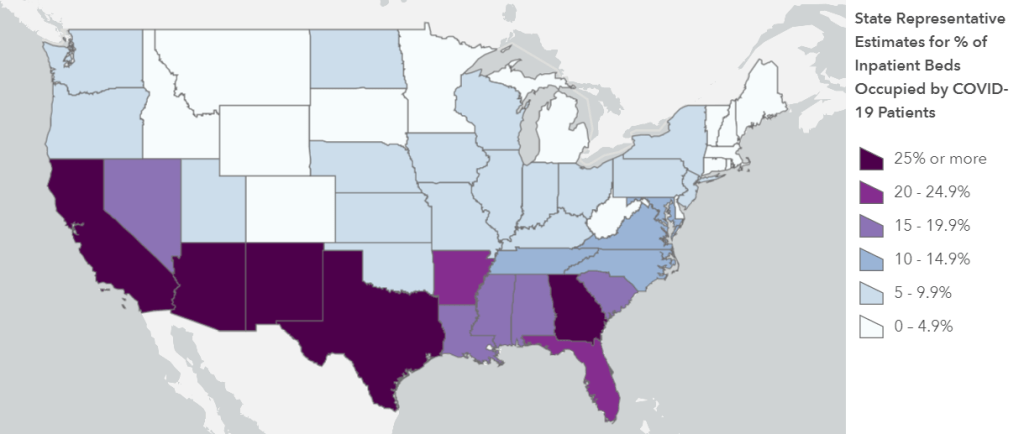
    Screenshot retrieved from the HHS Protect Public Data Hub on July 26, 2020.

    On July 14, the White House announced that hospitals across America would no longer report their COVID-19 patient numbers and supply needs to the Centers for Disease Control and Prevention (CDC). Instead, they would report numbers through a data portal set up in April by the Department of Health & Human Services (HHS). A July 10 guidance issued by HHS requests that hospitals send reports on how many overall patients they have, how many COVID-19 patients they have, the status of those patients, and their needs for crucial supplies such as PPE and remdesivir.

    In some ways, this switch actually makes sense: HHS’ data portal, built by a contractor called TeleTracking, is designed specifically to support more efficient data collection during COVID-19. HHS was already collecting hospitalization data second-hand through state reports, some hospital-to-HHS reports, and the CDC’s old system, called the National Healthcare Safety Network; the new system is more streamlined at the federal level. HHS is also the primary federal entity collecting data on COVID-19 lab test results, through reports that go directly from laboratories to HHS (often bypassing local and state public health departments).

    Simplifying data collection to one office—just HHS, rather than HHS and CDC—should theoretically make it easier for hospitals to report their needs and receive aid from the federal governmentquickly. But switching systems during the middle of a pandemic is dangerous. Switching systems during a COVID-19 surge in the Sun Belt when hospitals are being pushed to their full capacity is especially dangerous. Hospital databases, once set up to report to the CDC, must be reconfigured—or worse, exhausted healthcare workers must manually enter their numbers into the new system.

    STAT News’ Nicholas Florko and Eric Boodman explore this issue in more detail, but here is one quote from John Auerbach, president and CEO of Trust for America’s Health, which summarizes the problem:

    Hospitals are incredibly varied across the country in terms of their capacity to report data in a timely and accurate way. If you’re going to say every hospital, regardless of its size, its resources, its capacity, has to learn a new system quickly, it’s problematic.

    It is inevitable that, for the first few weeks of this new system, any hospital capacity data reported by HHS will be rife with errors. And yet, public health leaders, researchers, and people simply living in Texas and Florida need to know how their hospitals are doing right now, so HHS has published the results of their new reporting system only a week after the ownership shift. The new website HHS built to publish these data, called the HHS Protect Public Data Hub, went live this past Monday, July 20. (Veteran users noted that this page copied the homework of the dataset’s former home on the CDC website—same color scheme and everything.)

    As I send this newsletter, the HHS Protect dataset was most recently updated on Thursday, July 23 with data as of the previous day. Experts looking at these data, including my fellow volunteers at the COVID Tracking Project, quickly noticed that something seemed off:

    You read that right: according to HHS Protect, 118% of Rhode Island’s hospital beds are currently occupied. As are 123% of its intensive care beds. And that’s just an extreme example; when one compares the hospital capacity estimates in this HHS update to the most recent estimates from the CDC’s system (dated July 14), only 6 states do not show changes of at least 20%. New Mexico, for example, has supposedly seen its number of COVID-19 patients skyrocket 265% in eight days’ time.

    Yes, the HHS system is collecting figures from about 1,500 more hospitals than the CDC system did. And yes, 21 states are currently listed as having “uncontrolled spread” by public health research groupCOVID Exit Strategy. But hospitalization figures typically rise slowly, with a slight delay from cases; for journalists like myself who have been looking at this data point for months, the jump reported by HHS is simply not reasonable.

    It’s good news for journalists and public health leaders that hospital capacity data is once again publicly available from a standardized, federal source. But I have a lot of questions for HHS. What is the agency doing to support already-taxed hospitals that do not have the staff or resources to transfer their database systems? When hospitals inevitably submit their data with errors, what protocols are in place to catch these issues and ensure all data going out to the public portal is accurate? How will the new system support state public health departments, such as Missouri and South Carolina, that previously relied on the CDC for their hospitalization figures? Will HHS make other datasets available on the HHS Protect portal (such as lab data), and if so, when?

    A fellow volunteer from the COVID Tracking Project and I are drafting a strongly worded email to HHS’s press team including these questions and many more; I hope to have some answers for you by next week. In the meantime, you can read Stacker’s story on hospital capacity by state, which does not cite the new HHS figures. Don’t ask me how many times I had to update the story’s methodology.