Tag: Betsy recommendations

  • Learn data journalism basics with me at an upcoming workshop

    For the journalists and communicators reading this: have you ever been interested in using a dataset to tell a story, but weren’t sure which tools to use or how to get started with the project? Or are you curious about how data journalists find datasets for their reporting, and turn those numbers into accessible, visual stories? Or are you an editor who sometimes works with data journalists and would like to better understand their tools and methods to improve your collaboration?

    If any of this sounds familiar, you might be interested in a workshop that I will be running with The Open Notebook on October 31 that will cover reporting and producing data stories about science topics. For those unfamiliar with The Open Notebook, it’s a nonprofit site that provides excellent training and educational materials for science journalists, including articles, mentoring programs, a book, and workshops like this one. The workshop will build on an article I wrote for TON a couple of years ago.

    The full description of the workshop is below. It will take place on October 31 from 3:30 to 5 PM Eastern time. Tickets are $125, though discounted tickets are also available for those who need them. Feel free to email me if you have any questions about the event!

    Science writers are used to encountering data, whether we’re reading through dense scientific papers or trying to figure out what a statistic means for our readers. But sometimes, datasets themselves can be sources for stories—and they have led to some of the most widely read science stories of the last few years, from El Pais’ visualization of coronavirus spread to ProPublica’s investigation of burning sugar cane. Datasets can help us make complex topics accessible, visualize patterns from research, or even investigate instances of wrongdoing.

    A science writer interested in pursuing stories like these could find a wide variety of resources to help them get started on a data project. But the growing data journalism field can be overwhelming: you might not be sure how to pick an initial project, which online course to try, which tools to use, or whether you need to learn how to code first. (Spoiler alert: you don’t!)

    This 90-minute hands-on workshop from The Open Notebook, building on the instructor’s TON article about this topic, will provide a crash course in data reporting basics. It’s designed for science writers who are interested in pursuing data stories but aren’t quite sure how to get started, and for editors who are interested in working with writers on these stories.

    You’ll get an introduction to all of the steps of reporting and producing a data story, from finding story ideas to editing and fact-checking. The workshop will include an interactive tutorial showcasing two common tools that you can start using immediately.

    You will learn how to:

    Recognize potential data stories on your beat
    Search for public datasets that you can use
    Use free tools for data analysis and visualization
    Work with a data team or independently as a freelancer
    Make your data stories accessible
    Register for the workshop here.

  • New resource site for science journalists, communicators

    New resource site for science journalists, communicators

    Screenshot of the CASW Connector homepage.

    For the last few months, I’ve been working with the Council for the Advancement of Science Writing (CASW) on a new resource website for science journalists and communicators. The site launched this past week, and I’m sharing it here because I think it might be useful for a lot of COVID-19 Data Dispatch readers.

    Here’s a bit of info about the new website:

    CASW Connector is a curated library of resources on science journalism and communication, including articles, guides, training programs, conferences, fellowships, career advice, and more.

    The site aims to bring together resources from organizations, centers, and disciplines from around the internet that all serve the same goal: promoting excellence in communication about science to the public.

    CASW Connector is for journalists, scientists, communicators, educators, students, and anyone interested in sharing science with the public. You can search or browse resources handpicked by our team and suggested by our readers, and you can keep tabs on upcoming events and deadlines. You can even submit your own suggestions of events and resources you would like us to include.

    Later this summer, CASW Connector will launch a newsletter featuring short articles, announcements and updates; subscribe now to receive the first issues. And later this year we’ll launch a webinar series that is, like Connector itself, devoted to excellence in science writing and communication.

    We hope you’ll check Connector out, and share it with friends and colleagues! We welcome any feedback or suggestions you may have; drop us a line at connector@casw.org to tell us what you think!

  • Tips for using a portable HEPA filter

    Tips for using a portable HEPA filter

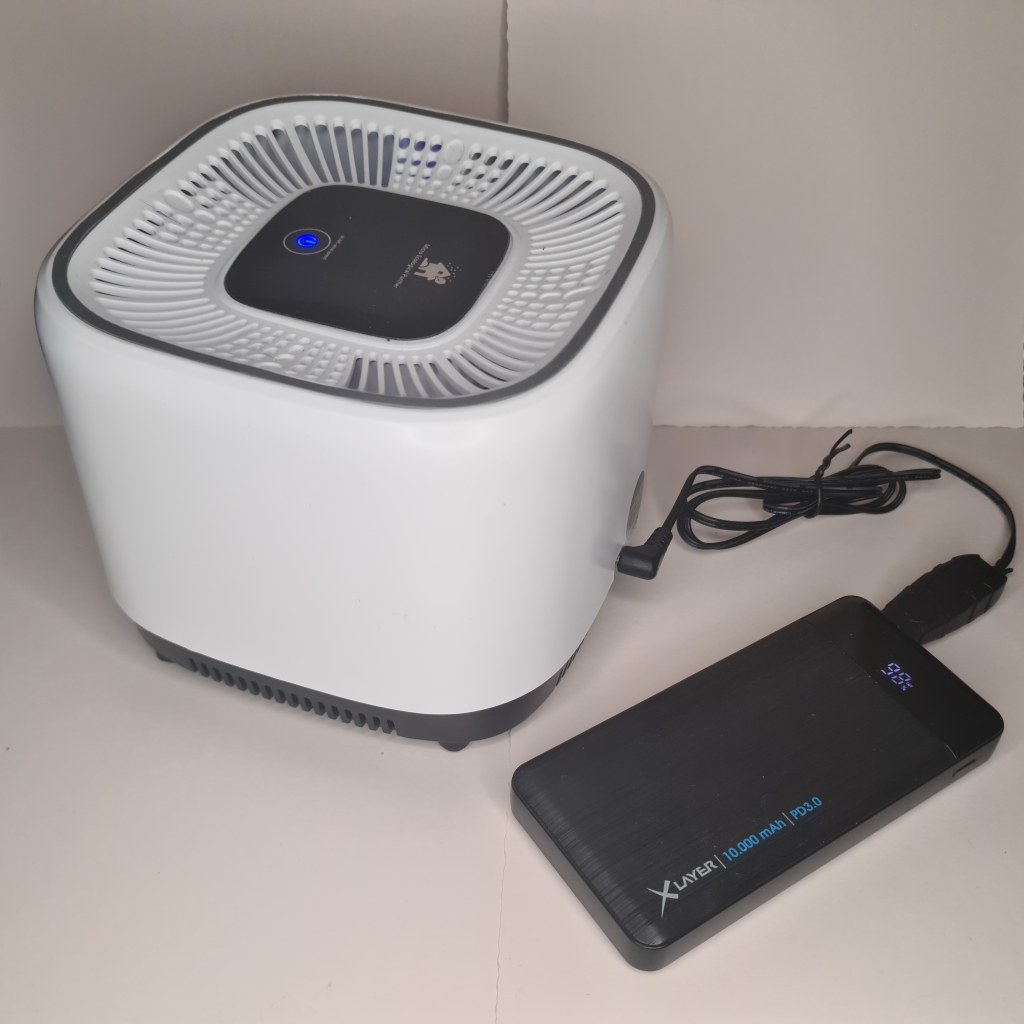
    Portable HEPA filter, connected to a battery for a longer charge. Photo by: C.Suthorn / cc-by-sa-4.0 / commons.wikimedia.org

    After I shared my travel experience last week, a couple of readers reached out asking for more details on using a portable HEPA filter, essentially a small air filter that can be moved from one place to another.

    Scientific research has shown that air filters can be valuable tools for reducing the risk of COVID-19, along with other respiratory viruses and pollution concerns, such as wildfire smoke. These filters essentially remove dangerous particles from the air, making indoor spaces safer.

    These air filters can be costly (prices range from $50 to $1,000), but may prove to be a helpful long-term investment if used often. My partner and I used ours while traveling, as well as in our apartment when we have guests over and during periods of intense wildfire smoke pollution in New York City.

    Here are a few tips and resources about using HEPA filters:

    • This spreadsheet, compiled by the air quality recommendations site Clean Air Stars, lists hundreds of portable air filters. For each filter, the spreadsheet includes information about their performance, cost, whether you need to purchase filters separately, and other details.
    • Clean Air Stars also offers a recommendation tool that will suggest how many air cleaner models and at what fan speed might be needed for a room of a given size.
    • This is the portable filter that I use: the QT3 Portable Air Purifier from Smart Air. It’s fairly small and lightweight, and filters 40 cubic meters per hour.
    • You might see filter options boasting their clean air delivery rate, or CADR. This is a measurement of an air purifier’s effectiveness, telling you how much filtered air the machine can provide in a given timespan (cubic meters per hour, cubic feet per minute, etc). For more details, see this blog post from Air Conditioner Lab.
    • Understanding your air filter’s CADR is important because it tells you the range in which your device works. For example, a smaller filter with a lower rating might clean the space immediately in front of you on a train, but would not clean the entire car. Smaller filters might also need to run for a longer time to clean an enclosed space (such as a hotel room).
    • If you’re traveling with an air filter, a portable battery can be helpful to extend the device’s runtime. My filter runs for a couple of hours on its own battery power, but will last for much longer if plugged into a portable battery.
    • Research and recommendations from air filter providers recommend placing your filter close to you and facing you, to get the clean air delivered as close to you as possible. 
    • If you’re also using a CO2 monitor, it’s important to note that the monitor’s reading likely won’t change due to a HEPA filter. CO2 monitors measure clean outdoor air in a space, so they do not register when existing air is filtered. A monitor that measures particle pollution would be needed to see the difference your filter is making.
    • Know when to change your device’s air filter! Many devices have built-in indicators telling you to do this (i.e. a light that flicks on when the filter needs replacement), while others will come with instructions recommending a filter change after a given period of time.
    • Air filter use is not an exact science. While you can find answers to some questions in scientific literature, others might require crowdsourcing on social media or trial and error on your own to find what works best for you. Overall, though, remember that any use of an air filter will be better than taking no steps to clean your air.

    I hope this is helpful. If you have more questions (or would like to share your own recommendations), please reach out!

  • How my partner and I stayed safe during summer travel

    How my partner and I stayed safe during summer travel

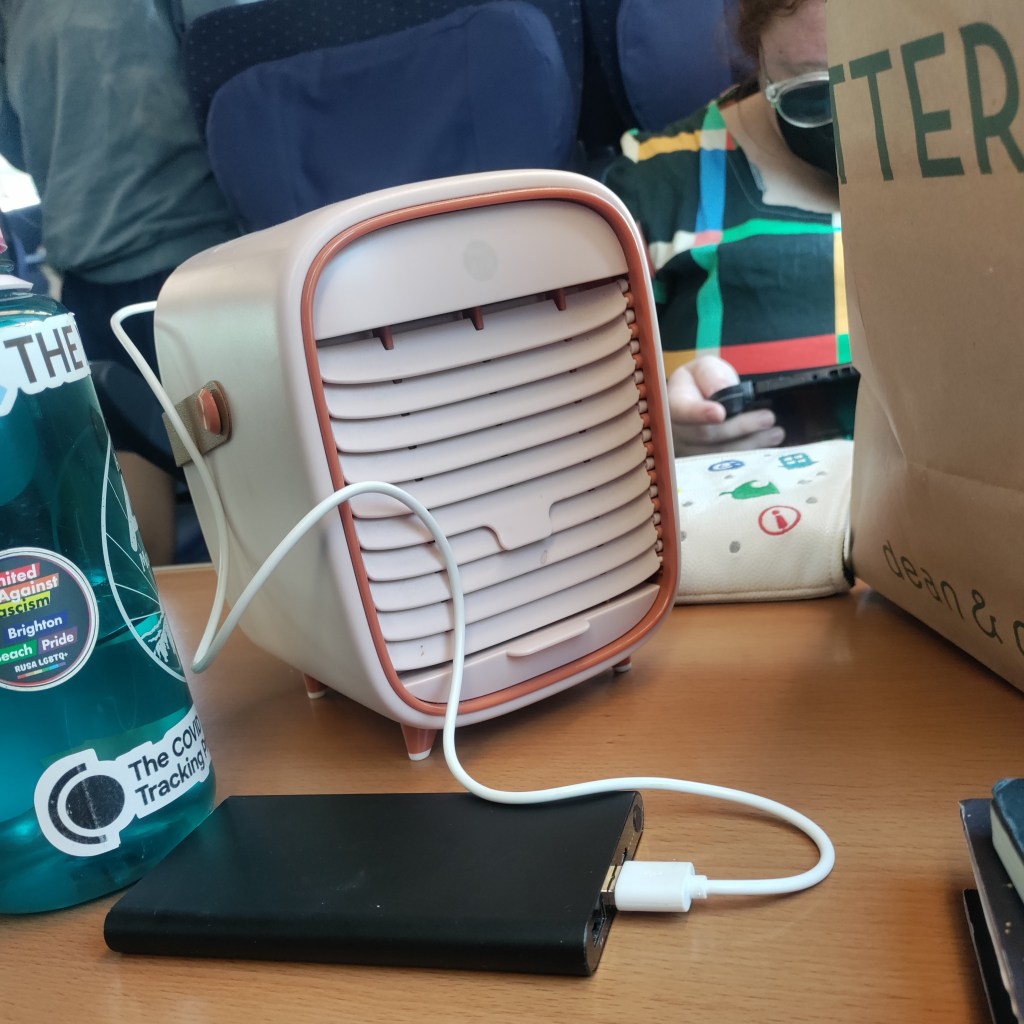
    Betsy and her partner’s portable HEPA filter, pictured on the train from Berlin to Brussels. Her partner (in an N95 mask) is visible in the background.

    A few days ago, my partner and I returned home from a two-week vacation to several cities in Europe. It was our first time traveling internationally since before the COVID-19 pandemic, and the trip required a lot of time on planes, on public transportation, and in crowded spaces.

    I’m sharing what we did to reduce our risk of COVID-19 (and other common pathogens!) during the trip, in the hope that this will be helpful for readers traveling this summer. While taking these sorts of precautions may be increasingly unpopular in many places, these measures still reduce the risk of illness for individual travelers and the people around them.

    Here’s what we did:

    • Reduced potential exposure and tested before we traveled: It’s pretty typical for me to avoid crowds and indoor events prior to traveling. In this case, my partner and I did attend Pride marches in New York City the weekend before our trip, but we only attended outdoor events and wore masks in the crowds to reduce our risk. We also both got PCR tests the day before leaving (we’re lucky to live near one of the few public testing sites in the city that are still open).
    • Masked indoors, with high-quality masks: I consistently wore N95 masks on the trip, including my reusable respirator on planes. (I wrote more about my respirator in this post last summer.) My partner also wore an N95 or KN95 throughout the trip. We have different preferences for which masks fit us well, so we had a few masks of different brands packed to accommodate that.
    • Avoided indoor dining (as much as possible): All of our meals were outdoors. My partner is vegan, so any restaurant where we ate had to fit into a Venn diagram of “vegan options” plus “outdoor seating”; this might sound challenging to find, but with a bit of planning—and with thanks to the Happy Cow app—it was actually quite doable. We had to eat briefly on planes at a couple of points, but we minimized that time as much as possible (eg. masking in between bites) and did so only when plane air filtration systems were going.
    • Took advantage of smoking sections: European cities tend to have a more prominent smoking culture than the U.S., so many restaurants and bars have outdoor smoking sections. This can be a tricky situation for COVID-cautious travelers; yes, you’re outside, but you’re also breathing in a lot of second-hand smoke. Still, my partner and I found these sections to be a helpful option. We even had lunch in an outdoor smoking zone at the Keflavik Airport (in Iceland) during a layover on our way home to NYC.
    • Used a CO2 monitor to gauge ventilation in some spaces: I am a proud owner of an Aranet CO2 monitor, which I mostly use to track ventilation at my apartment and public spaces in NYC. I brought the monitor on the trip, and used it to identify which public buildings had better air quality. For example, train platforms at Berlin Hauptbahnhof (the city’s central train station) are open to outdoor air and have frequent airflow, as evidenced by a CO2 reading I took of 611 ppm—well within the Aranet monitor’s “green zone.” So, I felt comfortable taking off my mask there for a few minutes to drink coffee.
    • Used a HEPA filter on trains, hotel rooms: My partner and I have a personal, portable HEPA filter that runs on a battery and fits easily in my duffel bag. I brought it along on the trip and used it a few times, mostly on crowded trains and in hotel rooms that did not have great airflow. It also doubled as an extra fan in our Airbnb in Amsterdam (which was not air-conditioned).
    • Rapid-tested every two days: Over the two weeks of traveling, my partner and I took a rapid test every two days to check for any developing illness. We also requested testing from friends and family members with whom we spent time indoors, such as a friend whom we stayed with in Berlin.
    • Testing and symptom monitoring after getting home: Since arriving home in NYC on Wednesday evening, my partner and I have each gotten PCR tests. I also rapid-tested once, as an extra check before attending an event on Thursday. We’re planning to do another round of PCR testing next week and monitor for any symptoms; so far, we haven’t seen any signs of illness.

    I acknowledge that these safety measures may sound like a lot of effort. Certainly, tools like rapid tests and a personal HEPA filter cost money, and may not be accessible to many people. And in an ideal world, everyone would be able to travel in a world where these tools are free and commonplace, rather than a reason for extra advanced planning.

    There are also increasing social pressures to not take precautions, especially in some of the places that we visited. I had a few conversations with strangers who insisted I was strange for wearing an N95, that COVID-19 was “over”; I was even patted down and pulled into a security screening at the Amsterdam airport by guards who decided my respirator was suspicious.

    I am the kind of person who doesn’t back down to this pressure, especially when I have the research and reporting to back up my convictions. But I don’t want to be an isolated person taking precautions in a sea of others who aren’t acting to protect public health.

    Broader change is really needed; in the meantime, though, I hope my experience is informative for others.
    If you are also traveling this summer and you have other tips you’d like to share with the COVID-19 Data Dispatch community, please send them to me! You can email me or comment on this post.

  • COVID-19 safety and solidarity at Pride: A reflection

    COVID-19 safety and solidarity at Pride: A reflection

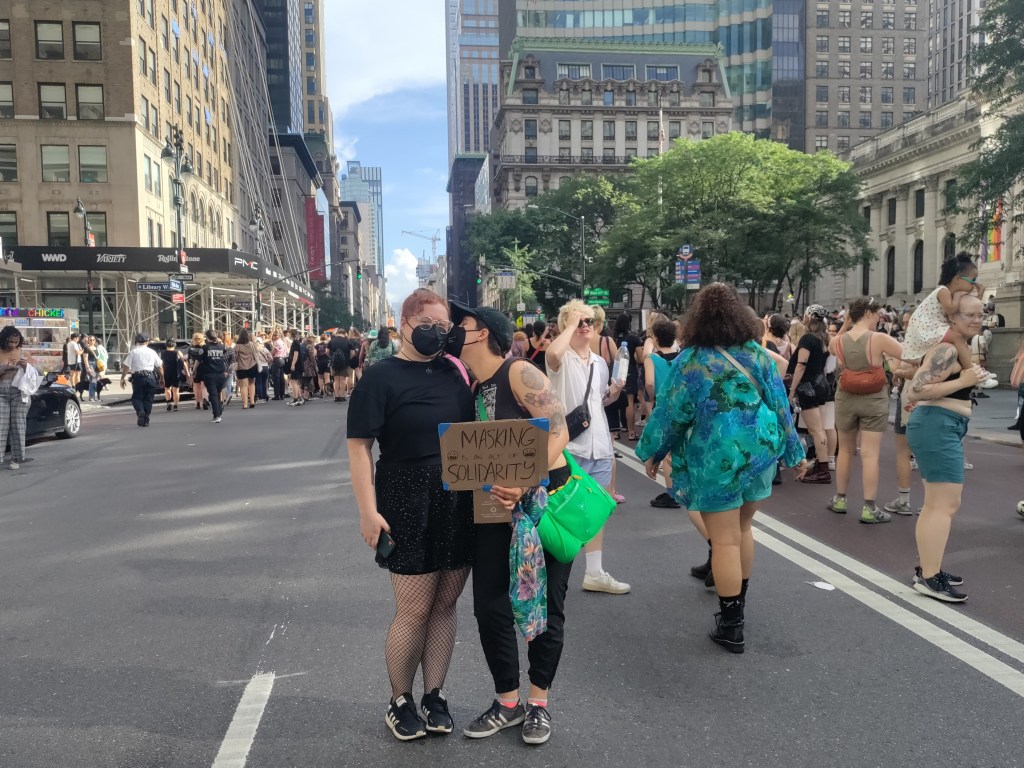
    Betsy (center, right) and her partner Laura (left) at the NYC Dyke March, masked up in KN95s.

    For years, Pride has been my favorite holiday. I love the crowds, the parties, the marches (not the parades with corporate floats, but the people-led marches), the explosions of anger and joy, the connections with my community.

    COVID-era Pride has been more complicated than past years, as we layer safety measures onto the celebration. For me and many others I know in the LGBTQ+ community, Pride has become an opportunity to reflect on the importance of connecting this community and those calling for COVID-19 safety—disabled and immunocompromised people, those with Long COVID, and others at higher risk. This practice can be challenging, as others push for a return to the Pride we knew before the pandemic. But it’s not impossible, especially when we remember our values of inclusion and solidarity.

    This year, one of the biggest Pride marches in New York City became emblematic of the tension between safety and a desire to party like it’s 2019. Called Queer Liberation March, this march originated in local organizers’ desires to protest on Pride, honoring the legacy of the original Stonewall protest. (Official NYC Pride, also called “Corporate Pride” by many, has become sanitized over time, to the point that you’re more likely to see corporate floats and politicians than community leaders.) So, Queer Liberation March offers an alternative; I’ve attended it since the first iteration in 2019, which commemorated 50 years since Stonewall.

    A few weeks ago, Queer Liberation March garnered negative attention on social media due to an apparent disregard for COVID-19 safety. When a commenter on the march’s Instagram asked whether masks would be required at the march, an organizer with access to that Instagram account responded with a tirade dismissing the idea of any mask requirement, even suggesting that people who wanted to mask would not be welcome at the march. Obviously, many LGBTQ+ New Yorkers pushed back, expressing anger and disappointment that a Pride protest would exclude our community’s higher-risk members.

    The march’s organizers listened and deliberated. Queer Liberation March has not had explicit COVID-19 safety protocols in 2020, 2021, or 2022, though the march partnered with local health organizations to offer easy vaccine access for people at Pride. (This year, organizations are offering sexual health resources, such as HIV testing and mpox vaccines.) But the community response suggested that, this year, the march had to do more to prioritize COVID-19 safety.

    I actually reached out myself to Queer Liberation March’s organizers; I wasn’t acting as a journalist, but as a member of the Rude Mechanical Orchestra, a band that plays regularly at marches and rallies around the city, including past iterations of this march. Through conversations with a couple of the organizers, I shared resources on COVID-19 safety and walked through how my band approaches this topic. (You can read more about that on our website, though note that our data protocols are due for an update, and in this Science News article I wrote in 2021.)

    Eventually, Queer Liberation March announced a safety policy. The march recommends that attendees mask up, along with testing before and after the event. Organizers are also coordinating mask-required sections at the front and back of the march, which will be protected by marshals equipped with extra masks to hand out. This policy is far from perfect; the “masking section” strategy in particular has garnered some criticism for essentially segregating higher-risk marchers from those who see COVID-19 safety as less of a priority.

    Though it’s not perfect, I was personally glad to see these safety steps at one of NYC’s biggest Pride events. Another large march, the Dyke March (which took place yesterday), adopted similar strategies. When my partner and I attended the Dyke March, we masked up in KN95s and saw quite a few other attendees doing the same. One marshall offered to direct us to that march’s mask-required section. I also saw marshalls pushing wheelchairs for marchers who weren’t able to walk the full 40 blocks—another important step towards accessibility.

    The Queer Liberation March is happening this afternoon. Around the time you read this post, I’ll probably be at the starting point, lining up with my band. So I can’t say yet how successful their COVID-19 safety policies will be. But I still wanted to highlight this march as an example, to show that 2023 is not too late to change course and adopt some safety measures. If NYC’s biggest (non-corporate) Pride marches can do it, no other organizers should have an excuse not to.

    Solidarity is a wide tent. Pride is for all LGBTQ+ people, including those who are disabled, chronically ill, or simply can’t afford to miss work for two weeks. If a Pride event doesn’t include these groups, it isn’t a true Pride event. And inclusion is easier than you think. Many people will test if you ask them, or will mask for a few hours if you ask them—especially if you explain why it’s important, using the terms of their community: “We keep us safe.”

  • Resources from last week’s community event

    Thank you to everyone who logged onto Slack for last Sunday’s community event! I really appreciated the opportunity to hear your COVID-19 questions and concerns, and I hope the discussion was helpful for those who attended.

    One thing I loved about the event was that it didn’t just consist of me answering questions. The readers who attended also helped answer each other’s questions and shared resources, such as information about air filters and local COVID-safe meet-up groups.

    To bring those resources outside those who attended the event, I’ve compiled the list here:

    For both readers who attended the event and those who didn’t, I would love to hear your feedback. Should I host more of these? If yes, what would you like to discuss at events—general COVID-19 questions, or more focus on specific topics? Is Slack a good platform to use? (I.e., would it be worthwhile to pay for pro options on the server?)

    Let me know what you’re thinking: email me, comment on this blog post, etc. And thank you again to those who attended last Sunday, I learned a lot from all of you.

  • Clean air has value beyond COVID-19, the wildfire smoke shows us

    Clean air has value beyond COVID-19, the wildfire smoke shows us

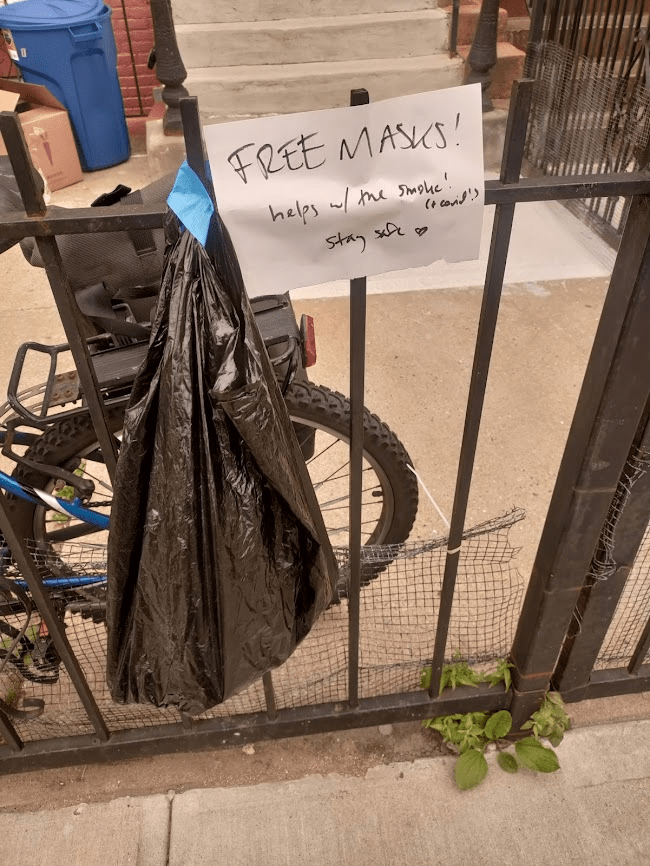
    I left some free masks outside my apartment for my neighbors this week. That orange tint on the photo is from the poor air quality in NYC.

    This week, much of the eastern U.S. was inundated with wildfire smoke that traveled south from Canada. While fires have been blazing across the country for several weeks, some recent particularly-intense wildfires in Quebec led to smoke so full of pollutants, it set poor air quality records in the U.S.

    Americans living in California and other Western states have grown accustomed to wildfire smoke over the last few years; you might remember the orange skies over West Coast cities in fall 2020. But for people on the East Coast (myself included), this week’s smoke was a rude reminder that climate disasters have no borders or boundaries.

    The smoke also reminded us how important clean air is for our health. The same public health measures that help reduce COVID-19 risk can also reduce the impacts of wildfire smoke. High-quality masks filter out both the pollution in smoke and coronavirus particles at the individual level; ventilation improvements do this at the collective level. And these health measures help with other respiratory viruses, other types of pollution, chronic conditions like asthma… the list goes on.

    For COVID-cautious folks like me who still wear masks in public spaces, the smoke situation this week demonstrated that yes, many people are willing to put a mask on if they understand why it’s needed—and if the masks are widely available. In New York City this week, I saw more people wearing masks than I have since the height of the Omicron wave in winter 2021-2022. Public officials encouraged masking and even gave out masks in large numbers.

    In addition to broader mask use, more people have become interested in cleaning the air in their homes and in public spaces. Air filter sales spiked on Amazon this week, CNN reported, as did Google searches for these items. My Twitter feed has been full of recommendations for air-cleaning devices and instructions for building DIY filters.

    This is all great to see, but I hope it’s not just a one-week trend. If we invest in cleaner air now—both individually and collectively—we’ll be more prepared for the next round of wildfire smoke. (While the worst has likely passed for now, we’re likely to see more events like this in the future.) And we’ll be more protected against COVID-19 and other respiratory diseases.

    With that in mind, here are some suggestions that apply to both COVID-19 and air pollution:

    • Stock up on high-quality masks, i.e. N95s and KN95s. This STAT article has some helpful information about which masks work well for COVID-19 protection as compared to air pollution. Notably, for COVID-19 protection, it’s more important to mask inside, while for air pollution protection, it’s more important to mask outside.
    • Buy or make air filters for your home. Air filters can dramatically improve air quality in an indoor space, and you don’t have to spend hundreds of dollars to get one. Corsi-Rosenthal boxes can be easily constructed with less than $100 of materials.
    • Monitor your local air quality. This can include buying a monitor to measure CO2 or pollutants, or following air quality data through public sources. I’ve personally started checking AirNow.gov, a site run by the U.S. government, and IQAir, a crowdsourced air quality tracking site. Checking local air quality data can inform your behavioral choices, similar to checking local COVID-19 statistics.
    • Get involved with mask distribution. This week has shown many people are willing to put on a mask, if they understand why it’s needed and can access one. You can help share information and resources, whether that’s getting involved with a mask distribution group in your area or simply donating individually to friends and neighbors. (For example, I left some free masks outside my apartment building this week.)
    • Advocate for clean air in public spaces. Public buildings can do a lot to improve their air, such as updating HVAC systems and adding air filters to high-traffic spaces. There are already many groups advocating for this, such as parents organizing for ventilation upgrades at their kids’ schools; I hope the recent wildfire smoke adds new motivation to those efforts.

    Do you have other suggestions or resources that you’d like to share with other COVID-19 Data Dispatch readers? Email me, and I’ll send your suggestions in a future newsletter issue.

    More about air quality

  • Mainstream media’s COVID-19 failure

    It’s pretty clear, at this point, that the U.S.’s political leaders would like for us all to pretend that the pandemic is over. President Biden says he doesn’t think about it (even though everyone in his orbit is still PCR-tested regularly), Congress hasn’t passed any new COVID-19 funding since spring 2021 (but sends billions to the military), state and local governments end their final mask mandates (yes, the ones in healthcare settings), and so on.

    And the mainstream media—tasked with holding these powerful people accountable—has let them do it. Most news outlets these days barely want to include the word “COVID-19” in their headlines, let alone give you an honest picture of the risks that this disease still poses. Many individual journalists are doing their best to get the important news out, but they have to push back against shrinking editorial budgets, colleagues who spread misinformation, weariness from sources, and other structural barriers.

    Personally, as a freelancer still covering this topic, I would love to write about only COVID-19, all the time. But in order to keep working, I’ve had to branch out. Even when I write COVID-related stories, these days, the headlines often aren’t directly about the coronavirus; they focus on broader issues like health surveillance or chronic disease that are easier to give broader appeal (or at least, what my editors see as broader appeal).

    I’m eternally grateful to have the COVID-19 Data Dispatch and its community of readers, as a place where I can keep prioritizing this topic and sharing my honest perspectives, rather than watering them down for more mainstream outlets. But this is a pretty small fish in the sea of media coverage—I know my work only goes so far.

    So, I was really glad to see an excellent article in Neiman Lab this week that captures exactly how mainstream media has failed on covering COVID-19 over the last two years. Climate journalist Kendra Pierre-Louis explains that yes, COVID-19 is still a major health threat, and publications have failed their duty to the public by largely ignoring it.

    I highly recommend reading the full story, but here’s one section that exemplifies Pierre-Louis’ argument:

    Outlets like The New Yorker, The Washington Post, and NPR, to name just a few, have amplified voices and arguments that helped create a narrative that not only pathologizes those who remain cautious about the disease, but also fails to adequately convey the risks associated with Covid such that many people are unwittingly taking on potentially lifelong risks.

    In the process, we’ve failed at our field’s core tenets — to hold power to account and to follow the evidence. Our failures here could last a generation. As reporters, it’s our responsibility to accurately represent the needs of diverse perspectives and avoid an ableist bias that diminishes the real and lasting health concerns not only of those who are keenly at risk but those who are cautious about repeatedly catching a virus that scientists are still grappling to understand.

    I hope this article inspires some reflection among other journalists, if not some real changes in editorial priorities.

  • My tips for covering Long COVID (using data, records, and patient interviews)

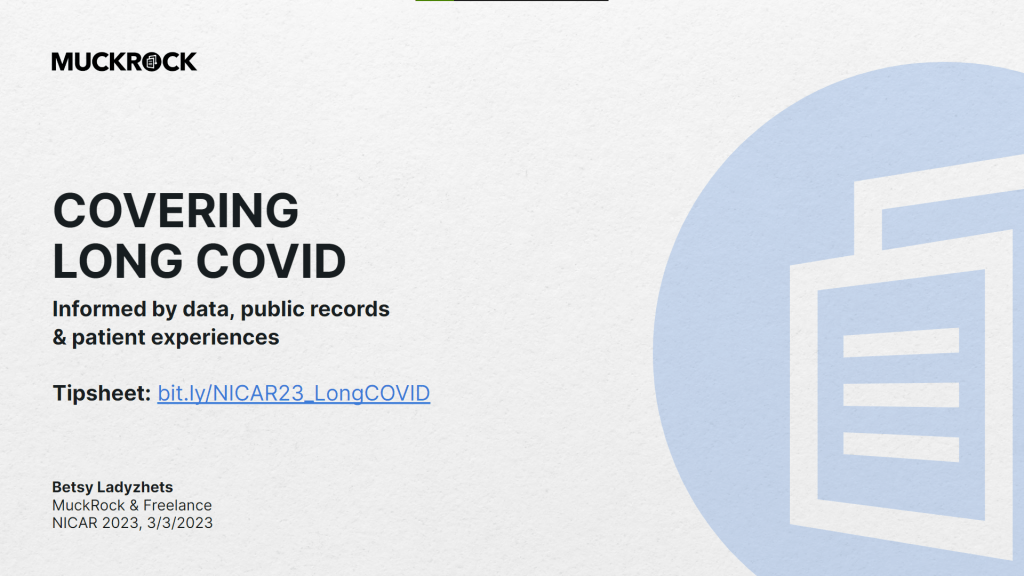
    Cover slide from my workshop at NICAR this weekend.

    On Friday, I led a workshop at NICAR about covering Long COVID. NICAR is a data journalism conference—the acronym stands for National Institute for Computer-Assisted Reporting, which is an old-school term for data journalism—so my session focused on data sources, along with suggestions for public records requests and for interviewing long-haulers.

    My main goal for the workshop was to introduce Long COVID as a worthwhile coverage topic for journalists who aren’t already on the science or health beat. Plenty of science/health reporters (like myself) have written great articles about biomedical research, patient experiences, and other similar topics. But there are many other facets of Long COVID, ranging from its impact on work to the public agencies that should be held accountable for failing to address this crisis.

    To that end, I spent part of the session talking about excellent Long COVID articles that don’t focus on science/health topics. I also gave attendees a prompt to brainstorm story ideas for their beats or coverage areas. This led to some interesting conversations about potential local stories on Long COVID clinics, Household Pulse Survey data, tracking disability applications, and more.

    If you’re curious to see more of what I shared from the session: here’s a link to the tipsheet I compiled, and here’s a link to my slides.

    Also: as I’ve mentioned previously, I am currently leading a project at MuckRock (where I work part-time) to investigate U.S. government responses to Long COVID. For any journalists who may be interested in collaborating with MuckRock on Long COVID or other public health topics, you can reach out to us here.

    More Long COVID coverage

  • Collecting imperfect environmental data with a CO2 monitor

    Collecting imperfect environmental data with a CO2 monitor

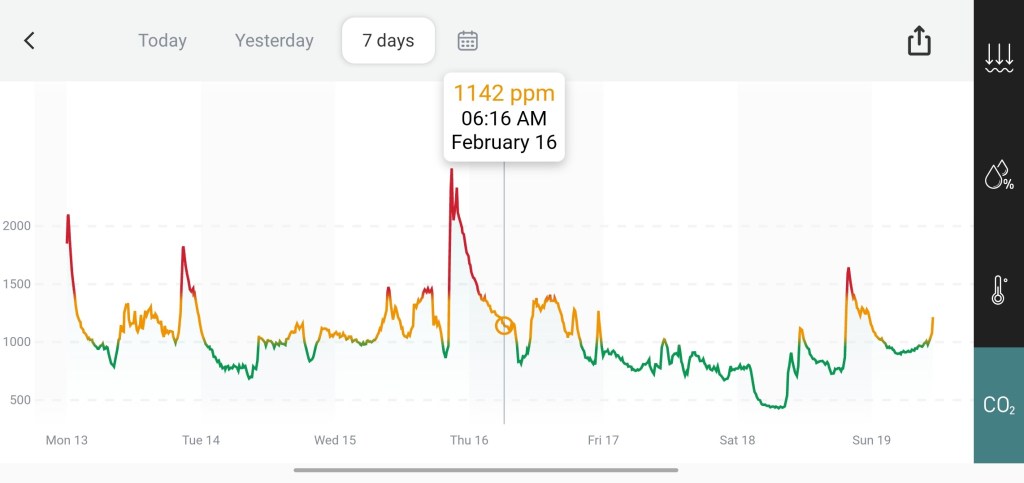
    A chart from the Aranet app shows CO2 concentrations in my apartment over the last week.

    I recently bought a carbon dioxide monitor, and have been using it to collect data in my apartment and other places. In the week since I’ve been monitoring, I’ve noticed how personal data collection like this can be helpful in identifying ventilation issues, but comes with many caveats.

    You might have seen photos of these devices on Twitter or in news articles; they’ve become an increasingly popular way to measure ventilation in public spaces, as a proxy for potential risks of COVID-19 spread. The basic theory is that CO2 builds up more in spaces where there’s not a lot of clean air circulation. So, when you see higher CO2 readings, that indicates less clean air coming in, which likely means COVID-19 and other viruses could be hanging around for longer, too. Higher CO2 is also correlated with other health risks, like headaches and diminished neurological function.

    My CO2 monitor has mostly lived on the desk in my home office for the last week, with a couple of outings (to the park near my apartment, on the subway, etc.). I’ve been surprised by how much CO2 varies even in this one spot. A few observations:

    • The highest peaks of CO2 concentration usually correspond with cooking, since my kitchen has a gas stove. Even though my desk is across the apartment from the stove, the gas is still enough to send the meter above 1,500 ppm or higher.
    • CO2 concentration also tends to increase when there’s more conversation in the room, such as me doing Zoom interviews or talking to my partner, who shares the home office. (Talking puts more particles into the air than just breathing.)
    • CO2 concentration tends to drop when the room is empty and/or when the electric heater is turned off, leading to lowest levels overnight. (Our apartment has electric heating/cooling units instead of older-school radiators, and my desk sits right underneath the one in the office. Do these units expel CO2? I need to do more research here.)
    • Opening the office’s window usually corresponds with a decrease in CO2 concentration, though not as significant a decrease I’d expect given that the CO2 concentration outside is much lower—around 400 to 500 ppm. Perhaps opening the window further would lead to improvements, but it’s too cold in New York City to test that right now.

    Of course, it’s hard to explain every single uptick and downturn in the CO2 monitor’s readings. I also have to acknowledge that a device I can buy for $250 on the internet is far from perfect; it has quirks and errors that will take me much longer than a week to fully understand. Still, I’m enjoying this small-self experiment into my environment.

    Overall, the CO2 monitor has shown me and my partner that our apartment is not particularly well-ventilated. The CO2 concentrations in our office often range from 1,000 to 1,400 ppm, which indicates poor airflow. (Under 1,000 ppm is generally considered a safe level.) I’ve taken the meter on the subway a couple of times, and found that subway cars may even have lower CO2 than our office, if the car isn’t too crowded.

    We were already thinking about buying an air filter for the apartment, and the CO2 results add some urgency to this task. Also, the next time we move, we’re going to look for places without gas stoves—often a challenging task when you’re renting in New York City, but there are some options.

    Have you used a CO2 monitor, or tried to upgrade the ventilation in your home? I’d love to hear from you about it: comment below or reach out via email.