Blog

  • Featured sources, Nov. 22

    These sources, along with all others featured in previous weeks, are included in the COVID-19 Data Dispatch resource list.

    • State COVID-19 vaccine plans: A new report from the Kaiser Family Foundation explores how state public health departments are planning to distribute COVID-19 vaccines once they become available. The report includes common themes and concerns across all 50 state plans, as well as links to the plans themselves. One insight that stuck out to me: “Just over half (25 of 47, or 53% ) of state plans report having immunization registries/database systems in place that are described as being (at least fairly) comprehensive and reliable; in the other state plans that information is unclear.”
    • COVID-19 Testing Communications Toolkit: The Brown School of Public Health has compiled a resource to help public health communicators encourage COVID-19 testing. The toolkit includes evidence-based tutorials, handouts, and an image library, all of which are free for public use.
    • COVID-19 and Impacted Communities: A Media Communications Guide: This is another communications tool from the New York COVID-19 Working Group. The guide includes best practices for explaining key terms, advice on framing stories, and how to avoid stereotypical narratives about minority communities.
    • SARS-CoV-2 and COVID-19 Data Hub: Erin Sanders, a nurse practitioner and contact tracer, has compiled a list of data sources on the novel coronavirus. The list includes clinical data, transmission data, and genomic data, among other medical and epidemiological topics.
  • Racism is a public health threat

    This week, the American Medical Association (AMA) announced that the association recognizes racism as a public health threat. The association is adopting a new policy which acknowledges systemic racism, cultural racism, and interpersonal racism as barriers to healthcare for many Americans and as threats to equitable public health across the country. Although the policy does not specifically address COVID-19, it speaks to the impact that America’s racist history and healthcare system has had in making it more likely for Black Americans to become infected with the coronavirus and suffer worse health outcomes.

    “The AMA recognizes that racism negatively impacts and exacerbates health inequities among historically marginalized communities. Without systemic and structural-level change, health inequities will continue to exist, and the overall health of the nation will suffer,” said AMA Board Member Willarda V. Edwards, M.D., M.B.A.

    I highlighted this decision because, in order to address a public health threat, the threat must be tracked with good, complete data. In the several months I’ve worked on the COVID Racial Data Tracker, I have seen how public health agencies often push demographic data on COVID-19 into inaccessible charts or hard-to-find reports, or do not even report these data at all. In other words, it may be difficult for many people of color in the U.S. to find crucial information on how the pandemic is impacting their communities.

    Many states have greatly increased their demographic reporting on COVID-19 cases, deaths, and other metrics since the spring, and states have supported initiatives to serve minority communities. But there is still a lot of room for improvement. The AMA’s decision signals that the medical community is committed to dismantling the threat racism poses to American public health. Journalists, science communicators, and other community leaders must join in that work.

    If you’d like to advocate for better demographic data in your state: you can see the disparities using the COVID Racial Data Tracker’s Infection and Mortality charts, and you can reach out to your state’s leadership with a custom contact form.

  • Federal data updates, Nov. 22

    America’s federal public health agencies are busy in the lead-up to Thanksgiving, as are the researchers and volunteer networks filling those agencies’ information gaps. Here are three major updates:

    • CDC’s COVID Data Tracker now reports more county-level data: Since it was first published in the spring, the CDC’s COVID-19 data dashboard has included cases and deaths by U.S. county, relying upon data compiled by USA Facts and verified by the agency. As of yesterday, the county dashboard now also reports total PCR tests and test positivity. Testing data have previously been available directly from the HHS (state-level) and the Center for Medicare & Medicaid Services (county-level), but the CDC dashboard is far more accessible. Users can select a specific county and see a variety of trends in cases, tests, and deaths. The data from this dashboard aren’t yet available for download; I’ll report back if this changes.
    • Pharmacies will be able to distribute COVID-19 vaccinesLast week, the HHS announced that the agency has set up partnerships with both national pharmacy chains and networks representing smaller pharmacies in order to broadly distribute COVID-19 vaccines as they become available. (Pfizer applied for Emergency Use Authorization this past Friday.) According to the HHS, these partnerships cover “approximately 60 percent of pharmacies throughout the 50 states, the District of Columbia, Puerto Rico, and the U.S. Virgin Islands.” The press release does not mention how these pharmacies will be plugged into their respective state vaccine registries.
    • How state COVID-19 dashboards are faringAlthough many states are reporting more COVID-19 data than they were last spring, their dashboards are overall still not conveying some key metrics, according to a new report from Resolve to Save Lives. This research group, a nongovernmental initiative run by the global health organization Vital Strategies, first reviewed state dashboards in July. (See my first issue for more details.) The new report—along with an interactive map—reflects improvements that states have made since the summer while highlighting what crucial public health information is still missing. Case investigation and contact tracing are two key areas where “data… remained largely unavailable.”
  • HHS releases data on new admissions, staffing shortages

    HHS releases data on new admissions, staffing shortages

    How many people in the U.S. are currently hospitalized with COVID-19? As of yesterday, 83,200.

    This question calls attention to the people deeply impacted by the pandemic—people in hospital beds, on ventilators, struggling to breathe. But it is also a deeply practical question. Public health experts and policymakers need to know where hospitals are becoming overwhelmed with patients in order to distribute supplies where they are most needed. Researchers and data nerds like myself, meanwhile, can use hospitalization metrics to track the pandemic’s impact on different communities: reported cases may be an unreliable metric, challenged by inadequate testing and uneven reporting guidelines, but it’s hard to miss a person in the hospital.

    Longtime readers may remember that this newsletter started because of hospitalization data. Back in July, when hospitalization data moved from the purview of the CDC to the HHS, I wanted to explain why these data are so important and how the change in control impacted the numbers themselves. In the months since, the HHS has increased both the number of hospitals reporting to its system and the volume of information that is publicly released about those hospitals.

    I’m returning to the topic now because the HHS has made two major upgrades to its hospitalization dataset in the past week: it now includes new admissions and staffing shortages for every state. The metrics are only available at the state level; I’m hoping that county- and even individual hospital-level numbers may be released in the coming weeks.

    New admissions are a useful metric because they provide a clear picture of where outbreaks are worsening, and by what degree. Patients may stay in the hospital (and be counted in a “current hospitalizations” figure) for weeks on end; isolating the number of new patients incoming allows public health researchers to see how the burden on hospitals is growing.

    Across the U.S., over 10,000 patients with confirmed cases of COVID-19 are now being admitted each day.

    New COVID-19 admissions rose from about 6,000 per day in late October to over 10,000 per day in mid-November. Full-size chart available here.

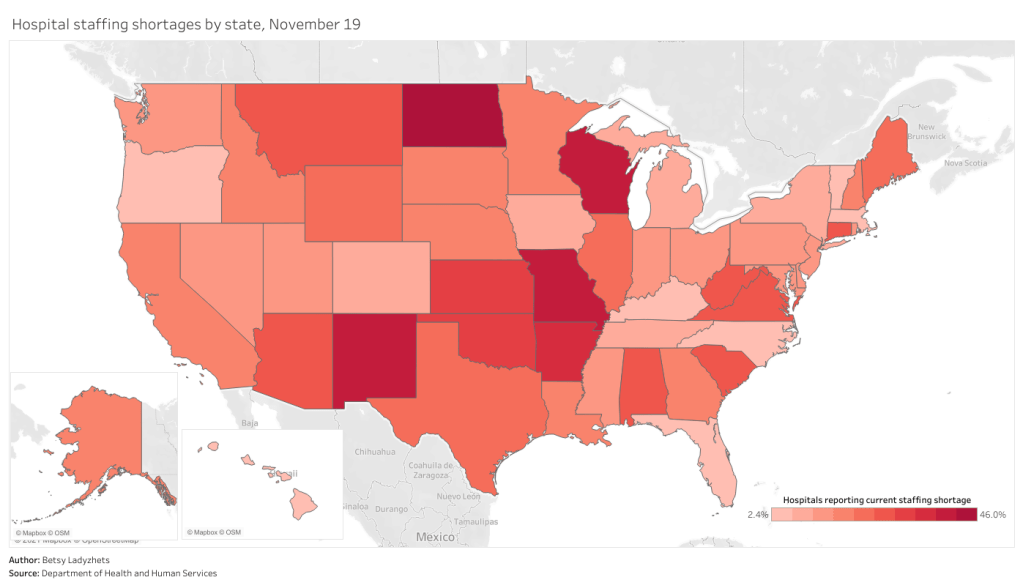
    Staffing shortages, meanwhile, are a useful metric because they demonstrate where in the country healthcare systems are hardest hit. The HHS specifically asks hospitals to report when their staffing shortages are critical, meaning that these facilities are in serious danger of being unable to operate as normal. Staffing shortages may be the result of healthcare workers feeling burnt out, quitting, or becoming sick with COVID-19 themselves.

    As of November 19, the most recent date these data are available, 18% of hospitals are currently facing a critical shortage—that’s about 1,100 out of the 6,100 hospitals reporting. 200 more hospitals report that they will be facing a critical shortage in the next week.

    In North Dakota, Wisconsin, Missouri, and New Mexico, over one third of hospitals are facing a critical staffing shortage. Full-size chart available here.

    Finally, here’s a look at the nation’s current hospital capacity—that is, how many hospital beds are currently occupied with sick people. As of November 19, about 600,000 of the nation’s 980,000 hospital beds are full (61%). 88,000 of those people have been diagnosed with COVID-19 (9%). These numbers will grow in the coming weeks as thousands of recently diagnosed Americans become sicker.

    Across the Midwest and South, several states have over three quarters of hospital beds occupied. Full-size chart available here.

    For more context on these hospitalization data and what they mean for the exhausted, terrified healthcare workers serving patients, check out:
  • National numbers, Nov. 22

    National numbers, Nov. 22

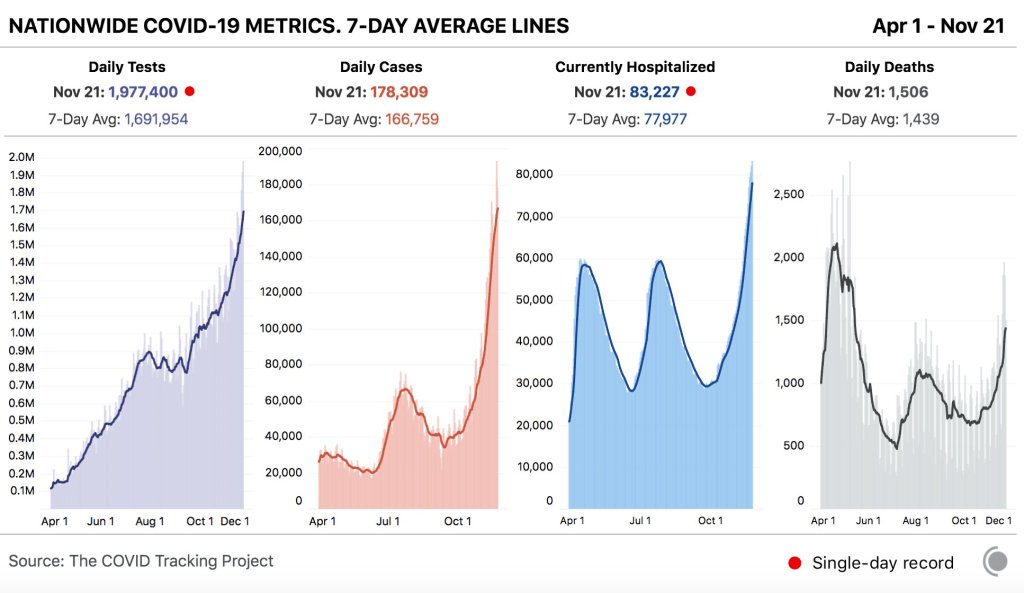
    In the past week (November 15 through 21), the U.S. reported about 1.2 million new cases, according to the COVID Tracking Project. This amounts to:

    • An average of 167,000 new cases each day (19% increase from the previous week)
    • 358 total new cases for every 100,000 Americans
    • 1 in 279 Americans getting diagnosed with COVID-19 in the past week
    • 10% of the total cases the U.S. reported in the full course of the pandemic
    Nationwide COVID-19 metrics published in the COVID Tracking Project’s daily update on November 21. The new cases seven-day average has doubled since the beginning of November.

    1 in every 114 Americans has been diagnosed with COVID-19 since the beginning of November, and cases aren’t slowing anywhere in the nation. The COVID Exit Strategy tracker categorizes the spread in every state except for Maine and Hawaii as “uncontrolled”; even Vermont, praised by public health experts for its mitigation efforts, is now seeing record numbers.

    America also saw:

    • 10,100 new COVID-19 deaths last week (3.1 per 100,000 people)
    • 83,200 people currently hospitalized with the disease, as of yesterday (20% increase from the previous week; 76% increase from the start of November)

    To see how your community is faring, check the COVID-19 Risk Levels Dashboard for state- and county-level insights.

  • Featured sources, Nov. 15

    These sources, along with all others featured in previous weeks, are included in the COVID-19 Data Dispatch resource list.

  • Our favorite COVID-19 sources

    Last week, I asked readers to share their go-to sources for COVID-19 data about their community. Thank you to everyone who responded! I am always on the lookout for great sources myself, so I appreciated seeing what folks are using.

    Here are a couple of responses that I wanted to highlight:

    • The New York Times cases map: Two readers noted that they liked the NYT dashboard, which makes it easy to compare COVID-19 metrics in different parts of the country. The NYT offers data at the county level and provides annotations and context with much more detail than most government sources.
    • City and county sites: Seven readers said that they regularly check their county or city dashboards for local information. One reader complimented the City of Chicago dashboard as “consistently updated with official data, easy to use.”
    • Social media: Readers referred to Twitter links to articles shared by both national and local journalists. One reader praised daily COVID-19 update posts shared on a local Boston subreddit: “The posts take publicly available Massachusetts health data and synthesize them in a way I’ve gotten very used to. This is the source I depend on when I tell people that COVID hasn’t been getting better in Massachusetts since June.”
    • The Glastonbury Town Manager weekly email: My mom’s favorite source is the email newsletter sent by the local administration in my hometown, Glastonbury, Connecticut. This email—which I’ve highlighted in the newsletter before—includes data for the town, updates for the state, and public service announcements.
    • New York Governor Cuomo’s daily updates: You have to hand it to him: no other local leader is using PowerPoint quite like Cuomo. Also, nobody else built a literal model of his state’s COVID-19 case curve.
  • What a President Biden could mean for COVID-19 data

    Last weekend, President-Elect Biden and Vice President-Elect Harris unveiled a Transition Plan. Their website covers detailed steps that the new administration intends to take for addressing COVID-19, climate change, economic recovery, and more.

    One item in the COVID-19 plan caught my attention immediately:

    Create the Nationwide Pandemic Dashboard that Americans can check in real-time to help them gauge whether local transmission is actively occurring in their ZIP codes. This information is critical to helping all individuals, but especially older Americans and others at high risk, understand what level of precaution to take.

    A nationwide pandemic dashboard? Standardizing information from all 50 states? Providing local data down to the ZIP code level? This is literally all I’ve wanted from federal COVID-19 data since February. If the Biden team provides a publish date for this dashboard, I will mark it on my calendar and eagerly count down the days.

    But, as you might imagine from reading my Source Callouts, I have a lot of thoughts on what types of organization, design, and documentation can make COVID-19 dashboards either easy to use—or frustratingly complex. Many other COVID Tracking Project volunteers, who have similarly been wading through state dashboards, have similar expertise. A group of data entry veterans, designers, science communication specialists, and other Project volunteers put together a set of recommendations for the dashboard that President-Elect Biden’s administration might build.

    You can read all the recommendations on the Project’s blog. Here are a few highlights:

    • Prioritize clarity, by putting the most important data points front and center.
    • Offer transparency, through accessible data definitions and methodologies as well as time series which allow users to see how metrics have changed over time.
    • Structure the dashboard with consistency, through the use of logical section headers, color schemes, and regular updates.
    • Provide absolute and per capita values for all major metrics.
    • Report different test types seperately, and provide both positives and totals to allow for accurate test positivity calculations.
    • Make the design inclusive, through providing access for different internet connection speeds, mobile use, and easily surfaced information (i.e. no hovering).
    • Provide annotations and disclaimers to help users understand caveats and complexities in the data.
    • Include data in the forms of chartssortable tables, and downloadable spreadsheets to allow for easy analysis.
    • Place sex, age, race/ethnicity, and other demographic data in context by comparing COVID-19 rates with the overall population.

    There’s a pretty big caveat to my dashboard excitement, though. In order for President-Elect Biden’s administration to put together a Nationwide Pandemic Dashboard, his team must first be able to access the nationwide pandemic data. So far, as President Trump has yet to concede the election, current Department of Health and Human Services (HHS) leadership are not able to communicate with their successors. POLITICO’S Adam Cancryn described the situation in a November 10 story:

    Biden’s HHS transition team is not yet allowed to have any contact with its agencies, including with officials at the center of the pandemic response like infectious disease expert Anthony Fauci and HHS testing czar Brett Giroir. It’s also barred from accessing nonpublic information or setting up government offices, limiting the new administration’s ability to get a full picture of the public health crisis that it’ll take responsibility for in just over two months.

    The separate coronavirus-specific squad has been held up as well, over concerns about how to structure it ahead of the formal start of the transition process and how willing the Trump administration will be to cooperate.

    The sooner top national politicians accept the election results, the sooner Biden’s COVID-19 team can get to work. That work includes data dashboards, ramping up testing, public health communication, and just about everything else we need to get the virus under control.

  • How to think about vaccine results

    This past Monday, pharmaceutical company Pfizer announced preliminary clinical trial results for its COVID-19 vaccine. In an interim analysis of the vaccine’s phase 3 study, the vaccine was shown to be 90% effective in preventing COVID-19. In other words, based on the people in Pfizer’s study who have become diagnosed with COVID-19 so far, those who got vaccinated were 90% less likely to get sick compared with the people who did not.

    90% is an exciting number. The Food & Drug Administration (FDA) set a threshold of 50% effectiveness for COVID-19 vaccines to be authorized, and experts have been telling us for months that even a 60% or 70% effectiveness would still be incredibly useful in reducing infections across the population. Pfizer’s initial 90% rate blows those expectations out of the water.

    Plus, this effectiveness value bodes well for other vaccine candidates. Pfizer’s vaccine, developed through a partnership with German biotech BioNTech, uses a new vaccine technology based on synthetic messenger RNA, or mRNA; so does the vaccine developed by Moderna, which is also currently in clinical trials. (For more backstory on mRNA, BioNTech, and Moderna, I highly recommend Damian Garde’s feature in STAT News.)

    But we can’t get too excited. Pfizer reported its preliminary data not in a peer-reviewed scientific paper, but in a press release, and some key details about the company’s clinical trial are not yet public. I used information from STAT NewsKHN, and SciLine to compile a few key questions that should be in all of our minds as we think about this and future vaccine data releases.

    • What is the sample size? Or, how many people were involved in the trial, and how many of them were diagnosed with COVID-19? For Pfizer’s trial, this is a question we can answer: about 44,000 people are enrolled in the study, and the 90% effectiveness rate is based on results from 94 people who contracted COVID-19, the majority of whom did not receive a vaccine dose. This may seem like a tiny fraction of the participants, but many experts are cautiously optimistic in hoping the 90% rate will hold up for a larger group.
    • Who is included in the sample size? COVID-19 has disproportionately impacted the elderly, people of color, people with certain medical conditions, and other marginalized groups. It is thus crucial that a vaccine is effective for people in these groups—in other words, these people must be represented in the vaccine trial. Pfizer reports that 42% of the overall study participants have “diverse backgrounds,” but the specific backgrounds of the patients who got sick are unknown.
    • Does the vaccine work for severe cases? While the majority of people diagnosed with COVID-19 are able to survive the disease with mild symptoms in their own homes, the minority of people who become seriously ill constitute the pandemic’s massive loss, as well as its burden on our nation’s healthcare system. A vaccine that reduces the disease’s severity through boosting immune system defenses may be incredibly valuable, even if it does not entirely prevent infection.
    • Does the vaccine work for mild or asymptomatic cases? A vaccine that prevents mild cases would help keep COVID-19 spread at bay, even if this vaccine does not reduce the disease’s severity. Pfizer’s press release does not include any specifics on the 94 patients who were diagnosed with COVID-19; experts are hoping that such details may be revealed in a forthcoming scientific paper.
    • Does the vaccine have any adverse effects? In other words, is the vaccine safe? We all know that flu vaccines make our arms sore, and other vaccines can give us mild colds. These types of common effects are usually nothing to worry about, but vaccines may pose a more severe danger to a small fraction of the population; for example, one in every ten thousand patients might have an allergic reaction that sends them to the hospital. So far, Pfizer has not reported any severe effects of its vaccine, but the current clinical trial gives the company a much wider pool of people in which dangerous reactions might be observed.
    • What are the vaccine’s logistical needs? One dose or two? At what temperature does the vaccine need to be stored? How long can it be at room temperature before it needs to be administered? How many doses can be manufactured in a day, a week, a year? What’s the price tag? Pfizer has given preliminary answers to some of these questions (two doses, -70 degrees Celsius) but the company is finalizing its manufacturing and distribution strategies as it completes its clinical trial.

    Even when a vaccine is authorized by the FDA, distributing and tracking it poses a whole new set of questions. I’ve written about vaccine data before, and I expect that this will be a topic I cover in increasing detail during the months to come.

  • A new metric for conceptualizing cases

    A new metric for conceptualizing cases

    Last week, a new metric appeared in the COVID Tracking Project’s daily updates. Within days, this metric was also featured in my newsletterBenjy Renton’s Off the Silk RoadNew York Governor Andrew Cuomo’s Twitter accountNPR, and even the New York Times.

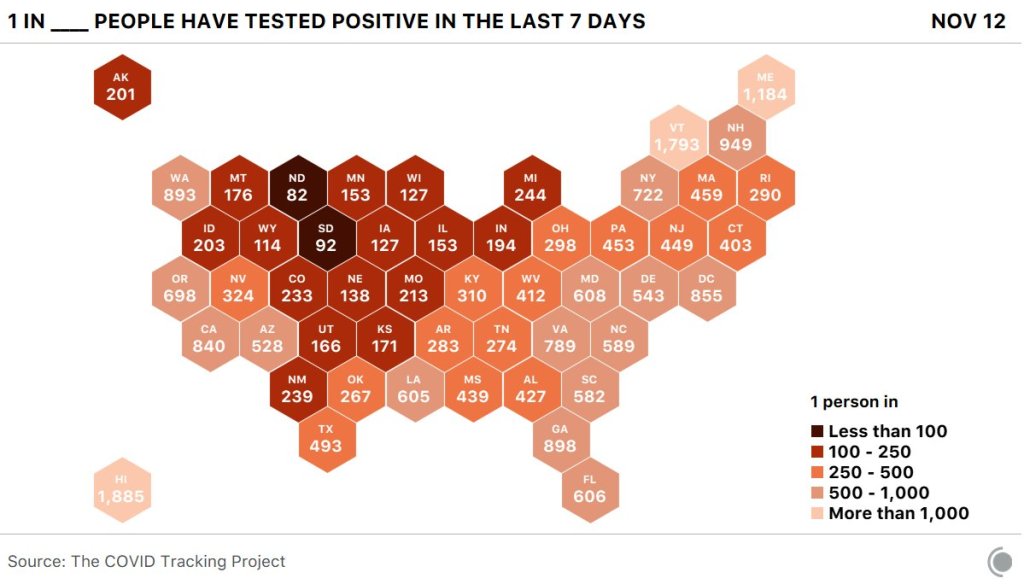
    Here’s how it works. You take the number of COVID-19 cases reported in the past week and divide the current U.S. population by that case number. There are variations; the metric may also be calculated for different time spans or smaller geographies, such as a specific U.S. state. But the standard calculation focuses on the nation, over the past week.

    For example: in the past week, one in 331 Americans has been diagnosed with COVID-19. If we extend that out to the past two weeks: one in 192 Americans has been diagnosed with COVID-19 since November 1.

    Here’s what it looks like by state (reflecting data from November 5 to 12):

    “1 in X” chart published in the COVID Tracking Project’s daily update on November 12.

    The biggest challenge that data journalists like me face right now is putting massive COVID-19 numbers into a context that readers may easily understand. I’ve used a variety of analogies, comparisons, and visualizations, but I like this number because it feels visceral. I’ve had lectures smaller than 331 people. I’ve been to protests ten times bigger. It’s a number of people that I can picture, a number of people that would fit in my neighborhood park.

    Among COVID Tracking Project volunteers, this metric is known as the Camberg Number—after Nicki Camberg, City Data Manager at the Project, who first shared it in Slack earlier in November. I asked her where she got the idea for this calculation and how she’s thinking about pandemic data during this terrifying surge.

    Here’s what she said:

    When thinking about COVID-19, the metrics we’ve been using have started to blur together and stop having the same impact after months of staring at them. What is the difference between 100,000 and 150,000 new cases? Well, obviously, 50,000 more cases, but I can’t conceptualize that, nor can most people. Numbers that high feel almost abstract and easy to ignore. I could feel myself starting to normalize these increasing case and hospitalization rates, and I had to figure out a way to stop that from happening. If I, someone who spends all day every day collecting, discussing, and working with COVID-19 data, was starting to get desensitized to the pandemic—what must it be like for the general public?

    I knew I had to find a way to make it more personally relatable, but also find a way to use the data I look at every day to better inform my own decisions. When I go to the grocery store, what is the probability that someone in the store with me tested positive? How many people in my grade currently have COVID? If my grandmother leaves her house, how many people does she have to interact with before it’s likely she was in the presence with someone who could infect her?

    The first time I calculated this number was November 5th. The US had just hit 116,000 new cases in a day, the second day in a row of record breaking cases and the start of a week of near-constant exponential increases. I calculated that roughly 1 in 3,000 Americans were diagnosed with COVID-19 that day, and I was shocked. 1 in 3,000 people? That number felt like a punch in the gut, and made me see the devastating effect of this pandemic more than any other statistic I’d heard for months. It gets even worse when this is applied to state or local levels (which one can do using the newly released CTP City Dataset), and it is genuinely devastating when done by race.

    From the feedback I’ve gotten, it seems like a lot of people are feeling the same way I am: jaded and exhausted after half a year of a never ending pandemic. Sometimes we need a shock to the system to realize that this is not normal, is not something that can be ignored. Until there is a vaccine, cases will only continue to spike with the holiday season unless we all choose to practice radical empathy and collectively do all we can to curb the spread of the virus.