Blog

  • CDC now reporting a vaccination count (and other updates)

    CDC now reporting a vaccination count (and other updates)

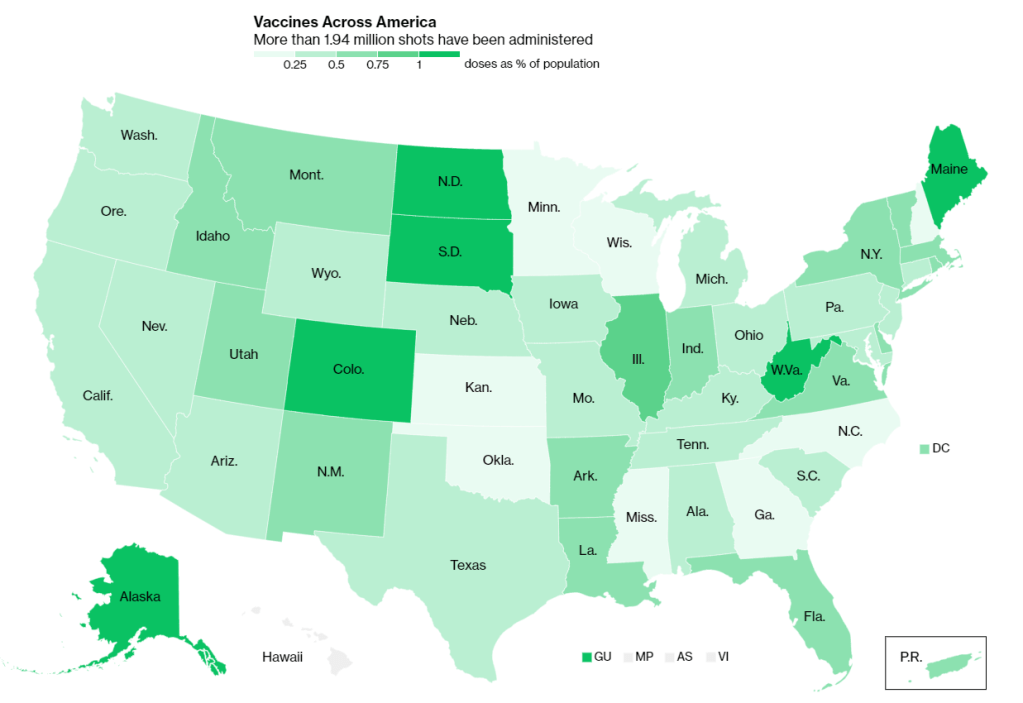
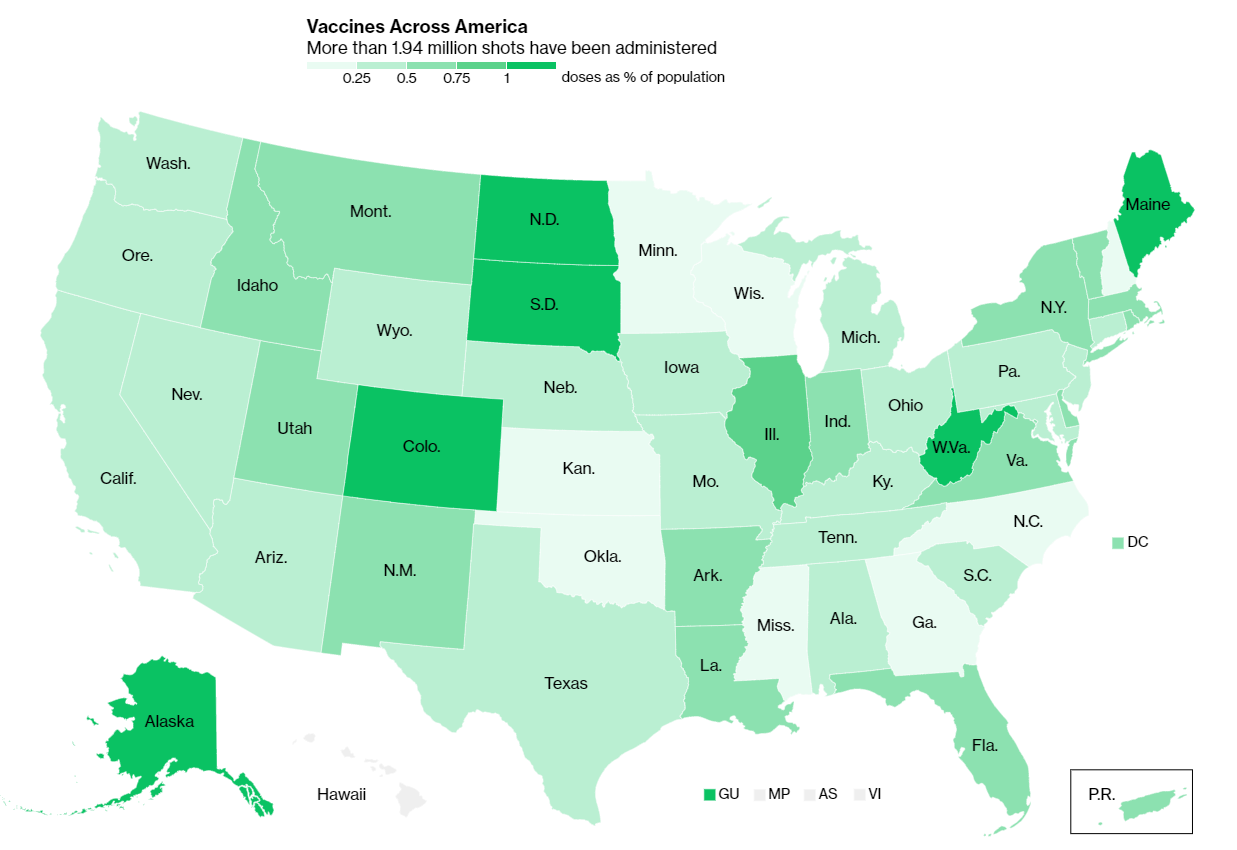
    Screenshot of Bloomberg’s COVID-19 Vaccine Tracker, taken on December 26.

    Despite the holiday, many jurisdictions have begun reporting COVID-19 vaccination data since my last issue. Here are the major updates:

    • CDC added vaccinations to its dashboard: Mere hours after I published last week’s newsletter questioning when the federal government would release a national count of how many Americans had been vaccinated, the CDC began posting just that. The CDC COVID Data Tracker now includes both a count of how many vaccine doses have been distributed and a count of how many people have received their first dose—1.9 million as of Saturday, December 26. The count includes both Pfizer and Moderna’s vaccines, and incorporates reporting from states, local public health agencies, and federal entities including the Bureau of Prisons, Veterans Administration, and Indian Health Services. More detailed geographic and demographic data are not yet available from the CDC.
    • 27 states are now reporting COVID-19 vaccination data: While the COVID Tracking Project is not tracking vaccinations, the Project is keeping a running list of states that are reporting vaccine-related metrics. As of December 25, 27 states are reporting vaccine doses administered or another similar metric. Of the states reporting vaccinations, nine are reporting race and ethnicity of the residents vaccinated—that’s a huge jump from last Sunday, when only Florida was reporting this information. In other demographic metrics: 14 states are reporting age of those vaccinated, 10 are reporting sex or gender, and 14 are reporting county.
    • How the COVID Tracking Project hopes vaccines will be tracked: In addition to its state dashboard annotations, the Project released a blog post last week detailing key information that Project leads believe should be prioritized by state and federal public health departments, as well as what states are reporting so far. Key metrics include: the number of people fully vaccinated (not just the number of doses administered), demographic data reported in absolute numbers (not percentages), county-level data, and data on vaccinations in long-term care facilities.
    • New Mexico will notify residents when they qualify for vaccination: This past Wednesday, the New Mexico Department of Health launched a website where state residents can sign up to learn when they will be eligible to receive a COVID-19 vaccine. The sign-up form is currently somewhat confusing to use, as a new user must click “Schedule a New Appointment” to put in their contact details—even if they aren’t eligible for vaccination yet. Still, this effort to provide transparency about vaccination progress on such an individual level is unique among states thus far.
    • Our World in Data is tracking COVID-19 vaccinations worldwide: As of December 26, the open-source data repository Our World in Data is compiling vaccination counts from 10 countries: the U.S., the U.K., China, Russia, Israel, Canada, Bahrain, Chile, Mexico, and Costa Rica. So far, the U.S. has administered the most doses at 1.9 million, while Bahrain has administered the most doses when adjusted for population, at 3 doses for every 100 people.
    • Initial COVID-19 vaccine data in North Carolina reveals racial disparities: Samantha Kummerer, reporter for ABC11 in Raleigh-Durham, North Carolina, used the state’s early demographic data to draw attention to healthcare disparity. “When compared to the overall population of North Carolina, both Black and Latino communities are severely underrepresented in COVID-19 vaccination data,” Kummerer writes. She goes on to explain that these data reflect the hospital workforce in North Carolina, which was the first group to be vaccinated—and which is overwhelmingly white. This story reflects why it is so important for states to be transparent about their vaccination demographics, even at such an early stage of vaccine deployment.

    Join the COVID Data Dispatch community

  • The 20 best COVID-19 data stories of 2020

    The 20 best COVID-19 data stories of 2020

    Here are 20 stories that have uncovered significant patterns of the pandemic, demonstrated a mastery of craft, and inspired me to be a better data journalist.

    (Disclaimer: I primarily read U.S. coverage from national and New York City-specific publications, so this list is not as diverse as I’d like; still, I did my best to include a variety of outlets and topics, featuring data viz-heavy stories as well as more traditional articles which explain COVID-19 numbers.)

    • Edward Holmes’ tweet announcing that the novel coronavirus genome has been posted (Jan. 10): Okay, so this isn’t technically a work of data journalism. But it seemed crucial to me that I include the most important tweet of the year. When Holmes publicly shared the genome of SARS-CoV-2—sequenced by Shanghai professor Yong-Zhen Zhang—scientists around the world immediately sprung into action, developing tests and therapeutics for the novel virus. “Please feel free to download, share, use, and analyze this data,” a note on the Virological.org posting reads. And scientists did: the first vaccines were designed within days.
    • Limited data may be skewing assumptions about severity of coronavirus outbreak, experts say (STAT News, Jan. 30): Helen Branswell’s diligent record on covering COVID-19 speaks for itself—I had to go eight pages back in her archive to find stories from January. (Her first story on the virus was published on January 4). This January 30 piece points out how a limited case definition hindered Chinese scientists attempting to determine how far the virus had spread through the country. Throughout the pandemic, Branswell has been an experienced voice who can clearly spell out the implications of medical data, as she does here: she explains why the severe COVID-19 cases that had been reported so far were the “tip of the iceberg.”
    • The Strongest Evidence Yet That America Is Botching Coronavirus Testing (The Atlantic, March 6): I wish I could include every single one of Alexis Madrigal and Rob Meyer’s COVID-19 data stories in this list; throughout the pandemic, these reporters have used data from the COVID Tracking Project (which they cofounded) to explain major COVID-19 trends and draw attention to issues in the U.S. Their work shows how journalists can benefit from truly getting inside of a dataset and spending months watching the same metrics. I chose these reporters’ first story, however, because it was the basis for the COVID Tracking Project itself. “How many people have actually been tested for the coronavirus?” Madrigal and Meyer ask. The answer, it turns out, took hundreds of volunteers, intensive infrastructure, and endless partnerships that spanned far beyond March.
    • Why It’s So Freaking Hard To Make A Good COVID-19 Model (538, March 31): At a time when it seemed like every other Twitter account suddenly belonged to an armchair epidemiologist, 538’s Maggie Koerth, Laura Bronner, and Jasmine Mithani swept in to expound upon the complexities of infectious disease modeling. The article uses simple graphics—flowcharts of color-coded boxes—to show all the factors that can go into calculations of how many people might get sick and die during the COVID-19 pandemic. Rereading it this week, I was struck by how relevant the story still is in articulating fundamental uncertainties about this virus.
    • Mapping Covid-19 outbreaks in the food system (Food & Environment Reporting Network, April 22/ongoing): Meatpacking plants and other food processing facilities have been some of the biggest outbreak sites in the U.S., but most government sources do not report specifically on these outbreaks. Reporter Leah Douglas has singlehandedly filled this gap by synthesizing reports from local news outlets, health agencies, and food production companies. She has updated the data visualizations in this story regularly since April. As of December 18, the most recent update, at least 1,257 meatpacking and food processing plants have seen COVID-19 cases. Tyson Foods has seen the most cases, at over 11,000.
    • How to Understand COVID-19 Numbers (ProPublica, July 21): Caroline Chen is a veteran infectious disease reporter who lived through Hong Kong’s SARS outbreak and reported on Ebola. With the help of designer Ash Ngu, she walks readers through a couple of key principles in understanding—and reporting—COVID-19 data. The story explains why to use seven-day averages over raw case numbers, how to understand test positivity rates, and more. I covered it in my first newsletter issue back in July and was inspired to write my own “how to understand COVID-19 numbers” story for Stacker in the fall.
    • To Navigate Risk In a Pandemic, You Need a Color-Coded Chart (WIRED, July 21): In this delightfully meta story, Maryn McKenna unpacks the design choices that go into those green-to-red risk charts that were widely shared across social media when states began reopening in the summer. She explains the challenge of taking risk—something that is inherently impossible to fully quantify—and putting it into one-size-fits-all guidance. True COVID-19 risk, the story explains, must incorporate one’s location, environment, behavior, and many more factors.
    • Which Cities Have The Biggest Racial Gaps In COVID-19 Testing Access? (538, July 22): A lot of journalists have tried to explain how systemic racism in America led to disproportionately high COVID-19 cases and deaths for the Black community. But this story, by a team of six 538 researchers and designers, is particularly effective. The graphics demonstrate a clear disparity: “testing sites in and near predominantly Black and Hispanic neighborhoods are likely to serve far more patients than those near predominantly white areas.” In South Texas, for example, a single testing site may have served 600,000 people—leading to extensive test wait times and other barriers to healthcare for COVID-19 patients.
    • Thousands of Texans are getting rapid-result COVID tests. The state isn’t counting them. (Houston Chronicle, Aug. 2): Fun story about this one: back in August, when I was working on my antigen testing issue, I needed to cite this piece on the disconnect between how antigen tests were being reported by Texas’ state public health agency and how they were being reported by several Texas counties. I paid for a subscription to the Houston Chronicle to get around the site’s paywall. And then, probably because I am a Millennial/Gen Z cusp who hates unnecessary phone calls… I never canceled my subscription. I have no regrets, though—the Houston Chronicle does good work. This particular story provided a clear explanation of antigen test reporting issues long before many other news outlets became aware of the test type.
    • Why the United States is having a coronavirus data crisis (Nature, Aug. 25): This story, by Nature’s Amy Maxmen, uses global context to explain why it is so damn hard for the U.S. to collect and share COVID-19 data. While South Korea has coordinated case reporting and contact tracing from 250 regional public health agencies, local agencies in the U.S. are overworked, underpaid, and relying on outdated technology. The article also discusses how a lack of federal leadership and data standards trickles down to make data collection, analysis, and transparency harder for epidemiologists.
    • A long time to wait (Spotlight PA, Sept. 24): There was a period in summer 2020 during which Sara Simon tweeted every day about delays in Pennsylvania’s COVID-19 reporting. The state often reported COVID-19 deaths months later than they had occurred, due to an antiquated data system that was not updated in time for Pennsylvania’s outbreaks—and caused additional confusion for public health workers and state data watchers alike. Simon and her colleagues’ story explores these reporting issues, while a data visualization of the death reporting lag in every state provides context.
    • Data Journalists’ Roundtable: Visualizing the Pandemic (The Open Notebook, Sept. 29): This roundtable interview brings together four data journalists to share the design choices behind COVID-19 graphics they produced. It includes both discussions of the journalists’ biggest challenges and behind-the-scenes notes on specific charts, ranging from a visualization of cell phone data to one of high-risk health conditions in minority communities. (One of the graphics featured is, in fact, a chart from the 538 article on COVID-19 modeling that I highlighted earlier in this list.)
    • This Overlooked Variable Is the Key to the Pandemic (The Atlantic, Sept. 30): Never has a science writer elaborated upon a single variable so expertly as Zeynep Tufekci does in this story. She uses k, a measure of how a virus disperses, to explain why some COVID-19 patients are able to infect many other people—in what epidemiologists call superspreading events—while other patients do not infect anyone else at all. The story walks readers through an immense amount of scientific evidence while clarifying basic principles with easy-to-grasp analogies.
    • Covid-19’s stunningly unequal death toll in America, in one chart (Vox, Oct. 2): This story lives up to its headline’s promise. The chart in question, by Vox’s Christina Animashaun, visualizes COVID-19 death rates with small human icons: each “person” represents one in 100,000 Americans who have died from the disease. As of early October, 98 of every 100,000 Black Americans had died from COVID-19, compared to 47 of every 100,000 white Americans. As of December 26, 126 out of every 100,000 Black Americans and 74 out of every 100,000 white Americans have now died of this disease.
    • Test Positivity in the US Is a Mess (The COVID Tracking Project, Oct. 8): Out of the many informative blog posts produced by the COVID Tracking Project since last spring, this is the one I’ve shared most widely. Project Lead Erin Kissane and Science Communication Lead Jessica Malaty Rivera clearly explain how COVID-19 test positivity—what should be a simple metric, the share of tests conducted in a given region that return a positive result—can be calculated in several different ways. Graphics by Júlia Ledur illustrate the different options, with the help of a cartoon COVID-19 patient called Bob. The post both highlights a major issue in COVID-19 data reporting and explains why the Project does not report test positivity on its own site.
    • We Don’t Really Know if COVID is Spreading in Lincoln Schools (Seeing Red Nebraska, Oct. 13): This local news story takes a deep dive into reporting issues in the Lincoln Public Schools district. Reporter Trish Wonch Hill explains why the school district’s data dashboard is “close to useless,” unpacks a flaw in the district’s contact tracing protocol that discounts in-school disease spread, and highlights a group of parents who have been tracking school cases on their own crowd-sourced dashboard. Data on COVID-19 in schools have been severely lacking throughout the pandemic—every local news outlet should be conducting this type of investigation.
    • A room, a bar and a classroom: how the coronavirus is spread through the air (El País, Oct. 28): This set of data visualizations by Madrid-based newsletter El País was shared far and wide after its publication in the fall—for good reason. As a reader scrolls through the charts, they clearly see how the novel coronavirus may travel through aerosols, or small air particles, in an indoor space. The charts effectively dispel widespread beliefs that sitting six feet apart or keeping masks on throughout a long conversation will protect everyone in the room from getting infected.
    • Pandemic Backlash Jeopardizes Public Health Powers, Leaders (KHN, Dec. 15/ongoing): Since the summer, reporters at KHN and The Associated Press have produced stories in the publications’ joint “Underfunded and Under Threat” series, highlighting how public health departments across the nation were ill-prepared for the pandemic. (The dataset behind this series was a featured source in one of my early issues back in August.) This story focuses on the leaders of local public health agencies who have faced pressure to leave their jobs during the pandemic, putting faces to the impacts of budget cuts and anti-mask threats.
    • 1 in 5 Prisoners in the U.S. Has Had COVID-19 (The Marshall Project, Dec. 18/ongoing): Similarly to the KHN story above, this article by criminal justice-focused outlet The Marshall Project is part of a broader reporting project. Since March, the Project has been compiling data on COVID-19 cases and deaths in prisons around the country, in partnership with The Associated Press. (Dataset available here.) This December article visualizes the full brunt of the pandemic in each state’s prisons—in South Dakota, three out of five prisoners have been infected—while also telling several individual stories about the people who have gotten sick in prison and the advocates who are fighting for them.
    • Remembering the New Yorkers We’ve Lost to‌ COVID‑19 (THE CITY, ongoing): Nonprofit local newsroom THE CITY is building an online memorial of the New Yorkers who have died due to COVID-19. As of December 18, the memorial includes 1,946 names—remembering about 8% of the over 24,000 New Yorkers who have been lost. Earlier in December, THE CITY hosted a two-day event series to honor the dead, including readings of poetry and the obituaries written by the publication’s staff. I also participated in a protest last summer during which hundreds of these names were read aloud; it was a sobering reminder of the people behind the COVID-19 data I use in my work every day.
  • National numbers, Dec. 27

    National numbers, Dec. 27

    National numbers

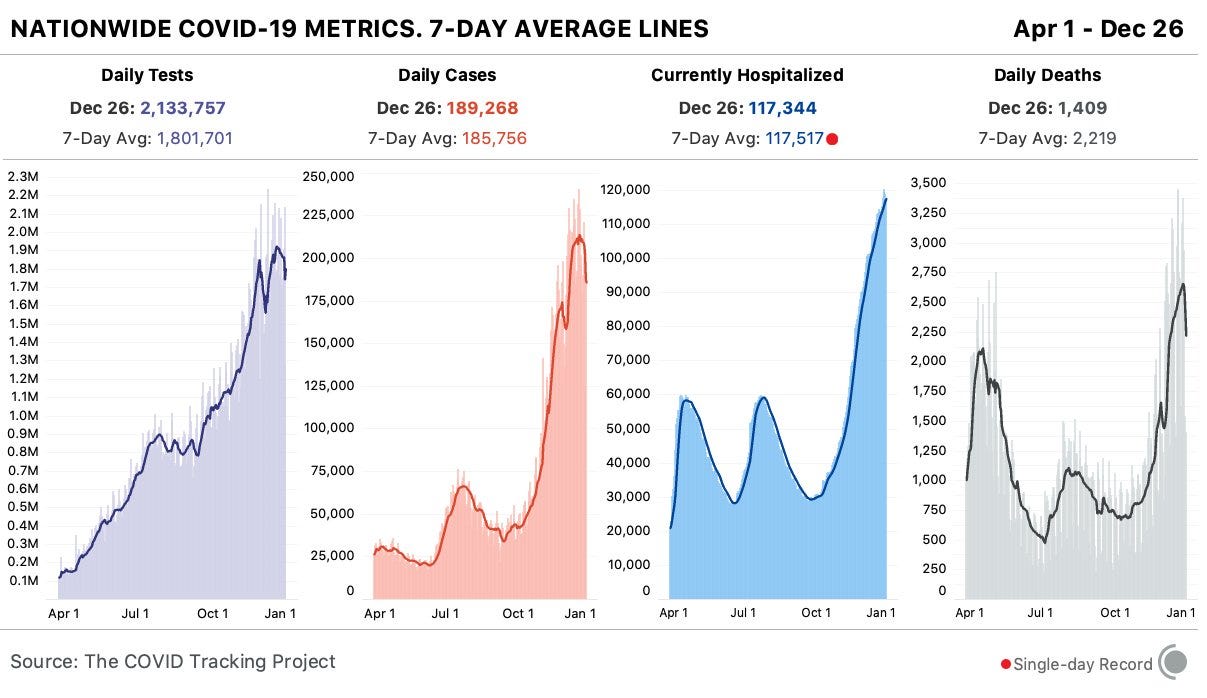
    In the past week (December 20 through 26), the U.S. reported about 1.3 million new cases, according to the COVID Tracking Project. This amounts to:

    • An average of 186,000 new cases each day
    • 397 total new cases for every 100,000 Americans
    • 1 in 252 Americans getting diagnosed with COVID-19 in the past week
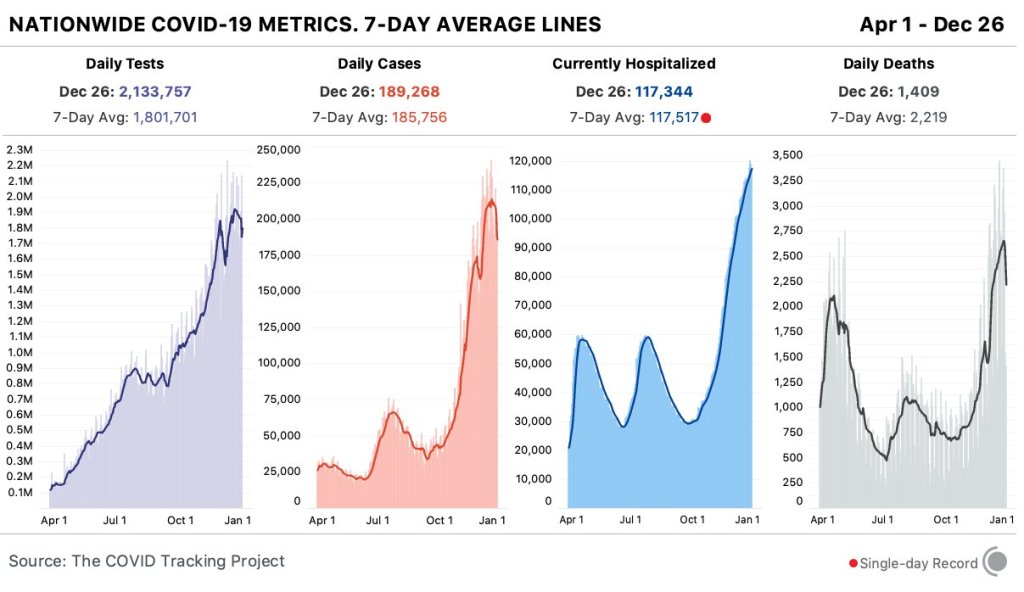
    Four bar charts showing key COVID-19 metrics for the US for April 1 to December 26. Today, states reported 2.1M tests, 189k cases, 117,344 currently hospitalized, and 1,409 deaths.
    Nationwide COVID-19 metrics published in the COVID Tracking Project’s daily update on December 26.

    Last week, America also saw:

    • 117,000 people now hospitalized with COVID-19 (36 for every 100,000 people)
    • 15,600 new COVID-19 deaths (4.7 for every 100,000 people)

    Around Thanksgiving, I wrote that COVID-19 data would likely get weird during and after the holiday. When the public health officials who compile and publish COVID-19 counts take a (well deserved!) day or two off, the cases, tests, and deaths that were not reported on those days off will be belatedly added to post-holiday counts. Here’s a COVID Tracking Project blog post that explains the trend in more detail.

    This pattern did, in fact, come to pass after Thanksgiving: the week of the holiday, 1.1 million cases were reported, followed by 1.3 million cases the next week and 1.6 million the week after that. We should expect this to happen once again over Christmas; indeed, the COVID Tracking Project noted that 20 states did not report COVID-19 data on December 25. The true impact of over a million people traveling will not be seen in the data for weeks to come.

    But while public health agencies may take a day off, hospitals never close. This week, more Americans were hospitalized with COVID-19 than ever: the number peaked on December 24, at over 120,000. That’s double the highest national patient number we saw in the spring or summer.

    Over 3 million Americans died in 2020—the highest number of lives lost in one year since the nation began this morbid count. At least 323,000 of those deaths were directly caused by the novel coronavirus.

  • Featured sources, Dec. 20

    These sources, along with all others featured in previous weeks, are included in the COVID-19 Data Dispatch resource list.

    • Mass Incarceration, COVID-19, and Community Spread: The nonprofit Prison Policy Initiative has published a new report showing how prisons impacted COVID-19 case rates in 2020. One major finding: rural counties with more incarcerated people per square mile had more COVID-19 cases, especially at higher percentiles.
    • COVID Border Accountability ProjectThis interactive map documents travel and immigration bans that countries have introduced in response to COVID-19. It’s compiled by a team of academic researchers, engineers, and other non-academic volunteers, and updated weekly on Wednesdays.
    • The Buffalo News’ trackers of COVID-19 cases in college athletics: CDD reader Rachel Lenzi, who covers college athletics for The Buffalo News, has kindly allowed me to share her spreadsheets compiling COVID-19 reports of COVID-19 cases in NCAA football and basketball programs. Football spreadsheetbasketball spreadsheet.
  • Schools go on winter break but discourse continues

    Rounding out the issue with a couple of updates on school data:

    • CDC issues new estimates for the cost of keeping K-12 schools safe: It would take about $22 billion for all public schools in the country to safely reopen in the spring, according to the CDC. The state-by-state estimates incorporate face masks, desk shields, cleaning supplies, transportation, and more. But these estimates are “significantly lower” than other estimates calculated by education organizations, as the CDC failed to include additional costs for face masks, food service, and contact tracing, according to U.S. News & World Report.
    • Rockefeller Foundation advocates for mass testing in schools: “Altogether, K-12 schools, their students, teachers and staff, will need approximately 300 million Covid-19 tests performed each month from February through June,” write the authors of a new Rockefeller report focused on safely controlling COVID-19 spread while vaccines are rolled out. The report provides detailed guidelines on testing and case studies from which readers can learn.
    • The College COVID-19 Outbreak Watchlist goes on winter break: After 15 weeks of updating his watchlist of colleges with high COVID-19 case numbers, Benjy Renton is taking a couple of weeks off. (From this dashboard, anyway.) Many schools have also suspended their COVID-19 reporting, as few students are on campus.

  • Facility-level hospitalization data updated on schedule

    Facility-level hospitalization data updated on schedule

    In the interest of giving credit to the HHS where credit is due: the agency updated its new facility-level hospitalization dataset right on schedule this past Monday.

    This dataset allows Americans to see exactly how COVID-19 is impacting individual hospitals across the country. In last week’s issue, I explained why I was excited about this dataset and what researchers and reporters could do with it. (The highlights: hyperlocal data that can be aggregated to different geographies, a time series back to August, demographic information on COVID-19 patients, and HHS transparency.)

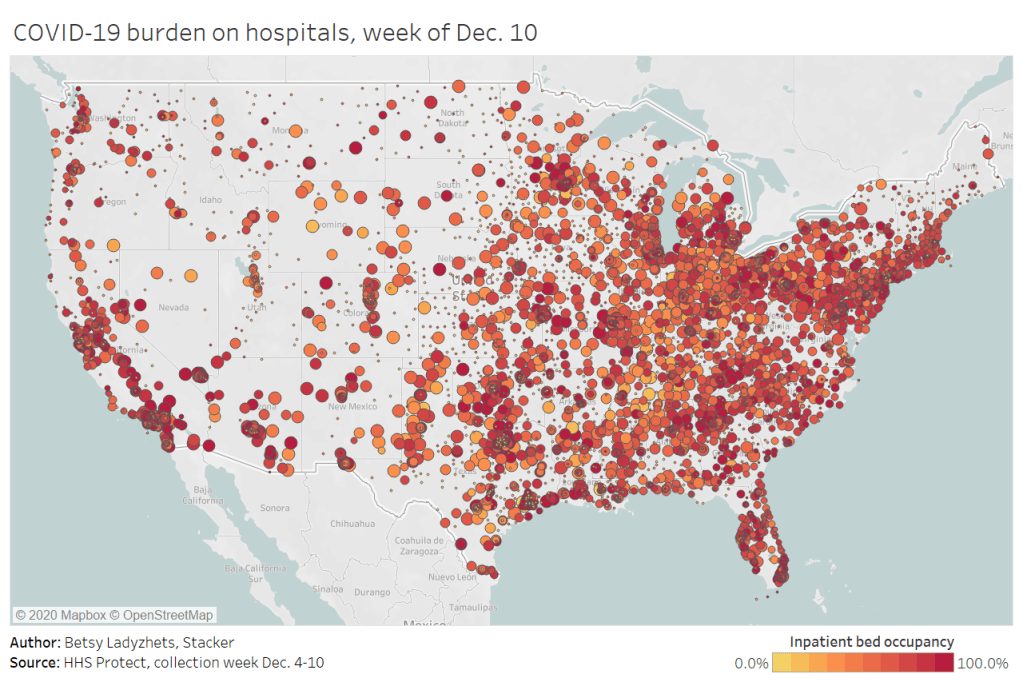
    Last week, I used this hospitalization dataset—along with the HHS’s state-level hospitalization data—to build several visualizations showing how COVID-19 has hit hospitals at the individual, county, and state levels.

    I also wrote a brief article on COVID-19 hospitalizations for Stacker, hosting visualizations and highlighting some major insights. The article was sent out to local journalists across the country via a News Direct press release. (If your outlet wants to repurpose Stacker’s article, get in touch with my coworker Mel at melanie@thestacker.com!)

    A few national statistics:

    • Nearly 700 hospitals are at over 90% inpatient capacity, as of the most recent HHS data. 750 hospitals are at over 90% capacity in their ICUs.
    • The states with the highest rates of occupied beds are Maryland (79.8% of all beds occupied), Washington D.C. (80.0%), and Rhode Island (85.2%).
    • States with the highest shares of their populations hospitalized with COVID-19 are Arizona (53 patients per 100,000 population), Pennsylvania (55 per 100K), and Nevada (67 per 100K).
    • 19% of hospitals in the nation are facing critical staffing shortages, while 24% anticipate such a shortage within the next week.
    • Staffing shortages are highest in Arkansas (33.6% of hospitals in the state), Wisconsin (35.6%), and North Dakota (42.0%).

    Meanwhile, The Accountability Project has developed a datasette version of this hospitalization dataset. With a bit of code, you can query the data to access metrics for a specific hospital, city, county, or state. The Project has provided example queries to help you get started.

  • HHS releases long-awaited national profile reports

    HHS releases long-awaited national profile reports

    For months, public health advocates have called on the federal government to release in-depth data reports that are compiled internally by the White House Coronavirus Task Force.

    The reports include counts of COVID-19 cases, deaths, and tests, as well as test positivity calculations. In addition to state-level data, the reports feature county-level data and even data for individual metropolitan areas, color-coded according to risk levels for each region. The reports have also drawn on these data to provide specific recommendations for each state. They have been a key piece of the federal government’s support for governors and other state leaders—but they haven’t been shared with the public.

    Liz Essley Whyte and her colleagues at the Center for Public Integrity have obtained copies of many of these reports and made them publicly available. But the scattered PDFs—often posted for only a few states at a time—provided only small snapshots from the vast trove of data HHS was using behind the scenes.

    This past Friday, the Department of Health and Human Services (HHS) began releasing all national COVID-19 reports and the data behind them. Now officially called “COVID-19 Community Profile Reports,” the reports are expected to be released as PDFs and spreadsheets every day.

    I asked Liz Essley Whyte why this release—one that she’s spent months pushing for—is so important. Here’s what she said:

    This release has local data that is so important for helping people make daily decisions about what’s safe. It also gives us the same picture of the pandemic that our federal government does, allowing us to weigh its response. It’s data that was assembled with taxpayer dollars and that affects everyone’s lives, so it was past time for it to be made public. I’m very glad it’s out there now. I think if it’s pursuing full transparency the White House should also make public the policy recommendations it gives to states weekly in the governors’ reports, alongside this helpful data.

    Whyte has also provided a tour of the information available in these reports, specifically geared towards local journalists who might want to use them.

    Here’s my own tour, a.k.a. why I’m excited about this new dataset:

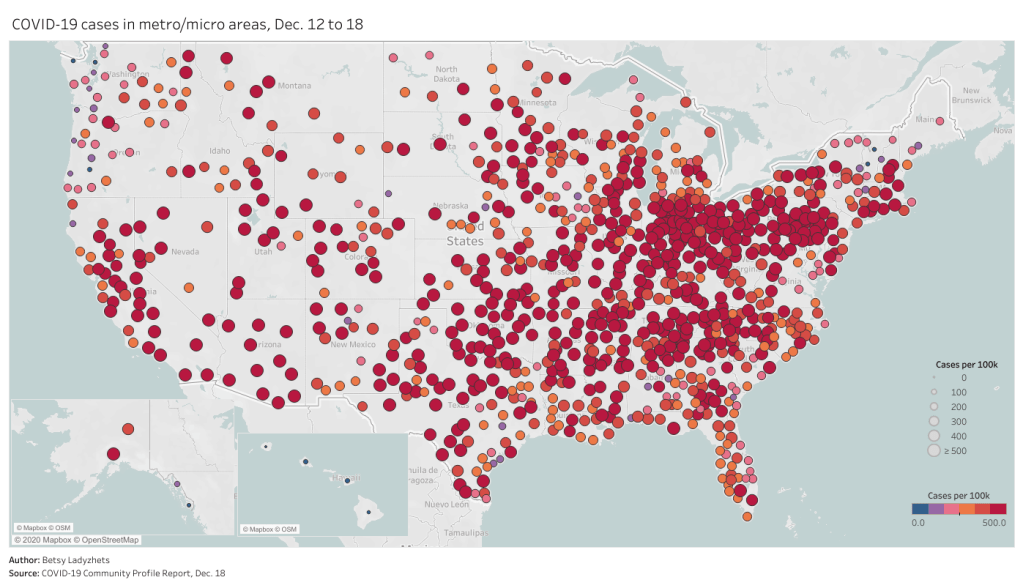
    • Data on metropolitan areas: Other sources were compiling state- and county-level data prior to Friday, but standardized data on how COVID-19 is impacting America’s cities were basically impossible to find. This new dataset includes information on over 900 metropolitan and micropolitan areas, making it much easier to compare outbreaks in urban centers.
    • Standardized data: One of the biggest challenges for COVID-19 data users has been a lack of consistency. Some states report every day of the week, some skip weekends. Some states report their tests using one unit, some report using another. Some states include antigen tests in their numbers, some don’t. And so on. But the HHS can smooth out these inconsistencies internally, as national testing laboratories and state public health departments are all required to report in the same way. What I’m saying is, this new report allows us to do something we haven’t been able to reliably do since the start of the pandemic: compare testing numbers across states.
    • Major metrics in one place: Before Friday, if I wanted case and death numbers by county, I’d go to the New York Times, while if I wanted testing numbers by county, I’d go to the Center for Medicare & Medicaid Services. The scattered nature of pandemic reporting has led researchers and journalists to cobble together stories from multiple disparate sources; now, we can get three major metrics in one easy place. (This data reporter loves to only have one Excel spreadsheet open at a time.)
    • Contextual data built in: Not only does this new dataset include several important metrics in one place, it also contextualizes those metrics with key demographic information. For each state, county, and metro area in the dataset, numbers such as the share of this region living without insurance and the share of the region over age 65 are included right next to that region’s COVID-19 metrics. Two indices that indicate the region’s demographic vulnerability to the virus are also included: the CDC’s Social Vulnerability Index and the Surgo Foundation’s COVID-19 Community Vulnerability Index. I covered both in my November 29 issue.
    • Rankings for policymakers: In addition to raw counts of cases, deaths, and tests, the Community Profile Reports include calculated values that make it easy for local leaders to see how their communities compare. The reports rank states according to their cases per 100,000 population, positivity rate (for PCR tests), hospital admissions, and other metrics. They highlight key cities that demand attention and aid, such as Phoenix, Arizona and Nashville, Tennessee. They even forecast death totals based on current case counts—a morbid metric, but a useful one nonetheless.
    • More transparency: Like the facility-level hospitalization dataset released last week, the Community Profile Reports signify that the HHS is finally stepping up to provide the American public with the information that informs key public health decisions. The absence of national data during this pandemic was never meant to be filled permanently by journalists or volunteer data-gatherers—the federal government is built for this work. Journalists are, instead, built to watch this work closely and hold it accountable.

    In the agency’s Friday press release, HHS states:

    HHS believes in the power of open data and transparency. By publicly posting the reports that our own response teams use and by having others outside of the federal response use the information, the data will only get better.

    As of Saturday night, the dataset has already been downloaded nearly 6,000 times. That’s nearly 6,000 people who can use these data and make them better—and the number will only grow.

  • 15 states are reporting COVID-19 vaccination data—federal government lags behind

    15 states are reporting COVID-19 vaccination data—federal government lags behind

    !function(){“use strict”;window.addEventListener(“message”,(function(a){if(void 0!==a.data[“datawrapper-height”])for(var e in a.data[“datawrapper-height”]){var t=document.getElementById(“datawrapper-chart-“+e)||document.querySelector(“iframe[src*=’”+e+”‘]”);t&&(t.style.height=a.data[“datawrapper-height”][e]+”px”)}}))}();

    Back in September, I read the Interim COVID-19 Vaccination Playbook released by the Centers for Disease Control and Prevention—the first national plan for how vaccination was supposed to proceed. Here’s an excerpt from my newsletter issue covering this playbook:

    Once COVID-19 vaccination begins, the CDC will report national vaccination data on a dashboard similar to the agency’s existing flu vaccination dashboard. According to the playbook, this dashboard will include estimates of the critical populations that will be prioritized for vaccination, locations of CDC-approved vaccine providers and their available supplies, and counts of how many vaccines have been administered.

    This past week, the first COVID-19 vaccine doses were administered to frontline healthcare workers across the country. The FDA issued Emergency Use Authorization to a second vaccine. But I haven’t seen a vaccination dashboard from the CDC; the closest we’ve come so far is a dataset listing initial allocations of Pfizer doses for every state. This federal agency is lagging behind several states that are making their vaccination counts public, as well as journalists who have already begun to compile the limited information that’s available.

    Here’s how the reporting of vaccination data is supposed to work. When someone goes in to get their COVID-19 shot, the provider of that shot will enter their name and other personal information to a state registry called an Immunization Information System, or IIS. Vaccine providers that issue shots and send data may include hospitals, clinics, pharmacies, pop-up vaccination sites, and any other institution that is giving shots.

    Most states and several large cities, like New York City, have these immunization registries; New Hampshire is still getting its registry ready to track COVID-19 vaccines. The registries stay private, with data only available for the people who ship, administer, and manage vaccines. A data system called the IZ gateway will help different state immunization systems link up with each other and with the CDC, which has asked all states to formally agree to share their data with this federal agency. (The CDC has asked states to share a pretty extensive list of data points for each vaccine patient, including names and addresses, which some states are not willing to send.)

    The CDC has also developed a system to help vaccine providers manage supplies and patients, a public-facing website that will help Americans see where they can get vaccinated, and a new software that will pull all vaccine-related information into one place for Operation Warp Speed officials to use. Finally, an HHS data system called the Vaccine Adverse Event Reporting System will collect information on patient reactions to the vaccines, such as headaches and fatigue—both of which are expected reactions to the Pfizer and Moderna vaccines.

    For more detail on these data systems, see this article by USA TODAY’s Aleszu Bajak and Janet Loehrke, which I drew upon to write this part of the newsletter.

    Theoretically, the CDC should have precise counts of how many people have received vaccine doses in every state, as well as personal identifying information for all of those people. So far, however, it appears that many states are beginning to make these data public, while the federal government has yet to release national numbers.

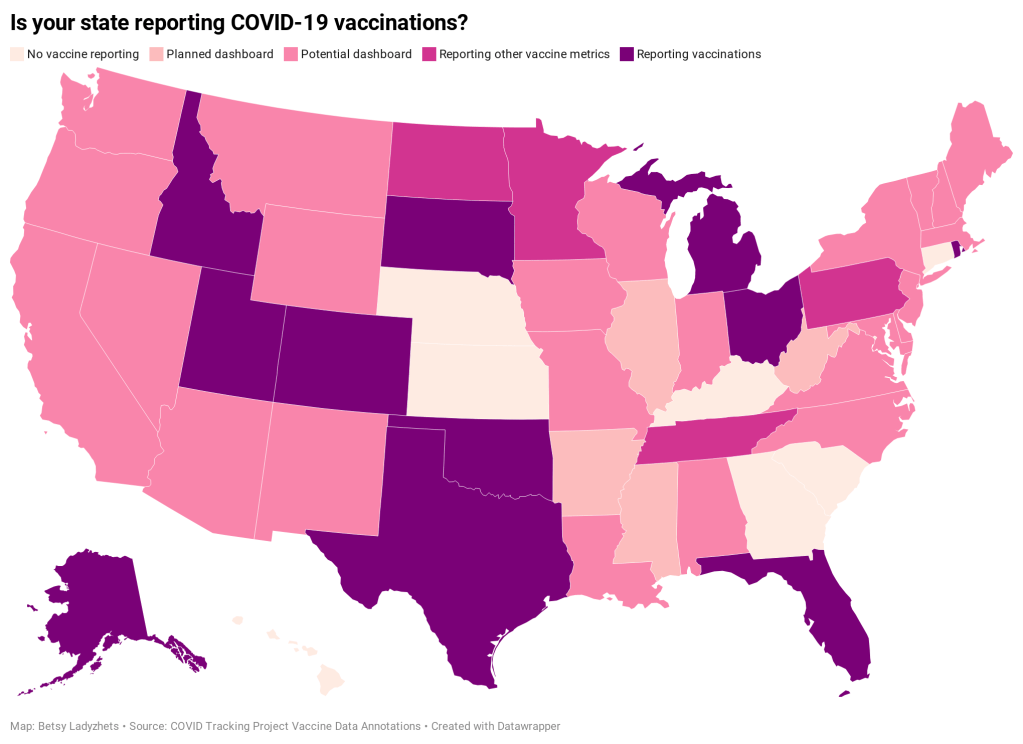
    According to ongoing analysis by the COVID Tracking Project, 15 states are reporting some form of vaccination data as of December 19. Here’s the breakdown:

    • Five states have added a count of vaccine doses administered as a single metric on their dashboards: Alaska, Colorado, Idaho, Oklahoma, and Rhode Island.
    • Two states have added vaccination-specific pages to their dashboards: South Dakota and Utah.
    • Three states have built entirely new dashboards for vaccination: Michigan, Ohio, and Texas.
    • Florida is releasing daily vaccination reports.
    • Four states are reporting vaccine-related metrics (such as counts of approved providers and doses delivered) that don’t yet include actual counts of the doses administered: Minnesota, Pennsylvania, North Dakota, and Tennessee.
    • Five states are reporting some form of demographic data: Michigan reports vaccinations by age; Texas reports by county; Utah reports by local health jurisdiction; Ohio reports by age and county; South Dakota reports by age, gender, and county; and Florida reports by race, age, gender, and county.

    For links to all of these states’ dashboards and reports, see the COVID Tracking Project’s annotations.

    Florida is the only state to report vaccination counts broken down by race so far, though the state has not yet reported such counts for different ethnicities. Public health experts have widely agreed that people of color—especially Black Americans, Native Americans, and Hispanic/Latino Americans—should be prioritized in COVID-19 vaccination because these communities have been disproportionately impacted by the pandemic. But without knowing vaccination rates in these vulnerable communities, it will be impossible to determine whether they are receiving the medical treatment they deserve.

    A recent article by ProPublica’s Caroline Chen, Ryan Gabrielson, and Topher Sanders calls attention to the lack of standardization that currently exists for state collection of race and ethnicity data:

    In state vaccination registries, race and ethnicity fields are simply considered “nice to have,” explained Mitchel Rothholz, chief of governance and state affiliates for the American Pharmacists Association. While other fields are mandatory, such as the patient’s contact information and date of birth, leaving race and ethnicity blank “won’t keep a provider from submitting the data if they don’t have it.”

    In other words, if a Black woman gets the Moderna vaccine at a Walgreens in Brooklyn, she could feel uncomfortable disclosing her race on the pharmacy’s form—and little action would be taken to explain to her why such disclosure is important and how her information would be used. The “race” checkbox on her form would be left blank. She would likely go uncounted by researchers and journalists trying to hold the government accountable to its promises of equity.

    The federal government should be both more rigorous in requiring race and ethnicity data and more transparent in disclosing these data—but I’d take a simple, national count of how many people in America have received COVID-19 shots to start. Recent data releases from the HHS have made me pretty optimistic about the federal public health agency’s ability to be transparent (see: the next two sections of this issue.) But the lack of a federal dataset so far means that key COVID-19 information is once again scattered.

    In a Poynter webinar last week, Al Thompkins asked a panel of top infectious disease experts—including scientists on both the FDA’s and the CDC’s vaccine advisory panels—a simple question: Will the public be able to see counts of how many people are getting vaccinated? None of those experts had a clear answer. There may be a dashboard in the works behind the scenes of which the panelists hadn’t been informed, but their responses still did not inspire confidence.

    Of course, journalists are once again stepping in to cobble together vaccination counts from all the public sources they can find. Bloomberg has counted 211,000 Pfizer doses in the U.S., as of December 19, by compiling numbers from state websites, press conferences, and interviews. The New York Times has surveyed state public health departments. Benjy Renton continues to update a Tableau dashboard that compares planned Pfizer and Moderna shipments to state populations.

    And the Kaiser Family Foundation released its COVID-19 Vaccine Monitor, an ongoing project to track public perception of and experiences with vaccination. The latest survey from this monitor shows that 71% of Americans would “definitely or probably” get a vaccine for COVID-19 if it was determined to be safe and freely available.

    This week, as I’ve seen the vaccination numbers—and the photos of frontline healthcare workers getting these well-deserved shots—I’ve felt something strange. Something hopeful. For the first time since March, I’m looking at numbers that I actually want to see go up. Now, if we could just get more comprehensive numbers, and get them more standardized, and get them reported with a priority on racial justice…
  • National numbers, Dec. 20

    National numbers, Dec. 20

    In the past week (December 13 through 19), the U.S. reported about 1.5 million new cases, according to the COVID Tracking Project. This amounts to:

    • An average of 211,000 new cases each day
    • 451 total new cases for every 100,000 Americans
    • 1 in 222 Americans getting diagnosed with COVID-19 in the past week
    • 39% of the total cases reported across the globe this week, according to the World Health Organization
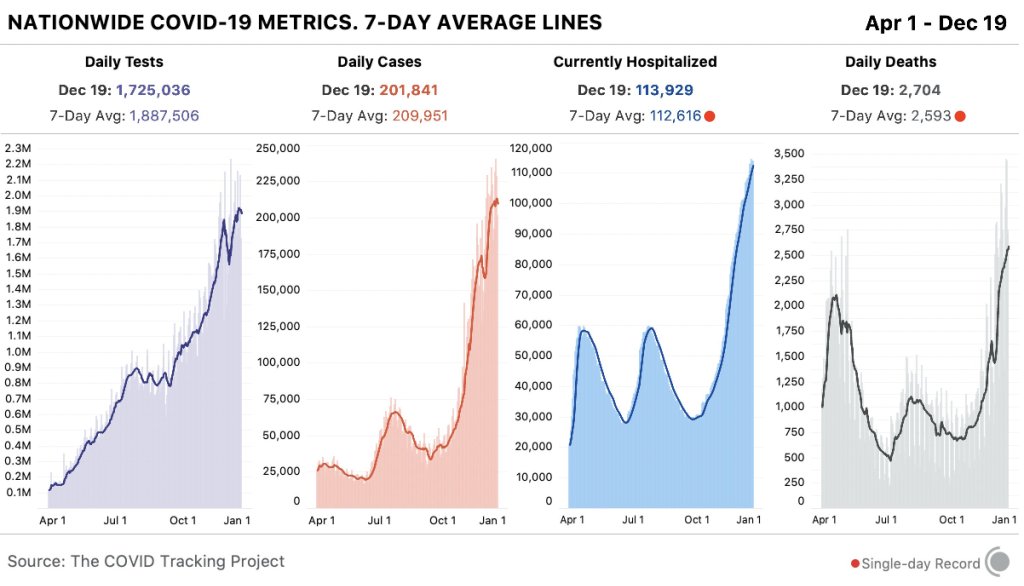
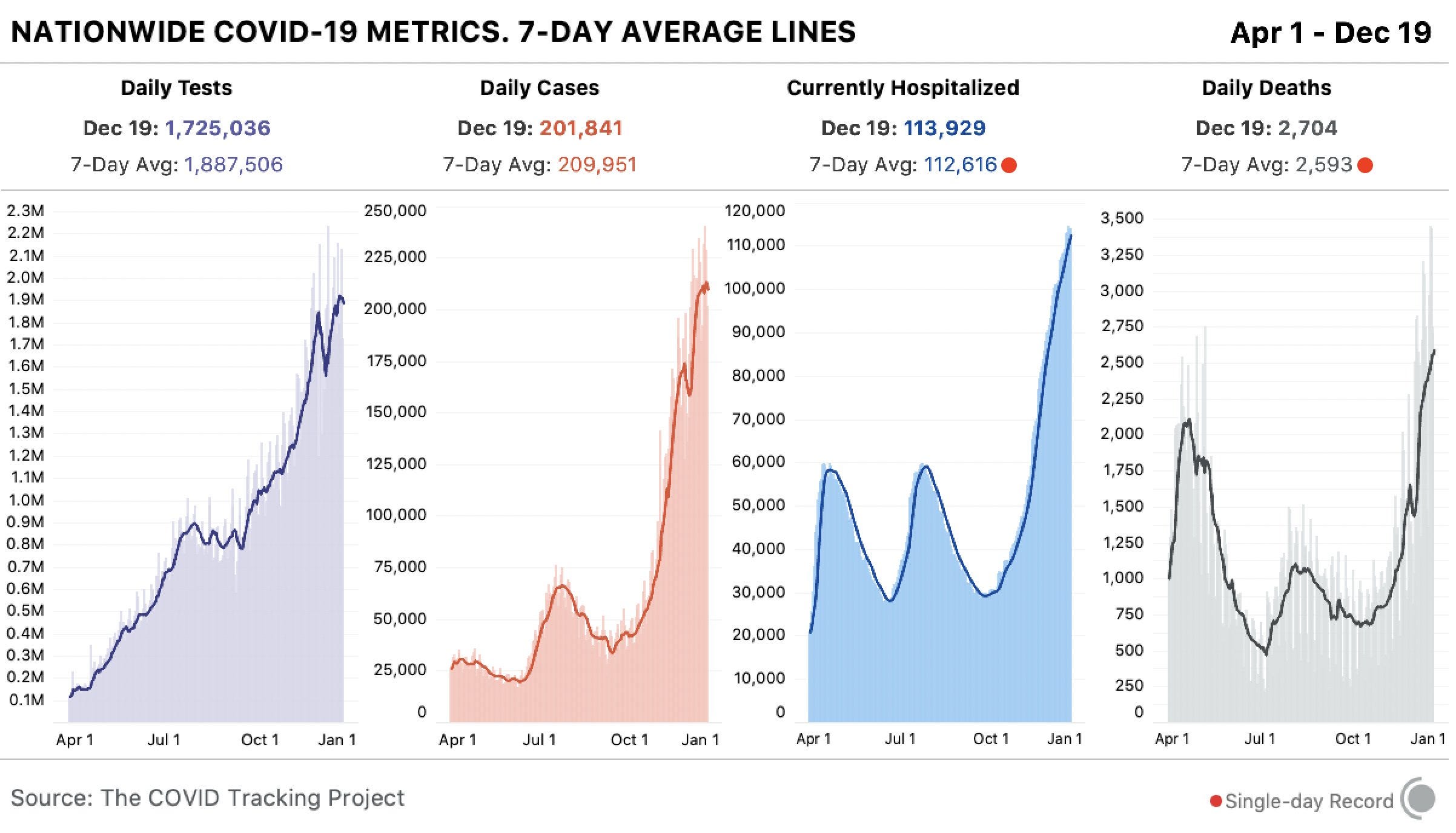
    4 bar charts showing key COVID-19 metrics for the US over time from April 1 to December 19. Today, states reported 1.7M tests, 202k cases, 113,929 currently hospitalized, and 2,704 deaths.
    Nationwide COVID-19 metrics published in the COVID Tracking Project’s daily update on December 19. Seven-day averages for hospitalizations and deaths are at all-time highs.

    Cases appear to be slowing nationwide, the Project’s weekly update reports—but the trend should be interpreted with caution, as many cases reported last week were delayed by the Thanksgiving holiday. And national counts obscure regional patterns: while the Midwest may have finally passed its peak of new cases, the Northeast, South, and West are all facing still-rising outbreaks. California alone reported 287,000 cases this week, and the state’s hospitals are already full.

    Last week, America also saw:

    • 114,000 people now hospitalized with COVID-19 (35 for every 100,000 people)
    • 18,300 new COVID-19 deaths (5.6 for every 100,000 people)

    The nation continues to pass its own record for deaths reported in a single week. COVID-19 is, unambiguously, the leading cause of death in the U.S. right now.

  • COVID source shout-out: FDA’s techies

    I watched a pretty significant quantity of the FDA’s vaccine advisory committee (or VRBPAC) meeting on Thursday. The meeting lasted nearly nine hours, from 9 AM to about 5:40 PM Eastern, and was plagued by top infectious disease experts who simply could not turn on their microphones.

    It was a typical Zoom meeting with a few older colleagues. But it was also a critically important meeting to discuss the safety of a novel biological product that might save thousands of lives. That’s why, this week, I am paying homage to the FDA tech people behind the scenes who needed to turn on and off those microphones, share those slides, and generally get all the VRBPAC information where it needed to go. As far as I could tell, they kept the meeting running smoothly without seriously angering any of the esteemed committee members. No small achievement!

    Also, the meeting had banger hold music during the breaks. (Disclaimer: I am a 23-year-old white girl who listens to indie instrumentals and the “How to Train Your Dragon” soundtrack while working. You might want to take my categorization of banger hold music with a grain of salt.)

    If you want to read actual, serious coverage of the VRBPAC meeting, STAT News kept a thorough liveblog.