Blog

  • Why did the CDC change its breakthrough case reporting?

    Why did the CDC change its breakthrough case reporting?

    Earlier this month, the CDC made a pretty significant change in how it tracks breakthrough cases. Instead of reporting all cases, the agency is only investigating and collecting data on those cases that result in hospitalizations or deaths.

    In case you need a refresher: “breakthrough cases” are those infections that occur after a patient is fully vaccinated (including both doses, if applicable, and the two-week waiting period after a final dose). These cases are rare—like, one in ten thousand rare. As I wrote back in April, it’s important to contextualize any reporting on these cases with their incredible rareness so that we hammer home just how effective the vaccines are.

    But just because breakthrough cases are rare doesn’t mean we shouldn’t pay attention to them. In fact, it’s critical to pay attention to these cases in order to monitor precisely how well our vaccines are working—and how new variants may threaten the protections those vaccines provide.

    As The Atlantic’s Katherine J. Wu explains:

    Breakthroughs can offer a unique wellspring of data. Ferreting them out will help researchers confirm the effectiveness of COVID-19 vaccines, detect coronavirus variants that could evade our immune defenses, and estimate when we might need our next round of shots—if we do at all.

    As I’ve discussed in past variant reporting, numerous studies have demonstrated that the vaccines currently in use in the U.S.—especially the Pfizer and Moderna vaccines—work well against all variants. That includes variants of concern, such as B.1.617 (from India), B.1.351 (from South Africa), and P.1 (from Brazil). But the vaccine efficacy rates for some of these variants are lower than that stellar 95% we saw in Pfizer and Moderna’s clinical trials. And some common therapeutic drugs don’t work well for patients infected with variants, too.

    As a result, scientists are concerned that, while the vaccines are working well now, they might not work well forever. Whenever the coronavirus infects a new person, it has the opportunity to evolve. And that continued evolution must be monitored. The first coronavirus variant able to evade our vaccines may emerge in a foreign country with a raging outbreak—but it may also emerge here in the U.S. Closely monitoring all breakthrough cases will help us find that dangerous variant.

    (Of note: A new, potentially-concerning variant was identified just last night in Vietnam; WHO scientist Maria Van Kerkhove described it as an offshoot of the variant from India, B.1.617, with “additional mutation(s).”)

    With that in mind, let’s unpack the CDC’s reporting change. When the vaccine rollout started, the agency was investigating all breakthrough cases that came to its attention—including those in patients with only mild symptoms, or with no symptoms at all. According to an agency study released this past Tuesday, the CDC identified 10,262 such breakthrough cases from 46 U.S. states and territories between January 1 and April 30, 2021.

    Keep in mind: By April 30, about 108 million Americans had been fully vaccinated. Dividing 10,262 by 108 million is where I got that “one in ten thousand” comparison I cited earlier. As I said: very rare.

    Starting on May 1, however, the CDC changed its strategy. Now, it is only tracking breakthrough cases that result in severe illness for patients, leading to hospitalization and/or death. The CDC says that this choice is intended to focus on “the cases of highest clinical and public health significance” rather than tracking down asymptomatic cases.

    In its May 25 report, CDC scientists said that 27% of the breakthrough cases identified before May 1 were asymptomatic. 10% of the infected individuals were hospitalized, though almost a third of those patients were hospitalized for a reason unrelated to COVID-19. Only 160 patients (less than 2% of the breakthrough cases) died.

    We need to take these numbers with a grain of salt, though, because the CDC has likely undercounted the true number of asymptomatic cases. Both clinical trials and studies on vaccine effectiveness in the real world have suggested that those people who get infected with COVID-19 after completing a vaccination regime are more likely to have mild symptoms, or no symptoms at all.

    Plus, the CDC is recommending that vaccinated Americans don’t need to get tested before traveling, if they have come into contact with someone known to have COVID-19, or for many of the other reasons that many of us got tested this past year. (The agency is still recommending that fully vaccinated people get tested if they’re experiencing COVID-19 symptoms, though.)

    As I wrote at Slate Future Tense last month, such guidelines are likely to drive down the number of COVID-19 tests conducted across the U.S. And this trend seems to be happening, so far: PCR tests dropped from their winter surge levels this spring, and are now dropping again. (Antigen and other rapid tests may be getting used more, but we don’t have any comprehensive data on them.)

    With that drop in testing—combined with the overall challenge of identifying asymptomatic COVID-19 cases outside of dedicated studies—it would be pretty damn hard for the CDC to track down all breakthrough cases. The agency’s focus on more serious cases instead may thus be considered a conservation of resources, directing research efforts and care to those Americans who get seriously ill after vaccination.

    But “a conservation of resources” is also a nice way of saying, the CDC made a lazy choice here. The agency has poured money into genomic surveillance over the past few months, sequencing over 20,000 cases a week (compared to a few thousand cases a week before Biden took office). In recent weeks, the Biden administration has announced renewed funding for public health and similar commitments to prioritizing scientific research. If the CDC wants to find and sequence breakthrough cases in order to identify vaccine-busting variants, there should be nothing stopping the agency.

    Or, as epidemiologist Dr. Ali Mokdad told the New York Times: “The C.D.C. is a surveillance agency. How can you do surveillance and pick one number and not look at the whole?”

    Out of those 10,262 cases that the CDC reported this week, only 5% had sequence data available—but the majority of those sequined cases were variants of concern, including B.1.1.7 and P.1. At The Atlantic, Wu reported that epidemiologists in some parts of the country are seeing more breakthrough cases tied to concerning variants, while others are seeing breakthrough case sequences that match the overall infections in the community.

    To me, this high level of unknowns and uncertainties mean that we need more breakthrough case reporting and sequencing, not less. And we need a national public health agency that commits to true surveillance, so that we aren’t flying blind when the coronavirus inevitably evolves beyond our current defenses.

    (P.S. Shout-out to Illinois, the one state that reports its own breakthrough case data.)

    More vaccine reporting

    • Sources and updates, November 12
      Sources and updates for the week of November 12 include new vaccination data, a rapid test receiving FDA approval, treatment guidelines, and more.
    • How is the CDC tracking the latest round of COVID-19 vaccines?
      Following the end of the federal public health emergency in May, the CDC has lost its authority to collect vaccination data from all state and local health agencies that keep immunization records. As a result, the CDC is no longer providing comprehensive vaccination numbers on its COVID-19 dashboards. But we still have some information about this year’s vaccination campaign, thanks to continued CDC efforts as well as reporting by other health agencies and research organizations.
    • Sources and updates, October 8
      Sources and updates for the week of October 8 include new papers about booster shot uptake, at-home tests, and Long COVID symptoms.
    • COVID source shout-out: Novavax’s booster is now available
      This week, the FDA authorized Novavax’s updated COVID-19 vaccine. Here’s why some people are excited to get Novavax’s vaccine this fall, as opposed to Pfizer’s or Moderna’s.
    • COVID-19 vaccine issues: Stories from COVID-19 Data Dispatch readers across the U.S.
      Last week, I asked you, COVID-19 Data Dispatch readers, to send me your stories of challenges you experienced when trying to get this fall’s COVID-19 vaccines. I received 35 responses from readers across the country, demonstrating issues with insurance coverage, pharmacy logistics, and more.
  • National numbers, May 30

    National numbers, May 30

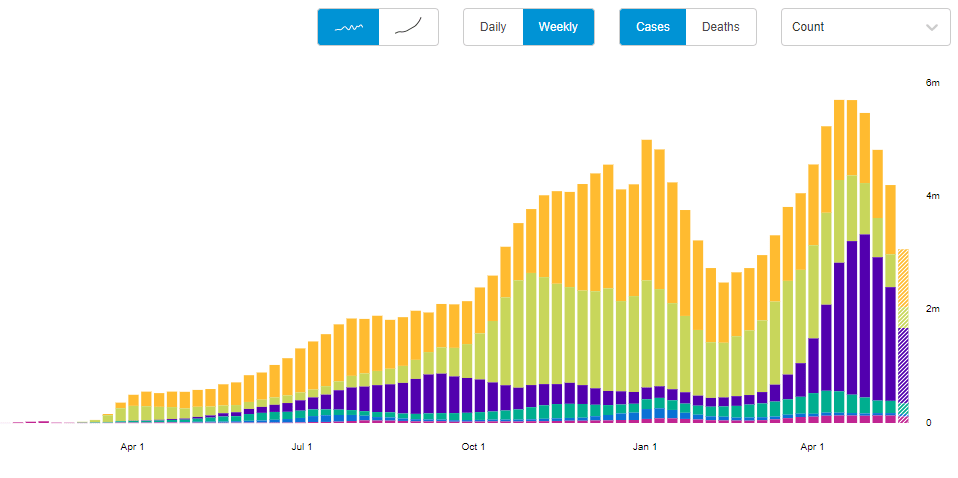
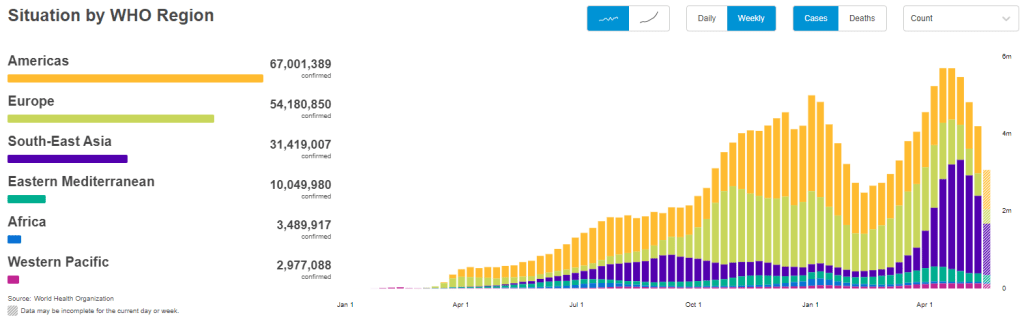
    New COVID-19 cases by region, via the WHO (data as of May 29).

    In the past week (May 22 through 28), the U.S. reported about 151,000 new cases, according to the CDC. This amounts to:

    • An average of 22,000 new cases each day
    • 46 total new cases for every 100,000 Americans
    • 22% fewer new cases than last week (May 15-21)

    Last week, America also saw:

    • 21,900 new COVID-19 patients admitted to hospitals (6.7 for every 100,000 people)
    • 3,000 new COVID-19 deaths (0.9 for every 100,000 people)
    • 70% of new cases in the country now B.1.1.7-caused (as of May 8)
    • An average of 1.4 million vaccinations per day (per Bloomberg)

    Cases, deaths, and hospitalizations all continue to drop nationwide. The U.S. reported about 3,000 COVID-19 deaths last week, in total—at the peak of the winter surge, we saw more than 3,000 deaths a day.

    This trend is echoed in most states. In the May 27 Community Profile Report, the HHS classifies almost every state as “orange” (between 50 and 100 new cases per 100,000 residents over the past week) or “yellow” (between 10 and 50 cases per 100,000). Wyoming is the only state in the “red” classification, at 101 cases per 100,000 over the past week—while California is in the green, with only 9 cases per 100,000.

    In New York City, where I live, every single ZIP code currently has a test positivity rate at 3% or lower—for the first time since last summer. This is yet another piece of good news showing how well the vaccines work. Half of the total U.S. population has had at least one dose and more than half of the adult population is fully vaccinated, as of yesterday.

    The vaccines also continue to do their part against variants. The CDC variant data—updated this week—indicate that B.1.1.7 is still growing, but it’s leveling off as new cases slow. This variant has gone from causing about 60% of cases in early April, to 67% in mid-April, to 70% in early May; a much slower decline than what we saw in February and March.

    Of more concern: P.1, the variant first identified in Brazil, is causing 7% of U.S. cases as of May 8—and the CDC’s Nowcast estimate puts it at almost 10% of cases by May 22. B.1.617, the variant first identified in India, is also sharply increasing; its case share doubled from April 24 to May 8. Both of these variants are more transmissible (B.1.617 dangerously so) and may have lowered vaccine efficacy.

    But the harm these variants can cause in the heavily-vaccinated U.S. pales in comparison to the risk they pose in other nations. As evidenced by the World Health Organization chart above, the share of cases in Southeast Asia and other lower-income nations is increasing even as cases in the U.S. and Europe drop. The U.S. should focus on providing aid to the nations where vaccinations are lagging so that we can help inoculate people before more, harder-to-contain variants evolve.

    In other words, there’s a reason I’m not giving space to the lab leak theory in this publication. If you’d like to read more about the issue, I recommend this article by Amy Maxmen.

  • COVID source callout: CDC’s vaccinations by age data

    COVID source callout: CDC’s vaccinations by age data

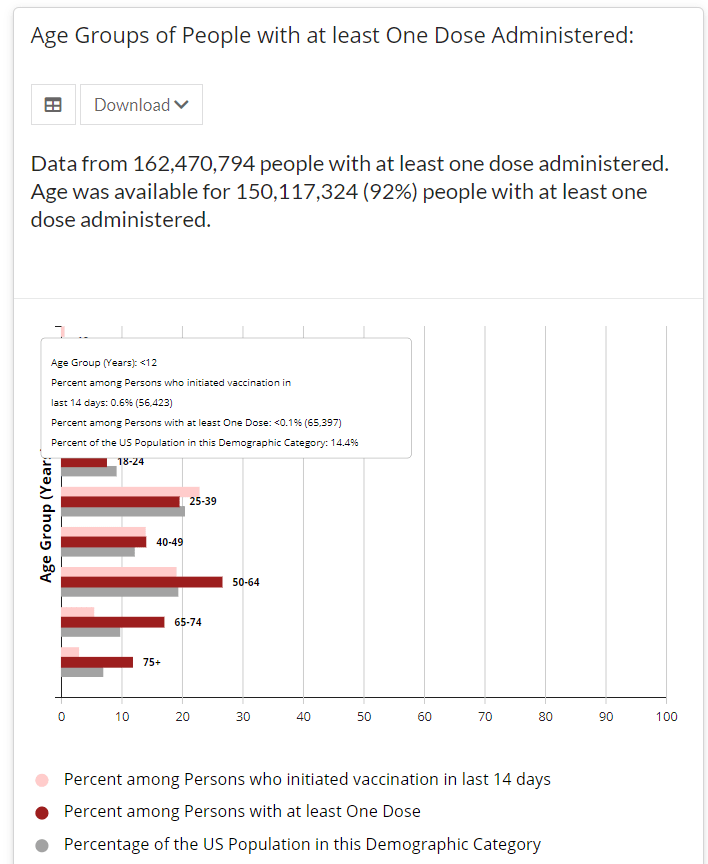
    Screenshot of the CDC’s vaccine dashboard, showing about 65,000 first dose vaccinations for children under age 12.

    When I sent out last week’s issue, the CDC’s Vaccination Demographics page was grouping newly eligible 12 to 15-year-olds in with 16 to 17-year-olds. Now, the agency’s age reporting has diversified a bit: you can find separate vaccination numbers for children ages 16 to 17, 12 to 15, and under 12.

    Wait… under 12?

    That’s right. The CDC reports that about 65,000 children under age 12 have received at least one vaccine dose as of May 22, even though this age group is not yet eligible for any of the vaccines on the market.

    Where did this number come from? The CDC’s page doesn’t offer any explanations, but possibilities may include:

    • Pfizer and Moderna are currently running clinical trials for the under-12 population, and children in these trials may have been entered into vaccination records.
    • Errors in the data pipeline—maybe some kids in the 12 to 15 age group were logged as under 12 instead, or some birthdays were input incorrectly.

    But the Pfizer and Moderna trials have enrolled only 12,000 under-12 participants total. That leaves over 50,000 vaccinations that we can’t explain—it’s a pretty big number to attribute to data errors.

    If anyone from the CDC is reading this and can tell me what’s up… my email is betsy@coviddatadispatch.com.

  • Featured sources, May 23

    • GAO analysis of COVID-19 in nursing homes: The Government Accountability Office, an organization that does research and audits on behalf of Congress, has a new report out this week on the devastating COVID-19 outbreaks that took place in nursing homes. The GAO researched about 13,000 facilities, using CDC data from May 2020 to January 2021. 94% of the nursing homes in the study faced at least one COVID-19 outbreak, with the majority of outbreaks (85%) lasting five weeks or more.
    • Johns Hopkins Pandemic Data Initiative: The Johns Hopkins Coronavirus Resource Center is one of the most widely-cited sources of COVID-19 data, providing detailed and up-to-date information for both the U.S. and the world. But the resource center’s scientists “have struggled to work with COVID-19 data that is inconsistent, incomplete, and insufficient,” writes JHU data lead Beth Blauer in a blog post. A new section of the resource center will explore data inconsistencies and highlight possible solutions.
    • Excess deaths by U.S. county: Excess deaths, or those deaths that occur above a region’s past baseline, are a common metric for examining the true toll of COVID-19. In addition to reporting excess deaths by U.S. states and demographic categories, the CDC’s National Center for Health Statistics (NCHS) also reports this information by county. A group of researchers (Stokes et al.) recently analyzed these county-level data and found that U.S. COVID-19 deaths may be underestimated by about 20%; their findings were published this week in PLOS Medicine.
    • Vaccine consent laws by state: As the Pfizer vaccine is now available to children ages 12 to 15, a lot of teenagers out there may want to know if they can get vaccinated without parental permission. The site VaxTeen provides these kids with information on the consent laws in every state, as well as a guide for talking to your parents about vaccines and other resources. (H/T Robin Lloyd.)

  • Vaccine cocktails look viable—just in time for hot-vax summer

    Some good global vaccine news this week: it looks like vaccine cocktails may be a promising option.

    A clinical trial based in Spain of around 600 participants (aged 18-59) reported encouraging results regarding mix-and-match vaccines (or “heterologous prime-and-boost,” if you want the jargon) meaning one shot of one vaccine and the second shot of another. In this study, the first dose given was AstraZeneca, and the second was Pfizer. 

    The study found that protective IgG antibodies were 30-40 times higher in the treatment group than the control group (those who had only received the first dose of the AstraZeneca vaccine). Neutralizing antibodies were also seven times higher after the Pfizer dose compared to the control, while usually they double in number after the second AstraZeneca shot. 

    As some people familiar with Covid vaccines may note, these vaccines use two different mechanisms to stimulate the immune system: the AstraZeneca shot uses an adenovirus vector modified with the SARS-CoV-2 spike protein while the Pfizer vaccine uses messenger RNA to coax cells into making the spike protein themselves. This early success demonstrates that vaccines with different mechanisms can be combined to induce a strong immune response.

    In the wake of the AstraZeneca blood clot news, it’s reasonable to expect that some may be hesitant to get the second shot if they have received the first AstraZeneca shot. Some authorities have advised people who have gotten the first dose of AstraZeneca to get an alternative for the second shot. Having an alternative that hasn’t been linked to blood clots might persuade those hesitant to get the second AstraZeneca shot to complete a vaccination regimen, especially if it might stimulate even more of an immune response than the regular AstraZeneca regimen.

    There’s currently another heterologous prime-and-boost trial in place in the United Kingdom with a slightly more complicated experimental setup (the four groups were AstraZeneca for both shots, Pfizer for both shots, Pfizer for the first and AstraZeneca for the second, or vice versa), with all participants over 50. 

    This study hasn’t reported results regarding immune responses yet, but they have reported some preliminary reactogenicity results. On May 12, researchers reported that mild side effects like fever or fatigue were more common in people who had received mixed vaccines. However, there were no severe side effects, and the mild ones subsided after a few days. The Spanish study did not find this, and instead found that mild side effects were about as common as they were with a regular vaccine regimen. 

    The UK study is expected to report immune response data soon, so it’ll be interesting to see if it matches the results found by the Spanish study. We’ll keep you updated when those results come out.

    More vaccine reporting

    • Sources and updates, November 12
      Sources and updates for the week of November 12 include new vaccination data, a rapid test receiving FDA approval, treatment guidelines, and more.
    • How is the CDC tracking the latest round of COVID-19 vaccines?
      Following the end of the federal public health emergency in May, the CDC has lost its authority to collect vaccination data from all state and local health agencies that keep immunization records. As a result, the CDC is no longer providing comprehensive vaccination numbers on its COVID-19 dashboards. But we still have some information about this year’s vaccination campaign, thanks to continued CDC efforts as well as reporting by other health agencies and research organizations.
    • Sources and updates, October 8
      Sources and updates for the week of October 8 include new papers about booster shot uptake, at-home tests, and Long COVID symptoms.
    • COVID source shout-out: Novavax’s booster is now available
      This week, the FDA authorized Novavax’s updated COVID-19 vaccine. Here’s why some people are excited to get Novavax’s vaccine this fall, as opposed to Pfizer’s or Moderna’s.
    • COVID-19 vaccine issues: Stories from COVID-19 Data Dispatch readers across the U.S.
      Last week, I asked you, COVID-19 Data Dispatch readers, to send me your stories of challenges you experienced when trying to get this fall’s COVID-19 vaccines. I received 35 responses from readers across the country, demonstrating issues with insurance coverage, pharmacy logistics, and more.
  • The CDC needs to release state-by-state data on who’s getting vaccinated

    The CDC needs to release state-by-state data on who’s getting vaccinated

    For months, I’ve been calling on the CDC to release state-by-state demographic data on who is getting vaccinated. While the vast majority of states report this information themselves, the state data are completely unstandardized—making it difficult to perform comprehensive analyses or compare one state to another.

    “The vaccine data that individual states are publishing replicate the patchwork nature of the other state-level COVID-19 data our teams have been compiling,” COVID Tracking Project leaders Alice Goldfarb and Erin Kissane wrote in The Atlantic in January.

    While many more states are reporting vaccination demographics now than in January—Montana and Wyoming are the only two states that now fail to report vaccinations by race—the data continue to be patchwork and hard to analyze.

    Bloomberg has devoted a small team to analyzing and presenting these data in the publication’s U.S. Vaccine Demographics Tracker. But Bloomberg isn’t making their underlying data public, so other journalists and researchers are unable to build on this work. And really, it shouldn’t be on journalists to standardize from a fragmented state-by-state landscape—it should be the work of the CDC.

    That’s why I was thrilled when, this week, we finally got that data from the CDC. Well… sort-of.

    A team from KHN received CDC state-by-state demographic vaccination data via a public records request. This team—which includes Hannah Recht, Rachana Pradhan, and Lauren Weber—analyzed the CDC’s data and made their work public on GitHub.

    The data indicate that, despite promises from the White House to prioritize vulnerable communities in the vaccination campaign, a lot of inequities persist: “KHN’s analysis shows that only 22% of Black Americans have gotten a shot, and Black rates still trail those of whites in almost every state.”

    !function(){“use strict”;window.addEventListener(“message”,(function(a){if(void 0!==a.data[“datawrapper-height”])for(var e in a.data[“datawrapper-height”]){var t=document.getElementById(“datawrapper-chart-“+e)||document.querySelector(“iframe[src*=’”+e+”‘]”);t&&(t.style.height=a.data[“datawrapper-height”][e]+”px”)}}))}();

    In some states, white residents have been vaccinated at almost twice the rate of Black residents. In Iowa, for example, 15% of the Black population has received at least one dose—compared with 37% of the white population. Other states with high disparities include Florida, New Hampshire, Maine, Wisconsin, New Jersey, New York, Hawaii, and Connecticut.

    Hispanic/Latino vaccination rates also lag behind the rates for white residents in some states, but the disparities are not as drastic as those for the Black population. Nationwide, 22% of Black Americans have received at least one dose, compared to 33% of white Americans.

    Both Native Americans and Asian Americans have higher vaccination rates than the white population. Many tribes, in particular, have made dedicated efforts to promote vaccination.

    And another hopeful caveat: vaccination rates for minorities have improved in recent weeks as the rate for white Americans goes down. In the last two weeks, about half of first doses administered in the U.S. have gone to people of color. This includes about 24% of doses going to Hispanic/Latino Americans, 10% going to Black Americans, and 8% going to Asian Americans.

    The day after KHN’s analysis was published, Victoria Knight (another KHN reporter) asked CDC Director Dr. Rochelle Walensky whether the agency would add state-level race and ethnicity vaccination data to its dashboard.

    “We have been updating our website,” Dr. Walensky said in response. “I can’t say that it’s daily; I believe that it’s weekly.”

    And yet as of Sunday morning, May 23, state-by-state demographic data are nowhere to be found on the CDC’s site.

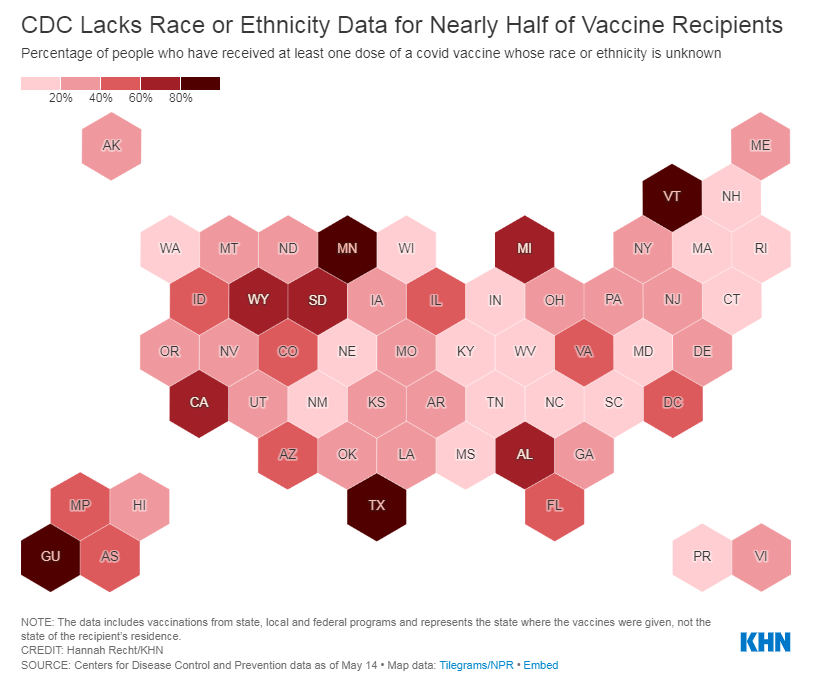
    Knight also asked what the CDC is doing to address the high number of vaccinations for which demographic details are unknown. Race/ethnicity data are missing for about 44% of vaccinated Americans, meaning that true disparities may be even starker.

    !function(){“use strict”;window.addEventListener(“message”,(function(a){if(void 0!==a.data[“datawrapper-height”])for(var e in a.data[“datawrapper-height”]){var t=document.getElementById(“datawrapper-chart-“+e)||document.querySelector(“iframe[src*=’”+e+”‘]”);t&&(t.style.height=a.data[“datawrapper-height”][e]+”px”)}}))}();

    In some states, that unknown percentage is much higher than 44%. Eight states “either refuse to provide race and ethnicity details to the CDC or are missing that information for more than 60% of people vaccinated,” according to KHN. These states are excluded from KHN’s analysis as a result: they are Alabama, California, Michigan, Minnesota, South Dakota, Texas, Vermont and Wyoming.

    Dr. Walensky told reporters the CDC is working with state and local public health departments to improve demographic reporting, but didn’t provide specifics.

    In order to continue improving vaccination rates for minority communities, the CDC needs to actually make all of the agency’s data public. If state-by-state demographic data were easily available, researchers and reporters like me could more easily identify both the success stories and the disappointments—and help the states that are lagging catch up. 

    As Hannah Recht put it on Twitter: “we should not have to keep FOIAing for CDC state-level data that they could just put online if they wanted to.”

    More vaccine reporting

    • Sources and updates, November 12
      Sources and updates for the week of November 12 include new vaccination data, a rapid test receiving FDA approval, treatment guidelines, and more.
    • How is the CDC tracking the latest round of COVID-19 vaccines?
      Following the end of the federal public health emergency in May, the CDC has lost its authority to collect vaccination data from all state and local health agencies that keep immunization records. As a result, the CDC is no longer providing comprehensive vaccination numbers on its COVID-19 dashboards. But we still have some information about this year’s vaccination campaign, thanks to continued CDC efforts as well as reporting by other health agencies and research organizations.
    • Sources and updates, October 8
      Sources and updates for the week of October 8 include new papers about booster shot uptake, at-home tests, and Long COVID symptoms.
    • COVID source shout-out: Novavax’s booster is now available
      This week, the FDA authorized Novavax’s updated COVID-19 vaccine. Here’s why some people are excited to get Novavax’s vaccine this fall, as opposed to Pfizer’s or Moderna’s.
    • COVID-19 vaccine issues: Stories from COVID-19 Data Dispatch readers across the U.S.
      Last week, I asked you, COVID-19 Data Dispatch readers, to send me your stories of challenges you experienced when trying to get this fall’s COVID-19 vaccines. I received 35 responses from readers across the country, demonstrating issues with insurance coverage, pharmacy logistics, and more.
  • How violence in Israel and Palestine is impacting COVID-19 rates

    How violence in Israel and Palestine is impacting COVID-19 rates

    As many Americans who lived through wildfire season, hurricane season, or the Texas winter storm know well: it’s hard to protect yourself in a pandemic when you’re dealing with another simultaneous disaster.

    And it is especially hard to protect yourself when you live in a region that’s cut off from resources and medical expertise—as is the case for people in Gaza and other Palestinian territories.

    In the past couple of weeks, violence in this region has shut down hospitals and prevented vaccine deliveries. Unvaccinated people have crowded into shelters in Gaza, while all testing and vaccination efforts have stalled.

    Gaza has also lost critical medical leadership in the recent violence: two senior doctors at  Al-Shifa Hospital, the largest hospital in the Gaza Strip, were killed in recent Israeli airstrikes. An early-morning attack on the al-Wehda district last Sunday killed Dr. Ayman Abu al-Ouf, head of internal medicine at the hospital, and Dr. Mooein Ahmad al-Aloul, a psychiatric neurologist, along with at least 30 others.

    Al Jazeera reports that “medical personnel remain in short supply” throughout the Palestinian territories, leaving people to instead rely on international aid groups for medical care. And constant air raids have limited medical care even further. One Israeli attack blocked the main road leading to Al-Shifa hospital, for example, and a Doctors Without Borders clinic was hit last weekend.

    “People are not daring to visit health facilities. We are fearing this will have a major negative impact,” Sacha Bootsma, an official from the World Health Organization, told the New York Times.

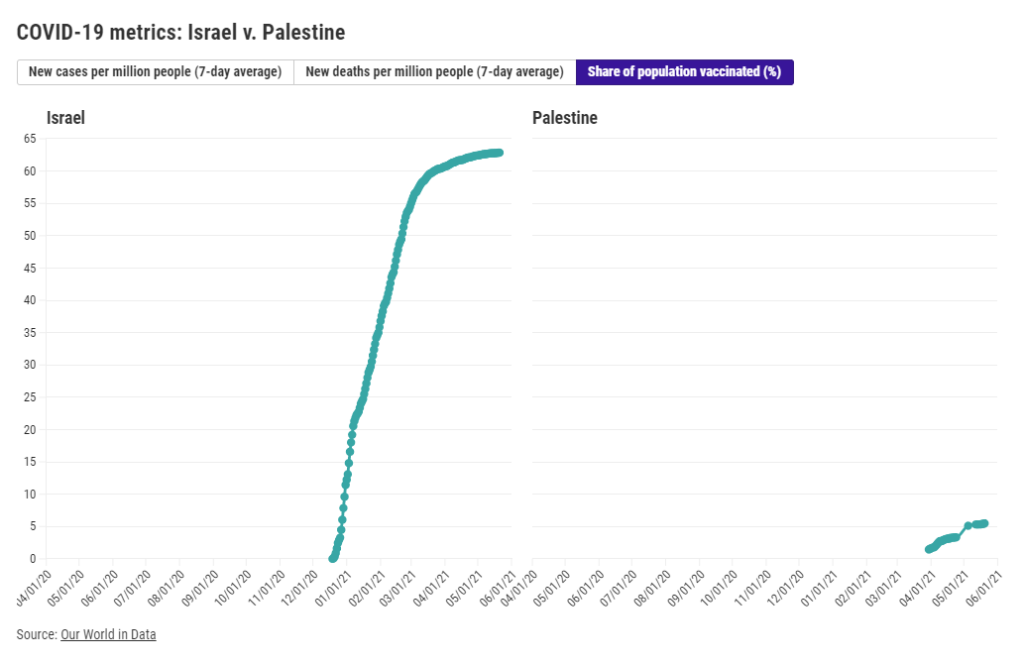
    About 5% of Palestinians have been vaccinated as of May 20. Most of those doses have come from COVAX, the global vaccine alliance, and shipments have faced logistical challenges in getting to Gaza through an Israeli blockade. The United Nations released a statement in January calling on Israel to “ensure swift and equitable access to COVID-19 vaccines for the Palestinian people under occupation,” but Israeli leaders have denied this responsibility.

    Israel, meanwhile, is largely protected against a COVID-19 surge. The country has been a global leader in vaccinations; by the end of February, over half of the population had received at least one dose. Now, almost two-thirds of the population are vaccinated.

    Cases in Israel have remained at low levels throughout the violence in recent weeks thanks to the vaccines. The country has seen fewer than 20 new cases per million people a day since mid-April. Palestine, meanwhile, faced a surge during March and April, with the territories’ highest COVID-19 case numbers yet.

    While reported case numbers in Palestine have dropped in recent weeks, this is more likely due to a lack of testing than an actual drop in infections. And the situation is not improving. Though Israeli and Palestinian forces have now formally reached a cease-fire, Israeli police have continued to attack Palestinians—including an attack against worshippers at al-Aqsa Mosque.

    Continued violence and lack of medical care for Palestinians may mean that the pandemic continues here long after it ends for Israel. As is true of all COVID-19 outbreaks, continued transmission may breed coronavirus variants that threaten the rest of the world.

    More international reporting

    • National numbers, May 23

      National numbers, May 23

      In the past week (May 15 through 21), the U.S. reported about 195,000 new cases, according to the CDC. This amounts to:

      • An average of 28,000 new cases each day
      • 59 total new cases for every 100,000 Americans
      • 19% fewer new cases than last week (May 8-14)
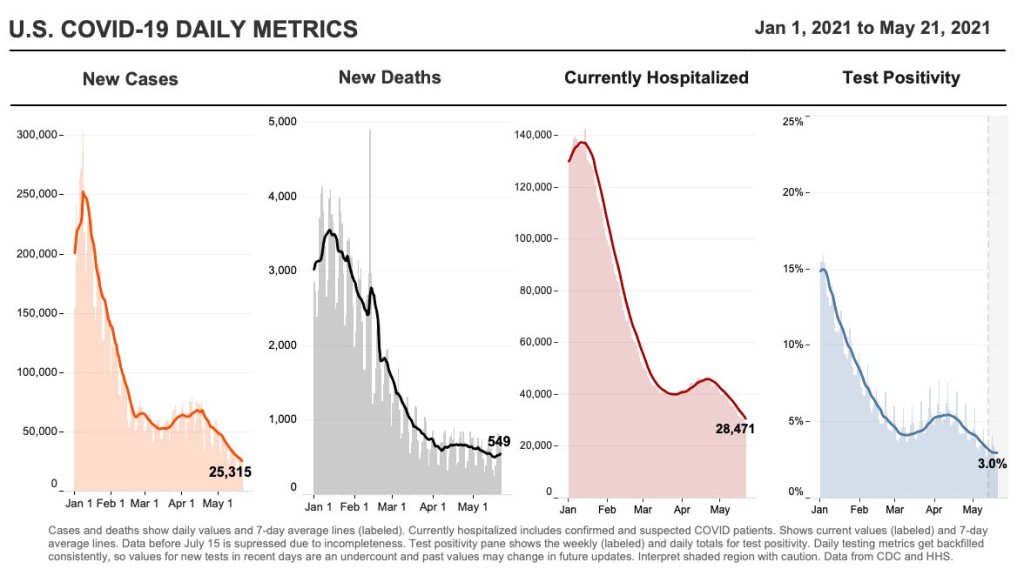
      Nationwide COVID-19 metrics as of May 21, sourcing data from the CDC and HHS. Posted on Twitter by Conor Kelly.

      Last week, America also saw:

      • 24,000 new COVID-19 patients admitted to hospitals (7.3 for every 100,000 people)
      • 3,500 new COVID-19 deaths (1.1 for every 100,000 people)
      • 66% of new cases in the country now B.1.1.7-caused (as of April 24)
      • An average of 1.9 million vaccinations per day (per Bloomberg)

      I’m starting to feel like a broken record in these updates—but in a good way. U.S. cases continue falling, with our seven-day average now at a level not seen since May 2020.

      Trends in COVID-19 deaths usually echo trends in cases with about a month’s delay. After several weeks of falling cases, the U.S. is now seeing fewer than 500 new COVID-19 deaths a day. This week, 24 states averaged fewer than one new death a day for every 100,000 residents.

      These states include California, Arizona, the Dakotas, and other states that made headlines in past months for their concerning outbreaks—yet another indication that the vaccines are working. Only three states (Michigan, Pennsylvania, and Alaska) saw over two deaths a day for every 100,000 people.

      Vaccinations continue at the slow, steady, 1.5-to-2 million a day pace we’ve seen for the past couple of weeks. About 61% of adults have had at least one dose, and almost half of adults are now fully vaccinated. Meanwhile, many kids in the 12 to 15 age range are taking advantage of their new eligibility: about 1.6 million have received at least one dose so far. 16% of the first doses administered in the last two weeks went to this population.

      Variant numbers haven’t been updated since last week. B.1.1.7 continues to be the dominant variant in the U.S., and other concerning variants (such as B.1.617 from India) continue to spread. But accumulating evidence suggests that the vaccines work well against all variants. Just yesterday, researchers in the U.K. reported 81% effectiveness against B.1.617, according to the Financial Times.

    • COVID source shout-out: Goodnight Turbovax

      COVID source shout-out: Goodnight Turbovax

      So long, farewell, I hope we never have to meet again: the sun is setting for the incredibly hardworking bot Turbovax.info. (As of May 15 it is still operational, and it is not clear when the bot will be retired for good.) New York City has opened more walk-in vaccine centers and as more people get vaccinated, and the bot’s creator, Huge Ma, tweeted that “It’s been a real honor to serve all of you but the need for TurboVax has come and gone.” The site has seen decreasing traffic since at least mid-April, as Ma tweeted on April 15 that there had been a 70% drop in bot traffic from the week before.

      The bot (and its creator) became somewhat of a local legend when vaccine appointments in NYC were harder to find than an under-$900k Brooklyn brownstone. They drew attention from outlets ranging from The Guardian to The New York Times to a particularly notable profile of Ma in The Cut—making “Vax Daddy” (or “Vaddy”) a household name for many engrossed in COVID-19 news. Mayoral candidate Andrew Yang has even courted Ma’s endorsement. (To date, he has not endorsed a candidate, though he has endorsed more protected bike lanes.)

      Ma has used his platform to advocate for AAPI folks and to denounce anti-Asian racism. On February 27, he suspended the bot as a form of protest as anti-Asian hate crimes rose across the country. (It was restored on March 1.) His continuing advocacy and fundraising for Welcome to Chinatown, a nonprofit providing resources for small businesses in the Chinatown area of Manhattan, has raised $200,000, according to his Twitter.

      We here at the CDD salute Ma’s incredible work, and personally, I’m particularly grateful for Turbovax for getting one of my friends vaccinated, posting really cute pictures of his cat MaoMao, and getting Bowen Yang back on Twitter for a brief spell. And amidst the sentimentality, there’s a smidge of good news: while the actual bot is being retired, Ma will still be tweeting from the @Turbovax account “bc it’s fun.”

    • Source updates, May 16

      Two more important CDC data updates for this week:

      • Vaccine demographics, for the past 14 days and over time: This week, the CDC added a new category to its Vaccine Demographics page. Previously, the page allowed users to compare overall first dose and fully vaccinated rates for different race/ethnicity, age, and sex groups; now, you can also make those comparisons specifically for vaccinations in the last two weeks. For a time series view, check out the Vaccine Demographic Trends page, which shows vaccination rates over time—now available for race/ethnicity, sex, and age. The race/ethnicity view clearly shows that White and Asian Americans are getting vaccinated at higher rates than other groups.
      • Variant tracker “Nowcast”: Loyal CDD readers will already know that I love to drag the CDC for reporting their variant data with an enormous lag; often the most recent figures on the agency’s Variant Proportions page are a month old. Well, maybe somebody on their team is reading, because this week, the CDC added a new option to its variant dashboard that addresses this issue. Selecting “Nowcast On” (below the variant color bars) allows you to view prevalence estimates for the current week, in addition to the agency’s most recent week of data collection. A note below the dashboard explains that the “Nowcast” figures are based on modeling estimates that extrapolate from known proportions. For example, B.1.1.7 is known to cause 66% of U.S. cases as of April 24, but the “Nowcast” estimate puts it at 72% of cases as of May 8. This is actually pretty useful, thanks CDC!