- State vaccination data: This weekend, I updated my annotations on state and national vaccination data sources in the U.S. A few more states are now reporting information on booster shots, and several states have adjusted their vaccine coverage metrics to reflect vaccine eligibility for children in the 5 to 11 age group. Notably, since my last update, Alaska, D.C., Utah, and Vermont’s health agencies have all started reporting some demographic information regarding booster shot recipients in their states.
- Moral injury among healthcare workers during COVID-19: There have been a lot of headlines recently about burnout among healthcare workers. This study, based on a survey of 1,300 healthcare workers and published this week in JAMA Network Open, provides some statistics to underlie the trend. See the supplemental materials for sample quotations from the survey respondents, demonstrating their feelings of fatigue, isolation, and betrayal.
Category: Uncategorized
-
Sources and updates, November 28
-
National numbers, November 28
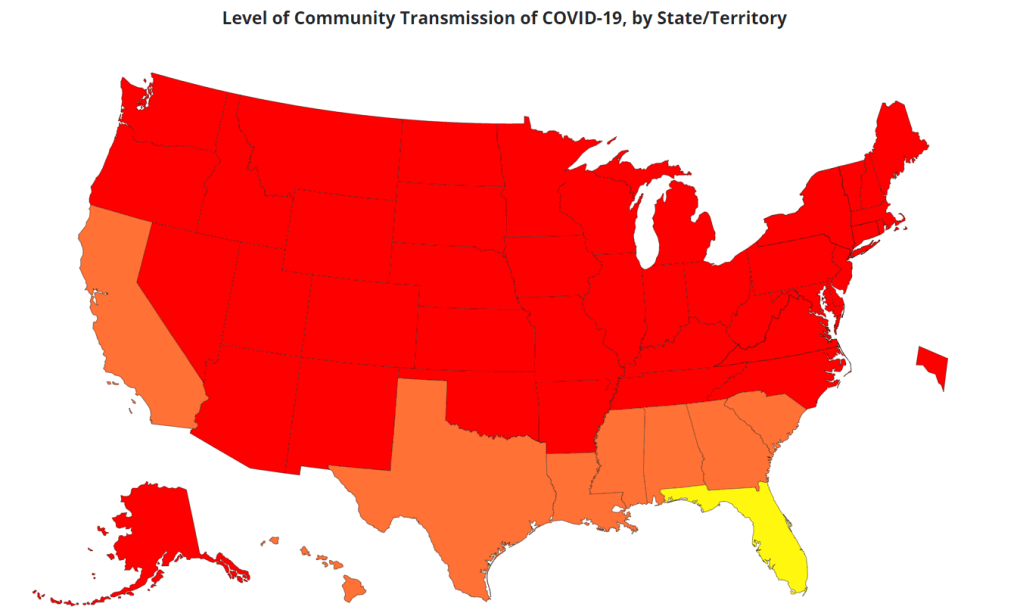
Community transmission levels by state, as of November 24. Florida is the only state with “moderate” transmission, while several other Southern states have “substantial” transmission. Chart via the CDC. In the past week (November 18 through 24), the U.S. reported about 660,000 new cases, according to the CDC.* This amounts to:
- An average of 94,000 new cases each day
- 201 total new cases for every 100,000 Americans
Last week, America also saw:
- 41,000 new COVID-19 patients admitted to hospitals (12 for every 100,000 people)
- 6,900 new COVID-19 deaths (2.1 for every 100,000 people)
- 100% of new cases are Delta-caused (as of November 20)
- An average of 1.8 million vaccinations per day (including booster shots; per Bloomberg)
*Note: This week, the CDC did not provide COVID-19 data updates for most metrics on Thursday, Friday, or Saturday due to the holiday, so my update is based on Wednesday’s data.
As is typically the case on holidays, Thanksgiving has made COVID-19 reporting a bit wonky. The CDC didn’t update its dashboard at all from Thursday through Saturday, and it is not updating vaccination data all weekend. At the same time, public health workers at many state and local agencies are taking a well-deserved long weekend off—leading to delayed reports of cases that will show up in the next couple of weeks.
Still, cases seem to continue trending up at the national level. The U.S. is now reporting close to 100,000 new cases a day, and holiday travel is likely to push this number up further. Michigan, Minnesota, and New Hampshire are the country’s three biggest hotspots, per the latest Community Profile Report (released Wednesday), all with over 500 total new cases per 100,000 people in the past week.
Other Northern states—Wisconsin, Maine, Colorado, Vermont—are also reporting high case rates, while Southern states continue to see lower numbers. Florida actually has the lowest case rate in the country, at 49 new cases per 100,000 people in the past week. This state is likely benefitting from COVID-19’s seasonal nature, combined with a lot of built-up immunity from the region’s summer Delta surge.
Nationally, the number of COVID-19 deaths in the U.S. in 2021 has surpassed the total deaths from the virus in 2020. Even though vaccines have been widely available for most of this year. The 2020 number is likely a significant undercount, as many people who contracted the coronavirus in spring 2020 were unable to get tested—but still, this milestone is disheartening.
Vaccination numbers have increased dramatically in the U.S. in recent weeks with well over one million shots given a day, thanks to booster shot availability and new eligibility for children under age 12. About 38 million people have now received their third doses, according to the CDC. But whether this will be enough to blunt the coming winter surge remains to be seen.
-
Sources and updates, November 21
- CDC adds data on 5-11 vaccinations: The main vaccinations page on the CDC’s COVID-19 dashboard now includes vaccination rates for all U.S. residents ages 5 and older, in addition to all the previous categories (12 and older, 18 and older, 65 and older). These rates are available by dose and by state. Plus, the CDC has added an age 5-11 category to its demographic vaccination trends page. Notably, age 5-11 data haven’t been added to the Community Profile Reports yet, but I expect this will happen in the next couple of weeks.
- Breakthrough case reporting by state: 36 states are reporting breakthrough COVID-19 cases, 34 are reporting breakthrough hospitalizations, and 37 are reporting breakthrough deaths, according to a report from former COVID Tracking Project researchers and the Rockefeller Foundation. The report also discusses the challenges of tracking breakthrough cases and the importance of linking clinical and demographic data to these cases.
- Long COVID resources from ApresJ20: ApresJ20, a Long COVID association based in France, has compiled this extensive document of over 1,000 scientific papers about the condition. Topics include defining Long COVID, characterizing symptoms, managing patient care, genetic associations, and more. For each paper, the document includes its title, authors, publish date, peer review status, and summary.
-
National numbers, November 21
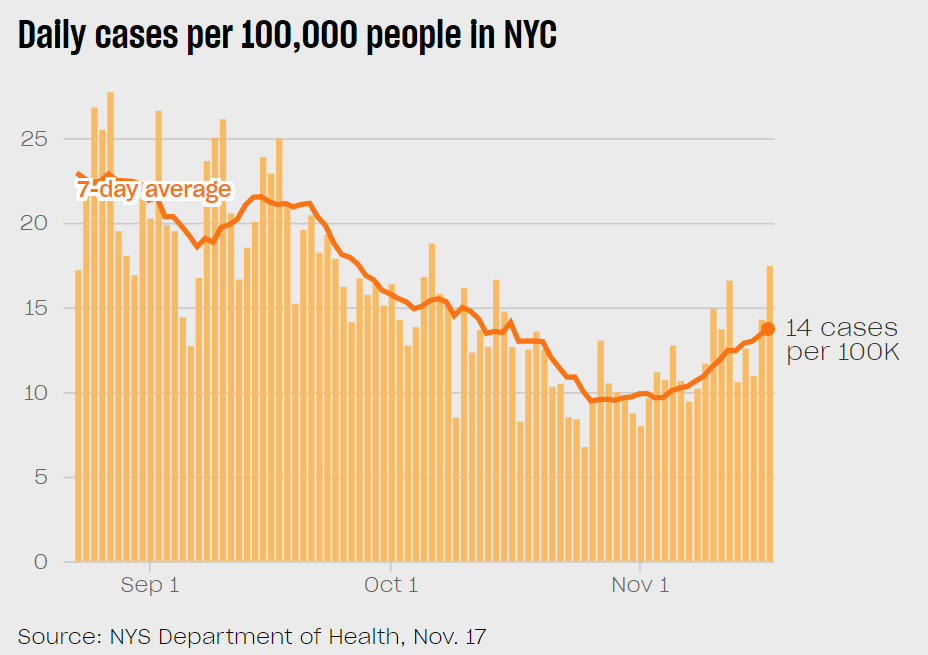
New York City is now seeing about 14 new cases for every 100,000 people each day. Chart via THE CITY’s COVID-19 dashboard. In the past week (November 13 through 19), the U.S. reported about 620,000 new cases, according to the CDC. This amounts to:
- An average of 88,000 new cases each day
- 189 total new cases for every 100,000 Americans
- 16% more new cases than last week (November 6-12)
Last week, America also saw:
- 38,000 new COVID-19 patients admitted to hospitals (12 for every 100,000 people)
- 7,200 new COVID-19 deaths (2.2 for every 100,000 people)
- 100% of new cases are Delta-caused (as of November 13)
- An average of 1.3 million vaccinations per day (including booster shots; per Bloomberg)
Last week, I wrote that the U.S. was at the start of a winter surge; this week, the surge is beginning to take off. Nationwide, cases are up 16% from last week to this week, and up 24% from two weeks ago. It’s not as sharp of an increase as what we saw during the first Delta surge in the summer, but it’s still concerning. New hospitalizations are also rising, up about 5% from last week.
Michigan and Minnesota are now the country’s top hotspots, with 589 and 524 new cases for every 100,000 people in the past week, respectively, per the latest Community Profile Report. Other hotspots include more northern states: New Hampshire, North Dakota, Wisconsin, Vermont. After being a success story for most of the pandemic, Vermont is now seeing its highest case numbers yet.
Meanwhile, in Europe, the ongoing surge has prompted increasingly strict COVID-19 safety measures. The government of Austria, which is also seeing record-high case numbers, announced on Friday that COVID-19 vaccination is now mandatory for the entire adult population. This follows a lockdown for unvaccinated Austrians only.
Nearly 80% of Austrian adults are vaccinated, according to the New York Times; the U.S. is in a similar position. But here, all the attention is on booster shots—more than 33 million Americans have now received boosters—and on shots for kids in the recently eligible 5 to 11 age group. About 10% of kids in that age group have now received their first doses, which may seem less impressive when one considers that the U.S. had enough doses for the entire eligible population ready to go when the FDA and CDC approved the shots.
In NYC, where I live, the case rate is now up at about 14 new cases for every 100,000 people, every day. That adds up to almost 100 new cases for every 100,000 people in the last week, meeting the CDC’s threshold for high transmission. About three in every four residents are vaccinated.
To combat this increase, city leaders announced on Monday that all adults were eligible for a booster shot—a few days before the FDA and CDC made the same decision for all adults in the U.S. (More on that eligibility later in this issue.) But no efforts have been made to cut down on indoor dining, curb the crowds in Times Square, or actually enforce mask-wearing on the subway. In this new surge, it truly feels like everyone is out here fending for themselves.
-
Sources and updates, November 14
- Directory of Local Health Departments: The National Association of County and City Health Officials maintains this database of all local public health departments in the U.S. You can navigate to health department lists for specific states by clicking on the map, or explore a 180-page PDF that includes the name, website link, and contact information (in some cases) for every single department.
- Media and Misinformation update from the KFF Vaccine Monitor: The Kaiser Family Foundation typically updates its COVID-19 Vaccine Monitor project with reports once a month. This week, however, the Vaccine Monitor team released an additional report focusing on American adults’ experiences with misinformation. One key finding: about 78% of those surveyed “believe or are unsure about at least one common falsehood” about COVID-19 or the vaccines.
- More data on vaccination for kids 5-11 is coming: About 900,000 children in the recently-eligible 5 to 11 age group were vaccinated in the first week since the CDC authorized shots for these kids, the White House announced on Wednesday. At the time, this estimate was higher than official numbers on the CDC’s dashboard due to data lags; but the agency is planning to publish more data on this age group by the end next week, according to Bloomberg editor Drew Armstrong.
-
Thinking about COVID-19 risk as winter approaches
I recently received a question from a COVID-19 Data Dispatch reader that followed a similar theme to many questions that readers, friends, and family members have asked me in the past few months. The question essentially outlined an event in the reader’s personal life that they’d been invited to attend, and asked for my advice: should they go? How risky was this event?
I have a hard time answering these types of questions directly, because I am no medical expert—I’m far from qualified to give direct advice. Instead, I like to outline my own attitudes towards risk at the pandemic’s current moment, and try to explain what I might do in that situation.
Right now, this type of decision-making feels harder than ever before. The majority of Americans are fully vaccinated, and we know how well the vaccines work. A growing number of Americans are getting booster shots, which we know are highly protective for seniors (and at least seem to reduce infection risk for others). So many of us are tired of the pandemic, and want to have a normal holiday season this year.
But at the same time, I feel an impetus to stay cautious—to protect the people around me as much as I can—as COVID-19 cases start to rise again in New York City, where I live, and in many other places around the country.
It’s also important to note here that everyone has a different risk comfort zone right now, partially as a product of a dearth of local and federal safety regulations at this point in the pandemic. If you’re fully vaccinated, and you’re comfortable hanging out inside with a large group of fully vaccinated people, there is evidence to suggest that is a largely safe situation for you. But if you’re not comfortable at such an event, there is also evidence to suggest that you may be able to pick up the coronavirus (even from a fully vaccinated crowd) and bring it back to someone who is more vulnerable than you are. Every choice comes with a calculation—what risk are you willing to bring to yourself and to those around you?
With all of that in mind, there are a few things I consider when I try to decide how “risky” an event might be. First of all, I still consider outdoor events to be very safe; the benefits of open air, wind, and sun far outweigh Delta’s high capacity for transmission. Then, for indoor events, I think about a few different layers of safety measures:
- Will everyone be fully vaccinated?
- Will negative COVID-19 tests be required before the event?
- Will masks be required?
- Will windows be open, or will ventilation in the space otherwise be high-quality?
- What are the COVID-19 case numbers in the surrounding county; are they above or below the CDC’s “substantial transmission” threshold (50 total new cases for every 100,000 people in the past week)?
When at least three of these five conditions are met, I personally would consider an event safe for attendance. When fewer than three conditions are met, I tend to add additional layers of protection for myself and others in my immediate community by wearing a high-quality mask and getting tested before and after. (I might use an at-home rapid test or a PCR test, depending on how much security I want in that test result.
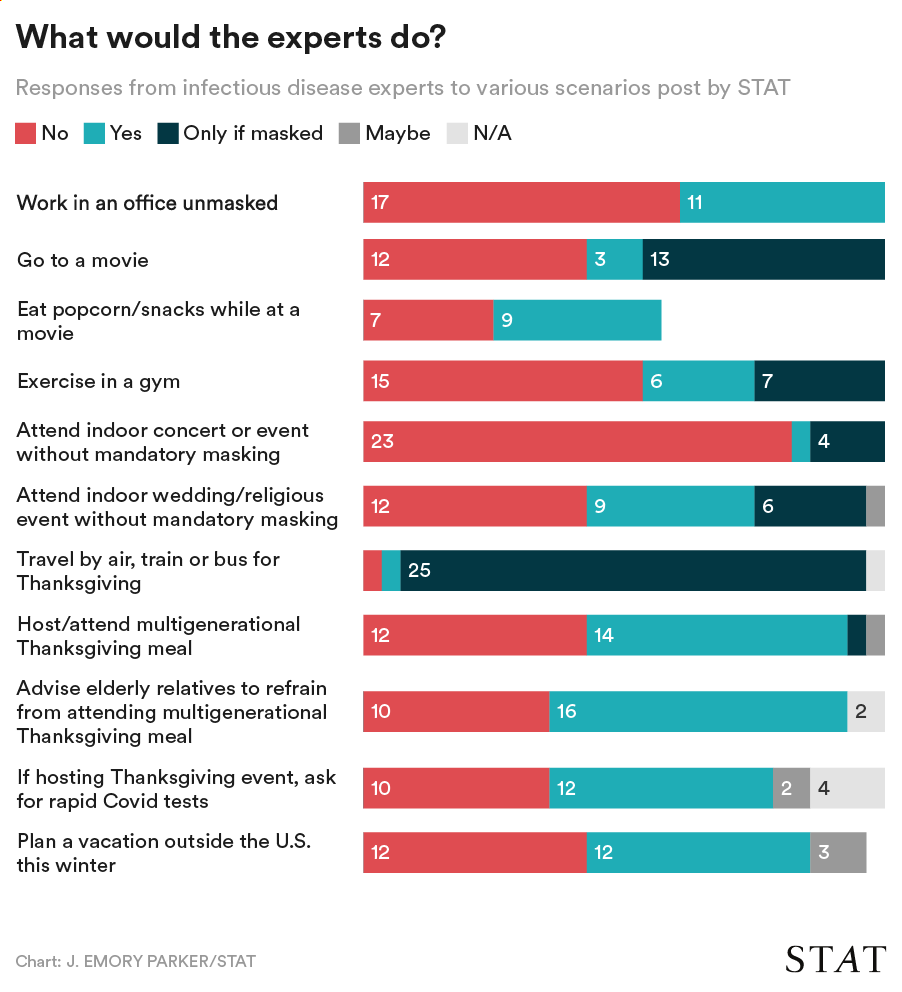
STAT News surveyed 28 infectious disease experts on activities they would currently feel comfortable doing. Chart via STAT. Finally, if you’d rather listen to the insights of some high-profile COVID-19 experts than to me, I’ve got a source for you: STAT News recently surveyed 28 infectious disease experts on which activities they would feel comfortable doing right now. The responses to STAT’s survey reveal a diversity of risk comfort levels, even among people who are incredibly well-informed about the pandemic.
The vast majority of experts said they would travel by air, train, or bus for Thanksgiving (mostly with a mask on), and the majority said they would not attend an indoor concert or event without mandatory masks. Other than that, all the questions are fairly split. The article (which I recommend reading in full!) includes a number of insights from those experts explaining their survey responses.
-
National numbers, November 14
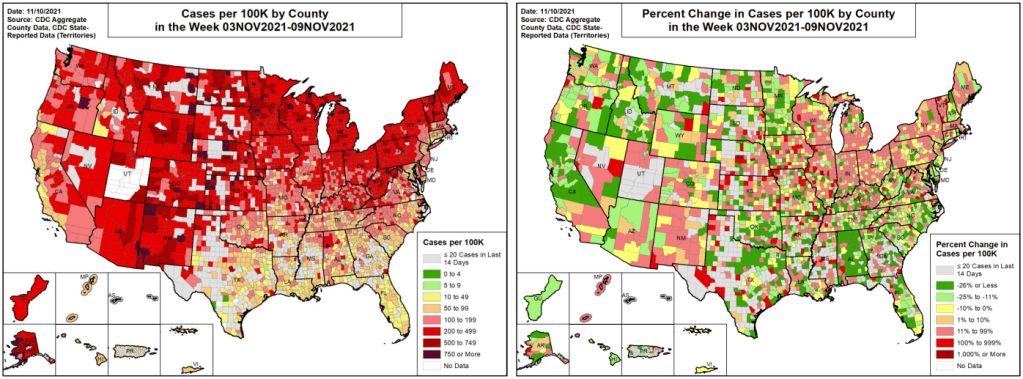
Many Northern states are seeing cases increase right now as Southern states have lower transmission levels. Charts from the November 10 Community Profile Report. In the past week (November 6 through 12), the U.S. reported about 510,000 new cases, according to the CDC. This amounts to:
- An average of 73,000 new cases each day
- 156 total new cases for every 100,000 Americans
- 3% more new cases than last week (October 30-November 5)
Last week, America also saw:
- 36,000 new COVID-19 patients admitted to hospitals (11 for every 100,000 people)
- 7,000 new COVID-19 deaths (2.1 for every 100,000 people)
- 100% of new cases are Delta-caused (as of November 6)
- An average of 1.4 million vaccinations per day (including booster shots; per Bloomberg)
It may be happening slowly, but the U.S. is clearly at the start of a winter COVID-19 surge. The number of newly reported cases rose this week for the first time since early September, while the number of COVID-19 patients in hospitals has plateaued.
Delta is still causing practically 100% of COVID-19 cases in the country, so a new variant is probably not to blame for this potential surge. Instead, it’s a consequence of the cold weather, combined with less-stringent safety behaviors among many Americans as we approach the holiday season. One epidemiologist told NBC that a surge may be “inevitable” at this time of year.
In line with COVID-19’s cold-weather advantage, many Northern states are seeing cases increase right now as Southern states—which were hit harder by the summer Delta surge—have lower transmission levels. Alaska, North Dakota, New Mexico, Montana, and Wyoming had the highest case rates last week, per the latest Community Profile Report.
Cases are also rapidly increasing in Maine, Vermont, Minnesota, Michigan, Colorado, and other chillier states. At Vermont’s St. Michael’s College, Halloween parties were a major source of new COVID-19 cases—even though 98% of people on campus are vaccinated, according to local outlet WCAX3.
Still, it’s important to point out here that the U.S. is in a far better spot now than we were at this time last year. As Dr. Ashish Jha pointed out on Twitter recently, we have winter coming and the vast majority of schools in the country are open, but cases are flat rather than rising sharply as they did last November.
Of course, we have vaccines to thank for this improved position. More than two-thirds of the U.S. population has received at least one vaccine dose; as of this week, that number includes over one million children under age 12, according to the CDC. Vaccinating more children and other people who are currently unvaccinated, booster shots for seniors, and continued use of masks and testing can help keep case numbers (relatively) low as we head into the coldest months.
-
Send me your holiday COVID-19 questions
It’s been about one year since I wrote the post, “Your Thanksgiving could be a superspreading event.” This post, inspired by a question I received from a reader, explained that a superspreading event occurs when one person infects many others with the coronavirus in a short period of time. I also went over how we identify these events and where they tend to occur—typically in crowded, indoor, poorly ventilated settings where people are packed together for long periods of time.
I ended the post by arguing that Thanksgiving celebrations, along with transportation and other activities along the way to those celebrations, could potentially become superspreading events. This year, the risk of spreading COVID-19 at a holiday gathering is still present—but for many gatherings, it’s much more manageable thanks to vaccines.
If you’re planning a holiday gathering this year, here are a couple of resources I’d recommend:
- Upcoming holiday season (Your Local Epidemiologist): In this post, Dr. Katelyn Jetelina goes through a couple of different potential scenarios for holiday gatherings based on vaccine levels. If everyone is fully vaccinated, she writes, “approach the celebration like we did before the pandemic.” If not, more safety layers—such as encouraging new vaccinations, testing, and ventilation—may be useful.
- Preparing for the holidays? Don’t forget rapid tests for COVID-19 (Harvard Health Publishing): This article, by Dr. Robert Shmerling, focuses more on the role of COVID-19 tests; Shmerling suggests that holiday hosts may offer rapid tests as guests arrive, or require a PCR test as a prerequesite to the gathering. He acknowledges, however, that rapid tests are currently pricey in the U.S. and come with other caveats.
- What 5 health experts advise for holiday travel this year (Washington Post): For the unvaccinated, “your recommendations are identical to what they were last year,” Ohio State University’s Iahn Gonsenhauser told WaPo. But for the vaccinated, travel and gatherings are safer; the experts quoted in this article recommend asking about the vaccination status of other holiday guests, packing rapid tests, and making a backup plan in case someone tests positive.
But even the best resources cannot cover every possible scenario. So, I’d like to open this up for reader questions: What do you want to know about COVID-19 as we head into the 2021 holiday season?
To send me a question, simply comment below. You can also email me (betsy@coviddatadispatch.com) or hit me up on Twitter or Facebook.
-
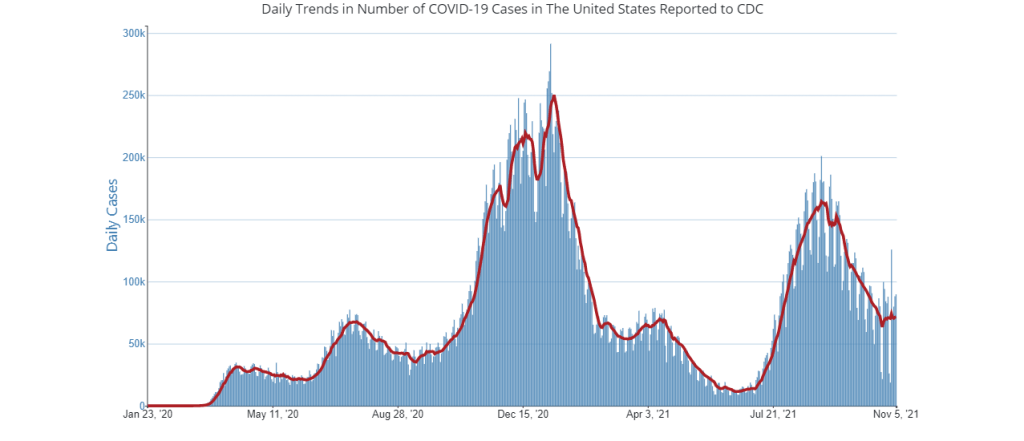
National numbers, November 7

U.S. COVID-19 cases are in a clear plateau. Chart via the CDC, downloaded on November 7. In the past week (October 30 through November 5), the U.S. reported about 490,000 new cases, according to the CDC. This amounts to:
- An average of 70,000 new cases each day
- 150 total new cases for every 100,000 Americans
- 1% fewer new cases than last week (October 23-29)
Last week, America also saw:
- 36,000 new COVID-19 patients admitted to hospitals (11 for every 100,000 people)
- 8,000 new COVID-19 deaths (2.4 for every 100,000 people)
- 99% of new cases are Delta-caused (as of October 30)
- An average of 1.8 million vaccinations per day (including booster shots; per Bloomberg)
At the national level, new COVID-19 cases seem to have entered a plateau. The U.S. has reported about 70,000 new cases a day for the past three weeks; while hospitalization and death numbers continue to go down, those drops are rather slight compared to what we saw earlier this fall.
Cold-weather states continue to see the highest case rates: Alaska, Montana, North Dakota, and Wyoming are at the top this week, with over 400 new cases for every 100,000 people as of the latest Community Profile Report.
New Hampshire is now a concerning hotspot as well—the state saw almost a 200% increase in cases from last week to this week. Colorado, Minnesota, New Mexico, and Michigan are also reporting significant increases.
Throughout the pandemic, trends in the U.S. have often followed trends in Europe, with this country seeing new surges a few weeks after they happen across the Atlantic. And right now, Europe is “at the epicentre” of the pandemic, according to the World Health Organization. Russia and Germany have recently recorded record cases, while other European countries are reinstating safety restrictions.
This week, the world marked five million COVID-19 deaths, while the U.S. marked 750,000. Both numbers are almost certainly undercounts, due to under-testing, limited medical record-keeping in some places, and other issues. In the U.S., over 1,000 people continue to die each day despite widely available vaccines.
Vaccination numbers are going up, though—driven largely by booster shots and by shots for the 5 to 11 age group, now officially eligible. The federal vaccines.gov site has been updated to include vaccination sites for these kids.
But as we celebrate kids getting vaccinated, it’s important to recognize the global inequities at play here:
-
Sources and updates, October 31
A lot of COVID-19 data sources caught my eye this week!
- More booster data from the CDC: This week, the CDC added both booster shot trends by day and booster shots by primary series type to its COVID Data Tracker. For booster shot trends, click “People Receiving a Booster Dose” on the Trends page, and for primary series data, scroll down to “Covid-19 Booster Dose Type by Primary Series Type” on the Vaccination Totals page. So far, it looks like a lot of Johnson & Johnson recipients are opting for mRNA boosters.
- KFF’s latest Vaccine Monitor update: The Kaiser Family Foundation has released the latest edition of its monthly vaccine poll, the COVID-19 Vaccine Monitor. This month’s edition focuses on vaccinations for children ages 5 to 11, in line with the recent discussions around shots for this age group, but it also includes other polling on general vaccination demographics, boosters, mandates, and more.
- Under-testing in U.S. prisons and jails: A new report from the UCLA Law COVID Behind Bars Data Project explores how insufficient COVID-19 testing of incarcerated people in the U.S. contributes to skewed case rates. Even in the states that have tested their incarcerated populations the most, this report shows, that testing is still far less frequent than testing for other congregate living facilities, like nursing homes.
- Impact of School Opening on SARS-CoV-2 Transmission: A group of scientists (including school data expert Emily Oster) recently published a new paper in Nature examining how school reopening models—remote, hybrid, or in-person—contribute to community transmission. In most parts of the country, reopening model did not have a significant impact on transmission, they found; the South was an exception. The authors shared the data underlying their paper, with some information from Burbio and the CDC removed due to requirements from those organizations.
- Reporting recipe for breakthrough case data: Dillon Bergin, my colleague at the Documenting COVID-19 project, wrote this reporting recipe, which guides local newsrooms through acquiring data on and covering breakthrough cases in their areas. The recipe accompanies a recent story that Dillon wrote, in collaboration with the Las Vegas Review-Journal, on breakthrough cases by occupation in Las Vegas. (Unsurprisingly, healthcare workers and casino workers were likely to have breakthrough cases, the Las Vegas data show.)
- Polling on small businesses and vaccine mandates: Here’s another vaccine survey released this week, this one from the U.S. Chamber of Commerce. The agency asked small businesses about their positions on vaccine mandates, as well as hiring challenges and other issues. 64% of small business owners support “businesses in their area requiring vaccines for their employees,” the survey found.
 COVID-19 Data Dispatch