The data problem underlying booster shot confusion

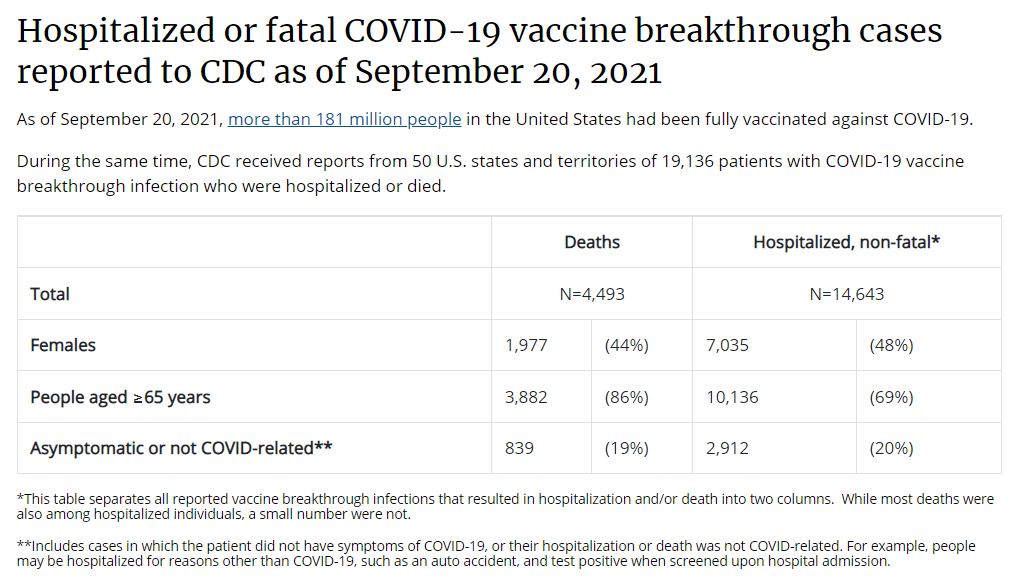
This is all the breakthrough case data that the CDC gives us. Screenshot taken on September 26.

This past Thursday, an advisory committee to the CDC recommended that booster doses of the Pfizer vaccine be authorized for seniors and individuals with high-risk health conditions. The committee’s recommendation, notably, did not include individuals who worked in high-risk settings, such as healthcare workers—whom the FDA had included in its own Emergency Use Authorization, following an FDA advisory committee meeting last week.

Then, very early on Friday morning, CDC Director Rochelle Walensky announced that she was overruling the advisory committee—but agreeing with the FDA. Americans who work in high-risk settings can get booster shots. (At least, they can get booster shots if they previously received two doses of Pfizer’s vaccine.)

This week’s developments have been just the latest in a rather confusing booster shot timeline:

Why has this process been so confusing? Why don’t the experts agree on whether booster shots are necessary, or on who should get these extra shots? Part of the problem, of course, is that the Biden administration announced booster shots were coming in August, before the scientific agencies had a chance to review all the relevant evidence.

But from my (data journalist’s) perspective, the booster shot confusion largely stems from a lack of data on breakthrough cases.

Let’s go back in time—back four months, or about four years in pandemic time. In May, the CDC announced a major change in its tracking of breakthrough cases. The agency had previously investigated and published data on all breakthrough cases, including those that were mild. But starting in May, the CDC was only investigating and publishing data on those severe breakthrough cases, i.e. those which led to hospitalization or death.

At the time, I called this a lazy choice that would hinder the U.S.’s ability to track how well the vaccines are working. I continued to criticize this move, when researchers and journalists attempted to do the CDC’s job—but were unable to provide data as comprehensive as what the CDC might make available. 

Think about what might have been possible if the CDC had continued tracking all breakthrough cases, or had even stepped up its investigation of these cases through increased testing and genomic sequencing. Imagine if we had data showing breakthrough cases by age group, by high-risk health condition, or by occupational setting—all broken out by their severity. What if we could compare the risk of someone with diabetes getting a breakthrough case, to the risk of someone who works in an elementary school?

If we had this kind of data, the FDA and CDC advisory committees would have information that they could use to determine the potential benefits of booster shots for specific subsets of the U.S. population. Instead, these committees had to make guesses. Their guesses didn’t come out of nowhere; they had scientific studies to review, data from Pfizer, and information from Israel and the U.K., two countries with better public health data systems than the U.S. But still, these guesses were much less informed than they might have been if the CDC had tracked breakthrough cases and outbreaks in a more comprehensive manner.

From that perspective, I can’t really fault the CDC and the FDA for casting their guesses with a fairly wide net—including the majority of Americans who received Pfizer shots in their authorization. There’s also a logistical component here; the U.S. has a lot of doses that are currently going unused (thanks to vaccine hesitancy), and may be wasted if they aren’t used as boosters.

But it is worth emphasizing how a lack of data on breakthrough cases has driven a booster shot decision based on fear of who might be at risk, rather than on hard evidence about who is actually at risk. Other than seniors; the risk for that group is fairly clear.

The booster shot decision casts a wide net. But at the same time, it creates a narrow band of booster eligibility: only people who got two doses of Pfizer earlier in 2021 are now eligible for a Pfizer booster. Recipients of the Moderna and Johnson & Johnson vaccines are still left in the dark, even though some of those people may need a booster more than many people who are now eligible for additional Pfizer shots. (Compare, say, a 25-year-old teacher who got Pfizer to a 80-year-old, living in a nursing home, with multiple health conditions who got Moderna.)

That Pfizer-only restriction also stems from a data issue. The federal government’s current model for approving vaccines is very specific: first a pharmaceutical company submits its data to the FDA, then the FDA reviews these data, then the FDA makes a decision, then the CDC reviews the data, then the CDC makes a decision.

By starting with the pharmaceutical company, the decision-making process is restricted to options presented by that company. As a result, we aren’t seeing much data on mixing-and-matching different vaccines, which likely wouldn’t be profitable for vaccine manufacturers. (Even though immunological evidence suggests that this could be a useful strategy, especially for Johnson & Johnson recipients.)

In short, the FDA and CDC’s booster shot decision is essentially both ahead of evidence on who may benefit most from a booster, but behind evidence for non-Pfizer vaccine recipients. It’s kind-of a mess.

I also can’t end this post without acknowledging that we need to vaccinate the whole world, not just the U.S. Global vaccination went largely undiscussed at the FDA and CDC meetings, even though it is a top concern for many public health experts outside these agencies.

At an international summit this week, President Biden announced more U.S. donations to the global vaccine effort. His administration seems convinced that the U.S. can manage both boosters at home and donations abroad. But the White House only has so much political capital to spend. And right now, it’s pretty clearly getting spent on boosters, rather than, say, incentivizing the vaccine manufacturers to share their technology with the Global South.

I can only imagine this situation getting messier in the months to come.

More vaccine reporting

Comments

53 responses to “The data problem underlying booster shot confusion”

  1. Answering your COVID-19 questions - Reader feedback Avatar

    […] As I wrote last week, we do not have a lot of data on who’s most vulnerable to breakthrough COVID-19 cases. We do know that seniors are more vulnerable—this is one point where most experts agree. We know that adults with the same health conditions that make them more likely to have a severe COVID-19 case without a vaccine (autoimmune conditions, diabetes, kidney disease, etc.) are also more vulnerable to breakthrough cases, though we don’t have as much data here. And we know that vaccinated adults working in higher-risk locations like hospitals, nursing homes, and prisons are more likely to encounter the coronavirus, even if they may not necessarily be more likely to have a severe breakthrough case. […]

    Like

  2. […] stopped tracking mild breakthrough cases—most large scale data on the frequency of those cases comes from abroad—which has made it hard to weigh the need for booster shots. Estimates range from around 50 to 90 […]

    Like

  3. […] stopped tracking mild breakthrough cases—most large scale data on the frequency of those cases comes from abroad—which has made it hard to weigh the need for booster shots. Estimates range from around 50 to 90 […]

    Like

  4. […] stopped tracking mild breakthrough cases—most large scale data on the frequency of those cases comes from abroad—which has made it hard to weigh the need for booster shots. Estimates range from around 50 to 90 […]

    Like

  5. […] stopped tracking soft leap forward cases—most massive scale data on the frequency of those cases comes from abroad—which has made it laborious to weigh the need for booster shots. Estimates fluctuate from […]

    Like

  6. […] stopped tracking mild breakthrough cases—most large scale data on the frequency of those cases comes from abroad—which has made it hard to weigh the need for booster shots. Estimates range from around 50 to 90 […]

    Like

  7. […] tender leap forward cases—most substantial scale knowledge on the frequency of those cases comes from foreign—which has made it exhausting to weigh the want for booster pictures. Estimates fluctuate from […]

    Like

  8. […] stopped tracking mild breakthrough cases—most large scale data on the frequency of those cases comes from abroad—which has made it hard to weigh the need for booster shots. Estimates range from around 50 to 90 […]

    Like

  9. […] stopped tracking mild breakthrough cases—most large scale data on the frequency of those cases comes from abroad—which has made it hard to weigh the need for booster shots. Estimates range from around 50 to 90 […]

    Like

  10. […] moderate advancement cases– most big scale information on the frequency of those cases originates from abroad— which has actually made it tough to weigh the requirement for booster shots. Price quotes […]

    Like

  11. […] stopped tracking mild breakthrough cases—most large scale data on the frequency of those cases comes from abroad—which has made it hard to weigh the need for booster shots. Estimates range from around 50 to 90 […]

    Like

  12. […] stopped tracking mild breakthrough cases—most large scale data on the frequency of those cases comes from abroad—which has made it hard to weigh the need for booster shots. Estimates range from around 50 to 90 […]

    Like

  13. […] gentle breakthrough instances—most giant scale information on the frequency of these instances comes from abroad—which has made it laborious to weigh the necessity for booster photographs. Estimates vary from […]

    Like

  14. […] stopped tracking mild breakthrough cases—most large scale data on the frequency of those cases comes from abroad—which has made it hard to weigh the need for booster shots. Estimates range from around 50 to 90 […]

    Like

  15. […] stopped tracking mild breakthrough cases—most large scale data on the frequency of those cases comes from abroad—which has made it hard to weigh the need for booster shots. Estimates range from around 50 to 90 […]

    Like

  16. New study demonstrates potential for measuring breakthrough risk - Vaccines Avatar

    […] in a specific, vulnerable population—besides studies demonstrating higher risk for older adults. As I wrote two weeks ago, a lack of specific data on breakthrough cases has contributed to confusion and debate surrounding […]

    Like

  17. COVID source callout: Booster shot trends - Source spotlight Avatar

    […] third vaccine doses for patients with weakened immune systems—and over two weeks since the agency approved third Pfizer doses for patients with increased breakthrough case risk. Since August 13, the CDC’s dashboard says, […]

    Like

  18. […] part, these discussions are complicated because the U.S. has limited data available on how well the vaccines are working – and who is at most risk for a breakthrough […]

    Like

  19. […] part, these discussions are complicated because the U.S. has limited data available on how well the vaccines are working – and who is at most risk for a breakthrough […]

    Like

  20. […] part, these discussions are complicated because the US has done so limited data available about how well the vaccines work – and who is most at risk for a […]

    Like

  21. […] part, these discussions are complicated because the US has done so limited data available about how well the vaccines work – and who is most at risk for a […]

    Like

  22. […] part, these discussions are complicated because the U.S. has limited data available about how effectively vaccines work – and who is most at risk for a […]

    Like

  23. […] half, these discussions are difficult as a result of the U.S. has limited data available on how properly the vaccines are working – and who’s at most danger for a breakthrough […]

    Like

  24. […] discussions sont en partie compliquées parce que les États-Unis ont données limitées disponibles sur l’efficacité des vaccins – et qui est le plus à risque pour un cas […]

    Like

  25. […] part, these discussions are complicated because the U.S. has limited data available on how well the vaccines are working – and who is at most risk for a breakthrough […]

    Like

  26. […] part, these discussions are complicated because the U.S. has limited data available on how well the vaccines are working – and who is at most risk for a breakthrough […]

    Like

  27. […] part, these discussions are complicated because the U.S. has limited data available on how well the vaccines are working – and who is at most risk for a breakthrough […]

    Like

  28. […] part, these discussions are complicated because the U.S. has limited data available on how well the vaccines are working – and who is at most risk for a breakthrough […]

    Like

  29. […] part, these discussions are complicated because the U.S. has limited data available on how well the vaccines are working – and who is at most risk for a breakthrough […]

    Like

  30. […] part, these discussions are complicated because the U.S. has limited data available on how well the vaccines are working – and who is at most risk for a breakthrough […]

    Like

  31. […] part, these discussions are complicated because the U.S. has limited data available on how well the vaccines are working – and who is at most risk for a breakthrough […]

    Like

  32. […] part, these discussions are complicated because the U.S. has limited data available on how well the vaccines are working – and who is at most risk for a breakthrough […]

    Like

  33. […] part, these discussions are complicated because the U.S. has limited data available on how well the vaccines are working – and who is at most risk for a breakthrough […]

    Like

  34. […] part, these discussions are complicated because the U.S. has limited data available on how well the vaccines are working – and who is at most risk for a breakthrough […]

    Like

  35. […] part, these discussions are complicated because the U.S. has limited data available on how well the vaccines are working – and who is at most risk for a breakthrough […]

    Like

  36. […] संयुक्त राज्य अमेरिका के पास है सीमित डेटा उपलब्ध टीके कितनी अच्छी तरह काम करते हैं – […]

    Like

  37. […] part, these discussions are complicated because the U.S. has limited data available on how well the vaccines are working – and who is at most risk for a breakthrough […]

    Like

  38. […] part, these discussions are complicated because the U.S. has limited data available on how well the vaccines are working – and who is at most risk for a breakthrough […]

    Like

  39. Delta variant and behaviour brought about vaccine efficacy drop over the summer season in New York, DOH find out about unearths - elegant news Avatar

    […] those discussions are difficult for the reason that U.S. has restricted knowledge to be had on how neatly the vaccines are running – and who’s at maximum possibility for a step […]

    Like

  40. […] part, these discussions are complicated because the U.S. limited data available How well the vaccines are working – and who is most at risk for a successful […]

    Like

  41. […] part, these discussions are complicated because the U.S. has limited data available on how well the vaccines are working – and who is at most risk for a breakthrough […]

    Like

  42. […] part, these discussions are complicated because the U.S. limited data available How well the vaccines are working – and who is most at risk for a successful […]

    Like

  43. […] these discussions are sophisticated as a result of the U.S. has limited data available on how properly the vaccines are working – and who’s at most danger for a breakthrough […]

    Like

  44. […] moderate advancement cases– most big scale information on the frequency of those cases originates from abroad— which has actually made it difficult to weigh the requirement for booster shots. Quotes vary […]

    Like

  45. Booster shots: What we’ve learned—and what we still don’t know - Vaccines Avatar

    […] fact, the discussions on both days were wide-reaching and full of questions, touching on the many continued gaps in our knowledge about the need for additional vaccine doses. The FDA committee continues to make decisions based on […]

    Like

  46. […] half, these discussions are difficult as a result of the U.S. has limited data available on how nicely the vaccines are working – and who’s at most danger for a breakthrough […]

    Like

  47. […] fundamental ambiguities: small data sets that document boosters’ effects in the real world, sparse information On success infection among vaccinated Americans, and how much about the lack of clarity change in […]

    Like

  48. Booster shot data slowly makes it onto state dashboards, but demographic information is lacking - Vaccines Avatar

    […] we see the same pattern with booster shots? Considering the immense confusion that has surrounded America’s booster shot rollout in the last couple of months, it would not be […]

    Like

  49. Public health data in the US is “incredibly fractured”: Zoe McLaren on booster shots and more - Vaccines Avatar

    […] these additional doses. Frequent COVID-19 Data Dispatch readers might recognize that argument from this CDD post, published at the end of […]

    Like

  50. […] معظم البيانات واسعة النطاق حول تكرار مثل هذه الحالات تأتي من الخارج– مما جعل من الصعب تقييم الحاجة إلى لقاحاتٍ معززة. […]

    Like

Leave a reply to Delta variant and end of social distancing were the biggest reasons why efficacy of COVID-19 vaccines against infection fell by as much as 25% over the summer – not waning of antibodies, New York DOH study finds – newsBlok Cancel reply