Tag: Variants

  • The federal public health emergency ends next week: What you should know

    The federal public health emergency ends next week: What you should know

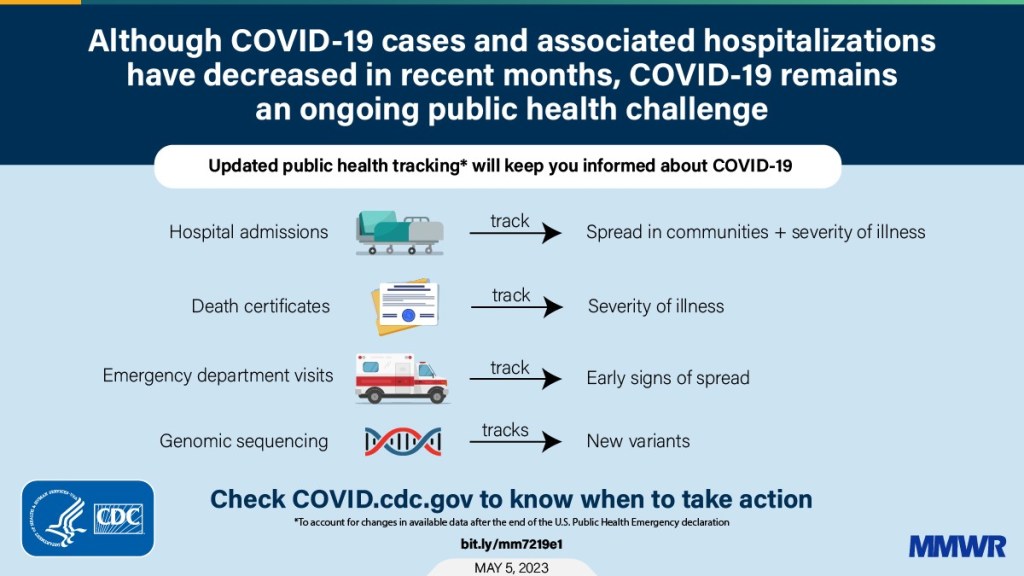
    A chart from the CDC’s recent report on surveillance changes tied to the end of the federal public health emergency.

    We’re now less than one week out from May 11, when the federal public health emergency (or PHE) for COVID-19 will end. While this change doesn’t actually signify that COVID-19 is no longer worth worrying about, it marks a major shift in how U.S. governments will respond to the ongoing pandemic, including how the disease is tracked and what public services are available.

    I’ve been writing about this a lot in the last couple of months, cataloging different aspects of the federal emergency’s end. But I thought it might be helpful for readers if I compiled all the key information in one place. This post also includes a few new insights about how COVID-19 surveillance will change after May 11, citing the latest CDC reports.

    What will change overall when the PHE ends?

    The ending of the PHE will lead to COVID-19 tests, treatments, vaccines, and data becoming less widely available across the U.S. It may also have broader implications for healthcare, with telehealth policies shifting, people getting kicked off of Medicaid, and other changes.

    Last week, I attended a webinar about these changes hosted by the New York City Pandemic Response Institute. The webinar’s moderator, City University of New York professor Bruce Y. Lee, kicked it off with a succinct list of direct and indirect impacts of the PHE’s end. These were his main points:

    • Free COVID-19 vaccines, tests, and treatments will run out after the federal government’s supplies are exhausted. (Health experts project that this will likely happen sometime in fall 2023.) At that point, these services will get more expensive and harder to access as they transition to private healthcare markets.
    • We will have fewer COVID-19 metrics (and less complete data) to rely on as the CDC and other public health agencies change their surveillance practices. More on this below.
    • Many vaccination requirements are being lifted. This applies to federal government mandates as well as many from state/local governments and individual businesses.
    • The FDA will phase out its Emergency Use Authorizations (EUAs) for COVID-19 products, encouraging manufacturers to apply for full approval. (This doesn’t mean we’ll suddenly stop being able to buy at-home tests—there’s going to be a long transition process.)
    • Healthcare worker shortages may get worse. During the pandemic emergency, some shifts to work requirements allowed facilities to hire more people, more easily; as these policies are phased out, some places may lose those workers.
    • Millions of people will lose access to Medicaid. A federal rule tied to the PHE forbade states from kicking people off this public insurance program during the pandemic, leading to record coverage. Now, states are reevaluating who is eligible. (This process actually started in April, before the official PHE end.)
    • Telehealth options may become less available. As with healthcare hiring, policies during the PHE made it easier for doctors to provide virtual care options, like video-call appointments and remote prescriptions. Some of these COVID-era rules will be rolled back, while others may become permanent.
    • People with Long COVID will be further left behind, as the PHE’s end leads many people to distance themselves even more from the pandemic—even though long-haulers desperately need support. This will also affect people who are at high risk for COVID-19 and continue to take safety precautions.
    • Pandemic research and response efforts may be neglected. Lee referenced the “panic and neglect” cycle for public health funding: a pattern in which governments provide resources when a crisis happens, but then fail to follow through during less dire periods. The PHE’s end will likely lead us (further) into the “neglect” part of this cycle.

    How will COVID-19 data reporting change?

    The CDC published two reports this week that summarize how national COVID-19 data reporting will change after May 11. One goes over the surveillance systems that the CDC will use after the PHE ends, while the other discusses how different COVID-19 metrics correlate with each other.

    A lot of the information isn’t new, such as the phasing out of Community Level metrics for counties (which I covered last week). But it’s helpful to have all the details in one place. Here are a few things that stuck out to me:

    • Hospital admissions will be the CDC’s primary metric for tracking trends in COVID-19 spread rather than cases. While more reliable than case counts, hospitalizations are a lagging metric—it takes typically days (or weeks) after infections go up for the increase to show up at hospitals, since people don’t seek medical care immediately. The CDC will recieve reports from hospitals at a weekly cadence, rather than daily, after May 11, likely increasing this lag and making it harder for health officials to spot new surges.
    • National case counts will no longer be available as PCR labs will no longer be required to report their data to the CDC. PCR test totals and test positivity rates will also disappear for the same reason, as will the Community Levels that were determined partially by cases. The CDC will also stop reporting real(ish)-time counts of COVID-associated deaths, relying instead on death certificates.
    • Deaths will be the primary metric for tracking how hard COVID-19 is hitting the U.S. The CDC will get this information from death certificates via the National Vital Statistics System. While deaths are reported with a significant lag (at least two weeks), the agency has made a lot of progress on modernizing this reporting system during the pandemic. (See this December 2021 post for more details.)
    • The CDC will utilize sentinel networks and electronic health records to gain more information about COVID-19 spread. This includes the National Respiratory and Enteric Virus Surveillance System, a network of about 450 laboratories that submit testing data to the CDC (previously established for other endemic diseases like RSV and norovirus). It also includes the National Syndromic Surveillance Program, a network of 6,300 hospitals that submit patient data to the agency.
    • Variant surveillance will continue, using a combination of PCR samples and wastewater data. The CDC’s access to PCR swab samples will be seriously diminished after May 11, so it will have to work with public health labs to develop national estimates from the available samples. Wastewater will help fill in these gaps; a few wastewater testing sites already send the CDC variant data. And the CDC will continue offering tests to international travelers entering the country, for a window into global variant patterns.
    • The CDC will continue tracking vaccinations, vaccine effectiveness, and vaccine safety. Vaccinations are generally tracked at the state level (every state health agency, and several large cities, have their own immunization data systems), but state agencies have established data sharing agreements with the CDC that are set to continue past May 11. The CDC will keep using its established systems for evaluating how well the vaccines work and tracking potential safety issues as well.
    • Long COVID notably is not mentioned in the CDC’s reports. The agency hasn’t put much focus on tracking long-term symptoms during the first three years of the pandemic, and it appears this will continue—even though Long COVID is a severe outcome of COVID-19, just like hospitalization or death. A lack of focus on tracking Long COVID will make it easier for the CDC and other institutions to keep minimizing this condition.

    On May 11, the CDC plans to relaunch its COVID-19 tracker to incorporate all of these changes. The MMWR on surveillance changes includes a list of major pages that will shift or be discontinued at this time.

    Overall, the CDC will start tracking COVID-19 similar to the way it tracks other endemic diseases. Rather than attempting to count every case, it will focus on certain severe outcomes (i.e., hospitalizations and deaths) and extrapolate national patterns from a subset of healthcare facilities with easier-to-manage data practices. The main exception, I think, will be a focus on tracking potential new variants, since the coronavirus is mutating faster and more aggressively than other viruses like the flu.

    What should I do to prepare for May 11?

    If you’ve read this far, you’re probably concerned about how all these shifts will impact your ability to stay safe from COVID-19. Unfortunately, the CDC, like many other public agencies, is basically leaving Americans to fend for themselves with relatively little information or guidance.

    But a lot of information sources (like this publication) are going to continue. Here are a few things I recommend doing this week as the PHE ends:

    • Look at your state and local public health agencies to see how they’re responding to the federal shift. Some COVID-19 dashboards are getting discontinued, but many are sticking around; your local agency will likely have information that’s more tailored to you than what the CDC can offer.
    • Find your nearest wastewater data source. With case counts basically going away, wastewater surveillance will be our best source for early warnings about surges. You can check the COVID-19 Data Dispatch list of wastewater dashboards and/or the COVIDPoops dashboard for sources near you.
    • Stock up on at-home tests and masks. This is your last week to order free at-home/rapid tests from your insurance company if you have private insurance. It’s also a good time to buy tests and masks; many distributors are having sales right now.
    • Figure out where you might get a PCR test and/or Paxlovid if needed. These services will be harder to access after May 11; if you do some logistical legwork now, you may be more prepared for when you or someone close to you gets sick. The People’s CDC has some information and links about this.
    • Contact your insurance company to find out how their COVID-19 coverage policies are changing, if you have private insurance. Folks on Medicare and Medicaid: this Kaiser Family Foundation article has more details about changes for you.
    • Ask people in your community how you can help. This is a confusing and isolating time for many Americans, especially people at higher risk for COVID-19. Reaching out to others and offering some info or resources (maybe even sharing this post!) could potentially go a long way.

    That was a lot of information packed into one post. If you have questions about the ending PHE (or if I missed any important details), please email me or leave a comment below—and I’ll try to answer in next week’s issue.
    More about federal data

  • National numbers, April 23

    National numbers, April 23

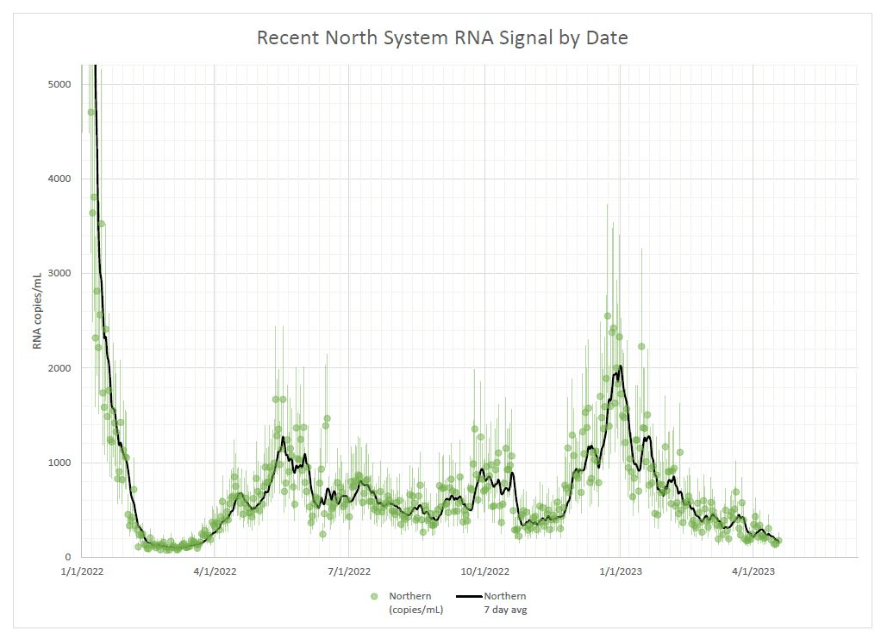
    Coronavirus concentrations are trending down in Boston’s wastewater, a promising signal.

    In the past week (April 13 through 19), the U.S. officially reported about 94,000 new COVID-19 cases, according to the CDC. This amounts to:

    • An average of 13,000 new cases each day
    • 7% fewer new cases than last week (April 6-12)

    In the past week, the U.S. also reported about 12,000 new COVID-19 patients admitted to hospitals. This amounts to:

    • An average of 1,700 new admissions each day
    • 3.7 total admissions for every 100,000 Americans
    • 8% fewer new admissions than last week

    Additionally, the U.S. reported:

    • 1,200 new COVID-19 deaths (170 per day)
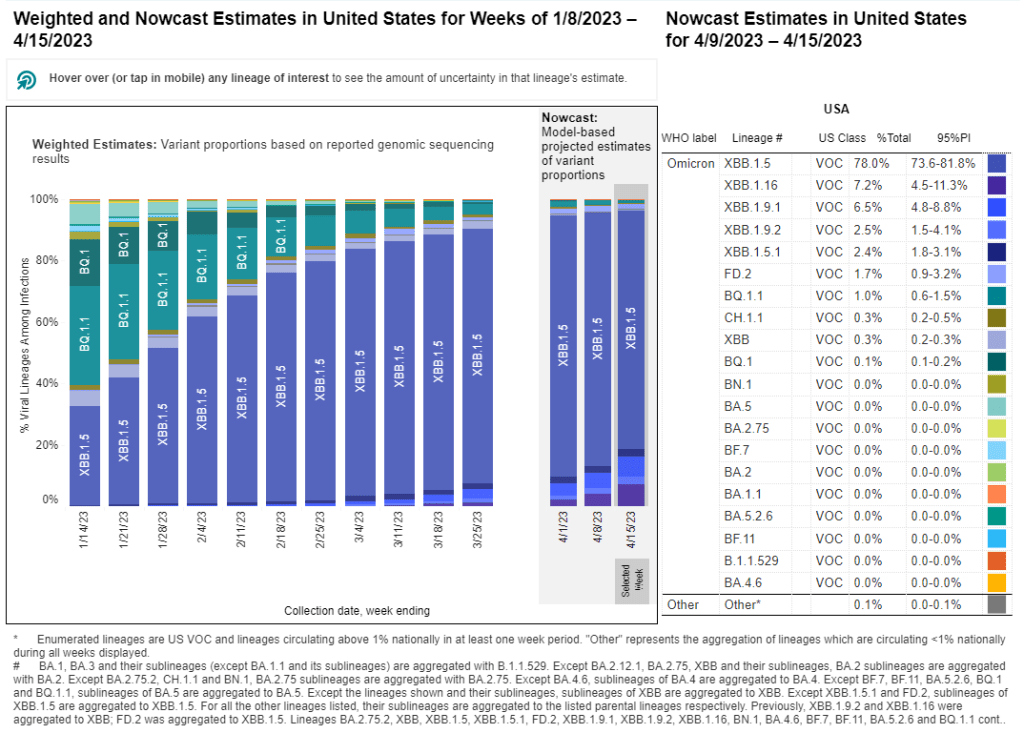
    • 74% of new cases are caused by Omicron XBB.1.5; 11% by XBB.1.9; 10% by XBB.1.16 (as of April 22)
    • An average of 35,000 vaccinations per day

    Across the U.S., COVID-19 spread continues at a moderately high plateau as newer versions of Omicron compete with XBB.1.5. Officially-reported cases and new hospitalizations declined by 7% and 8% respectively, compared to the prior week.

    Wastewater surveillance data from Biobot and from the CDC similarly show that COVID-19 spread is at a plateau. Nationally, coronavirus concentrations in sewage are higher than they were at this point in 2021 (when the initial vaccine rollout was in full swing), but lower than at this point in 2022 (when BA.2 had started spreading widely).

    Of course, it’s important to flag that official case counts are becoming even more unreliable these days, as PCR testing becomes increasingly difficult to access and state health departments no longer prioritize timely reporting to the CDC. According to CDC, five states didn’t report COVID-19 cases and deaths last week: Arkansas, Florida, Iowa, Mississippi, and Pennsylvania. (Iowa has permanently stopped reporting.)

    These case reporting issues are likely to continue—and perhaps accelerate—when the federal public health emergency ends next month. I’m thinking about how to adjust these National Numbers reports when that happens; that will likely involve foregrounding wastewater data and hospitalizations rather than cases.

    Regionally, Biobot’s surveillance shows a slight uptick in coronavirus spread on the West Coast and declines in the other major regions. Some counties in California have reported recent increases in wastewater, according to Biobot and WastewaterSCAN, but it’s currently tough to tell if this is a sustained surge or isolated outbreaks.

    The West Coast and Midwest continue to be hotspots for newer versions of Omicron, according to the CDC’s estimates, with XBB.1.9 still most prevalent by far in the region including Iowa, Kansas, Missouri, and Nebraska. Nationwide, the CDC estimates that XBB.1.9 caused about 11% of new cases in the last week and that XBB.1.16 caused 10% of new cases.

    XBB.1.16 (also called “Arcturus”) was recently classified as a variant of interest by the World Health Organization because it can spread significantly faster than other Omicron lineages. The variant is likely to “spread globally and contribute to an increase in case incidence,” according to the WHO.

    While I’m wary of the new variants, I have been heartened to see coronavirus levels in wastewater remain mostly at plateaus—or even decline—in many places across the U.S. In Boston, for example, coronavirus levels have been on a downward trend since early 2023. I hope to see this trend continue. 

  • National numbers, April 16

    National numbers, April 16

    New subvariants XBB.1.16, XBB.1.9.1, and XBB.1.9.2 are on the rise, according to the CDC’s estimates.

    In the past week (April 6 through 12), the U.S. officially reported about 100,000 new COVID-19 cases, according to the CDC. This amounts to:

    • An average of 15,000 new cases each day
    • 17% fewer new cases than last week (March 30-April 5)

    In the past week, the U.S. also reported about 13,000 new COVID-19 patients admitted to hospitals. This amounts to:

    • An average of 1,900 new admissions each day
    • 3.9 total admissions for every 100,000 Americans
    • 14% fewer new admissions than last week

    Additionally, the U.S. reported:

    • 1,300 new COVID-19 deaths (190 per day)
    • 78% of new cases are caused by Omicron XBB.1.5; 9% by XBB.1.9; 7% by XBB.1.16 (as of April 15)
    • An average of 35,000 vaccinations per day (CDC link)

    COVID-19 spread appears to be at a continued plateau nationally, with slight declines in cases, hospitalizations, and viral concentrations in wastewater. New variants are on the horizon, though, at a time when data are becoming increasingly less reliable. 

    The CDC reported about 100,000 new cases this week, the lowest this number has been since early summer 2021. Unlike that period, however, PCR tests are much less available and reporting infrastructures are being dismantled.

    Wastewater surveillance data from Biobot show that transmission is actually several times higher now than it was at that previous low point. We’re in an undercounted plateau, rather than a real lull. Even so, less COVID-19 is spreading now than we’ve seen throughout the last few months.

    To get a more accurate picture of potential COVID-19 case counts in your area, I recommend going to the Iowa COVID-19 Tracker, an independent dashboard run by Sara Anne Willette. Willette has mapped out “likely cases per 100,000 people” by county, by multiplying the CDC’s data by 20 to account for underreporting.

    Wastewater data suggest that most parts of the U.S. are seeing steady (though slight) declines in transmission, with the exception of the West coast. Some counties in California have reported increased coronavirus levels in wastewater in the last week, according to Biobot and WastewaterSCAN, including parts of the Bay Area.

    One culprit for the increases could be newer Omicron subvariants, particularly XBB.1.9 and XBB.1.16. The CDC added XBB.1.16—which has drawn international concern, due to its connection with a recent surge in India—to its variant proportion estimates, along with XBB.1.9.2, a relative of XBB.1.9.1. (Yes, we’re getting into alphabet soup territory again here.)

    Nationally, the CDC estimates that XBB.1.16 caused about 7% of new cases in the last week, while the XBB.1.9s together caused 9%. At the regional level, XBB.1.16 is more prevalent in the West and Southwest (at over 20% of new cases in the region including Texas and other Gulf coast states), while the XBB.1.9s are more prevalent in the Midwest.

    The CDC published its second-to-last data update yesterday (which is still called the “Weekly Review,” even though it is far from weekly at this point). According to this update, most of the CDC’s public COVID-19 data “won’t be affected by the end of the public health emergency,” though the agency says it’ll provide more details in its final update on May 12.

    I personally expect that, while the national data systems might remain in place, more state and local health agencies will stop reporting, as we saw from Iowa recently. This will, of course, make the numbers less and less reliable.

  • Sources and updates, March 19

    • Long-term effects of COVID-19 on kids: The National Academies of Sciences, Engineering, and Medicine (NASEM) recently published a report about how the COVID-19 pandemic has impacted children and families. It includes a variety of health impacts (physical, behavioral, mental), interventions taken by schools and other institutions, access to healthcare coverage, impacts of COVID-related economic policies, and recommendations for addressing this issue in the future. The report’s authors note that, for “almost every outcome” related to health and well-being, COVID-19’s impacts were worse for Black, Hispanic/Latino, Native American, and low-income families.
    • Shorter sleep duration during the pandemic: On a similar topic: the CDC’s Preventing Chronic Disease journal recently published an article about teenagers’ sleep habits during the pandemic. The study used data from the 2021 Adolescent Behaviors and Experiences Survey, a nationally-representative survey of high school students. About three-quarters of students surveyed slept for less than eight hours a night, and students who slept less were more likely to report that doing their schoolwork became more difficult during the pandemic. While shorter sleep was becoming an issue before COVID-19, this study shows how COVID-related stress may have exacerbated the problem.
    • Maternal mortality keeps getting worse: This week, the CDC released its most recent, official statistics on maternal mortality in the U.S. The new data reflect deaths in 2021, and show that mortality rates rose to about 33 deaths per 100,000 births, compared to rates closer to 20 per 100,000 births in 2020 and 2019. Mortality rates were more than 2.5 times higher for Black women compared to white women. For more recent data (and additional demographic figures), see this story and GitHub repository from MuckRock, also shared in last week’s newsletter.
    • WHO updates its variant tracking system: The World Health Organization announced on Thursday that it will start classifying subvariants of Omicron as distinct Variants of Interest (VOIs) and Variants of Concern (VOCs), and will assign new Greek-letter names to VOCs. Omicron lineages have accounted for the vast majority of coronavirus circulating globally since early 2022, but all subvariants have previously been clustered under that one Greek-letter name. Now, the WHO will give us new names as needed, hopefully making future variants a bit easier to talk about. The WHO also updated its definitions for classifying new subvariants as VOCs or VOIs.
    • Wastewater monitoring continues to expand: Two updates about local wastewater surveillance programs caught my attention this week. First, the City of Chicago’s public health department has announced it will start monitoring wastewater for polio, in collaboration with the University of Illinois, state health department, and national CDC. And second, two local agencies in the Bay Area, California recently started testing wastewater for traces of drugs, including fentanyl, methamphetamine, cocaine, and nicotine. We’ll likely see more announcements like this across the U.S. as agencies continue to expand their wastewater surveillance programs beyond COVID-19.

  • Wastewater surveillance can get more specific than entire sewersheds

    Wastewater surveillance can get more specific than entire sewersheds

    The first page from a comic about wastewater surveillance in K-12 schools, developed for UC San Diego’s SASEA program

    This week, I had a new article published in The Atlantic about how COVID-19 wastewater surveillance can be useful beyond entire sewersheds, the setting where this testing usually takes place. Sewershed testing is great for broad trends about large populations (like, an entire city or county), the story explains. But if you’re a public health official seeking truly actionable data to inform policies, it’s helpful to get more specific.

    My story focuses on one wastewater testing setting that’s been in the news a lot lately: airplane bathrooms, from which researchers can identify new variants arriving with international travelers. But airplanes are far from the only place where specific wastewater surveillance can be valuable. Here are some of those other places, highlighting some information that I learned in reporting this story (but couldn’t fit in the final article).

    K-12 schools

    Early in the pandemic, colleges and universities became a hub for wastewater surveillance innovation. At campuses like Columbia University in NYC, researchers tested the sewage at individual dorms in order to determine exactly which students were getting sick—and take quick action, usually by requiring students at the infected dorm to get PCR-tested and quarantining the people who tested positive.

    But the same technique can apply to schools with younger students. In late 2020, the University of California San Diego expanded its testing program to elementary schools, in an initiative called the Safer at School Early Alert System. The program started with 10 schools in the 2020-21 school year, then expanded to 26 in the 2021-22 year. Wastewater testing at specific sewershed points next to the schools led researchers to identify asymptomatic COVID-19 cases with high accuracy, program leader Rebecca Fielding-Miller told me.

    The San Diego program isn’t alone: other public school systems have tried out building-level wastewater testing, usually in collaboration with nearby research groups. While the research projects tend to successfully show that wastewater surveillance can pick up infections, it’s challenging for school systems to get the funding to do these programs long-term. (Unlike universities, which are in total control of their funding, public schools need to rely on local governments).

    As a consequence of these funding challenges, the San Diego program wasn’t renewed for the 2022-23 school year. “We really would have wanted to keep doing it, but funding ran out,” Fielding-Miller said.

    Hospitals, other healthcare facilities

    Much of the U.S.’s health strategy throughout the pandemic has focused on keeping hospitals from becoming overwhelmed—or at least helping hospitals weather COVID-19 surges. Wastewater surveillance can help accomplish this, by giving hospital administrators warnings about potential increased transmission; wastewater trends usually predict hospitalization trends by a week or more. And when wastewater surveillance is happening at hospitals themselves, these warnings can be really specific.

    At NYC Health + Hospitals, the city’s public hospital system, administrators can get these warnings from wastewater testing at the system’s eleven hospitals. The surveillance program includes weekly tests for COVID-19, flu, and mpox (formerly called monkeypox), in collaboration with local researchers. The resulting data “gives us better situational awareness,” said Leopolda Silvera, a global health administrator at Health + Hospitals. If the health system notices a coming surge at one hospital, they can adjust resources accordingly—such as sending more staff to the emergency department.

    The Health + Hospitals wastewater program has been running for about a year, Silvera said. At this point, it’s the only program she knows of that does building-level surveillance at hospitals. In the future, the hospital system might start testing for other pathogens and health threats like antimicrobial resistance.

    Congregate facilities

    Congregate facilities like nursing homes and senior living facilities can include a lot of vulnerable people who are at higher risk for severe COVID-19, all living in close quarters. As a result, this is another category of settings where it could be helpful to have building-level wastewater surveillance: facility administrators could learn quickly about upcoming surges and respond, by doing widespread PCR testing or instituting a temporary mask mandate.

    The state of Maryland used to have a program doing exactly this, with a focus on correctional facilities throughout the state—particularly facilities housing the most vulnerable residents. The wastewater surveillance program ran through May 2022, at which point it “quietly ended,” according to local outlet the Maryland Daily Record. An initial $1 million in funding for wastewater testing in Maryland ran out; while the CDC National Wastewater Surveillance System picked up testing at wastewater treatment plants, no new entity was able to continue testing at the congregate living facilities.

    According to the Daily Record, the building-level wastewater testing was incredibly helpful for informing COVID-19 measures at correctional facilities and helped keep cases down. I hope the Maryland program isn’t the last example we see of this testing in the U.S.

    Large, communal workplaces

    Early in the pandemic, some of the U.S.’s worst COVID-19 outbreaks happened at factories, particularly large food processing plants. People in these settings are often working in close quarters, easily able to infect each other—and when an outbreak happens, there are ramifications for both individual employees and the company’s business.

    These large facilities could be another target for wastewater surveillance: if company administrators see a warning about rising COVID-19 from their buildings’ sewage, they could institute basic public health measures to curb the spread. Such is the strategy for some mine companies in rural Canada, which work with biotech company LuminUltra to test their wastewater. People often live and work at these sites, making them relatively closed settings for transmission.

    At these locations, COVID-19 was previously “kind-of out of control, clinical testing was very reactive,” said Jordan Schmidt, director of product applications at LuminUltra. With wastewater testing, the mining companies can keep outbreaks “to a handful of people.” Fewer people get sick and there’s less interruption to business, he said.

    Neighborhood-level testing

    As public health agencies face lower budgets and overall lower awareness about COVID-19, some officials want to maximize their limited resources. If you only have the funding and staff for two mobile PCR testing sites this week, you’d want to make sure they go to a neighborhood where the testing would be most helpful, right?

    The Boston Public Health Commission had this goal in mind when they launched a new neighborhood-level wastewater testing program, in collaboration with Biobot Analytics. The program includes testing twice a week at 11 sites across Boston, selected to provide good coverage of the city and also enable testing without too much disruption to traffic. While testing just started in January, the program is already helpful for identifying specific COVID-19 patterns, said Kathryn Hall, deputy commissioner for the health agency.

    Boston’s program is focused on COVID-19 right now, but could expand to other diseases as needed, Hall said: “Now that we have the infrastructure in place, it allows us to be really be prepared and also to ask novel and interesting questions.”

    Airplanes

    Airplane surveillance fits into a slightly different category than the other settings I described here. When researchers test airplane wastewater, they aren’t seeking to get advanced warnings of new surges or inform public health policies. Instead, the goal is to track variants—with a focus on any new coronavirus mutations that might come into the U.S. from abroad. (Read the Atlantic story for more details on how this works!)

    Other transportation hubs could be useful for tracking variants too, experts told me. This could mean large train stations, bus stations, shipping ports—any location that involves a lot of people moving from one place to another. After all, variants can evolve in the U.S. as easily as they can in other parts of the world.

    Overall, the specific wastewater testing settings described here could be valuable pieces of expanding the U.S.’s overall surveillance network, along with the more-traditional sewershed testing. But all these testing sites need sustained funding to actually provide valuable data in the long run, something that could be in jeopardy as the federal public health emergency ends.

    More wastewater surveillance

  • Data implications of China ending its zero-COVID policies

    Data implications of China ending its zero-COVID policies

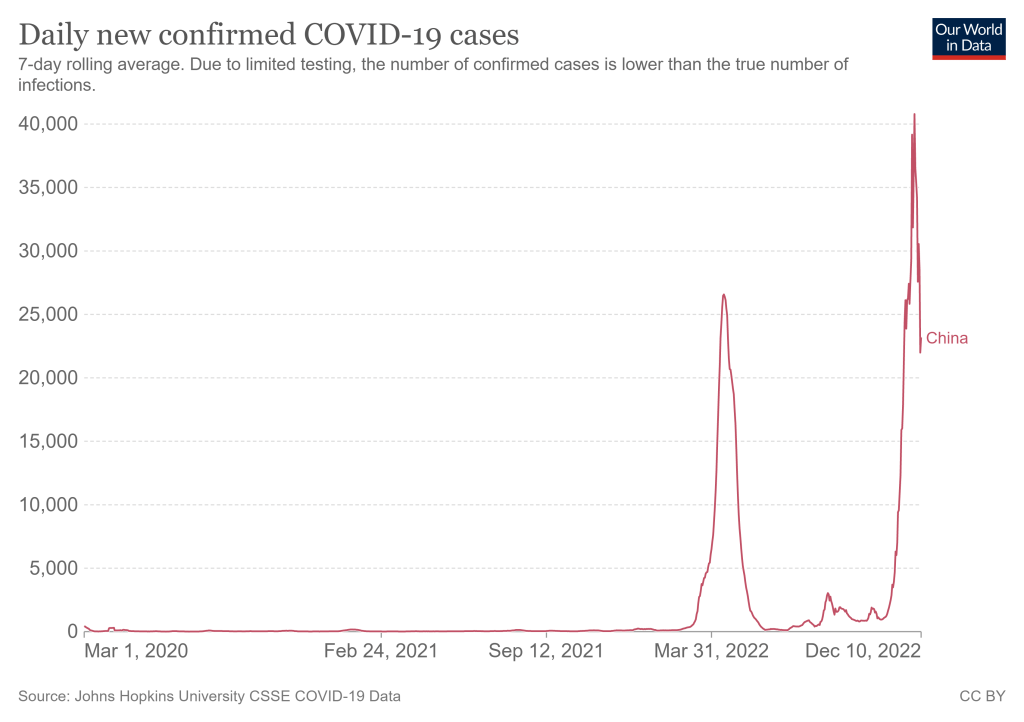
    As China rolls back on COVID-19 safety measures, its rising case load is likely to shoot up further. Chart from Our World in Data.

    China has rolled back some of its most rigorous COVID-19 safety policies, essentially moving away from its “zero COVID” strategy, following recent protests. I am no expert on China’s political or health policies here, but I did want to share some reflections on what this rollback could mean for global COVID-19 data, citing from Katherine Wu’s recent story in The Atlantic.

    First of all, it’s important to note that we don’t have much information about coronavirus variants circulating in China. According to the global database GISAID, China has submitted a total of just 667 Omicron sequences—compared to nearly two million from the U.S. The country’s most recent sample was submitted on November 29, almost two weeks ago. Some reports, like this one in the Global Times, suggest that Omicron BF.7 is the dominant variant in Beijing, but the pattern could be different in other parts of the country.

    Without more data, it’s hard to say for sure. And this is concerning because, if a new variant evolves in China as the virus spreads more widely there in the coming weeks, it could take more time for the rest of the world to learn about it than if a new variant emerged in other countries. Quick responses and international collaboration have been crucial in responses to new variants over the last two years; the global scientific community needs to be prepared to study and adapt to any new variant that might come out of China.

    At the same time, China’s case data are going to become less reliable as the country reduces its clinical testing. Daily case numbers have already appeared to drop, per Our World in Data, but this could be a product of less testing for asymptomatic people (and/or data delays) rather than a surge actually turning around. I also noted that Our World in Data does not have any testing numbers for China more recent than April 2022.

    China is already more limited at sharing COVID-19 data than other countries. But if case numbers become less reliable, it will get harder for international health experts to keep tabs on how bad China’s surge is getting. And it could get very bad: one modeling analysis, published in Nature in May, found that an unchecked Omicron wave in the country could lead to demand for intensive care units at 15.6 times the country’s current capacity—and 1.55 million deaths.

    Based on its current healthcare system, China is not prepared for a massive national surge of severe COVID-19 cases. It’s probably even less prepared for the massive surge of Long COVID cases that could follow. This has implications for global health, economics, and more.

    From the last paragraph of Wu’s great article:

    Even without a spike in severe disease, a wide-ranging outbreak is likely to put immense strain on China—which may weigh heavily on its economy and residents for years to come. After the SARS outbreak that began in 2002, rates of burnout and post-traumatic stress among health-care workers in affected countries swelled. Chinese citizens have not experienced an epidemic of this scale in recent memory, Chen told me. “A lot of people think it is over, that they can go back to their normal lives.” But once SARS-CoV-2 embeds itself in the country, it won’t be apt to leave. There will not be any going back to normal, not after this.

    More international data