Tag: survey

  • Staggering new Long COVID research, and a correction

    Staggering new Long COVID research, and a correction

    The Census and NCHS are releasing new, comprehensive data on Long COVID prevalence based on a nationally representative survey.

    I’m doing another post dedicated to Long COVID research this week, unpacking a noteworthy new data source. Also, I have an update about a Long COVID study that I shared in last week’s issue.

    First: new data from the Household Pulse Survey suggests that almost 20% of Americans who got COVID-19 are currently experiencing Long COVID symptoms. The Household Pulse Survey is a long-running Census project that provides data on how the pandemic has impacted Americans, with questions ranging from job loss to healthcare access.

    In the most recent iteration of this survey, which started on June 1, the Census is asking respondents about Long COVID: specifically, respondents can share whether they had COVID-related symptoms that lasted three months or longer. The first round of data from this updated survey were released last week (representing respondents surveyed between June 1 and June 13), in a collaboration between the Census and the CDC’s National Center for Health Statistics (NCHS).

    The numbers are staggering. Here are a few notable findings, sourced from the NCHS press release:

    • An estimated 14% of all U.S. adults have experienced Long COVID symptoms at some point during the pandemic.
    • About 7.5% of all U.S. adults are currently experiencing Long COVID symptoms, representing about one in 13 Americans.
    • Out of U.S. adults who have ever had COVID-19, about 19% are currently experiencing Long COVID symptoms.
    • Older adults are more likely to report Long COVID than younger adults, while women are more likely to report it than men.
    • About 8.8% of Hispanic or Latino adults are currently experiencing Long COVID, compared to 6.8% of Black adults and 7.5% of White adults.
    • Bisexual and transgender adults were more likely to report current Long COVID symptoms (12.1% and 14.9%, respectively) than those of other sexualities and genders.
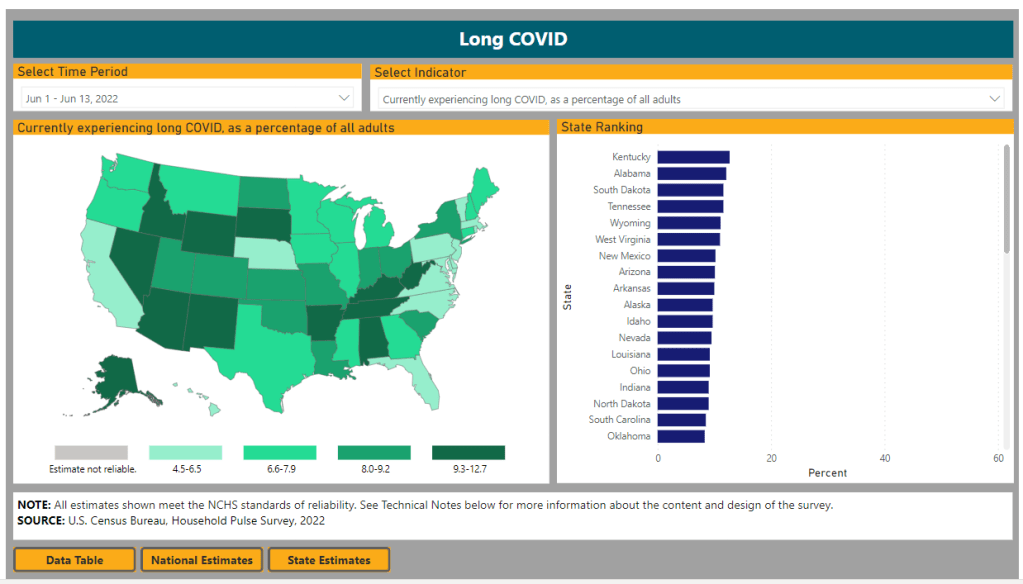
    • States with higher Long COVID prevalence included Southern states like Kentucky, Alabama, and Tennessee.

    This study is a big deal. The Household Pulse Survey is basically the closest comparison that the U.S. has to the U.K.’s highly-lauded Office for National Statistics survey, in that the survey can collect comprehensive data from a representative subset of Americans and use it to provide national estimates.

    In other words: two years into the pandemic, we finally have a viable estimate of how many people have Long COVID, and it is as large an estimate as Long COVID advocates warned us to expect. Plus, demographic data! State-by-state-data! This is incredibly valuable, moreso because the Household Pulse Survey will continue incorporating Long COVID into its questions.

    Also, it’s important to note that Long COVID patients were involved in advocating for and shaping the new survey questions. Big thanks to the Patient-Led Research Collaborative and Body Politic for their contributions!

    Next, two more Long COVID updates from the past week:

    • Outcomes of coronavirus reinfection: A new paper from Ziyad Al-Aly and his team at the Veterans Affairs Saint Louis healthcare system, currently under review at Nature, explores the risks associated with a second coronavirus infection. They found that a second infection led to higher risk of mortality (from any cause), hospitalization, and specific health outcomes such as cardiovascular disorders and diabetes. “The risks were evident in those who were unvaccinated, had 1 shot, or 2 or more shots prior to the second infection,” the researchers wrote in their abstract.
    • NIH data now available for Long COVID research: The National Institutes of Health’s “All of Us” research program is releasing a dataset from almost 20,000 people who have had COVID-19 for scientists to study. The data come from clinical records, genomic sequencing, and patient-reported metrics; researchers can use them to examine Long COVID trends, similarly to the way in which Al-Aly’s team uses VA records to study COVID-19 outcomes.

    And finally, a correction: Last week, I shared a paper published in The Lancet which indicated Long COVID may be less likely after an Omicron infection compared to a Delta infection. A reader alerted me to some criticism of this study in the Long COVID community.

    Specifically, the estimates in the paper are much lower than those found by the U.K.’s ONS survey, which is considered more reliable. This Lancet paper was based not on surveys but on a health app which relies on self-reported, volunteer data. In addition, the researchers failed to break out Long COVID risk by how many vaccine doses patients had received, which may be a key aspect of protection.

    Finally, as I noted last week, even if the risk of Long COVID is lower after an Omicron infection, the risk is still there. And when millions of people are getting Omicron, a small share of Omicron infections leading to Long COVID still leads to millions of Long COVID cases.
    More Long COVID reporting

  • Reader survey: What do you want to see in 2022?

    Reader survey: What do you want to see in 2022?

    Last January, as I relaunched the COVID-19 Data Dispatch on its own website, I also started a membership program. The membership, as I envisioned it, would allow readers to support my work while also getting access to an exclusive Slack server where they could network with each other and help shape the publication’s coverage.

    I quickly learned, however, that while some people were willing to support my work, the Slack server was not very popular. Those who have kept up memberships over the past year have mostly done so because they like the COVID-19 Data Dispatch and want to help me keep it free for everyone.

    This is awesome, obviously—and I’m very grateful to those donors, who have supported the CDD’s tech costs, payment for Intern Sarah Braner last spring, and a couple of guest articles. But in 2022, I would like to revamp readers’ options for donating in a way that aligns more closely with your interests.

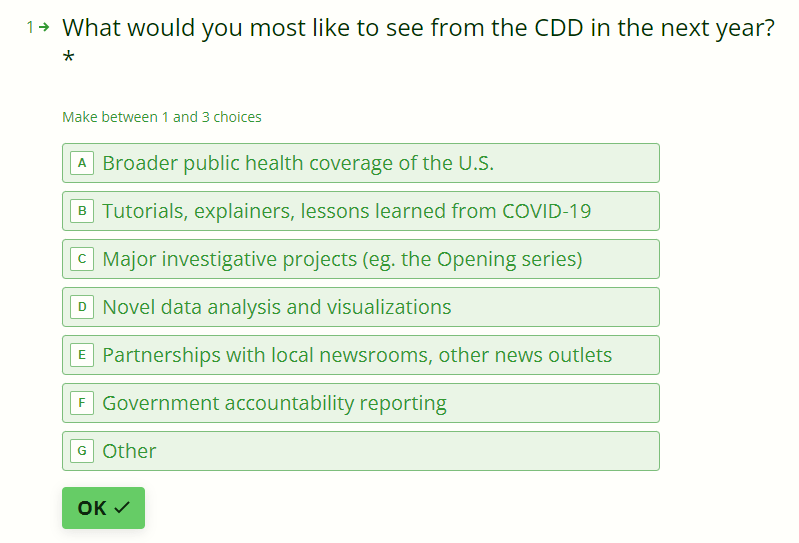
    The survey will help me figure that out, as well as give me an overall sense of what you all would like to see from the COVID-19 Data Dispatch in 2022. It should take under five minutes to complete, and can be done on a computer or smartphone.

    //embed.typeform.com/next/embed.js

    If the embedded form above doesn’t work, you can fill out the survey at this link: https://form.typeform.com/to/Ilo69Uzx

    And if you’re interested in supporting the CDD, you can do so here:

  • Survey: Looking forward to 2022

    Survey: Looking forward to 2022

    I recently wrapped up a big project over here at the COVID-19 Data Dispatch. (In case you missed it: I profiled five school communities that had successful reopenings in 2020-2021. Check out the project here!) Now that it’s done, I’ve been doing a bit of reflecting on the next steps for this publication—specifically, what I’d like it to look like one year from now.  

    My mission here is to provide you, my readers, with the information you need to understand what’s going on with COVID-19 in your community. I’m committed to covering the pandemic, for as long as it remains the number one health and science story in America.

    But what happens when COVID-19 is no longer the number one health and science story in America? I started to consider this question early in summer 2021, before Delta came roaring in—and made many people realize that we were still pretty far away from the “end of the pandemic.” Delta allowed me to procrastinate, basically. But this is the kind of question one can only put off for so long, so here I am, considering it again.

    As I think about the COVID-19 Data Dispatch’s future, I’m thinking about everything that this country needs to do in preparation for the next public health crisis. Because there will be a next public health crisis—in fact, climate change is already producing a never-ending stream of crises all around us. What information do we need, and what data-driven stories can we tell, to get ready? How can I serve my fellow journalists, scientists, health experts, and the other people in my community?

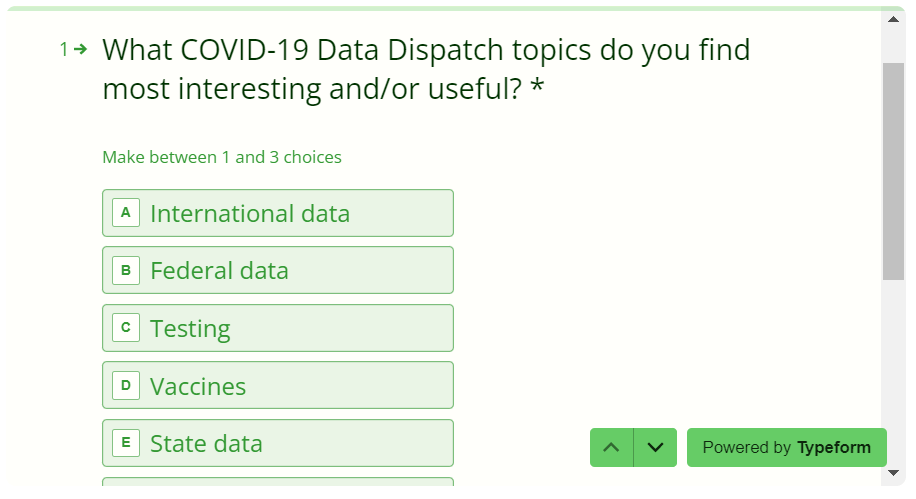
    To help me figure this out, I’ve put together a survey for you, dear readers! It should be easy to fill out: 10 questions, mostly multiple choice. It can be done on a computer or a phone, and shouldn’t take you more than five minutes.

    //embed.typeform.com/next/embed.js

    If the widget above doesn’t load, go to this link to fill out the survey: https://form.typeform.com/to/YOlZ2zB4

  • When will the pandemic end? 26 science writers and communicators respond

    When will the pandemic end? 26 science writers and communicators respond

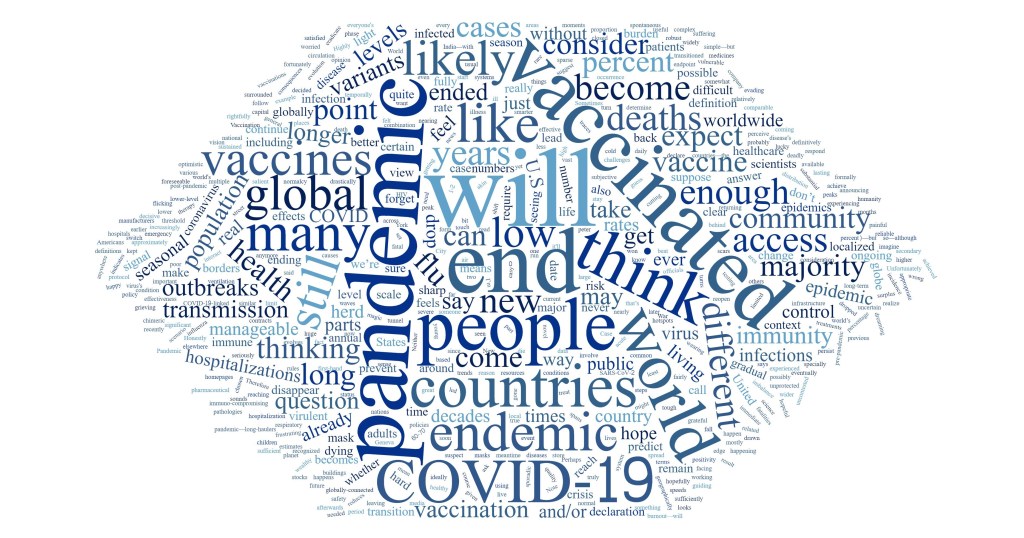
    Wordcloud of the survey’s responses, made by Betsy Ladyzhets.

    In July 2020, I started the COVID-19 Data Dispatch. Inspired in part by a desire to express my thoughts on the challenges of pandemic tracking and in part by a desire to be useful for my friends and colleagues who were less plugged into COVID-19 news, the project grew from a newsletter to a full-fledged publication with its own website, resources, and membership program.

    Within months of my starting the publication, though, people started asking me about its end. What would I do when COVID-19 was “over”? I never knew how to answer. While there may be benchmarks that public health experts can use to declare the pandemic at an end, this end feels more complex for science writers like myself who have been intensely covering the COVID-19 crisis.

    The questions reached a fever pitch this spring as millions of Americans got vaccinated and reopenings became inevitable. So, I did what I often do when I face a challenge in my work: I reached out to my community.

    Working with The Open Notebook, I surveyed 26 other COVID-19 reporters and communicators. I asked when they thought the pandemic might come to an end, as well as how they would take lessons from the past year into the “post-COVID” stages of their careers.

    Many of the writers who responded took that first question literally. They provided vaccination thresholds (60 percent, 70 percent), positivity rate thresholds (1 percent, 2 percent), and other metrics. “When there is a sustained period with no or little COVID-19 related fatalities globally,” wrote The City’s Ann Choi.

    Others took the question in more complicated and nuanced directions. These writers redirected the question back at me—noting that even when the world meets numeric thresholds, millions will remain vulnerable.

    For example, freelance journalist Roxanne Khamsi wrote, “We’re still living in an HIV pandemic.” The Atlantic’s Ed Yong said, “I’ve come to think that the question, ‘When will the pandemic end?’ isn’t very useful, and it’s more salient to ask, ‘For whom is the pandemic still ongoing?’” Other writers pointed to immunocompromised people for whom the vaccines may not be effective, long-haulers still suffering from symptoms, and the inequities between the U.S. and the many nations with little access to vaccines.

    As a science writer covering public health, I feel duty-bound to think of the most vulnerable; many of the writers who responded to my survey echoed that sentiment. Even when the majority of the U.S. is vaccinated, I still intend to cover the communities that face barriers to getting their shots, the immunocompromised patients for whom the shots may not work, and the countries where shots are still not available at all. I’m inspired by the boundless curiosity and compassion of other writers who continue this work, too.

    In addition to asking about the end of the pandemic itself, I asked what lessons these writers would take into their future reporting. Their answers fit a similar theme, compassion and curiosity. Some wrote that science writing must intersect more with non-science fields: “Every beat is deeply intersectional, and it’s time to see newsrooms that reflect that,” said U.S. News reporter Chelsea Cirruzzo. Climate coverage may be one example of this trend; climate reporters like HEATED’s Emily Atkin are calling for more collaboration between science and non-science journalists writing about this crisis.

    Other survey responses discussed the importance of communicating uncertainty, challenging established scientific norms, and holding accountable the institutions that fail to protect the vulnerable. “Assume nothing, question everything and everyone,” wrote The New York Times’s Apoorva Mandavilli.

    When will the pandemic end? It won’t be when the world sees its last COVID-19 case, because that could be centuries from now. Maybe it will be, as Berlin-based freelancer Hristio Boytchev wrote, “When the incidence numbers disappear from the homepages of major news media.”

    Even if incidence numbers disappear from homepages, though, I know that science sections, health sections, and independent publications like mine will keep the coverage going for a long time yet.

    To read the full responses from each science writer, head over to The Open Notebook’s website.