Tag: summer surge?

  • National numbers, September 24

    National numbers, September 24

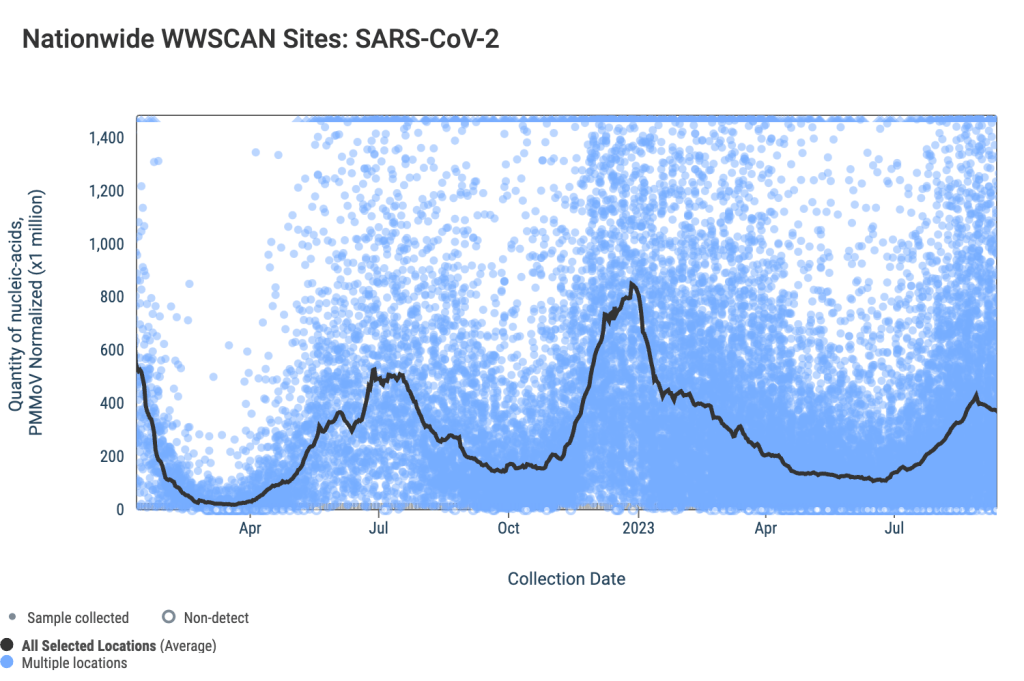
    Data from the WastewaterSCAN network suggests that COVID-19 spread has leveled off somewhat after this summer’s increase.

    During the most recent week of data available (September 3-9), the U.S. reported about 20,500 new COVID-19 patients admitted to hospitals, according to the CDC. This amounts to:

    • An average of 2,900 new admissions each day
    • 6.3 total admissions for every 100,000 Americans
    • 8% more new admissions than the prior week (August 27-September 2)

    Additionally, the U.S. reported:

    • 12.5% of tests in the CDC’s surveillance network came back positive
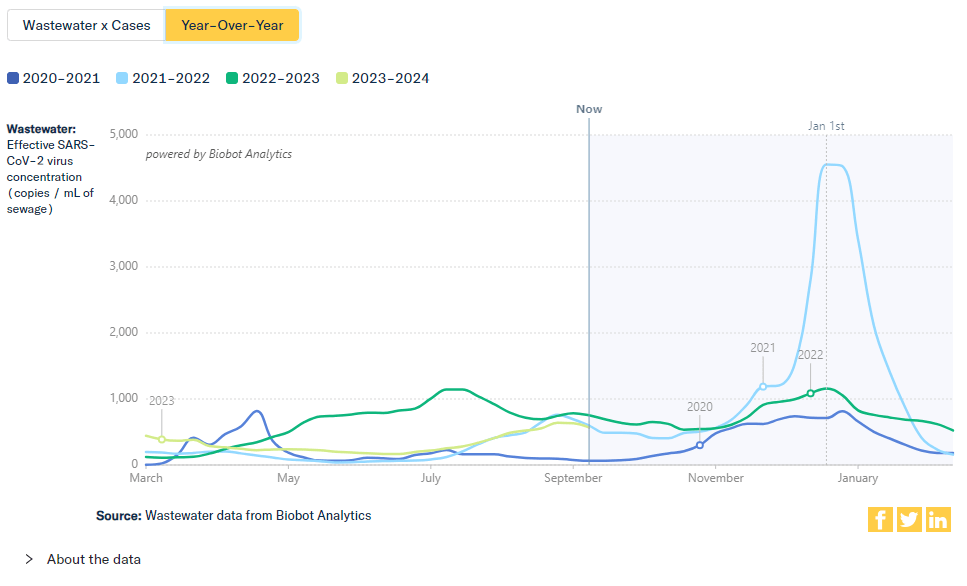
    • A 5% lower concentration of SARS-CoV-2 in wastewater than last week (as of September 13, per Biobot’s dashboard)
    • 25% of new cases are caused by Omicron EG.5, 24% by XBB.1.6, 14% by FL.1.5.1 (as of September 16)

    The COVID-19 plateau that I’ve described over the last couple of weeks continues, with wastewater and test positivity data showing that viral spread has slowed in much of the U.S. However, this is likely just a lull before respiratory virus season starts in earnest.

    National wastewater data from the WastewaterSCAN project suggest that COVID-19 spread has leveled off in recent weeks, after rising throughout July and August. Biobot Analytics’ data present a similar picture, though the company didn’t update its data this past Thursday (so the most recent numbers are as of September 13).

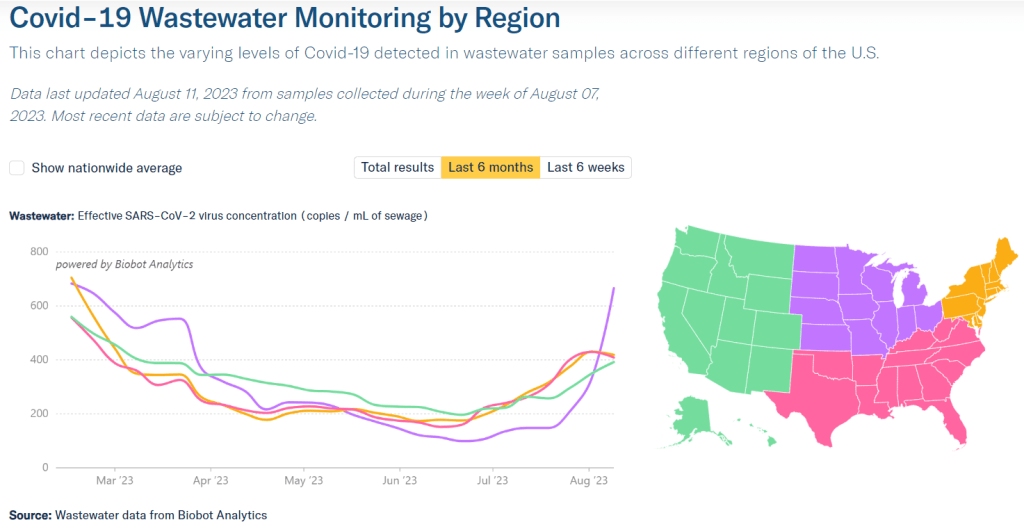
    SCAN and Biobot’s data both show plateaus or declines in all four major regions. But the Northeast and Midwest are reporting more coronavirus in their wastewater sites (at least, in aggregate) than the South and West Coast.

    Some sewersheds in the Northeast and Midwest regions have reported increases in recent weeks, while others are leveling off. In Boston and New York City, for example, most sewersheds report declines or plateaus; while sewersheds in Kansas City and Lawrence, Kansas report upward trends.

    To find wastewater data for your region, check the Biobot, WastewaterSCAN, and CDC dashboards. I maintain a list of national, state, and a few local wastewater surveillance dashboards on the COVID-19 Data Dispatch website.

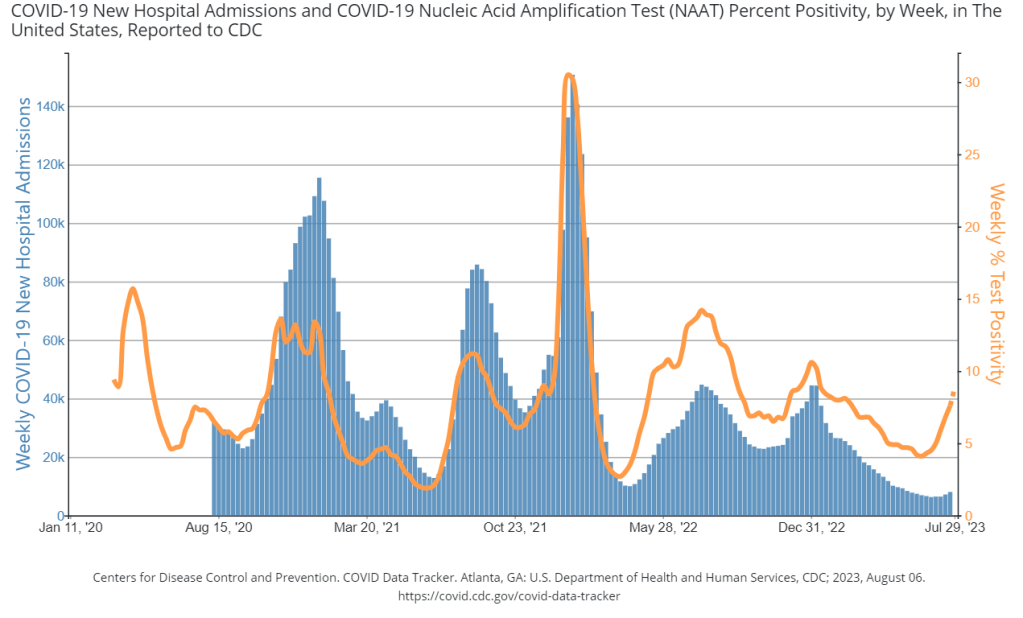
    National COVID-19 test positivity is also trending slightly down, according to the CDC’s surveillance network. Test positivity fell slightly to 12.5% in the week ending September 16, from over 14% in the prior three weeks. Walgreens’ testing data show a continued decline in positivity as well.

    Hospital admissions for COVID-19 are still going up, according to the CDC—though these data are reported with a significant delay. More than 20,000 people were hospitalized with COVID-19 during the week ending September 9, demonstrating that this disease can still cause severe symptoms. And the CDC has no surveillance data on Long COVID, making that similarly-harmful outcome less visible.

    It’s now officially fall, and October marks the start of the respiratory virus season—meaning we can expect more spread of the flu, RSV, and other pathogens along with COVID-19. This is a good time to stock up on high-quality masks, air filters, and other tools that help protect against multiple diseases.
  • National numbers, September 17

    National numbers, September 17

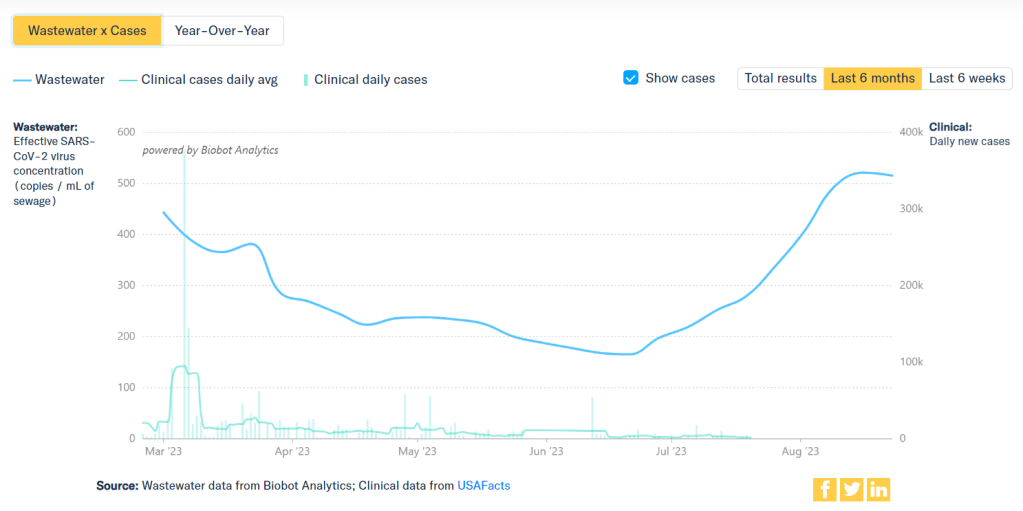
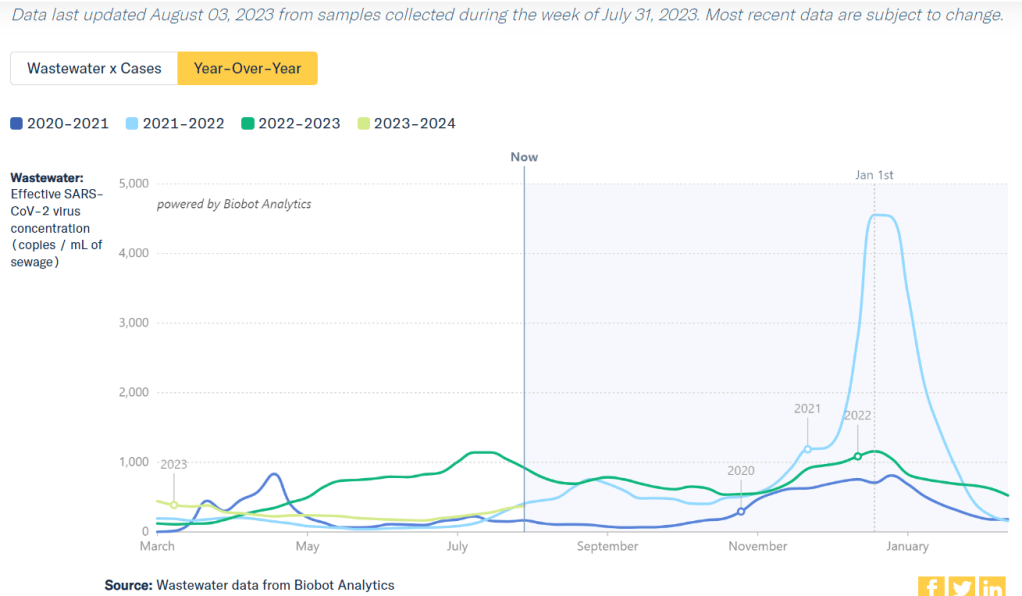
    Wastewater data from Biobot suggest that coronavirus levels in the U.S. right now are similar to this time in 2021, during the Delta surge.

    During the most recent week of data available (August 27-September 2), the U.S. reported about 18,900 new COVID-19 patients admitted to hospitals, according to the CDC. This amounts to:

    • An average of 2,700 new admissions each day
    • 5.7 total admissions for every 100,000 Americans
    • 9% more new admissions than the prior week (August 20-26)

    Additionally, the U.S. reported:

    • 14.4% of tests in the CDC’s surveillance network came back positive
    • A 10% lower concentration of SARS-CoV-2 in wastewater than last week (as of September 6, per Biobot’s dashboard)
    • 25% of new cases are caused by Omicron EG.5, 24% by XBB.1.6, 14% by FL.1.5.1 (as of September 16)

    For the second week in a row, available data suggest that the current COVID-19 surge may be turning around, or at least heading for a plateau. But there’s still a lot of coronavirus going around—and this will likely remain true through the winter respiratory virus season.

    Wastewater data from both Biobot Analytics and WastewaterSCAN suggest that coronavirus spread may be ticking down, after two months of increases. Biobot’s national trends show a 10% decline in SARS-CoV-2 levels in wastewater last week, after a 1% decline the week prior. WastewaterSCAN’s trends show a slow decline in the last week, following a slow increase over the summer.

    This decline isn’t universal across the country: according to Biobot’s regional data, the South and Northeast are reporting clearer declines in coronavirus spread, while the West is in a plateau and the Midwest is in an increase. Sewersheds in Midwestern cities like South Bend, Indiana, Coralville, Iowa, and Lincoln, Nebraska have reported major increases in SARS-CoV-2 levels in the last couple of weeks, per WastewaterSCAN.

    Test positivity data from the CDC’s respiratory virus testing network also suggest that this summer’s COVID-19 surge may be leveling off. About 14.3% of COVID-19 tests in this CDC network came back positive in the week ending September 9, compared to 14.4% and 14.6% in the prior two weeks. (Note: this network includes a sample of testing labs across the country, but is less comprehensive than our testing data were before the federal health emergency’s end.)

    Walgreens’ COVID-19 dashboard, which reports test positivity data from the pharmacy chain, shows the positivity rate leveling off as well. The share of Walgreens tests coming back positive went down slightly from 45% in late August to 40% this past week. Walgreens’ dashboard, like the wastewater data, shows that more people are testing positive in the Midwest and West regions.

    Hospitalizations for COVID-19 continue to trend up, with the CDC reporting about 2,700 new patients a day during the week ending September 2. While this number may seem small compared to the overwhelmed hospitals we saw in past surges, it’s important to remember that CDC hospitalization data are both delayed and incomplete.

    Our most recent data are from two weeks ago, and reporting standards for hospitals are more lenient now than they have been earlier in the pandemic—though the CDC does still collect data directly from facilities across the country.

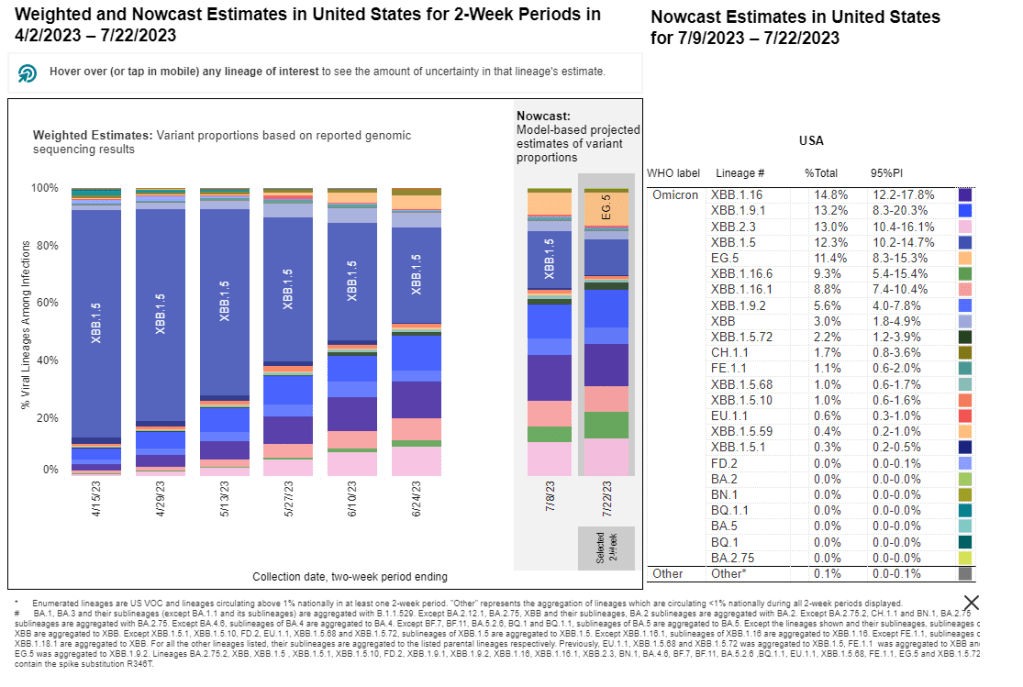
    Variant estimates, also from the CDC, suggest that EG.5 and XBB.1.6 are still the dominant lineages in the U.S. Each accounted for about one in four COVID-19 cases in the last two weeks, while other versions of XBB caused the rest. BA.2.86 hasn’t appeared in the CDC’s prevalence estimates yet, but scientists have detected it in several states, suggesting it could be spreading under the radar.

    Biobot’s wastewater data suggest that COVID-19 spread in the U.S. is similar now to this time in 2021, during the Delta surge. If 2023 continues to follow trends from the last two years, we could see transmission plateau in early fall, then rise again during the holiday season.  Any lull that we do experience may be a good time to stock up on masks, rapid tests, and other tools to protect yourself and your community.

  • National numbers, September 10

    National numbers, September 10

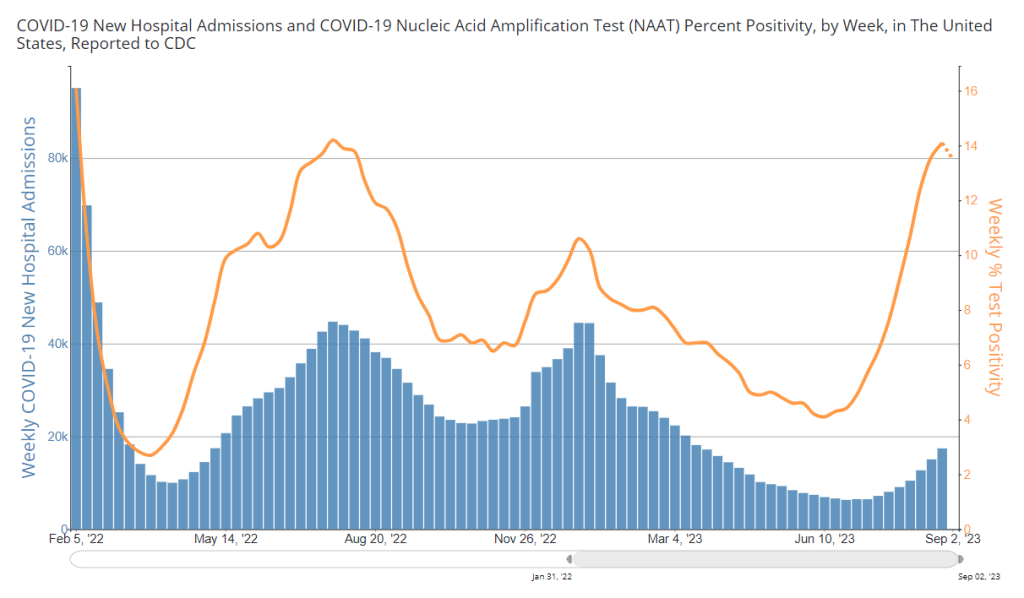
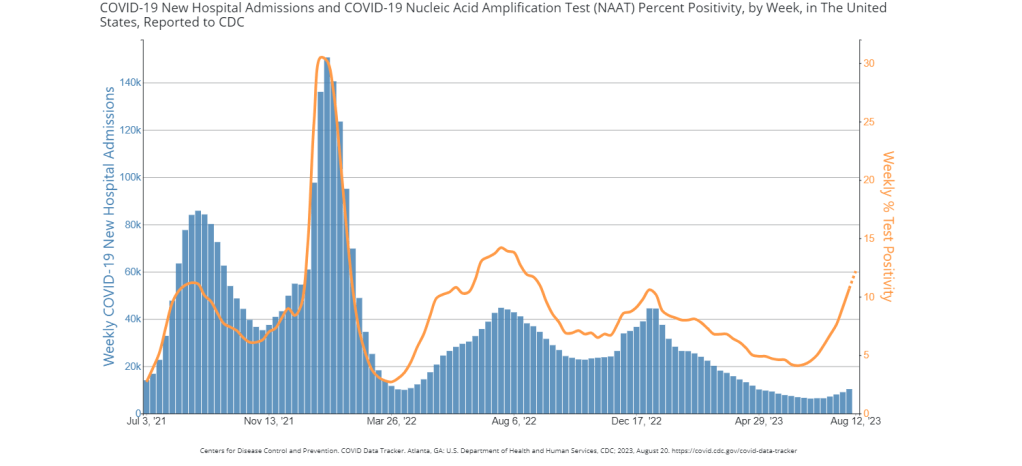
    COVID-19 test positivity and viral levels in wastewater may be turning around, but hospitalizations are still going up. Chart from the CDC, data as of September 7.

    During the most recent week of data available (August 20-26), the U.S. reported about 17,400 new COVID-19 patients admitted to hospitals, according to the CDC. This amounts to:

    • An average of 2,500 new admissions each day
    • 5.3 total admissions for every 100,000 Americans
    • 16% more new admissions than the prior week (August 13-19)

    Additionally, the U.S. reported:

    • 13.5% of tests in the CDC’s surveillance network came back positive
    • A 0.3% higher concentration of SARS-CoV-2 in wastewater than last week (as of September 6, per Biobot’s dashboard)
    • 23% of new cases are caused by Omicron XBB.1.6; 22% by EG.5; 15% by FL.1.5.1 (as of September 2)

    After two months of consistent increases in major COVID-19 metrics, we have once again reached, “Has the surge peaked?” territory. Preliminary data from wastewater and testing are suggesting potential plateaus, while more people are still getting hospitalized with COVID-19.

    National trends from Biobot Analytics’ wastewater surveillance network show very similar coronavirus levels in sewage this week and last week: 641 virus copies per milliliter of sewage on September 6, compared to 639 on August 30. These data are preliminary, though, and could change as more sewersheds report.

    Biobot’s regional data suggest different trends in different parts of the country: the South and West coast might be turning around, the Northeast is still reporting an increase (but the speed of increase there is slowing), and the Midwest is reporting a sharp increase following a recent decrease.

    Data from the CDC network and WastewaterSCAN similarly show mixed results depending on your location. Among CDC sites with recent data, about half reported increased coronavirus in their wastewater in the last two weeks, while the other half reported decreases. WastewaterSCAN’s network reports continued increases in Midwestern states, including sewersheds in Michigan, Ohio, and Kansas.

    Test positivity data from the CDC’s respiratory surveillance network also indicate that the summer surge might have peaked, or at least might be slowing. For the first time in several weeks, test positivity decreased slightly in the most recent CDC update, from 14.1% in the week ending August 26 to 13.5% in the week ending September 2.

    Walgreens’ COVID-19 positivity tracker (which shares data from tests conducted by the pharmacy network) reported a slight decrease as well, from 43.6% in the week ending August 26 to 40.6% in the week ending September 2. Like the wastewater surveillance data, this information is preliminary but could be a good sign.

    Meanwhile, COVID-19 hospitalizations—a more delayed metric—are still increasing. About 2,500 people were newly hospitalized with COVID-19 each day in the week ending August 26. Hospitalizations have particularly gone up for older adults, according to data from insurance company Humana shared with STAT News.

    Many students went back to school last week, as the fall semester gets underway. This could be another driver of COVID-19 spread, as travel and gatherings were in the summer. Better air quality, masks, and other measures could make schools safer for students, teachers, staff, and their families.

  • National numbers, September 3

    National numbers, September 3

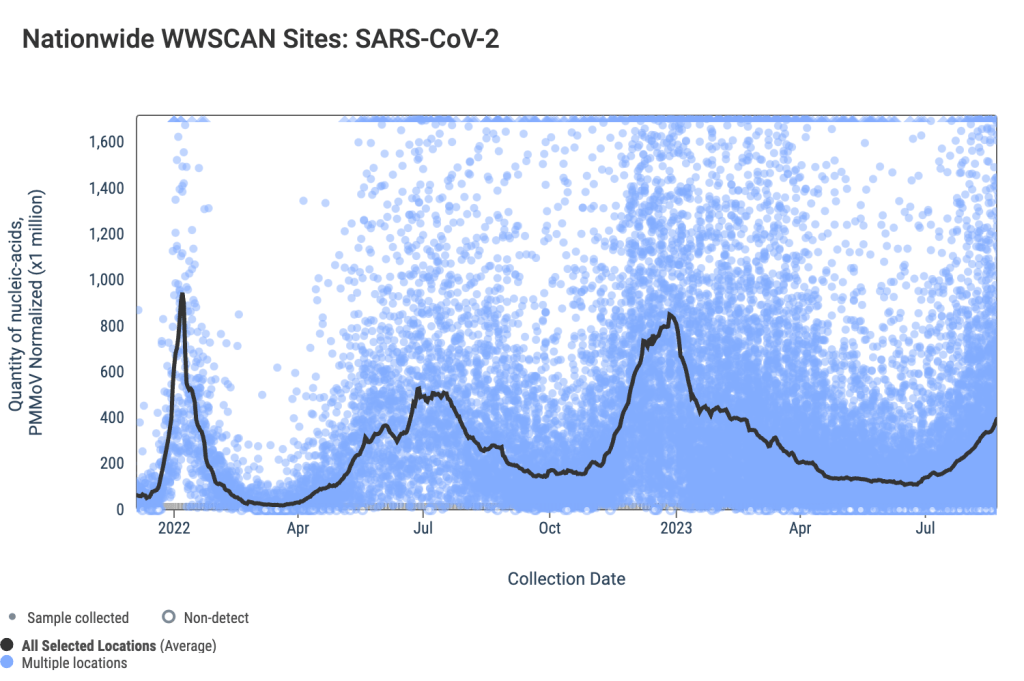
    COVID-19 data from WastewaterSCAN suggest that coronavirus spread is still trending up nationwide.

    During the most recent week of data available (August 13-19), the U.S. reported about 15,100 new COVID-19 patients admitted to hospitals, according to the CDC. This amounts to:

    • An average of 2,200 new admissions each day
    • 4.6 total admissions for every 100,000 Americans
    • 19% more new admissions than the prior week (August 6-12)

    Additionally, the U.S. reported:

    • 14.9% of tests in the CDC’s surveillance network came back positive
    • A 3% higher concentration of SARS-CoV-2 in wastewater than last week (as of August 30, per Biobot’s dashboard)
    • 23% of new cases are caused by Omicron XBB.1.6; 22% by EG.5; 15% by FL.1.5.1 (as of September 2)

    The late-summer COVID-19 surge is still in full swing, with all major metrics showing further increases in disease spread this week. BA.2.86 isn’t spreading widely yet but is worth continued surveillance.

    Last week, I wrote that wastewater data from Biobot Analytics showed a potential plateau—but cautioned those data were tentative. Unfortunately, further updates this week suggest that COVID-19 transmission is still increasing, albeit not as dramatically as it was in July.

    Data from WastewaterSCAN show a similar pattern: a sharp increase in COVID-19 spread from late June through July, followed by a slight leveling off, and then followed by further increase. This could be caused by a newer variant entering the picture, driven by behaviors, or (most likely) some combination of the two.

    Regional data from both Biobot and WastewaterSCAN indicate that COVID-19 transmission might be approaching plateaus in the South and Midwest, but is going up sharply in the Northeast and West coast. The Midwest, after showing decreases in Biobot’s data over recent weeks, is now trending up again.

    The CDC’s test positivity and hospitalization numbers continue to rise as well. New hospital admissions for COVID-19 reached 2,000 per day during the week ending August 19, and are likely still higher now. Test positivity is up to 15%, the highest this metric has been since last winter’s holiday surge.

    In the CDC’s latest variant estimates (posted on Saturday), EG.5 and XBB.1.6 continue to dominate in a crowded landscape of Omicron XBB relatives. The agency hasn’t yet found enough BA.2.86 for this new variant to be included in the update. However, this could indicate low testing rather than an actual low prevalence of BA.2.86.

    The CDC often takes COVID-19 reporting breaks over holiday weekends, and this one is no exception: the agency will not update its dashboard on Monday, according to a note posted at the top of the page. Hospitalizations, test positivity, and other metrics will be updated later in the week.

    Of course, the coronavirus doesn’t care about holidays—in fact, it usually spreads more widely when people travel and gather. Fully understanding this Labor Day weekend’s impact could take several weeks, at our current pace of data reporting.

  • National numbers, August 27

    National numbers, August 27

    Biobot’s wastewater surveillance data suggest a potential plateau in COVID-19 spread, though future weeks of data will be needed to say for sure.

    During the most recent week of data available (August 6-12), the U.S. reported about 12,600 new COVID-19 patients admitted to hospitals, according to the CDC. This amounts to:

    • An average of 1,800 new admissions each day
    • 3.8 total admissions for every 100,000 Americans
    • 22% more new admissions than the prior week (July 30-August 5)

    Additionally, the U.S. reported:

    • 13.4% of tests in the CDC’s surveillance network came back positive
    • A 1% lower concentration of SARS-CoV-2 in wastewater than last week (as of August 23, per Biobot’s dashboard)
    • 25% of new cases are caused by Omicron XBB.1.6; 21% by EG.5; 11% by XBB.2.3; 13% by FL.1.5.1 (as of August 19)

    This week, our limited COVID-19 data picture suggests that transmission may be starting to level off. But if BA.2.86 or another newer variant enters this high-spread environment, the outlook could get less rosy.

    One sign of a possible plateau: Biobot’s national wastewater surveillance dashboard shows a very slight downward trend, with SARS-CoV-2 levels dropping by about 1% from August 16 to August 23. This is based on just one week of data, though, so we’ll have to see what further updates show.

    Biobot’s regional data similarly show potential good trends: the Midwest appears to have passed the peak during this surge, as of the last two weeks, while the South and Northeast also show slight plateaus. Coronavirus levels are still trending up in the West, but less intensely.

    Data from both Biobot and WastewaterSCAN suggest that COVID-19 spread has turned a corner in some Midwest sewersheds, such as Johnson County, Kansas; Lawrence, Kansas; Lonoke County, Arkansas; Lincoln, Nebraska; and Warren, Michigan. Still, more data are needed to see if these trends hold.

    Test positivity data from the CDC’s respiratory surveillance network also suggest that COVID-19 spread may be slowing. After a rapid rise through July, test positivity increased by just 8% in the most recent week of data (ending August 19), from 12.4% to 13.4%. This is still a high overall positivity rate, though, especially considering how difficult PCR tests are to access these days.

    Hospitalizations continue to rise as well: the CDC reported a 22% increase in new COVID-19 patients from the week ending August 5 to the week ending August 12. While hospitalizations are significantly delayed compared to other metrics, these data show one of the surge’s severe impacts. We have even less data about Long COVID, the other main severe impact.

    BA.2.86, a new variant that scientists are watching closely, isn’t yet impacting transmission in the U.S. based on our current data. But it could lead to another increase in cases, if it proves able to outcompete the now-dominant group of XBB variants. (More on BA.2.86 later in today’s issue.)

    Remember: new variants don’t appear magically out of nowhere. People encourage their evolution, by allowing the virus to continue spreading unchecked. In addition to protecting ourselves and our communities, COVID-19 safety measures help to prevent further mutation.

  • National numbers, August 20

    National numbers, August 20

    While the rise in hospitalizations has been modest, test positivity is on a similar level to the last couple of surges, per the CDC. Data as of August 18.

    During the most recent week of data available (July 30 through August 5), the U.S. reported about 10,300 new COVID-19 patients admitted to hospitals, according to the CDC. This amounts to:

    • An average of 1,500 new admissions each day
    • 3.1 total admissions for every 100,000 Americans
    • 14% more new admissions than the prior week (July 23-29)

    Additionally, the U.S. reported:

    • 12.2% of tests in the CDC’s surveillance network came back positive
    • A 10% higher concentration of SARS-CoV-2 in wastewater than last week (as of August 16, per Biobot’s dashboard)
    • 25% of new cases are caused by Omicron XBB.1.6; 21% by EG.5; 11% by XBB.2.3; 13% by FL.1.5.1 (as of August 19)

    The summer COVID-19 surge continues. While wastewater surveillance data suggest that transmission trends may be turning around in some places, the virus is largely still increasing across the U.S. New variants are on the horizon, too.

    Nationally, coronavirus levels in wastewater are the highest they’ve been since last winter’s holiday surge, according to data from Biobot Analytics. Viral concentrations have tripled since mid-June, and continue to follow a similar pattern to the Delta surge that we experienced at about the same time in summer 2021.

    Biobot’s regional data suggest that the Midwest—which reported a serious spike last week—may have turned a corner in this surge, with viral levels going into a plateau. This pattern is based on just one week of data, though, so we’ll have to see what next week’s numbers show.

    Wastewater data from the CDC and WastewaterSCAN similarly show continued increases in COVID-19 spread. Some counties in Southern states, such as Florida, Georgia, and Alabama, are reporting particularly large upticks. Hawaii may be a state to watch, too, as residents face health access challenges following the recent wildfires.

    Test positivity also continues to increase, with the CDC reporting that about 12% of COVID-19 tests reported to its respiratory network returned positive results in the week ending August 16. Hospital admissions and emergency department visits are still going up as well, though these metrics are reported with two-week delays.

    The CDC updated its variant data this week, reporting that Omicron EG.5 continues to outcompete other XBB lineages. EG.5 doesn’t have a huge advantage in transmission, though, so it’s increasing relatively slowly amid a sea of other similar variants.

    But a new variant, called BA.2.86, may be one to watch more closely. Health officials are on the alert after seeing just a few cases in the U.S., Israel, and Denmark due to a number of mutations in this variant’s spike protein, which diverge significantly from other strains. (More on this variant later in today’s issue.)

    While the CDC says it’s monitoring this new variant, the agency’s genomic surveillance is far sparser than it was a year or two ago. The agency and its research partners are now sequencing under 5,000 coronavirus samples a week, compared to almost 100,000 a week at the height of Omicron. With this small sample pool, the CDC is less equipped to catch BA.2.86, or any other variants that may arise.

  • National numbers, August 13

    National numbers, August 13

    Wastewater data from Biobot Analytics suggest that coronavirus levels in the Northeast and South may be leveling off, while the Midwest is seeing a major spike.

    During the most recent week of data available (July 23 through 29), the U.S. reported about 9,000 new COVID-19 patients admitted to hospitals, according to the CDC. This amounts to:

    • An average of 1,300 new admissions each day
    • 2.8 total admissions for every 100,000 Americans
    • 13% more new admissions than the prior week (July 16-22)

    Additionally, the U.S. reported:

    • 10.6% of tests in the CDC’s surveillance network came back positive
    • A 9% higher concentration of SARS-CoV-2 in wastewater than last week (as of August 9, per Biobot’s dashboard)
    • 31% of new cases are caused by Omicron XBB.1.6; 17% by EG.5; 11% by XBB.2.3; 10% by XBB.1.9 (as of August 5)

    All major COVID-19 metrics continue to increase in the U.S., as we deal with a late-summer surge. Wastewater surveillance suggests that current virus spread is on pace with the Delta surge in 2021, though other data sources are less reliable these days.

    Wastewater data from Biobot continue to show an uptick nationally, following the same upward trend that started in late June. The CDC’s wastewater surveillance system and WastewaterSCAN network report similar trends.

    Biobot’s regional data suggest that the Northeast and South, the first two regions to see COVID-19 increases this summer, might be approaching their peaks, but it’s too early to say for sure. Regional test positivity numbers, from the CDC, show no sign of slowing their rise.

    Meanwhile, COVID-19 spread is going way up in the Midwest, per Biobot and WastewaterSCAN. Some sewersheds in Iowa, Michigan, Ohio, and nearby states have reported their viral levels in wastewater more than doubling over the last couple of weeks.

    Test positivity nationwide is now over 10%, per the latest data from the CDC’s respiratory virus testing network. Walgreens’ COVID-19 dashboard, which displays testing data from its pharmacies (i.e. a smaller sample size than the CDC network), reports a record high: of about 2,400 COVID-19 tests conducted in the week ending August 6, 45% were positive.

    Hospital admissions for COVID-19 are also on the rise, with about 1,300 new hospitalizations for COVID-19 each day in the week ending July 29, per the CDC. While it’s true that these numbers are far lower than peaks during prior surges, the data are also less reliable now— with fewer hospitals reporting to the CDC and fewer measures in those hospitals (like masking) to control infections.

    A lot of articles in the last couple of weeks have connected the recent surge to EG.5, the latest Omicron subvariant gaining ground in the U.S. However, this variant is not necessarily causing the surge; it doesn’t seem to be meaningfully more contagious or more severe than other recent strains, scientists are finding.

    Rather than a variant, I would personally attribute this surge to summer travel and gatherings, combined with waning immunity—it’s been many months since most Americans had contact with the virus through vaccination or infection.

    All of the virus-spreading activities going on right now will give SARS-CoV-2 more avenues to mutate. And there are other variants circulating globally that could cause more problems in the U.S. as well, as Eric Topol outlines in a recent Substack post. The next booster can’t come soon enough.

  • This summer, COVID-19 safety is more individualized than ever

    This summer, COVID-19 safety is more individualized than ever

    Current coronavirus levels in wastewater are close to the summer 2021 Delta surge, according to Biobot.

    COVID-19 metrics have been on the rise in the U.S. for about a month now, indicating that we’re experiencing a summer surge. This is pretty unsurprising for many public health experts, as the country has experienced increased transmission during the last three summers.

    Unlike past years, though, this summer’s surge comes after the end of the federal public health emergency. We now have less data than ever to follow COVID-19 trends, combined with less access to health measures than ever.

    We’re also dealing with continued minimization of the problem. Coverage of the current surge in mainstream media sources tends to downplay any concerns, suggesting that hospitalizations are low (even though those data are delayed), or that masking isn’t necessary (even though this tool works best as a preventative measure), or that all infections are now mild (even though Long COVID remains a risk for any case). The People’s CDC offers more critique here.

    Despite these challenges, enough information is out there that anyone committed to safety can keep up with COVID-19 news and protect themselves. Unfortunately, this practice now requires much more individual effort—a far cry from the collective measures that we took back in 2020. But we still have opportunities to show leadership, by sharing information and resources with our communities.

    Here are a few things I’m doing in the current surge, and recommendations to consider sharing:

    • Assume all data are delayed and undercounted. COVID-19 data sources are sparser than ever, so the trends we see are likely to be small reflections of larger issues. Biobot’s wastewater dashboard, for example, provides results from a sample of sewersheds across the U.S.; the same increases are likely happening in places where we aren’t tracking them.
    • Watch your local wastewater numbers. Despite the uneven coverage of wastewater surveillance, this is still the best tool for advanced warnings on COVID-19 now that case data are no longer available. If your city or county doesn’t have a wastewater testing site, you can likely find a nearby one to follow for trends. See the CDD’s resource page for links to dashboards.
    • Stock up on high-quality masks. N95s and KN95s are really necessary to protect yourself from the ever-evolving Omicron variants. There are a lot of places to buy these online; Project N95 is my personal favorite, as you can get masks directly from their manufacturers and contribute to mask donations for less-resourced communities.
    • Consider a higher-value respirator for riskier activities. If you’re traveling or going to a higher-risk event this summer, a reusable respirator might be helpful. I wrote more about why I bought one in this post last summer.
    • Stock up on rapid tests. Most health insurance plans no longer cover these (following the end of the federal health emergency), but some local governments are still giving them out for free in public spaces, like libraries in NYC. You might also buy tests in bulk online. I personally use iHealth Labs, because they sell packs of five tests that are easy to bring while traveling and frequently run sales.
    • Make a plan for isolation/quarantine. In case you or a member of your household gets sick, it can be helpful to have an advance plan on where you might isolate, how to keep air clean in shared spaces, where to get Paxlovid, etc. Your Local Epidemiologist has more tips on how to deal with a positive test.
    • Share information and resources. Surveys have suggested that many Americans would mask and take other public health measures during surges, but those people might not know about the current rise in transmission. Sharing information with your community (along with masks, rapid tests, and other tools, if you have surplus) can help broaden safety measures.
    • Remember why you’re taking precautions. During increased social pressures against COVID-19 safety, I personally find it helpful to remember why I find these behaviors important. Some reasons are selfish (for example, taking a week or two off work would be difficult) while others are more philosophical (such as a dedication to the principles of broader public health)—but all of them are valuable.

    If you have questions or additional suggestions, please share them below.

  • National numbers, August 6

    National numbers, August 6

    Test positivity is way up in the U.S., while hospitalizations are starting to follow this trend. Chart via the CDC.

    During the most recent week of data available (July 16 through 22), the U.S. reported about 8,000 new COVID-19 patients admitted to hospitals, according to the CDC. This amounts to:

    • An average of 1,150 new admissions each day
    • 2.4 total admissions for every 100,000 Americans
    • 12% more new admissions than the prior week (July 9-15)

    Additionally, the U.S. reported:

    • 8.9% of tests in the CDC’s surveillance network came back positive
    • A 10% higher concentration of SARS-CoV-2 in wastewater than last week (as of August 2, per Biobot’s dashboard)
    • 31% of new cases are caused by Omicron XBB.1.6; 17% by EG.5; 11% by XBB.2.3; 10% by XBB.1.9 (as of August 5)

    Over the last few weeks, the signals of a summer COVID-19 surge in the U.S. have grown steadily clearer. Viral levels in wastewater, test positivity, and hospitalizations are all climbing across the country.

    Wastewater surveillance data from Biobot suggest that coronavirus levels have doubled nationally in the last month. The surge is impacting all major regions of the country; the Northeast and South saw earlier increases, but the Midwest and West Coast are now catching up.

    The CDC’s wastewater surveillance network also points to increasing COVID-19 spread, with sites across the country reporting higher viral levels. While wastewater surveillance remains uneven (some states are testing in every county, others in just a handful of locations), it still gives us enough information to identify a widespread surge.

    Test positivity from the CDC’s lab testing network shows continued increases as well. About 8.9% of COVID-19 tests reported to the agency returned positive results in the week ending July 29, compared to 4.5% in the week ending June 24. This increase, too, is consistent across regions.

    Hospitalizations for COVID-19 are also going up, according to the CDC. These data are significantly delayed, with the most recent numbers dating to about two weeks ago. So, while overall patient numbers remain low right now, I expect they will continue to rise as the surge goes on.

    The coronavirus’ continued evolution is likely playing a role in this summer’s increased spread, as are summer travel and waning immunity from past vaccinations. Omicron EG.5, a descendant of the XBB.1.9 lineage, is the latest variant to spread widely, according to the CDC’s estimates.

    No one version of XBB has yet shown a significant ability to spread much faster or cause more severe symptoms than other variants. Rather, many iterations of this Omicron lineage are spreading in tandem, continuing to mutate with every infection. And with fewer PCR tests happening, it’s harder for health agencies to keep track.

    This summer’s surge may be less visible than ever. But wastewater data suggest we’re seeing similar levels of COVID-19 spread as we saw with Delta in summer 2021. Precautions are still important!

  • National numbers, July 23

    National numbers, July 23

    A wide variety of XBB-related Omicron variants are competing across the U.S. Data from the CDC, as of July 22.

    During the most recent week of data available (July 2 through 8), the U.S. reported about 6,200 new COVID-19 patients admitted to hospitals, according to the CDC. This amounts to:

    • An average of 900 new admissions each day
    • 1.9 total admissions for every 100,000 Americans
    • 1% fewer new admissions than the prior week (June 25-July 1)

    Additionally, the U.S. reported:

    • 6.3% of tests in the CDC’s surveillance network came back positive
    • A 9% higher concentration of SARS-CoV-2 in wastewater than last week (as of July 19, per Biobot’s dashboard)
    • 24% of new cases are caused by Omicron XBB.1.6; 19% by XBB.1.9; 13% by XBB.2.3 (as of July 22)

    COVID-19 data in the U.S. is showing increasingly clear signs of a summer surge, with infections rising across the country. However, thanks to the federal public health emergency’s end, we have less and less data to track this trend.

    Wastewater data from Biobot Analytics show that national coronavirus levels have gone up by about 68% in the last month. Current levels are far below this time last year (when the Omicron BA.4/BA.5 surge was in full swing), but still at their highest in several months.

    Biobot’s regional data suggest that the COVID-19 uptick is hitting all major regions. But the increases have been most pronounced in the Northeast and South; coronavirus levels have doubled in both regions in the last month, per Biobot.

    The CDC’s wastewater surveillance network has picked up these increases as well, with more than half of testing sites in this network (with recent data) reporting coronavirus upticks in the last two weeks. Some major cities, such as Boston and Los Angeles, are also reflecting the increase.

    Test positivity data from the CDC also show the increasing COVID-19 spread: nationally, test positivity from the labs in the agency’s surveillance network has gone up from 4.3% one month ago to 6.3% in the most recent week of data. The most prominent increases for this metric are similarly in the Northeast and South, and in the health region including Oregon, Washington, Idaho, and Alaska.

    One metric not yet showing an increase is the CDC’s hospital admissions data. But the agency has continued to report these data with a lag: as of today, the most recent hospitalization numbers are as of July 8, two weeks ago. The CDC has yet to provide a clear explanation for this reporting lag.

    Either way, the data we do have give us sufficient warnings about this summer’s uptick in COVID-19 spread. One likely culprit is the continued evolution of Omicron XBB: about 15 different subvariants are currently competing, according to the CDC’s latest data. No variant seems to be a clear winner yet.

    Regardless of which variant comes to dominate next, the same safety measures continue to work against COVID-19.