Tag: source shout-out

  • COVID source shout-out: excess deaths estimates

    This week, a team of demography researchers published a paper sharing excess death estimates by county, for the first two years of the COVID-19 pandemic. The team, led by Andrew Stokes at Boston University, has been analyzing excess death data for years in order to understand the true toll of COVID-19 on the U.S.

    To measure excess deaths, researchers compare the number of deaths that they’d expect to occur in a given place, over a given timeframe—based on modeling from historical data—to the number of deaths that actually happened. This metric is a helpful one for COVID-19 research, because official COVID-19 deaths are undercounted for a variety of reasons. (To name a few: lack of standards for death certificates, politicization of the pandemic, health equity issues.)

    Especially now that official COVID-19 data are becoming less and less reliable, I see excess deaths as a useful avenue for continued reporting on the pandemic. And for any journalists or researchers interested in looking into this issue, Stokes and his team’s work is a great starting point. I collaborated with them for MuckRock’s Uncounted project, using a preprint iteration of the paper published this week.

    For more info on this topic, see the Uncounted project and this 2021 post about excess death data from the CDC.

  • COVID source shout-out: Advocating for masks in healthcare

    A reader recently sent me this petition to the Illinois state legislature, which asks lawmakers to request that the state health department reconsider its position on masks in healthcare settings. This petition is one of many advocacy efforts that have pushed for healthcare organizations to continue prioritizing COVID-19 safety.

    In Illinois: the state health department ended its mask requirement in healthcare settings on May 11, timed with the end of the public health emergency. This petition, authored by patients, doctors, and researchers in Illinois, requests that legislators tell the health department that this choice was a mistake. Illinois residents can sign onto it here.

    For readers outside Illinois who’d like to get involved with these efforts, Mandate Masks US, the COVID Advocacy Initiative, and COVID Safe Campus have compiled a toolkit to advocate for masks in healthcare with political and healthcare organizations. The People’s CDC offers some resources in this area as well. While the advocacy groups’ Week of Action on this issue may have passed (it took place in mid-May), there are still many ways to help push for safer healthcare settings.

  • COVID source shout-out: Cryptic lineage investigation in Ohio

    Marc Johnson, a molecular virologist and wastewater surveillance expert at the University of Missouri, recently went viral on Twitter with a thread discussing his team’s investigation into a cryptic SARS-CoV-2 lineage in Ohio. I was glad to see the project get some attention, because I find Johnson’s research in this area fascinating and valuable for better understanding the links between coronavirus infection and chronic symptoms.

    A “cryptic lineage” is a technical term for, basically, a strange viral mutation that researchers have identified in a specific location. Unlike common variants that spread through the population (Delta, Omicron, BA.5, XBB, etc.), these lineages typically are contained in one place, or even in one person. They’re usually identified by wastewater surveillance, since that technique picks up more people’s infections than testing at doctors’ offices.

    Johnson has become a specialist in investigating these cryptic lineages over the last couple of years. His lab at the University of Missouri runs the state’s wastewater surveillance program, which includes genetic sequencing for sewage samples. And his team also collaborates on sequencing research for wastewater surveillance in other parts of the U.S. This Nature article from last year goes into more detail about how these investigations work.

    In the last few months, Johnson and his colleagues have been investigating one cryptic lineage in Ohio. The scientists have traced the lineage to Columbus and a town called Washington Court House; they believe it represents one sick person, who lives in Columbus and goes to Washington Court House for work. This individual is shedding a massive amount of coronavirus, orders of magnitude higher than the average COVID-positive person. See more details in this story by The Columbus Dispatch.

    Johnson and his colleagues would like to identify the person behind this lineage for two reasons. First, they can connect the person with doctors who can help treat their COVID-19 symptoms—it’s likely they’re having a pretty nasty gastrointestinal experience. Second, the scientists hope to better understand how viral particles that shed from a long-term infection might be related to chronic symptoms, as persistent virus in different organ systems is one of the leading hypotheses for why Long COVID occurs.

    I’ve interviewed Johnson before for stories about wastewater surveillance and I think he does fascinating work, so I was glad to see his Twitter thread get some attention. If you can help identify the Ohio resident with lots of coronavirus in their gut, get in touch with him!
  • COVID source shout-out: Body Politic

    Body Politic, a health justice organization that has led Long COVID organizing over the last three years, shut down its Slack support group this week. The group has been a valuable place for long-haulers to connect and find resources; it’s also helped launch other important projects, such as the Patient-Led Research Collaborative and the Long COVID Survival Guide.

    The organization isn’t ending its support of long-haulers, though: it’s partnered with New Health, a mobile app developed to continue community Long COVID support. “New Health will be hiring Body Politic moderators and board members as their first paid staff, and members of our community are currently testing their app,” Body Politic leaders wrote in an April blog post describing the transition.

    I’ve written previously about Body Politic’s fundraising efforts as the group sought to transition form a grassroots, all-volunteer organization to a format that was more sustainable, and I’m glad to see that the group’s leaders have found this solution. But it’s a bit sad to see the original Slack group close—the end of an era.

    Thank you to all the volunteers who made the Body Politic group possible, from a journalist who has relied on many of its members and resources in my reporting on Long COVID!

  • COVID source shout-out: Virginia’s new wastewater dashboard

    COVID source shout-out: Virginia’s new wastewater dashboard

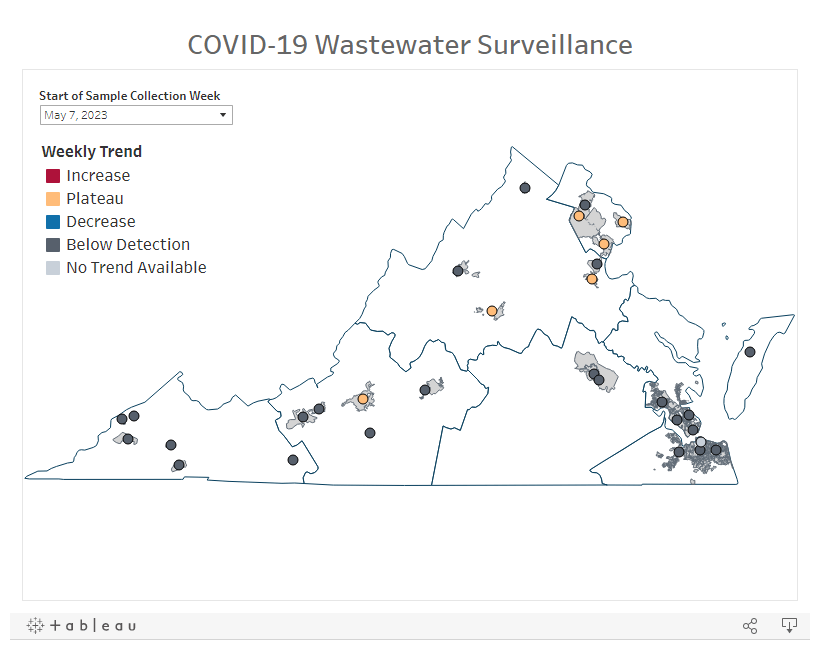
    One of the visuals available on Virginia’s new wastewater dashboard.

    With the public health emergency ending, a lot of state and local health departments are sunsetting or paring down their COVID-19 dashboards. Wastewater surveillance data are an exception, though, with agencies continuing to test sewage (and share the results) as other forms of COVID-19 testing become less available.

    Virginia’s Department of Health is one notable example: this past week, the agency added a new wastewater surveillance section to its COVID-19 dashboard. The new section includes a map of testing sites, coronavirus trends by site, viral loads over time, and plenty of text explaining how to interpret the data.

    This dashboard will be a great resource for Virginia residents aiming to continue following COVID-19 spread in their communities. It’ll be updated weekly on Tuesdays, according to the department.

  • COVID source shout-out: Wastewater testing at the San Francisco airport

    A few months ago, I wrote about how testing sewage from airplanes could be a valuable way to keep tabs on the coronavirus variants circulating around the world. International travel is the main way that new variants get from one country to another, so monitoring those travelers’ waste could help health officials quickly spot—and respond to—the virus’ continued mutations.

    This spring, San Francisco International Airport became the first in the U.S. to actually start doing this tracking; I covered their new initiative for Science News. The airport is working with the CDC and Concentric, a biosecurity and public health team at the biotech company Ginkgo Bioworks, which already collaborates with the agency on monitoring travelers through PCR tests.

    The San Francisco airport started collecting samples on April 20, and scientists at Concentric told me that they’re happy with how it’s going so far. Airport staff are collecting one sample each day, with each one representing a composite of many international flights. Parsing out the resulting data won’t be easy, but the scientists hope to learn lessons from this program that they can take to other surveillance projects.

    Both scientists at Concentric and outside experts are also excited about the potential to monitor other novel pathogens through airplane waste (though the San Francisco project is focused on coronavirus variants right now). Read my Science News story for more details!

  • COVID source shout-out: WastewaterSCAN’s newsletter

    COVID source shout-out: WastewaterSCAN’s newsletter

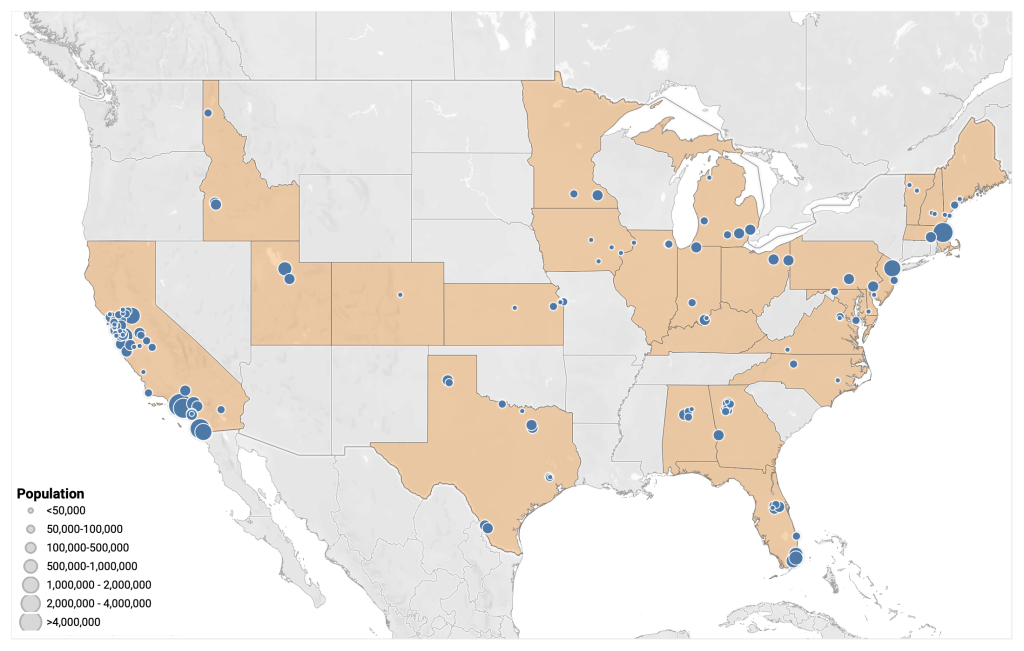
    Map of WastewaterSCAN sites, from the project’s March 24 newsletter.

    A few weeks ago, I learned that the WastewaterSCAN project has a newsletter, which shares updates about COVID-19 and other diseases nationally and for the Bay Area in California. It’s a helpful resource for following infectious disease trends.

    WastewaterSCAN, for any readers who might be unfamiliar, is a wastewater surveillance project founded by researchers at Stanford and Emory Universities. The project started in 2020 by monitoring wastewater in the Bay Area for SARS-CoV-2, but has since expanded to about 150 sites nationwide and six testing targets: the coronavirus, flu, RSV, mpox, norovirus, and human metapneumovirus (HMPV).

    In the newsletter, the SCAN team shares summary data about all of these diseases, as well as some variant analysis for SARS-CoV-2. The language is sometimes a bit technical (as its primary audience is the team’s academic and public health partners), but still very useful for seeing where diseases are rising or falling. SCAN’s local updates are especially helpful for anyone living in the Bay Area.

    Also, the SCAN team recently had a paper published in the Lancet discussing their work monitoring wastewater for diseases beyond COVID-19. The new article shows this technology’s potential for broader public health surveillance.

  • COVID source shout-out: A win for CDC FOIAs

    American Oversight, a nonprofit watchdog organization that shares government information through public records requests, recently reached a settlement in a lawsuit with the CDC. The settlement’s terms will make it easier for anyone requesting CDC documents to get results.

    Early in the pandemic, American Oversight filed a number of FOIA (Freedom of Information Act) requests to the CDC about the agency’s COVID-19 response. Some of those requests were rejected for being “overly broad,” which demonstrated “significant problems with the agency’s FOIA practices” and led to American Oversight filing a lawsuit in May 2020, the organization explains in a recent blog post.

    The CDC and American Oversight have now reached a settlement about this records lawsuit—and its terms require the agency to instruct all CDC FOIA officers to be more considerate of “broad” requests. Rather than issuing blanket rejections, FOIA officers should look closely at request descriptions and consult with their supervisors “to ensure all angles of the request have been considered,” according to an email that CDC leadership has sent to staff, in consultation with American Oversight.

    This settlement could have huge ramifications for other people requesting records from the CDC (including yours truly) as journalists and researchers continue to investigate how the U.S. handled COVID-19. Thank you to American Oversight for pushing on transparency!

  • COVID source shout-out: Remembering the COVID Tracking Project

    This Tuesday, March 7, will mark two years since the COVID Tracking Project stopped collecting data. For readers who might not know, I was a long-time volunteer for the Project; my early newsletters referenced it so frequently that I added a disclaimer to my “About” page clarifying that the COVID-19 Data Dispatch is a separate, personal endeavor.

    I got to catch up with a few fellow COVID Tracking Project alums at the NICAR conference this past weekend, which led me to some reflection on the care and comradery that shaped CTP. The Project was a massive effort to provide U.S. COVID-19 data that would help people understand pandemic trends during a confusing, scary time. But it was also a place of collective learning, innovation, friendship, and so many Slack threads.

    To quote from the post I wrote about CTP on the day of our final data entry shifts:

    I have seen the Project as another form of mutual aid. I’ve given countless hours to CTP over the past year in the form of data entry shifts, analysis, writing, and custom emojis—but those hours have also been given back to me, in everything from Tableau tricks to playlist recommendations. My fellow volunteers, the vast majority of whom I’ve never met in person, are my neighbors. We live in the same spreadsheets and Slack channels; we see the world in the same way.

    That final day of data collection feels like it was just yesterday, and also like more than two years have passed. Sometimes, I miss those earlier days of the pandemic, when covering COVID-19 felt like an “all hands on deck” top priority. The beat is lonelier these days, of course. (And I probably don’t have to tell you how few people were wearing masks at NICAR, even among those who used to report on COVID-19.)

    Even so, CTP was a model for a newer, better, more collaborative form of data journalism. I hope the COVID-19 Data Dispatch can remain a vestige of those efforts, for as long as it’s necessary.

  • COVID source shout-out: Mandate Masks NY

    Political leaders in New York State recently ended a policy requiring masks in healthcare settings. This is obviously a big issue for high-risk New Yorkers, many of whom have spoken out on social media about wanting to attend important doctors’ appointments without risking COVID-19.

    In response to the change, local advocacy organization Mandate Masks NY has compiled a list of hospitals and healthcare centers in New York that are still maintaining mask requirements independently of the state policy. You can find the list here; and the organization has compiled several other lists of businesses requiring masks, available on their website.

    As a former COVID Tracking Project volunteer, I’m always glad to see volunteer efforts producing important databases that wouldn’t otherwise be available. Also: it looks like the Mandate Masks NY Twitter account was suspended this weekend—if you know anything about that, please reach out!