Tag: Source callout

  • COVID source callout: Lack of transparency from CDC committee

    Last week, I shared an update about the Healthcare Infection Control Practices Advisory Committee (HICPAC), a group of advisors to the CDC that has been working on updated guidelines for limiting infectious disease spread in healthcare settings. The committee has faced criticism for failing to incorporate lessons from COVID-19 into its guidance, as well as for a lack of transparency in its operations.

    The transparency issues continued this week, according to a press release by National Nurses United (NNU), a nurses union that’s been at the forefront of advocacy for better infection control guidelines. HICPAC only released a draft of its updated guidance on November 2, the day before it voted on the document. And it’s only giving the American public five days to review the document and provide feedback through public comments.

    “HICPAC’s draft is permissive and weak and seeks not just to maintain existing practice — which has been shown to be inadequately protective — but even rolls back the use of some important measures, such as airborne infection isolation rooms,” said NNU president Zenei Triunfo-Cortez in a statement.

    Despite calls to delay a vote on this document until hearing from healthcare workers and public health experts, HICPAC voted unanimously to finalize the guidance draft during its meeting this week. The vote indicates a lack of public transparency and a lack of consideration for relevant health expertise—which is troubling considering how influential this guidance is for setting standards in healthcare centers across the country.

    For more details about HICPAC and instructions on making public comments, see this CDC webpage.
  • COVID source callout: You can’t search for COVID-19 information on Threads

    Threads, the new text-based social media platform from Meta (the parent company of Facebook and Instagram), has blocked users from searching about COVID-19 or Long COVID. The block is a harmful choice by Meta, which will make it difficult for health experts, people with Long COVID, and other seeking information to find each other on this platform.

    A search function became available on Threads last week, reports Taylor Lorenz in The Washington Post. Health experts and COVID-conscious users tested it out, and quickly discovered that searching for “COVID” or “Long COVID” led to a blank screen with no seach results. Threads instead directed the users to the CDC’s website.

    Lorenz received a statement from Meta confirming that the company is blocking these search results:

    Meta acknowledged in a statement to The Washington Post that Threads is intentionally blocking the search terms and said that other terms are being blocked, but the company declined to provide a list of them. A search by The Post discovered that the words “sex,” “nude,” “gore,” “porn,” “coronavirus,” “vaccines” and “vaccination” are also among blocked words.

    “The search functionality temporarily doesn’t provide results for keywords that may show potentially sensitive content,” the statement said, adding that the company will add search functionality for terms only “once we are confident in the quality of the results.”

    It’s unclear what steps Meta is taking to improve the “quality of the results” when users search for COVID-19 information, or when these searches will be available. But for now, experts and advocates who spoke to Lorenz say that the information block is harmful. “Censoring searches for COVID and Long COVID will only leave an information gap that will be filled by misinformation from elsewhere,” said science communicator Lucky Tran.

    I personally am not on Threads, and this recent news makes me even more wary of the platform than I’d been already. If you’re looking for a Twitter/X alternative to follow me on, I’ve been trying out Mastodon and Bluesky.

  • COVID source callout: CDC infection control committee may roll back protections

    A little-known CDC advisory committee is suddenly in the public spotlight, as it considers recommending fewer safety measures to reduce infection in hospitals and other healthcare settings. Despite major pushback at a recent meeting, it’s unclear whether this committee will actually live up to its infection control duties.

    The Healthcare Infection Control Practices Advisory Committee, or HICPAC, is a group of experts that advises the CDC on infectious disease safety measures in healthcare settings. It develops guidance that is rigorously followed across U.S. facilities, and the guidance is due for an update this year—for the first time since COVID-19 hit.

    In the last three years, healthcare and public health workers have learned a lot about the importance of masks and clean air for reducing respiratory disease risk. You might think that HICPAC would acknowledge this in its updated guidance, calling for hospitals to use high-quality masks and ventilation. Instead, however, HICPAC’s guidance disregards the last three years of airborne virus research, suggesting for example that N95s aren’t more protective than surgical masks and that masking is only needed when a disease is spreading very widely.

    These guidelines could have massive implications for the healthcare system. Many high-risk people are already hesitant to go to the doctor, in a time when mask requirements in these settings have largely been lifted. COVID-19 is spreading widely in these settings, limited data suggest. The new guidelines, if adopted, would extend the current COVID-19 “normal” to many other diseases, from seasonal flu to new viruses that may emerge.

    Naturally, a coalition of better-informed individuals and organizations (healthcare workers, scientists, patients, etc.) are pushing back against HICPAC. At a public meeting this past Tuesday, many attendees spoke against the guidance change, citing health research as well as their own experiences in the last three years. The committee failed to meaningfully acknowledge this criticism; in fact, it cut off the public comment period after just 40 minutes, leaving many attendees unable to share their feedback.

    Transparency concerns about HICPAC—which doesn’t usually share public updates or livestream its meetings—add to concerns about the committee’s guidance decisions. But the pressure is on for HICPAC to respond to its critics, improve its new guidance, and live up to its title.

    Further reading and how to get involved:

  • COVID source callout: Nebraska stops reporting wastewater data

    The Nebraska state health department has discontinued its wastewater surveillance data page, depriving residents of important COVID-19 updates at a time when cases are rising.

    Multiple local news outlets in the state (including the Omaha World-Herald, the Lincoln Journal-Star, and the radio station KIOS) reported the removal. Nebraska’s health department previously shared wastewater updates through PDF reports, published every two weeks; these reports included recent COVID-19 trends along with data about variants sequenced in the state’s sewage.

    Now, the health department’s wastewater surveillance page redirects to an error message, reading: “This page is currently unavailable.” The change came as wastewater data in Nebraska and across the country were showing an increase in coronavirus spread, local reporters covering the story have pointed out.

    Nebraska’s health department discontinued this webpage due to the federal public health emergency’s end in May, a spokesperson for the agency told the World-Herald and Journal-Star. The agency is still tracking wastewater data, the spokesperson said. But it’s apparently redesigning its public website to include as little information as possible.

    “Data continues to be tracked for that program and is available upon request,” the agency spokesperson told local reporters. Nebraska’s wastewater data still appear to be available on the CDC’s dashboard, as well. But new data for Nebraska sites were most recently added to that dashboard in early August, so it’s unclear whether CDC updates will continue after the local page’s end.

    Even if the Nebraska health department does continue sending data to the CDC, the national dashboard is less accessible to residents hoping to keep track of COVID-19 trends than the state’s reports were. As I’ve written before, local dashboards and alert systems are always better when it comes to tailoring updates for a specific community.

  • COVID source call-out: When will we get fall boosters?

    The CDC expects that our next round of COVID-19 booster shots will be available in early fall, likely late September or early October. But this limited information has been distributed not through formal reports or press releases—rather, through the new CDC director’s media appearances.

    These booster shots will be targeted to Omicron XBB.1.5, one of the most recently-circulating subvariants. It’ll be an important immunity upgrade, especially for seniors and other higher-risk people, as the last round of updated vaccines came almost a year ago. Plus, these new boosters are basically the federal government’s one initiative to combat COVID-19 as we head into another inevitable fall and winter of respiratory illness.

    Considering the shots’ importance, we have surprisingly little information about when they’ll be available or how they will be distributed. During one media appearance (on NPR’s All Things Considered in early August), CDC Director Dr. Mandy Cohen said that the boosters would be available “probably in the early October time frame.” Then, a week later (on former federal official Andy Slavitt’s podcast), she said boosters would come “by the third or fourth week of September.”

    In both interviews, Cohen shared few details beyond this vague timeline. I would love to see more details from the federal government about their plans—for producing the shots, and also for distributing them in our post-federal emergency landscape. It also seems unclear how the CDC and other agencies will promote the boosters, considering how most officials are now pretending COVID-19 is no longer a concern. (Case in point: Cohen’s many mask-less appearances since she started as CDC director.)

  • COVID source callout: Medicaid unwinding

    The Biden administration has recently boasted that the number of Americans without health insurance hit a “record low” earlier this year. But that statement rings hollow when you consider how millions of people will lose their insurance in the coming months, thanks to the end of the federal COVID-19 emergency.

    Early in the pandemic, the federal government gave states more funding for Medicaid programs, under the condition that they kept people enrolled in insurance rather than reevaluating their eligibility every year. This change led more people to be covered under Medicaid than ever before: about 94 million in total.

    Now, however, the COVID-19 emergency has ended and states are able to reevaluate who qualifies for Medicaid, in a process called “Medicaid unwinding.” Every state has a different evaluation process, many of them involving a lot of bureaucratic hassle (waiting for paperwork in the mail, finding the right forms to fill out online, enrolling in different health insurance if you no longer qualify for Medicaid, etc.).

    The Centers for Medicare & Medicaid Services (CMS) released new data this week about people losing access to Medicaid. About 700,000 people lost their health insurance in April 2023 alone, CMS reports. That accounts for just 18 states that had started their reevaluation process in April; experts estimate that millions more will lose coverage in the coming months.

    Losing health insurance during the ongoing pandemic means losing access to COVID-19 tests, vaccines, treatments, and care for Long COVID, not to mention all the routine health services that people need. Doesn’t really seem like something the Biden administration should be bragging about.

  • COVID source callout: NYT continues to push misleading information

    Longtime readers may remember that I am no fan of “The Morning,” a daily newsletter from the New York Times that has frequently downplayed COVID-19 in recent years. Last summer, for example, I called out the newsletter for misleading reporting about who was dying most from COVID-19.

    Well, this week, the newsletter’s primary author, David Leonhardt, has done it again. Leonhardt wrote on Monday that “the pandemic really is over.” As evidence, he pointed to excess deaths (i.e. deaths above expected norms from past years), writing that this metric has returned to a pre-COVID-19 baseline.

    It is true that excess deaths have been low since early 2023, when the country’s holiday COVID-19 surge concluded. And sure, this is good news about COVID-19’s current impact on mortality. You can see the CDC’s estimates here. However, Leonhardt’s newsletter fails to mention several caveats:

    • If the pandemic were truly “over,” excess deaths would actually be below historical averages, not at them, to reflect people who had died prematurely of COVID-19 in the last three years. (Health law scholar Blake Murdoch pointed this out on Twitter.)
    • Current death data are seriously undercounting COVID-19 deaths, thanks to the now-very-limited availability of COVID-19 tests combined with limited surveillance following the end of the federal public health emergency. The CDC revises up its estimates every week.
    • Excess death data, in general, are typically considered preliminary estimates for about a year. So, the data Leonhardt sites are preliminary and likely to be revised up once the CDC compiles more information from death certificates.
    • The pandemic has disproportionately impacted people of color and other vulnerable groups. Analysis from APM Research Lab shows that this pattern has continued through the first half of 2023.
    • Plenty of other metrics (including wastewater surveillance, hospitalizations, and the virus’ continued evolution) suggest that COVID-19 is still circulating and still making people sick. The U.S. is likely heading into a summer surge right now, in fact.
    • Leonhardt fails to mention Long COVID, one of the most dire outcomes of COVID-19. Even though millions of people are still dealing with prolonged symptoms.

    So, for whom is the pandemic really “over”?  It might be over for Leonhardt himself, but it’s not over for people with Long COVID, people still mourning lost loved ones, high-risk people still taking every precaution, people who will get infected this summer, and so many more. All of these people challenge the NYT’s misleading narrative.

  • The CDC’s new COVID-19 dashboard hides transmission risk

    The CDC’s new COVID-19 dashboard hides transmission risk

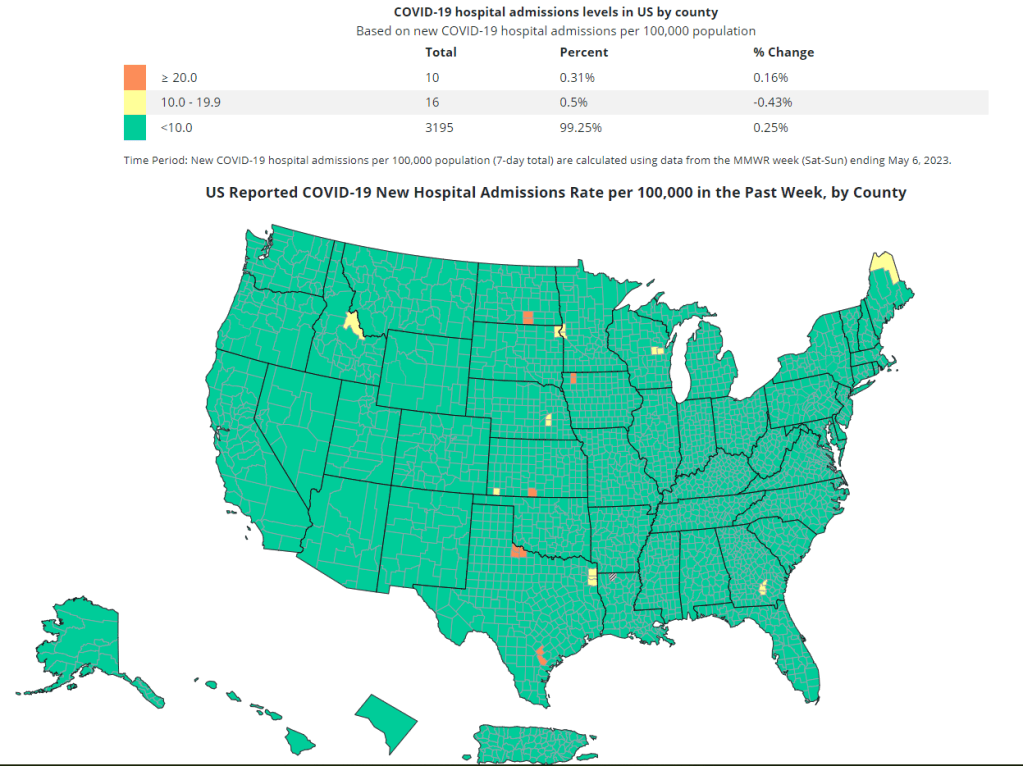
    The CDC’s new COVID-19 dashboard suggests that the national situation is totally fine, because hospitalizations are low. But is that correct?

    On Thursday, the CDC revamped its COVID-19 dashboard in response to changing data availability with the end of the federal public health emergency. (For more details on the data changes, see my post from last week.) The new dashboard downplays continued COVID-19 risk across the U.S.

    Overall, the new dashboard makes it clear that case counts are no longer available, since testing labs and state/local heath agencies aren’t sending those results to the CDC anymore. You can’t find case counts or trends on the homepage, at the top of the dashboard, or in a county-level map.

    Instead, the CDC is now displaying data that shows some of COVID-19’s severe impacts— hospitalizations and deaths—without making it clear how widely the virus is still spreading. Its key metrics are new hospital admissions, currently-hospitalized patients, emergency room visits, and the percentage of recent deaths attributed to COVID-19. You can find these numbers at national and state levels in a revamped “trends” page, and at county levels in a “maps” page.

    The “maps” page with county-level data has essentially replaced the CDC’s prior Community Level and Transmission Level page, where users were previously able to find COVID-19 case rates and test positivity rates by county. In fact, as of May 13, the URL to this maps page is still labeled as “cases” when you click into it from the main dashboard.

    While these changes might be logical (given that case numbers are no longer available), I think the CDC’s design choices here are worth highlighting. By prioritizing hospitalizations and deaths, the CDC implicitly tells users of this dashboard that the virus should no longer be a concern for you unless you’re part of a fairly small minority of Americans at high risk of those severe outcomes.

    But is that actually true, that COVID-19 is no longer a concern unless you’re going to go to the hospital? I personally wouldn’t agree. I’d prefer not to be out sick for a week or two, if I can avoid it. And I’d definitely like to avoid any long-term symptoms—or the long-term risks of heart problems, lung problems, diabetes, etc. that may come after a coronavirus infection.

    These outcomes still persist after a mild COVID-19 case. But the current CDC data presentation makes it hard to see those potential outcomes, or your risk of getting that mild COVID-19 case. The agency still has some data that can help answer these questions (wastewater surveillance, variant surveillance, Long COVID survey results, etc.) but those numbers aren’t prioritized to the same degree as hospitalizations and deaths.

    I’m sure the CDC data scientists behind this new dashboard are doing the best they can with the information they have available. Still, in this one journalist’s opinion, they could’ve done more to make it clear how dangerous—and how widely prevalent—COVID-19 still is.

    For other dashboards that continue to provide updates, see my list from a few weeks ago. I also recommend looking at your state and local public health agencies to see what they’re doing in response to the PHE’s end.

    More federal data

  • COVID source callout: Outbreak at a CDC conference

    Last week, we learned that a CDC conference—a gathering of experts in the agency’s epidemic intelligence service, no less—led to some COVID-19 cases, thanks to reporting by the Washington Post.

    Well, this past Tuesday, the Post published a follow-up story: more than 30 people got sick following the conference, and the CDC is working with the Georgia Department of Health to investigate. The case count was 35 as of Tuesday, and is surely higher now; about 2,000 people attended the conference.

    It’s now safe to say that this conference led to an outbreak. And that isn’t a surprising outcome, considering that it didn’t require masks or other COVID-19 safety measures. As I wrote last week, this outbreak basically signifies that the CDC considers ongoing COVID-19 spread at large events normal and unavoidable.

    Even though this situation is, in fact, disappointing and could have been avoided with basic safety measures. 🙃

  • COVID source callout: Spread at a CDC conference

    This past week, the CDC hosted a conference of about 2,000 people in the agency’s epidemic intelligence service. It was the first time this conference was held in-person since the pandemic started, and it appeared to take place with fairly limited (if any) COVID-19 precautions.

    And at least a few of the conference’s attendees tested positive for COVID-19 afterward, according to reporting by Dan Diamond at the Washington Post. While a CDC spokesperson told Diamond that the cases are “reflective of general spread in the community” and “should not be referred to as an outbreak,” it’s obviously not a great look for the agency to have virus spread at a conference intended to celebrate progress over COVID-19.

    These cases—and the CDC’s communication around them—add to a growing pattern of downplaying continued coronavirus transmission. The CDC is essentially saying it’s normal to risk COVID-19 at any large event going forward, even if that event is run by people who should, theoretically, have a good understanding of how to keep its attendees safe.

    Epidemiologist Ellie Murray elaborates on this idea in a Twitter thread about the situation: