Tag: September data

  • National numbers, September 24

    National numbers, September 24

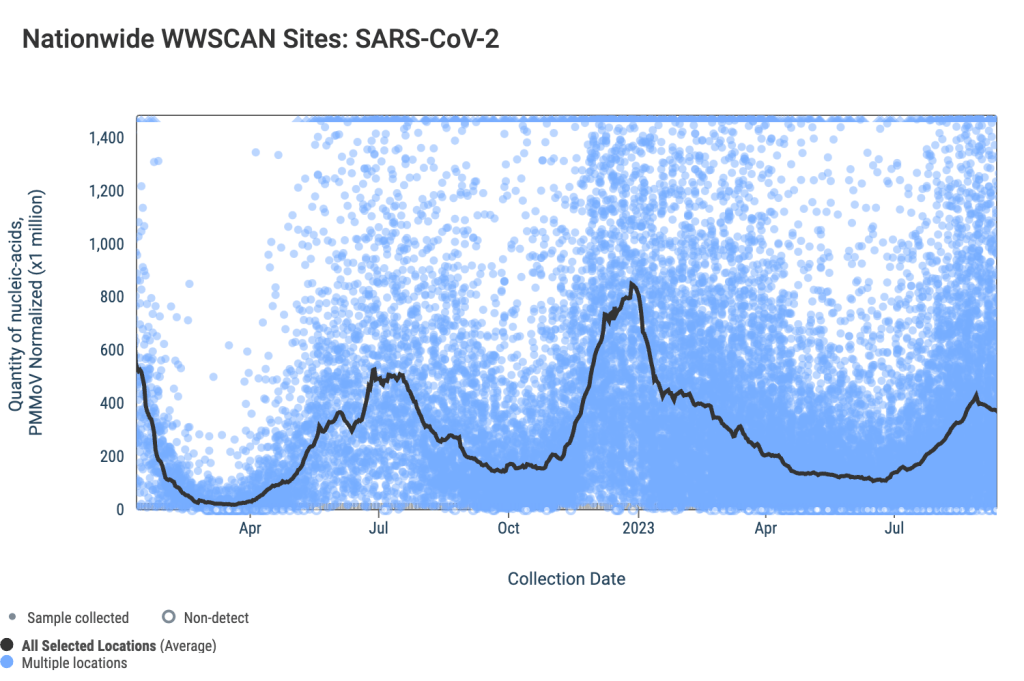
    Data from the WastewaterSCAN network suggests that COVID-19 spread has leveled off somewhat after this summer’s increase.

    During the most recent week of data available (September 3-9), the U.S. reported about 20,500 new COVID-19 patients admitted to hospitals, according to the CDC. This amounts to:

    • An average of 2,900 new admissions each day
    • 6.3 total admissions for every 100,000 Americans
    • 8% more new admissions than the prior week (August 27-September 2)

    Additionally, the U.S. reported:

    • 12.5% of tests in the CDC’s surveillance network came back positive
    • A 5% lower concentration of SARS-CoV-2 in wastewater than last week (as of September 13, per Biobot’s dashboard)
    • 25% of new cases are caused by Omicron EG.5, 24% by XBB.1.6, 14% by FL.1.5.1 (as of September 16)

    The COVID-19 plateau that I’ve described over the last couple of weeks continues, with wastewater and test positivity data showing that viral spread has slowed in much of the U.S. However, this is likely just a lull before respiratory virus season starts in earnest.

    National wastewater data from the WastewaterSCAN project suggest that COVID-19 spread has leveled off in recent weeks, after rising throughout July and August. Biobot Analytics’ data present a similar picture, though the company didn’t update its data this past Thursday (so the most recent numbers are as of September 13).

    SCAN and Biobot’s data both show plateaus or declines in all four major regions. But the Northeast and Midwest are reporting more coronavirus in their wastewater sites (at least, in aggregate) than the South and West Coast.

    Some sewersheds in the Northeast and Midwest regions have reported increases in recent weeks, while others are leveling off. In Boston and New York City, for example, most sewersheds report declines or plateaus; while sewersheds in Kansas City and Lawrence, Kansas report upward trends.

    To find wastewater data for your region, check the Biobot, WastewaterSCAN, and CDC dashboards. I maintain a list of national, state, and a few local wastewater surveillance dashboards on the COVID-19 Data Dispatch website.

    National COVID-19 test positivity is also trending slightly down, according to the CDC’s surveillance network. Test positivity fell slightly to 12.5% in the week ending September 16, from over 14% in the prior three weeks. Walgreens’ testing data show a continued decline in positivity as well.

    Hospital admissions for COVID-19 are still going up, according to the CDC—though these data are reported with a significant delay. More than 20,000 people were hospitalized with COVID-19 during the week ending September 9, demonstrating that this disease can still cause severe symptoms. And the CDC has no surveillance data on Long COVID, making that similarly-harmful outcome less visible.

    It’s now officially fall, and October marks the start of the respiratory virus season—meaning we can expect more spread of the flu, RSV, and other pathogens along with COVID-19. This is a good time to stock up on high-quality masks, air filters, and other tools that help protect against multiple diseases.
  • National numbers, September 17

    National numbers, September 17

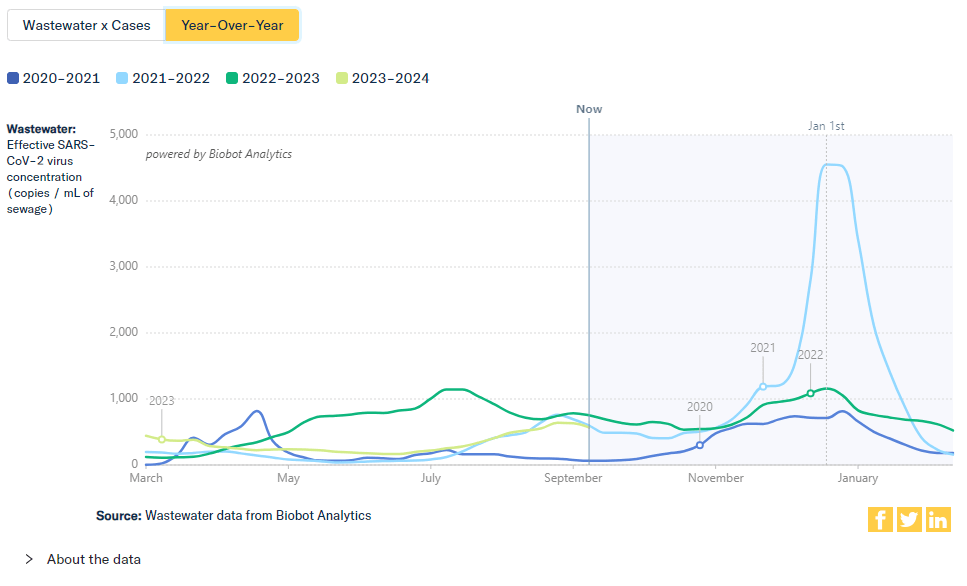
    Wastewater data from Biobot suggest that coronavirus levels in the U.S. right now are similar to this time in 2021, during the Delta surge.

    During the most recent week of data available (August 27-September 2), the U.S. reported about 18,900 new COVID-19 patients admitted to hospitals, according to the CDC. This amounts to:

    • An average of 2,700 new admissions each day
    • 5.7 total admissions for every 100,000 Americans
    • 9% more new admissions than the prior week (August 20-26)

    Additionally, the U.S. reported:

    • 14.4% of tests in the CDC’s surveillance network came back positive
    • A 10% lower concentration of SARS-CoV-2 in wastewater than last week (as of September 6, per Biobot’s dashboard)
    • 25% of new cases are caused by Omicron EG.5, 24% by XBB.1.6, 14% by FL.1.5.1 (as of September 16)

    For the second week in a row, available data suggest that the current COVID-19 surge may be turning around, or at least heading for a plateau. But there’s still a lot of coronavirus going around—and this will likely remain true through the winter respiratory virus season.

    Wastewater data from both Biobot Analytics and WastewaterSCAN suggest that coronavirus spread may be ticking down, after two months of increases. Biobot’s national trends show a 10% decline in SARS-CoV-2 levels in wastewater last week, after a 1% decline the week prior. WastewaterSCAN’s trends show a slow decline in the last week, following a slow increase over the summer.

    This decline isn’t universal across the country: according to Biobot’s regional data, the South and Northeast are reporting clearer declines in coronavirus spread, while the West is in a plateau and the Midwest is in an increase. Sewersheds in Midwestern cities like South Bend, Indiana, Coralville, Iowa, and Lincoln, Nebraska have reported major increases in SARS-CoV-2 levels in the last couple of weeks, per WastewaterSCAN.

    Test positivity data from the CDC’s respiratory virus testing network also suggest that this summer’s COVID-19 surge may be leveling off. About 14.3% of COVID-19 tests in this CDC network came back positive in the week ending September 9, compared to 14.4% and 14.6% in the prior two weeks. (Note: this network includes a sample of testing labs across the country, but is less comprehensive than our testing data were before the federal health emergency’s end.)

    Walgreens’ COVID-19 dashboard, which reports test positivity data from the pharmacy chain, shows the positivity rate leveling off as well. The share of Walgreens tests coming back positive went down slightly from 45% in late August to 40% this past week. Walgreens’ dashboard, like the wastewater data, shows that more people are testing positive in the Midwest and West regions.

    Hospitalizations for COVID-19 continue to trend up, with the CDC reporting about 2,700 new patients a day during the week ending September 2. While this number may seem small compared to the overwhelmed hospitals we saw in past surges, it’s important to remember that CDC hospitalization data are both delayed and incomplete.

    Our most recent data are from two weeks ago, and reporting standards for hospitals are more lenient now than they have been earlier in the pandemic—though the CDC does still collect data directly from facilities across the country.

    Variant estimates, also from the CDC, suggest that EG.5 and XBB.1.6 are still the dominant lineages in the U.S. Each accounted for about one in four COVID-19 cases in the last two weeks, while other versions of XBB caused the rest. BA.2.86 hasn’t appeared in the CDC’s prevalence estimates yet, but scientists have detected it in several states, suggesting it could be spreading under the radar.

    Biobot’s wastewater data suggest that COVID-19 spread in the U.S. is similar now to this time in 2021, during the Delta surge. If 2023 continues to follow trends from the last two years, we could see transmission plateau in early fall, then rise again during the holiday season.  Any lull that we do experience may be a good time to stock up on masks, rapid tests, and other tools to protect yourself and your community.

  • National numbers, September 25

    National numbers, September 25

    Reported COVID-19 cases in New York City have started going up slightly in the last few days, according to the city health department.

    In the past week (September 17 through 23), the U.S. reported about 380,000 new COVID-19 cases, according to the CDC. This amounts to:

    • An average of 54,000 new cases each day
    • 116 total new cases for every 100,000 Americans
    • 11% fewer new cases than last week (September 10-16)

    In the past week, the U.S. also reported about 28,000 new COVID-19 patients admitted to hospitals. This amounts to:

    • An average of 4,000 new admissions each day
    • 8.5 total admissions for every 100,000 Americans
    • 10% fewer new admissions than last week

    Additionally, the U.S. reported:

    • 2,400 new COVID-19 deaths (350 per day)
    • 83% of new cases are caused by Omicron BA.5; 12% by BA.4.6; 2% by BF.7;  1% by BA.2.75 (as of September 24)
    • An average of 300,000 vaccinations per day

    Nationally, official COVID-19 case counts continue to decline: reported cases are down about 11% last week compared to the prior week, while new COVID-19 patients in hospitals are down 10%. But signals from wastewater and variants suggest a fall surge may be starting soon. 

    “Currently, most of the country is reporting moderate to high SARS-CoV-2 levels in wastewater,” CDC officials noted in this Friday’s COVID Data Tracker Weekly Review. For almost 20% of sites, these coronavirus levels are the highest seen since December 2021, the CDC reports. About half the wastewater sites in the CDC’s network are reporting an increase in coronavirus levels and half are reporting a decrease.

    Notably, many of the wastewater sites reporting increased coronavirus spread are in the Northeast, a region that’s also a hotspot for Omicron subvariants BA.2.75 and BF.7. BF.7, a new sublineage that evolved from BA.5, is particularly worth watching (more on that below). Overall, the U.S.’s variant composition is slowly shifting from BA.5 to these two subvariants, along with BA.4.6—which caused 12% of new cases nationwide in the week ending September 24.

    According to the latest Community Profile Report, states reporting significant increases in cases from week to week include Nevada, California, New Hampshire, Kentucky, Massachusetts, New Jersey, New York, and Oregon. In New York City—often a bellwether for new surges—cases have started to tick up slightly, according to the city’s health department, after a long (and slow) decline from July’s summer peak.

    Meanwhile, other common respiratory viruses might make a comeback this fall, report Dr. Katelyn Jetelina and Dr. Caitlin Rivers in a joint issue of their newsletters. Data so far on the flu, RSV, rhinovirus, and other viruses we consider part of a normal fall season suggest that children in the U.S. might have a particularly virus-heavy fall and winter—putting more pressure on the healthcare system.

    One of the best ways to protect yourself from COVID-19 this fall is by receiving one of the new, Omicron-specific booster shots. According to the CDC, about 4.4 million Americans have received one so far, as of September 21. The new shots have brought our vaccine administration counts to over 300,000 new doses given a day, but that still pales in comparison to the millions administered daily during the spring 2021 campaign.

    I received my own booster on Friday at a NYC Health + Hospitals site. Unlike my primary series doses, for which my girlfriend and I had to wait in long lines with hundreds of other New Yorkers, we got our new shots in a small, hard-to-find room tucked away in a small corner of a south Brooklyn hospital campus. This vaccination campaign seems to be almost an afterthought when it deserves primetime attention.

  • National numbers, September 11

    National numbers, September 11

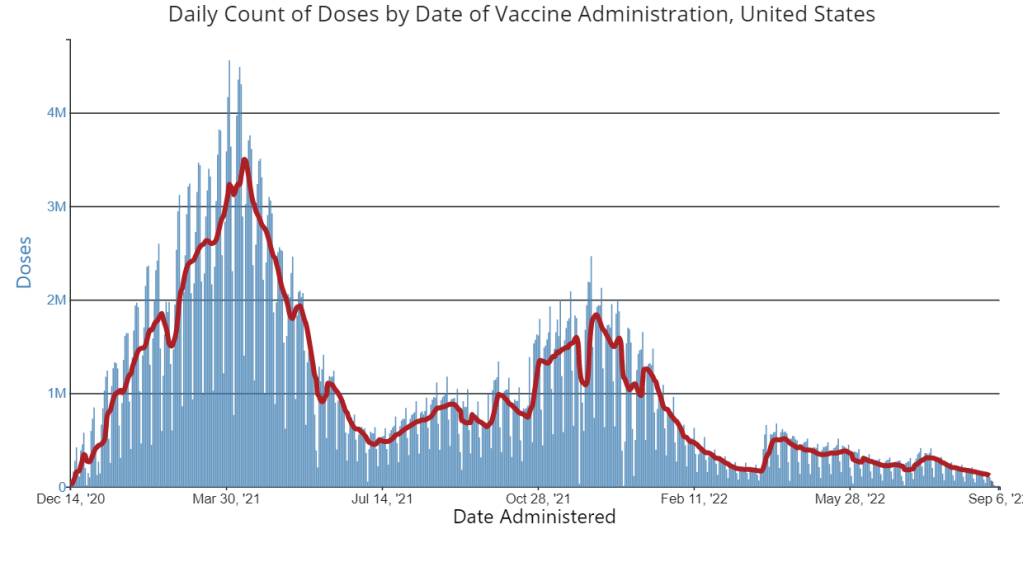
    A week after new COVID-19 boosters were authorized, the U.S. has yet to see a significant jump in vaccine doses administered. Chart via the CDC.

    In the past week (September 3 through 9), the U.S. reported about 500,000 new COVID-19 cases, according to the CDC. This amounts to:

    • An average of 70,000 new cases each day
    • 150 total new cases for every 100,000 Americans
    • 19% fewer new cases than last week (August 27-September 2)

    In the past week, the U.S. also reported about 32,000 new COVID-19 patients admitted to hospitals. This amounts to:

    • An average of 4,600 new admissions each day
    • 9.9 total admissions for every 100,000 Americans
    • 11% fewer new admissions than last week

    Additionally, the U.S. reported:

    • 2,200 new COVID-19 deaths (0.7 for every 100,000 people)
    • 88% of new cases are caused by Omicron BA.5; 9% by BA.4.6 (as of September 10)
    • An average of 25,000 vaccinations per day (per Bloomberg)

    It might appear that the U.S. reported a significant drop in COVID-19 cases last week, as the CDC’s numbers dropped to about 70,000 new cases a day last week from 87,000 new cases a day in the prior week. But in fact, the decline was likely exaggerated by Labor Day weekend, as testing labs and the public health workers who crunch data took time off.

    Wastewater data from the last two weeks tell a different story. In Biobot’s most recent update, the company reported a slight increase in coronavirus concentration in wastewater at the national level. Regionally, the virus grew in the Northeast, Midwest, and South.

    While hospital admissions and other healthcare system metrics continue to show a decline, wastewater data is often an advanced indicator for new coronavirus surges. In this case, it could mean the often-predicted fall wave is beginning in some parts of the country. Remember: wastewater surveillance can catch transmission upticks early because it doesn’t rely on individuals getting PCR tests or seeking out healthcare—factors that can cause lags and undercounting in case and hospitalization data.

    Potential factors contributing to increased COVID-19 outbreaks might include holiday gatherings and travel, the start of the school year, and new Omicron subvariants taking over. BA.4.6, the lineage from BA.4 that may be even more transmissible, went from causing about 8% of new cases in the week ending September 3 to 9% in the week ending September 10, according to CDC estimates; meanwhile, BA.5’s prevalence dropped by about 1%.

    This might seem like a small shift, but it is an indicator of BA.4.6’s capacity to eventually outcompete BA.5—and reinfect people who previously caught a different version of Omicron. BA.4.6 is causing a higher share of cases in the Midwest, specifically in Iowa, Kansas, Missouri, and Nebraska, so those are states to particularly watch for increased COVID-19 spread.

    At the same time, the CDC reports that 1% of cases nationwide were caused by BA.2 lineages (not BA.2.12.1) last week. This is likely the work of BA.2.75, another subvariant of concern that the CDC isn’t yet tracking separately. (More on that later in the issue.)

    The federal government’s main action to mitigate this probably-coming surge is a new booster campaign, with the Omicron BA.4/BA.5 shots authorized last week. But vaccination numbers have been low so far, with far fewer than 100,000 doses administered each day last week.

  • National numbers, September 4

    National numbers, September 4

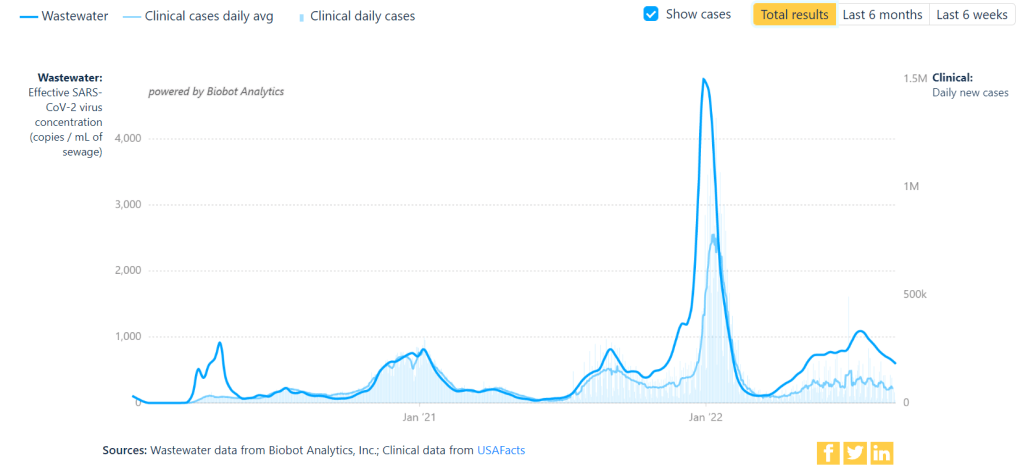
    Coronavirus trends in wastewater compared to official case numbers, since spring 2020. Screenshot from Biobot’s dashboard, retrieved September 4.

    In the past week (August 27 through September 2), the U.S. reported about 590,000 new COVID-19 cases, according to the CDC. This amounts to:

    • An average of 80,000 new cases each day
    • 179 total new cases for every 100,000 Americans
    • 8% fewer new cases than last week (August 20-26)

    In the past week, the U.S. also reported about 36,000 new COVID-19 patients admitted to hospitals. This amounts to:

    • An average of 5,100 new admissions each day
    • 10.8 total admissions for every 100,000 Americans
    • 4% fewer new admissions than last week

    Additionally, the U.S. reported:

    • 2,800 new COVID-19 deaths (0.9 for every 100,000 people)
    • 89% of new cases are caused by Omicron BA.5; 8% by BA.4.6 (as of September 3)
    • An average of 70,000 vaccinations per day (per Bloomberg)

    Over the past month, COVID-19 trends in the U.S. have been fairly consistent: disease spread has declined slowly around the country. Official case counts dropped from about 120,000 a day in the first week of August, to about 80,000 a day last week.

    New hospital admissions, a more reliable metric these days, have also declined. A month ago, U.S. hospitals were admitting over 6,000 new COVID-19 patients a day; last week, that number was about 5,000. Wastewater data from Biobot and from the CDC suggest that this trend has been broadly consistent across different regions.

    But coronavirus transmission is not currently at low levels by any means. For example, look at Biobot’s national chart showing virus concentration in wastewater compared to officially-reported case numbers. From case numbers alone, you might think that COVID-19 is much less prevalent now than it was in late August or early September last year. But the wastewater data reveal that transmission now is actually pretty close to early-Delta surge levels. (It is, in fact, PCR testing that has declined.)

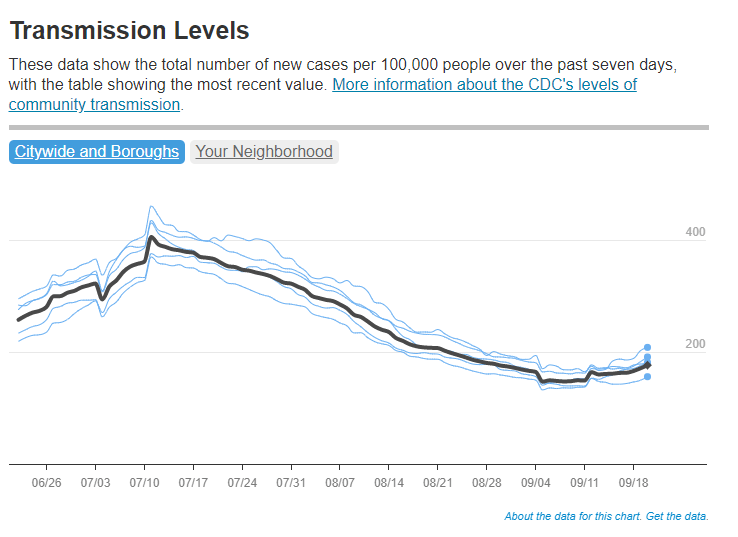
    Similarly, the CDC’s Community Transmission Levels (also known as the older metrics, based on cases and test positivity) show that about 90% of U.S. counties are currently facing high transmission and should require masks indoors. Even the current—and much more lenient—Community Levels suggest that more than half of the country is in a high- or medium-COVID-risk zone.

    The summer surge has waned so slowly thanks to the U.S.’s complete abandonment of measures to mitigate COVID-19’s spread, combined with the rise of newer Omicron subvariants. BA.5 continues to dominate here, causing almost 90% of new cases in the week ending September 3, though it’s facing competition from BA.4.6: a version of BA.4 that appears to have a slight advantage.

    Most experts agree that we will probably face another surge this fall and winter, as more people gather inside and travel for the holidays. The question is how severe that wave will be, which may be determined via a contest between updated vaccines (more on that later in the issue) and the coronavirus’ continued capacity for mutation.

    One potential sign of such a wave: wastewater surveillance in South Africa has picked up an increase in coronavirus concentration, Bloomberg reported yesterday. Also: your usual reminder to be wary of data trends in the days following the holiday weekend.

  • National numbers, September 26

    National numbers, September 26

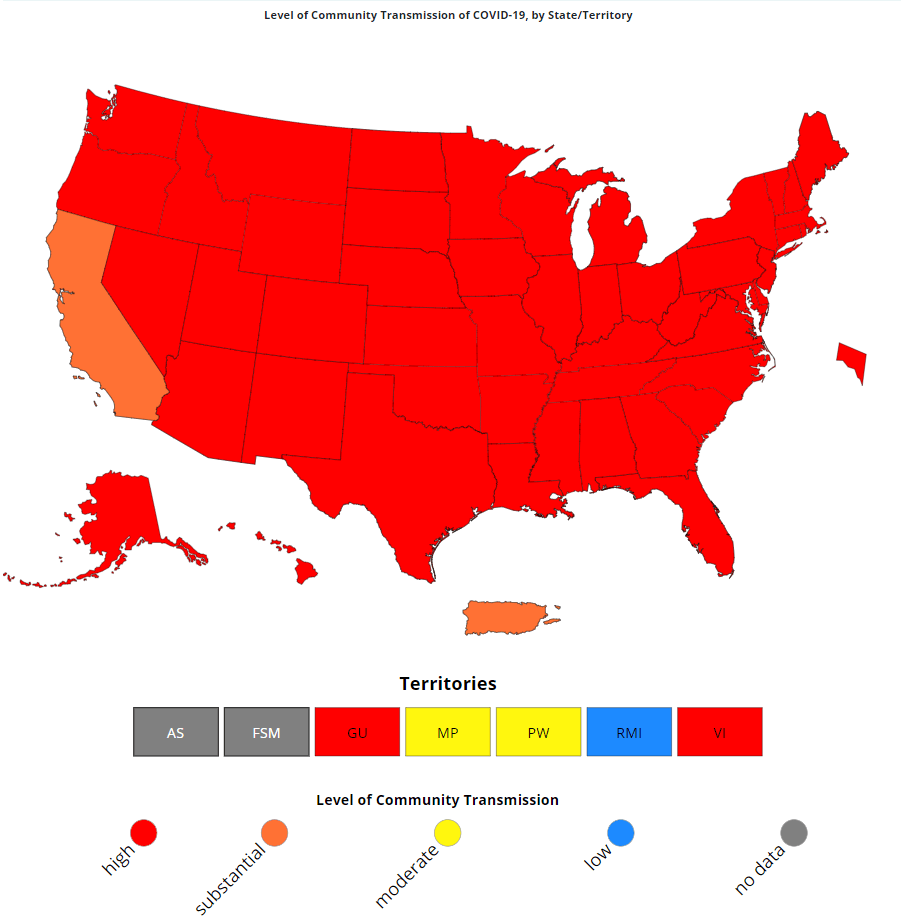
    California dropped to “substantial” transmission this week, while other states remained in “high” transmission.

    In the past week (September 18 through 24), the U.S. reported about 850,000 new cases, according to the CDC. This amounts to:

    • An average of 122,000 new cases each day
    • 259 total new cases for every 100,000 Americans
    • 17% fewer new cases than last week (September 11-17)

    Last week, America also saw:

    • 67,000 new COVID-19 patients admitted to hospitals (21 for every 100,000 people)
    • 11,000 new COVID-19 deaths (3.3 for every 100,000 people)
    • 99% of new cases are Delta-caused (as of September 18)
    • An average of 700,000 vaccinations per day (per Bloomberg)

    Following the Labor Day reporting blips of the past two weeks, COVID-19 cases are now clearly trending down in the U.S. The daily new case average is close to what we saw in early August, at the start of the Delta surge.

    The U.S. can’t let its guard down yet, though. Almost every state still reported over 100 new cases for every 100,000 people in the past week, putting the vast majority of the country into a high coronavirus transmission zone, per the CDC’s categories. The only state to drop below this “high transmission” threshold is California, which reported 86 new cases per 100,000 in the week ending September 23.

    Alaska, West Virginia, Wyoming, and Montana are all far past that “high transmission” threshold, at over 600 new cases per 100,000 in the past week. Alaska appears to be the nation’s newest Delta hotspot. The state reported a record 1,735 COVID-19 cases on Friday, though some of those cases were part of a reporting backlog (meaning they occurred earlier).

    Nationwide, hospitalizations are also continuing to come down. The country recorded fewer than 10,000 new patients a day last week, for the first time since early August. But the current numbers are still far higher than what we saw in June and early July.

    Deaths—the slowest-moving pandemic metric—continue rising, with about 11,000 new deaths a day. It bears repeating: the vast majority of these deaths occur in unvaccinated Americans. The U.S. has now passed 675,000 deaths, meaning that COVID-19 has killed more Americans than the 1918 Spanish flu pandemic did over a century ago.

    Despite the continued dangers of being unvaccinated, dose numbers are now also dropping in the U.S. After a couple of weeks approaching one million doses a day, we’re now back down at 700,000 doses a day, per Bloomberg’s dashboard. And the upcoming booster shot rollout is certain to confuse these data; already, 2.4 million Americans have received an additional dose, per the CDC.

  • National numbers, September 19

    National numbers, September 19

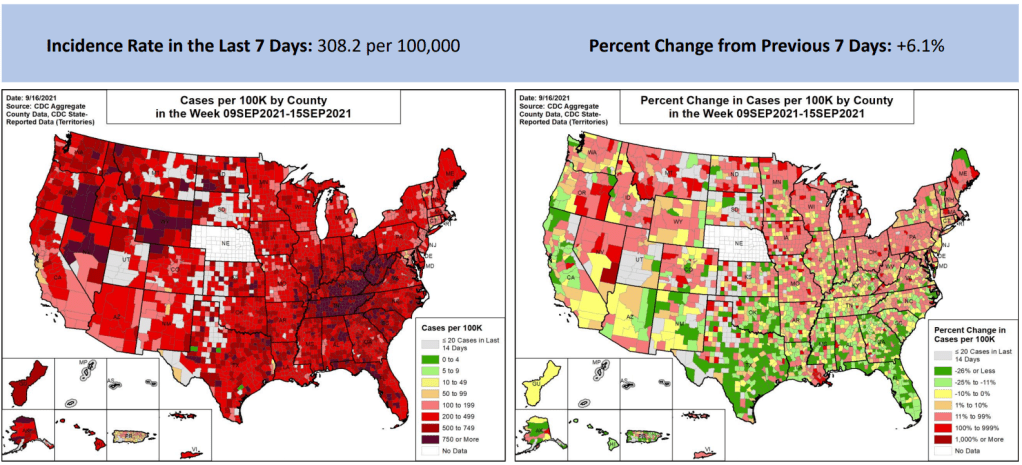
    Some previous Delta hotspots are seeing case numbers decrease, while others are now seeing their highest cases yet. Charts from the September 16 Community Profile Report.

    In the past week (September 11 through 17), the U.S. reported about one million new cases, according to the CDC. This amounts to:

    • An average of 146,000 new cases each day
    • 312 total new cases for every 100,000 Americans
    • 6% more new cases than last week (September 4-10)

    Last week, America also saw:

    • 78,000 new COVID-19 patients admitted to hospitals (24 for every 100,000 people)
    • 10,000 new COVID-19 deaths (3.1 for every 100,000 people)
    • 100% of new cases now Delta-caused (as of September 11)
    • An average of 800,000 vaccinations per day (per Bloomberg)

    Last week, national case numbers appeared to be in a decline, with a 13% decrease from the prior week. This week, cases bumped back up slightly—most likely due to delayed reporting driven by the Labor Day weekend, as I predicted in last week’s issue.

    Still, this week’s daily new case average is lower than it was a couple of weeks ago. And the number of COVID-19 patients newly admitted to hospitals, a crucial metric that’s less susceptible to holiday reporting interruptions, has continued to drop: from about 12,000 new patients a day last week to 11,000 new patients a day this week.

    But we can’t say the same thing for death numbers, unfortunately. Over 10,000 COVID-19 deaths were reported in the U.S. last week, the highest number since March 2021 (at the tail end of the winter surge.)

    The country reached a sad milestone this week: one in 500 Americans have died of COVID-19, according to a Washington Post analysis. For Black, Hispanic, and Native Americans, as well as states that have been harder-hit by the pandemic, that number is lower. In Brooklyn, where I live, COVID-19 has killed one in every 240 residents.

    In some parts of the country, the Delta surge appears to be letting up. Florida saw an 18% decrease in cases from last week to this week, according to the September 16 Community Profile Report, while Texas saw an 8% decrease. California—where residents just voted to keep harsh-on-COVID-19 Governor Gavin Newsom in power—saw a whopping 23% decrease in cases, week over week.

    Meanwhile, other parts of the South and West are seeing their highest case numbers yet. Both Tennessee and West Virginia have recorded over 700 new cases for every 100,000 residents in the past week. (For context: the CDC says that over 100 new cases per 100,000 constitutes high transmission.) In West Virginia, hospitals are “overwhelmingly inundated” with COVID-19 patients. And in Alabama, though case numbers are coming down, a whopping 50% of hospital ICU patients have COVID-19.

    According to the latest CDC variant estimates, 99.7% of new cases in the country are now caused by Delta. Delta has been causing over 99% of cases for a few weeks now. Has the variant run its course here? Could it mutate into something even more transmissible, or more deadly? Or is the CDC even collecting data comprehensively enough for us to tell? Many different scenarios seem plausible as we head into the colder months.

  • National numbers, September 12

    National numbers, September 12

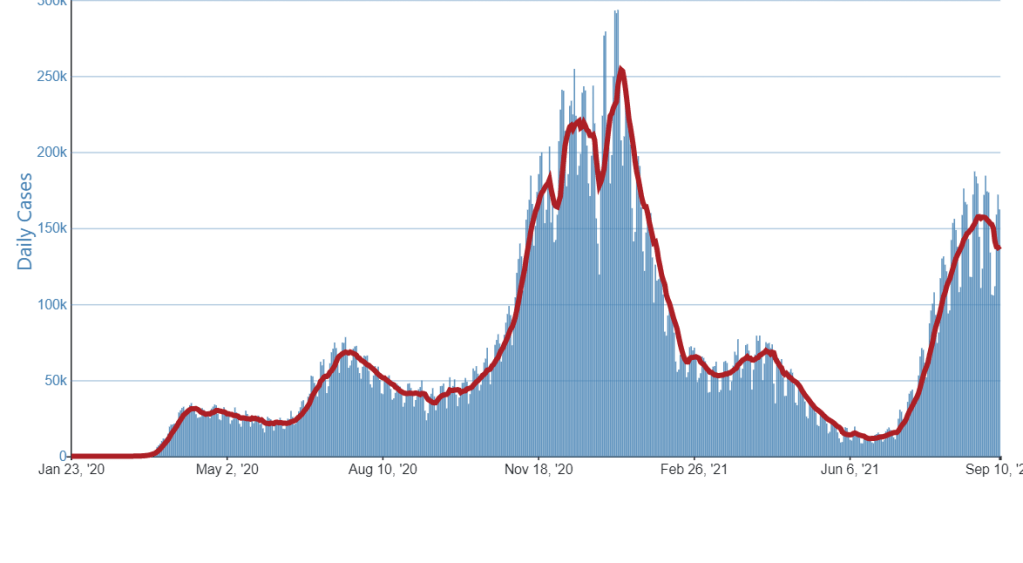
    COVID-19 cases appear to be going down in the U.S., though some of that drop may be due to Labor Day reporting delays. Chart from the CDC, retrieved September 12.

    In the past week (September 4 through 10), the U.S. reported about 960,000 new cases, according to the CDC. This amounts to:

    • An average of 137,000 new cases each day
    • 291 total new cases for every 100,000 Americans
    • 13% fewer new cases than last week (August 29-September 3)

    Last week, America also saw:

    • 82,000 new COVID-19 patients admitted to hospitals (25 for every 100,000 people)
    • 7,500 new COVID-19 deaths (2.3 for every 100,000 people)
    • 99% of new cases now Delta-caused (as of September 4)
    • An average of 700,000 vaccinations per day (per Bloomberg)

    Last week, I wrote that national U.S. COVID-19 cases were in a plateau. The pattern has continued this week: cases are down 13% from last week, new hospitalized patients are down 4%, and deaths are down 11%.

    It’s important to note here, though, that Labor Day likely skewed these numbers. As is typical of COVID-19 reporting on holidays, many local public health agencies—the initial source of case counts and other metrics—took the weekend off, leading those counts to get delayed. We may see higher numbers next week as reports catch up.

    Even as the national numbers drop, though, some states are seeing record case counts and overwhelmed hospitals. South Carolina is one example: this state is now seeing the highest case rate in the U.S., with 680 new cases for every 100,000 residents in the past week, per Community Profile Report data. Kentucky and West Virginia are ranking highly too, with 625 and 586 new cases for every 100,000 people in the past week, respectively.

    Both South Carolina and Kentucky have record numbers of COVID-19 patients in hospitals right now, while West Virginia is approaching its winter 2020 numbers. In Idaho, another state seeing record hospitalizations, state public health leadership placed several northern hospitals under “crisis standards of care,” meaning that clinicians could ration limited resources and prioritize those patients who are deemed most likely to survive.

    All of these states, of course, have low vaccination rates—under 50% of their populations are fully vaccinated. While vaccination rates rose nationally in August, dose counts now seem to be going down again: from a daily average of one million last week to 700,000 now.

    The Delta variant continues to dominate America’s COVID-19 surge. For several weeks now, this variant has been causing over 99% of new cases. And, while the Mu (or B.1.621) variant has made headlines, this variant appears not transmissible enough to compete with Delta. The CDC COVID Data Tracker Weekly Review noted this week that the Mu variant “reached its [U.S.] peak in late June,” causing under 5% of cases, and “has steadily decreased since.” It’s currently causing just 0.1% of cases, the CDC estimates.

    Also, we still aren’t doing enough testing. The overall national PCR test positivity rate is 9.1%, while rapid tests—increasingly popular during the Delta surge—are difficult to find in many settings. A lack of testing makes it difficult to identify all breakthrough cases and look out for future variants that may arise.

  • National numbers, September 5

    National numbers, September 5

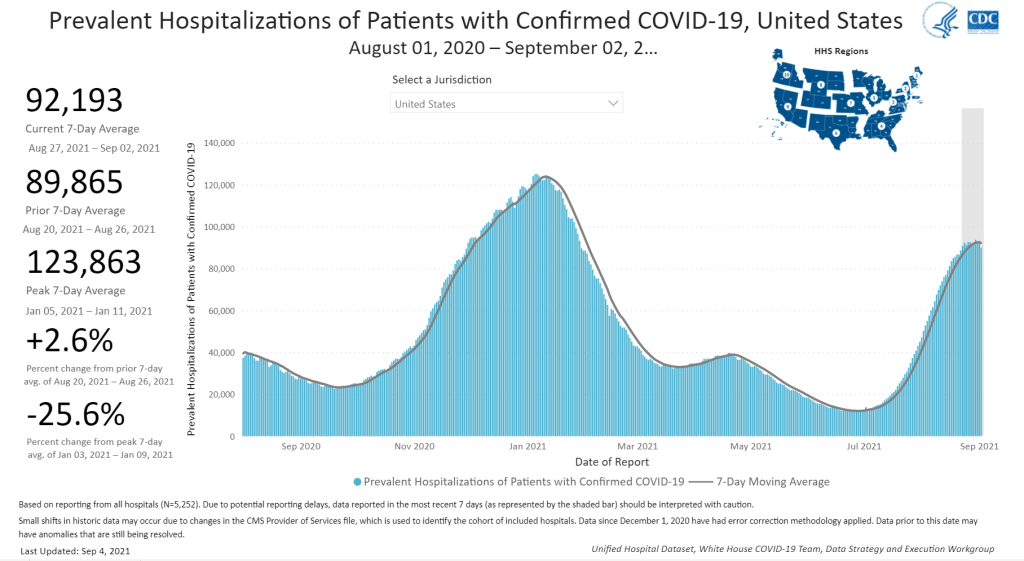
    About 90,000 Americans are currently in the hospital with COVID-19; this has been the daily average for the past two weeks. Chart via the CDC, screenshot taken on September 4.

    In the past week (August 28 through September 3), the U.S. reported about one million new cases, according to the CDC. This amounts to:

    • An average of 153,000 new cases each day
    • 327 total new cases for every 100,000 Americans
    • 5% more new cases than last week (August 21-27)

    Last week, America also saw:

    • 85,000 new COVID-19 patients admitted to hospitals (26 for every 100,000 people)
    • 7,300 new COVID-19 deaths (2.2 for every 100,000 people)
    • 99% of new cases now Delta-caused (as of August 28)
    • An average of one million vaccinations per day (per Bloomberg)

    Nationally, the current COVID-19 surge appears to be in a plateau. The number of new cases rose by just 5% this week, after a 3% rise last week. Hospitalizations are in a similar position: the number of patients in the hospital with COVID-19 has held steady at about 90,000 for the past two weeks.

    Among the COVID-19 experts I follow, I’ve seen some speculation that this could be the start of a Delta decline—similar to what we’ve seen in other countries, like India and the U.K. At the same time, others are noting that the U.K. saw a brief case decline followed by another rebound. If Delta does the same thing here, it would coincide with more schools starting their fall semesters and colder weather, neither of which bode well for transmission.

    And there are already a lot of children in hospitals right now. According to the COVID-NET surveillance system, there were about 14 children (under age 18) hospitalized with COVID-19 for every one million kids in the U.S. during the week ending August 28. For children under age 5, that number is 20 for every million—higher than at any other point in the pandemic.

    Thanks to COVID-19 and other diseases (like RSV, another virus that’s impacting many kids right now), pediatric intensive care units are overwhelmed, especially in the South. To understand what that means, I recommend this powerful op-ed by health equity expert Dr. Uché Blackstock. (Recent CDC research suggests that higher child hospitalization numbers are due to Delta’s high transmission, not because it impacts children more intensely. More on that later in the issue.)

    Meanwhile, high test positivity rates indicate that many COVID-19 cases are probably not being caught—especially those breakthrough cases in vaccinated people which may be mild, but can still spread the virus to others. At the national level, our test positivity rate is about 10% right now. In several states—South Dakota, Tennessee, Oklahoma, Alabama—positivity is over 20%, meaning we probably are not getting a clear picture of the surges in these locations.

    The U.S. is now seeing over 1,000 COVID-19 deaths a day, a level that we had not hit since the winter surge. Almost all of these deaths are preventable. This will continue, for as long as the Delta surge lasts.