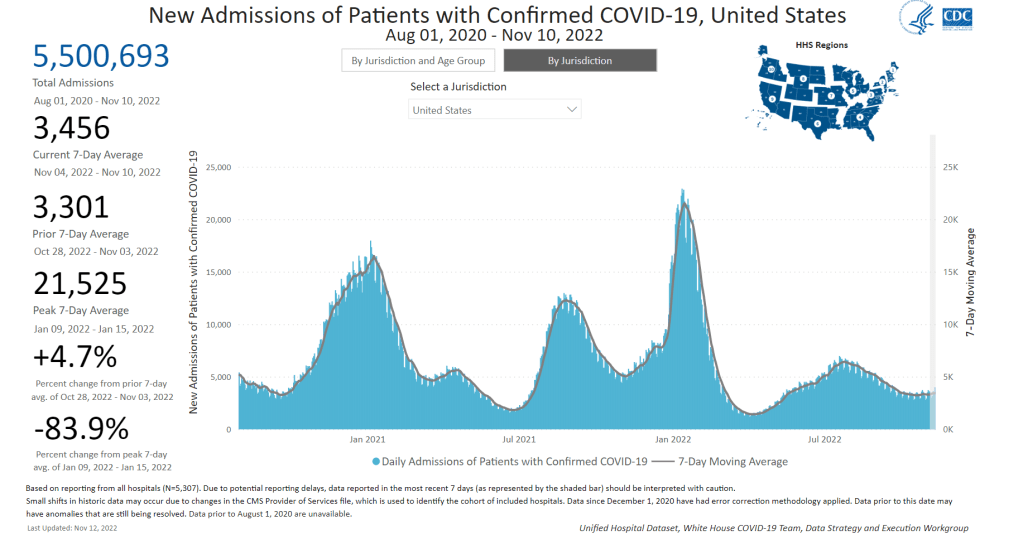
COVID-19 hospitalizations have risen slightly in recent weeks, indicating the start of a fall/winter surge, according to CDC data.
In the past week (November 3 through 9), the U.S. reported about 290,000 new COVID-19 cases, according to the CDC. This amounts to:
An average of 41,000 new cases each day
88 total new cases for every 100,000 Americans
6% more new cases than last week (October 27-November 2)
In the past week, the U.S. also reported about 24,000 new COVID-19 patients admitted to hospitals. This amounts to:
An average of 3,500 new admissions each day
7.4 total admissions for every 100,000 Americans
5% more new admissions than last week
Additionally, the U.S. reported:
2,300 new COVID-19 deaths (340 per day)
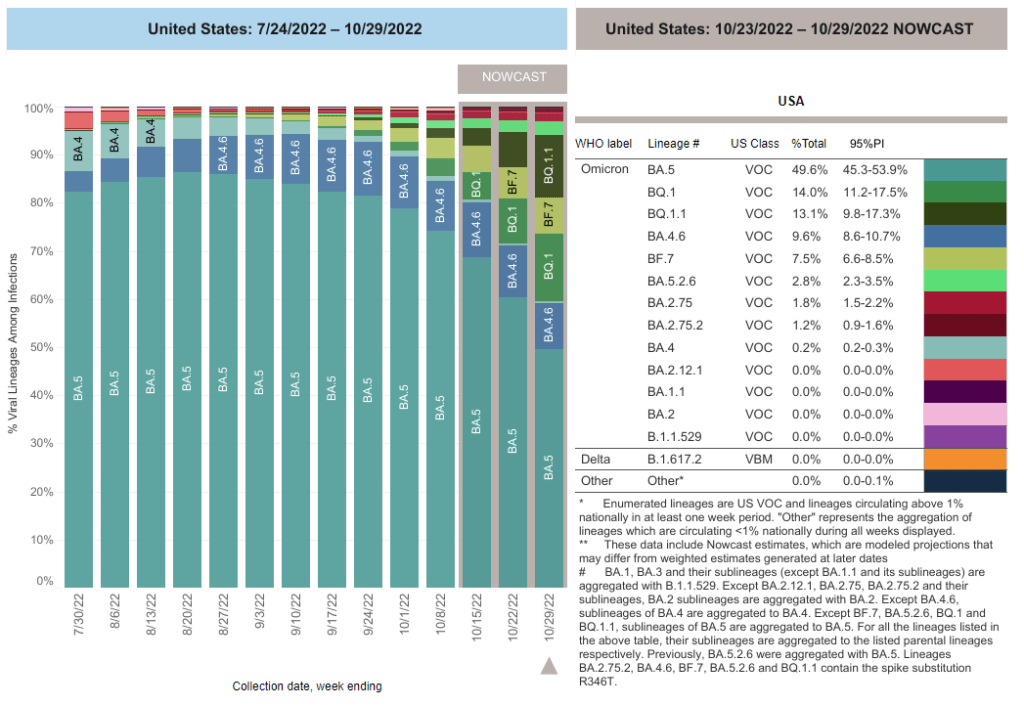
44% of new cases are caused by Omicron BQ.1 and BQ.1.1; 8% by BF.7; 2% by BA.2.75 and BA.2.75.2 (as of November 12)
An average of 400,000 vaccinations per day
We are beginning to see the impacts of colder weather and new variants this week, as both official COVID-19 cases and new hospital admissions went up slightly: increasing by 6% and 5% from the prior week, respectively.
Wastewater monitoring similarly shows an uptick in coronavirus transmission at the national level, according to Biobot’s dashboard. The Northeast still has the highest virus concentration, but other regions of the country are catching up—particularly the West coast, which reported a significant increase in the last two weeks.
About half of the wastewater surveillance sites included on the CDC’s national dashboard reported increases in coronavirus transmission over the two-week period ending November 7, with 30% of sites reporting increases of at least 100%.
Omicron BQ.1 and BQ.1.1 are likely a major source of increased virus spread. These two strains—subvariants of BA.5 that are even more contagious—now account for 44% of new cases in the week ending November 12, according to CDC estimates. New variants tend to have an impact on transmission when they reach about 50% prevalence, so we will likely see more BQ-driven spread in the weeks to come.
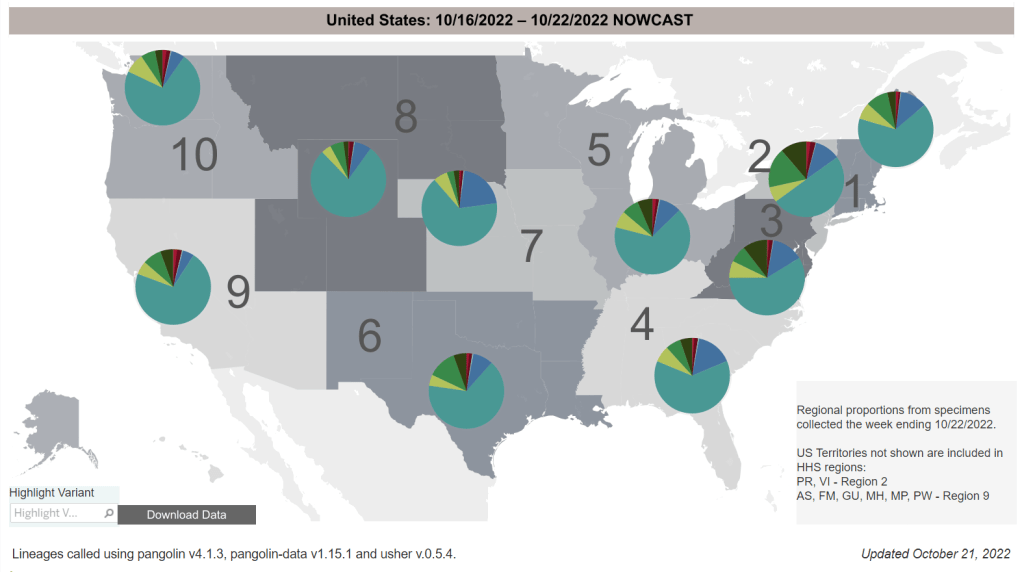
The New York/New Jersey region continues to report the highest amounts of BQ.1 and BQ.1.1: these variants represented about 60% of new cases in the last week. These two states also reported some of the highest (official) case rates in the country last week, along with Puerto Rico, New Mexico, and North Dakota, per the latest Community Profile Report. Cases and hospitalizations in New York City, often a bellwether for the rest of the country, are rising again.
At the same time, the U.S. is seeing an early and intense flu season. Most of the country’s Southeast region (from Virginia to Mississippi) reported the highest possible levels of influenza-like activity in the week ending November 5, according to the CDC. Flu, COVID-19, and RSV are all straining hospitals as we head into the holiday season.
The new, Omicron-specific booster shots provide enhanced protection against the latest variants, but uptake remains very low—as shown by new CDC data providing vaccinations by state. Only 10% of the eligible population has received one of the new shots, as of November 9.
2/ Here is where we stand on the % of the population who has received the bivalent booster, for 4 age groups: – 5-11 years (national 0.5%) – 12-17 years (national 2.6%) – 18-64 years (national 6.4%) – 65+ years (national 23%)
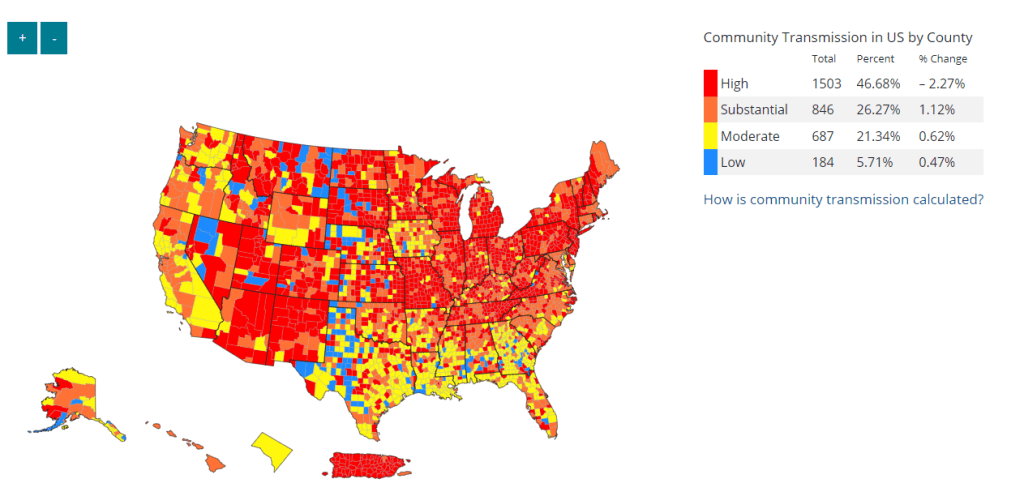
Despite significant undercounting of COVID-19 cases, the CDC’s Community Transmission Levels (based on case rates and test positivity) are high enough to suggest the majority of the country should be masking. Data here are as of November 2.
In the past week (October 27 through November 2), the U.S. reported about 270,000 new COVID-19 cases, according to the CDC. This amounts to:
An average of 39,000 new cases each day
83 total new cases for every 100,000 Americans
5% more new cases than last week (October 20-26)
In the past week, the U.S. also reported about 23,000 new COVID-19 patients admitted to hospitals. This amounts to:
An average of 3,300 new admissions each day
7.0 total admissions for every 100,000 Americans
1% fewer new admissions than last week
Additionally, the U.S. reported:
2,500 new COVID-19 deaths (360 per day)
35% of new cases are caused by Omicron BQ.1 and BQ.1.1; 9% by BF.7; 4% by BA.2.75 and BA.2.75.2 (as of November 5)
An average of 400,000 vaccinations per day
Continuing a trend from the last few weeks, nationwide COVID-19 cases and hospitalizations are still at plateaus or trending very slightly downward. We aren’t clearly in a fall surge yet, but concerning newer Omicron subvariants are rising—along with other respiratory diseases.
National wastewater trends are also still suggesting plateaus or downturns in coronavirus transmission, according to Biobot’s dashboard. The Northeast’s wastewater saw a major drop in coronavirus concentration over the last couple of weeks while other regions are at high, but steady levels.
As always, it’s important to remember that official case data are significantly undercounted. True infections are likely around 20 times higher than reported cases, though even that factor is difficult to estimate at this point in the pandemic.
Despite the undercounting, the CDC’s Community Transmission Levels (based on case rates and test positivity) suggest that 75% of U.S. counties are experiencing “high” or “substantial” coronavirus spread. If we had more accurate data, that number would likely shoot up to 100%. In other words, even today’s seemingly-low and underestimated case numbers are still high compared to earlier periods of the pandemic.
Newer versions of the Omicron variant will likely drive continued COVID-19 spread this fall. BQ.1 and BQ.1.1 have emerged as the most competitive subvariants and are quickly taking over from their parent lineage, BA.5. These two subvariants caused about 35% of new cases in the U.S. in the week ending November 5, according to the CDC’s estimates, while BA.5 caused 39%.
The BQs are most prevalent in the Northeast, especially New York and New Jersey: these subvariants caused over 50% of new cases in the NY/NJ region last week, according to the CDC. These two states and Connecticut also had the highest per-capita COVID-19 hospitalization rate last week, per the HHS Community Profile Report.
As hospitals around the country brace for a winter COVID-19 surge, they’re already dealing with high transmission of the flu. Flu hospitalizations have not been as high as they are this season since 2010-2011, the CDC reports. Last week, Washington D.C., Tennessee, South Carolina, and Alabama reported influenza-like illness rates so high that the CDC needed a new map color to express it.
Even if COVID-19 isn’t (yet) surging in your community, this is a good time to stock up on high-quality masks and rapid tests, and plan holiday gatherings that will keep friends and family members safe. Your Local Epidemiologist has a helpful guide for the latter.
BA.5 caused just under half of new COVID-19 cases nationwide in the last week, according to CDC estimates. But we have yet to see a new subvariant clearly take over.
In the past week (October 20 through 26), the U.S. reported about 270,000 new COVID-19 cases, according to the CDC. This amounts to:
An average of 38,000 new cases each day
81 total new cases for every 100,000 Americans
2% more new cases than last week (October 13-19)
In the past week, the U.S. also reported about 23,000 new COVID-19 patients admitted to hospitals. This amounts to:
An average of 3,200 new admissions each day
6.9 total admissions for every 100,000 Americans
1% more new admissions than last week
Additionally, the U.S. reported:
2,600 new COVID-19 deaths (380 per day)
27% of new cases are caused by Omicron BQ.1 and BQ.1.1; 8% by BF.7; 3% by BA.2.75 and BA.2.75.2 (as of October 29)
An average of 400,000 vaccinations per day
The national COVID-19 picture continues to be somewhat murky, thanks in part to poor-quality data. Both nationwide cases and new hospital admissions trended slightly upward in the last week (by 2% and 1%, respectively); this could reflect the beginnings of fall surges in some places, but it’s hard to say for sure.
Wastewater data from Biobot continue to suggest the Northeast is seeing more COVID-19 transmission than other parts of the country, though this region reported a decrease in viral levels over the last two weeks. Other regions are reporting plateaus in transmission, according to Biobot.
One reason we’re not seeing a definitive national surge yet could be that the newest iterations of Omicron have yet to fully dominate the country. BA.5 caused just under half of new COVID-19 cases nationwide last week, according to the CDC’s latest estimates, but the remaining half of cases were driven by a variety of new lineages: BQ.1, BQ.1.1, BA.4.6, and BF.7 all contributed over 5%.
When one of these subvariants (likely BQ.1.1) outcompetes the others, we will likely see a clearer picture of its impact on transmission. Also worth noting: XBB, the subvariant spreading quickly in Singapore and other Asian countries, has been identified in the U.S.—though its prevalence is too minimal to show up in the CDC’s estimates, at this point.
The BQ.1.1 variant is now at >20% prevalence in the US and XBB is officially here!
New York is a hotspot again: the state has a higher prevalence of BQ.1 and BQ.1.1 than other parts of the country, and some experts are concerned about rising COVID-19 hospitalizations here. In New York City, official cases have remained relatively stable for the last few weeks even as hospitalizations are going up, suggesting how continued low testing may make cases even less useful as a metric to watch.
This isn’t the only region seeing the start of a fall surge, though. The Twin Cities area in Minnesota reported a major spike in wastewater this week, with viral prevalence the highest it’s been since the original Omicron surge. Some counties in the South and West coast are showing similar warnings, according to Biobot’s dashboard.
And COVID-19 isn’t the only respiratory virus wreaking havoc right now, as we’ll discuss more in this issue. Places like NYC are seeing rising hospitalizations from the flu and RSV, placing additional strain on an already-overburdened healthcare system. Even if the coronavirus doesn’t have a drastic surge this winter, we could still see a lot of respiratory infections.
New Omicron subvariants are spreading across the U.S. BQ.1 (medium green) and BQ.1.1 (dark green) are particularly prevalent in the Northeast. Chart via the CDC.
In the past week (October 13 through 19), the U.S. reported about 260,000 new COVID-19 cases, according to the CDC. This amounts to:
An average of 37,000 new cases each day
79 total new cases for every 100,000 Americans
2% fewer new cases than last week (October 6-12)
In the past week, the U.S. also reported about 22,000 new COVID-19 patients admitted to hospitals. This amounts to:
An average of 3,200 new admissions each day
6.7 total admissions for every 100,000 Americans
4% fewer new admissions than last week
Additionally, the U.S. reported:
2,600 new COVID-19 deaths (390 per day)
11% of new cases are caused by Omicron BA.4.6; 17% by BQ.1 and BQ.1.1; 7% by BF.7; 3% by BA.2.75 and BA.2.75.2 (as of October 22)
An average of 400,000 vaccinations per day (CDC link)
Official COVID-19 case numbers continue to drop nationwide, according to the CDC, but I remain concerned that a fall surge is coming soon—if it isn’t already here.
As the CDC transitioned this week from daily to weekly case reporting (more on that later in the issue), the agency’s “COVID Data Tracker Weekly Review” report, which I use to write these posts, is now using three-week rolling averages for its trends instead of one-week averages. The three-week average suggests reported cases are down 30% in the last month. But the actual case numbers report a dip of just 1% from last week to this week, suggesting a plateau in cases.
Data from Biobot’s dashboard similarly suggest a plateau in nationwide transmission trends, with the Northeast reporting more viral transmission than other regions. The wastewater data suggest that, nationwide, coronavirus transmission is on a similar level to what it was in early fall last year, before Omicron arrived. But the case numbers are now much lower thanks to limited testing access.
Consider this: recent estimates from the Institute for Health Metrics and Evaluation suggest only 4% to 5% of actual coronavirus infections make it into the public health system now. If this is correct, actual infection numbers in the U.S. are 20 times higher than our actual count, amounting to 740,000 true cases a day.
The Northeast remains a hotspot, as the first region to note signs of a new surge. Some New England cities and counties—including Boston—are seeing spikes or high plateaus in their coronavirus levels in wastewater, Biobot reports. States in this region, especially New York and New Jersey, report more BQ.1 and BQ.1.1 than other parts of the country; if new variants aren’t contributing yet to a surge, they will be soon.
Overall, BQ.1 and BQ.1.1 are now causing about one in six new cases in the U.S. and are anticipated to become dominant subvariants within a few weeks. This could have implications for treatments such as Evusheld, a monoclonal antibody drug for immunocompromised people. While the bivalent/Omicron-specific booster shots should still work against BQ.1 and BQ.1.1, uptake of these vaccines remains very low. (See last week’s post for more subvariant details.)
In the past week (October 8 through 14), the U.S. reported about 270,000 new COVID-19 cases, according to the CDC. This amounts to:
An average of 39,000 new cases each day
83 total new cases for every 100,000 Americans
12% fewer new cases than last week (October 1-7)
In the past week, the U.S. also reported about 23,000 new COVID-19 patients admitted to hospitals. This amounts to:
An average of 3,300 new admissions each day
7.0 total admissions for every 100,000 Americans
4% fewer new admissions than last week
Additionally, the U.S. reported:
2,300 new COVID-19 deaths (330 per day)
12% of new cases are caused by Omicron BA.4.6; 11% by BQ.1 and BQ.1.1; 5% by BF.7; 3% by BA.2.75 and BA.2.75.2 (as of October 15)
An average of 400,000 vaccinations per day
While official case numbers remain low compared to past fall seasons—both national cases and hospital admissions dropped again this week—signals of a coming fall surge are accumulating from wastewater and local data.
According to Biobot’s dashboard, the coronavirus continues to spread in the Northeast at higher levels than the rest of the country with a new uptick this week. In places like Franklin County, Massachusetts, Fairfield County, Connecticut, and Middlesex County, New Jersey, coronavirus levels are higher now than they have been at any point in the last six months.
Similar patterns are starting to show up in clinical data: Northeast states including Vermont, Maine, Connecticut, New Hampshire, Massachusetts, New York, and New Jersey reported increased COVID-19 patients this past week, according to the October 13 Community Profile Report.
Along with colder weather and behavior patterns, new Omicron lineages could contribute to the increased transmission—if they aren’t contributing already. BQ.1 and BQ.1.1, two sublineages from BA.5, are now causing about 11% of new cases nationwide, according to the CDC’s most recent variant prevalence update. In the northeast, their prevalence is approaching to 20%. (More on the new subvariants in the next post.)
As many of the sublineages now circulating are descended from BA.5 or BA.4, the bivalent booster shots designed to protect against these variants should still help protect against newer strains. In fact, the FDA and CDC recently expanded eligibility for these new shots to younger age groups, going down to kids ages five to eleven.
But uptake of the new boosters remains low—in part because public communication has been so limited, many Americans don’t know they qualify for these shots. Only 15 million people have received the boosters as of October 12, a tiny fraction of the eligible population.
As you might have guessed from the last couple weeks of National numbers posts, I am anticipating that the U.S. will see a new COVID-19 surge this fall, along with potential surges of the flu and other respiratory diseases. And I’m not the only person making this prediction: in the last couple of weeks, this potential surge has been a major theme in news publications and health experts’ Twitter threads.
Yes, most of the U.S.’s major COVID-19 indicators appear to be at low levels right now (at least compared to earlier in the Omicron era). But rising numbers in Europe, as well as trends from some parts of the Northeast, provide reasons to worry. Here’s why it’s worth worrying, and some thoughts on better tracking these viruses in the future.
Why experts anticipate a fall surge
One likely reason for a fall surge, as writer Ewen Callaway explains in Nature, is an influx of new subvariants that have continued to evolve off of Omicron. While there are several lineages on the rise in various countries, researchers are finding that they tend to have similar mutations and capacities for reinfecting people, Callaway reports. Scientists call this “convergent evolution.”
From the story:
SARS-CoV-2-watchers are tracking an unprecedented menagerie of variants from a number of branches of the Omicron family tree, says Tom Peacock, a virologist at Imperial College London. Despite these variants’ distinct ancestries, they carry many of the same mutations to the SARS-CoV-2 spike protein (the part of the virus that immune systems target). “Clearly, there’s an optimal way for a variant to look going into this season,” says Peacock.
The new bivalent booster shots will help reduce severe disease from these newer Omicron iterations. But Americans are currently getting boosted in such small numbers that the shots might not help alleviate healthcare systems as much as experts might’ve hoped. And that brings me to another surge driver: behavior.
More than at any point in the pandemic, Americans are acting like COVID-19 is not worth a simple mask in public or test before a gathering—even though the coronavirus is still very capable of sending people to the hospital or giving them long-term symptoms. Indoor gatherings, holiday travel, fully opened schools, and all the behaviors that come with them will inevitably lead to outbreaks that are poorly tracked by our increasingly-less-resourced public health system (and that are largely ignored by leaders who encouraged the unsafe behavior).
So we can call this winter “post-pandemic” if we want. But given the policy failures and institutional dysfunctions that have accumulated over the past three years, it won’t be anything like a pre-pandemic winter, either. The more we resist that reality, the worse it will become. If we treat this winter as normal, it will be anything but.
In addition to COVID-19 and the flu, the U.S. is seeing increased transmission of other respiratory viruses particularly primed to spread among children, such as RSV, rhinoviruses and enteroviruses. Pediatricians and hospital directors told USA TODAY’s Adrianna Rodriguez that they’re seeing more sick kids, earlier in the school year than they would typically expect. Kids have less immunity to these viruses after limited spread in the last two winters, while minimal health precautions are making it easier for the viruses to infect more people.
Expanding COVID-19 surveillance to other viruses
In short, we could see a lot of respiratory virus cases in the next few months. These trends have got me thinking about how, in an ideal world, the U.S. public health system might expand our existing COVID-19 surveillance to better track all of the viruses that wreak havoc on our bodies during colder weather. (As I pointed out last month, our flu tracking is pretty terrible right now.)
Here are a few suggestions:
Expand wastewater surveillance to other respiratory viruses. Some pilot programs, such as the SCAN network based at Stanford and Emory Universities, have already started to monitor the flu, RSV, and other viruses in wastewater. But we need this type of tracking on a much broader scale, and we need it to be funded by the CDC and other major health institutions. (Biobot and the CDC’s expansion into monkeypox surveillance is a good first step here.)
Make multipurpose PCR tests widely available. My favorite place to get a COVID-19 test is one of the NYC health department’s express PCR sites. These public labs conduct PCR analysis on-site, so I get my test results in a few hours. And the results don’t just include COVID-19: the lab also tests for flu and RSV, so I can immediately rule out several explanations as to why my throat might be sore. We need many more labs doing this type of multi-virus testing.
Conduct population surveys for multiple respiratory diseases. I frequently reference the work of epidemiologist Denis Nash and his team at the City University of New York, who have surveyed New Yorkers and nationally to understand true COVID-19 infection rates. This type of work should be expanded to other diseases, in order to develop better, closer-to-real-time estimates of multiple conditions.
Add more diseases to hospital surveillance systems. Did you know that the HHS’s hospital utilization dataset includes hospitalizations for flu? While facilities have the opportunity to submit their flu patient numbers through the same system that they report on COVID-19 patients, flu reporting is optional—and therefore not very useful for analysis. A future iteration of the HHS’s hospital surveillance system should include mandatory flu reporting as well as other diseases, so that we can track severe cases more closely.
Incorporate respiratory virus tracking into school systems. For the first couple of pandemic-era semesters, many K-12 school systems maintained detailed records of their COVID-19 cases. This process has largely disappeared along with other COVID-19 measures—and while it lasted, it was incredibly burdensome for the school officials doing the tracking (many of them already-overworked school nurses). Still, in a future with more resources devoted to health in public schools, I’d like to see them become sites for tracking a variety of diseases and health conditions. The more collaboration between public schools and public health, the better.
If you know of researchers or organizations working on any of these surveillance mechanisms—or anything I haven’t included on this list—please reach out! I am always on the lookout for solutions story ideas.
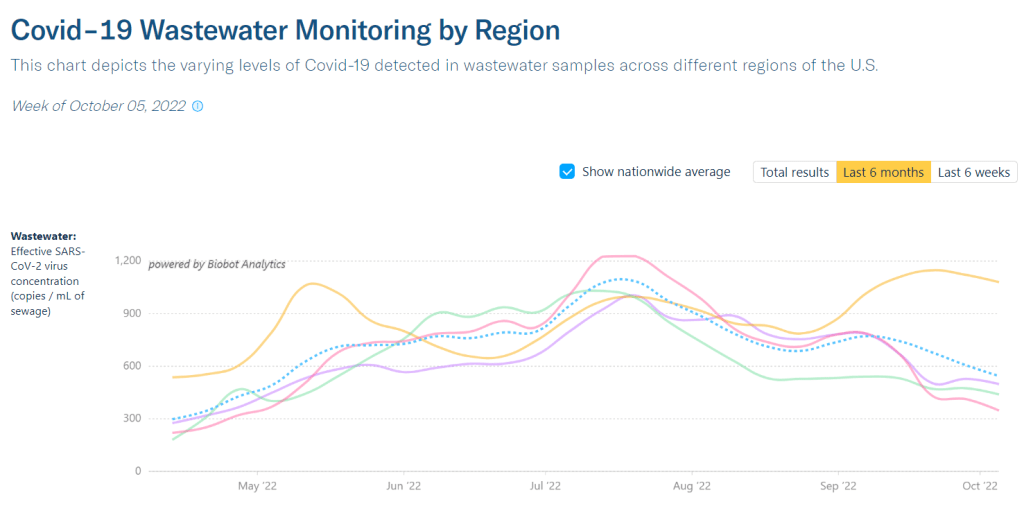
Regional wastewater data from Biobot suggest the Northeast currently has much higher coronavirus transmission levels than the rest of the country.
In the past week (October 1 through 7), the U.S. reported about 300,000 new COVID-19 cases, according to the CDC. This amounts to:
An average of 42,000 new cases each day
89 total new cases for every 100,000 Americans
10% fewer new cases than last week (September 24-30)
In the past week, the U.S. also reported about 23,000 new COVID-19 patients admitted to hospitals. This amounts to:
An average of 3,300 new admissions each day
7.1 total admissions for every 100,000 Americans
5% fewer new admissions than last week
Additionally, the U.S. reported:
2,400 new COVID-19 deaths (350 per day)
79% of new cases are caused by Omicron BA.5; 14% by BA.4.6; 5% by BF.7; 2% by BA.2.75 (as of October 8)
An average of 400,000 vaccinations per day (CDC link)
Following a pattern from the last couple of months, national COVID-19 cases and hospitalizations continued to trend slightly downward this week—though local indicators suggest we may experience a fall surge soon.
Biobot’s wastewater dashboard reports that coronavirus transmission has plateaued at a high level in the Northeast, and at lower levels in the Midwest, West, and South. More locally, several counties that Biobot monitors in Massachusetts, New Jersey, and nearby states are seeing increased viral levels in their wastewater; two prominent examples are Boston and Hartford, Connecticut.
Official COVID-19 cases are heavily underreported right now (by a factor of ten times or more); if we had a better testing infrastructure, they might match more closely to wastewater trends.
Even so, data from the HHS’s October 6 Community Profile Report show that several Northeast states reported among the highest case rates this week. Rhode Island, New Jersey, New York, and Massachusetts all reported 150 or more cases per 100,000 people in the week ending October 5. Kentucky and Puerto Rico reported even more cases, at rates over 200 per 100,000.
At the moment, we’re not seeing enough of the newer Omicron subvariants (BF.7, BA.2.75, etc.) to blame the transmission increases on them. Cold weather (driving people to gather indoors) and waning immunity from past cases and vaccinations are more likely culprits, as Katelyn Jetelina noted in a recent Your Local Epidemiologist post.
Jetelina also pointed out that fall waves are starting in Western European countries, including Germany and the U.K. The U.S. has followed trends in these countries throughout the pandemic, and it seems likely that the same thing will happen this fall—especially considering that the U.S. and European nations have similarly dismissive attitudes towards safety measures right now.
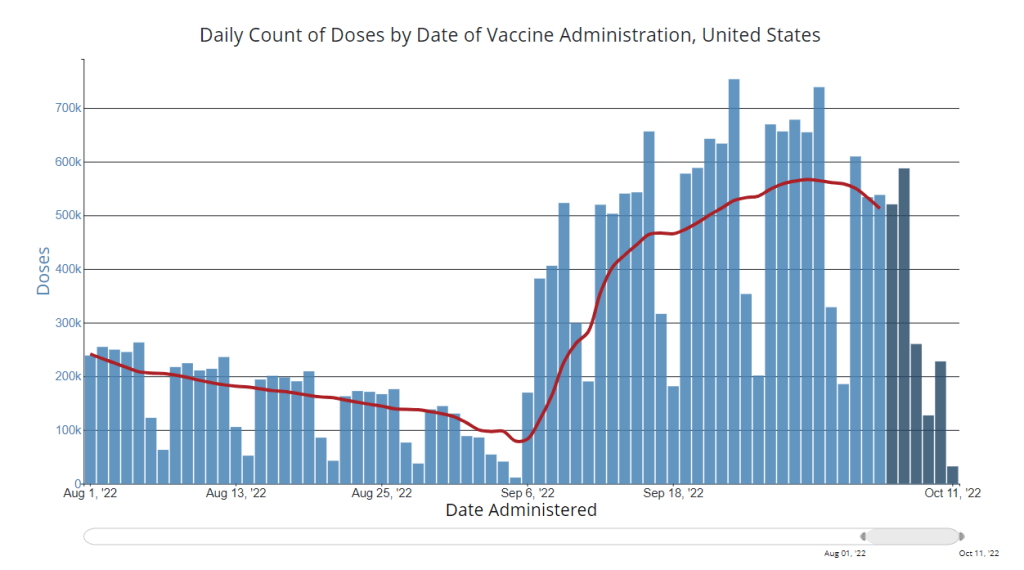
Again, the best way to protect yourself as we prepare for a potential surge is to get an Omicron-specific, bivalent booster shot. Uptake of these shots continues to be quite low in the U.S. so far: as of October 5, just 11.5 million Americans have received them, representing about 5% of the eligible population.


 COVID-19 Data Dispatch