Category: Vaccines

  • A dispatch from Provincetown, Mass.

    A dispatch from Provincetown, Mass.

    Provincetown in June 2006. Source: ingawh via Wikimedia Commons

    Last week, a COVID-19 outbreak in Cape Code, Massachusetts was revealed to be the subject of a major CDC study providing evidence of the Delta variant’s ability to spread through vaccinated individuals. The outbreak quickly became the subject of national headlines, many of them sensationalizing Delta’s breakthrough potential—while failing to provide much context on the people who actually got sick.

    Here’s one big piece of context. Provincetown, the center of this outbreak, is one of America’s best-known gay communities, and the outbreak took place during Bear Week. Bear Week, for the uninitiated, is a week of parties for gay, bisexual, and otherwise men-loving men who identify as bears—a slang term implying a more masculine appearance, often facial and body hair.

    This week, I had the opportunity to talk to Mike, a Bear Week attendee from Pittsburgh who caught COVID-19 in Provincetown. (Mike asked me to use only his first name to protect his privacy.) He told me about his experience attending parties, getting sick, and learning about the scale of the outbreak.

    We also discussed how Provincetown and the Bear Week community were uniquely poised to identify this outbreak, thanks to a better-than-average local public health department and a group of men who were willing to share their health information with officials.

    The interview below has been lightly edited and condensed for clarity.


    Betsy Ladyzhets: My first question is just like, how are you doing? How have you been after being involved in this outbreak?

    Mike: I’m good… I live in Pittsburgh, I drove back on that Saturday [after the week of Provincetown events] and on Sunday, I started coughing really bad as I was driving home. This just came out of nowhere. I had to pull over, I’m like, yeah, I’m not good. This cough was a lot worse than I had anticipated. So, that was my first symptom. I went into the office Monday after getting home…  My first test was negative, on like Monday or Tuesday. But like, I’m still coughing. I didn’t fully trust it. So I got another one Friday, a PCR test.

    BL: So, you got tested twice? Did you experience contact tracing, or how did you get identified as part of the outbreak?

    M: I mean, I just knew I’d been there. Um, no one reached out but… There was a Facebook group, probably ten or fifteen thousand people in it. Lots of people posted about their test results. Like, people after they were leaving [Provincetown], started quarantining.

    The thing about Provincetown is, there were events that happened in the first week [of July, for July 4] that no one really had time to process… Then Bear Week, the week I went, I went at the busiest week of the year for the town. And it had to be, from a planning perspective, I don’t know that was necessarily the best time to have two huge events back to back.

    All the official events for the week that I went were canceled, though there were some of the regular bars and stuff doing events. There was, at the time, I think one venue that has a mostly outdoor party every day from like three to seven, that was very heavily attended with one or two thousand people every day, mostly outside and it’s possible to distance at. I only ended up going once or twice just because it wasn’t really where I wanted to be regardless of COVID risks, it wasn’t particularly a scene that I was craving at the time.

    I only went to, maybe, three or four indoor things the whole time, and it was without a mask for two or three of them. There’s a bunch of nightclubs in Provincetown that were still having events. And I don’t think that any of the bars themselves that were having events were requiring vaccination cards or anything. One venue that I saw a show at, they announced the next day that they were making either masks or proof of vaccination required. One of the venues that has outdoor events, they just moved all their shows outside instead of inside.

    BL: I see. And you mentioned the Facebook group, was that how you found out that a lot of people were getting tested and things like that?

    M: Yeah, there were somewhere between ten and fifteen thousand people in the group, planning this whole week. People usually come to Provincetown from all over, sometimes from abroad, though I don’t think there were many people coming from abroad this year because of the restrictions.

    BL: How did you learn about the big CDC study getting written about this?

    ML: I didn’t really have any idea until afterwards. There were lots of people in the group saying that Barnstable County, or the Massachusetts Department of Health, wanted to know—they wanted people to call if they’d gotten a positive test so they could keep better track of it. I mean, I think part of why the report was able to happen was that it was in a place with better respect for public health than, like, the state of Florida would have, if this kind of outbreak would’ve happened there.

    B: Yeah, I mean, it definitely seems like they responded quickly. Because I know they had, like, a 15% positivity rate one week, and then within a pretty short time it was back down.

    M: The town itself is a mostly gay, retirement-somewhat community. They can spend lots of money on other things [like public health]. They’re not necessarily spending money on schools because of how many people don’t have any kids around that they need to spend money on. And I mean, there are a lot of residents who live there year-round who tend to be older and are at more risk.

    So the week [Bear Week] itself is unique, and then there was a huge community presence about it, everyone wanted to be—for the most part, we’re comfortable about reporting afterwards. I don’t think anyone knew, walking into this, what it would lead to, but… there’s a feeling of community, and that ten thousand-ish Facebook group, I don’t think we otherwise would have necessary talked to each other or told each other about Massachusetts [public health department] asking people to call if they were positive.

    BL: And did you do that? Did you call them?

    M: Um, I personally didn’t, since I didn’t even find out I was positive until a few days later.

    BL: Now, as you know, this outbreak has gotten a lot of national coverage, it’s been kind of sensationalized, with a lot of people focusing on the vaccine breakthrough cases and stuff like that. I know you were not personally one of the people whose test measurements are included there. But what is that experience like of being part of this thing that has gotten so much national attention?

    M: I posted about it on social media and there were lots of people who were surprised or whatnot. I think, at least in my head, I went in with a calculated risk, of like 10, 20, 30, or more in the ten thousand-ish people coming, a lot of them are traveling on planes. I drove, thinking I’ll come into this place and I think I’ll make okay decisions…

    And there were people in this one place for a whole week, that I guess you were able to test from the CDC’s perspective. I don’t think there are many other places that are as remote as Provincetown where people are staying for the entire week, and everyone generally leaves on the same day, and everyone was in conversation with one another, talking about what happened.


    Related links

  • Vaccine requirements are the next big strategy

    After vaccine incentives largely failed to drive up vaccination numbers, government agencies and corporations alike are now opting for requirements. Hundreds of thousands of Americans learned this week that, in order to keep their jobs, they need to get their shots—or go through a more arduous process like weekly COVID-19 testing.

    Here are the major mandates I saw announced this week, and how many people are impacted by each one. 

    • All city workers in NYC: 340,000 municipal workers in the city will need to get vaccinated or tested weekly. This includes teachers, police, and firefighters; a previous NYC guidance (announced last week) focused on public health workers. Staffers in nursing homes and other congregate care settings need to be vaccinated by August 16, while other workers need to do it by September 13—the first day of school in NYC this fall.
    • All state workers in California: A few hours after the NYC requirement was announced, California governor Gavin Newsom said that all CA state employees will similarly need to get vaccinated or opt into weekly testing. This applies to about 246,000 state employees and an undetermined number of healthcare workers, according to the New York Times.
    • All frontline workers in the Department of Veterans Affairs (VA): Also on Monday, the VA announced that all healthcare workers in VA facilities need to get vaccinated, along with facilities staff and others on the frontlines of patient care. Employees have eight weeks to get fully vaccinated, or may face consequences including potential firing. This applies to about 115,000 workers.
    • All Disney employees: Disney is requiring vaccinations for all salaried and non-union employees. Those who haven’t gotten their shots yet have 60 days to do so, and new hires need to be fully vaccinated before starting work. It’s unclear from the company’s announcement if Disney workers will get a testing option or what the consequences for remaining unvaccinated may be. Disney employs over 200,000 people.
    • All Walmart employees: Walmart, the largest retailer in the U.S., is requiring all U.S.-based corporate employees to be vaccinated by October 4. This doesn’t include workers in Walmart stores, but those workers are strongly encouraged to get their shots as well—and will get a $150 bonus upon vaccination. Walmart employs about 1.5 million people in the U.S., in total.
    • All Google employees: Alphabet CEO Sundar Pichai announced Google’s new policy on Wednesday: anyone coming back to work at a Google campus must be vaccinated. The policy is starting in the U.S., but will be expanded to the rest of the world as well; Google employs over 100,000 people globally.
    • Netflix actors and crew: Netflix is requiring all actors and crew in close contact with those actors to get vaccinated in order to come on set. Some have called for the requirement to be expanded to everyone at the company. The company employed about 9,400 full-time workers in 2020; it’s unclear how many will be impacted by the requirement.
    • Shake Shack workers and customers: The franchise’s founder and CEO announced Shake Shack’s requirement on Thursday, saying it would apply to full-service restaurants in NYC and Washington, D.C. While this requirement impacts far fewer workers than others in this list, it’s unique in that workers aren’t the only ones who need to be vaccinated: any customer hoping to dine in a Shake Shack needs proof of vaccination, too.

    It’s unclear how much of a dent these mandates will make in overall vaccination numbers over the next few weeks. But surveys from KFF and others have suggested that, for many Americans, a vaccination requirement may be the last push they need to get their shots.

  • Breakthrough case reporting: Once again, outside researchers do the CDC’s job

    Breakthrough case reporting: Once again, outside researchers do the CDC’s job

    In May, the CDC switched from tracking and reporting all cases that occur in vaccinated Americans to reporting only those that cause hospitalizations or deaths. At the time, I criticized this move as a lazy choice that left the U.S. without critical information as Delta and other variants spread through the country.

    Now, Delta is causing the vast majority of cases—and the CDC still isn’t reporting on non-severe breakthroughs. As a result, entities outside the federal government are once again compiling data from states in order to fill in gaps left by the national public health agency.

    On Friday, both Bloomberg and NBC published breakthrough case analyses. Bloomberg reported 112,000 total breakthrough cases from 35 states, as of the end of July. This is a tiny fraction of the vaccinated population—over 164 million Americans—but it is far higher than the national breakthrough case number reported by the CDC in May, pre-reporting switch.

    Bloomberg’s report includes plenty of expert critiques of the CDC’s May decision, suggesting that the lack of data led to many local public health officials flying blind as Delta spread.

    With better understanding of how delta spreads, different public health measures or warnings could have been put in place for vaccinated people, said Rachael Piltch-Loeb, a Harvard Chan School of Public Health researcher on public health emergency responses.

    According to NBC, America’s breakthrough case total is even higher: at least 125,000 cases from 38 states. Nine states, including Pennsylvania and Missouri, failed to provide NBC with any breakthrough case information, while 11 did not provide death and hospitalization numbers. Still, these cases have clearly increased substantially in the past two months, NBC reports:

    In Utah on June 2, 2021, just 27 or 8 percent of the 312 new cases in the state were breakthrough cases. As of July 26 there were 519 new cases and almost 20 percent or 94 were breakthroughs, according to state data.

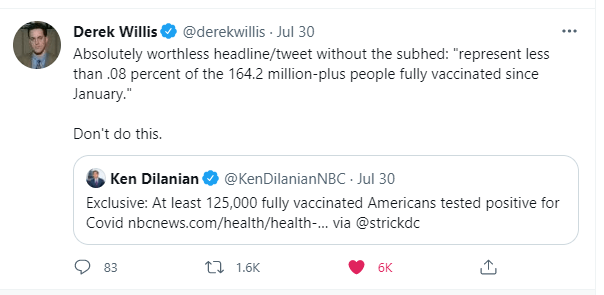
    Now, it’s important to emphasize that breakthrough cases are still very rare and very mild, compared with non-breakthrough COVID-19. The 125,000 cases reported by NBC comprise less than 0.08% of the 164 million Americans who’ve been fully vaccinated. And the CDC reports just 6,600 severe breakthrough cases (leading to hospitalization and/or death) as of July 26.

    Any news article, headline, or tweet about breakthroughs should make that denominator explicitly clear—something that one NBC reporter failed to do when sharing his outlet’s story on Friday.

    Also on Friday, the Kaiser Family Foundation (KFF) published detailed annotations on state breakthrough case reporting. 24 states and D.C. have provided public data on this topic, according to KFF; some are reporting data regularly, while others have included the information in limited press releases and other reports.

    If your state is one of the 26 states not providing any public breakthrough case data at all, I’d recommend reaching out to the state public health agency and asking why not. Yes, it’s challenging to identify these cases when vaccinated people tend to have mild symptoms and might not think to get a test. And yes, the vast majority of people who have a breakthrough case will likely be fine in a couple of weeks. But the information is vital as Delta continues to wreak havoc across the country.

    More vaccine reporting

    • Sources and updates, November 12
      Sources and updates for the week of November 12 include new vaccination data, a rapid test receiving FDA approval, treatment guidelines, and more.
    • How is the CDC tracking the latest round of COVID-19 vaccines?
      Following the end of the federal public health emergency in May, the CDC has lost its authority to collect vaccination data from all state and local health agencies that keep immunization records. As a result, the CDC is no longer providing comprehensive vaccination numbers on its COVID-19 dashboards. But we still have some information about this year’s vaccination campaign, thanks to continued CDC efforts as well as reporting by other health agencies and research organizations.
    • Sources and updates, October 8
      Sources and updates for the week of October 8 include new papers about booster shot uptake, at-home tests, and Long COVID symptoms.
    • COVID source shout-out: Novavax’s booster is now available
      This week, the FDA authorized Novavax’s updated COVID-19 vaccine. Here’s why some people are excited to get Novavax’s vaccine this fall, as opposed to Pfizer’s or Moderna’s.
    • COVID-19 vaccine issues: Stories from COVID-19 Data Dispatch readers across the U.S.
      Last week, I asked you, COVID-19 Data Dispatch readers, to send me your stories of challenges you experienced when trying to get this fall’s COVID-19 vaccines. I received 35 responses from readers across the country, demonstrating issues with insurance coverage, pharmacy logistics, and more.
  • Unpacking Delta numbers from this week’s headlines

    Unpacking Delta numbers from this week’s headlines

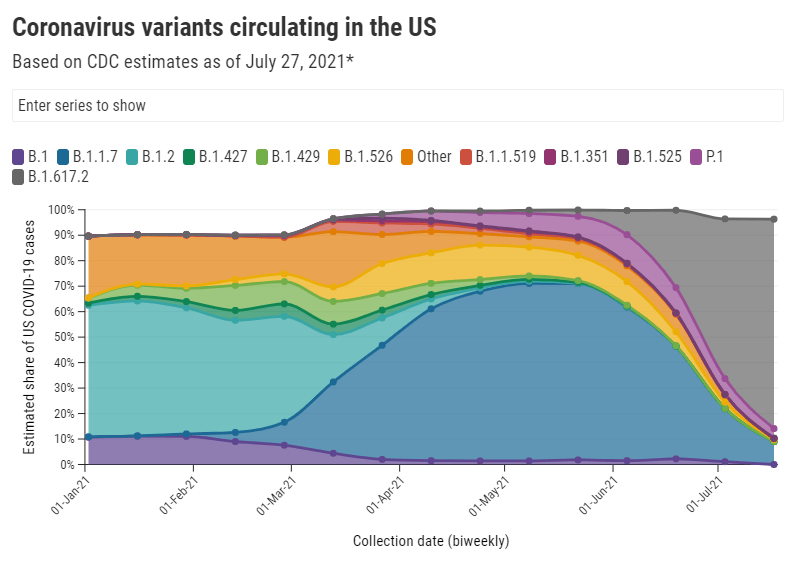
    It should be no surprise, at this point in the summer, that Delta (B.1.617.2) is bad news. From the moment it was identified in India, this variant has been linked to rapid transmission and rapid case increases, even in areas where the vaccination rates are high.

    This week, however, the CDC’s changed mask guidance—combined with new reports on breakthrough cases associated with Delta—has triggered widespread conversation about precisely how much damage this variant can do. “I’ve not seen this level of anxiety from everyone since the beginning of the pandemic,” Dr. Katelyn Jetelina wrote in her newsletter Friday.

    In the CDD today, I’m unpacking six key statements that you’ve likely seen in recent headlines, including where the statistics came from and what they mean for you.

    1. Delta causes a viral load 1,000 times higher than the original coronavirus strain.

    This number comes from a recent study in Guangzhou, China that was published as a preprint earlier in July. The researchers looked at viral load, a measurement of how much virus DNA is present in patients’ test samples; a higher viral load generally means the patient can infect more people, though it’s not a one-to-one relationship (more on that below).

    Based on measurements from 62 people infected with Delta, the researchers concluded that Delta patients have about 1,000 times more virus in their bodies compared to patients infected with the original coronavirus strain in early 2020. This paper has not yet been peer-reviewed, but outside experts have cited it as evidence behind Delta’s super-spreading ability.

    For more explanation on how Delta differs from past coronavirus strains, check out this KHN story by Liz Szabo.

    2. Delta causes similar viral loads in vaccinated and unvaccinated people who get infected.

    This finding comes from a highly anticipated CDC report published Friday in the agency’s Morbidity and Mortality Weekly Report (MMWR). CDC researchers measured viral loads—remember, a reflection of how much virus DNA is in a patient’s body—in vaccinated and unvaccinated people who got infected during an outbreak in Provincetown, Massachusetts. They found that the two groups had similar measurements, on average. Test samples in this outbreak were also sequenced; 90% of cases in the outbreak were definitively caused by Delta.

    It’s important to be precise when we talk about this CDC report, because viral load is just one specific measurement. While the viral load can reflect how capable someone is of transmitting the coronavirus, the CDC’s data do not definitively tell us that vaccinated and unvaccinated people are equally capable of transmitting Delta.

    Experts commenting on the CDC’s findings have said that other factors, such as length of infection and virus presence in a patient’s nose and mouth, also play into coronavirus transmission.For example, here’s a quote from a Science News story discussing the CDC’s findings:

    The result “just gives you an indication of how much viral RNA is in the sample, it tells you nothing about infectiousness,” says Susan Butler-Wu, a clinical microbiologist at the University of Southern California. These data “are a cause for concern, but this is not a definitive answer on transmissibility” from vaccinated people, she says.

    And here’s a Twitter thread from a vaccine scientist discussing how the CDC has conflated viral load measurements with actual transmission:

    In other words: vaccinated people are not capable of spreading Delta to the same degree as the unvaccinated. The infection and transmission risks for vaccinated people are still much lower. Here’s one reason why…

    3. A breakthrough infection will be over faster than a non-breakthrough infection.

    This finding comes from a study out of Singapore, published yesterday as a preprint. Researchers looked at viral loads over time for patients infected with Delta, comparing numbers for those patients who had and had not been vaccinated. They found that the viral load decreased more quickly in those vaccinated patients who had a breakthrough case, signifying that vaccinated patients both recover more quickly and lose their ability to get someone else infected more quickly.

    In other words, when a vaccinated person has a breakthrough case, their immune system is more prepared to face the coronavirus. That prepped immune system will help the person avoid severe disease, while also getting the virus out of the body more quickly than the immune system would be able to without a vaccine’s help.

    This study is not yet peer-reviewed, but it aligns with other research showing that vaccinated people with breakthrough cases tend to have mild symptoms and spend less time being contagious.

    4. An interaction of one second is enough time for Delta to spread from one person to another.

    In spring 2020, public health leaders agreed on a rule of thumb for COVID-19 risk: if you were indoors with someone, unmasked, for at least 15 minutes, that person qualified as a “close contact” who could give you the coronavirus, or vice versa. Now, with Delta, the equivalent of that 15-minute close contact is one second. I first saw this statistic in a STAT News interview with epidemiologist Dr. Céline Gounder, but it’s been reported in other publications as well.

    Let me emphasize here, though, that this one-second rule applies to indoor transmission. We don’t yet know how much Delta increases the risk of outdoor transmission, which was almost entirely negligible for past variants.

    5. The average person with Delta infects at least twice as many others as the average person with the original coronavirus strain.

    In spring 2020, the average person who got sick with COVID-19 would infect a couple of others, while a select few would cause superspreading events. Now, we’re learning that the average person who gets Delta can infect more. An internal CDC report leaked by the Washington Post says that Delta may infect eight or nine people on average and spreads “as easily as chickenpox.”

    While this comparison is obviously pretty concerning, outside experts have been skeptical of the CDC’s generalization of data from that one Massachusetts outbreak. Plus, the CDC’s estimate of Delta’s capacity for infection is higher than estimates we’ve seen from other sources. Studies out of England suggest that the variant infects five to seven people on average—still high, but not quite chickenpox levels.

    6. Hospitalizations are rising in undervaccinated areas, while well-vaccinated areas are on the alert.

    Florida has been setting COVID-19 records recently. The state now has more people in the hospital with COVID-19 than at any other time during the pandemic, including the winter surge.

    Meanwhile, hospitalizations in Texas are up more than 300% from lows in late June. Austin is running out of ICU beds. Louisiana, Arkansas, and Nevada have all seen more than 10 new COVID-19 patients for every 100,000 residents in the past week. And the healthcare workers treating these patients are burnt out from over a year of pandemic work.

    In well-vaccinated areas, hospitalizations are low for now; even with Delta, the vaccines do a great job of protecting people against severe disease and death. But hospitals in these cities are still on high alert, ready to treat unvaccinated patients and those seniors, immunocompromised patients, and others for whom the vaccines may not be as effective.

    For example, see this thread from University of California San Francisco medical professor Bob Wachter. (San Francisco has the highest vaccination rate of any city in America.)

    TL;DR

    The TL;DR here is: Delta is way more contagious than any variant we’ve seen before. For unvaccinated people, any indoor, unmasked interaction with someone who has Delta—even a very short interaction—is enough for you to get infected. For vaccinated people, the risk of getting and spreading Delta is elevated compared to past coronavirus strains, but it is still far lower than the risk for unvaccinated people.

    So, when the CDC suggests that vaccinated people go back to mask-wearing (if you ever stopped), the agency is saying, wear a mask on behalf of the unvaccinated people around you. Those who are vaccinated are at more risk now than they were in May or June, but vaccination is still the best protection we have against infection, transmission, and—most importantly—severe COVID-19 disease.

    Or, to quote WNYC health and science editor Nsikan Akpan: “The vaccines will keep you from dying. Masks will keep away infections. Otherwise, the COVID odds are against you.”

    More variant reporting

    • The booster shot conversation: What you should know

      The booster shot conversation: What you should know

      Pfizer vaccine, in use at Walter Reed National Military Medical Center. DoD photo by Lisa Ferdinando.

      Recently, a lot of U.S. COVID-19 news has centered around booster shots—additional vaccine doses to boost patients’ immunity against the coronavirus. Questions abound: do we need these shots, when might we need them, how do they impact vaccination campaigns?

      In other countries, booster shots are being deployed as a measure of extra protection for people with weaker immune systems as Delta spreads. In France, extra vaccine doses are available for organ transplant recipients, those on dialysis, and others. Israel is similarly offering third Pfizer doses to Israelis with medical conditions that cause immunodeficiency. And in Thailand, healthcare workers are getting booster shots of the AstraZeneca vaccine after two doses of Sinovac, which has demonstrated lower efficacy than other vaccines.

      Even in the U.S., a small number of immunocompromised patients have received third doses—many of them in clinical trials analyzing how well boosters work. Medical experts tend not to question why boosters may be needed for immunocompromised patients, as their weakened immune systems also make the patients more vulnerable to severe cases of COVID-19.

      The real questions come when we start to consider booster shots for everyone. Pfizer, which has developed a third dose for the general population, recently announced that the company applied for Emergency Use Authorization from the FDA. The company says its currently approved two-shot regimen will cause patients to lose some protection six months after they’ve been vaccinated—and become more vulnerable to Delta—with continued lower immunity over time.

      Officials at the FDA and CDC, however, have said that boosters aren’t yet necessary. The agencies released a joint statement to that effect, and U.S. health officials say they want to see more data—especially from Israel, where Pfizer has been in heavy use. Pfizer’s data on waning efficacy aren’t yet public (released by press release, not scientific paper), which complicates the conversation. Still, some health officials say we will eventually need booster shots, just not right now, according to POLITICO.

      While U.S. public health experts seek more data, our booster shot conversation appears selfish in other parts of the world. While over 3.6 billion doses have been administered globally across 180 countries, high-income countries are getting vaccinated 30 times faster than lower-income countries, according to Bloomberg. More than half of Americans have received at least one shot, compared to under 1% in many African countries.

      Dr. Tedros Adhanom Ghebreyesus, Director-General of the WHO, slammed the U.S. and other wealthy nations at a press briefing last week for even considering booster shots. “The priority now must be to vaccinate those who have received no doses and protection,” he said. “Instead of Moderna and Pfizer prioritizing the supply of vaccines as boosters to countries whose populations have relatively high coverage, we need them to go all out to channel supply to COVAX, the Africa Vaccine Acquisition Task Team and low- and low-middle income countries, which have very low vaccine coverage.”

      For more details and expert takes on the situation, I recommend this article from several ace STAT News reporters.

      More vaccine reporting

      • Sources and updates, November 12
        Sources and updates for the week of November 12 include new vaccination data, a rapid test receiving FDA approval, treatment guidelines, and more.
      • How is the CDC tracking the latest round of COVID-19 vaccines?
        Following the end of the federal public health emergency in May, the CDC has lost its authority to collect vaccination data from all state and local health agencies that keep immunization records. As a result, the CDC is no longer providing comprehensive vaccination numbers on its COVID-19 dashboards. But we still have some information about this year’s vaccination campaign, thanks to continued CDC efforts as well as reporting by other health agencies and research organizations.
      • Sources and updates, October 8
        Sources and updates for the week of October 8 include new papers about booster shot uptake, at-home tests, and Long COVID symptoms.
      • COVID source shout-out: Novavax’s booster is now available
        This week, the FDA authorized Novavax’s updated COVID-19 vaccine. Here’s why some people are excited to get Novavax’s vaccine this fall, as opposed to Pfizer’s or Moderna’s.
      • COVID-19 vaccine issues: Stories from COVID-19 Data Dispatch readers across the U.S.
        Last week, I asked you, COVID-19 Data Dispatch readers, to send me your stories of challenges you experienced when trying to get this fall’s COVID-19 vaccines. I received 35 responses from readers across the country, demonstrating issues with insurance coverage, pharmacy logistics, and more.
    • What’s up with Texas’ county-level vaccination data?

      What’s up with Texas’ county-level vaccination data?

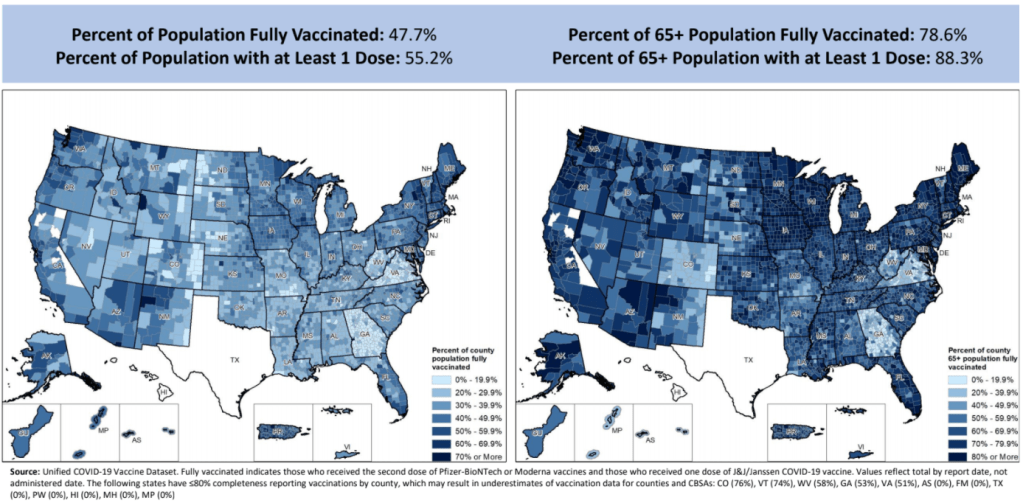
      Vaccination rates by county, included in the July 8 HHS Community Profile report. Note the missing data for Texas.

      Anyone who’s tried to work with the federal government’s vaccination data has noticed this issue: there’s a Texas-shaped hole in the numbers.

      While the CDC and HHS report vaccination data for counties and metropolitan areas in the vast majority of states, data are missing for the entire state of Texas. Data are also incomplete for several other states, including Colorado, Nebraska, and Virginia.

      What’s up with Texas? A reporter friend recently asked me this question, inspiring me to look into the issue. There’s limited information directly on the CDC dashboard; a vague note in the Community Profile Reports simply notes that several states have “ ≤80% completeness reporting vaccinations by county,” including Texas at 0%—implying that the states, rather than the federal agency, is at fault.

      A great article by Houston Chronicle reporter Kirkland An dives into the precise issue. An cites a CDC page on county-level vaccination data reporting, which says that, “Texas provides data that are aggregated at the state level and cannot be stratified by county.” (I later realized that this page is linked in incredibly tiny text at the very bottom of the CDC’s dashboard—classic.) 

      Why is Texas providing state-level data? The answer, it turns out, lies with a unique state law:

      When asked about the lack of data, Douglas Loveday, a press officer with the Texas Department of State Health Services (DSHS), said, “State statute prevents us from sharing person-level immunization data.”

      Texas Health and Safety Code Sec. 161.0073 states that DSHS “may not release registry information to any individual or entity without the consent of the individual or the individual’s legally authorized representative.” There are exceptions to the rule, specifically reporting “non-identifying summary statistics.” But reporting individual records to the CDC, even if they have been stripped of identifying information, is not one of the exceptions granted by the code.

      In other words: almost every other state submits anonymous, line-level vaccination data to the CDC. Each line in the dataset represents one vaccinated individual, including their county of residence and other demographic information. The CDC aggregates this line-level information into the county-level statistics published on its dashboard. But Texas is prohibited from sending this type of individual data outside of the state without individual consent, so Texas is missing from the CDC data.

      Texas’ health agency does compile its own county-level vaccination data, which are available on the Texas COVID-19 vaccine dashboard. But most public health researchers (and journalists like yours truly) rely on the CDC’s standardized, national datasets—leaving Texas out of many important analyses on the vaccine rollout. 

      An reports that Texas’s agency does send the CDC aggregated county-level data; it’s just organized by vaccine provider, instead of by county of residence for vaccine recipients. The national agency is working with Texas to switch to county-of-residence reporting so that the state may appear in national datasets without breaking state law. Hopefully, that Texas-sized hole in the data may be filled soon.

      (It’s unclear whether similar efforts are underway for a Hawaii-sized hole in the same dataset; the CDC currently reports that Hawaii “does not provide CDC with county-of-residence information.”)

    • Breakthrough cases: What we know right now

      Breakthrough cases: What we know right now

      Washington is one of the states reporting high levels of detail about breakthrough cases. Screenshot via June 23 report.

      For the past few months, we’ve been watching the vaccines and variants race in real time. With every new case, the coronavirus has the opportunity to mutate—and many scientists agree that it will inevitably mutate into a viral variant capable of outsmarting our current vaccines.

      How will we know when that happens? Through genomic surveillance, examining the structure of coronavirus lineages that arise in the U.S. and globally. While epidemiologists may consider any new outbreak a possible source of new variants, one key way to monitor the virus/variant race is by analyzing breakthrough cases—those infections that occur after someone has been fully vaccinated. 

      In May, the CDC changed how it tracks breakthrough cases: the agency now only investigates and reports those breakthrough cases that result in hospitalizations or deaths. I wrote about this in May, but a new analysis from COVID Tracking Project alums and the Rockefeller Foundation provides more detail on the situation.

      A couple of highlights from this new analysis:

      • 15 states regularly report some degree of information about vaccine breakthroughs, some including hospitalizations and deaths.
      • Six states report sequencing results identifying viral lineages of their breakthrough cases: Nebraska, Arkansas, Alaska, Montana, Oregon, and Washington.
      • Washington and Oregon are unique in providing limited demographic data about their breakthrough cases.
      • Several more states have reported breakthrough cases in isolated press briefings or media reports, rather than including this vital information in regular reports or on dashboards.
      • When the CDC stopped reporting breakthrough infections that did not result in severe disease, the number of breakthrough cases reported dropped dramatically.
      • We need more data collection and reporting about these cases, on both state and federal levels. Better coordination between healthcare facilities, laboratories, and public health agencies would help.

      Vaccine breakthrough cases are kind-of a data black box right now. We don’t know exactly how many are happening, where they are, or—most importantly—which variants they’re tied to. The Rockefeller Foundation is working to increase global collaboration for genomic sequencing and data sharing via a new Pandemic Prevention Institute.

      Luckily, there is a lot we do know from another side of the vaccine/variant race: vaccine studies have consistently brought good news about how well our current vaccines work against variants. The mRNA vaccines in particular are highly effective, especially after one has completed a two-dose regimen. If you’d like more details, watch Dr. Anthony Fauci in Thursday’s White House COVID-19 briefing, starting about 14 minutes in.

      New research, out this week, confirmed that even the one-shot Johnson & Johnson vaccine works well against the Delta variant. The company reported that, after a patient receives this vaccine, blood antibody levels are high enough to beat off an infection from Delta. In other words, people who got the J&J shot do not need to rush to get a booster shot from an mRNA vaccine (a recent debate topic among some experts).

      Again, we’ll need more genomic surveillance to carefully watch for the variant that inevitably does beat our vaccines. But for now, the vaccinated are safe from variants—and getting vaccinated remains the top protection for those who aren’t yet. 

      More variant reporting

      • The US missed Biden’s July 4 goal: How did your community do?

        The US missed Biden’s July 4 goal: How did your community do?

        The U.S. missed President Biden’s big vaccination goal: 70% of adults vaccinated with at least one dose by July 4. As of July 3, we are at 67% of adults with one dose, and 58% fully vaccinated.

        I did a data-driven look at the vaccination goal this week in a story for the Daily Mail. The story focuses on which parts of the country have met the goal—and which areas fell short. Those under-vaccinated areas are highly vulnerable to the Delta variant (B.1.617.2), which is now spreading rapidly in many of those pockets. Reminder: the Delta variant is much more transmissible than even the Alpha variant (B.1.1.7), and its presence is doubling in the U.S. every two weeks.

        There are over 1,000 counties in the U.S. with one-dose vaccination rates under 30%, CDC Director Dr. Walensky said at a press briefing last week. The U.S. has about 3,100 counties in total.

        Is your county one of them? Check it out on this interactive map, reflecting data as of July 1:

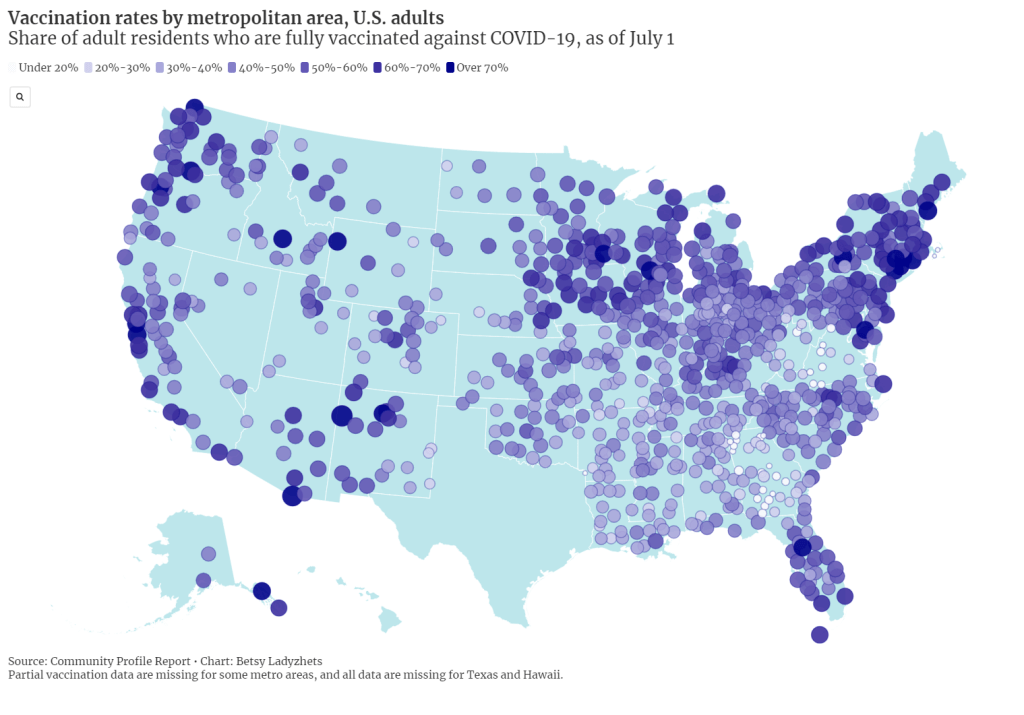
        I also made a map showing vaccination rates by metropolitan area. You can clearly see clusters of high vaccination in the Northeast and on the West coast, while parts of the South and Midwest are under-vaccinated. Note that Texas is missing in both this dataset and the county-level data due to issues in the state’s reporting to the CDC.

        For my Daily Mail story, I also asked two of the COVID-19 science communicators I most admire to explain the significance of that missed 70% goal. I talked to Dr. Uché Blackstock, physician and founder of the organization Advancing Health Equity, and Dr. Katelyn Jetelina, epidemiologist at the University of Texas and writer of the Your Local Epidemiologist newsletter.

        Here are both of their takes on the missed goal:

        So, we didn’t meet the 70% goal. It means that we fell short. It also means that we just don’t have enough people vaccinated, not even close, to reach herd immunity.

        To me, as an epidemiologist, someone in the field and also someone within a community, it means that we have reached—or are about to reach—saturation [of the vaccine market]. We need to start becoming very innovative about how to address vaccine hesitancy, as well as how to address vaccine equity.

        That’s really going to be the next phase of public health approaches. And then, how do we go about doing this… You know, we’re well beyond billboards now. We really need to mobilize a grassroots movement. We need to listen about concerns, we need to educate about these concerns.

        And then, we need to make vaccines more accessible. Especially among pediatrics, where—pediatrician offices can’t store the vaccine. So we have to go to schools and really engage with families in a “nontraditional sense.”

        Dr. Katelyn Jetelina

        This 70%, especially for one dose, is sort of an arbitrary number, because we know that being fully vaccinated is what’s needed to fully protect you against variants. I think it was obviously wise and aspirational to have a goal. But at this point, because we’re basically seeing the number of people vaccinated decreasing weekly, and substantially since last April… I think we need to change our perspective.

        We had the early adopters who came in droves to get vaccinated. We’re not going to see the same numbers anytime soon. And so, I think that this idea of having a goal, while it’s aspirational, I think that we have to put that aside and think more realistically about the challenges we’re dealing with.

        And the challenges we’re dealing with are actually quite complicated… There are still access issues, although I do think the Biden administration is doing—at least trying to do a substantial job in knocking down those barriers. They’re providing transportation, childcare, increasing the access points for getting vaccinations, encouraging small businesses to offer their workers paid sick leave to get vaccinated and to recover from the vaccine.

        But I think this other issue that we’re seeing among people who are not vaccinated, it varies depending on the population, the geographical area. We know rural populations are less likely [to get vaccinated]. And we know that, among the “wait and see” group, about half of those are people of color.

        I hate to blame it on this so-called “vaccine hesitancy” because I don’t think it’s that simple. I do think, though, that there is a significant distrust of government, there is distrust of the healthcare system, and there is a lot of misinformation out there about the vaccines. All of these are essentially creating the perfect storm that is preventing us from getting to this aspirational [70%] number.

        But here, we’re at this point where it’s a race against the variants, and I think that we just have to get as many people vaccinated as possible. I know that sounds incredibly vague, but that really is the goal.

        Dr. Uché Blackstock

        I made a third chart for today’s issue, visualizing vaccination rates by state from March through June. It really shows how vaccine enthusiasm has leveled off, just about everywhere in the country—but the plateaus started earlier in many of those states that have lower rates now. 

        I typically try to avoid anything approaching medical advice in the COVID-19 Data Dispatch, as I am a journalist with just an undergraduate biology degree and a couple of years of science reporting experience. But this week, it feels appropriate to wholeheartedly, unambiguously encourage vaccination.

        I know the audience for a publication like this one skews towards people who probably have their shots already. Rather, I want to encourage you to find those people in your community who aren’t yet vaccinated, and help them take that step.

        Recent research suggests that lotteries and other large-scale incentives do not significantly encourage vaccination; instead, we need small-scale incentives. One-on-one conversations with people, opportunities for concerns to be voiced and addressed, appointments that can be tailored to the individual’s needs. Anything that you can do to play a role in these initiatives, please get out there and do it.

        Of course, if you (or your friends/family/community members/etc.!) have questions about vaccines, or anything else COVID-19 related, you know where to find me. Inquiries welcome at betsy@coviddatadispatch.com

        More vaccine reporting

        • Sources and updates, November 12
          Sources and updates for the week of November 12 include new vaccination data, a rapid test receiving FDA approval, treatment guidelines, and more.
        • How is the CDC tracking the latest round of COVID-19 vaccines?
          Following the end of the federal public health emergency in May, the CDC has lost its authority to collect vaccination data from all state and local health agencies that keep immunization records. As a result, the CDC is no longer providing comprehensive vaccination numbers on its COVID-19 dashboards. But we still have some information about this year’s vaccination campaign, thanks to continued CDC efforts as well as reporting by other health agencies and research organizations.
        • Sources and updates, October 8
          Sources and updates for the week of October 8 include new papers about booster shot uptake, at-home tests, and Long COVID symptoms.
        • COVID source shout-out: Novavax’s booster is now available
          This week, the FDA authorized Novavax’s updated COVID-19 vaccine. Here’s why some people are excited to get Novavax’s vaccine this fall, as opposed to Pfizer’s or Moderna’s.
        • COVID-19 vaccine issues: Stories from COVID-19 Data Dispatch readers across the U.S.
          Last week, I asked you, COVID-19 Data Dispatch readers, to send me your stories of challenges you experienced when trying to get this fall’s COVID-19 vaccines. I received 35 responses from readers across the country, demonstrating issues with insurance coverage, pharmacy logistics, and more.
      • Novavax vaccine performs well—including against variants

        Novavax vaccine performs well—including against variants

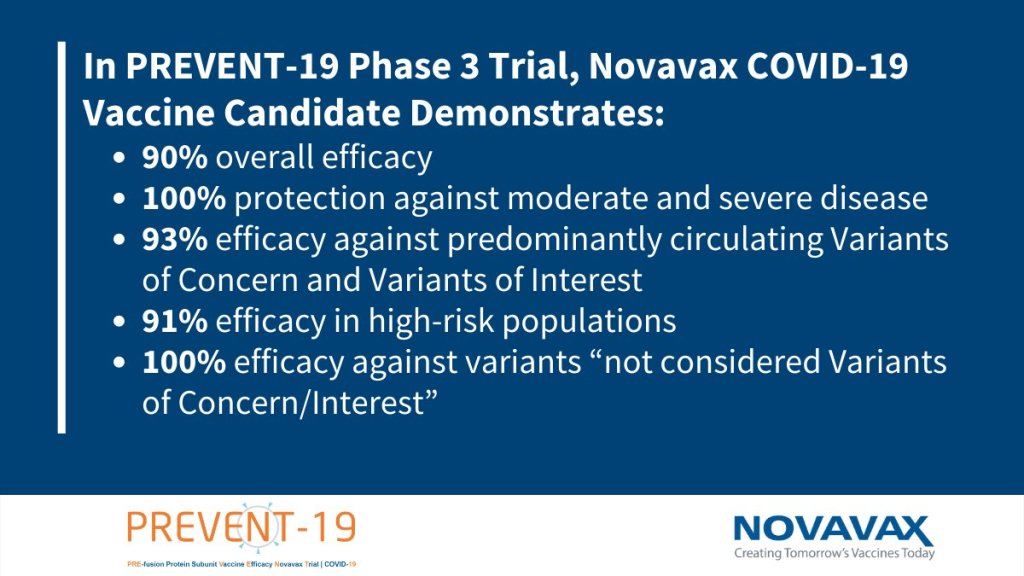
        The COVID-19 news world saw a return of Monday-morning vaccine results this week. Novavax, a small biotech company based in Maryland, announced that its vaccine demonstrated 90% overall efficacy and 100% protection against moderate and severe COVID-19 disease.

        These results come from a trial conducted in the U.S. and Mexico between January and April this year, at a time when the Alpha (or B.1.1.7) variant was becoming dominant here. Among almost 30,000 trial participants, 77 cases were observed: 63 in the placebo group and 14 in the vaccine group, for an efficacy of 90.4%. All of the moderate and severe cases (ten moderate, four severe) were observed in the placebo group.

        Novavax even sequenced samples from 54 out of the 77 cases. The majority of those sequenced cases were variants of concern or variants of interest; Novavax’s vaccine demonstrated 93.2% efficacy against variants of concern/interest and 100% efficacy against non-concerning variants. This finding aligns with other vaccine studies suggesting that the COVID-19 vaccines developed on older versions of the virus still work well against variants, especially at protecting against severe disease and death.

        This new vaccine uses a coronavirus protein—a different method from both Moderna/Pfizer (mRNA vaccines) and AstraZeneca/Johnson & Johnson (adenovirus vaccines). It’s given in two doses, three weeks apart. It had far fewer side effects than other COVID-19 vaccines, with small numbers of participants reporting sore arms and fatigue.

        The Novavax vaccine is also comparatively easier to transport and store than other viruses; it can be stored at refrigerated temperatures. While it’s unlikely to be used in the U.S., it could be critical for vaccine rollouts in other parts of the world.

        More vaccine data

        • Sources and updates, November 12
          Sources and updates for the week of November 12 include new vaccination data, a rapid test receiving FDA approval, treatment guidelines, and more.
        • How is the CDC tracking the latest round of COVID-19 vaccines?
          Following the end of the federal public health emergency in May, the CDC has lost its authority to collect vaccination data from all state and local health agencies that keep immunization records. As a result, the CDC is no longer providing comprehensive vaccination numbers on its COVID-19 dashboards. But we still have some information about this year’s vaccination campaign, thanks to continued CDC efforts as well as reporting by other health agencies and research organizations.
        • Sources and updates, October 8
          Sources and updates for the week of October 8 include new papers about booster shot uptake, at-home tests, and Long COVID symptoms.
        • COVID source shout-out: Novavax’s booster is now available
          This week, the FDA authorized Novavax’s updated COVID-19 vaccine. Here’s why some people are excited to get Novavax’s vaccine this fall, as opposed to Pfizer’s or Moderna’s.
        • COVID-19 vaccine issues: Stories from COVID-19 Data Dispatch readers across the U.S.
          Last week, I asked you, COVID-19 Data Dispatch readers, to send me your stories of challenges you experienced when trying to get this fall’s COVID-19 vaccines. I received 35 responses from readers across the country, demonstrating issues with insurance coverage, pharmacy logistics, and more.
      • COVID source shout-out: The CDD vaccinations page

        Since early January, the COVID-19 Data Dispatch has maintained a page of detailed annotations on all the major sources for vaccination data in the U.S. This includes government sources (the CDC, all 50 states, and D.C.), along with a few notable news publications and independent dashboards. I’ve updated the page weekly, usually checking every data source on Saturday or Sunday to look for any changes or additions.

        When I started maintaining these annotations, I saw major changes each week. States were bringing new dashboards online, adding more local geographies, adding more demographic data. I enjoyed watching the development and looking out for new features—almost a year of COVID Tracking Project data entry shifts had trained me for this nerdy practice. 

        Now, however, most U.S. vaccination dashboards (and many international ones) are relatively stable. All the states and independent vaccine trackers have figured out what they’re doing, and they’re not really making changes. I rarely see new features, and when I do, they’re usually minor adjustments to a dashboard’s organization or terminology.

        As a result, I’m adjusting my schedule. The CDD vaccinations page will now update every other week instead of weekly. I will be doing an update later today after sending this issue, then the following update will come in two weeks, on June 27.

        I’m still going to look out for demographic vaccine data from the last two states not providing this information (Montana and Wyoming) and for any states that cut back their updating schedule (as Florida did last week). But I am expecting these biweekly updates to be more cursory than exciting going forward.