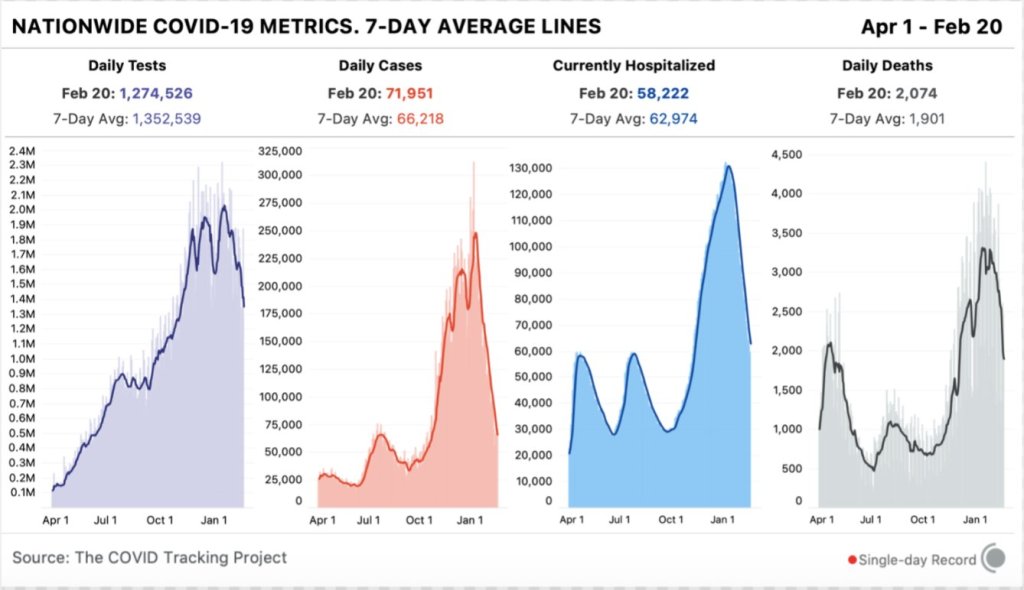
In the past week (February 14 through 20), the U.S. reported about 464,000 new cases, according to the COVID Tracking Project. This amounts to:
An average of 66,000 new cases each day
141 total new cases for every 100,000 Americans
1 in 708 Americans getting diagnosed with COVID-19 in the past week
About two-fifths of the new cases reported in the week of January 23
Nationwide COVID-19 metrics published in the COVID Tracking Project’s daily update on February 20. Hospitalizations are now dropping below the spring and summer peaks.
Last week, America also saw:
58,200 people now hospitalized with COVID-19 (18 for every 100,000 people)
13,300 new COVID-19 deaths (4.1 for every 100,000 people)
An average of 1.49 million vaccinations per day (per Bloomberg)
The number of COVID-19 patients in U.S. hospitals is now the lowest it’s been since early November. About 7,000 new patients were admitted each day this week—while this is still a huge number, it’s a notable drop from the peak (18,000 per day) we saw earlier in the winter.
I got those new hospital admission numbers from the COVID Data Tracker Weekly Review, a new report that the CDC recently started publishing in conjunction with its COVID-19 dashboard. It’s kind-of like a longer, more numbers-heavy, less snarky version of this newsletter segment.
The Weekly Review this past Friday also highlighted the progression of coronavirus variants in the U.S. We’ve now detected over 1,500 cases of B.1.1.7 (the variant originating in the U.K.), as well as 21 cases of B.1.351 (originated in South Africa) and 5 cases of P.1 (originated in Brazil). While sequencing efforts have increased significantly in the past few weeks, these numbers are likely still massive undercounts. The CDC encourages Americans to “stop variants by stopping the spread.” In other words, all the behaviors we’ve been using to keep ourselves and our communities safe from spreading the virus will also help reduce its opportunities to mutate.
One more piece of good news from this week’s COVID-19 data: vaccinations may already be having an impact in nursing homes and other long-term facilities. The share of deaths occurring in these facilities dropped under 20% this week, for the first time since the COVID Tracking Project started collecting these data.
The pace of vaccinations was slowed this week thanks to winter storms across the South and Midwest. But this news from LTC facilities is a hopeful note of how elderly Americans may be more protected in the weeks to come.
COVID-19 Federal Datasets webinar: This past week, the health data research organization CareSet hosted a webinar walking the audience through the HHS’s Community Profile Reports and other facets of federal COVID-19 data reporting. The session featured Kevin Duvall from HHS and Amy Gleason from the U.S. Digital Services. If you use (or are interested in using) the Community Profile Reports, I highly recommend watching the recording; Duvall and Gleason provided great context on how the HHS stepped up its data collection this year.
Subnational COVID-19 vaccination data: Barcelona-based data scientist Lucas Rodés-Guirao has compiled vaccination data at subnational levels (or, states and regions) for 20 different countries. The dataset includes the U.S. as well nations in Europe and South America; it’s sourced from public data released by national public health agencies.
Anti-Asian Hate Incidents: Stop AAPI Hate, a national coalition documenting anti-Asian hate and discrimination during the COVID-19 pandemic, has released a new report with data on 2020 incidents. According to the report, Stop AAPI Hate has received 2,800 firsthand accounts of anti-Asian hate from 47 states and D.C. since the organization started collecting reports in mid-March.
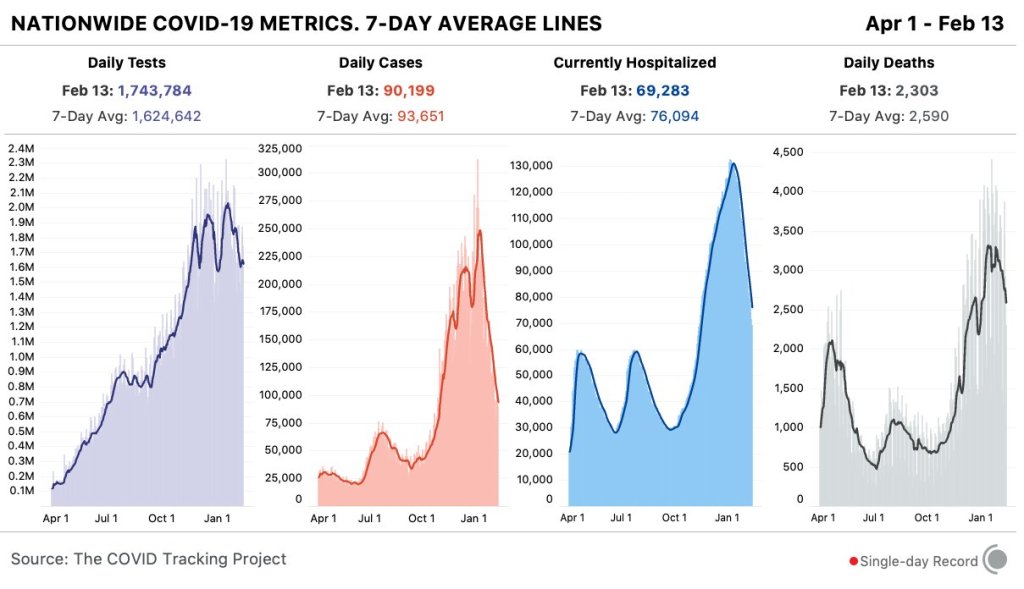
In the past week (February 7 through 13), the U.S. reported about 656,000 new cases, according to the COVID Tracking Project. This amounts to:
An average of 94,000 new cases each day
200 total new cases for every 100,000 Americans
1 in 501 Americans getting diagnosed with COVID-19 in the past week
The 7-day average for new cases was under 100,000 this week for the first time since October—but it’s still far above the records that America set during our spring and summer surges.
Nationwide COVID-19 metrics published in the COVID Tracking Project’s daily update on February 13. Cases, deaths, and hospitalizations are continuing to decline.
Last week, America also saw:
69,300 people now hospitalized with COVID-19 (21 for every 100,000 people)
21,800 new COVID-19 deaths (6.6 for every 100,000 people)
An average of 1.64 million vaccinations per day (per Bloomberg)
This past week, fewer Americans died of COVID-19 than any previous week in 2021, according to the COVID Tracking Project. In White House briefings this week, CDC Director Dr. Rochelle Walensky said that it will take a unified effort for us to continue this trend, especially as coronavirus variants pose an increased threat.
Nearly 1,000 cases of the B.1.1.7 variant (which originated in the U.K.) have been reported in the US as of February 11. Though the U.S. has increased our genomic sequencing efforts by about tenfold in the past three weeks, this number is still likely a significant undercount.
“We must continue to take action,” Dr. Walensky said on Wednesday—stressing the importance of wearing masks (yes, two masks at once!), physically distancing, and washing your hands.
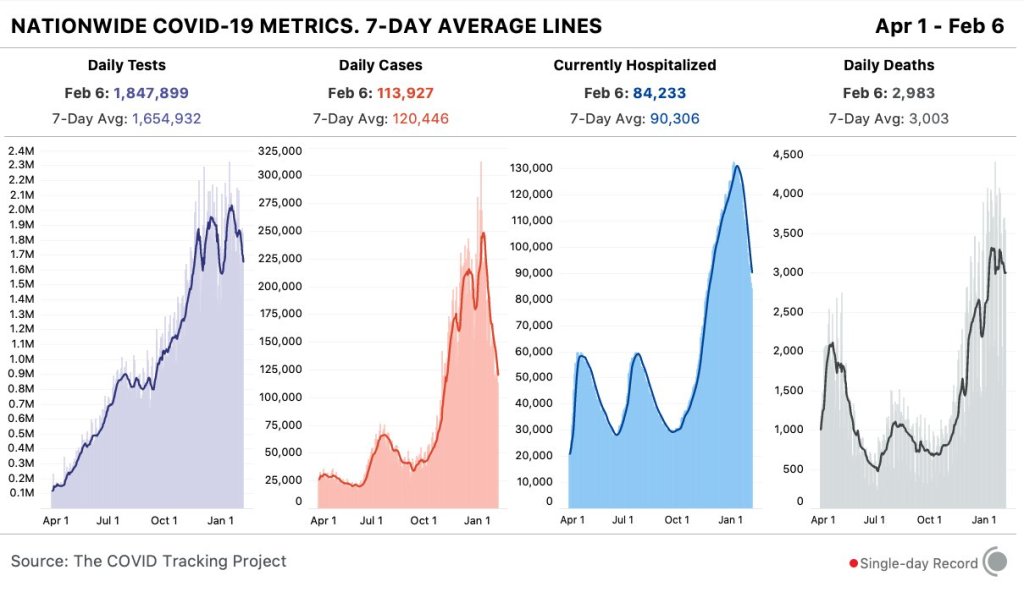
In the past week (February 1 through 6), the U.S. reported about 840,000 new cases, according to the COVID Tracking Project. This amounts to:
An average of 120,000 new cases each day
257 total new cases for every 100,000 Americans
1 in 389 Americans getting diagnosed with COVID-19 in the past week
50% fewer new cases than we reported in the first full week of January
Nationwide COVID-19 metrics published in the COVID Tracking Project’s daily update on February 6. The U.S. reported fewer than 1 million new cases for the first week since Thanksgiving.
Last week, America also saw:
84,200 people now hospitalized with COVID-19 (26 for every 100,000 people)
22,500 new COVID-19 deaths (6.9 for every 100,000 people)
An average of 1.4 million vaccinations per day (per Bloomberg)
This is the first week in which America has reported fewer than 1 million new COVID-19 cases since Thanksgiving. Also, per the COVID Tracking Project, the number of Americans in the hospital with COVID-19 has decreased for 25 days in a row. Bloomberg reported a record 2.1 million vaccine doses yesterday. Whichever metric you look at, the news is good.
CDC Director Rochelle Walensky emphasized the declining rates in White House COVID-19 briefings this week. On Friday, for example, she noted that the number of new COVID-19 patients on February 2 was about 10,500—compared to the peak of 18,000 reported on January 5. Still, 10,000 new admissions was bad news when I reported this number at the end of November.
But, as I keep stressing in these updates, we can’t get too excited about the good news. As of February 4, the U.S. is up to 611 cases of the B.1.1.7 (or UK) variant, 5 cases of the B.1.351 (or South Africa) variant, and 2 cases of the P.1 (or Brazil) variant—and these numbers are likely significant undercounts. For more information on these variants and how they impact vaccination, read Sarah Braner’s post later in the issue.
COVID-19 Neuro Databank: The National Institutes of Health has started a new database to keep track of neurological symptoms associated with COVID-19. The database will be fully anonymized, and it’ll be accessible for scientists who want to better understand neurological complications with the disease. For more information, see this press release from the NIH.
Covid Performance Index: How do different countries rank in their management of the pandemic? This index, from think tank the Lowy Institute, attempts to answer that question by comparing infection rates, death rates, and testing for 98 countries with available data. New Zealand, Vietnam, and Taiwan are at the top of the list; the U.S. ranks #94.
COVAX Global Supply Forecast: Another global data source is this report from COVAX, an initiative from the World Health Organization and Gavi, the Coalition for Epidemic Preparedness. The report provides summaries of the global vaccine supply, including both existing contracts and those under negotiation.
OpenSky COVID-19 Flight Dataset: Martin Strohmeier, a computer scientist at Oxford University, and other collaborators have compiled a dataset of flight data related to the COVID-19 pandemic. According to a blog post published in late December, Strohmeier plans to update the dataset once a month.
The medical journal JAMA released an article written by three CDC officials about opening schools. The conclusion was that it appears that reopening schools safely is possible—but before we turn everyone loose, there are a lot of caveats. And critically, protective measures that need to be taken are not limited to the schools themselves.
When experts say that schools can be reopened safely, it means that so far, schools haven’t been driving community transmission the way other public spaces remaining open have. In a case study comparing 154 students who had been infected with SARS-CoV-2 and 243 who had not, schools posed much less of an infection risk than other social activities. The paper also cited two case studies, one from North Carolina and one from Wisconsin, where cases in general were fairly uncommon, and the vast majority of the recorded cases came from cases acquired from the community, not the schools.
It’s clearly inaccurate to say that COVID-19 simply hasn’t hit schools. Indeed, if it hadn’t, we wouldn’t need our school trackers. And while many US school outbreaks have mostly been small, it’s not impossible a future outbreak could be anything but. The JAMA paper cites an outbreak in Israel where out of 1161 students and 151 staff members tested, 153 and 25 cases were found in students and staff, respectively, within two weeks of reopening. “Crowded classrooms…, exemption from face mask use, and continuous air conditioning that recycled interior air in closed rooms” were cited as contributing to the outbreak. Additionally, school-related activities such as extracurriculars and athletics could also pose a higher risk.
For longtime readers of this newsletter or even for anyone who’s kept up with the news, the path to reopening schools may sound familiar. Measures taken need to include universal mask use, a robust screening program, physical distancing, and hybrid models of education to reduce classroom density (including online options). But, critically, the article also stresses that measures need to be taken in the surrounding community to reduce spread, singling out indoor dining in particular. Indeed, schools are not isolated islands; the health of students returning for school depends on if a community can control the spread. Schools themselves may not be driving much community spread, but if COVID-19 is running uncontrolled in the community, it’s still not going to be safe to hold in-person classes.
While it is exciting that schools reopening may be on the horizon, safe schools are nowhere near promised if governments and administrations aren’t willing to take necessary measures to control community spread. Closing restaurants and gyms is politically unpopular in many places. The economic incentives to keep indoor dining and to open movie theaters are hard to ignore. It may be a choice – open your schools and keep tight restrictions everywhere else, or loosen restrictions on dining and gyms and keep schools online. It’s not an easy choice. But, as the JAMA article points out, “Committing today to policies that prevent SARS-CoV-2 transmission in communities and in schools will help ensure the future social and academic welfare of all students and their education.”
Two days after the JAMA article was published, NYT columnist David Brooks published a column decrying teachers unions and insisting that schools reopen, citing financial concerns for students in the future and current mental health problems. He pointed out that typically, white students have had greater access to in-person learning than black and brown students, going on to say: “I guess I would ask you, do Black lives matter to you only when they serve your political purpose? If not, shouldn’t we all be marching to get Black and brown children back safely into schools right now?”
The response was swift, with many pointing out that the pandemic has disproportionately affected black and brown communities in terms of infection and death rates, and that they are more likely to live in underfunded communities where it might be a lot harder to keep students and staff safe. and that teachers maybe shouldn’t be blamed for not wanting to go back to work when there is still uncontrolled spread across the country. This Twitter thread sums up a lot of the backlash.
We do know that black and brown children have been disproportionately affected by the pandemic; Hispanic/Latino and Black children account for 38.2% of cases in their age group while Hispanic/Latino and Black people account for only 31.4% of Americans. If schools do reopen in person, it’s clear that actions need to be taken to address structural inequity that would prevent them from doing so safely.
On November 18, New York City mayor Bill de Blasio announced that the city’s schools would close until further notice. The NYC schools discrepancy is indicative of an American education system that is still not collecting adequate data on how COVID-19 is impacting classrooms—much less using these data in a consistent manner.
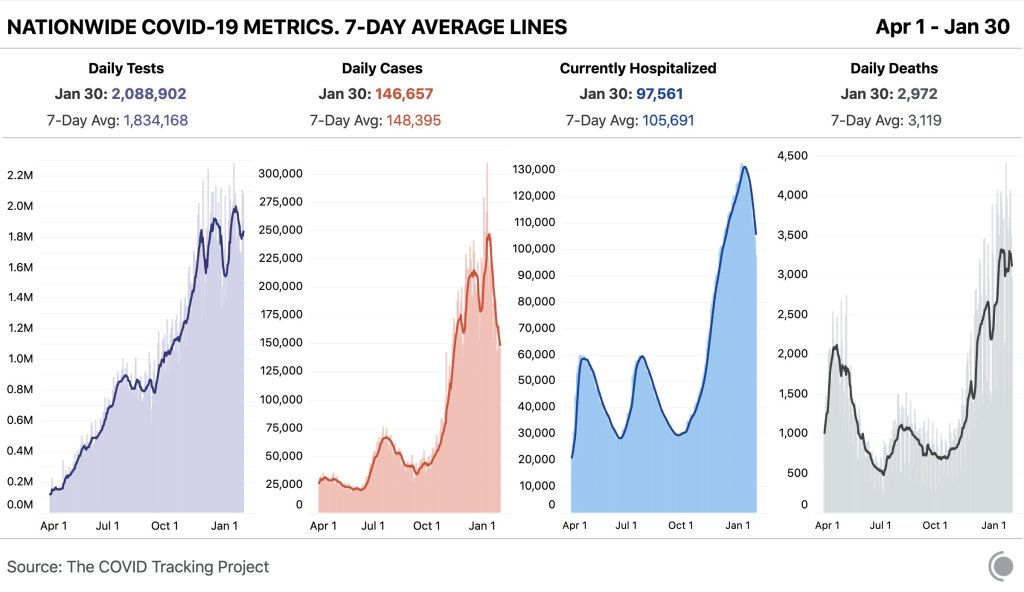
In the past week (January 24 through 31), the U.S. reported about 1.0 million new cases, according to the COVID Tracking Project. This amounts to:
An average of 148,000 new cases each day
317 total new cases for every 100,000 Americans
1 in 316 Americans getting diagnosed with COVID-19 in the past week
38% fewer new cases than we reported three weeks ago
Nationwide COVID-19 metrics published in the COVID Tracking Project’s daily update on January 30. Current hospitalizations are under 100,000 for the first time in almost two months.
Last week, America also saw:
97,600 people now hospitalized with COVID-19 (30 for every 100,000 people)
21,800 new COVID-19 deaths (6.7 for every 100,000 people)
An average of 1.35 million vaccinations per day (according to Bloomberg)
The number of patients hospitalized with COVID-19 is under 100,000 for the first time since December 1. Still, this current number is about 60% higher than the peak number of patients hospitalized during either of the U.S.’s previous surges last spring and summer (60,000).
While new COVID-19 cases and hospitalizations continue to slow, continuing the trend from last week, new SARS-CoV-2 variants continue to give experts cause for concern. South Carolina’s public health department identified two cases of the B 1.351 variant first reported in South Africa; this variant is known to be more contagious and less susceptible to vaccines. Meanwhile, the B.1.1.7 variant (first reported in the U.K.) continues to spread—CDC officials are concerned that it could be the dominant strain here by the spring.
And New York—which has already reported 42 B.1.1.7 cases—is planning to open indoor dining in February. I’m no public health expert, but I plan to be ordering takeout for a long time yet.
In the past week (January 17 through 23), the U.S. reported about 1.2 million new cases, according to the COVID Tracking Project. This amounts to:
An average of 173,000 new cases each day
370 total new cases for every 100,000 Americans
1 in 270 Americans getting diagnosed with COVID-19 in the past week
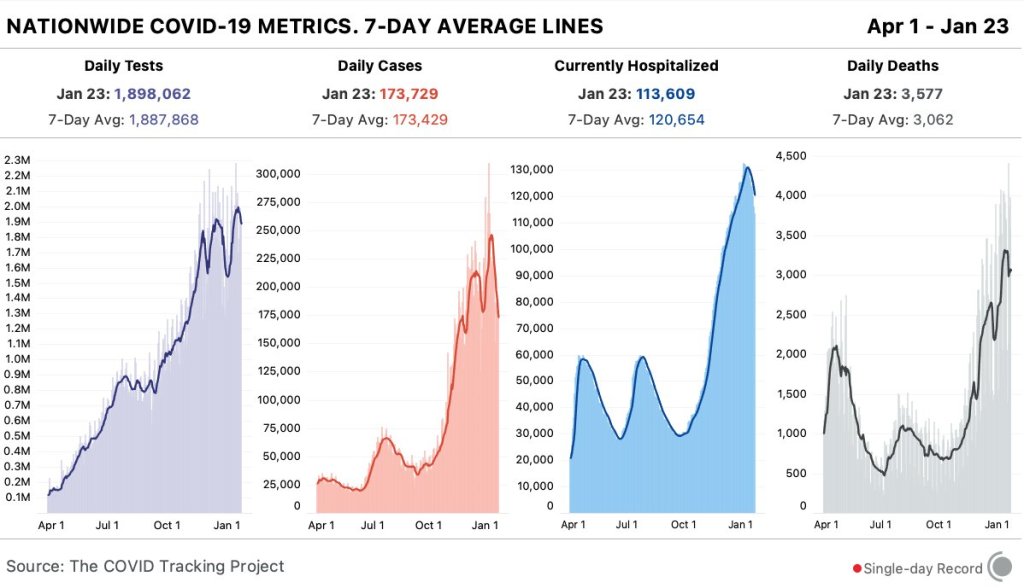
Nationwide COVID-19 metrics published in the COVID Tracking Project’s daily update on January 23. New daily cases and current hospitalizations are steadily dropping, but deaths are still over 3,000 each day.
Last week, America also saw:
113,600 people now hospitalized with COVID-19 (35 for every 100,000 people)
21,400 new COVID-19 deaths (6.5 for every 100,000 people)
Two major metrics, new cases and current hospitalizations, are down for the second week in a row. (See the numbers trending down on the COVID Tracking Project chart, above.) The number of new cases reported this week is the lowest it’s been since Thanksgiving. And, while well over 100,000 Americans are in the hospital with COVID-19, we are seeing about 17,000 fewer patients nationwide than we did two weeks ago.
A decline in COVID-19 cases sweeping the nation, backed by concurrent declines in COVID-19 hospitalizations. We may already be beyond the peak of this virus. https://t.co/vtUWyKSVTz
6-month consequences of COVID-19 in patients discharged from hospital (Huang et al., The Lancet): I don’t usually feature scientific papers here, but this new study is important. It’s the biggest paper so far on COVID-19 long haulers, those patients who struggle with the disease for months after their diagnosis (or after not getting a diagnosis at all). This study followed about 1,700 patients over 6 months.
Global.health COVID-19 dataset: Global.health describes itself as a “global data repository and visualization platform that enables open access to real-time epidemiological anonymized line list data.” Its COVID-19 dataset—which promises information on 5 million anonymized cases—is not yet published, but is definitely a source to look out for.
COVID-19 survey of Medicare beneficiaries: This week, the Centers for Medicare & Medicaid Services published results of a survey of Medicare beneficiaries, focused on their experiences with COVID-19. The data include American seniors’ perceptions of vaccines, perceptions of COVID-19 safety, care experiences, and more.
In the past week (January 10 through 16), the U.S. reported about 1.5 million new cases, according to the COVID Tracking Project. This amounts to:
An average of 220,000 new cases each day
469 total new cases for every 100,000 Americans
1 in 213 Americans getting diagnosed with COVID-19 in the past week
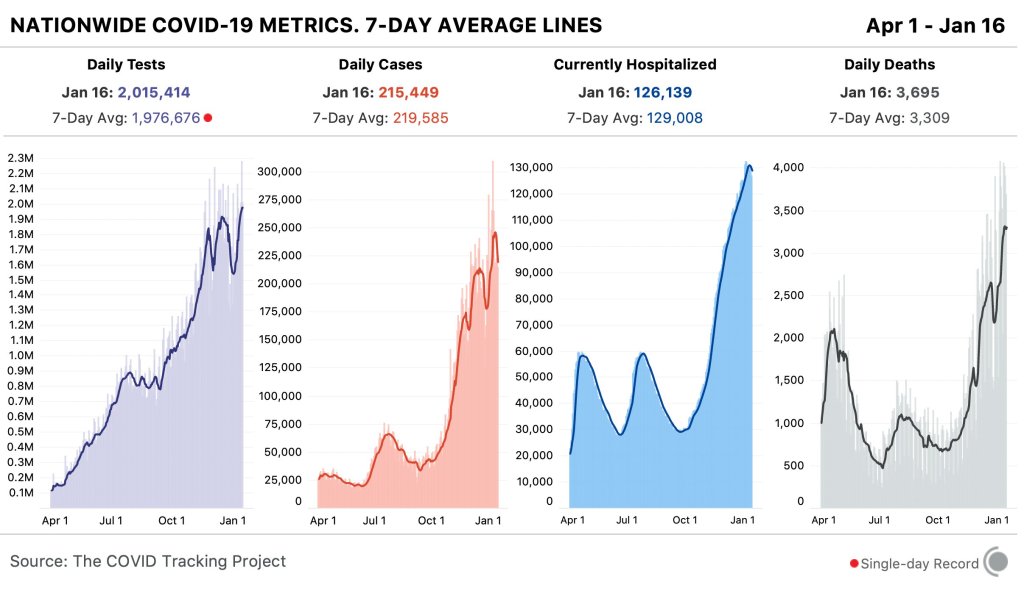
Nationwide COVID-19 metrics published in the COVID Tracking Project’s daily update on January 16. Hospitalizations appear to be leveling off, but deaths are still over 3,000 eachday.
Last week, America also saw:
126,000 people now hospitalized with COVID-19 (38 for every 100,000 people)
23,200 new COVID-19 deaths (7.1 for every 100,000 people)
Two weeks out from New Years (and the subsequent reporting weirdness), cases seem to be stabilizing, somewhat. But “stabilizing,” at this point in the pandemic, still means ridiculous numbers. 220,000 new cases each day! That’s like the population of Baton Rouge, Louisiana getting diagnosed with COVID-19 every day.
Meanwhile, COVID-19 deaths are at their highest point in the pandemic, averaging 3,300 deaths per day.
One positive note in this week’s numbers is that hospitalizations appear to be leveling off. But, as the COVID Tracking Project’s weekly update points out, the hospitalization picture is far different across different parts of the country. And with the more contagious B.1.1.7 variant getting detected in more and more states, the worst point of the pandemic for the U.S. may be still to come.

 COVID-19 Data Dispatch