Category: Source spotlight

  • COVID source callout: The Morning

    Many COVID-19 experts have developed a growing skepticism about “The Morning,” the flagship daily newsletter from the New York Times. David Leonhardt, who writes this newsletter, has pretty limited expertise in science and health reporting, yet he frequently delivers pandemic “explainers” that mislead readers—often by cherry-picking data or suggesting false consensus among experts.

    This week, one of Leonhardt’s columns was particularly misleading. Titled “COVID and Race,” the newsletter reported that white Americans are now dying of COVID-19 at higher rates than Black, Latino, and Asian Americans.

    But Leonhardt missed one very important factor: age-adjustment. Public health experts frequently adjust morbidity and mortality rates by age in order to account for demographic differences among groups. For COVID-19, this is especially important, because the disease disproportionately impacts older adults—and white Americans generally live longer than people of color because of many other structural health factors.

    In her Your Local Epidemiologist newsletter, Dr. Katelyn Jetelina further explained why age-adjsutment is important and why this “COVID and Race” column is wrong. When you adjust the death rates by age, Black and Latino Americans are, in fact, still more heavily impacted by COVID-19 deaths than white Americans, though the gap is shrinking.

    Leonhardt’s newsletter also failed to discuss how COVID-19 has impacted Native Americans. This population has faced the highest death rates throughout the pandemic, according to the CDC and other sources.

    It’s important to call out this error, I think, because “The Morning” has a huge reach and can be influential in impacting national pandemic conversations. If we ignore the continued health disparities around COVID-19, we will fail to address them.
  • COVID source shout-out: the gasoline index?

    Two weeks ago, I reported that the Yankee Candle Index is once again predicting a major COVID-19 surge; in other words, an influx of online reviewers are complaining that they cannot smell their Yankee Candles. (Remember, loss of smell is a major COVID-19 symptom.)

    Well, this week, the Yankee Candle Index was joined by a new indicator: gasoline. Apparently, there’s a new TikTok trend in which users try to smell gasoline and find that it has no scent. I am not a TikTok user, so I learned about this from Twitter, but I agree with the COVID-19 commentators pointing out that this is likely a symptom of the BA.2/BA.2.12.1 surge.

    If about one in five New Yorkers got these Omicron subvariants within a two-week period, then that’s potentially a lot of people (in NYC, in the Northeast, or even nationwide) who have lost some sense of smell recently.

  • COVID source callout: CDC Community Levels

    COVID source callout: CDC Community Levels

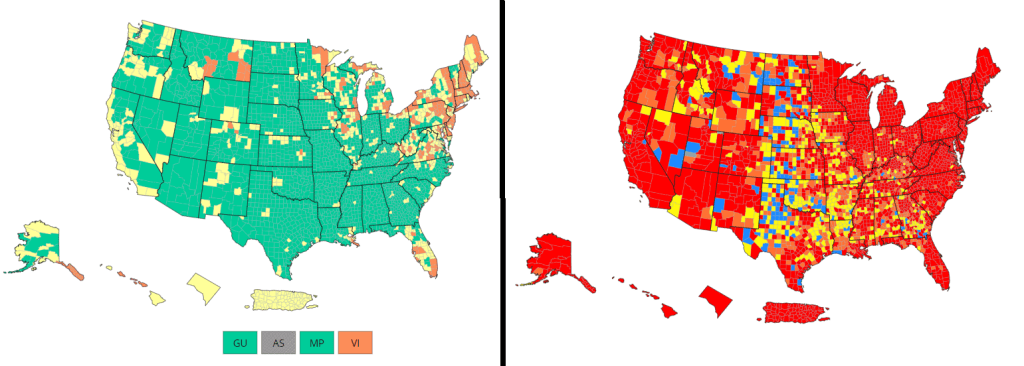
    (Useless) Community Levels on the left; (useful) Community Transmission Levels on the right. Charts via the CDC.

    Anyone who’s been regularly reading the COVID-19 Data Dispatch for the last few weeks can probably tell that I think the CDC’s Community Levels are pretty useless. I was critical of these new metrics when the agency changed its guidance from the old Community Transmission Levels back in February. And during the BA.2 surge, I’ve pointed out how the CDC’s Community Levels map makes it look like the U.S. is doing fine at managing COVID-19 when, in fact, we are doing anything but.

    If you need a refresher, here are a few of the problems with the Community Levels:

    • The guidance overly uses hospitalization metrics; while these metrics (especially hospital admissions) are very reliable in showing COVID-19’s impact on the healthcare system, they lag behind actual infections and completely ignore Long COVID.
    • Hospitalizations are actually a regional metric, not a county-level metric (since plenty of U.S. counties do not have hospitals). As a result, the CDC’s Community Levels calculations are confusing and difficult to replicate in some places.
    • Thresholds in the Community Levels system, already using lagging indicators, are set very high—to the point that, by the time a county reaches the high level, its healthcare system is already in big trouble.
    • The CDC does not recommend universal masking until a county reaches the high level; it only recommends one-way masking for vulnerable people, which we know doesn’t really work, at lower levels.

    Essentially, these Community Levels are so lenient that many state and local leaders have taken the guidance as an excuse to avoid instituting new COVID-19 safety measures during the BA.2 surge. In Philadelphia, business owners even cited the CDC’s lenient guidance when suing the city for instituting a new indoor mask mandate.

    Moreover, as revealed by a recent article in the Tampa Bay Times, it appears that the CDC is not even consistent with its calculations of these Community Levels. The agency labeled three Florida counties as at medium COVID-19 risk, even though they met all the criteria for high risk, due to a data reporting issue from the Florida state health department.

    To quote from the article: “A public health tool isn’t useful if it can be undone by a single data issue, said University of South Florida virologist Michael Teng.”

    Reminder, you can still see the CDC’s old Community Transmission Level guidance (which is somewhat more useful for determining one’s actual COVID-19 risk) on the agency’s COVID-19 data portal. Just click the dropdown menu on the county view tab and select Community Transmission Levels.

  • COVID source shout-out: The Yankee Candle Index

    It is a well-known pattern, at least on COVID-19 Media and Data Twitter, that new national surges of the virus are generally preceded by one nontraditional indicator: an increase in one-star Yankee Candle reviews in which users complain that they can’t smell their candles. Remember, a key COVID-19 symptom is loss of smell.

    Well, I regret to announce that this Yankee Candle Index is once again suggesting that a lot of COVID-19 is circulating in the U.S. right now:

    The Yankee Candle Index last suggested a spike in late December 2021, as Omicron was taking off nationwide. (At the time, I pointed readers to this SFGate article for more information; it’s still a helpful source if you’re unfamiliar with this index.)

  • COVID source callout: “No recent data” at hundreds of sewershed sites

    COVID source callout: “No recent data” at hundreds of sewershed sites

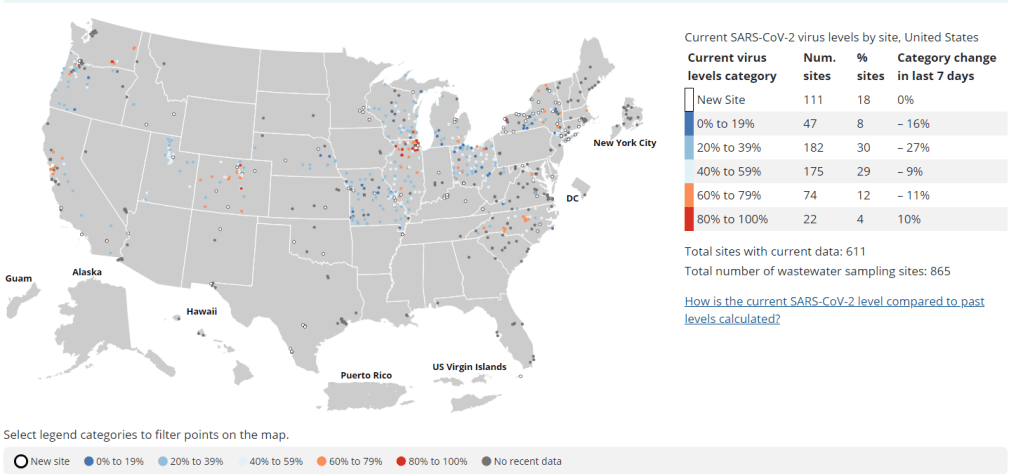
    Screenshot of the CDC’s wastewater dashboard. Note all the gray dots indicating “no recent data.”

    Anyone who’s pulled up the CDC’s National Wastewater Surveillance System (NWSS) dashboard in the last week or two has likely noticed this trend: hundreds of sewershed sites are currently marked as “no recent data.” I keep a particularly close eye on the sites in New York City, which have been reporting “no recent data” for at least two weeks.

    According to the CDC, a site marked as “no recent data” has reported findings from fewer than two wastewater samples in the last 15 days. In practice, it could either indicate that a site actually isn’t sampling its wastewater frequently enough for the CDC’s standards, or it could indicate a lack of capacity to process those samples. Probably, both things are happening at a lot of these sites.

    From corresponding with press officers at NWSS, I know that the team is working with state and local health agencies, as well as with individual sewershed sites, to ensure accurate data and standardize reporting. This is a massive task, considering that wastewater surveillance started as a grassroots effort in labs with many different sampling and analytical methods, and I appreciate the NWSS team’s efforts.

    But I think they could increase transparency about the sites where recent data isn’t available—either on the dashboard itself or in other public communications. I shouldn’t have to hunt through Twitter replies to find the most basic info about wastewater data updates! Especially when this source is becoming increasingly important in the wake of less reliable case data.

  • COVID source shout-out: U.K. Long COVID estimates

    COVID source shout-out: U.K. Long COVID estimates

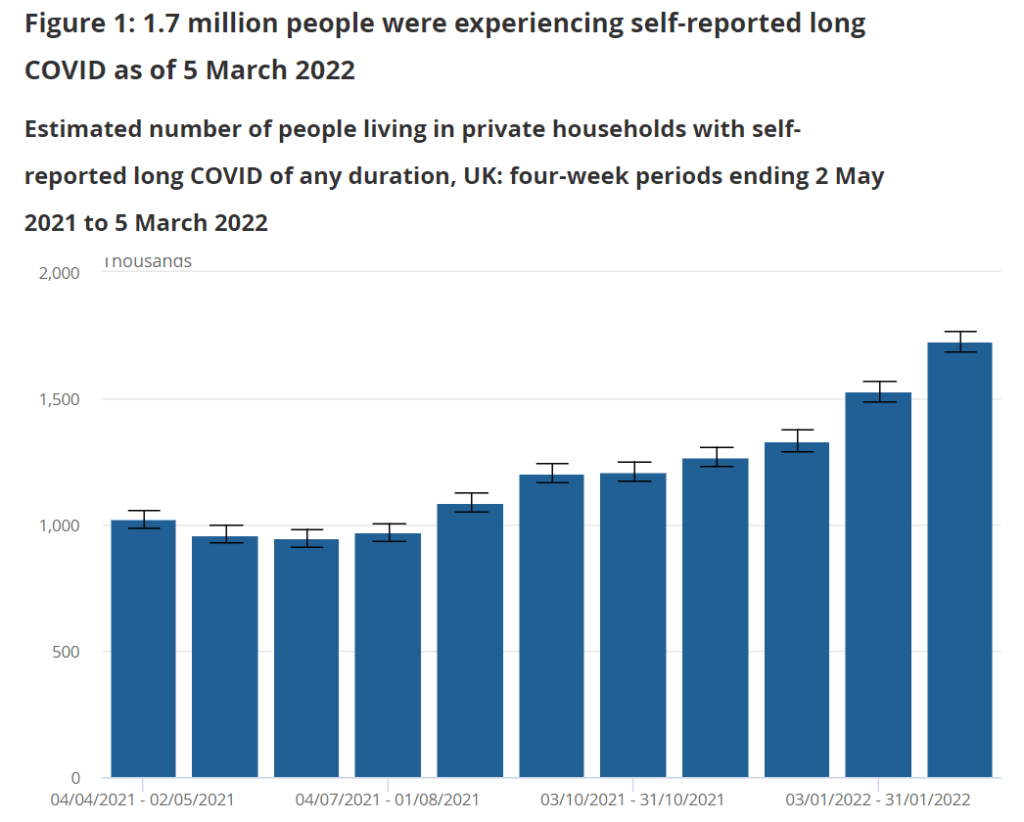
    About 1.7 million people in the U.K. were experiencing self-reported Long COVID as of early March, according to the U.K. Office of National Statistics.

    I spent a lot of time this weekend talking about the U.S.’s lack of Long COVID data, particularly our inability to answer such questions as, “How many Americans have Long COVID?” and, “What is the condition’s demographic breakdown?”

    In comparison, I pointed other journalists to reports from the U.K.’s Office for National Statistics. This office regularly surveys Brits on their Long COVID experiences, asking a representative sample of the population whether they are experiencing any long-term COVID-19 symptoms.

    The most recent report, published in early April, found that about 1.7 million people—or 2.7% of the U.K.—was “experiencing self-reported long COVID” (defined as symptoms persisting for four weeks or more after an initial infection). Imagine what the scale of Long COVID might be in the U.S.

    A new report is coming this week, on May 6.

  • COVID source shout-out: SCAN’s wastewater dashboard

    COVID source shout-out: SCAN’s wastewater dashboard

    For my recent wastewater data story, I’ve been looking at a lot of wastewater surveillance dashboards from different health agencies and research groups.

    One of my favorites is from Sewer Coronavirus Alert Network (SCAN), a project based out of Stanford University. The project started with sewershed sites in California but is now expanding to other parts of the country, I learned from Marlene Wolfe, an environmental scientist at Emory University who works on the project (and whom I interviewed for the story).

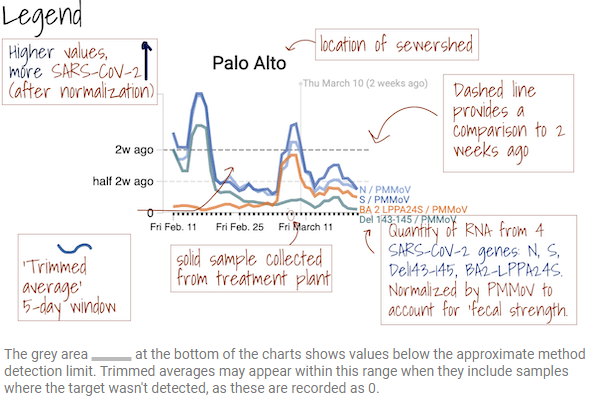
    The SCAN dashboard includes a detailed legend instructing users on how to view wastewater data.

    I like this dashboard because it does a good job of explaining exactly what users are looking at. On the top of the page, you see a legend walking you through the charts that appear below, along with a map showing the regions covered by these sewersheds.

    The charts themselves have built-in context for users seeking to interpret recent trends: you can see how current coronavirus levels compare to levels from two weeks ago. And you have the option to toggle between different timescales: four weeks, six weeks, 12 weeks, six months, a year, and all surveillance since fall 2020. Other parts of the dashboard allow users to look at data that have been smoothed and normalized, showing how interpretations of coronavirus levels in wastewater may change depending on the analysis method.

    In addition to the COVID-19 charts, the SCAN website also includes data on flu and RSV levels at sewershed sites, along with a detailed methodology section. I found this document describing different sources of variability in wastewater data particularly helpful, and linked out to it in my story.

    I hope to see the CDC’s wastewater dashboard one day become this extensive!

  • COVID source shout-out: CDC wastewater dashboard upgrades

    COVID source shout-out: CDC wastewater dashboard upgrades

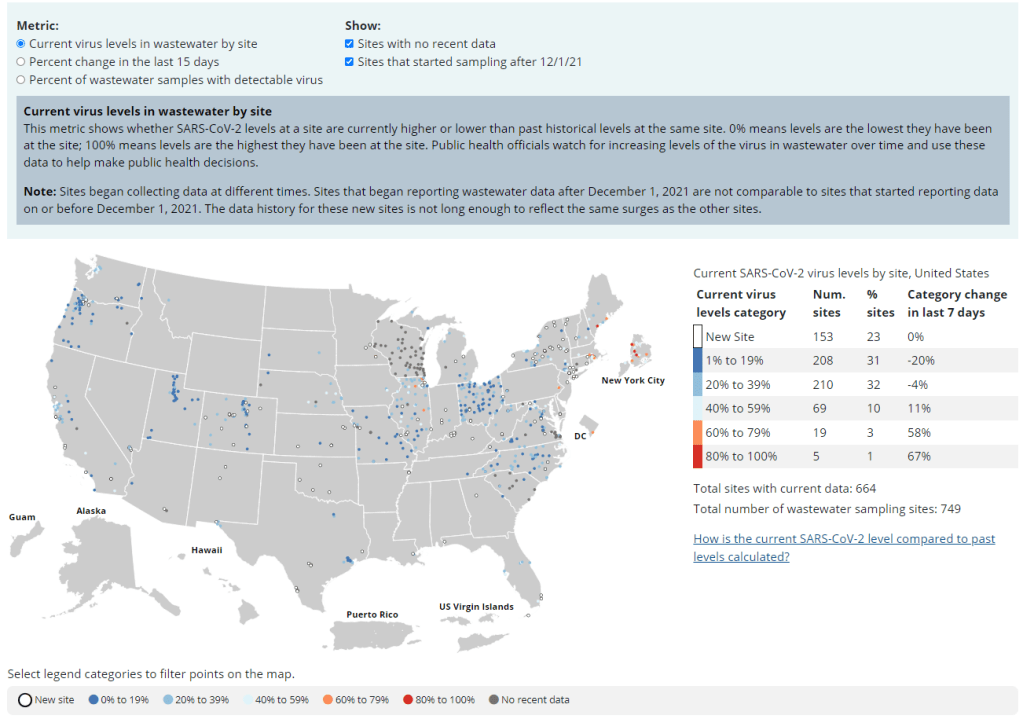
    The CDC’s updated wastewater dashboard includes more metrics and more context for people seeking to understand wastewater trends in their area.

    After the CDC released its National Wastewater Surveillance System (NWSS) dashboard in February, the agency faced some criticism from scientists, data reporters, and others who found this dashboard didn’t actually do a very good job of presenting wastewater data. The initial dashboard only included one metric, percent change in wastewater levels over the last 15 days; without more context, it was difficult to understand where a high percent change was actually cause for concern.

    But the CDC has responded to its criticism! This past Friday, the agency updated its wastewater dashboard to include a lot more context. Among the changes:

    • You can now toggle between three metrics: the old percent change value, along with current virus levels in a site’s wastewater and the share of wastewater samples at a given site that tested positive for the coronavirus in the last 15 days.
    • Clicking on a specific site provides users with a mini-chart of wastewater levels at that collection spot over the last few weeks.
    • The dashboard lets you toggle on and off sites with no recent data and sites that started sampling during the Omicron wave.
    • Above and below the dashboard, the CDC has added more definitions and explanations to help users understand what they’re looking at.

    On Friday evening, I posted on Twitter, asking wastewater and data viz experts to weigh in on the updated dashboard:

    Responses were mostly positive, with researchers saying that they were glad to see the CDC respond to criticism and add more information to the dashboard. Still, there’s more the agency can do, such as adding the population sizes covered by each site and, maybe, moving away from percentage changes as such a central metric.

    To quote Claire Duvallet, data scientist at Biobot: “I think collapsing all three metrics to have the same units, and to choose percentage as that unit, is very confusing. Percentage changes are already so 🤯 to think about, & percentage changes of categories of percentages is just too much for my brain.”

  • COVID source callout: Florida, again

    Last summer, Florida was one of the first states to decommission its daily COVID-19 dashboard and replace it with far-less-detailed weekly reports. Many other states have followed Florida’s lead in the last few months, making their reporting less frequent and cutting down on some metrics like cases and testing.

    But that’s not enough for Florida! The state recently switched from weekly COVID-19 reports to reports every other week—making it even more difficult for reporters, researchers, and others in the state to follow their local COVID-19 trends. Florida additionally stopped reporting cases in non-state residents, which is pretty notable for one of the country’s biggest tourism hotspots.

    Of course, Florida is still reporting some COVID-19 data daily to the federal government, as all states are required to do. But this doesn’t bode well for the future of state data reporting.

  • COVID source shout-out: Cyrus Shahpar

    The Twitter account of White House COVID-19 Data Director Dr. Cyrus Shahpar is, as I’ve said in the CDD before, an excellent source of updates on all things federal pandemic data. Shahpar shares daily updates of new vaccinations in the U.S., usually shortly before the CDC’s tracker updates. He also shares updated variant prevalence estimates, changes and additions to the CDC COVID-19 dashboard, and other data news.

    But this past Wednesday, Shahpar’s account took on a new purpose: tech support for the CDC’s dashboard. 

    Shahpar said he would “look into” an error with the dashboard’s formatting, after journalist Alexander Tin flagged the issue to him. It’s unclear whether Shahpar’s efforts directly led to the dashboard getting fixed, but it was indeed back to its normal appearance by the next morning.