For the last few months, I’ve been working with the Council for the Advancement of Science Writing (CASW) on a new resource website for science journalists and communicators. The site launched this past week, and I’m sharing it here because I think it might be useful for a lot of COVID-19 Data Dispatch readers.
Here’s a bit of info about the new website:
CASW Connector is a curated library of resources on science journalism and communication, including articles, guides, training programs, conferences, fellowships, career advice, and more.
The site aims to bring together resources from organizations, centers, and disciplines from around the internet that all serve the same goal: promoting excellence in communication about science to the public.
CASW Connector is for journalists, scientists, communicators, educators, students, and anyone interested in sharing science with the public. You can search or browse resources handpicked by our team and suggested by our readers, and you can keep tabs on upcoming events and deadlines. You can even submit your own suggestions of events and resources you would like us to include.
Later this summer, CASW Connector will launch a newsletter featuring short articles, announcements and updates; subscribe now to receive the first issues. And later this year we’ll launch a webinar series that is, like Connector itself, devoted to excellence in science writing and communication.
We hope you’ll check Connector out, and share it with friends and colleagues! We welcome any feedback or suggestions you may have; drop us a line at connector@casw.org to tell us what you think!
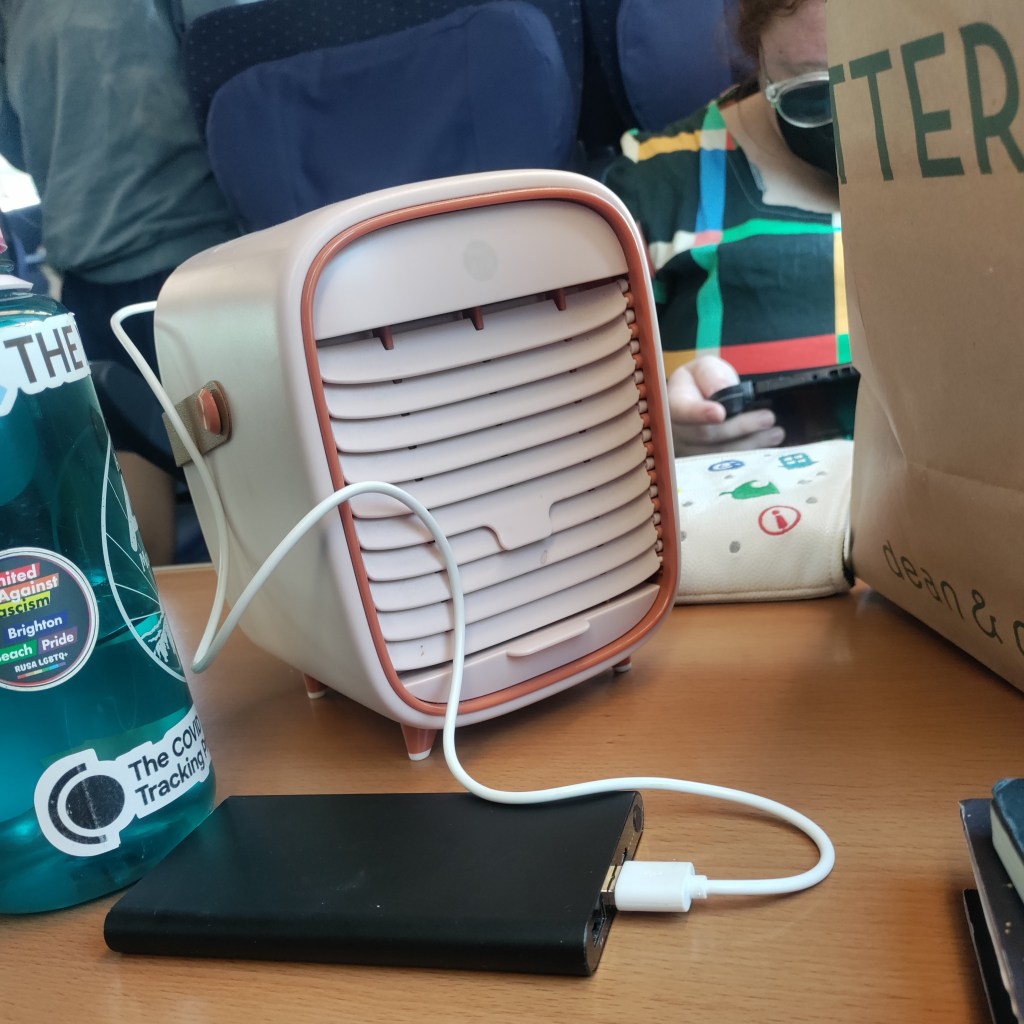
Betsy and her partner’s portable HEPA filter, pictured on the train from Berlin to Brussels. Her partner (in an N95 mask) is visible in the background.
A few days ago, my partner and I returned home from a two-week vacation to several cities in Europe. It was our first time traveling internationally since before the COVID-19 pandemic, and the trip required a lot of time on planes, on public transportation, and in crowded spaces.
I’m sharing what we did to reduce our risk of COVID-19 (and other common pathogens!) during the trip, in the hope that this will be helpful for readers traveling this summer. While taking these sorts of precautions may be increasingly unpopular in many places, these measures still reduce the risk of illness for individual travelers and the people around them.
Here’s what we did:
Reduced potential exposure and tested before we traveled: It’s pretty typical for me to avoid crowds and indoor events prior to traveling. In this case, my partner and I did attend Pride marches in New York City the weekend before our trip, but we only attended outdoor events and wore masks in the crowds to reduce our risk. We also both got PCR tests the day before leaving (we’re lucky to live near one of the few public testing sites in the city that are still open).
Masked indoors, with high-quality masks: I consistently wore N95 masks on the trip, including my reusable respirator on planes. (I wrote more about my respirator in this post last summer.) My partner also wore an N95 or KN95 throughout the trip. We have different preferences for which masks fit us well, so we had a few masks of different brands packed to accommodate that.
Avoided indoor dining (as much as possible): All of our meals were outdoors. My partner is vegan, so any restaurant where we ate had to fit into a Venn diagram of “vegan options” plus “outdoor seating”; this might sound challenging to find, but with a bit of planning—and with thanks to the Happy Cow app—it was actually quite doable. We had to eat briefly on planes at a couple of points, but we minimized that time as much as possible (eg. masking in between bites) and did so only when plane air filtration systems were going.
Took advantage of smoking sections: European cities tend to have a more prominent smoking culture than the U.S., so many restaurants and bars have outdoor smoking sections. This can be a tricky situation for COVID-cautious travelers; yes, you’re outside, but you’re also breathing in a lot of second-hand smoke. Still, my partner and I found these sections to be a helpful option. We even had lunch in an outdoor smoking zone at the Keflavik Airport (in Iceland) during a layover on our way home to NYC.
Used a CO2 monitor to gauge ventilation in some spaces: I am a proud owner of an Aranet CO2 monitor, which I mostly use to track ventilation at my apartment and public spaces in NYC. I brought the monitor on the trip, and used it to identify which public buildings had better air quality. For example, train platforms at Berlin Hauptbahnhof (the city’s central train station) are open to outdoor air and have frequent airflow, as evidenced by a CO2 reading I took of 611 ppm—well within the Aranet monitor’s “green zone.” So, I felt comfortable taking off my mask there for a few minutes to drink coffee.
Used a HEPA filter on trains, hotel rooms: My partner and I have a personal, portable HEPA filter that runs on a battery and fits easily in my duffel bag. I brought it along on the trip and used it a few times, mostly on crowded trains and in hotel rooms that did not have great airflow. It also doubled as an extra fan in our Airbnb in Amsterdam (which was not air-conditioned).
Rapid-tested every two days: Over the two weeks of traveling, my partner and I took a rapid test every two days to check for any developing illness. We also requested testing from friends and family members with whom we spent time indoors, such as a friend whom we stayed with in Berlin.
Testing and symptom monitoring after getting home: Since arriving home in NYC on Wednesday evening, my partner and I have each gotten PCR tests. I also rapid-tested once, as an extra check before attending an event on Thursday. We’re planning to do another round of PCR testing next week and monitor for any symptoms; so far, we haven’t seen any signs of illness.
I acknowledge that these safety measures may sound like a lot of effort. Certainly, tools like rapid tests and a personal HEPA filter cost money, and may not be accessible to many people. And in an ideal world, everyone would be able to travel in a world where these tools are free and commonplace, rather than a reason for extra advanced planning.
There are also increasing social pressures to not take precautions, especially in some of the places that we visited. I had a few conversations with strangers who insisted I was strange for wearing an N95, that COVID-19 was “over”; I was even patted down and pulled into a security screening at the Amsterdam airport by guards who decided my respirator was suspicious.
I am the kind of person who doesn’t back down to this pressure, especially when I have the research and reporting to back up my convictions. But I don’t want to be an isolated person taking precautions in a sea of others who aren’t acting to protect public health.
Broader change is really needed; in the meantime, though, I hope my experience is informative for others. If you are also traveling this summer and you have other tips you’d like to share with the COVID-19 Data Dispatch community, please send them to me! You can email me or comment on this post.
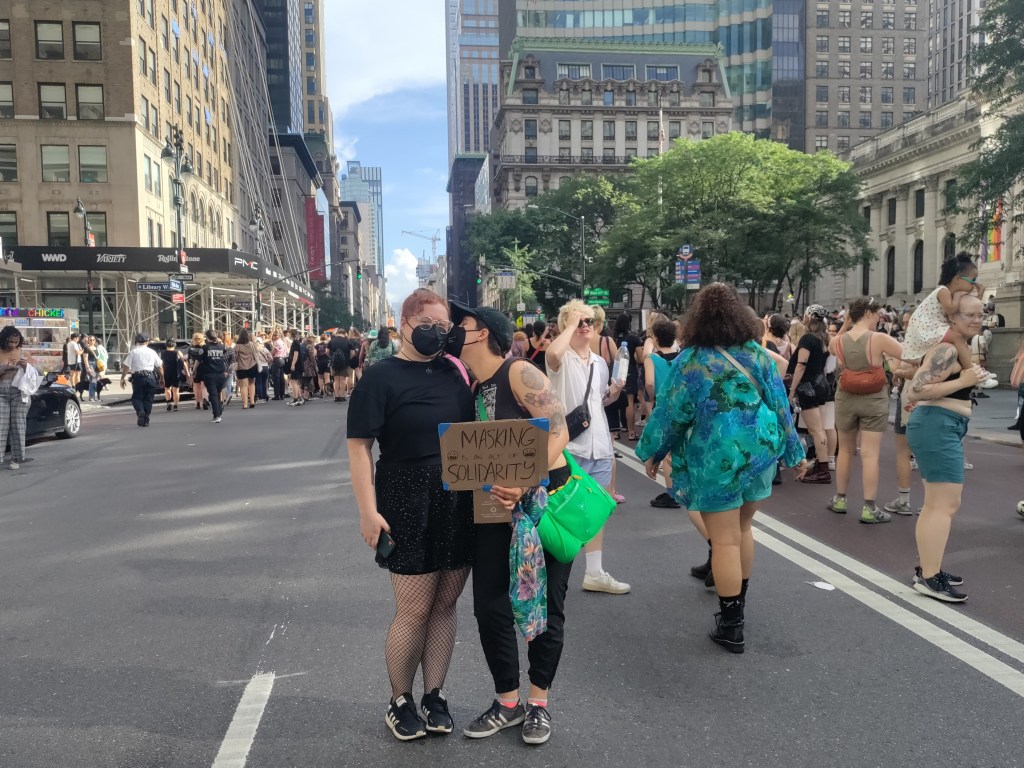
Betsy (center, right) and her partner Laura (left) at the NYC Dyke March, masked up in KN95s.
For years, Pride has been my favorite holiday. I love the crowds, the parties, the marches (not the parades with corporate floats, but the people-led marches), the explosions of anger and joy, the connections with my community.
COVID-era Pride has been more complicated than past years, as we layer safety measures onto the celebration. For me and many others I know in the LGBTQ+ community, Pride has become an opportunity to reflect on the importance of connecting this community and those calling for COVID-19 safety—disabled and immunocompromised people, those with Long COVID, and others at higher risk. This practice can be challenging, as others push for a return to the Pride we knew before the pandemic. But it’s not impossible, especially when we remember our values of inclusion and solidarity.
This year, one of the biggest Pride marches in New York City became emblematic of the tension between safety and a desire to party like it’s 2019. Called Queer Liberation March, this march originated in local organizers’ desires to protest on Pride, honoring the legacy of the original Stonewall protest. (Official NYC Pride, also called “Corporate Pride” by many, has become sanitized over time, to the point that you’re more likely to see corporate floats and politicians than community leaders.) So, Queer Liberation March offers an alternative; I’ve attended it since the first iteration in 2019, which commemorated 50 years since Stonewall.
A few weeks ago, Queer Liberation March garnered negative attention on social media due to an apparent disregard for COVID-19 safety. When a commenter on the march’s Instagram asked whether masks would be required at the march, an organizer with access to that Instagram account responded with a tirade dismissing the idea of any mask requirement, even suggesting that people who wanted to mask would not be welcome at the march. Obviously, many LGBTQ+ New Yorkers pushed back, expressing anger and disappointment that a Pride protest would exclude our community’s higher-risk members.
The march’s organizers listened and deliberated. Queer Liberation March has not had explicit COVID-19 safety protocols in 2020, 2021, or 2022, though the march partnered with local health organizations to offer easy vaccine access for people at Pride. (This year, organizations are offering sexual health resources, such as HIV testing and mpox vaccines.) But the community response suggested that, this year, the march had to do more to prioritize COVID-19 safety.
I actually reached out myself to Queer Liberation March’s organizers; I wasn’t acting as a journalist, but as a member of the Rude Mechanical Orchestra, a band that plays regularly at marches and rallies around the city, including past iterations of this march. Through conversations with a couple of the organizers, I shared resources on COVID-19 safety and walked through how my band approaches this topic. (You can read more about that on our website, though note that our data protocols are due for an update, and in this Science News article I wrote in 2021.)
Eventually, Queer Liberation March announced a safety policy. The march recommends that attendees mask up, along with testing before and after the event. Organizers are also coordinating mask-required sections at the front and back of the march, which will be protected by marshals equipped with extra masks to hand out. This policy is far from perfect; the “masking section” strategy in particular has garnered some criticism for essentially segregating higher-risk marchers from those who see COVID-19 safety as less of a priority.
Though it’s not perfect, I was personally glad to see these safety steps at one of NYC’s biggest Pride events. Another large march, the Dyke March (which took place yesterday), adopted similar strategies. When my partner and I attended the Dyke March, we masked up in KN95s and saw quite a few other attendees doing the same. One marshall offered to direct us to that march’s mask-required section. I also saw marshalls pushing wheelchairs for marchers who weren’t able to walk the full 40 blocks—another important step towards accessibility.
The Queer Liberation March is happening this afternoon. Around the time you read this post, I’ll probably be at the starting point, lining up with my band. So I can’t say yet how successful their COVID-19 safety policies will be. But I still wanted to highlight this march as an example, to show that 2023 is not too late to change course and adopt some safety measures. If NYC’s biggest (non-corporate) Pride marches can do it, no other organizers should have an excuse not to.
Solidarity is a wide tent. Pride is for all LGBTQ+ people, including those who are disabled, chronically ill, or simply can’t afford to miss work for two weeks. If a Pride event doesn’t include these groups, it isn’t a true Pride event. And inclusion is easier than you think. Many people will test if you ask them, or will mask for a few hours if you ask them—especially if you explain why it’s important, using the terms of their community: “We keep us safe.”
It’s pretty clear, at this point, that the U.S.’s political leaders would like for us all to pretend that the pandemic is over. President Biden says he doesn’t think about it (even though everyone in his orbit is still PCR-tested regularly), Congress hasn’t passed any new COVID-19 funding since spring 2021 (but sends billions to the military), state and local governments end their final mask mandates (yes, the ones in healthcare settings), and so on.
And the mainstream media—tasked with holding these powerful people accountable—has let them do it. Most news outlets these days barely want to include the word “COVID-19” in their headlines, let alone give you an honest picture of the risks that this disease still poses. Many individual journalists are doing their best to get the important news out, but they have to push back against shrinking editorial budgets, colleagues who spread misinformation, weariness from sources, and other structural barriers.
Personally, as a freelancer still covering this topic, I would love to write about only COVID-19, all the time. But in order to keep working, I’ve had to branch out. Even when I write COVID-related stories, these days, the headlines often aren’t directly about the coronavirus; they focus on broader issues like health surveillance or chronic disease that are easier to give broader appeal (or at least, what my editors see as broader appeal).
I’m eternally grateful to have the COVID-19 Data Dispatch and its community of readers, as a place where I can keep prioritizing this topic and sharing my honest perspectives, rather than watering them down for more mainstream outlets. But this is a pretty small fish in the sea of media coverage—I know my work only goes so far.
So, I was really glad to see an excellent article in Neiman Lab this week that captures exactly how mainstream media has failed on covering COVID-19 over the last two years. Climate journalist Kendra Pierre-Louis explains that yes, COVID-19 is still a major health threat, and publications have failed their duty to the public by largely ignoring it.
I highly recommend reading the full story, but here’s one section that exemplifies Pierre-Louis’ argument:
Outlets like The New Yorker, The Washington Post, and NPR, to name just a few, have amplified voices and arguments that helped create a narrative that not only pathologizes those who remain cautious about the disease, but also fails to adequately convey the risks associated with Covid such that many people are unwittingly taking on potentially lifelong risks.
In the process, we’ve failed at our field’s core tenets — to hold power to account and to follow the evidence. Our failures here could last a generation. As reporters, it’s our responsibility to accurately represent the needs of diverse perspectives and avoid an ableist bias that diminishes the real and lasting health concerns not only of those who are keenly at risk but those who are cautious about repeatedly catching a virus that scientists are still grappling to understand.
I hope this article inspires some reflection among other journalists, if not some real changes in editorial priorities.
The Open Notebook has launched a new community program, called the Covering Science Slack, which could be a great opportunity for some journalist readers of the COVID-19 Data Dispatch. In this Slack server, general assignment and local journalists who are interested in improving their science reporting skills engage in discussions with experienced science journalists, who serve as mentors.
After a 12-week pilot program in 2022, the Covering Science Slack is now expanding: applications are open for a new cohort to join the Slack community. This iteration of the program has funding for regular discussions and activities through at least September 2023, and it’s free for participants.
Here’s how TON describes the program in their call for applications:
This community includes local and general-assignment reporters and editors, as well as a smaller number of experienced science journalists who serve as mentors within the group. Members are invited to seek (and offer) advice on any topic related to covering science, such as how to exchange ideas on topics such as finding suitable expert sources, refining story angles, evaluating scientific studies and claims, making sense of new findings and their implications, and more. Members can also participate in various types of learning opportunities and activities, including one-on-one peer mentoring, guided Slack discussions, reading groups, webinars centered on core challenges of covering science, and informal virtual gatherings.
With support from the Burroughs Wellcome Fund, we are now accepting applications for new members. The program will run at least through September, 2023, and we hope to establish the program as a sustainable, continuously running community.
I know a lot of COVID-19 Data Dispatch readers are local or general-assignment journalists; if you fit into this category, please consider applying to join the Slack server! It’s a great opportunity to learn more about science reporting in an informal setting, with a relatively low time commitment. Also, I’m now one of the mentors in the server, if that’s a draw for anyone.
Transparency note: This is not a paid advertisement or anything in that capacity, though I have written for The Open Notebook in the past (including a collaborative project between TON and the CDD). I’m just sharing this because I think it’s a valuable opportunity and would love for readers to take advantage of it.
Last week, in response to my call for donations to the COVID-19 Data Dispatch, I received some very generous support from readers. Thank you to everyone who donated—you are truly helping me keep this a free, accessible publication for anyone following COVID-19 news.
Following up on last week’s post, I wanted to share some suggestions for other COVID-related organizations that are taking donations this holiday season. If you have the resources and are looking for places to donate, please consider these nonprofits!
Body Politic, which runs one of the foremost Long COVID online support groups, is seeking donations to transition from a grassroots, all-volunteer organization to a format that’s more sustainable in the long-term. Their funding goal is $500,000.
The COVID-19 Longhauler Advocacy Project seeks donations to support its work advancing Long COVID research and supporting patients. Like Body Politic, this organization was founded by volunteers themselves dealing with Long COVID.
Marked by COVID is a nonprofit advocacy organization, also volunteer-run, seeking recognition of the Americans who lost their lives to COVID-19 and improved public health policies in the U.S.
Peste Magazine is a new online magazine focused on health journalism, advocacy, and the arts. The publication’s work so far has focused on COVID-19 but also includes other health justice topics; donations help to support payments for writers.
ME Action is a leading advocacy organization for people with myalgic encephalomyelitis/chronic fatigue syndrome (ME/CFS), a chronic condition that shares many symptoms with (and is often co-diagnosed with) Long COVID. Since the pandemic started, it’s also been involved with Long COVID advocacy.
Solve ME/CFS is another advocacy organization for ME/CFS and now Long COVID, focused particularly on funding and supporting research on these conditions.
Dysautonomia International is a leading advocacy group for dysautonomia, an umbrella term for conditions involving a malfunctioning autonomic nervous system. Similar to ME/CFS, dysautonomia is often a co-diagnosis for Long COVID.
Your local mutual aid group: Early in the pandemic, hundreds of mutual aid groups started across the country to help share food and other supplies with people in need. Some of them are still doing this important work! Websites like Mutual Aid Hub and this NYC directory can help you find a group in your area.
Disclaimer: This is not sponsored content, these recommendations come from my own research and reporting on COVID-19. If you’d like to recommend another organization, let me know and I’ll include it in a future issue.
This week, you’ve probably been inundated with shopping deals and donation requests from every business that has you on its email list. ‘Tis the season to ask for money, after all.
But how many of those asks are from a one-reporter operation delivering crucial COVID-19 news and resources?
I often hear from readers that the COVID-19 Data Dispatch is their favorite source for pandemic news, or even their only source for pandemic news. This is something that flatters and terrifies me—like, I cannot stress enough that I am not a health professional, and I should not be taking the place of an actual public health institution. I am simply a science and health journalist who cares very much and works very hard.
That said, our actual health institutions (like our media, our political leaders, and so many other institutions) continue to pretend COVID-19 is no longer a problem—leaving people like me to pick up their slack.
So, if you have found this newsletter, this blog, or any of my other COVID-related writing and analysis valuable: please consider donating to support my work. You can either make a monthly donation with Pico or a one-time donation with Ko-fi.
This support helps to cover my website and other tech costs (detailed here), as well as the occasional article from a guest contributor. It also helps support my time, as I work on this project largely during my evenings and weekends.
Even small donations go a long way. And if you’re not able to support the COVID-19 Data Dispatch financially right now, your regular readership still means a lot. Thank you!
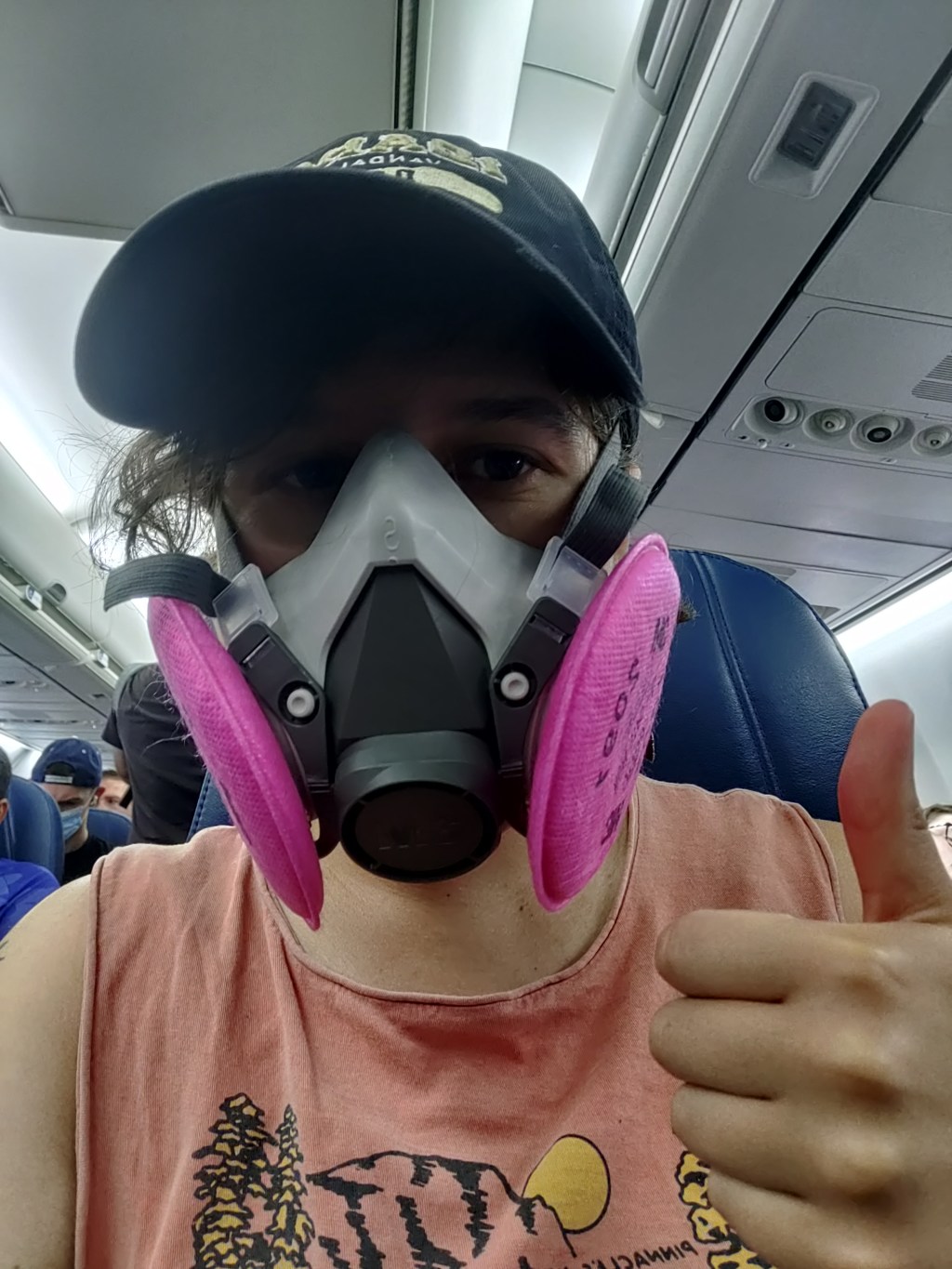
The author in a 3M respirator (with P100 filters), on the plane to Denver, Colorado.
This weekend, I traveled to Denver, Colorado for the final trip in an early-career fellowship which has covered some travel and trainings for me this past year.
Of course, going anywhere on a plane right now, during an intense COVID-19 surge, is not something I’d normally choose to do. This is basically my one plane trip of the summer; all my other travel has been by train and/or car. (And the fellowship event itself had some safety measures in place, eg. required masks and rapid tests.)
But I know a lot of people are traveling by plane right now—I know, because I saw so many of them at JFK Airport. So, I wanted to share a few things I did on this trip to reduce my risk.
First: I bought a respirator. These devices, considered to be a step above N95s/KN95s, are intended for use in occupational settings, such as for workers in chemical plants or firefighters going into smoke. You can read more about them on this CDC NIOSH (National Institute for Occupational Safety and Health) page.
I think of mine like a reusable N95 mask, with great longevity and an excellent seal to my face. I ordered one from 3M, which has several NIOSH-approved options. I also learned more about different respirators at Patient Knowhow, a site with reviews of a few major N95-equivalent options. (I recently talked to the site’s founder, Devabhaktuni Srikrishna, for an upcoming article on ventilation.)
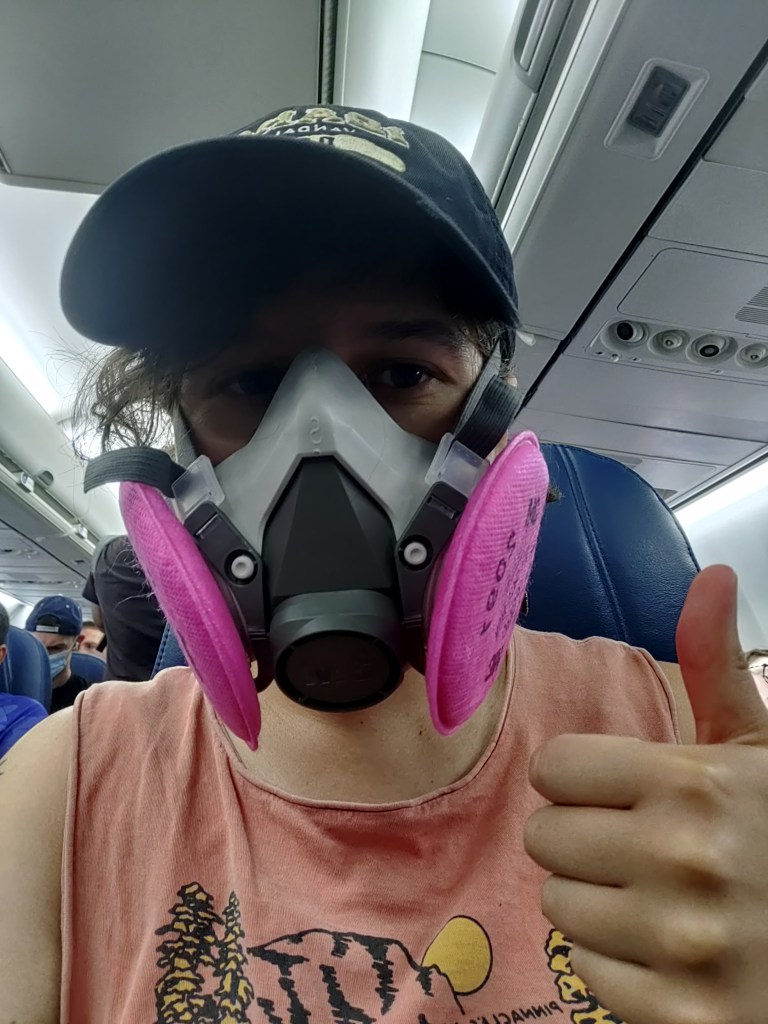
plane trip with respirator was a success! TSA asked me to take it off when I went through security (so I put on a disposable mask for a few minutes), but otherwise I had no issues. pic.twitter.com/SDUA4slIQY
It’s important to note that, if you get one of these respirators, you may need to order air filters separately. I got P100 filters, which are the highest grade. Another add-on may be an exhalation valve filter, which cleans the air you exhale out of your respirator (basically, further ensuring that you aren’t getting other people sick as you wear it).
Now, one challenge with these respirators is that they may freak people out a little. I feel like a bug-eyed sci-fi villain with mine on; though I’m well-accustomed to NYC’s blase attitude towards weird behavior, so I don’t mind if I freak people out. For others, this could be a greater concern.
Respirators also aren’t common mask options yet, though they seem to be growing more popular—my Twitter selfie of me in my respirator on the plane got over 200 likes. But they aren’t yet well-known in transit settings. While I personally didn’t have issues (other than a bit of confusion at JFK’s security screening), I know that others have been told to take these off on flights. It’s good to have a backup N95/KN95 in case that happens.
Second: I follow guidance from ventilation experts. If you’d like to read about how plane ventilation works, masking options, and other small ways to improve travel safety, you can find a lot of this advice on Twitter. “Ventilation Twitter,” as I recently described it to a journalist friend, is generally very welcoming and willing to triage questions.
One key piece of advice: while I kept my respirator on throughout my flights (seriously, the briefest breaks possible for water and food), I made especially sure to stay masked while planes were at the gate or landing. These are the points in a flight when the plane’s ventilation system isn’t switched on, making masking more important.
Saahil Desai provides a helpful explanation of these priority periods for masking in a recent Atlantic article. Though I’d like to note, some experts have suggested that the article downplays the importance of masking as much as you can throughout a flight and using other safety strategies as well.
More helpful threads on this subject…
Top 10 tips everyone should know about wearing #N95 & #elastomeric masks.
Third: I avoid indoor dining as much as possible. This is, of course, one of the highest-risk settings for catching the coronavirus, because you have to take your mask off to eat or drink—while others nearby are also unmasking to eat or drink.
Sometimes, one can be put into tricky situations when there are truly no outdoor dining options (such as on a long airplane trip). But even in that scenario, there are ways to reduce risk. For example, when I needed to eat breakfast at JFK Airport, I found a corner of an unused gate where I could be relatively far from other people, rather than sitting in a crowded food court area.
I also appreciated that the other fellows in my group followed my recommendation for an outdoor dinner on Thursday evening, before our official activities started!
And finally: lots of testing. Remember, rapid tests can indicate whether you’re actively spreading the coronavirus, but PCR tests are still the gold standard for accuracy. I try to get PCR tests before and after travel or large gatherings, to be certain of my status. (Though I acknowledge that I live in NYC, where public testing is still available, albeit in decline.)
This trip went from Thursday to Saturday, with the riskiest event being an indoor dinner on Friday evening. My tests included: PCR test on Wednesday (same-day results); rapid test on Thursday morning; rapid test on Friday morning; rapid test on Friday evening (right before the dinner); rapid test on Saturday morning; and a planned PCR test for next Wednesday or Thursday. Rapid tests and symptom monitoring were also required for the rest of my group.
Is all of this inconvenient? Sure, somewhat. But I consider it worthwhile to have a safe trip and protect the people around me. If you have other safety tips or questions on this topic to share, please reach out and let me know.
In the last few weeks, I’ve been thinking a lot about how to remain hopeful.
COVID-19 continues to spread—in fact, the U.S. is likely in the second-largest surge of the entire pandemic right now—but we aren’t counting the majority of cases, much less taking collective health actions to prevent them. Leaders across the political spectrum have largely shrugged off any potential for new safety measures, instead focusing on business interests.
It takes a lot of effort not to simply give up, in this environment. Sometimes, at a gathering or on the New York City subway, I feel a lot of peer pressure to just take off my mask and ignore the risks. But I think about people I’ve talked to in my reporting: Long COVID advocates, people with weakened immune systems, exhausted experts, school officials working to keep their students safe, and so many others. In solidarity with them, I keep the mask on.
I thought about solidarity this week, when I read Ed Yong’s latest COVID-19 feature in The Atlantic. The story is headlined, “America is Sliding into the Long Pandemic Defeat.” But I like the subtitle better: “In the face of government inaction, the country’s best chance at keeping the crisis from spiraling relies on everyone to keep caring.”
In this piece, Yong takes readers through a history of public health’s connections to other social movements, and introduces us to people across the U.S. who are making those connections now. He talks about community health work: “It creates a bedrock of trust and solidarity, without which public health cannot operate.” And he talks about the potential for new policies and health infrastructure that could save lives, even in our current COVID-ambivalent climate.
Obviously, you should read the full story. I personally found it motivating to continue my own COVID-19 work. But, in reflection, I also wanted to share a few ideas for how to find hope and solidarity in this difficult period. This is a little outside my usual data wheelhouse, but it’s informed by my two years of reporting on (and living through) this pandemic.
Here are eight suggestions.
Talk to people. To friends, family members, people you meet at the grocery store, and so on. Ask them, “Did you know, we’re in a surge right now?” “Have you received your booster shot?” “Do you know where to get free rapid tests in our community, and when to use them?” The simplest questions can spark valuable conversation, in my experience.
Educate specifically about Long COVID. Show people the recent statistics from the Household Pulse Survey, now the best estimates we have for how many Americans are currently dealing with this condition. Talk about potential symptoms and how the condition may impact someone’s life. There is still not enough awareness in the U.S. about how COVID-19 can cause more than short-term symptoms; individual conversations can help with this.
Ask for the extra safety measures. If your friend is hosting a party, for example, can you ask them to instruct the guests to rapid test beforehand? If you’re attending a large meeting, can you ask the organizers about recommending masks? Even if not everybody follows the guidance, people might think about safety in a way that they hadn’t before. And vulnerable people in the room will be grateful that they didn’t need to do all the asking themselves.
Make connections around health. How can you build trust in public health in your community? Who are the leaders who could help advocate for measures like free testing, or would continue to encourage vaccinations when we likely need a new round of booster shots in the fall? Think about who you know, and how they can help.
Advocate for federal measures. This means funding for more vaccines, tests, and treatments, of course. But it also means federal air quality standards for buildings. Protections for essential workers. Disability rights, which could include (as Yong’s story notes) requiring masks when a disabled person may be present. Call your representatives, and ask them what they’re doing in these areas.
Learn about public health history. There are actually a lot of precedents that we can draw on for COVID-19 advocacy, Yong explains in his story. These range from the Black Panthers serving breakfast at schools to ACT UP pushing for a new paradigm in clinical trials. Reading history like this can provide ideas for current actions.
Reframe language around safety measures. Nobody likes a “mandate” or a “requirement.” Americans hate following rules. For this reason, I often see health experts instead using words like “safety measures,” and explaining why they work. Connecting to the language of a particular community can also help; for example, in activist spaces, I remind people that “we keep us safe” also applies to COVID-19 protections.
Think about the long game. What can you do to maintain energy, avoid burnout, and share your resources with others? This is another lesson from history, I think: even if I feel discouraged about a lack of change in the short-term, I remember that true paradigm shifts take a long time. Hope is a long-term practice.
This time next week, I’ll be at NICAR 2022—the Investigative Reporters and Editors’ annual data journalism conference. And I do mean “at”: though the conference this year will be held in a hybrid format with both in-person and virtual options, I’ve chosen to travel for the in-person sessions in Atlanta, Georgia.
It will be my first in-person conference and my second time traveling via airplane since February 2020. While I’m nervous about the travel and the gathering, I feel confident in the conference’s COVID-19 protocols (requiring full vaccination and boosters, plus indoor masking), in low transmission levels at both my origin and destination, and in my own ability to wear high-quality masks and utilize rapid tests as I go. (I wrote about precautions that I took on my first pandemic-era airplane trip in a post last summer.)
I chose to attend NICAR in-person to better take advantage of data journalism skills sessions—and, of course, in-person networking! If you’re planning to attend and would like to meet up, please reach out: email me, hit me up on Twitter, etc.
Also, for folks attending in-person or tuning in virtually, I’m excited to share that I’ll be a panelist at a conference session discussing the use of data for solutions journalism. The session’s moderator is Matt Kauffman, who leads data reporting at the Solutions Journalism Network. Dedicated readers might remember that the Solutions Journalism Network supported my Opening project last summer; I’ll be discussing my work on that project (which provided lessons from public schools that safely reopened during the 2020-2021 school year) and other solutions-related reporting at this session.
The session is scheduled for next Saturday, March 5, from 3:45 to 5 PM Eastern time, and will be livestreamed for virtual attendees. Here’s the full description:
Solutions journalism is rigorous, evidence-based reporting on responses to social problems. And data make for a great partner in solutions reporting, because when the impact of a response can be measured in numbers, it’s easy to discover the places that stand out and are worth a deeper look.
This session will explore the use of “positive deviants” – outliers in data that might point to a place or a program that has found a better way: the school district that cut the achievement gap by implementing specific policies; the state that applied new protocols in hospitals that significantly reduced the number of women who die in childbirth; the neighborhoods that have reversed environmental injustices and greatly improved urban tree canopy. Stories like these attract readers and viewers, who are increasingly turned off by news coverage focused exclusively on failure.
Adding a solutions lens to traditional investigative reporting leads to better accountability journalism, and data can play a key role in that. This session will present an overview of solutions journalism and positive deviance, followed by tips from a reporter explaining how they used data in pursuit of a timely and critical solutions story: identifying school districts around the country that found ways to safely reopen schools during the pandemic.




 COVID-19 Data Dispatch