Author: branersa

  • Some optimistic vaccine news but variants still pose a major threat

    Some optimistic vaccine news but variants still pose a major threat

    Last week, Janssen, a pharmaceutical division owned by megacorp Johnson & Johnson, released results for its phase 3 ENSEMBLE study. The Janssen vaccine uses an adenovirus vector (a modified common cold virus that delivers the DNA necessary to make the coronavirus spike protein), can be stored at normal fridge temperatures, and only requires one dose. Here’s a table of the raw numbers from Dr. Akiko Iwasaki of Yale:

    At first glance it does look like it’s “less effective” than the mRNA vaccines from Moderna and Pfizer. But, when you look at the severe disease, there’s a 100% decrease in deaths. No one who got the J&J vaccine died of coronavirus, no matter where they lived— including people who definitely were diagnosed with the South African B.1.351 variant. Here’s how that compares with the Moderna, AstraZeneca, Pfizer, and Novavax vaccines, per Dr. Ashish Jha of Brown:

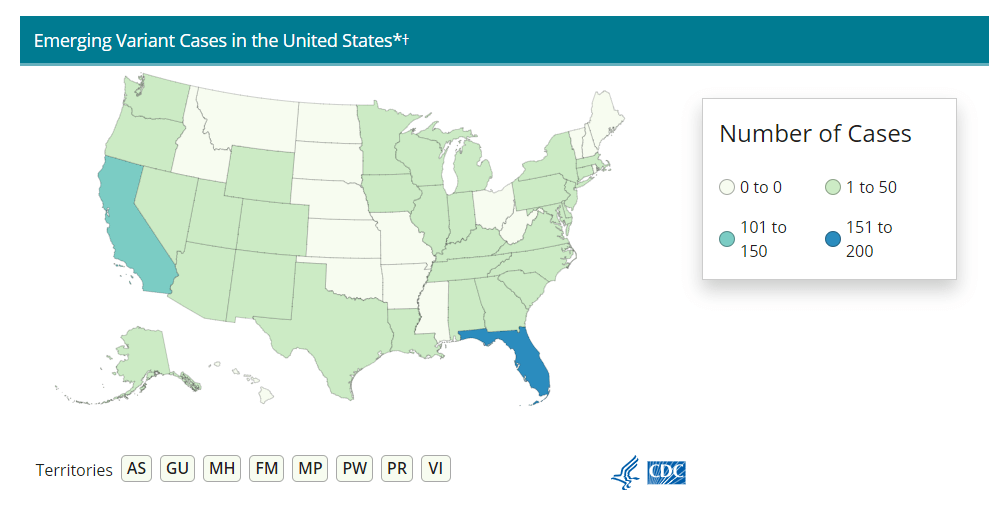
    Nobody who got any of the vaccine candidates was hospitalized or died from COVID-19. That’s huge, especially as variants continue to spread across the U.S. (Here’s the updated CDC variant tracker.)

    J&J’s numbers are especially promising when it comes to variant strains. Moderna and Pfizer released their results before the B.1.1.7 (U.K.) or B.1.351. (S.A.) variants reached their current notoriety, which makes J&J’s overall efficacy numbers look worse by comparison. But the fact that no one who got the J&J vaccine was hospitalized no matter which variant they were infected with is a cause for optimism. (B.1.351 is the variant raising alarms for possibly being able to circumvent a vaccine’s protection due to a helpful mutation called E484K. A Brazilian variant, P1, also has this mutation, though there’s not a lot of research on vaccine efficacy for this particular mutant.)

    It also means that vaccination needs to step up. While it may seem counterintuitive to step up vaccinations against variants that can supposedly circumvent them, it’s important to note that there still was a significant decrease in COVID-19 cases in vaccinated patients from South Africa. A 57% drop compared with the 95% prevalence of the B.1.351 still suggests that vaccination can prevent these cases, and thus can seriously slow the spread of the variant.

    What does all of this mean for COVID-19 rates? We can infer a few things. For starters, when vaccines are distributed to the general public around April or May, we may see hospitalization rates and death rates drop more than positive test rates. Positive test rates should obviously drop too, but they’ll probably stay at least a little higher than hospitalizations and death rates for a while.

    Second, it means that we really need to ramp up sequencing efforts in the U.S.. We need more data to tell us just how well these vaccines can protect against the spreading variants, but we can’t collect that data if we don’t know which strain of SARS-CoV-2 someone gets. We here at the CDD have covered sequencing efforts – or lack thereof – before, but the rollout has still been painfully slow. CDC Director Rochelle Walensky stressed that “we should be treating every case as if it’s a variant during this pandemic right now,” during the January 29 White House coronavirus press briefing. But the 6,000 sequences per week she’s pushing for as of the February 1 briefing should have been the benchmark months ago. We’re still largely flying blind until we can get our act together.

    Some states in particular may be flying blinder than others. As Caroline Chen wrote in ProPublica yesterday, governors of New York, Michigan, Massachusetts, California, and Idaho are planning to relax more restrictions, including those on indoor dining. Such a plan is probably the perfect way to ensure these variants spread, so much that even Chen was surprised at how pessimistic the outlook was when she asked 10 scientists for the piece.

    The B.1.1.7 variant is expected to become the dominant strain in the U.S. by March, according to the CDC. And on top of that, the B.1.1.7 variant seems to have picked up that helpful E484K mutation in some cases as well. Per Angela Rasmussen of Georgetown University, if these governors don’t realize how much they’re about to screw everything up, “the worst could be yet to come.” God help us.
  • Experts say schools could reopen, but data are still scarce

    The medical journal JAMA released an article written by three CDC officials about opening schools. The conclusion was that it appears that reopening schools safely is possible—but before we turn everyone loose, there are a lot of caveats. And critically, protective measures that need to be taken are not limited to the schools themselves. 

    When experts say that schools can be reopened safely, it means that so far, schools haven’t been driving community transmission the way other public spaces remaining open have. In a case study comparing 154 students who had been infected with SARS-CoV-2 and 243 who had not, schools posed much less of an infection risk than other social activities. The paper also cited two case studies, one from North Carolina and one from Wisconsin, where cases in general were fairly uncommon, and the vast majority of the recorded cases came from cases acquired from the community, not the schools. 

    It’s clearly inaccurate to say that COVID-19 simply hasn’t hit schools. Indeed, if it hadn’t, we wouldn’t need our school trackers. And while many US school outbreaks have mostly been small, it’s not impossible a future outbreak could be anything but. The JAMA paper cites an outbreak in Israel where out of 1161 students and 151 staff members tested, 153 and 25 cases were found in students and staff, respectively, within two weeks of reopening. “Crowded classrooms…, exemption from face mask use, and continuous air conditioning that recycled interior air in closed rooms” were cited as contributing to the outbreak. Additionally, school-related activities such as extracurriculars and athletics could also pose a higher risk.

    For longtime readers of this newsletter or even for anyone who’s kept up with the news, the path to reopening schools may sound familiar. Measures taken need to include universal mask use, a robust screening program, physical distancing, and hybrid models of education to reduce classroom density (including online options). But, critically, the article also stresses that measures need to be taken in the surrounding community to reduce spread, singling out indoor dining in particular. Indeed, schools are not isolated islands; the health of students returning for school depends on if a community can control the spread. Schools themselves may not be driving much community spread, but if COVID-19 is running uncontrolled in the community, it’s still not going to be safe to hold in-person classes. 

    While it is exciting that schools reopening may be on the horizon, safe schools are nowhere near promised if governments and administrations aren’t willing to take necessary measures to control community spread. Closing restaurants and gyms is politically unpopular in many places. The economic incentives to keep indoor dining and to open movie theaters are hard to ignore. It may be a choice – open your schools and keep tight restrictions everywhere else, or loosen restrictions on dining and gyms and keep schools online. It’s not an easy choice. But, as the JAMA article points out, “Committing today to policies that prevent SARS-CoV-2 transmission in communities and in schools will help ensure the future social and academic welfare of all students and their education.”

    Two days after the JAMA article was published, NYT columnist David Brooks published a column decrying teachers unions and insisting that schools reopen, citing financial concerns for students in the future and current mental health problems. He pointed out that typically, white students have had greater access to in-person learning than black and brown students, going on to say: “I guess I would ask you, do Black lives matter to you only when they serve your political purpose? If not, shouldn’t we all be marching to get Black and brown children back safely into schools right now?”

    The response was swift, with many pointing out that the pandemic has disproportionately affected black and brown communities in terms of infection and death rates, and that they are more likely to live in underfunded communities where it might be a lot harder to keep students and staff safe. and that teachers maybe shouldn’t be blamed for not wanting to go back to work when there is still uncontrolled spread across the country. This Twitter thread sums up a lot of the backlash. 

    Indeed, even if schools do open up, as we talked about in our January 17 issue, we’re still having a lot of problems tracking cases. There still isn’t a federal dataset; however, there is reason to hope that we’ll get some better federal data soon after Biden included a call for data to inform safe K-12 school reopening and data on the pandemic’s impact on teachers and students in his executive order on school reopening(See the CDD’s K-12 school data annotations here.)

    We do know that black and brown children have been disproportionately affected by the pandemic; Hispanic/Latino and Black children account for 38.2% of cases in their age group while Hispanic/Latino and Black people account for only 31.4% of Americans. If schools do reopen in person, it’s clear that actions need to be taken to address structural inequity that would prevent them from doing so safely.

    Related posts

    • COVID-19 school data remain sporadic
      On November 18, New York City mayor Bill de Blasio announced that the city’s schools would close until further notice. The NYC schools discrepancy is indicative of an American education system that is still not collecting adequate data on how COVID-19 is impacting classrooms—much less using these data in a consistent manner.
  • COVID-19 data whistleblower Rebekah Jones gets arrested, tests positive

    Late Sunday, January 17, COVID-19 data scientist Rebekah Jones turned herself in to Florida Law Enforcement authorities. The charge against her, according to a press release from the Florida Department of Law Enforcement (FDLE) on the 18th, is “one count of offenses against users of computers, computer systems, computer networks and electronic devices”. She allegedly hacked a government communication system and sent an authorized message urging workers to “[s]peak up before another 17,000 are dead.” 

    She was released on the 18th with a bond of $2,500, and is allowed to have internet access—but is not allowed to access the Florida Department of Health website—until her trial. According to her attorney, she tested positive for COVID-19 before her release. The main dashboard for her project, Florida Covid Action, is still updating as of 6:44 PM on January 22nd, and The COVID Monitor (her tracker of COVID-19 cases in schools) appears to still be active as well. 

    Earlier in December, Jones faced a police break-in as police raided her house to search for evidence that she had illegally accessed government data. They seized her phone and computer, and pointed guns at her and her children. Jones denies all charges, and she sued the FDLE for “violat[ing] her rights under the First, Fourth, and Fourteenth Amendments”, along with “terroriz[ing]” her family.

    Jones was fired from her government job in May 2020, in what she claims was retaliation for her refusal to manipulate data in order to make it look like Florida was in a better position to reopen than it actually was. Since her firing, she has maintained two ongoing COVID-19 data projects: Florida Covid Action uses open-source information as an alternative general dashboard, and The Covid Monitor tracks K-12 school data nationwide. (We’ve used their dashboard before in our schools coverage.)  

    It is unclear when Jones’ next court appearance will be. For now, she has been cleared to return to her home in Maryland, where she moved out of fear for her family’s safety. 

    We’re covering her story because whether the allegations against her prove true or not, Florida leadership and law enforcement clearly consider Jones a threat. And no matter the outcome of the trial, her story forces us to question the state of Florida’s commitment to unaltered, accurate data. 

  • Meet your new intern

    Hi! I’m Sarah, and I’m going to be helping out around here for the time being. I’m currently a junior at Barnard College (Betsy’s alma mater) studying cell and molecular biology, and I’m looking to go into health journalism after I graduate. When I’m not dreaming of an all-powerful national data dashboard, I’m writing as the Science Editor for Bwog.com, pipetting a lot (remotely) in the research lab I work for, trying to keep my puppy from eating the carpet, or knitting my thousandth hat.

    Happy to be here, and I look forward to digging through the complex world of Covid-19 data with you all!

  • We’re not doing enough sequencing to detect B.1.1.7

    We’re not doing enough sequencing to detect B.1.1.7

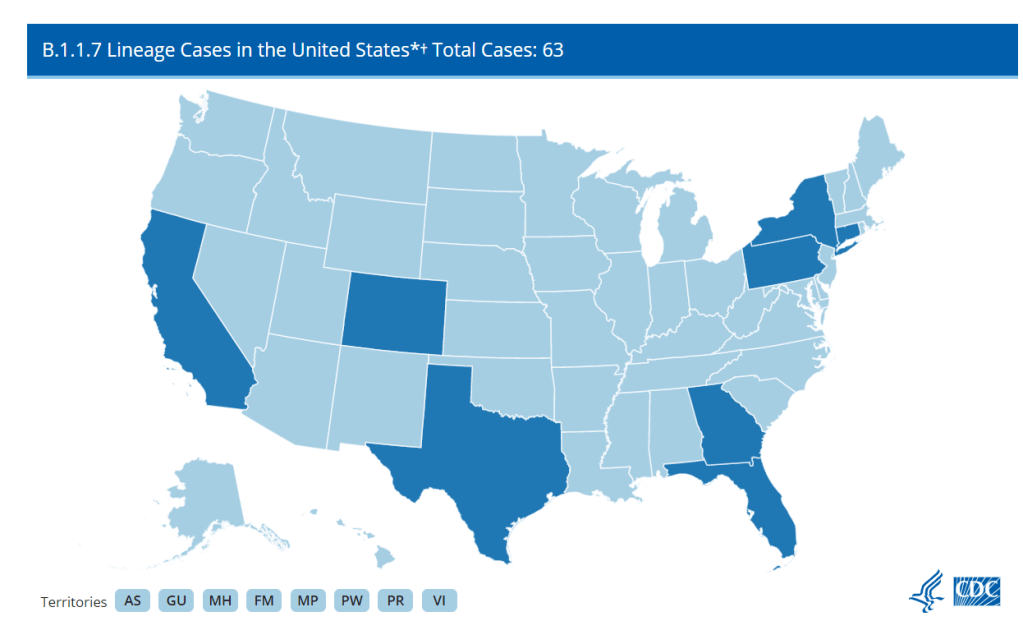
    The CDC has identified 63 cases of the B.1.1.7 variant as of Jan. 8, but this is likely a significant undercount thanks to the nation’s lack of systematic sequencing.

    A new, more transmissible strain of COVID-19 (known as B.1.1.7) has caused quite a stir these past few weeks. It surfaced in the United Kingdom and has been detected in eight states: California, Colorado, Connecticut, Florida, Georgia, New York, Texas, and Pennsylvania. The fact that a mutant strain happened isn’t a surprise, as RNA viruses mutate quite often. But as vaccines roll out, the spread of a new strain is yet another reminder that we’re nowhere near out of the woods yet.  

    It’s entirely possible to differentiate between strains of SARS-CoV-2 through genetic testing. To detect the B.1.1.7 variant, COVID-19 positive samples can be sequenced to search for a telltale deletion in the virus’s RNA. And in theory, we could track the spread of this variant with good testing data. A truly robust tracking effort should include a centralized surveillance program to sequence the RNA of the SARS-CoV-2 virus in all positive cases—or at least a good sample—to detect any mutant strains and track their impact. However, this is an area where the US has consistently faltered: as of December 23rd, only 51,212 out of 18 million positive cases had been sequenced. 

    As with most of the government’s response, handling this seems to be mostly up to the states. According to releases from Colorado, Pennsylvania, Connecticut, and Texas, it looks like these states are making sequencing efforts. Georgia said, “The variant was discovered during analysis of a specimen sent by a pharmacy in Georgia to a commercial lab”, which I can only assume means they have been conducting some kind of sequencing effort. I couldn’t find references to the extent of sequencing efforts in the announcements from California, Florida, or New York

    From these releases, it’s obvious that there is no unified cross-state effort. Pennsylvania stated that they had been sending “10-35 random samples biweekly to the CDC since November to study sequencing,” but that’s not going to be nearly enough to track this more transmissible variant. Are there any plans to ramp up sequencing? And that’s just from Pennsylvania because they deigned to tell us—are all states going to ramp up sequencing? It’s just not clear. 

    And after all that, starting to test for the variant now still won’t tell us just how widespread it is. The first case in New York was in someone with no evident travel history. Indeed, this is true for most people who have been infected, and, per Dr. Angela Rasmussen in Buzzfeed News, this suggests that the variant is already circulating in the community. To know how widespread the variant is, we would need to retroactively test samples that had already tested positive. Colorado’s press release mentioned that they would be doing some retroactive testing, but what about the other seven states? 

    Plus, that’s just states with already confirmed cases—there absolutely will be more confirmed cases in other states, because if it is already present in the community, there probably already are cases in other states. To know just where this variant is, every positive test in the US stretching back months into the past would have to be retroactively re-tested for the variant—an unlikely occurrence. 

    Even if there were a coordinated effort to retroactively sequence all positive tests, some cases of the variant could still slip through the cracks, because most states still aren’t doing enough PCR testing as it is. As of January 8th, according to Ashish Jha’s team at the Brown University School of Public Health, 86% of states aren’t meeting their testing targets. (Meeting testing targets indicates that enough testing is happening to “identify most people reporting symptoms and at least two of their close contacts.” State targets on this dashboard were last configured on October 1, so keep that in mind.) Only two states where the variant has surfaced, Connecticut and New York, are meeting their targets—and cases are surging in both states right now. Longtime readers are going to be very familiar with this problem, but if any new people are reading, this means that in most states we don’t even know how widespread our “garden variety” COVID-19 is. So how are we supposed to know where the UK variant is if we can’t even keep track of the virus that’s been here for almost a year? 

    Beyond testing, even reporting on confirmed cases of the variant is spotty at best. The CDC is reporting how many detected cases of COVID-19 have been caused by the variant, but no state with a confirmed case caused by B.1.1.7 is displaying that data on their dashboard. (I checked the 8 states’ dashboards and left a comment on California’s because the ask box was right there.) Why is this not on their dashboards? I couldn’t tell you, but it seems like important information that should be reported.

    All of these unanswered questions show, yet again, that we desperately need a unified effort from the federal government to track and combat this virus. It should not be this hard to find how we’re tracking the spread of this variant, it should not be this hard to tell which methods work for even identifying the variant, and it should at least be possible to find this data on state health dashboards. It might look like we’re close to the finish line as vaccines continue to be distributed, but we’re tripping over the exact same problems we did at the beginning.