As many Americans who lived through wildfire season, hurricane season, or the Texas winter storm know well: it’s hard to protect yourself in a pandemic when you’re dealing with another simultaneous disaster.
And it is especially hard to protect yourself when you live in a region that’s cut off from resources and medical expertise—as is the case for people in Gaza and other Palestinian territories.
In the past couple of weeks, violence in this region has shut down hospitals and prevented vaccine deliveries. Unvaccinated people have crowded into shelters in Gaza, while all testing and vaccination efforts have stalled.
Gaza has also lost critical medical leadership in the recent violence: two senior doctors at Al-Shifa Hospital, the largest hospital in the Gaza Strip, were killed in recent Israeli airstrikes. An early-morning attack on the al-Wehda district last Sunday killed Dr. Ayman Abu al-Ouf, head of internal medicine at the hospital, and Dr. Mooein Ahmad al-Aloul, a psychiatric neurologist, along with at least 30 others.
Al Jazeera reports that “medical personnel remain in short supply” throughout the Palestinian territories, leaving people to instead rely on international aid groups for medical care. And constant air raids have limited medical care even further. One Israeli attack blocked the main road leading to Al-Shifa hospital, for example, and a Doctors Without Borders clinic was hit last weekend.
“People are not daring to visit health facilities. We are fearing this will have a major negative impact,” Sacha Bootsma, an official from the World Health Organization, told the New York Times.
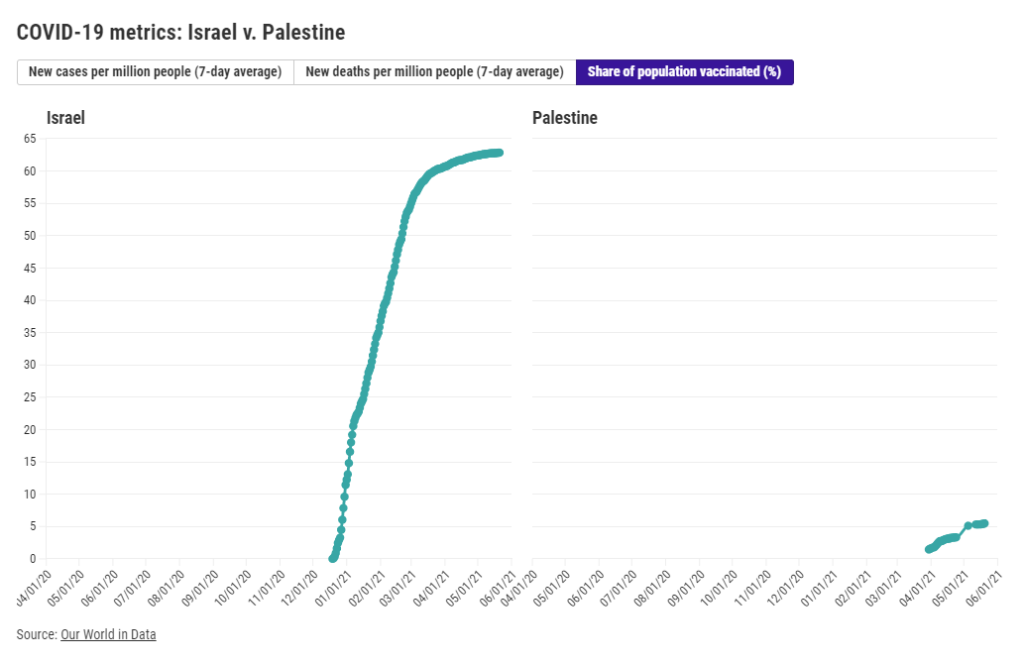
About 5% of Palestinians have been vaccinated as of May 20. Most of those doses have come from COVAX, the global vaccine alliance, and shipments have faced logistical challenges in getting to Gaza through an Israeli blockade. The United Nations released a statement in January calling on Israel to “ensure swift and equitable access to COVID-19 vaccines for the Palestinian people under occupation,” but Israeli leaders have denied this responsibility.
Israel, meanwhile, is largely protected against a COVID-19 surge. The country has been a global leader in vaccinations; by the end of February, over half of the population had received at least one dose. Now, almost two-thirds of the population are vaccinated.
Cases in Israel have remained at low levels throughout the violence in recent weeks thanks to the vaccines. The country has seen fewer than 20 new cases per million people a day since mid-April. Palestine, meanwhile, faced a surge during March and April, with the territories’ highest COVID-19 case numbers yet.
While reported case numbers in Palestine have dropped in recent weeks, this is more likely due to a lack of testing than an actual drop in infections. And the situation is not improving. Though Israeli and Palestinian forces have now formally reached a cease-fire, Israeli police have continued to attack Palestinians—including an attack against worshippers at al-Aqsa Mosque.
Continued violence and lack of medical care for Palestinians may mean that the pandemic continues here long after it ends for Israel. As is true of all COVID-19 outbreaks, continued transmission may breed coronavirus variants that threaten the rest of the world.


Leave a reply to Russia’s invasion of Ukraine has COVID-19 impacts – International data Cancel reply