Tag: White House

  • New pandemic preparedness office at the White House

    The White House has launched a new office focused on high-level pandemic preparedness, about six months after Congress requested this. The new Office of Pandemic Preparedness and Response Policy will be a permanent office in the executive branch, according to a fact sheet from the Biden administration.

    This announcement is good news; it’s a small step towards improving the U.S.’s infrastructure for responding to future disease threats. But we shouldn’t just be focusing on pandemic preparedness—the U.S. also needs better infrastructure for many health issues impacting the country now, including the continued impacts of COVID-19.

    According to the White House, the new office’s responsibilities include:

    • Coordinating the executive branch’s “domestic response to public health threats that  have pandemic potential or may cause significant disruption.” Current notable threats include COVID-19, mpox, polio, flu, and RSV.
    • Coordinating federal science and technology efforts related to pandemic preparedness, such as developing next-generation vaccines and treatments. A current focus here is next-gen vaccines for COVID-19, though it’s unclear how this new office will coordinate with other federal agencies on that initiative, per reporting by Sarah Owermohle at STAT.
    • Develop pandemic preparedness reports for Congress, including a shorter review every two years and more in-depth reports every five years.

    The Biden administration has appointed retired Major General Paul Friedrich (MD), currently the senior director for global health security at the National Security Council, to lead the new office. Friedrich has decades of experience leading global health initiatives in the military and for the federal government; he advised the Pentagon in the early months of COVID-19.

    Between this new office and Congress’ work on reauthorizing the Pandemic and All-Hazards Preparedness Act, there’s been a lot of discussion on preventing future pandemics in the last couple of weeks. This is obviously good news; COVID-19 has taught U.S. officials at all levels that they will need more resources for the next big health threat.

    But at the same time, the focus on pandemic preparedness can potentially distract us from the many current health threats that we face now. That includes COVID-19 and Long COVID, along with many common diseases, chronic conditions, and other health issues that could be managed better. For example, our seasonal flu surveillance could use an upgrade! 

    The U.S. has plenty of resources to devote to present and future health threats; we could be doing much more on both fronts.
  • What the public health emergency’s end means for COVID-19 data

    This past Monday, the White House announced that the federal public health emergency for COVID-19 will end in May. While this decision might be an accurate reflection of how most of the U.S. is treating COVID-19 right now, it has massive implications for Americans’ access to tests, treatments, vaccines—and data.

    I wrote about the potential data issues last September, in anticipation of this emergency ending. Here are the highlights from that post:

    • Outside of a public health emergency, the CDC has limited authority to collect data from state and local health agencies. And even during the emergency, the CDC’s authority has been minimal enough that national datasets for some key COVID-19 metrics (like breakthrough cases and wastewater surveillance) have been very spotty.
    • When the federal emergency ends, the Department of Health and Human Services (HHS) may lose its ability to require reporting of some key data, including: PCR test results (from states), hospital capacity information and COVID-19 patient numbers (from individual hospitals), COVID-19 cases and deaths in nursing homes.
    • It’s possible that the HHS and/or CDC will negotiate new data reporting requirements with states and other entities that don’t rely on the public health emergency. They have about three months to do this. I haven’t seen much news on that yet, but I’ll keep an eye out and share updates as I find them.
    • Regardless, I expect that reporting COVID-19 numbers to federal data systems will become even more voluntary than it already is for health agencies, hospitals, congregate facilities, and other settings. We will likely have to rely more on targeted surveillance systems (which compile data from a subset of healthcare facilities) rather than comprehensive national datasets, similar to our current surveillance systems for the flu and other endemic diseases.

    At the same time, the public health emergency’s end will lead to changes in the distribution of vaccines, tests, and treatments. The Kaiser Family Foundation has a helpful explanation of exactly what’s changing. Here are the highlights:

    • Vaccines will remain free to all as long as the stockpile of doses purchased by the federal government lasts. However, the ending emergency will likely impact the government’s ability to buy more vaccines—including future boosters that might be targeted to new variants. Vaccine manufacturers are planning to raise their prices, and cost will become a burden for uninsured and underinsured people.
    • At-home, rapid tests will no longer be covered by traditional Medicare, while Medicare Advantage coverage will vary by plan. Most private insurance providers will likely still cover the tests, but prices may go up (similarly to the prices for vaccines).
    • PCR tests are also likely no longer going to be covered by a lot of insurance plans and/or are going to get more expensive. Notably, Medicaid will continue covering both at-home and PCR tests through September 2024.
    • Treatments (primarily Paxlovid right now) will remain free for doses purchased by the federal government, similar to the situation with vaccines. After the federally-purchased supply runs out, however, we will similarly see rising costs and dwindling access.

    KFF also has produced a detailed report about how the end of the federal emergency will impact healthcare coverage more broadly.

    In short, the end of the public health emergency will make it harder for Americans to get tested, receive treatments, and stay up to date with COVID-19 vaccines. The testing access changes, in particular, will lead to official case numbers becoming even less accurate, as fewer people seek out tests. At the same time, Americans will lose access to the data we need to know how much of a threat COVID-19 presents in the first place.

    It’s also worth noting that, on the same day the White House announced the end of its emergency declaration, the World Health Organization announced the opposite: the global public health emergency is continuing, though it may end later in 2023. As Americans largely ignore COVID-19, millions of people around the world are unvaccinated, facing new surges, dealing with new variants, etc.

    COVID-19 clearly remains a looming threat at the global level. In the U.S., we technically have the best vaccines and treatments to deal with the disease—but these tools are going underutilized, and the Biden administration’s decision this week will only make it harder for people to get them. Maybe we shouldn’t have to rely on an emergency declaration to get basic data and access to health measures in the first place.

    More federal data

  • COVID source callout: Misinformation from the White House

    You might have seen this statistic from President Biden or other White House officials: “COVID deaths are down nearly 90%.” The statistic is misleading and incorrect, to the point that I’d consider it misinformation—especially right now, as the U.S. faces a largely-ignored surge.

    Let me explain where this number comes from. The White House is comparing average daily deaths from COVID-19 in recent weeks to this metric during the peak of the winter 2020-2021 surge, when Biden took office.

    On January 20, 2021, the day of Biden’s inauguration, about 3,200 people were dying from COVID-19 each day, according to CDC data. This past week, as Biden battled COVID-19, about 400 people were dying each day. The percent change between 3,200 and 400 is about 88%, or “nearly 90%.”

    But it’s misleading to just compare daily averages, as Biden has presided over several COVID-19 surges since he took office: the Delta surge last summer and fall, the first Omicron surge in the winter, and the Omicron subvariant surge this spring and summer. In fact, the number of COVID-19 deaths that occurred in the last year (July 2021 to July 2022) is pretty close to what it was in the prior year, and that’s not even accounting for thousands of excess deaths linked to the pandemic.

    While Biden’s administration has contributed to COVID-19 vaccines, treatments, testing, and other safety measures, it’s far from eliminating our collective risk from the coronavirus. Always question when you see a percent change without context!

  • Two major Long COVID reports are coming in August

    Two major Long COVID reports are coming in August

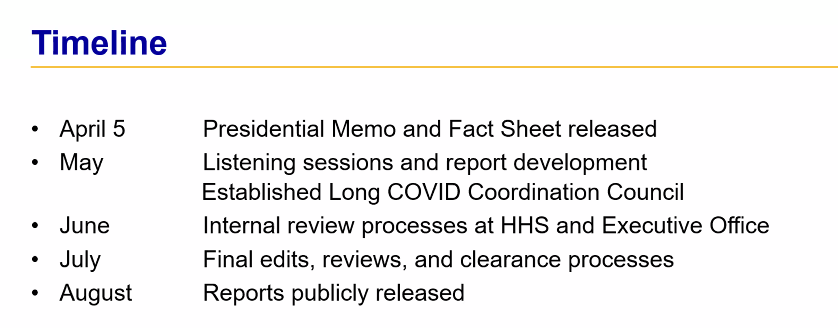
    Two new White House/HHS reports about Long COVID and other long-term pandemic impacts will be released next month. Screenshot via Twitter.

    This past Friday, the White House and the Department of Health and Human Services held a briefing previewing two major reports about Long COVID.

    The reports, which the Biden administration plans to release in August, will share government resources and research priorities for Long COVID, as well as priorities for other groups impacted long-term by the pandemic, such as healthcare workers and people who lost loved ones to COVID-19. Friday’s briefing served to give people and organizations most directly impacted by this work (particularly Long COVID patients) advanced notice about the reports and future related efforts.

    It was also, apparently, closed to the press—a fact that I did not learn until I had already publicly livetweeted half of the meeting. I later confirmed with other journalist friends that the White House and HHS press offices did not do a great job of communicating the meeting’s supposedly closed status, as none of us knew this beforehand.

    Officials honestly didn’t share much information at this briefing that I didn’t already know, so it’s not as though I obtained a huge scoop by watching it. (For transparency’s sake: I received a link to register for the Zoom meeting via the COVID-19 Longhauler Advocacy Project’s listserv, and identified myself as a journalist when I signed up.)

    Due to confusion around the briefing’s status and the fact that other attendees (besides myself) livetweeted it, I feel comfortable sharing a few key points from the call. If this gets me in trouble with the HHS press office, well… they’ve never answered my emails anyway.

    Key points:

    • These upcoming August reports are responding to a memorandum that the Biden administration issued in April calling for action on Long COVID. 
    • Over ten federal government agencies have been involved in producing the reports, which officials touted as an example of their comprehensive response to this condition.
    • One report will focus on services for Long COVID patients and others facing long-term impacts from the pandemic. My impression is that this will mostly highlight existing services, rather than creating new COVID-focused services (though the latter could be developed in the future).
    • The second report will focus on Long COVID research, providing priorities for both public and private scientific and medical research efforts. Worth noting: existing public Long COVID research is not going well so far, for reasons I have covered extensively.
    • An HHS team focused on human-centered design has been pursuing an “effort to better understand Long COVID” (quoting from their web page). This project is currently wrapping up its first stage, and expects to publish a report in late 2022.
    • Some Long COVID patients and advocates would like to see more urgent action from the federal government than what they felt was on display at this briefing.

    Here are a couple of Tweets from advocates who attended:

    I look forward to covering the reports when they’re released in August.

    More Long COVID reporting

  • Biden’s new COVID-19 plan excludes data

    Biden’s new COVID-19 plan excludes data

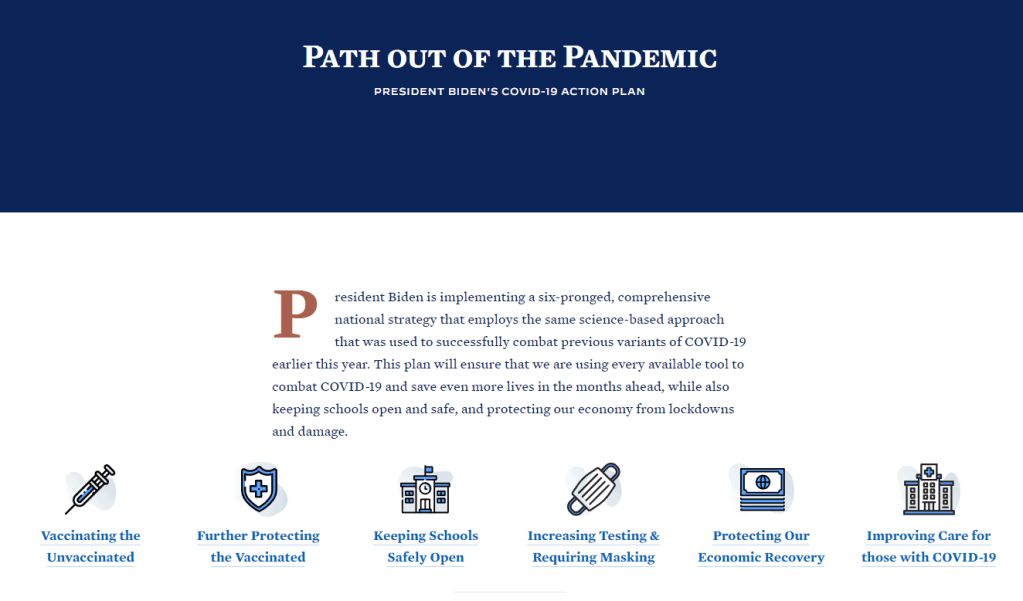
    No mention of data reporting or infrastructure here. Screenshot taken from whitehouse.gov on September 12.

    On Thursday, President Joe Biden unveiled a major new plan to bring the U.S. out of the pandemic. If you missed the speech, you can read through the plan’s details online.

    Key points include vaccination requirements for large employers, federal workers, and federal contractors; booster shots (if the FDA and CDC approve them); and making rapid tests more accessible for the average American. Much of the plan aligns with safety strategies that COVID-19 experts have been recommending for months—or, in the case of rapid testing access, over a year.

    But I and other data nerd friends were quick to notice that one major topic is missing: data collection. Numerous reports and investigations have demonstrated how the U.S.’s underfunded state and local public health agencies were completely unprepared to collect and report COVID-19 metrics, hindering our response to the pandemic. (This POLITICO investigation is one recent example of such a story.) Local data collection has gotten even worse during the latest surge, as many states cut back on their COVID-19 reporting and the federal government has failed to comprehensively track breakthrough cases.

    As a result, one might expect Biden’s plan to take steps towards improving COVID-19 data collection in the U.S. Perhaps the plan could have provided funding to local public health agencies, tied to a requirement that they report certain COVID-19 metrics on a daily basis. Perhaps it could have included increased tracking for breakthrough cases, or increased genomic sequencing to identify the next variant that inevitably becomes a concern after Delta.

    Instead, the plan’s only mention of “data” is a line about how well the vaccines work: “recent data indicates there is only 1 confirmed positive case per 5,000 fully vaccinated Americans per week.”

    Without prioritizing data, the Biden administration is failing to prepare the U.S.—both for future phases of this pandemic and for future public health crises.

  • I am once again asking: why are journalists doing this?

    I am once again asking: why are journalists doing this?

    President Trump and the First Lady tested positive for COVID-19 in the early morning on Friday, October 2. As I draft this newsletter on Sunday morning, at least 15 other people connected to the President have tested positive, ranging from Bill Stepien, Trump’s campaign manager, to New York Times Washington correspondent Michael Shear.

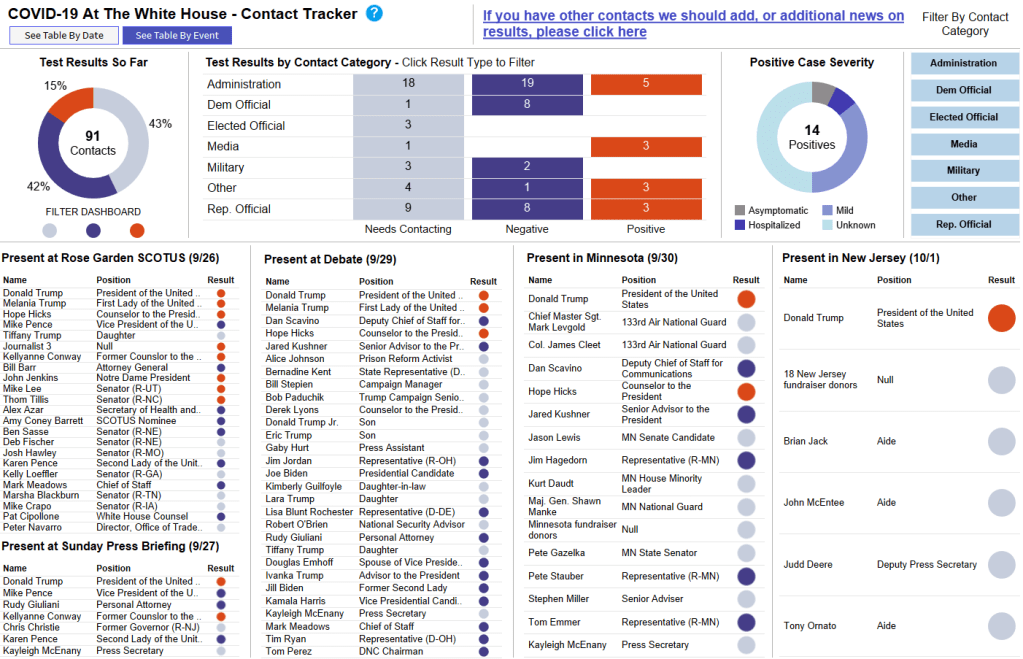
    You might expect me to source this number and these names from a federal public health agency, which is conducting all of these tests and making their results public. Not in this pandemic! My source is, of course, a dashboard compiled by volunteer journalists and science communicators.

    This dashboard, called the COVID-19 At The White House Contact Tracker, is attempting to trace over 200 contacts in connection with the President and his staff. The team behind it includes Benjy Renton, independent reporter on COVID-19 in higher education, Peter Walker, data visualization lead at the COVID Tracking Project, and Jesse O’Shea, MD, infectious disease expert at Emory University.

    The Contact Tracker is an incredible public service. In its current form, the dashboard lists 235 White House contacts who should get tested for COVID-19, along with their positions, test results (if known), symptoms (if they test positive), and the date of their most recent test. You can also view the data as a timeline, based on each person’s last contact with the President, and as a map based on the Rose Garden ceremony, the debate, and two other potential spreading events.

    It is not surprising, after months of poor data reporting from the federal government that, instead of the CDC or the HHS, the best source of data on this high-profile outbreak is—as Dr. O’Shea puts it— “three awesome dudes [contact tracing] from our homes.” But it is worth emphasizing.

    What are federal public health agencies prioritizing right now, you might ask? The HHS is planning a $300 million-plus ad campaign with the goal of “defeating despair” about the coronavirus. And this money came out of the CDC’s budget. I was planning to devote a bigger section to this campaign before COVID-19 hit the White House, but instead, I will direct you to an excellent (and terrifying) POLITICO feature on the subject. Dan Diamond also discusses his investigation of the campaign on his podcast, POLITICO’s Pulse Check.