Tag: Source callout

  • COVID source callout: Montana ends its dashboard

    Last week, I wrote about the Iowa health department’s move to end COVID-19 case reporting requirements for labs, and in turn stop reporting these data to the CDC. Well, Montana just became the next state to follow this trend.

    The state’s public health agency announced that it will stop updating its COVID-19 dashboard on May 5, the week before the federal public health emergency ends, in a note on the dashboard and a statement to local media outlets.

    Unlike Iowa, Montana will continue reporting COVID-19 numbers to the CDC; so residents of that state will still be able to find information on the CDC’s dashboard. But the discontinuation of Monatana’s own dashboard shows how the state is taking resources out of pandemic response and treating COVID-19 as an endemic virus—even though it’s not.

  • COVID source callout: Iowa ends COVID-19 case reporting

    As of April 1, Iowa’s state health department is no longer requiring public health laboratories to report positive COVID-19 test results—and no longer reporting statewide data to the CDC. This decision, announced in late February, is part of a growing trend away from relying on case data as people use at-home tests instead of PCR tests.

    Iowa’s health department “will continue to review and analyze COVID-19 and other health data from several sources,” including hospitalization metrics and syndromic surveillance, according to the agency. It’s essentially treating COVID-19 similarly to the flu and other common respiratory viruses.

    As a result of this change, Iowa is now no longer reporting COVID-19 case data to the CDC, the national agency said in this week’s data update. National, regional, state, and county-level CDC data exclude the state of Iowa, starting on April 1.

    This move seems like a natural extension of the state health reporting changes that we’ve seen across the country since last spring. I wouldn’t be surprised if more state health departments similarly stop reporting every COVID-19 case when the federal health emergency ends in May. Unfortuantely, this will become another driver of increasingly-less-reliable COVID-19 data in the U.S.

  • COVID source callout: GISAID in danger of losing trust

    GISAID, the global database of virus sequences, has faced a lot of criticism recently from the virologists and bioinformaticians who rely on it—potentially hindering responses to future virus outbreaks.

    First, there was controversy around genetic information from environmental samples taken at the Huanan Seafood Wholesale Market in Wuhan, China, which Chinese researchers posted to GISAID. An outside group of scientists found the sequences and analyzed them, finding the samples supported the hypothesis that SARS-CoV-2 originated in animals and jumped to humans at the seafood market. And then, GISAID revoked those scientists’ access to the database. (The original Chinese research group eventually published their findings.)

    Last week, another controversy came to light: GISAID is claiming that the first SARS-CoV-2 sequence to be publicly shared was posted on its platform, back in January 2020. Even though plenty of evidence suggests the first sequence was shared days earlier at virological.org, a virology forum. Reporting in Science Magazine and evidence shared on Twitter shows the true story of these early days of info-sharing, as well as how GISAID has tried to retroactively revise the narrative.

    While these issues might seem inconsequential outside of a small circle of experts, the controversies could lead some of the world’s top virologists and epidemiologists to stop using a major source for outbreak information. It doesn’t really matter who posted a SARS-CoV-2 sequence first. But it does matter that experts have trusted places to share data and collaborate on vital research.

    Without open data-sharing platforms like GISAID, the world may be less prepared for coming novel disease outbreaks. These recent controversies (and the broader debate over COVID-19’s origins) also speak to larger gaps in trust that could hinder future collaborations.

  • COVID source callout: CDC ends its data newsletter

    This past Friday, the CDC’s COVID-19 data team announced that its newsletter, the COVID Data Tracker Weekly Review, will send its final issue on Friday, May 12. That’s the day after the federal public health emergency for COVID-19 ends.

    For the last two years, the Weekly Review newsletter has been a great source of accessible updates on the state of COVID-19 in the U.S.; it includes summary statistics on cases, hospitalizations, vaccinations, variants, wastewater surveillance, and deaths. I’ve frequently referenced the newsletter in my own National Numbers updates, and have pointed other journalists to it.

    But this newsletter hasn’t been as reliable as one might expect from the CDC. Its writers have frequently taken the week off for federal holidays, even when the holiday falls on a Monday—and the newsletter is sent on Fridays. In recent months, the CDC has only compiled this newsletter every other week, making the “weekly review” title a misnomer. And now, the CDC has announced there will be only three more issues: sent on March 31, April 14, and May 12. (Seems like the newsletter is briefly shifting to a monthly schedule before it ends?)

    While the CDC will continue to regularly update its main COVID-19 dashboard and other data sources, the agency’s failure to maintain even a fairly basic update newsletter really speaks to its deprioritization of COVID-19. It honestly boggles the mind that I, a freelance journalist writing about COVID-19 data in her spare time, send updates with more continuity than the entire national public health agency.

    Yet somehow, here we are! This newsletter may see continued shifts to its format, but it isn’t going anywhere.

  • COVID source callout: What, exactly, are the Bachelor’s COVID-19 safety protocols?

    COVID source callout: What, exactly, are the Bachelor’s COVID-19 safety protocols?

    Twitter user @tay_kass captioned this image, “the moment Zach realized he had COVID.” I don’t disagree!

    This week, the Bachelor tested positive for COVID-19. As both an avid watcher of the franchise and a COVID-19 reporter, I was immediately curious to see how the production would handle this. Unfortunately, the show was pretty sparse on safety details.

    Now, I understand why Bachelor producers and the higher-ups at ABC may not want to spend much of their episode time on the logistics of PCR tests or contestant quarantines. But I think they missed an opportunity here to show the viewers exactly what goes into COVID-19 safety on a high-budget TV show like the Bachelor.

    Film and TV sets tend to have rigorous safety protocols (with regular testing, masking for production teams, etc.), and could serve as models for other settings. The Bachelor could have shown millions of viewers what that looks like; instead, the lead’s COVID-19 case is mostly framed as a bummer for the women who were supposed to go on dates with him.

    With that in mind, here are a few things we know (and don’t know) about how the Bachelor handled this COVID-19 case, based on the episode itself and this interview on Entertainment Weekly:

    • Show lead Zach Shallcross isolated in his hotel room after testing positive. He’d already skipped a group date earlier in the day when he started to experience symptoms, but it’s unclear if he was actually isolating at that point (there might have been a camera person or two in his hotel room?).
    • All of the contestants get tested on a daily basis. Unclear if these are PCR or at-home/rapid tests, though my guess is PCR given that the production apparently had to wait some time for Zach’s test results after he started to not feel well.
    • The day before he tested positive, Zach went on a one-on-one date with contestant Gabi Elnicki. According to the EW interview, Gabi was “tested multiple times” immediately following Zach’s positive test, and got her own hotel room. This doesn’t appear to have been a full quarantine, though.
    • The other contestants seemed to have gotten lucky, to a certain extent, because Zach’s COVID-19 case occurred right after travel to London—so no other contestants had been exposed to him.
    • Zach’s symptoms were fairly mild, to the point that the production held a remote cocktail party and rose ceremony with him in his hotel room (i.e. he talked to contestants and then identified those who will stay for the next week over Zoom).
    • In next week’s episode, Zach will go on more dates, per the EW interview, so I assume he will have “recovered” enough to leave isolation. Will that mean his symptoms resolving, a negative rapid test, or just waiting a few days? It’s currently unclear.
    • The entire cast and crew of the Bachelor was fully vaccinated. Of course, this doesn’t prevent infection or transmission, but it could’ve played some role in keeping this one case from becoming an outbreak. It also seems like crew members are usually masked on set, though I could just be extrapolating based on a few shots we’ve seen of producers.

    As you can see, there are a lot of gaps in what we know about COVID-19 safety measures on the Bachelor… and I doubt those gaps will be filled, given what the production seems to prioritize in its airtime. If any editors reading this want to give me an assignment to investigate further, I am available.

  • Callout: No, NYC, those schools aren’t in Colombia

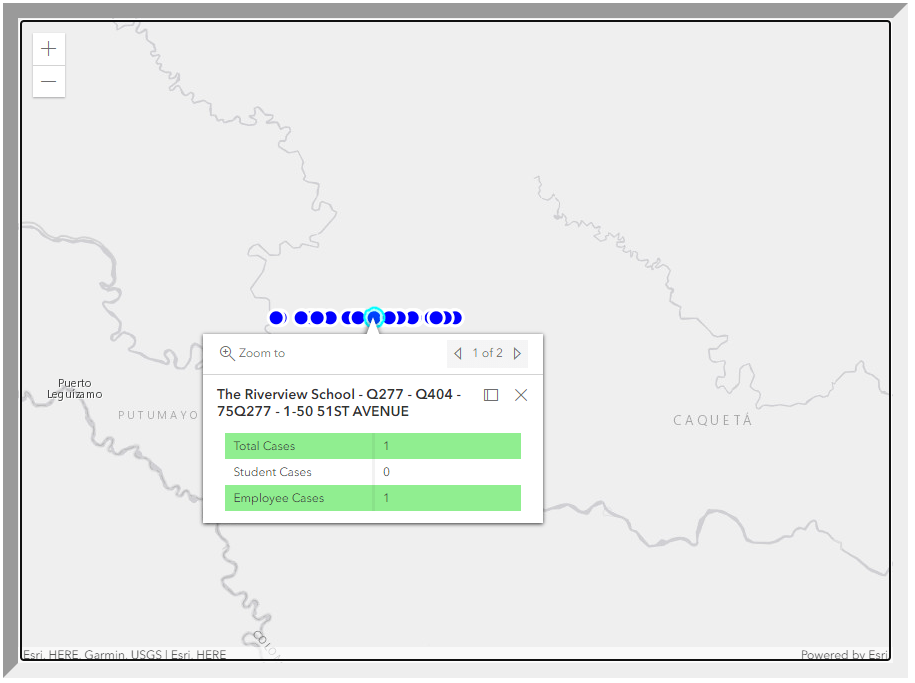
    Callout: No, NYC, those schools aren’t in Colombia

    These schools are not in the right location. Screenshot from the NYC DOE COVID-19 case map.

    For several days now, the New York City Department of Education’s COVID-19 case map has had a significant error: on this dashboard, a number of schools are erroneously located in Colombia. Like, the South American country.

    The error appears to be a problem with the dashboard’s geographical tagging, putting these schools in another continent instead of their correct NYC neighborhoods. But it’s a pretty big issue for parents and school staff who might be checking the map, looking for COVID-19 cases at their schools.

    If these users didn’t know to zoom out and then scroll down a fair amount—which they probably wouldn’t, unless they got very creative or followed the right people on Twitter—they would think there were no cases. Which is far from the truth.

    Shout-out to NYC schools data experts Mary Ann Blau and Sarah Allen for flagging this issue!

  • COVID source callout: CDC archives public datasets

    COVID source callout: CDC archives public datasets

    The CDC has archived a couple of major datasets providing COVID-19 cases and deaths by state and county.

    The CDC is now updating its COVID-19 cases and deaths data weekly, instead of daily, as I covered last week. This shift goes beyond the agency’s public dashboard: the CDC has also archived datasets with state- and county-level data providing COVID-19 cases and deaths, which were previously updated daily on data.cdc.gov.

    These datasets previously included the underlying numbers behind the CDC’s dashboard, allowing data-savvy Americans to produce their own analysis and visualizations. I learned about the archiving via a Twitter thread by Iowa data expert Sara Anne Willette, who uses the CDC’s data to update an independent dashboard tracking COVID-19 in her state.

    To replace these daily datasets, the CDC has posted a new dataset, “Weekly COVID-19 County Level of Community Transmission Historical Changes.” It appears to provide COVID-19 cases and test positivity rates by county, by week—but the data aren’t actually available yet. This dataset currently includes zero rows while the CDC resolves a “processing issue.”

    None of this is particularly surprising, considering that the CDC is clearly deprioritizing COVID-19 tracking and allocating its data analysis resources elsewhere. But it remains frustrating for those of us who still want to know what’s going on with COVID-19 in our communities.

  • COVID source callout: Do not follow this Twitter sensationalist

    As discussed earlier in this issue, the CDC’s variant prevalence estimates now include BQ.1 and BQ1.1—two newer sublineages that have evolved from BA.5. The agency started breaking out these subvariants in Friday’s variant data update; their presence was previously included in the overall BA.5 category.

    Throughout 2022, as Omicron has continually mutated and produced further lineages, the CDC’s policy has generally been to break out subvariants when they cause at least 1% of all cases in the U.S. Sometimes, though, it can be tricky to distinguish between subvariants, leading to bigger updates like the one we saw this Friday (with BQ.1 and BQ.1.1 both causing more than 5% of cases nationwide).

    Again, the CDC’s behavior here is pretty reasonable, in my opinion—especially when one considers that more limited PCR testing these days is making it harder to track new variants. But you might have gotten a different impression if you follow a certain sensationalist personality on Twitter, Eric Feigl-Ding.

    I’m not linking to Feigl-Ding’s Tweet, because I don’t want to give him attention. His tweet, which started with “Scoop—MOTHER OF GOD,” painted the CDC’s fairly normal data update as some kind of conspiracy by the agency to prevent Americans from learning the truth about circulating variants.

    For more details on why Feigl-Ding’s Tweet here was dangerous, please see this helpful thread by actual genomics expert Duncan MacCannell:

    It’s also worth noting that Feigl-Ding has done this kind of thing before, to the point where he has a reputation among legitimate experts for sensationalizing COVID-19 news and misleading his audience. (See this profile for more details.) I have personally had him blocked on Twitter for a while. Basically, do not follow this guy, and be skeptical if you see any of his posts on your timeline.

  • COVID source callout: CDC shifts to weekly updates

    This week, the CDC announced a big change to its COVID-19 data reporting: instead of updating case and death numbers daily, the figures will be updated weekly. The change comes into effect on October 20.

    Under the new schedule, data updates will be cut off on Wednesdays, though it’s unclear if the CDC will actually update its dashboard on Wednesdays or if this will happen on a day later in the week.

    According to the CDC’s data FAQ page, this change was made “to allow for additional reporting flexibility, reduce the reporting burden on states and jurisdictions, and maximize surveillance resources.” To me, this makes a lot of sense: as case data become increasingly less reliable (thanks to increased at-home testing, closing PCR sites, etc.), daily updates can be more misleading than they are valuable. Most states are not reporting daily data either.

    Also, much as it pains me to say this, the CDC’s COVID-19 dashboard is very likely not getting the views and attention that it received one or two years ago. If this change frees up agency data scientists to work on new tracking mechanisms that will be more useful, that seems like a fair trade-off to me. But it’s still a bummer to see the daily data go, especially at a time when we really need information to track a potential fall surge.

    Worth noting: the HHS Community Profile Reports are updating on a weekly cadence now as well.

  • COVID source callout: Wastewater data on a break

    If you went to check Biobot’s COVID-19 wastewater dashboard this week, you may have noticed that the company hasn’t updated its data since September 14.

    Biobot’s website doesn’t provide an explanation for the lack of updates, but you can find one on another source: the wastewater data page run by the Massachusetts Water Resources Authority (MWRA), covering the greater Boston area. As Biobot was founded in Boston (by scientists at the Massachusetts Institute of Technology), the city is one of Biobot’s longest-running COVID-19 sampling sites.

    As of September 25, a note on the MWRA page reads: “Biobot will be closing their lab next week for a company retreat. We don’t expect any data updates between 9/18/2022 and 9/25/2022. They expect to catch up to the normal posting schedule by 9/27/2022.”

    It seems logical to assume this lab closure also applies to the company’s national dashboard. 

    Now, to be clear, I have nothing against Biobot for taking a company retreat; anyone working in public health deserves a break sometimes, and I hope the retreat is productive for the company’s staff. But when a private company represents the best source for a crucial pandemic-tracking metric—as Biobot is able to provide unified, national and regional estimates better than the CDC can—even a week-long break can be a problem for people who rely on these data.

    Ideally, there should be enough public health funding going around that everyone working in wastewater surveillance can take all the breaks they need without disrupting data systems. This is just a small example of a much bigger issue.