Tag: reader questions

  • Reader question: How long will COVID-19 restrictions continue?

    Reader question: How long will COVID-19 restrictions continue?

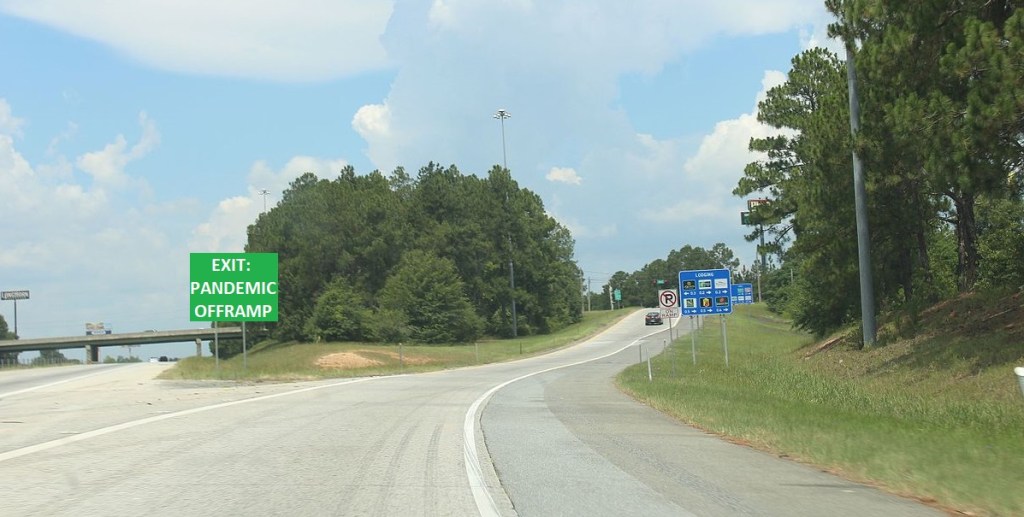
    When will we exit the COVID-19 safety freeway and enter a “pandemic offramp?” Image edited from Michael Rivera / Wikimedia Commons.

    A couple of weeks ago, I received a reader question from a friend of mine who recently got engaged! He and his fiancée are planning a wedding in summer 2023, and he asked me: “How likely do you think it is that (1) the COVID-19 pandemic remains a serious danger to our safety in the summer of 2023 and (2) the government still has the energy to keep enforcing COVID-19 restrictions?” I’m going to tackle these questions one at a time.

    Will the COVID-19 pandemic still be a serious danger to our safety in summer 2023?

    I talked to an epidemiologist last week (for an upcoming story); he pointed out that COVID-19 is incredibly unpredictable—even for the most knowledgeable experts.

    We don’t know why Delta surges appear to dip after two months, for example, or why cases might pick back up again after a decline. We can hypothesize (at least in the U.S.) that cold weather and more indoor gatherings are playing a role in the current beginnings-of-a-surge, but that’s a hypothesis. And there are plenty of other questions we’re still working to answer about the coronavirus, from why some people are superspreaders to how the virus can cause symptoms that last over a year.

    So, it’s hard for me to say whether we’ll see more COVID-19 surges after the one that seems likely this winter, or what those surges will look like—whether we can stave off most severe infections with vaccinations (and booster shots), or whether hospitals will become overwhelmed yet again.

    At the same time, we know that the vaccines are very good at protecting people from COVID-19. Three-dose series (and two-dose series with Johnson & Johnson) are especially good at protecting people, including from infection, transmission, severe disease, and Long COVID.

    These incredible vaccines were developed based on early coronavirus strains, identified in China in early 2021. And they’re still working great against pretty much all variants. In the past couple of months, I’ve asked several experts what they think future variants might look like; and the consensus is that new mutations basically will arise from Delta at this point. The virus could get more contagious (as we saw with AY.4.2), but it seems unlikely that it would evolve to evade vaccine-induced immunity.

    Here’s Senjuti Saha, a sequencing expert from Bangladesh (whom I interviewed for my Popular Science story on global vaccine equity), discussing this issue:

    If we let infections hang around for too long without protecting people, without decreasing the burden of infection, it would not be surprising at all [if we see] newer variants. Will this be just a more concerning mutant of Delta? It’s possible. But it also could be something completely new that we’re not able to predict at the moment.

    But I think it’s also very, very hard for us to get a new variant that will evade all vaccines. With the number of vaccines we have, we can really vaccinate many, many new people very, very quickly. I think no matter what variant comes, we will be able to bring it under control.

    Of course, as far as I know, nobody saw a variant as contagious as Delta coming—so this could be overly optimistic. Again, there’s still a lot we don’t understand about this virus!

    Will the government still enforce COVID-19 restrictions in summer 2023?

    This second part of my friend’s question gets at a concept called “pandemic offramps,” which I’ve seen discussed a lot in COVID-19 scientist circles recently. The idea is, essentially, we need to decide how to get off the current freeway of COVID-19 safety and resume some kind of “normal life.”

    The New York Times recently devoted its morning newsletter to this concept, asking when Americans will stop needing to “organize their lives around COVID-19.” The newsletter argued that vaccinated people already accept risk that’s comparable to COVID-19 in other ways, such as driving in cars.

    But this piece drew criticism for suggesting that the U.S. loosen restrictions more when a new surge is approaching, more than 1,000 Americans are dying of COVID-19 every day, and billions around the world are still unvaccinated.

    We’re clearly not anywhere close to the “end of the pandemic” right now. But at some point, our leaders will need to answer some questions, such as: When are masks no longer necessary in public spaces? What about rigid vaccination checks, or regular testing for certain schools and businesses?

    In a recent article for The Atlantic, Sarah Zhang argues that the U.S. needs to agree on a new COVID-19 goal. We’re no longer striving for 70% of adults to get vaccinated by July 4, so what are we striving for? Is there a vaccination threshold that we can label “herd immunity,” or a daily case threshold that would signify the ability to loosen restrictions?

    Since public health systems in the U.S. are so fragmented, these questions likely won’t be answered all at once for everyone, but will be answered individually—by states, cities, school districts, businesses, and other institutions. New Mexico has already done this, to a certain extent, with a tiered system that helps counties add or remove COVID-19 safety measures based on outbreak levels.

    And of course, in some states, it seems like leaders have already decided that any level of COVID-19 cases is acceptable, as long as businesses stay open. We can see other (less conservative) leaders go in this direction, too, with the popularization of booster shots rather than, say, implementing new mask mandates.

    So, my TL;DR here is: I think serious restrictions on the level of wedding cancellation are pretty unlikely. Rather, the wedding venue might require vaccines, maybe including booster shots (possibly even multiple rounds of booster shots!). Maybe it will require COVID-19 tests or masks indoors, or the wedding planners might want to impose such precautions themselves for the safety of their guests.

    Personally, I hope that by summer 2023, we can at least buy rapid tests in bulk at Costco.
  • Thinking about COVID-19 risk as winter approaches

    Thinking about COVID-19 risk as winter approaches

    I recently received a question from a COVID-19 Data Dispatch reader that followed a similar theme to many questions that readers, friends, and family members have asked me in the past few months. The question essentially outlined an event in the reader’s personal life that they’d been invited to attend, and asked for my advice: should they go? How risky was this event?

    I have a hard time answering these types of questions directly, because I am no medical expert—I’m far from qualified to give direct advice. Instead, I like to outline my own attitudes towards risk at the pandemic’s current moment, and try to explain what I might do in that situation.

    Right now, this type of decision-making feels harder than ever before. The majority of Americans are fully vaccinated, and we know how well the vaccines work. A growing number of Americans are getting booster shots, which we know are highly protective for seniors (and at least seem to reduce infection risk for others). So many of us are tired of the pandemic, and want to have a normal holiday season this year.

    But at the same time, I feel an impetus to stay cautious—to protect the people around me as much as I can—as COVID-19 cases start to rise again in New York City, where I live, and in many other places around the country. 

    It’s also important to note here that everyone has a different risk comfort zone right now, partially as a product of a dearth of local and federal safety regulations at this point in the pandemic. If you’re fully vaccinated, and you’re comfortable hanging out inside with a large group of fully vaccinated people, there is evidence to suggest that is a largely safe situation for you. But if you’re not comfortable at such an event, there is also evidence to suggest that you may be able to pick up the coronavirus (even from a fully vaccinated crowd) and bring it back to someone who is more vulnerable than you are. Every choice comes with a calculation—what risk are you willing to bring to yourself and to those around you? 

    With all of that in mind, there are a few things I consider when I try to decide how “risky” an event might be. First of all, I still consider outdoor events to be very safe; the benefits of open air, wind, and sun far outweigh Delta’s high capacity for transmission. Then, for indoor events, I think about a few different layers of safety measures:

    • Will everyone be fully vaccinated?
    • Will negative COVID-19 tests be required before the event?
    • Will masks be required?
    • Will windows be open, or will ventilation in the space otherwise be high-quality?
    • What are the COVID-19 case numbers in the surrounding county; are they above or below the CDC’s “substantial transmission” threshold (50 total new cases for every 100,000 people in the past week)?

    When at least three of these five conditions are met, I personally would consider an event safe for attendance. When fewer than three conditions are met, I tend to add additional layers of protection for myself and others in my immediate community by wearing a high-quality mask and getting tested before and after. (I might use an at-home rapid test or a PCR test, depending on how much security I want in that test result.

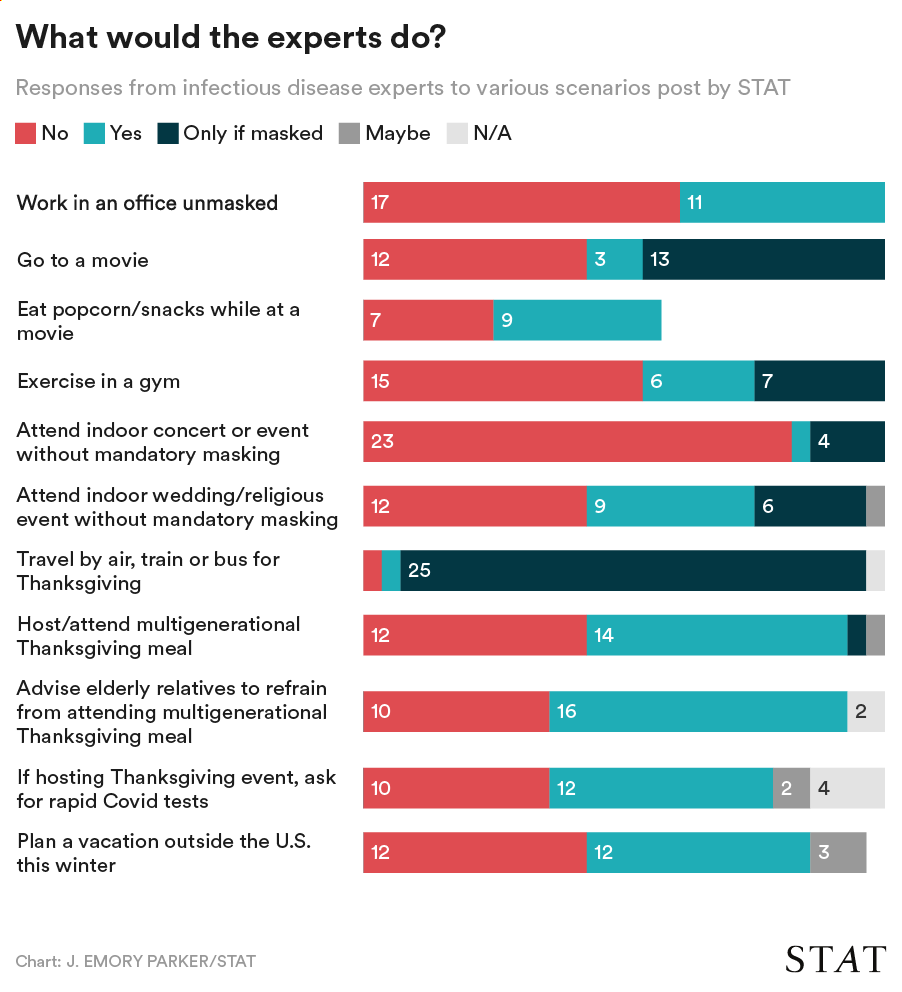
    STAT News surveyed 28 infectious disease experts on activities they would currently feel comfortable doing. Chart via STAT.

    Finally, if you’d rather listen to the insights of some high-profile COVID-19 experts than to me, I’ve got a source for you: STAT News recently surveyed 28 infectious disease experts on which activities they would feel comfortable doing right now. The responses to STAT’s survey reveal a diversity of risk comfort levels, even among people who are incredibly well-informed about the pandemic.

    The vast majority of experts said they would travel by air, train, or bus for Thanksgiving (mostly with a mask on), and the majority said they would not attend an indoor concert or event without mandatory masks. Other than that, all the questions are fairly split. The article (which I recommend reading in full!) includes a number of insights from those experts explaining their survey responses.

  • Send me your holiday COVID-19 questions

    It’s been about one year since I wrote the post, “Your Thanksgiving could be a superspreading event.” This post, inspired by a question I received from a reader, explained that a superspreading event occurs when one person infects many others with the coronavirus in a short period of time. I also went over how we identify these events and where they tend to occur—typically in crowded, indoor, poorly ventilated settings where people are packed together for long periods of time.

    I ended the post by arguing that Thanksgiving celebrations, along with transportation and other activities along the way to those celebrations, could potentially become superspreading events. This year, the risk of spreading COVID-19 at a holiday gathering is still present—but for many gatherings, it’s much more manageable thanks to vaccines.

    If you’re planning a holiday gathering this year, here are a couple of resources I’d recommend:

    • Upcoming holiday season (Your Local Epidemiologist): In this post, Dr. Katelyn Jetelina goes through a couple of different potential scenarios for holiday gatherings based on vaccine levels. If everyone is fully vaccinated, she writes, “approach the celebration like we did before the pandemic.” If not, more safety layers—such as encouraging new vaccinations, testing, and ventilation—may be useful.  
    • Preparing for the holidays? Don’t forget rapid tests for COVID-19 (Harvard Health Publishing): This article, by Dr. Robert Shmerling, focuses more on the role of COVID-19 tests; Shmerling suggests that holiday hosts may offer rapid tests as guests arrive, or require a PCR test as a prerequesite to the gathering. He acknowledges, however, that rapid tests are currently pricey in the U.S. and come with other caveats.
    • What 5 health experts advise for holiday travel this year (Washington Post): For the unvaccinated, “your recommendations are identical to what they were last year,” Ohio State University’s Iahn Gonsenhauser told WaPo. But for the vaccinated, travel and gatherings are safer; the experts quoted in this article recommend asking about the vaccination status of other holiday guests, packing rapid tests, and making a backup plan in case someone tests positive.

    But even the best resources cannot cover every possible scenario. So, I’d like to open this up for reader questions: What do you want to know about COVID-19 as we head into the 2021 holiday season?

    To send me a question, simply comment below. You can also email me (betsy@coviddatadispatch.com) or hit me up on Twitter or Facebook.

  • 12 Long COVID stats that demonstrate the importance of vaccination

    12 Long COVID stats that demonstrate the importance of vaccination

    Long COVID patients may suffer from about 100 different possible symptoms. Chart via Patient-Led Research Collaborative.

    Last week, one of the reader questions I answered addressed Long COVID, the condition in which people have COVID-related symptoms for weeks or months after their initial coronavirus infection. One reader had asked about monitoring for Long COVID patients (also called long-haulers); I later received another question about the risks of Long COVID after vaccination.

    These questions made me realize that I’ve devoted very little space to Long COVID in the COVID-19 Data Dispatch—even though I consider it one of the biggest COVID-19 data gaps in the U.S. Though it’s now been well over a year since the first Long COVID patients were infected, there is still so much we don’t know about the condition.

    For example, we don’t know a very rudimentary number: how many people in the U.S. are struggling with Long COVID. We also don’t have a clear, detailed picture of Long COVID symptoms, or how these symptoms arise from a coronavirus infection, or how they impact the daily lives of Long COVID patients.

    Why does this massive data gap exist? Long COVID studies are challenged by the lack of standardized patient data in the U.S., making it difficult to identify symptom patterns across large groups of people. We face a similar problem in tracking breakthrough cases, demographic information, and other COVID-19 trends.

    Plus, thanks to limited COVID-19 testing in the U.S. throughout the pandemic (and restrictions on who could get tested, back in spring 2020), a lot of Long COVID patients never had a positive test result—making it difficult for them to get a formal diagnosis. And many of the Long COVID studies that have been conducted focus on patients who had a positive COVID-19 test or were hospitalized for the disease, thus narrowing much of our clinical data to a small subset of the actual Long COVID population. 

    As I noted last week, the National Institutes of Health (NIH) has set up a major research initiative to study Long COVID. This initiative, called RECOVER, is poised to become our best source for Long COVID data in the future. But it’s in early stages right now, beginning to distribute funding to different research groups and recruit Long COVID patients for study. It could be years before we get results.

    All of that said, there are still a few things we know about Long COVID based on research thus far. Here’s a roundup of twelve key statistics.

    • Between 10% and 30% of coronavirus infections lead to Long COVID. This statistic comes from the NIH’s RECOVER Initiative website; it summarizes findings from past studies. Consider: 30% of the 44.2 million Americans with a documented COVID-19 case amounts to 13.3 million people with Long COVID. Even 10% of those 44.2 million would amount to 4.4 million people.
    • Some studies suggest that as many as one-third of COVID-19 patients may have persistent or returning symptoms. A recent study of electronic health records in the U.S. and U.K., run by scientists at the University of Oxford, suggests that the true share of COVID-19 patients who contract Long COVID is on the higher end of that 10%-30% estimate that the NIH provides. This new study found that 36% of COVID-19 patients (among a sample size of 270,000) had symptoms three and six months after their diagnosis.
    • Long COVID may manifest with over 100 different potential symptoms. There is a Long COVID paper that I personally come back to, whenever I want to see a clear picture of the many ways that this condition can impact patients. The paper, published in The Lancet in July, reports results from a survey of over 3,000 Long COVID patients conducted by the Patient-Led Research Collaborative. According to this survey, Long COVID patients may suffer from about 100 possible symptoms, including systemic, reproductive, cardiovascular, musculoskeletal, immunologic/autoimmune, head/eyes/ears/nose/throat, pulmonary, gastrointestinal, and dermatologic symptoms.
    • Long COVID symptoms may change over time. The Patient-Led Research Collaborative survey found that some patients may have changing symptoms, or relapses brought on by different activities. One very common Long COVID symptom is Post-Exertional Malaise, a condition in which patients experience a relapse after physical or mental exertion, even if that exertion is relatively minor.
    • Some Long COVID patients have been sick for over 18 months. The Patient-Led Research Collaborative survey covers symptoms over a course of seven months, but some Long COVID patients have been suffering for far longer. Some patients who initially contracted the coronavirus in spring 2020, during the first wave in the U.S., have now been sick for 18 months or more.
    • Many Long COVID patients are unable to work. According to the Patient-Led Research Collaborative survey, almost half of the Long COVID patients who responded (45%) “required a reduced work schedule, compared to pre-illness.” Another 22% were not working at the time of the survey because of Long COVID. Other studies have backed up the findings from this survey. At this point in the pandemic, some Long COVID patients are struggling to receive accommodations from their employers, even though the condition is recognized as a disability at the federal level.
    • Long COVID can occur at all age ranges, but is documented most in younger and middle-age adults. Among respondents to the Patient-Led Research Collaborative survey, about 24% were in their thirties, 31% in their forties, and 25% in their fifties—though patients ranged in ages from 18 to over 80. This survey and others have also found that Long COVID seems to be more common for women; this pattern aligns with other post-infectious conditions, like chronic fatigue syndrome and chronic Lyme disease.
    • Long COVID may lead to long-term neurological issues. This past summer at the Alzheimer’s Association International Conference, a few researchers presented findings on Long COVID and Alzheimer’s. Brain scans of COVID-19 patients, along with observations of patients’ prolonged symptoms, suggest that adults who suffer from Long COVID may have an increased risk of Alzheimer’s later in life. Severe COVID-19 patients in their sixties and seventies are already starting to see symptoms matching early-onset Alzheimer’s, one researcher told NPR.
    • Autoimmune response may be one cause for Long COVID symptoms. While scientists are still working to determine exactly how a coronavirus infection may lead to numerous symptoms, research thus far suggests that overreaction of the immune system could be a major player. Some clinicians who work with Long COVID patients have developed treatments based on dysautonomia, medical conditions caused by immune and autonomic nervous system issues.
    • About 5,200 children in the U.S. have been diagnosed with MIS-C, and 46 have died. MIS-C stands for Multisystem Inflammatory Syndrome in Children. The condition follows a COVID-19 infection in rare cases, leading to inflammation of different parts of the body. While this condition is not directly comparable to Long COVID, scientists think it may have similar causes. The condition has disproportionately impacted children of color in the U.S.: out of 5,200 cases, 61% are Black or Hispanic/Latino.
    • The risk of Long COVID is dramatically lower after a breakthrough infection, even if you contract the coronavirus. A recent study published in The Lancet found that vaccinated patients who later had a breakthrough COVID-19 case were about half as likely to report symptoms after four weeks, compared to unvaccinated patients who had a non-breakthrough COVID-19 case. Plus, vaccinated people are already far less likely to contract the coronavirus in the first place, because vaccination reduces risk of infection. Commenting on the study, NIH Director Dr. Francis Collins called it “encouraging news,” though he cautioned that more research is needed on this topic.
    • Vaccination may help alleviate COVID-19 symptoms for Long COVID patients. In addition to reducing one’s risk of developing Long COVID, vaccination can alleviate symptoms for Long COVID patients. A recent preprint, posted online at the end of September, found that Long COVID patients who got vaccinated were about twice as likely to completely recover, compared to unvaccinated patients. “Overall, this study adds to growing evidence that vaccines can improve symptoms and lessen the disease impact in Long COVID,” wrote Long COVID researcher Dr. Akiko Iwasaki, sharing the study on Twitter.

    To me, these Long COVID statistics—along with everything we still don’t know about the condition—provide a strong argument for vaccination. Long COVID can impact people who were young and healthy before they were infected, completely messing up their lives for months or even years. It surprises me that public health and political leaders don’t discuss this condition more when they tell people to get vaccinated.

    As for continued research: the NIH’s RECOVER Initiative has received over $1 billion in funding from Congress, and it’s just getting started on setting up studies. If you’re interested in learning more about the research—or signing up to participate in a RECOVER study—you can sign up for email alerts on the NIH website. 

  • Answering readers’ COVID-19 questions

    Editor’s note, Jan. 3, 2021: On Nov. 1, 2020, I ran a Q&A thread on Substack in order to answer readers’ questions in the lead-up to the U.S. election.

    Thank you to everyone who asked questions in the thread today. I appreciated the chance to hear about your current COVID-19 concerns, and I got a few ideas for future issue topics. I hope that my answers were useful.

    Here’s one question which I wanted to broadcast to everyone:

    Ross asked: Hi Betsy—long time reader, first time asker. Have we seen significant spikes in COVID in connection with national holidays, or are spikes largely attributable to other factors? Should we be expecting a Thanksgiving spike? What about an election protest spike?

    My response: Thanks Ross, that’s a good question! First of all, I need to clarify that it’s really hard to find a causal association between case spikes and specific events in the U.S., because our contact tracing apparatus simply isn’t up to it in most places. We can’t conclusively find out how many people were infected at a given event or location unless we can test all of them and get those test results to a central location and adjust for confounding factors, like other events that people attended/traveling they did. There have been a few scientific studies that look for these associations (Stanford University researchers recently published a paper about Trump rallies, for example) but largely it is difficult to make these conclusions as events are ongoing.

    That being said, the COVID Tracking Project has noted case spikes in the South after Memorial Day, which occurred when many states were loosening lockdown orders. It’s important to note here that these kinds of case spikes are usually delayed; it takes a couple of weeks for people to notice symptoms and get tested (causing cases to spike), and then another week or two for hospitalizations to spike, and then another week or two after that for deaths to spike. (Caroline Chen has explained this lag for ProPublica.) But to answer your question of whether experts are expecting a Thanksgiving spike: yes, they definitely are. Here’s Fauci talking about it, from a couple of weeks ago.

    And as for protests—this is also difficult to say for sure, as it is difficult to even estimate how many people attend a protest, let alone to test and contact trace them all. But, to my knowledge, no protest has been a superspreader event so far. Health experts cite the fact that protests are usually outside and have high mask compliance as a possible reason why they have not proven to be as risky as, say, Trump rallies.

    And one more:

    Martha asked: Hi Betsy, In this time of pandemic fatigue, I am interested in rankings of reasonable activities to keep some economic sectors going without becoming part of the problem (i.e. infected). What are your favorite (or a favorite) source that ranks activities? Do you know of any detailed studies that gets at nuances (with my pod vs. with people not in my pod)?

    My response: Maryn McKenna has actually written a great story about COVID-19 risk charts, including the strengths and weaknesses of a couple of widely-cited resources. It has been a couple of months since this story, though, and since then, more interactive resources have popped up. One that I like is the microCOVID project, which estimates your risk based on your location, the number of people you’ll be seeing, mask types, and more. Another resource, which I’ve cited in the newsletter before, is Georgia Tech’s COVID-19 Event Risk Assessment Planning Tool. This tool is simpler, but it gets very precise about the risk levels in your state and county.

    I haven’t seen specific studies that get at the nuances of risk levels inside/outside of a pod, largely because I think this is a hard thing for epidemiologists to track. (America! Bad at contact tracing!) But I will say that it is important for you to be clear and realistic about who is in your pod. For example, I live with three roommates in Brooklyn. I sometimes visit my sister, who lives in Manhattan. Two of my roommates are commuting to their respective offices on reduced schedules. So, if one of my sister’s roommates tests positive for COVID-19, that means that, depending on the timing, I, and all of my roommates, and all of my roommates’ coworkers should consider that we may have been exposed. The bigger your pod, the more regular testing can help assuage these types of concerns.

    My comment sections are always open for questions about the week’s issue. Or, if you would like to use a less public platform, you can hit me up at betsy@coviddatadispatch.com.

  • How many COVID-19 cases are actively circulating in your community?

    This section was inspired by a question my friend Abby messaged me yesterday. She asked:

    How come there don’t seem to be any stats on active cases? Obviously it’s important to track new cases, but what I mostly want to know is, what is the likelihood that, if I run into someone on the street, they have COVID-19, and it doesn’t seem like new cases tells me that.

    In response, I explained that active cases are pretty difficult to track in a country that hasn’t even managed to set up robust contact tracing at national or state levels. To keep tabs of active cases, a public health department would essentially need to call all infected people in its jurisdiction at regular intervals. Those people would need to answer questions about how they’re doing, what symptoms they have, and if they had gotten tested recently. This type of tracking might be doable for some smaller counties, but it’s challenging in larger counties, areas with swiftly rising COVID-19 case counts, areas without sufficient testing capacity, areas with health disparities where some residents aren’t likely to answer a call from a contact tracer… you get the idea.

    But it’s still possible to model how many people sick with COVID-19 are likely present in a community at a given time. Epidemiologists and statisticians can use a region’s new case rate—the number of people recently diagnosed with COVID-19—and other COVID-19 metrics, along with population density and demographic information, to estimate how many people in that region are currently infected. A recent analysis in the New York Times used this type of method to estimate how many infected students might come to schools across the country.

    If you’d like to see the likely infection rate in your area, check out the COVID-19 Event Risk Assessment Planning Tool developed by researchers at the Georgia Institute of Technology and Applied Bioinformatics Laboratory. Select a state and an event size, and the tool will tell you how likely it is that someone sick with COVID-19 is at this event. For example, at a 50-person event in New York: 2.2% risk. At a 50-person event in Florida: 21.3% risk.