Tag: race data

  • New, shareable graphics from the COVID Racial Data Tracker

    New, shareable graphics from the COVID Racial Data Tracker

    Twice a week, the COVID Tracking Project’s COVID Racial Data Tracker compiles and standardizes demographic data from every U.S. state and territory. I am intimately familiar with this work because I’m one of those volunteers. I watch the numbers tick up and, inevitably, paint a clear picture of how centuries of racism have left people of color more vulnerable to this pandemic.

    This week, the COVID Tracking Project’s web design team launched a new feature that makes our demographic data more accessible to readers. It’s called Infection and Mortality by Race and Ethnicity: simply click on a state or territory, and the feature will return a chart that compares COVID-19 cases and deaths to that region’s population.

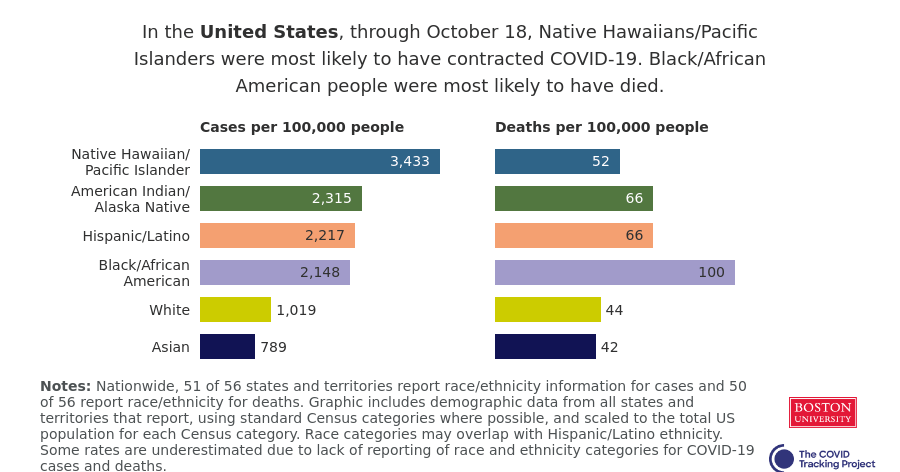
    Here’s the chart for the U.S. as a whole:
    Adjusting case and death values by population makes it much easier to see disparity. For example, while Native Hawaiians and Pacific Islanders are a relatively small fraction of America’s population, they are much more likely to contract the novel coronavirus. Meanwhile, Black, Hispanic/Latino, and indigenous Americans are more likely to die of the disease.

    These charts are easy to share on Facebook, Twitter, and Instagram, and the graphics will be updated automatically when our data updates twice a week. Volunteers who work on this part of the Project are hoping that these charts can make it easier for people to draw attention to COVID-19 disparity in their communities, as well as to the data that are still missing in many states. For example, here’s me yelling about New York.

    Check out the chart for your state, and if you feel compelled, share it. We need people talking about these data in order to drive change. (Also: shout-out to product lead Neesha Wadhwa and other design folks working behind the scenes at the COVID Tracking Project who made these charts possible!)

  • COVID source callout: West Virginia

    I have issues with West Virginia’s race data.

    First, West Virginia insists on reporting COVID-19 cases assigned to racial categories which do not exist. Two weeks ago, this was a category labeled, “Asian; Black or African American; White.” Last week, this was a category labeled, “Native Hawaiian or Other Pacific Islander; White.” The categories are particularly curious because WV usually only reports their cases according to three race categories: White, Black, and Other.

    (These extra categories have since disappeared from WV’s COVID Dashboard.)

    Relatedly, WV’s race data for cases is listed in a rather unintuitive location on the state’s dashboard: on a page labeled “County Summary.” If you did not look closely, you would think they weren’t reporting demographic data at all.

    And finally: WV used to report demographic information for deaths due to COVID-19 which occurred in the state. This information has not been reported since May 20. Sure, WV’s outbreak has been relatively small (with a total of 5,887 cases and 103 deaths as of July 26), but this is no excuse for failing to report the impacts of this outbreak on marginalized communities. According to CRDT figures, Black West Virginians make up 4% of the state’s population, but comprise 8% of its COVID-19 cases. To present a complete picture, the state should report death counts as well as the impacts of COVID-19 on other racial groups.

  • Featured sources, July 26

    These sources, along with all others featured in forthcoming weeks, are included in the COVID-19 Data Dispatch resource list.

    • The COVID Racial Data Tracker, by the COVID Tracking Project: COVID-19 is killing Black Americans at 2.5 times the rate of white Americans. The COVID Racial Data Tracker (or CRDT) keeps tabs on this disparity and others by collecting case and death counts, broken down by race and ethnicity, from state COVID dashboards. Our dataset is updated twice a week. And I say “our” because I work on this dataset; I’m happy to answer questions about it (betsyladyzhets@gmail.com).
    • Excess deaths associated with COVID-19 (U.S.): One dataset which the CDC hasn’t stopped publishing is a tally of the death toll in the U.S., including deaths which may be directly or indirectly related to the pandemic but have not been reported due to insufficient testing. The dataset is updated weekly, and you can see figures broken down by state and different demographic factors.
    • Excess deaths associated with COVID-19 (international)The Economist compiles a similar dataset to the CDC, tracking excess deaths in countries and cities around the world. You can read about and see visualizations based on these data here.