Tag: October data

  • National numbers, October 24

    National numbers, October 24

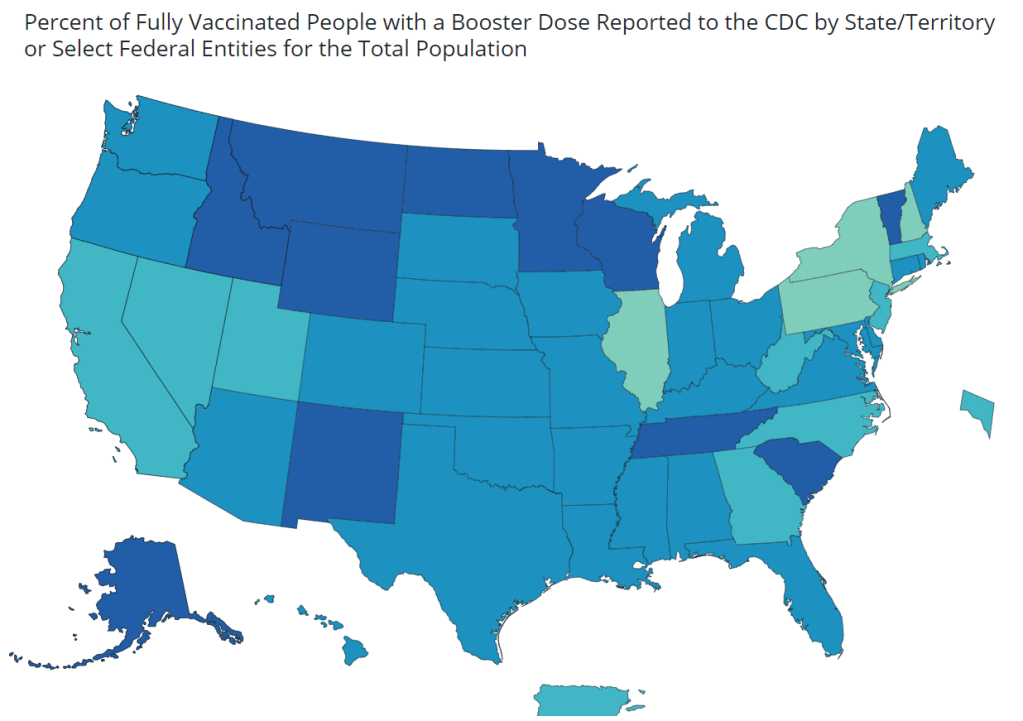
    As of October 22, the CDC is reporting booster doses administered by state. Darker blue corresponds to a higher share of the fully vaccinated population in the state that has received a booster; lighter blue/green corresponds to a lower share of the population.

    In the past week (October 15 through 21), the U.S. reported about 510,000 new cases, according to the CDC.* This amounts to:

    • An average of 73,000 new cases each day
    • 156 total new cases for every 100,000 Americans
    • 14% fewer new cases than last week (October 9-15)

    Last week, America also saw:

    • 42,000 new COVID-19 patients admitted to hospitals (13 for every 100,000 people)
    • 9,000 new COVID-19 deaths (2.7 for every 100,000 people)
    • 100% of new cases are Delta-caused (as of October 16)
    • An average of 800,000 vaccinations per day (including booster shots; per Bloomberg)

    *Note: This week’s update relies on data as of Thursday, October 21. I usually use Friday data (via the COVID Data Tracker Weekly Review), but was unable to do so this week because I headed offline for a hiking trip before the Friday data were posted. We’ll be back to the usual sourcing next week!

    Nationwide, COVID-19 cases continue to go down—slowly but surely. We’re now seeing roughly 70,000 new cases a day, comparable to case counts when the Delta surge started to really pick up at the end of July. It’s worth noting, though, that this is still higher than the peaks of both the spring and summer 2020 surges.

    At the state level, more parts of the country are approaching lower coronavirus transmission levels. As of Thursday, eight jurisdictions have dropped below 100 new cases per 100,000 people in the past week. From lowest case counts to highest, these are: California, Hawaii, Florida, Louisiana, Washington D.C., New Jersey, Maryland, and Mississippi.

    Alaska, Montana, and Wyoming remain the states with the highest COVID-19 rates, followed by Idaho and North Dakota. These states are all in northern parts of the U.S.—and their recent case increases have coincided with cold weather—the Washington Post and other outlets have noted. Other states may see similar COVID-19 upticks as it becomes too cold to socialize outdoors.

    Booster shots continue to inflate vaccination numbers, as these third doses comprise between one-third and one-half of doses administered in the U.S. each day. Over 11 million people have already received a booster dose—more than the total doses administered in a number of low-income countries.
  • National numbers, October 17

    National numbers, October 17

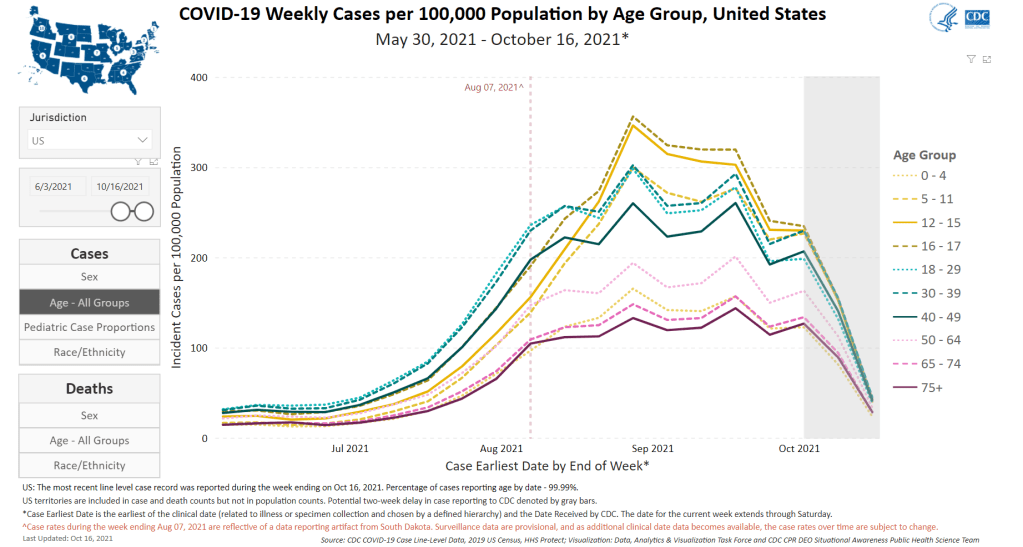
    Cases are going down for all age groups, but children continue to have high COVID-19 rates. Chart from the CDC.

    In the past week (October 9 through 15), the U.S. reported about 600,000 new cases, according to the CDC. This amounts to:

    • An average of 85,000 new cases each day
    • 180 total new cases for every 100,000 Americans
    • 13% fewer new cases than last week (October 2-8)

    Last week, America also saw:

    • 47,000 new COVID-19 patients admitted to hospitals (14 for every 100,000 people)
    • 9,000 new COVID-19 deaths (2.7 for every 100,000 people)
    • 100% of new cases are Delta-caused (as of October 9)
    • An average of 700,000 vaccinations per day (including booster shots; per Bloomberg)

    COVID-19 cases continue to drop across the U.S., slowly but surely. We’re now reporting about 85,000 new cases a day, down from 97,000 new cases a day last week, down from 108,000 new cases a day the week before last.

    Hospitalizations and deaths are falling nationwide as well. About 57,000 Americans are currently hospitalized with COVID-19, down 12% from last week. And about 1,200 people are dying from the disease each day, the vast majority of them unvaccinated.

    Still, most states continue to experience “high transmission,” per the CDC’s categories. Hawaii, Florida, and Alabama, three states that saw intense Delta surges in recent months, have now joined California and Connecticut in crossing the threshold to “substantial transmission”—with under 100 new cases for every 100,000 people in the past week, according to the latest Community Profile Report.

    Alaska, Montana, and Wyoming remain the most intense hotspots, with over 500 new cases for every 100,000 people in the past week. In Alaska, hospitals are still in crisis mode, with doctors forced to choose which patients they must prioritize for care. All three states are seeing case rates decrease, though, indicating that they may be past the peak of their surges.

    While cases among children are trending slightly downward as well, the number remains much higher than at other points in the pandemic. In the week ending October 7, cases among children represented about one in four COVID-19 cases reported in the U.S., according to the American Academy of Pediatrics.

    Vaccinations continue to be dominated by booster shots, with boosters making up between one-third and half of the doses administered each day this week. Already, 14% of U.S. seniors have received a booster dose, according to the CDC. 5% of the US population overall has received a booster dose. These numbers will only increase as Moderna and J&J boosters are authorized, following FDA advisory committee recommendations. (More on that later in today’s issue.)

  • National numbers, October 10

    National numbers, October 10

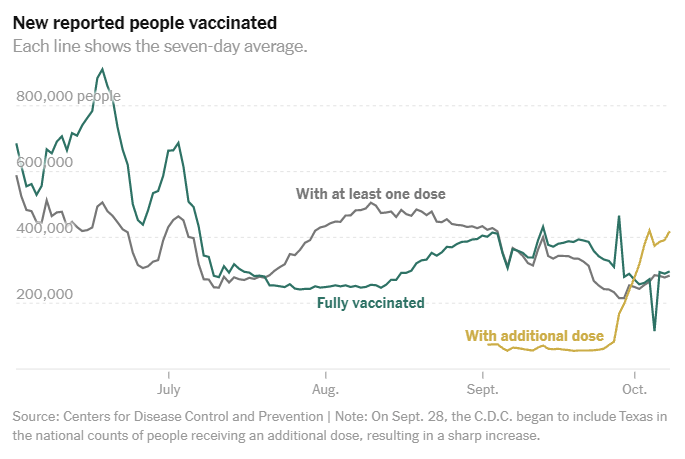
    The U.S. is now administering about one million vaccine doses a day, largely thanks to eligible Americans receiving their booster shots. Chart via the New York Times.

    In the past week (October 2 through 8), the U.S. reported about 670,000 new cases, according to the CDC. This amounts to:

    • An average of 95,000 new cases each day
    • 204 total new cases for every 100,000 Americans
    • 12% fewer new cases than last week (September 25-October 1)

    Last week, America also saw:

    • 52,000 new COVID-19 patients admitted to hospitals (16 for every 100,000 people)
    • 10,000 new COVID-19 deaths (3.1 for every 100,000 people)
    • 100% of new cases are Delta-caused (as of October 2)
    • An average of one million vaccinations per day (including booster shots; per Bloomberg)

    At the national level, COVID-19 cases continue to go down. The U.S. is now seeing fewer than 100,000 new cases a day, and about 62,000 Americans are currently hospitalized with COVID-19—a 14% drop from last week. 

    It may feel like the Delta surge is now “over,” but case rates are still incredibly high across the country compared to what we saw earlier this summer. California and Connecticut continue to be the only two states with “substantial” transmission, according to the CDC. Every other state has “high” transmission, meaning over 100 new cases for every 100,000 people in the past week.

    Alaska remains the country’s biggest hotspot, with over 800 new cases for every 100,000 people in the past week, per the latest Community Profile Report. Case numbers have dropped a bit since last week—when Alaska hit the highest per-capita COVID-19 case rate of any state during the entire pandemic thus far—but the state’s hospitals are still incredibly overwhelmed. Doctors are rationing care, unable to send most patients on hours-long trips to Washington state.

    Other Midwestern states continue to face Delta surges, including Montana, North Dakota, Wyoming, West Virginia, and Idaho. All five states have COVID-19 case rates over 500 new cases per 100,000 people in the past week.

    Vaccination numbers are going up nationwide, with over one million doses administered each day in the past week. But there’s a key caveat here: many of these doses are booster shots. On Saturday, for example, the CDC reported 1.15 million new doses—including over 500,000 booster shots. The number of people receiving their first doses is the lowest it’s been in months.