Tag: NWSS

  • Wastewater data gap follow-up: an update from Biobot

    Wastewater data gap follow-up: an update from Biobot

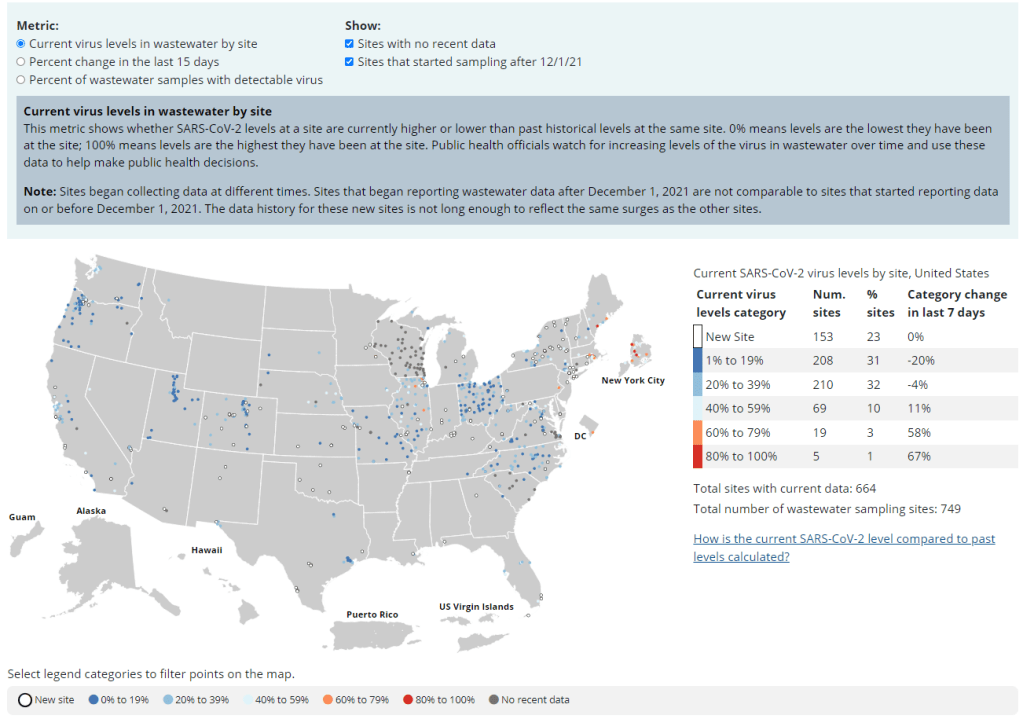
    Quite a few sites on the CDC NWSS dashboard are still not reporting recent data, but Biobot is working to bring them online.

    Last week, I pointed out a data gap on the CDC’s National Wastewater Surveillance System (NWSS) dashboard: hundreds of sewershed sites on the dashboard have not been updated with recent data in weeks.

    In this post, I hypothesized that the gap was likely a result of a shift for NWSS, as the CDC has switched from a contract with testing company LuminUltra to a contract with Biobot. In both cases, the outside company had been hired to conduct wastewater sampling and analysis for sites that don’t have capacity to do this themselves; as NWSS transitioned between testing providers, some sites were left without recent data.

    This week, I’m excited to share an update on the situation, courtesy of Becca Malizia, Biobot’s science communication manager, who reached out after seeing last week’s post. Below, you’ll find more details on the recent data gaps and Biobot’s new relationship with the CDC.

    Malizia confirmed that the transition between LuminUltra and Biobot has led to delays in wastewater data availability for some sites in the NWSS network. She pointed me to a footnote on the CDC dashboard, labeled “May 2022 Coverage Limitations”:

    Beginning April 15, 2022, approximately 150 wastewater sites in 29 states began transitioning to a new wastewater testing provider. During this transition, these sites will not have recent data displayed and will be colored gray on the map. It will take several weeks for enough data to be collected to calculate the metrics displayed on this page. Results for these sites are expected to be available again between mid-May and June 2022.

    Now, if the CDC was going for full transparency and ease of dashboard interpretation here, the agency should have placed this important note somewhere more obvious to the average user—not buried at the bottom of the page. But I’m glad to see this public information, including the estimate of when results for the transitioning sites will be available.

    Biobot also acknowledged the data gap in a Tweet on May 19, explaining that the company has experienced issues in distributing testing kits to participating sites:

    Further contributing to data delays, the sewershed sites for which Biobot is now in charge of sampling require a “minimum number of samples” before key metrics on the CDC NWSS dashboard can be calculated, Malizia said. The calculations for these metrics change from one lab to another, so Biobot needs to use data from its protocols rather than data from the prior LuminUltra contract.

    “Sites in the process of switching over from the previous contract may have some lag until there is enough data to do the calculations for the CDC metrics,” Malizia wrote. She also pointed to several other reasons why a sewershed site might collect wastewater data, but not have its data appear on the CDC dashboard, such as: a sewershed serving under 3,000 people, a sewershed serving a specific institution (like a college campus), and a sewershed where local leaders have elected not to send data to the CDC.

    Biobot has already onboarded more than 200 wastewater treatment plants, Malizia said; this includes sites that were previously included in the NWSS contract with LuminUltra, though a full list of those sites is not publicly available. By mid-July, Biobot aims to have 500 sites participating in its CDC program. The company works with state and local health departments to select wastewater sampling sites and coordinate with treatment plants.

    Now, it’s important to note that, outside of its CDC NWSS contract, Biobot coordinates wastewater testing and analysis for hundreds of sewershed sites through a program called the Biobot Network. This program is a public service offering from Biobot: the company does testing and analysis at no cost to sewersheds. But Biobot also does not send individual, sewershed-level data back to the participants. “Rather, the data is aggregated at the county level on our public dashboard (biobot.io/data) for the benefit of policymakers and the general public,” Malizia explained.

    (The free Biobot Network includes two sampling sites in Hillsborough, Florida which used to be paid Biobot customers in 2021, Malizia said, in comments responding to the Tampa Bay Times article I quoted last week. The final reports those sites received when they were paying customers were in August and October of last year. “Individual wastewater treatment plants can choose whether or not to share these reports with local government agencies,” Malizia said.) 

    Before it became a CDC contractor, Biobot was not able to submit wastewater data to the agency. Only state government agencies have access to the CDC NWSS platform used for data reporting, Malizia said; the CDC has made an exception for Biobot under the new contract. To me, this helps explain why there’s not a lot of overlap between Biobot Network sites and CDC NWSS sites, as well as why some other wastewater sampling (done by universities, research institutions, etc.) does not appear on the CDC dashboard.

    But, now that Biobot is a CDC contractor, will the company provide Biobot Network data to the agency? I asked Malizia this question, to which she responded:

    The Biobot Network will remain separate from the NWSS, however sites enrolled for the CDC NWSS Program will also be given the option to opt into the Biobot dashboard.

    In summary: Biobot is working hard to restore data from sites already in the CDC NWSS network and expand that network to more sites that don’t have capacity for wastewater sampling on their own. However, thanks to a combination of CDC bureaucracy and complex public and private data systems, it seems unlikely that we will get a singular dashboard including all wastewater testing sites in the country anytime soon.

    Also, Biobot’s current contract is only for nine months. Are we going to see another round of data gaps next winter, if the CDC decides to switch wastewater testing companies again?
  • More transparency needed on CDC wastewater data

    More transparency needed on CDC wastewater data

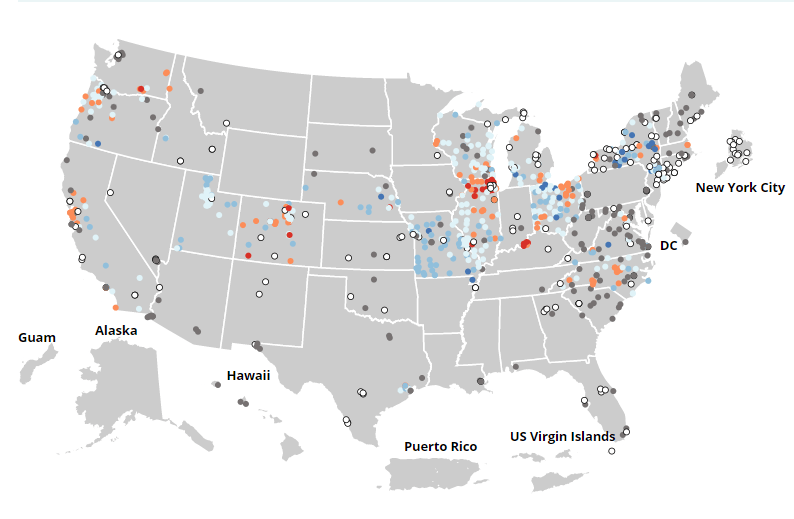
    Why are so many wastewater surveillance sites in the CDC’s network currently labeled as “new sites” (white) or “no recent data” (gray)? Here’s what I believe is going on.

    Update, May 22, 2022: After this post was published, Becca Malizia, Biobot’s science communication manager, reached out to provide some clarification on the current state of wastewater data in the U.S., as well as on Biobot’s relationship with the CDC. See this follow-up post for more details.

    As I mentioned last week: something strange is going on with the CDC’s National Wastewater Surveillance System (NWSS) data.

    Hundreds of sites on the CDC NWSS dashboard have been labeled as showing “no recent data” for a couple of weeks. As a New Yorker, I pay special attention to the New York City sites; twelve sites in the city were actually removed from the dashboard, then re-added as “new sites,” even though researchers in the city have been testing wastewater for the coronavirus since 2020.

    I have yet to do dedicated reporting on this topic, but I wanted to share a bit of information on why I think this is happening. (Please take this with a grain of salt!)

    Last winter, as part of CDC NWSS’ efforts to enable more states and counties across the country to test their wastewater for the coronavirus, the agency contracted with LuminUltra, a biological testing company that has become one of the leading wastewater testers during the pandemic. LuminUltra, in conjunction with NWSS and the Water Environment Federation, was responsible for testing and analyzing wastewater for state and local health departments that wanted to set up this monitoring, but didn’t have internal capacity to do so themselves.

    LuminUltra’s contract expired last month. In its place, CDC NWSS has set up a new contract with Biobot, another leading wastewater contractor, the company announced this week. Biobot will be responsible for collecting and analyzing wastewater data at 500 sites across the country; it’s unclear from the press release how many of these sites were also part of the old LuminUltra contract, but I’m guessing there’s a lot of overlap.

    Here’s the problem, though: LuminUltra stopped testing wastewater at hundreds of NWSS sites last month, but Biobot hasn’t yet resumed testing, data analysis, reporting to the CDC, etc. at all of these locations. As a result, the CDC NWSS dashboard currently includes a number of sites labeled as “new” or “no recent data,” making it difficult to actually use this federal source for evaluating wastewater trends.

    Considering that we’re facing a surge and U.S. case data are less reliable than ever, this is not exactly a great time to have a gap in our wastewater data! (Also, I think that something else may be going on with the New York City sites, but that’s a topic for another post.)

    As I said above, I haven’t done much reporting on this myself yet, but I wanted to share a relevant section from a recent Tampa Bay Times investigation about wastewater surveillance in Florida:

    One of the largest players in the private testing market is Biobot Analytics, an MIT start-up that wants to market the technology.

    Last year the company raised $20 million. It already has contracts with more than 700 municipalities in all 50 states, according to the Boston Globe, including Hillsborough County. But Biobot does not report that data to the CDC. Instead the company shares the data on its website, using its methodology.

    Biobot, which collects data from six Florida counties, said it’s up to local governments to share COVID-19 data with the CDC.

    The company started collecting Hillsborough’s data in June 2021. A county spokesperson said they haven’t received any reports from Biobot.

    The amount of coronavirus detected in Hillsborough’s wastewater has doubled in the past month, according to Biobot’s website. It’s an estimate based on the county’s Northwest Regional Water Reclamation Facility and the city of Tampa’s Howard F. Curren facility.

    It’s unclear if Biobot’s data-sharing policy will affect the nation’s wastewater surveillance program. The company took over the federal program on April 15, when it was awarded a $10.2 million contract to oversee the next year of testing.

    That contract covers 500 utility providers across the country, according to the CDC. But Biobot and the CDC say the company won’t share COVID-19 data from the 700 utilities not covered by the contract.

    I’m elevating this because, first of all, everyone should read the Tampa Bay Times piece—it is excellent local reporting on this issue. And second of all: does this mean that, even as Biobot takes over sampling and analysis for sites in the CDC NWSS network, the Biobot and CDC data systems will not be fully integrated?

    This seems like a major challenge for a data network that is already quite fragmented, and I would love to see more transparency from the CDC on the whole situation. If anyone else is reporting on this or has additional information, please reach out!

    More federal data

  • COVID source shout-out: CDC wastewater dashboard upgrades

    COVID source shout-out: CDC wastewater dashboard upgrades

    The CDC’s updated wastewater dashboard includes more metrics and more context for people seeking to understand wastewater trends in their area.

    After the CDC released its National Wastewater Surveillance System (NWSS) dashboard in February, the agency faced some criticism from scientists, data reporters, and others who found this dashboard didn’t actually do a very good job of presenting wastewater data. The initial dashboard only included one metric, percent change in wastewater levels over the last 15 days; without more context, it was difficult to understand where a high percent change was actually cause for concern.

    But the CDC has responded to its criticism! This past Friday, the agency updated its wastewater dashboard to include a lot more context. Among the changes:

    • You can now toggle between three metrics: the old percent change value, along with current virus levels in a site’s wastewater and the share of wastewater samples at a given site that tested positive for the coronavirus in the last 15 days.
    • Clicking on a specific site provides users with a mini-chart of wastewater levels at that collection spot over the last few weeks.
    • The dashboard lets you toggle on and off sites with no recent data and sites that started sampling during the Omicron wave.
    • Above and below the dashboard, the CDC has added more definitions and explanations to help users understand what they’re looking at.

    On Friday evening, I posted on Twitter, asking wastewater and data viz experts to weigh in on the updated dashboard:

    Responses were mostly positive, with researchers saying that they were glad to see the CDC respond to criticism and add more information to the dashboard. Still, there’s more the agency can do, such as adding the population sizes covered by each site and, maybe, moving away from percentage changes as such a central metric.

    To quote Claire Duvallet, data scientist at Biobot: “I think collapsing all three metrics to have the same units, and to choose percentage as that unit, is very confusing. Percentage changes are already so 🤯 to think about, & percentage changes of categories of percentages is just too much for my brain.”