Tag: November data

  • National numbers, November 27

    National numbers, November 27

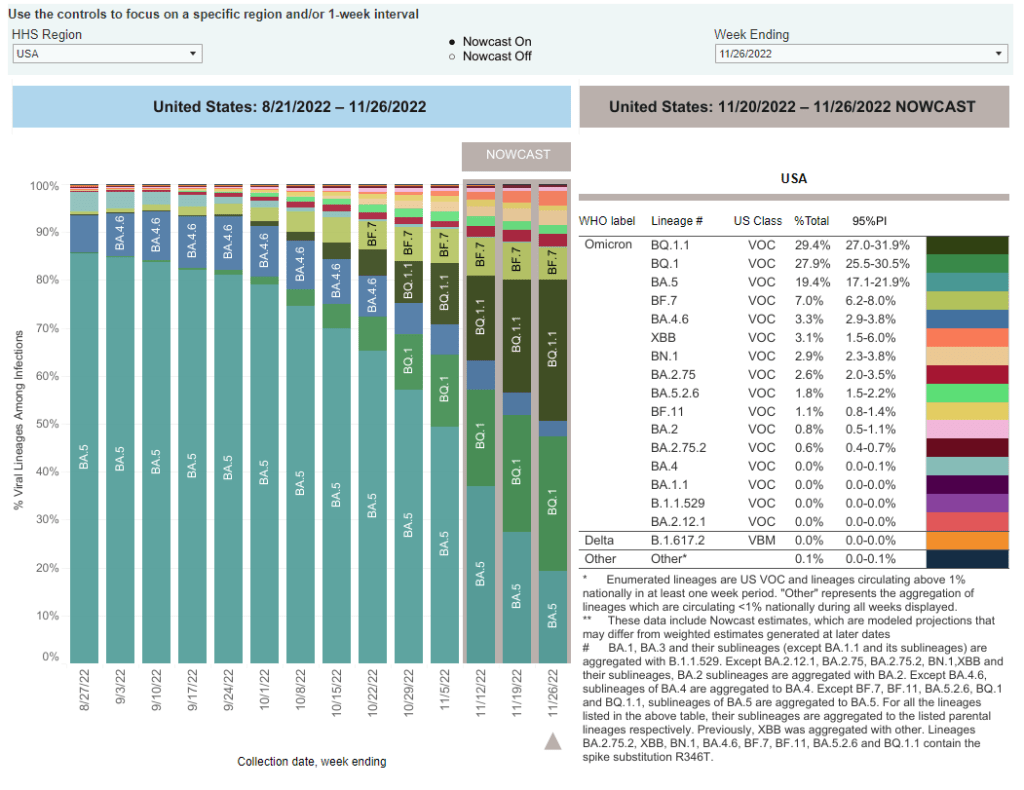
    BA.5 sublineages BQ.1 and BQ.1.1 are now the dominant variants in the U.S., while newer lineage XBB has made an appearance. Chart via the CDC.

    In the past week (November 17 through 23), the U.S. reported about 310,000 new COVID-19 cases, according to the CDC. This amounts to:

    • An average of 44,000 new cases each day
    • 93 total new cases for every 100,000 Americans
    • 8% more new cases than last week (November 10-16)

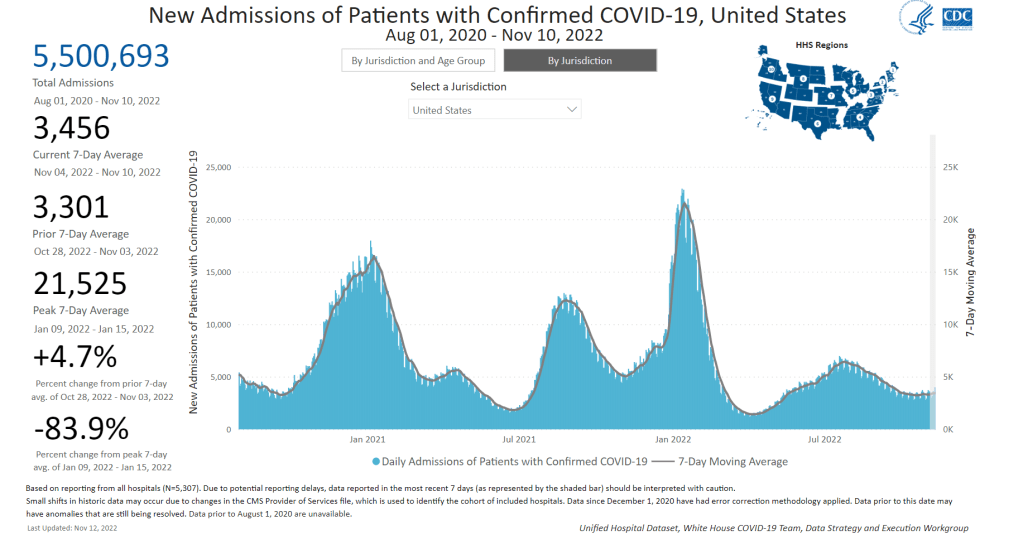
    In the past week, the U.S. also reported about 24,000 new COVID-19 patients admitted to hospitals. This amounts to:

    • An average of 3,400 new admissions each day
    • 7.2 total admissions for every 100,000 Americans
    • 0.2% more new admissions than last week

    Additionally, the U.S. reported:

    • 2,600 new COVID-19 deaths (380 per day)
    • 57% of new cases are caused by Omicron BQ.1 and BQ.1.1; 7% by BF.7; 3% by BN.1;  3% by XBB (as of November 26)
    • An average of 300,000 vaccinations per day

    Nationwide, reported COVID-19 cases went up last week: the CDC reports 8% more cases in the week ending November 23 than in the week ending November 16. Wastewater monitoring also suggests a pre-Thanksgiving uptick, according to Biobot, while new hospitalizations have been at a plateau.

    All eyes will be on wastewater data in the next couple of weeks, to look for potential spread after Thanksgiving travel and gatherings. We likely won’t see any immediate spikes in case data thanks to the data delays that always happen after holidays, but wastewater surveillance is less susceptible to these delays (and less biased by behavioral patterns). To look for wastewater data in your community, see the COVID-19 Data Dispatch’s resource page.

    Any outbreaks we see in the coming weeks will likely be driven by newer coronavirus variants, combining forces with holiday behavior. Omicron subvariants BQ.1 and BQ.1.1 caused about 57% of new COVID-19 cases in the week ending November 26, according to CDC estimates; the BQ lineage is more transmissible than its parent variant, BA.5, though it has not caused major case spikes in the U.S. yet.

    The CDC’s latest variant update also provides estimates on XBB, a subvariant that evolved from BA.2 and that has caused new surges in some Asian countries. XBB caused about 3% of new cases in the last week, the agency estimates, with higher prevalence in the Northeast and West coast. Health officials are closely watching XBB due to the many mutations on its spike protein, but it’s unclear whether this subvariant alone could cause a new surge.

    As we watch for new COVID-19 outbreaks, healthcare systems—especially children’s hospitals— across the country are already facing intense pressure from the flu, RSV, and other respiratory viruses. Many states, particularly on the East coast and in the South, continue to report very high levels of influenza-like activity, according to the CDC

    If you took part in a Thanksgiving gathering over the last few days: this week, you should look out for any respiratory symptoms and consider getting a PCR test, if you can. If possible, get a test that will check for COVID-19, the flu, and RSV at once. Make sure any disease spread stops with you!
  • National numbers, November 13

    National numbers, November 13

    COVID-19 hospitalizations have risen slightly in recent weeks, indicating the start of a fall/winter surge, according to CDC data.

    In the past week (November 3 through 9), the U.S. reported about 290,000 new COVID-19 cases, according to the CDC. This amounts to:

    • An average of 41,000 new cases each day
    • 88 total new cases for every 100,000 Americans
    • 6% more new cases than last week (October 27-November 2)

    In the past week, the U.S. also reported about 24,000 new COVID-19 patients admitted to hospitals. This amounts to:

    • An average of 3,500 new admissions each day
    • 7.4 total admissions for every 100,000 Americans
    • 5% more new admissions than last week

    Additionally, the U.S. reported:

    • 2,300 new COVID-19 deaths (340 per day)
    • 44% of new cases are caused by Omicron BQ.1 and BQ.1.1; 8% by BF.7;  2% by BA.2.75 and BA.2.75.2 (as of November 12)
    • An average of 400,000 vaccinations per day

    We are beginning to see the impacts of colder weather and new variants this week, as both official COVID-19 cases and new hospital admissions went up slightly: increasing by 6% and 5% from the prior week, respectively.

    Wastewater monitoring similarly shows an uptick in coronavirus transmission at the national level, according to Biobot’s dashboard. The Northeast still has the highest virus concentration, but other regions of the country are catching up—particularly the West coast, which reported a significant increase in the last two weeks.

    About half of the wastewater surveillance sites included on the CDC’s national dashboard reported increases in coronavirus transmission over the two-week period ending November 7, with 30% of sites reporting increases of at least 100%.

    Omicron BQ.1 and BQ.1.1 are likely a major source of increased virus spread. These two strains—subvariants of BA.5 that are even more contagious—now account for 44% of new cases in the week ending November 12, according to CDC estimates. New variants tend to have an impact on transmission when they reach about 50% prevalence, so we will likely see more BQ-driven spread in the weeks to come.

    The New York/New Jersey region continues to report the highest amounts of BQ.1 and BQ.1.1: these variants represented about 60% of new cases in the last week. These two states also reported some of the highest (official) case rates in the country last week, along with Puerto Rico, New Mexico, and North Dakota, per the latest Community Profile Report. Cases and hospitalizations in New York City, often a bellwether for the rest of the country, are rising again.

    At the same time, the U.S. is seeing an early and intense flu season. Most of the country’s Southeast region (from Virginia to Mississippi) reported the highest possible levels of influenza-like activity in the week ending November 5, according to the CDC. Flu, COVID-19, and RSV are all straining hospitals as we head into the holiday season.

    The new, Omicron-specific booster shots provide enhanced protection against the latest variants, but uptake remains very low—as shown by new CDC data providing vaccinations by state. Only 10% of the eligible population has received one of the new shots, as of November 9.

  • National numbers, November 6

    National numbers, November 6

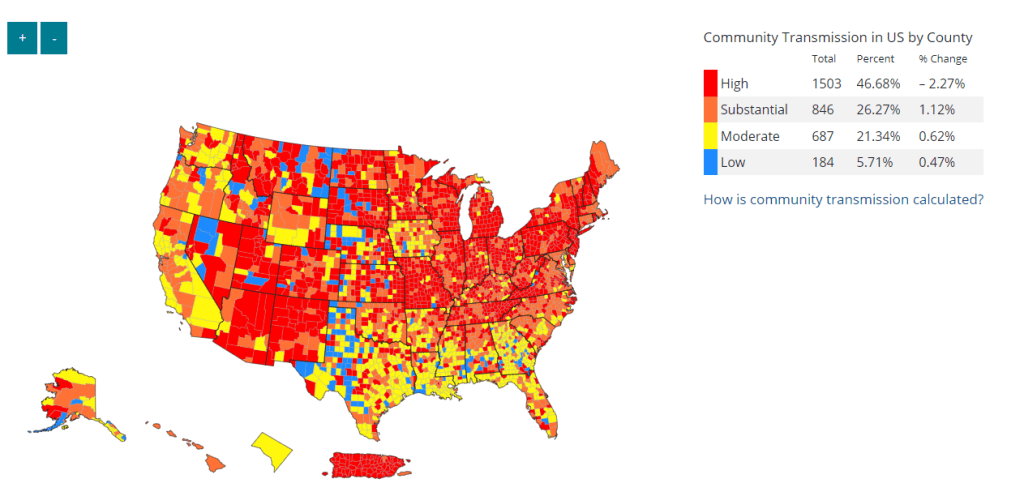
    Despite significant undercounting of COVID-19 cases, the CDC’s Community Transmission Levels (based on case rates and test positivity) are high enough to suggest the majority of the country should be masking. Data here are as of November 2.

    In the past week (October 27 through November 2), the U.S. reported about 270,000 new COVID-19 cases, according to the CDC. This amounts to:

    • An average of 39,000 new cases each day
    • 83 total new cases for every 100,000 Americans
    • 5% more new cases than last week (October 20-26)

    In the past week, the U.S. also reported about 23,000 new COVID-19 patients admitted to hospitals. This amounts to:

    • An average of 3,300 new admissions each day
    • 7.0 total admissions for every 100,000 Americans
    • 1% fewer new admissions than last week

    Additionally, the U.S. reported:

    • 2,500 new COVID-19 deaths (360 per day)
    • 35% of new cases are caused by Omicron BQ.1 and BQ.1.1; 9% by BF.7;  4% by BA.2.75 and BA.2.75.2 (as of November 5)
    • An average of 400,000 vaccinations per day

    Continuing a trend from the last few weeks, nationwide COVID-19 cases and hospitalizations are still at plateaus or trending very slightly downward. We aren’t clearly in a fall surge yet, but concerning newer Omicron subvariants are rising—along with other respiratory diseases.

    National wastewater trends are also still suggesting plateaus or downturns in coronavirus transmission, according to Biobot’s dashboard. The Northeast’s wastewater saw a major drop in coronavirus concentration over the last couple of weeks while other regions are at high, but steady levels.

    As always, it’s important to remember that official case data are significantly undercounted. True infections are likely around 20 times higher than reported cases, though even that factor is difficult to estimate at this point in the pandemic.

    Despite the undercounting, the CDC’s Community Transmission Levels (based on case rates and test positivity) suggest that 75% of U.S. counties are experiencing “high” or “substantial” coronavirus spread. If we had more accurate data, that number would likely shoot up to 100%. In other words, even today’s seemingly-low and underestimated case numbers are still high compared to earlier periods of the pandemic.

    Newer versions of the Omicron variant will likely drive continued COVID-19 spread this fall. BQ.1 and BQ.1.1 have emerged as the most competitive subvariants and are quickly taking over from their parent lineage, BA.5. These two subvariants caused about 35% of new cases in the U.S. in the week ending November 5, according to the CDC’s estimates, while BA.5 caused 39%.

    The BQs are most prevalent in the Northeast, especially New York and New Jersey: these subvariants caused over 50% of new cases in the NY/NJ region last week, according to the CDC. These two states and Connecticut also had the highest per-capita COVID-19 hospitalization rate last week, per the HHS Community Profile Report.

    As hospitals around the country brace for a winter COVID-19 surge, they’re already dealing with high transmission of the flu. Flu hospitalizations have not been as high as they are this season since 2010-2011, the CDC reports. Last week, Washington D.C., Tennessee, South Carolina, and Alabama reported influenza-like illness rates so high that the CDC needed a new map color to express it.

    Even if COVID-19 isn’t (yet) surging in your community, this is a good time to stock up on high-quality masks and rapid tests, and plan holiday gatherings that will keep friends and family members safe. Your Local Epidemiologist has a helpful guide for the latter.

  • National numbers, November 28

    National numbers, November 28

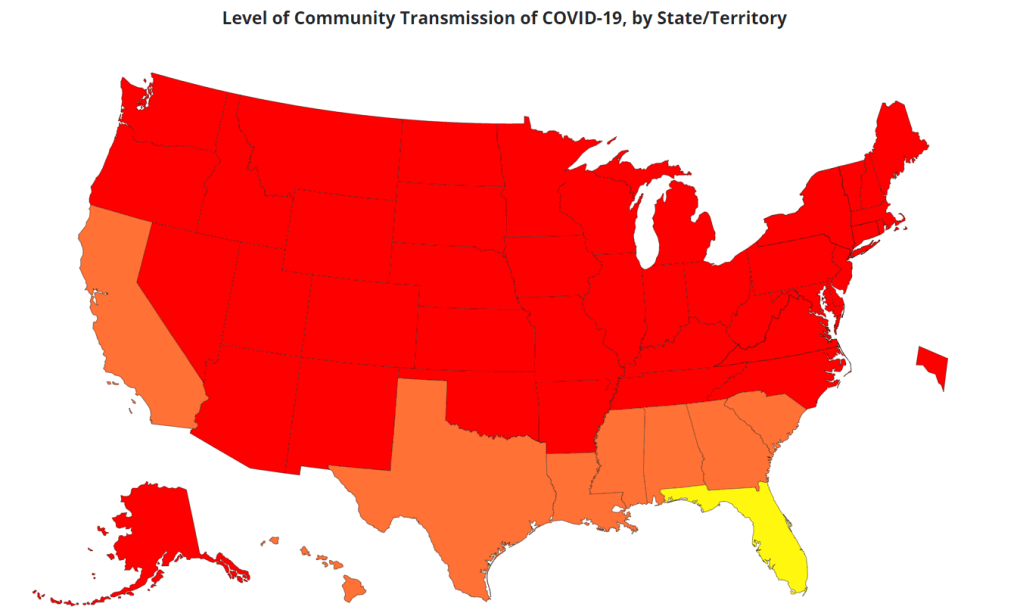
    Community transmission levels by state, as of November 24. Florida is the only state with “moderate” transmission, while several other Southern states have “substantial” transmission. Chart via the CDC.

    In the past week (November 18 through 24), the U.S. reported about 660,000 new cases, according to the CDC.* This amounts to:

    • An average of 94,000 new cases each day
    • 201 total new cases for every 100,000 Americans

    Last week, America also saw:

    • 41,000 new COVID-19 patients admitted to hospitals (12 for every 100,000 people)
    • 6,900 new COVID-19 deaths (2.1 for every 100,000 people)
    • 100% of new cases are Delta-caused (as of November 20)
    • An average of 1.8 million vaccinations per day (including booster shots; per Bloomberg)

    *Note: This week, the CDC did not provide COVID-19 data updates for most metrics on Thursday, Friday, or Saturday due to the holiday, so my update is based on Wednesday’s data.

    As is typically the case on holidays, Thanksgiving has made COVID-19 reporting a bit wonky. The CDC didn’t update its dashboard at all from Thursday through Saturday, and it is not updating vaccination data all weekend. At the same time, public health workers at many state and local agencies are taking a well-deserved long weekend off—leading to delayed reports of cases that will show up in the next couple of weeks. 

    Still, cases seem to continue trending up at the national level. The U.S. is now reporting close to 100,000 new cases a day, and holiday travel is likely to push this number up further. Michigan, Minnesota, and New Hampshire are the country’s three biggest hotspots, per the latest Community Profile Report (released Wednesday), all with over 500 total new cases per 100,000 people in the past week.

    Other Northern states—Wisconsin, Maine, Colorado, Vermont—are also reporting high case rates, while Southern states continue to see lower numbers. Florida actually has the lowest case rate in the country, at 49 new cases per 100,000 people in the past week. This state is likely benefitting from COVID-19’s seasonal nature, combined with a lot of built-up immunity from the region’s summer Delta surge.

    Nationally, the number of COVID-19 deaths in the U.S. in 2021 has surpassed the total deaths from the virus in 2020. Even though vaccines have been widely available for most of this year. The 2020 number is likely a significant undercount, as many people who contracted the coronavirus in spring 2020 were unable to get tested—but still, this milestone is disheartening.

    Vaccination numbers have increased dramatically in the U.S. in recent weeks with well over one million shots given a day, thanks to booster shot availability and new eligibility for children under age 12. About 38 million people have now received their third doses, according to the CDC. But whether this will be enough to blunt the coming winter surge remains to be seen.

  • National numbers, November 21

    National numbers, November 21

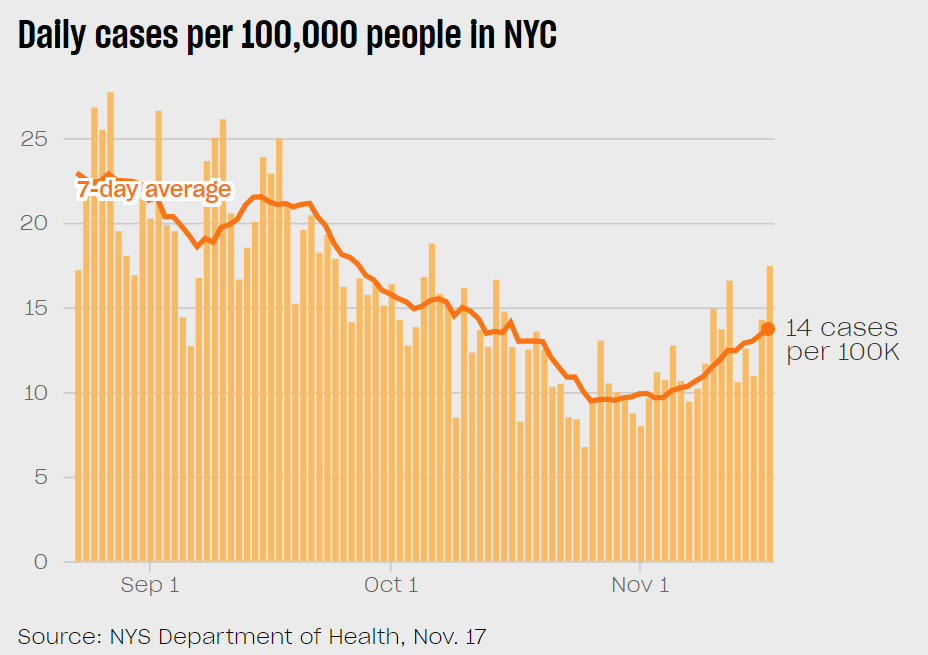
    New York City is now seeing about 14 new cases for every 100,000 people each day. Chart via THE CITY’s COVID-19 dashboard.

    In the past week (November 13 through 19), the U.S. reported about 620,000 new cases, according to the CDC. This amounts to:

    • An average of 88,000 new cases each day
    • 189 total new cases for every 100,000 Americans
    • 16% more new cases than last week (November 6-12)

    Last week, America also saw:

    • 38,000 new COVID-19 patients admitted to hospitals (12 for every 100,000 people)
    • 7,200 new COVID-19 deaths (2.2 for every 100,000 people)
    • 100% of new cases are Delta-caused (as of November 13)
    • An average of 1.3 million vaccinations per day (including booster shots; per Bloomberg)

    Last week, I wrote that the U.S. was at the start of a winter surge; this week, the surge is beginning to take off. Nationwide, cases are up 16% from last week to this week, and up 24% from two weeks ago. It’s not as sharp of an increase as what we saw during the first Delta surge in the summer, but it’s still concerning. New hospitalizations are also rising, up about 5% from last week.

    Michigan and Minnesota are now the country’s top hotspots, with 589 and 524 new cases for every 100,000 people in the past week, respectively, per the latest Community Profile Report. Other hotspots include more northern states: New Hampshire, North Dakota, Wisconsin, Vermont. After being a success story for most of the pandemic, Vermont is now seeing its highest case numbers yet.

    Meanwhile, in Europe, the ongoing surge has prompted increasingly strict COVID-19 safety measures. The government of Austria, which is also seeing record-high case numbers, announced on Friday that COVID-19 vaccination is now mandatory for the entire adult population. This follows a lockdown for unvaccinated Austrians only.

    Nearly 80% of Austrian adults are vaccinated, according to the New York Times; the U.S. is in a similar position. But here, all the attention is on booster shots—more than 33 million Americans have now received boosters—and on shots for kids in the recently eligible 5 to 11 age group. About 10% of kids in that age group have now received their first doses, which may seem less impressive when one considers that the U.S. had enough doses for the entire eligible population ready to go when the FDA and CDC approved the shots.

    In NYC, where I live, the case rate is now up at about 14 new cases for every 100,000 people, every day. That adds up to almost 100 new cases for every 100,000 people in the last week, meeting the CDC’s threshold for high transmission. About three in every four residents are vaccinated.

    To combat this increase, city leaders announced on Monday that all adults were eligible for a booster shot—a few days before the FDA and CDC made the same decision for all adults in the U.S. (More on that eligibility later in this issue.) But no efforts have been made to cut down on indoor dining, curb the crowds in Times Square, or actually enforce mask-wearing on the subway. In this new surge, it truly feels like everyone is out here fending for themselves.

  • National numbers, November 14

    National numbers, November 14

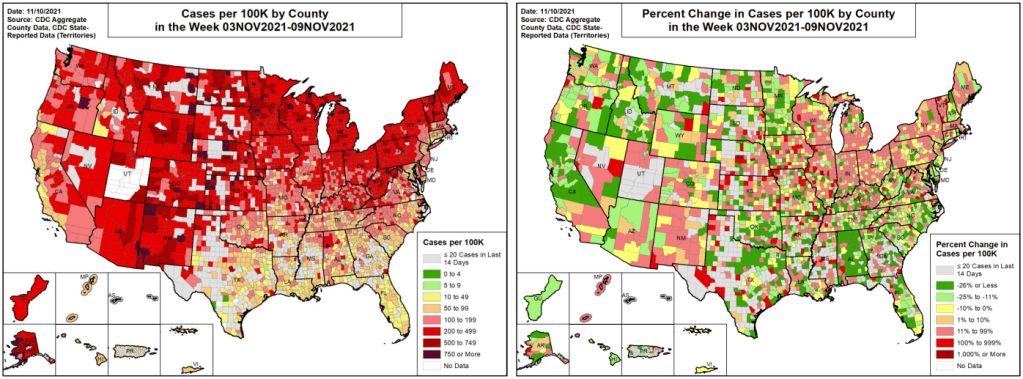
    Many Northern states are seeing cases increase right now as Southern states have lower transmission levels. Charts from the November 10 Community Profile Report.

    In the past week (November 6 through 12), the U.S. reported about 510,000 new cases, according to the CDC. This amounts to:

    • An average of 73,000 new cases each day
    • 156 total new cases for every 100,000 Americans
    • 3% more new cases than last week (October 30-November 5)

    Last week, America also saw:

    • 36,000 new COVID-19 patients admitted to hospitals (11 for every 100,000 people)
    • 7,000 new COVID-19 deaths (2.1 for every 100,000 people)
    • 100% of new cases are Delta-caused (as of November 6)
    • An average of 1.4 million vaccinations per day (including booster shots; per Bloomberg)

    It may be happening slowly, but the U.S. is clearly at the start of a winter COVID-19 surge. The number of newly reported cases rose this week for the first time since early September, while the number of COVID-19 patients in hospitals has plateaued.

    Delta is still causing practically 100% of COVID-19 cases in the country, so a new variant is probably not to blame for this potential surge. Instead, it’s a consequence of the cold weather, combined with less-stringent safety behaviors among many Americans as we approach the holiday season. One epidemiologist told NBC that a surge may be “inevitable” at this time of year.

    In line with COVID-19’s cold-weather advantage, many Northern states are seeing cases increase right now as Southern states—which were hit harder by the summer Delta surge—have lower transmission levels. Alaska, North Dakota, New Mexico, Montana, and Wyoming had the highest case rates last week, per the latest Community Profile Report.

    Cases are also rapidly increasing in Maine, Vermont, Minnesota, Michigan, Colorado, and other chillier states. At Vermont’s St. Michael’s College, Halloween parties were a major source of new COVID-19 cases—even though 98% of people on campus are vaccinated, according to local outlet WCAX3.

    Still, it’s important to point out here that the U.S. is in a far better spot now than we were at this time last year. As Dr. Ashish Jha pointed out on Twitter recently, we have winter coming and the vast majority of schools in the country are open, but cases are flat rather than rising sharply as they did last November.

    Of course, we have vaccines to thank for this improved position. More than two-thirds of the U.S. population has received at least one vaccine dose; as of this week, that number includes over one million children under age 12, according to the CDC. Vaccinating more children and other people who are currently unvaccinated, booster shots for seniors, and continued use of masks and testing can help keep case numbers (relatively) low as we head into the coldest months.

  • National numbers, November 7

    National numbers, November 7

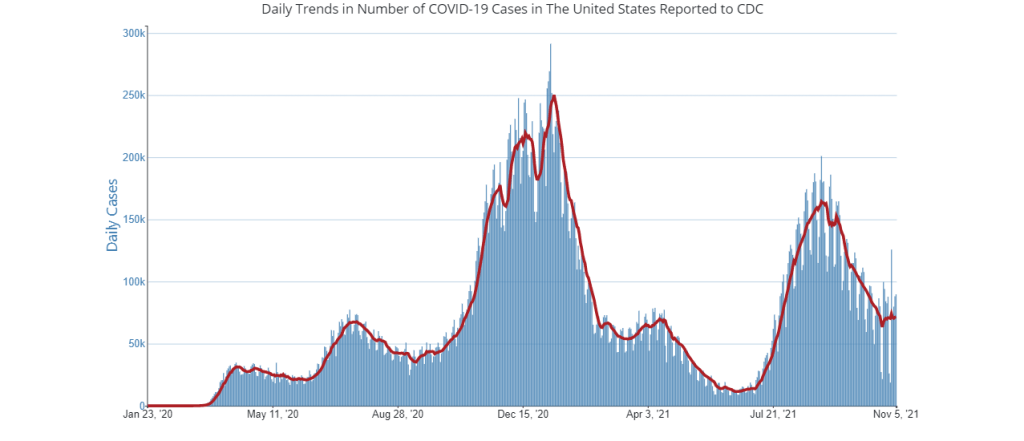
    U.S. COVID-19 cases are in a clear plateau. Chart via the CDC, downloaded on November 7.

    In the past week (October 30 through November 5), the U.S. reported about 490,000 new cases, according to the CDC. This amounts to:

    • An average of 70,000 new cases each day
    • 150 total new cases for every 100,000 Americans
    • 1% fewer new cases than last week (October 23-29)

    Last week, America also saw:

    • 36,000 new COVID-19 patients admitted to hospitals (11 for every 100,000 people)
    • 8,000 new COVID-19 deaths (2.4 for every 100,000 people)
    • 99% of new cases are Delta-caused (as of October 30)
    • An average of 1.8 million vaccinations per day (including booster shots; per Bloomberg)

    At the national level, new COVID-19 cases seem to have entered a plateau. The U.S. has reported about 70,000 new cases a day for the past three weeks; while hospitalization and death numbers continue to go down, those drops are rather slight compared to what we saw earlier this fall.

    Cold-weather states continue to see the highest case rates: Alaska, Montana, North Dakota, and Wyoming are at the top this week, with over 400 new cases for every 100,000 people as of the latest Community Profile Report.

    New Hampshire is now a concerning hotspot as well—the state saw almost a 200% increase in cases from last week to this week. Colorado, Minnesota, New Mexico, and Michigan are also reporting significant increases.

    Throughout the pandemic, trends in the U.S. have often followed trends in Europe, with this country seeing new surges a few weeks after they happen across the Atlantic. And right now, Europe is “at the epicentre” of the pandemic, according to the World Health Organization. Russia and Germany have recently recorded record cases, while other European countries are reinstating safety restrictions. 

    This week, the world marked five million COVID-19 deaths, while the U.S. marked 750,000. Both numbers are almost certainly undercounts, due to under-testing, limited medical record-keeping in some places, and other issues. In the U.S., over 1,000 people continue to die each day despite widely available vaccines.

    Vaccination numbers are going up, though—driven largely by booster shots and by shots for the 5 to 11 age group, now officially eligible. The federal vaccines.gov site has been updated to include vaccination sites for these kids.

    But as we celebrate kids getting vaccinated, it’s important to recognize the global inequities at play here:

  • National numbers, Nov. 29

    National numbers, Nov. 29

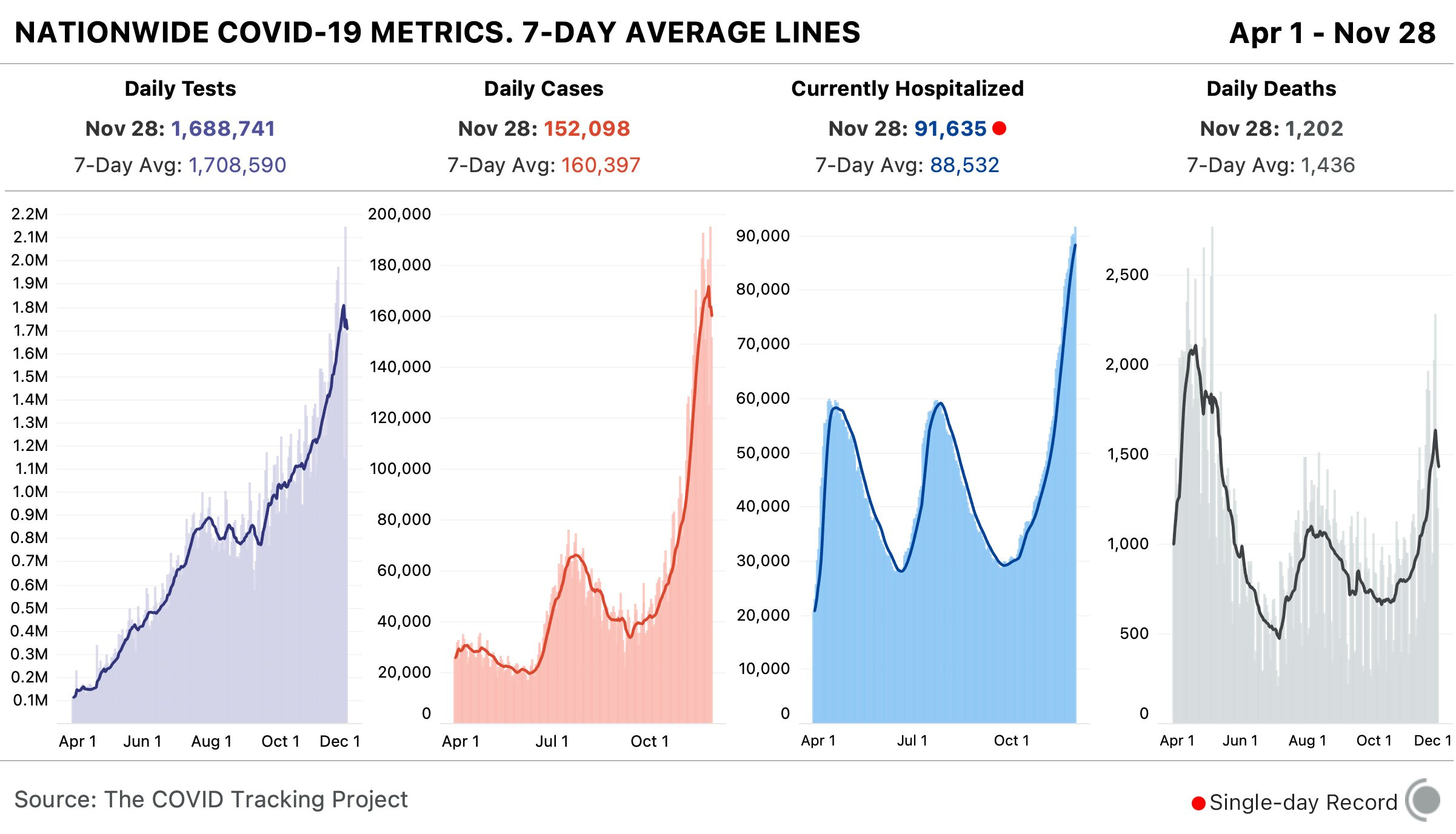
    In the past week (November 22 through 28), the U.S. reported about 1.1 million new cases, according to the COVID Tracking Project. This amounts to:

    • An average of 160,000 new cases each day (4% decrease from the previous week)
    • 343 total new cases for every 100,000 Americans
    • 1 in 292 Americans getting diagnosed with COVID-19 in the past week
    • 9% of the total cases the U.S. reported in the full course of the pandemic
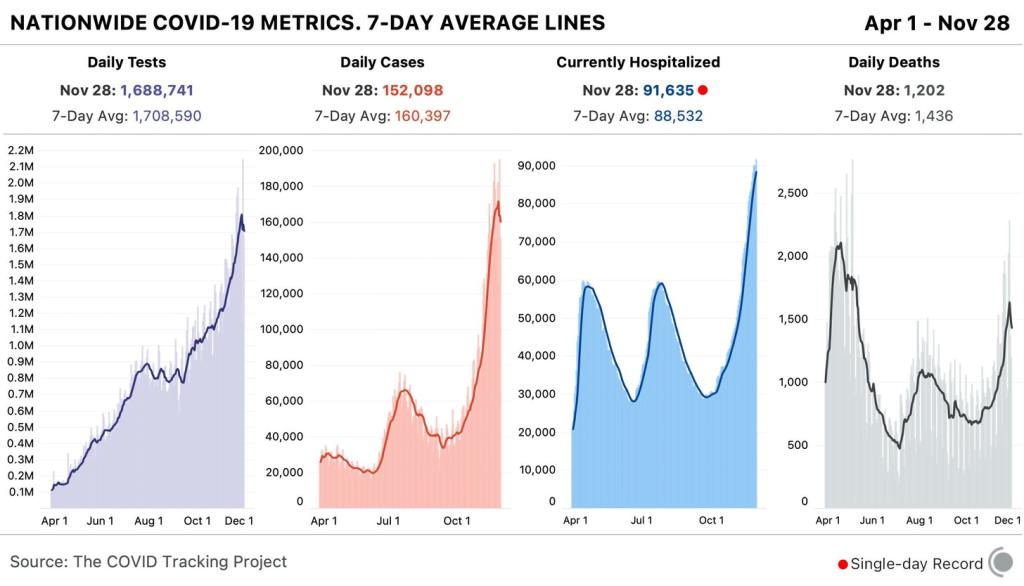
    Chart of tests, cases, current hospitalizations, and deaths nationwide. Current hospitalizations are a single-day record.
    Nationwide COVID-19 metrics published in the COVID Tracking Project’s daily update on November 21. While reported cases have fluctuated due to the Thanksgiving holiday (see below), hospitalizations continue to rise.

    1 in every 82 Americans has been diagnosed with COVID-19 since the beginning of November. Sit with that number for a minute. Picture 82 people. Imagine one of them getting sick, going to the hospital, having debilitating symptoms for months afterward. That is the weight of this pandemic on America right now.

    The COVID Exit Strategy tracker now categorizes the virus spread in every state except for Maine, Vermont, and Hawaii as “uncontrolled,” and even those three states are “trending poorly.” I know we just finished an exhaustive public health news cycle about Thanksgiving travel, but… I would recommend that you start making your Christmas plans now.

    America also saw:

    • 10,000 new COVID-19 deaths last week (3.1 per 100,000 people)
    • 91,600 people currently hospitalized with the disease, as of yesterday (93% increase from the start of November)

    This week, though, I need to caveat the data pretty heavily. The public health officials who collect and report COVID-19 numbers celebrate holidays just like the rest of us; but when dashboards go dark for a day or two, those data gaps can lead to some weird trends.

    Here’s how COVID Tracking Project lead Erin Kissane explains it, in a recent Project blog post:

    First, by Thanksgiving Day and perhaps as early as Wednesday, all three metrics [tests, cases, and deaths] will flatten out or drop, probably for several days. This decrease will make it look like things are getting better at the national level. Then, in the week following the holiday, our test, case, and death numbers will spike, which will look like a confirmation that Thanksgiving is causing outbreaks to worsen. But neither of these expected movements in the data will necessarily mean anything about the state of the pandemic itself. Holidays, like weekends, cause testing and reporting to go down and then, a few days later, to “catch up.” So the data we see early next week will reflect not only actual increases in cases, test, and deaths, but also the potentially very large backlog from the holiday.

    And indeed, new daily cases dropped from 183,000 on Wednesday to 125,000 on Thursday, rose to 194,000 on Friday, then dropped back to 152,000 on Saturday. Even in the states which still reported new cases, deaths, and tests on Thanksgiving, many testing sites and labs were closed, further contributing to reporting backlogs and discrepancies.

    If you’re watching (or reporting) the numbers in your community, the Project recommends using seven-day averages—for example, rather than just looking at today’s new cases for evidence that the pandemic is slowing, calculate the average of today’s new cases and new cases from the six previous days. Current hospitalization figures and the hospital capacity data reported by the Department of Health and Human Services (HHS) may also be more reliable, as hospitals don’t take days off.

    Finally, I’d like to echo the COVID Tracking Project in thanking the many thousands of people behind these data. There are healthcare workers, lab technicians, public health leaders, and data pipeline IT workers behind every single number that you see in this newsletter. I am grateful for all of their efforts.