Tag: novavax

  • COVID source shout-out: Novavax’s booster is now available

    This week, the FDA authorized Novavax’s updated COVID-19 vaccine. The CDC’s fall vaccine recommendations were already set up to include Novavax once it was authorized, so pharmacies and health providers can start administering it without any additional hurdles at the federal level.

    Novavax’s new vaccine, like the options from Pfizer and Moderna for this fall, is designed to protect against XBB.1.5, a recently circulating variant that is closely related to most of the strains causing disease in the U.S. right now. But unlike the Pfizer and Moderna vaccines (which use mRNA technology), Novavax’s uses a piece of viral spike protein to teach recipients’ immune systems how to recognize the coronavirus.

    Some scientists and health advocates I follow have been particularly looking forward to the Novavax authorization, hoping to get their shot rather than one of the mRNA options. There are two main reasons for this choice, based on my reading:

    • The Novavax vaccine may have fewer or easier side effects than the mRNA vaccines. This is particularly appealing for some people who had poor reactions to earlier mRNA vaccine doses (including, in some cases, long-term issues similar to Long COVID), and some people with chronic conditions.
    • Some experts say that “mixing and matching” different types of vaccines might lead to a more robust, long-term immune response against the coronavirus, compared to sticking with one vaccine type. 

    A recent article in Science goes into more detail about these considerations. Writer Jennifer Couzin-Frankel walks through scientific studies that look at Novavax compared to the other vaccine options, and explains some of the questions that we don’t have sufficient data to answer yet. For example, as fewer people have received Novavax vaccines compared to the mRNA options, it’s harder to see signals for potential rare adverse reactions. More studies are coming in that will help address these questions, but for now, many people are making personal choices about which vaccine to get this fall.
  • Sources and updates, August 6

    • Novavax vaccine safety: This week, the CDC published new data in its Morbidity and Mortality Weekly Report (MMWR) affirming the safety of Novavax’s COVID-19 vaccine. Unlike the Pfizer and Moderna vaccines (which use the virus’ genetic information), the Novavax vaccine works by inserting direct copies of the coronavirus spike protein into the body. It was authorized in summer 2022 as a primary series or booster for people who may be unable or unwilling to receive an mRNA vaccine. The CDC found that, among 70,000 Novavax vaccine doses administered between July 2022 and March 2023, no new safety concerns emerged.
    • Insurance coverage for COVID-19 tests: Insurance companies have covered COVID-19 tests very unevenly since the federal health emergency ended this spring. But that could change, if an advisory panel called the U.S. Preventive Services Task Force recommends that the federal government require insurers to cover COVID-19 testing. The panel is exploring this option, reports Sarah Owermohle at STAT News, though it could face legal challenges.
    • Breath test for COVID-19: A couple of weeks ago, I shared a new tool for detecting SARS-CoV-2 particles in the air, developed by researchers at Washington University in St. Louis. The same team has just published another paper, in ACS Sensors, about a similar tool that can diagnose a coronavirus infection using a patient’s breath. This breath test can detect the virus with as few as two breaths and in under 60 seconds, and is close in accuracy to a PCR test. The research team is working to continue testing this device and potentially manufacture it more broadly, according to a press release.
    • COVID-19 spread among white-tailed deer: A recent paper in Nature Communications describes how SARS-CoV-2 has circulated widely among white-tailed deer across the U.S. The research team (which includes scienitsts at the CDC, U.S. Department of Agriculture, and the University of Missouri) collected about 9,000 respiratory samples from deer in 26 states and Washington D.C. between fall 2021 and spring 2022. Hundreds of the samples were positive for SARS-CoV-2, leading the team to study genetic sequences and study how the virus had evolved in this population. The team’s full data are available online. (H/t Data Is Plural.)

  • Sources and updates, July 24

    • New CDC report on drug overdose deaths during the pandemic: Drug overdose deaths increased by 30% from 2019 to 2020, according to a new CDC report compiling data from 25 states and D.C. But this increase was higher for Black and Native Americans: deaths among these groups increased by 44% and 39%, respectively. The full report includes more details on how overdose deaths disproportionately occurred in Black and Native populations, as well as the need for more easily accessible treatments for substance abuse.
    • CDC survey of public health workers: Another CDC report that caught my attention this week presented results from a national survey of state and local public health workers in 2021. Almost three in four of the workers surveyed were involved with COVID-19 response last year. The survey provides further evidence of burnout among public health workers: 40% of those surveyed reported that they intend to leave their jobs within the next five years.
    • COVID-19 testing options: COVID-19 Testing Commons is a research group at Arizona State University’s College of Health Solutions that has compiled comprehensive information about COVID-19 tests available worldwide. You can search the database for tests by company, platform, type of specimen collected, regulatory status, and more. The group also recently compiled a report summarizing these testing options in the pandemic to date.
    • Congressional hearing on Long COVID: This week, Congress’s Select Subcommittee on the Coronavirus Crisis held a hearing specifically about Long COVID. Congressmembers heard from Long COVID patient advocates and researchers about the impacts of this condition and the urgent need for more research and support. I highly recommend reading or listening to the testimony of Hannah Davis, cofounder of the Patient-Led Research Collaborative, for a powerful summary of these impacts and needs. (If you’re watching the video: her testimony starts at about 28:50.)
    • CDC recommends Novavax vaccine: The CDC has officially authorized Novavax’s COVID-19 vaccine, following the FDA authorization that I mentioned in last week’s issue. Novavax’s vaccine is protein-based, which is an older type of vaccine but has been less common for COVID-19; some experts are hopeful that people who have hesitated with the mRNA vaccines may be more likely to get Novavax. Dr. Katelyn Jetelina has a helpful summary of this vaccine’s potential impact at Your Local Epidemiologist.
    • NYC prevalence preprint updated: I’ve linked a couple of times to this study from a group at the City University of New York, with the striking finding that an estimated one in five New Yorkers got COVID-19 during a two-week period in the BA.2/BA.2.12.1 surge. The researchers recently revised and updated their study, based on some feedback from the scientific community. Their primary conclusions are unchanged, lead author Denis Nash wrote in a Twitter thread, but the updated study includes some context about population immunity and NYC surveillance.

  • Novavax vaccine performs well—including against variants

    Novavax vaccine performs well—including against variants

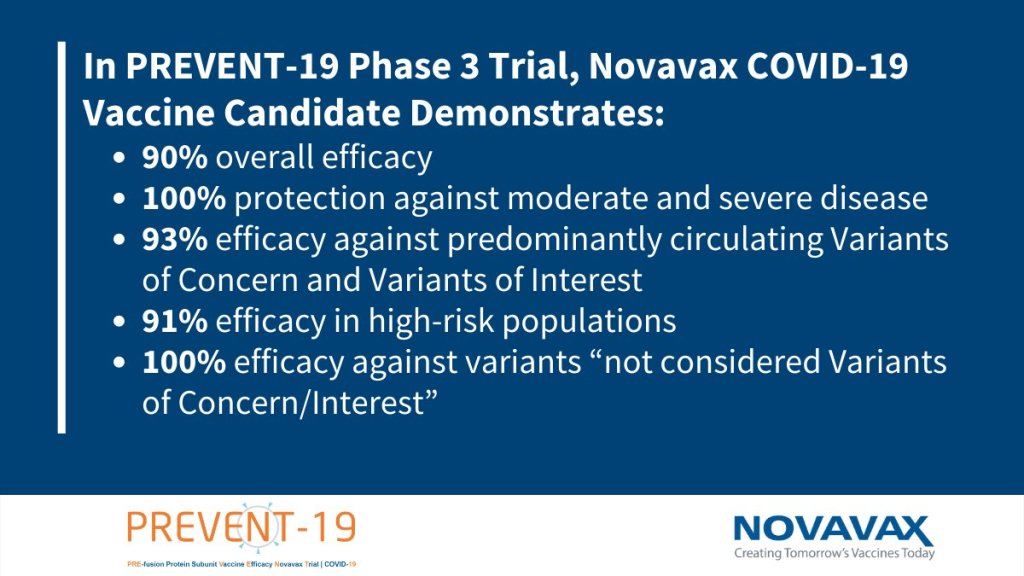
    The COVID-19 news world saw a return of Monday-morning vaccine results this week. Novavax, a small biotech company based in Maryland, announced that its vaccine demonstrated 90% overall efficacy and 100% protection against moderate and severe COVID-19 disease.

    These results come from a trial conducted in the U.S. and Mexico between January and April this year, at a time when the Alpha (or B.1.1.7) variant was becoming dominant here. Among almost 30,000 trial participants, 77 cases were observed: 63 in the placebo group and 14 in the vaccine group, for an efficacy of 90.4%. All of the moderate and severe cases (ten moderate, four severe) were observed in the placebo group.

    Novavax even sequenced samples from 54 out of the 77 cases. The majority of those sequenced cases were variants of concern or variants of interest; Novavax’s vaccine demonstrated 93.2% efficacy against variants of concern/interest and 100% efficacy against non-concerning variants. This finding aligns with other vaccine studies suggesting that the COVID-19 vaccines developed on older versions of the virus still work well against variants, especially at protecting against severe disease and death.

    This new vaccine uses a coronavirus protein—a different method from both Moderna/Pfizer (mRNA vaccines) and AstraZeneca/Johnson & Johnson (adenovirus vaccines). It’s given in two doses, three weeks apart. It had far fewer side effects than other COVID-19 vaccines, with small numbers of participants reporting sore arms and fatigue.

    The Novavax vaccine is also comparatively easier to transport and store than other viruses; it can be stored at refrigerated temperatures. While it’s unlikely to be used in the U.S., it could be critical for vaccine rollouts in other parts of the world.

    More vaccine data

    • Sources and updates, November 12
      Sources and updates for the week of November 12 include new vaccination data, a rapid test receiving FDA approval, treatment guidelines, and more.
    • How is the CDC tracking the latest round of COVID-19 vaccines?
      Following the end of the federal public health emergency in May, the CDC has lost its authority to collect vaccination data from all state and local health agencies that keep immunization records. As a result, the CDC is no longer providing comprehensive vaccination numbers on its COVID-19 dashboards. But we still have some information about this year’s vaccination campaign, thanks to continued CDC efforts as well as reporting by other health agencies and research organizations.
    • Sources and updates, October 8
      Sources and updates for the week of October 8 include new papers about booster shot uptake, at-home tests, and Long COVID symptoms.
    • COVID source shout-out: Novavax’s booster is now available
      This week, the FDA authorized Novavax’s updated COVID-19 vaccine. Here’s why some people are excited to get Novavax’s vaccine this fall, as opposed to Pfizer’s or Moderna’s.
    • COVID-19 vaccine issues: Stories from COVID-19 Data Dispatch readers across the U.S.
      Last week, I asked you, COVID-19 Data Dispatch readers, to send me your stories of challenges you experienced when trying to get this fall’s COVID-19 vaccines. I received 35 responses from readers across the country, demonstrating issues with insurance coverage, pharmacy logistics, and more.