Tag: National numbers

  • National numbers, Feb. 28

    National numbers, Feb. 28

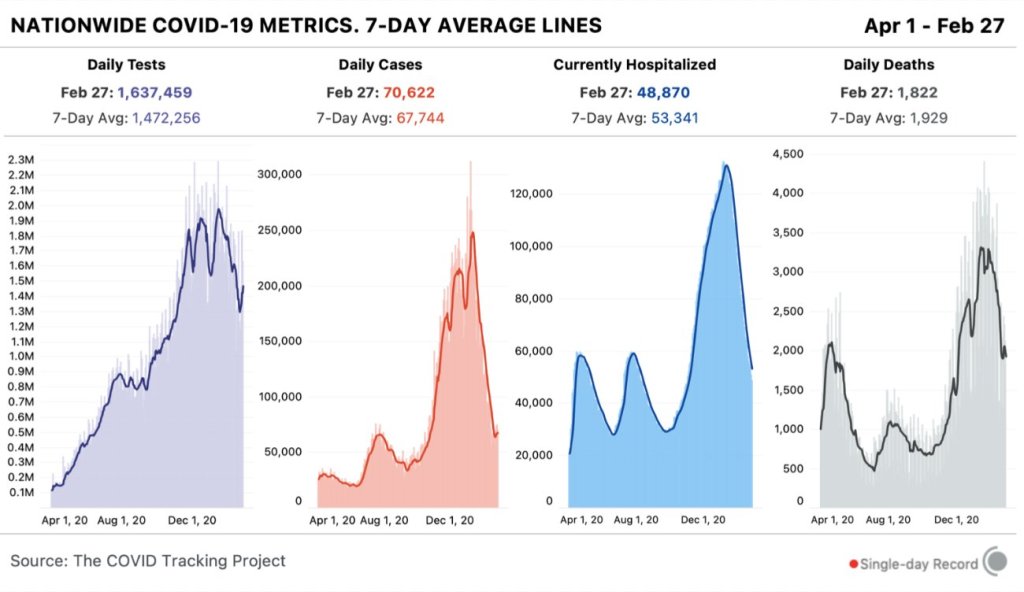
    In the past week (February 21 through 27), the U.S. reported about 475,000 new cases, according to the COVID Tracking Project. This amounts to:

    • An average of 68,000 new cases each day—about 2,000 more cases than the seven-day average on July 27, near the peak of the summer surge
    • 145 total new cases for every 100,000 Americans
    • 1 in 692 Americans getting diagnosed with COVID-19 in the past week
    Nationwide COVID-19 metrics published in the COVID Tracking Project’s daily update on February 27. New daily cases are now at a level similar to the summer peak.

    Last week, America also saw:

    • 48,900 people now hospitalized with COVID-19 (15 for every 100,000 people)
    • 14,300 new COVID-19 deaths (4.4 for every 100,000 people)
    • An average of 1.65 million vaccinations per day (per Bloomberg)

    After several weeks of declines, cases now appear to be in a plateau. But the COVID Tracking Project cautions that these numbers may also be the aftershocks of President’s Day and the winter storm, which led to artificially low numbers last week and delayed reporting arriving this week.

    One thing is for certain, though: vaccinations are recovering from the storm. We had two record vaccination days Friday and yesterday, with 2.2 million doses and 2.4 million doses reported, respectively. Nearly one in five adults and half of American seniors have received their first shot, White House advisor Andy Slavitt said in a COVID-19 briefing on Friday.

    Last week, we noted that vaccinations were already having an impact in nursing homes and other long-term care facilities. The Kaiser Family Foundation picked up that trend this week, with an analysis showing that deaths in these facilities have declined at the same time as residents have received vaccine doses. In the first month of America’s vaccine rollout, long-term care deaths decreased by 66%, while all other U.S. deaths increased by 61%.

    We can’t get complacent, though. The U.S. has now reported over 2,100 cases of the B.1.1.7 variant, up from 1,500 last week. Homegrown variants that originated in California and New York aren’t yet reported on the CDC’s variant cases dashboard, but I recommend reading up on them. B.1.526, the New York variant, may now account for one in four cases in NYC, per the New York Times; this variant has acquired a mutation that may make it less susceptible to vaccines.

    Federal public health leadership cited variant cases in COVID-19 briefings this week, advising Americans to keep up all the public health measures that have become so familiar by now: wear a mask, avoid crowds and travel, and get a vaccine when it’s available to you.
  • National numbers, Feb. 21

    National numbers, Feb. 21

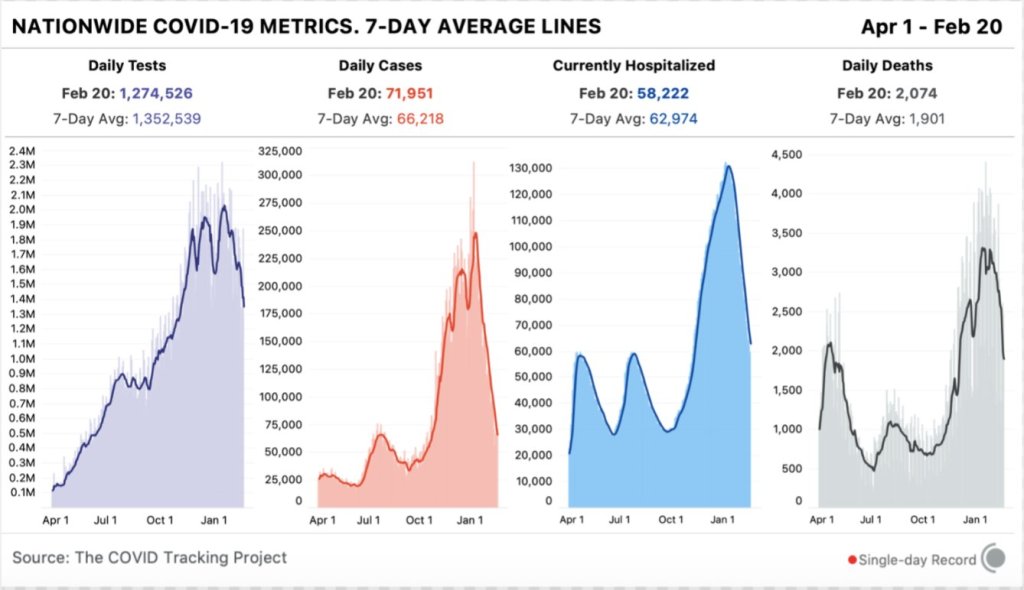
    In the past week (February 14 through 20), the U.S. reported about 464,000 new cases, according to the COVID Tracking Project. This amounts to:

    • An average of 66,000 new cases each day
    • 141 total new cases for every 100,000 Americans
    • 1 in 708 Americans getting diagnosed with COVID-19 in the past week
    • About two-fifths of the new cases reported in the week of January 23
    Nationwide COVID-19 metrics published in the COVID Tracking Project’s daily update on February 20. Hospitalizations are now dropping below the spring and summer peaks.

    Last week, America also saw:

    • 58,200 people now hospitalized with COVID-19 (18 for every 100,000 people)
    • 13,300 new COVID-19 deaths (4.1 for every 100,000 people)
    • An average of 1.49 million vaccinations per day (per Bloomberg)

    The number of COVID-19 patients in U.S. hospitals is now the lowest it’s been since early November. About 7,000 new patients were admitted each day this week—while this is still a huge number, it’s a notable drop from the peak (18,000 per day) we saw earlier in the winter.

    I got those new hospital admission numbers from the COVID Data Tracker Weekly Review, a new report that the CDC recently started publishing in conjunction with its COVID-19 dashboard. It’s kind-of like a longer, more numbers-heavy, less snarky version of this newsletter segment.

    The Weekly Review this past Friday also highlighted the progression of coronavirus variants in the U.S. We’ve now detected over 1,500 cases of B.1.1.7 (the variant originating in the U.K.), as well as 21 cases of B.1.351 (originated in South Africa) and 5 cases of P.1 (originated in Brazil). While sequencing efforts have increased significantly in the past few weeks, these numbers are likely still massive undercounts. The CDC encourages Americans to “stop variants by stopping the spread.” In other words, all the behaviors we’ve been using to keep ourselves and our communities safe from spreading the virus will also help reduce its opportunities to mutate.

    One more piece of good news from this week’s COVID-19 data: vaccinations may already be having an impact in nursing homes and other long-term facilities. The share of deaths occurring in these facilities dropped under 20% this week, for the first time since the COVID Tracking Project started collecting these data.

    The pace of vaccinations was slowed this week thanks to winter storms across the South and Midwest. But this news from LTC facilities is a hopeful note of how elderly Americans may be more protected in the weeks to come.

  • National numbers, Feb. 14

    National numbers, Feb. 14

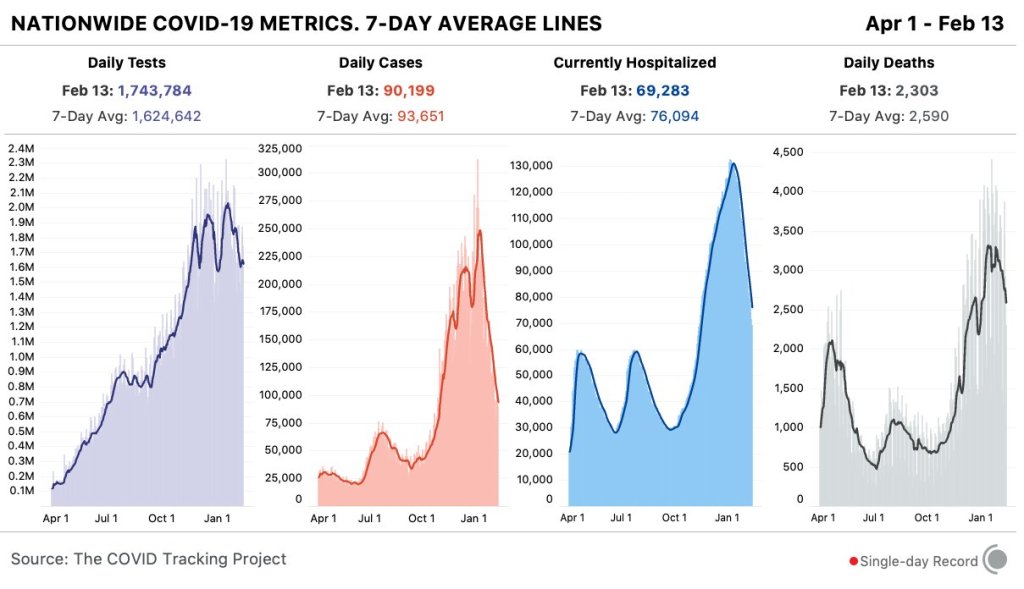
    In the past week (February 7 through 13), the U.S. reported about 656,000 new cases, according to the COVID Tracking Project. This amounts to:

    • An average of 94,000 new cases each day
    • 200 total new cases for every 100,000 Americans
    • 1 in 501 Americans getting diagnosed with COVID-19 in the past week

    The 7-day average for new cases was under 100,000 this week for the first time since October—but it’s still far above the records that America set during our spring and summer surges. 

    Nationwide COVID-19 metrics published in the COVID Tracking Project’s daily update on February 13. Cases, deaths, and hospitalizations are continuing to decline.

    Last week, America also saw:

    • 69,300 people now hospitalized with COVID-19 (21 for every 100,000 people)
    • 21,800 new COVID-19 deaths (6.6 for every 100,000 people)
    • An average of 1.64 million vaccinations per day (per Bloomberg)

    This past week, fewer Americans died of COVID-19 than any previous week in 2021, according to the COVID Tracking Project. In White House briefings this week, CDC Director Dr. Rochelle Walensky said that it will take a unified effort for us to continue this trend, especially as coronavirus variants pose an increased threat.

    Nearly 1,000 cases of the B.1.1.7 variant (which originated in the U.K.) have been reported in the US as of February 11. Though the U.S. has increased our genomic sequencing efforts by about tenfold in the past three weeks, this number is still likely a significant undercount.

    “We must continue to take action,” Dr. Walensky said on Wednesday—stressing the importance of wearing masks (yes, two masks at once!), physically distancing, and washing your hands.

  • National numbers, Feb. 7

    National numbers, Feb. 7

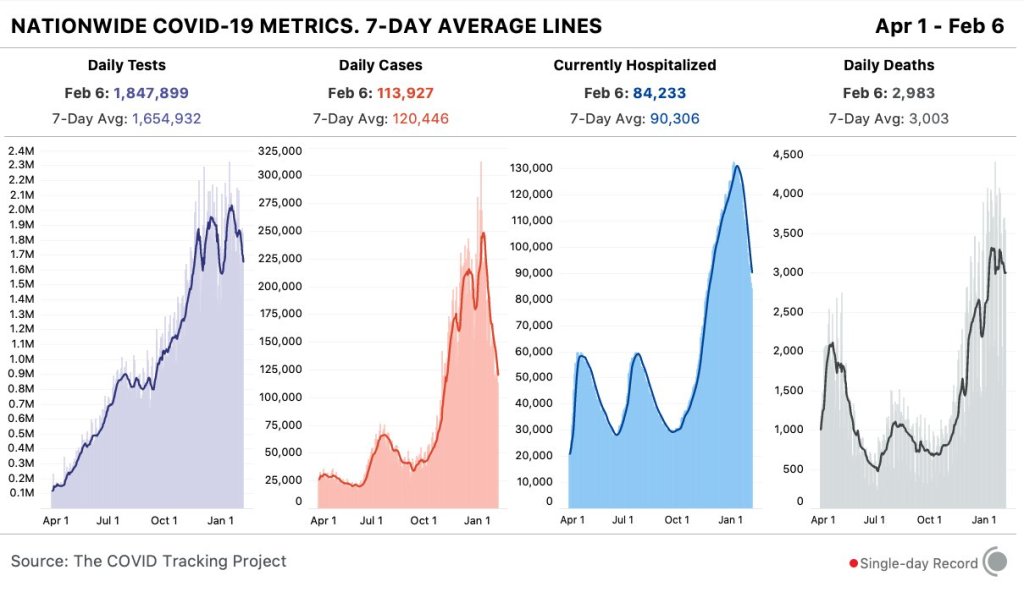
    In the past week (February 1 through 6), the U.S. reported about 840,000 new cases, according to the COVID Tracking Project. This amounts to:

    • An average of 120,000 new cases each day
    • 257 total new cases for every 100,000 Americans
    • 1 in 389 Americans getting diagnosed with COVID-19 in the past week
    • 50% fewer new cases than we reported in the first full week of January
    Nationwide COVID-19 metrics published in the COVID Tracking Project’s daily update on February 6. The U.S. reported fewer than 1 million new cases for the first week since Thanksgiving.

    Last week, America also saw:

    • 84,200 people now hospitalized with COVID-19 (26 for every 100,000 people)
    • 22,500 new COVID-19 deaths (6.9 for every 100,000 people)
    • An average of 1.4 million vaccinations per day (per Bloomberg)

    This is the first week in which America has reported fewer than 1 million new COVID-19 cases since Thanksgiving. Also, per the COVID Tracking Project, the number of Americans in the hospital with COVID-19 has decreased for 25 days in a row. Bloomberg reported a record 2.1 million vaccine doses yesterday. Whichever metric you look at, the news is good.

    CDC Director Rochelle Walensky emphasized the declining rates in White House COVID-19 briefings this week. On Friday, for example, she noted that the number of new COVID-19 patients on February 2 was about 10,500—compared to the peak of 18,000 reported on January 5. Still, 10,000 new admissions was bad news when I reported this number at the end of November.

    But, as I keep stressing in these updates, we can’t get too excited about the good news. As of February 4, the U.S. is up to 611 cases of the B.1.1.7 (or UK) variant, 5 cases of the B.1.351 (or South Africa) variant, and 2 cases of the P.1 (or Brazil) variant—and these numbers are likely significant undercounts. For more information on these variants and how they impact vaccination, read Sarah Braner’s post later in the issue.

  • National numbers, Jan. 31

    National numbers, Jan. 31

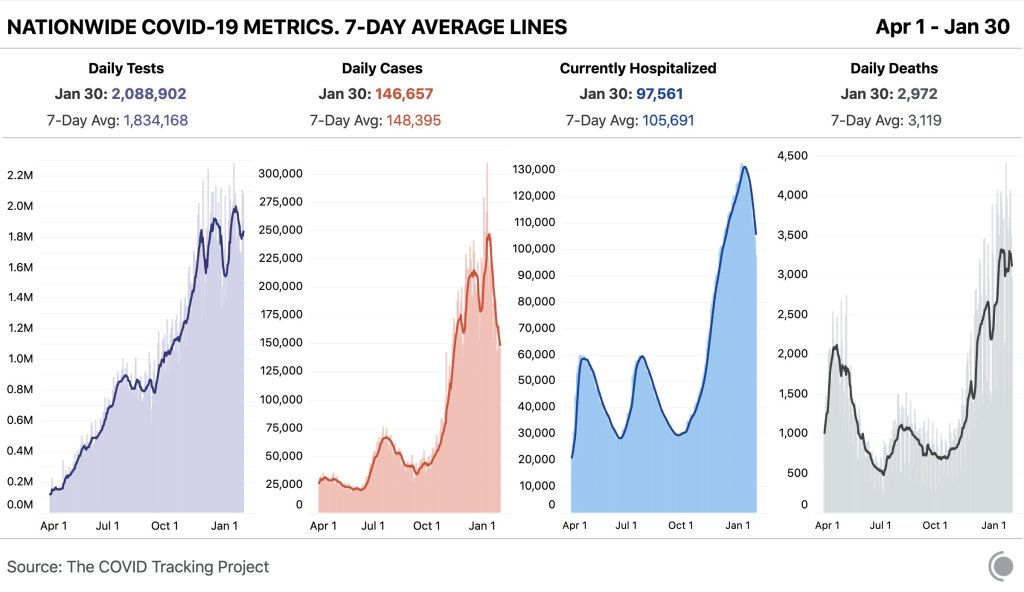
    In the past week (January 24 through 31), the U.S. reported about 1.0 million new cases, according to the COVID Tracking Project. This amounts to:

    • An average of 148,000 new cases each day
    • 317 total new cases for every 100,000 Americans
    • 1 in 316 Americans getting diagnosed with COVID-19 in the past week
    • 38% fewer new cases than we reported three weeks ago
    Nationwide COVID-19 metrics published in the COVID Tracking Project’s daily update on January 30. Current hospitalizations are under 100,000 for the first time in almost two months.

    Last week, America also saw:

    • 97,600 people now hospitalized with COVID-19 (30 for every 100,000 people)
    • 21,800 new COVID-19 deaths (6.7 for every 100,000 people)
    • An average of 1.35 million vaccinations per day (according to Bloomberg)

    The number of patients hospitalized with COVID-19 is under 100,000 for the first time since December 1. Still, this current number is about 60% higher than the peak number of patients hospitalized during either of the U.S.’s previous surges last spring and summer (60,000).

    In late 2020, COVID-19 became the leading cause of death in the U.S. It was the third-highest cause of death in that year overall. Already, in 2021, over 3,000 Americans have died of COVID-19 each day—making this disease a far higher burden than heart disease and cancer, typically the top two drivers of mortality.

    While new COVID-19 cases and hospitalizations continue to slow, continuing the trend from last week, new SARS-CoV-2 variants continue to give experts cause for concern. South Carolina’s public health department identified two cases of the B 1.351 variant first reported in South Africa; this variant is known to be more contagious and less susceptible to vaccines. Meanwhile, the B.1.1.7 variant (first reported in the U.K.) continues to spread—CDC officials are concerned that it could be the dominant strain here by the spring.

    And New York—which has already reported 42 B.1.1.7 cases—is planning to open indoor dining in February. I’m no public health expert, but I plan to be ordering takeout for a long time yet.

  • National numbers, Jan. 24

    National numbers, Jan. 24

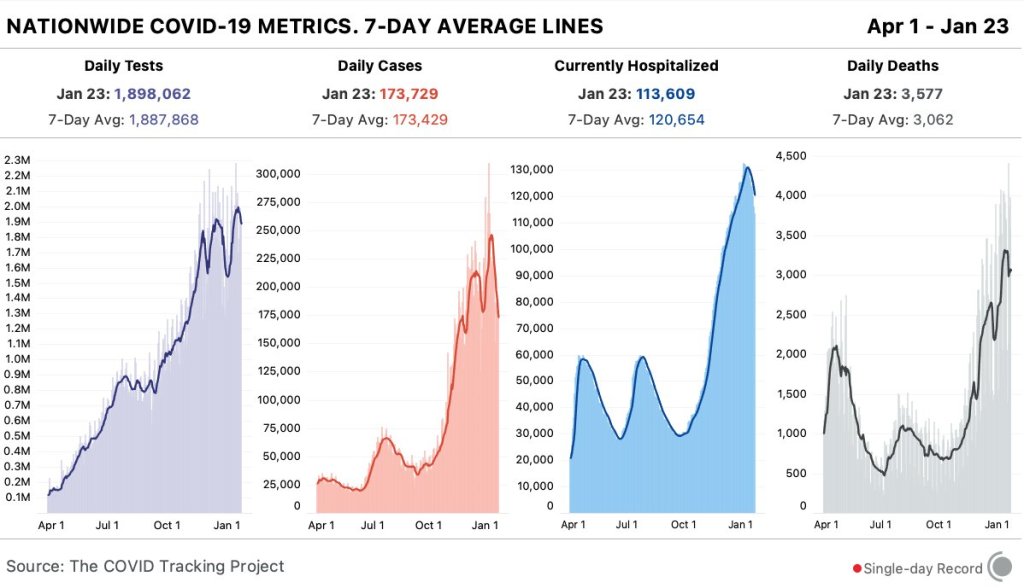
    In the past week (January 17 through 23), the U.S. reported about 1.2 million new cases, according to the COVID Tracking Project. This amounts to:

    • An average of 173,000 new cases each day
    • 370 total new cases for every 100,000 Americans
    • 1 in 270 Americans getting diagnosed with COVID-19 in the past week
    Nationwide COVID-19 metrics published in the COVID Tracking Project’s daily update on January 23. New daily cases and current hospitalizations are steadily dropping, but deaths are still over 3,000 each day.

    Last week, America also saw:

    • 113,600 people now hospitalized with COVID-19 (35 for every 100,000 people)
    • 21,400 new COVID-19 deaths (6.5 for every 100,000 people)

    Two major metrics, new cases and current hospitalizations, are down for the second week in a row. (See the numbers trending down on the COVID Tracking Project chart, above.) The number of new cases reported this week is the lowest it’s been since Thanksgiving. And, while well over 100,000 Americans are in the hospital with COVID-19, we are seeing about 17,000 fewer patients nationwide than we did two weeks ago.

    But this doesn’t mean we’re out of the woods yet. 195 cases caused by the more contagious B.1.1.7 variant have been identified in the U.S. as of Friday—as the vast majority of cases here aren’t sequenced, the true number of variant cases in the nation is likely much higher. And the new cases reported today indicate new hospital patients in two weeks, new casualties two weeks after that

    The U.S. passed 400,000 COVID-19 deaths this week, on the anniversary of the first case identified in this country. Within the next month, we could pass 500,000.

  • National numbers, Jan. 17

    National numbers, Jan. 17

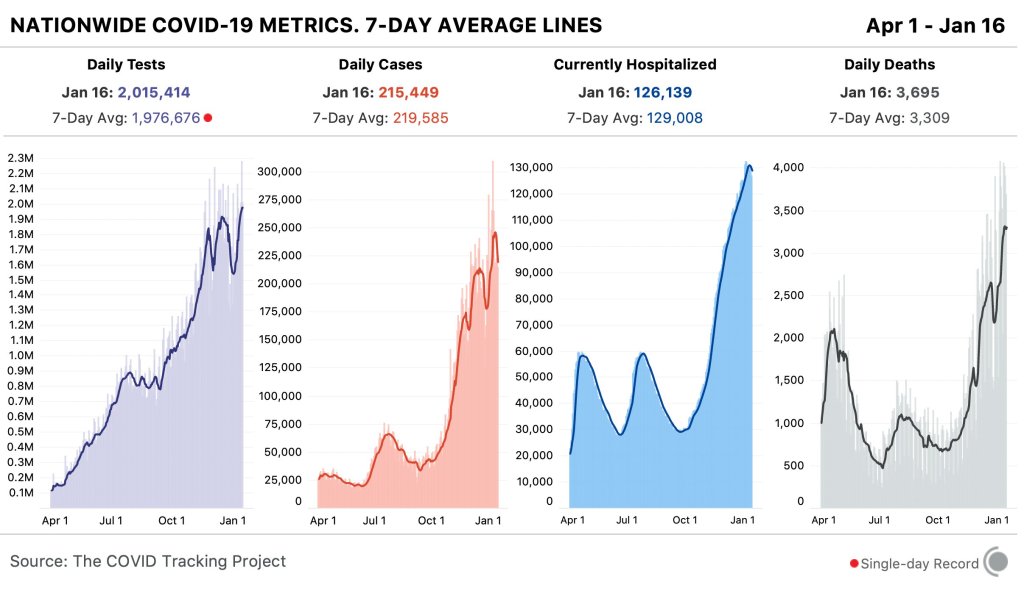
    In the past week (January 10 through 16), the U.S. reported about 1.5 million new cases, according to the COVID Tracking Project. This amounts to:

    • An average of 220,000 new cases each day
    • 469 total new cases for every 100,000 Americans
    • 1 in 213 Americans getting diagnosed with COVID-19 in the past week
    Nationwide COVID-19 metrics published in the COVID Tracking Project’s daily update on January 16. Hospitalizations appear to be leveling off, but deaths are still over 3,000 eachday.

    Last week, America also saw:

    • 126,000 people now hospitalized with COVID-19 (38 for every 100,000 people)
    • 23,200 new COVID-19 deaths (7.1 for every 100,000 people)

    Two weeks out from New Years (and the subsequent reporting weirdness), cases seem to be stabilizing, somewhat. But “stabilizing,” at this point in the pandemic, still means ridiculous numbers. 220,000 new cases each day! That’s like the population of Baton Rouge, Louisiana getting diagnosed with COVID-19 every day.

    Meanwhile, COVID-19 deaths are at their highest point in the pandemic, averaging 3,300 deaths per day.

    One positive note in this week’s numbers is that hospitalizations appear to be leveling off. But, as the COVID Tracking Project’s weekly update points out, the hospitalization picture is far different across different parts of the country. And with the more contagious B.1.1.7 variant getting detected in more and more states, the worst point of the pandemic for the U.S. may be still to come.

  • National numbers, Jan. 10

    National numbers, Jan. 10

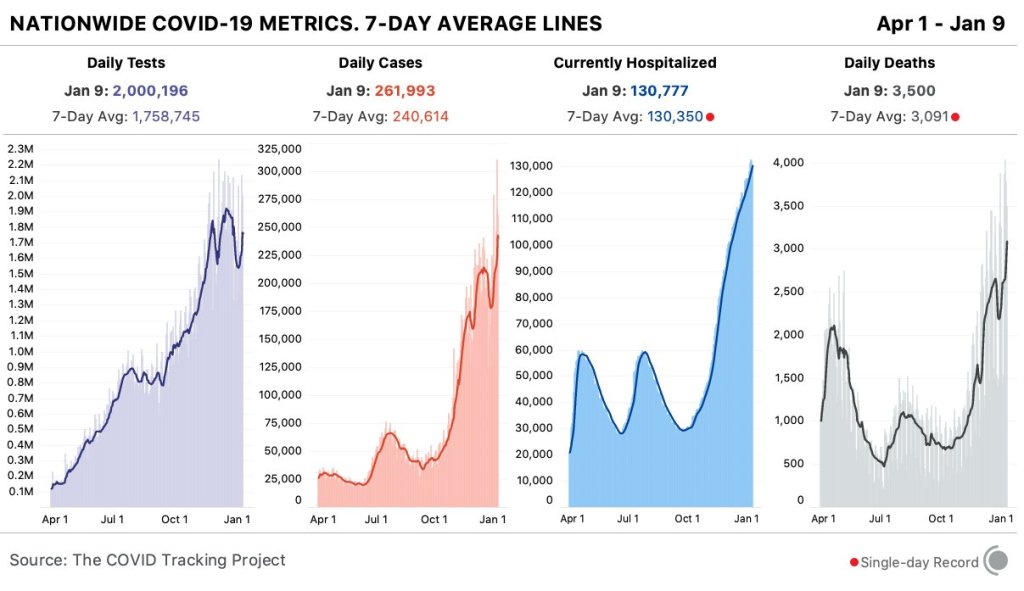
    In the past week (January 3 through 9), the U.S. reported about 1.7 million new cases, according to the COVID Tracking Project. This amounts to:

    • An average of 240,000 new cases each day
    • 447 total new cases for every 100,000 Americans
    • 1 in 196 Americans getting diagnosed with COVID-19 in the past week
    Nationwide COVID-19 metrics published in the COVID Tracking Project’s daily update on January 9. More than 3,000 Americans are now dying of COVID-19 every day.

    Already, in 2021, America has reported 2.1 million new COVID-19 cases. That’s 31 times the number of cases South Korea has reported in the entire pandemic. (Remember, the two nations had their first cases on the same day back in January 2020.)

    Last week, America also saw:

    • 131,000 people now hospitalized with COVID-19 (40 for every 100,000 people)
    • 21,700 new COVID-19 deaths (7 for every 100,000 people)

    The nation is now recording an average of 3,000 deaths every day, more than the number of lives lost on September 11, 2001. Yet cases are still rising—the COVID Tracking Project reported a record 310,000 on January 8—and hospitals continue to fill with patients.

    Some of the cases and deaths added to national counts this week were likely reported late, making up for holiday dips over the winter holidays. (See previous issues for more on this phenomenon.) But many weren’t. 

    “Things will get worse as we get into January,” Dr. Fauci said in an interview with NPR this week.

  • National numbers, Jan. 3

    National numbers, Jan. 3

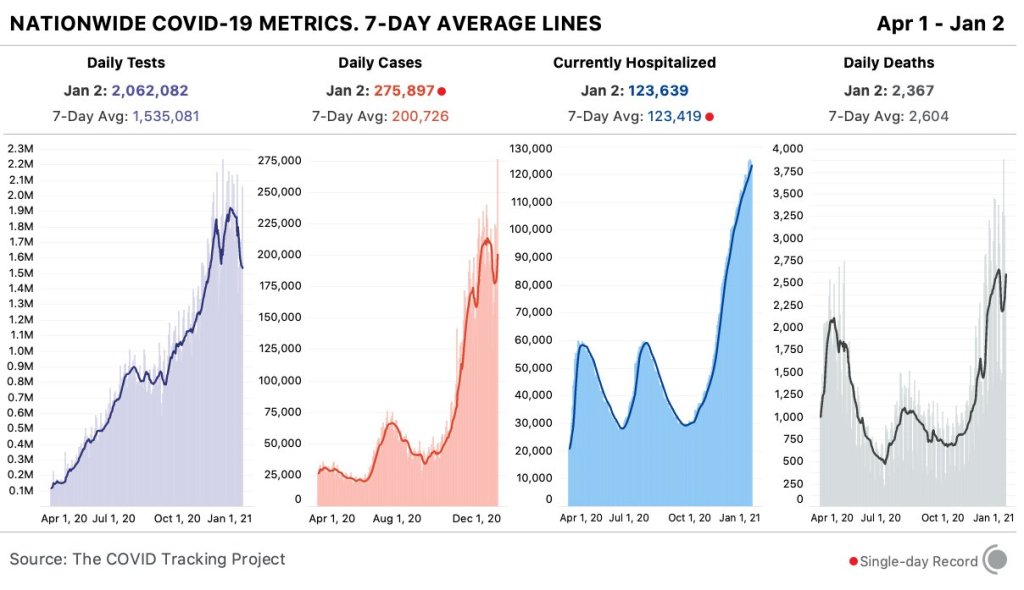
    In the past week (December 27 through January 2), the U.S. reported about 1.4 million new cases, according to the COVID Tracking Project. This amounts to:

    • An average of 201,000 new cases each day
    • 430 total new cases for every 100,000 Americans
    • 1 in 232 Americans getting diagnosed with COVID-19 in the past week
    Nationwide COVID-19 metrics published in the COVID Tracking Project’s daily update on January 2. Daily cases hit a new record thanks to reporting backlogs from New Years.

    These numbers must be interpreted with caution: COVID-19 reporting has been significantly impacted by Christmas and New Years. 20 states didn’t update their COVID-19 data on December 25, and 24 didn’t update their data on January 1—followed by a record day with 276,000 cases reported on January 2. As I’ve noted in previous issues, reporting gaps over holidays lead to spikes several days later, as states catch up on the cases, deaths, and tests that took place over their break.

    But hospitals didn’t close for the holidays. Over 125,000 Americans were hospitalized with COVID-19 this week—the nation continues to break its own record for this morbid metric. For more context and regional analysis on hospitalizations, see the COVID Tracking Project’s most recent weekly update.

  • National numbers, Dec. 27

    National numbers, Dec. 27

    National numbers

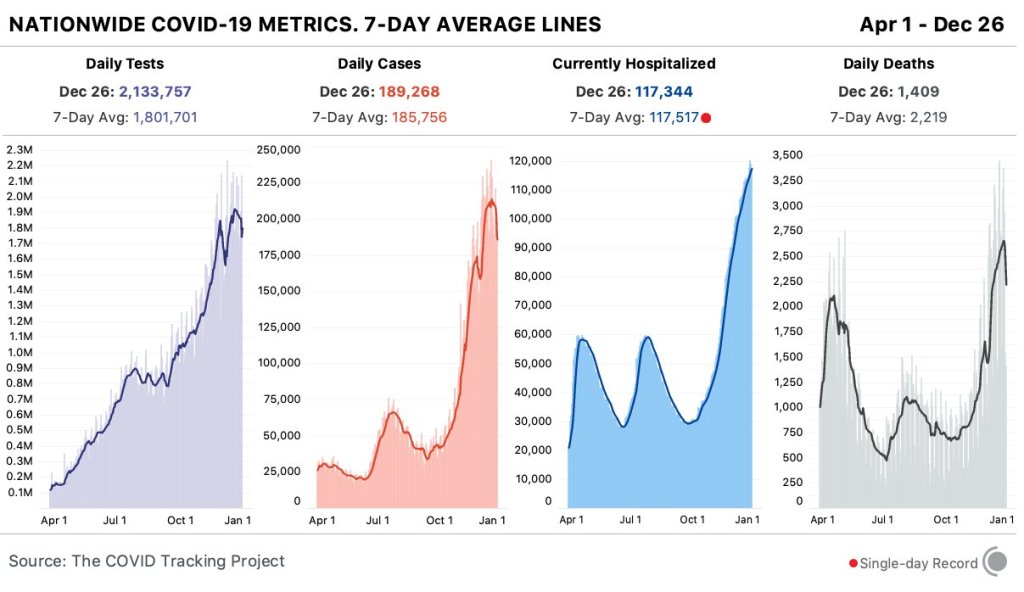
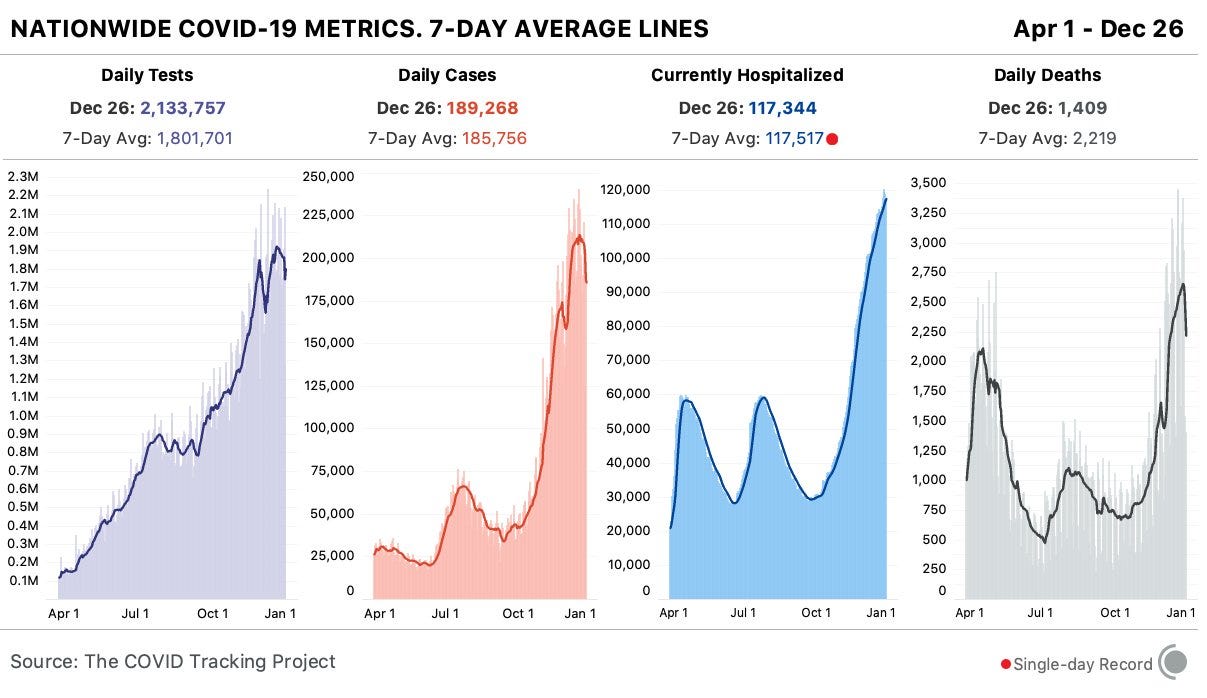
    In the past week (December 20 through 26), the U.S. reported about 1.3 million new cases, according to the COVID Tracking Project. This amounts to:

    • An average of 186,000 new cases each day
    • 397 total new cases for every 100,000 Americans
    • 1 in 252 Americans getting diagnosed with COVID-19 in the past week
    Four bar charts showing key COVID-19 metrics for the US for April 1 to December 26. Today, states reported 2.1M tests, 189k cases, 117,344 currently hospitalized, and 1,409 deaths.
    Nationwide COVID-19 metrics published in the COVID Tracking Project’s daily update on December 26.

    Last week, America also saw:

    • 117,000 people now hospitalized with COVID-19 (36 for every 100,000 people)
    • 15,600 new COVID-19 deaths (4.7 for every 100,000 people)

    Around Thanksgiving, I wrote that COVID-19 data would likely get weird during and after the holiday. When the public health officials who compile and publish COVID-19 counts take a (well deserved!) day or two off, the cases, tests, and deaths that were not reported on those days off will be belatedly added to post-holiday counts. Here’s a COVID Tracking Project blog post that explains the trend in more detail.

    This pattern did, in fact, come to pass after Thanksgiving: the week of the holiday, 1.1 million cases were reported, followed by 1.3 million cases the next week and 1.6 million the week after that. We should expect this to happen once again over Christmas; indeed, the COVID Tracking Project noted that 20 states did not report COVID-19 data on December 25. The true impact of over a million people traveling will not be seen in the data for weeks to come.

    But while public health agencies may take a day off, hospitals never close. This week, more Americans were hospitalized with COVID-19 than ever: the number peaked on December 24, at over 120,000. That’s double the highest national patient number we saw in the spring or summer.

    Over 3 million Americans died in 2020—the highest number of lives lost in one year since the nation began this morbid count. At least 323,000 of those deaths were directly caused by the novel coronavirus.