Tag: National numbers

  • National numbers, September 26

    National numbers, September 26

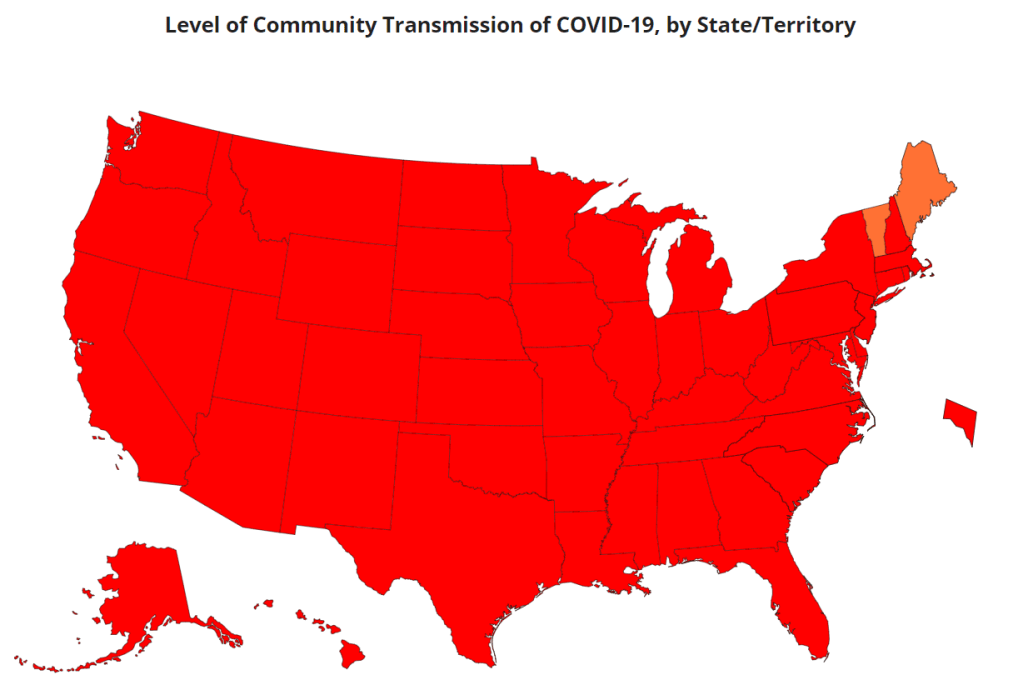
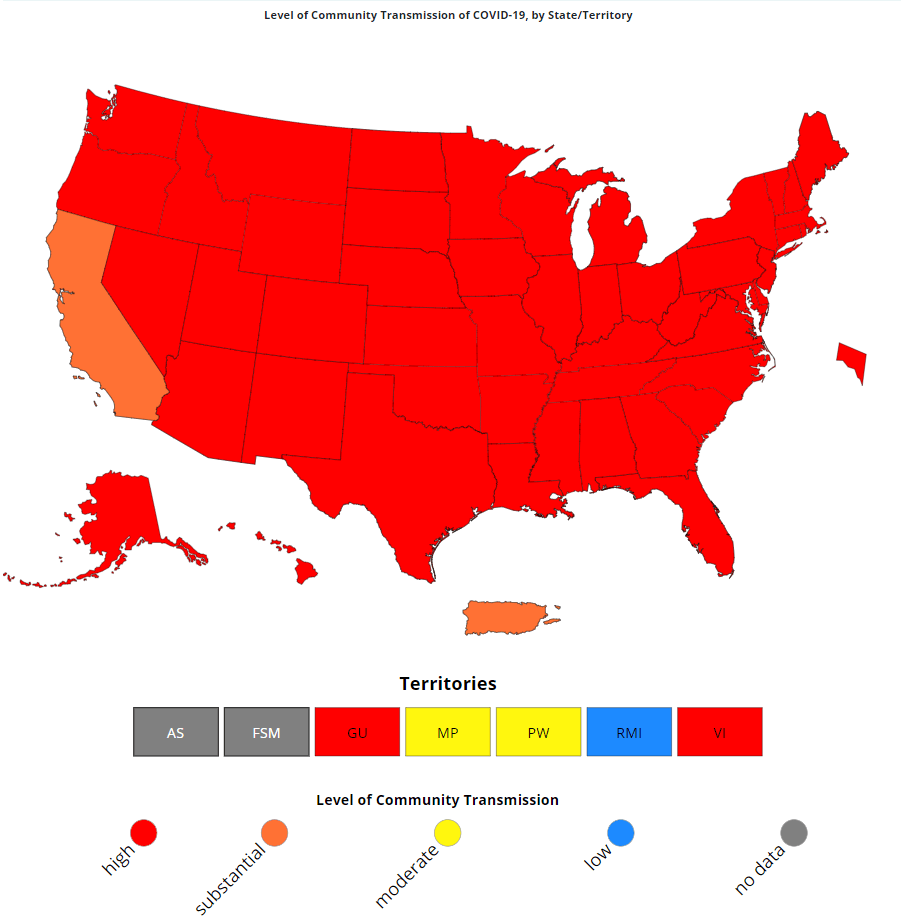
    California dropped to “substantial” transmission this week, while other states remained in “high” transmission.

    In the past week (September 18 through 24), the U.S. reported about 850,000 new cases, according to the CDC. This amounts to:

    • An average of 122,000 new cases each day
    • 259 total new cases for every 100,000 Americans
    • 17% fewer new cases than last week (September 11-17)

    Last week, America also saw:

    • 67,000 new COVID-19 patients admitted to hospitals (21 for every 100,000 people)
    • 11,000 new COVID-19 deaths (3.3 for every 100,000 people)
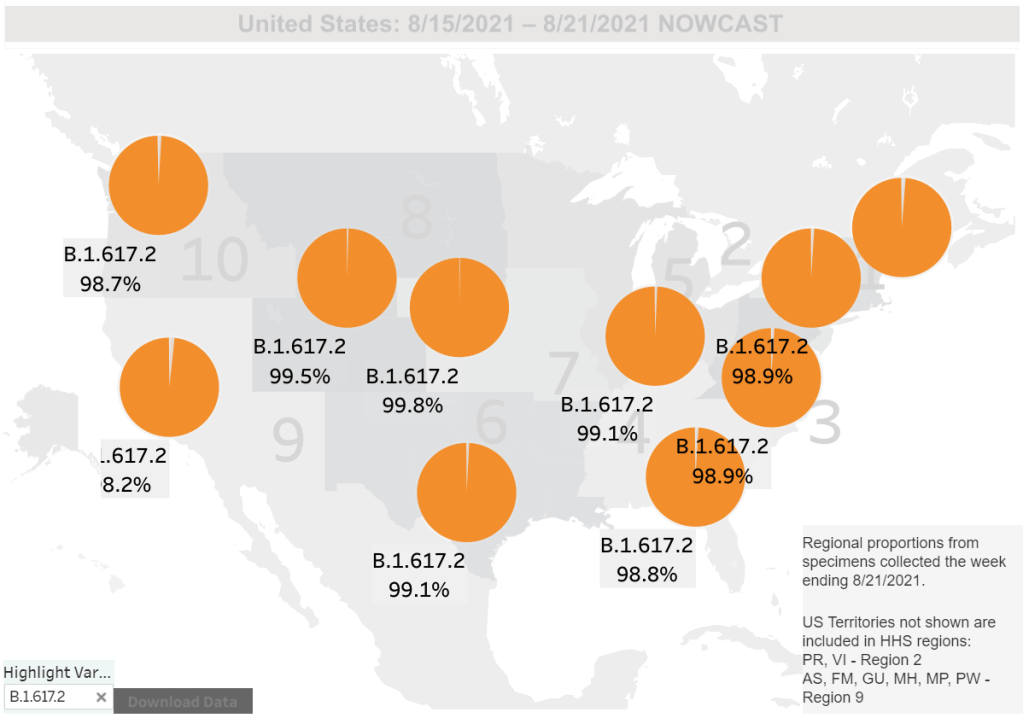
    • 99% of new cases are Delta-caused (as of September 18)
    • An average of 700,000 vaccinations per day (per Bloomberg)

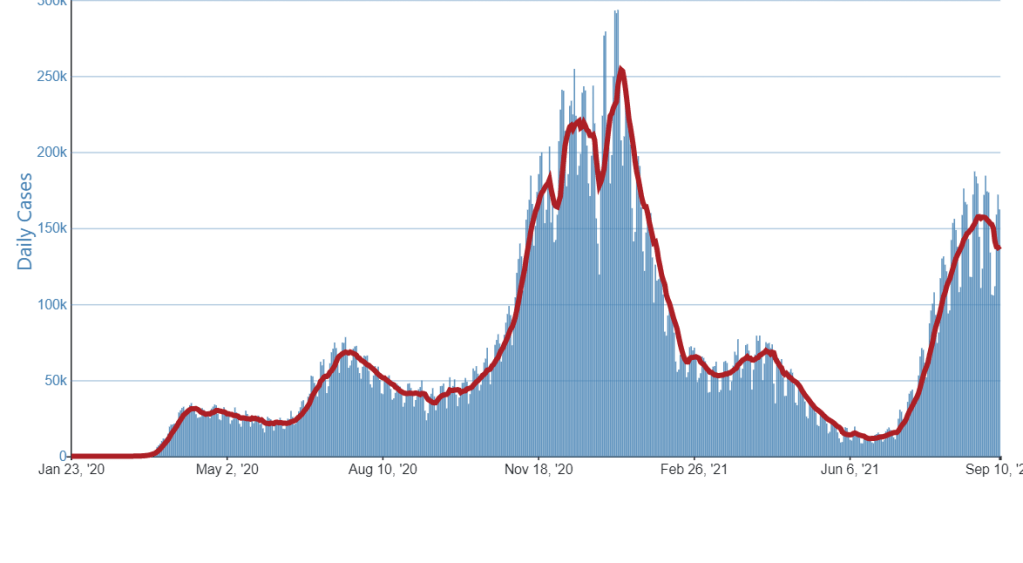
    Following the Labor Day reporting blips of the past two weeks, COVID-19 cases are now clearly trending down in the U.S. The daily new case average is close to what we saw in early August, at the start of the Delta surge.

    The U.S. can’t let its guard down yet, though. Almost every state still reported over 100 new cases for every 100,000 people in the past week, putting the vast majority of the country into a high coronavirus transmission zone, per the CDC’s categories. The only state to drop below this “high transmission” threshold is California, which reported 86 new cases per 100,000 in the week ending September 23.

    Alaska, West Virginia, Wyoming, and Montana are all far past that “high transmission” threshold, at over 600 new cases per 100,000 in the past week. Alaska appears to be the nation’s newest Delta hotspot. The state reported a record 1,735 COVID-19 cases on Friday, though some of those cases were part of a reporting backlog (meaning they occurred earlier).

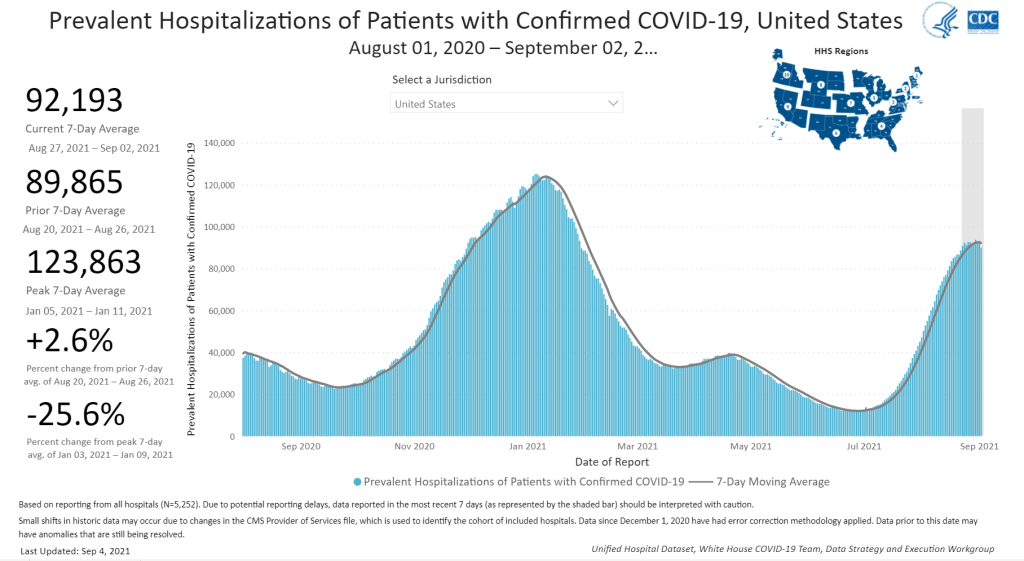
    Nationwide, hospitalizations are also continuing to come down. The country recorded fewer than 10,000 new patients a day last week, for the first time since early August. But the current numbers are still far higher than what we saw in June and early July.

    Deaths—the slowest-moving pandemic metric—continue rising, with about 11,000 new deaths a day. It bears repeating: the vast majority of these deaths occur in unvaccinated Americans. The U.S. has now passed 675,000 deaths, meaning that COVID-19 has killed more Americans than the 1918 Spanish flu pandemic did over a century ago.

    Despite the continued dangers of being unvaccinated, dose numbers are now also dropping in the U.S. After a couple of weeks approaching one million doses a day, we’re now back down at 700,000 doses a day, per Bloomberg’s dashboard. And the upcoming booster shot rollout is certain to confuse these data; already, 2.4 million Americans have received an additional dose, per the CDC.
  • National numbers, September 19

    National numbers, September 19

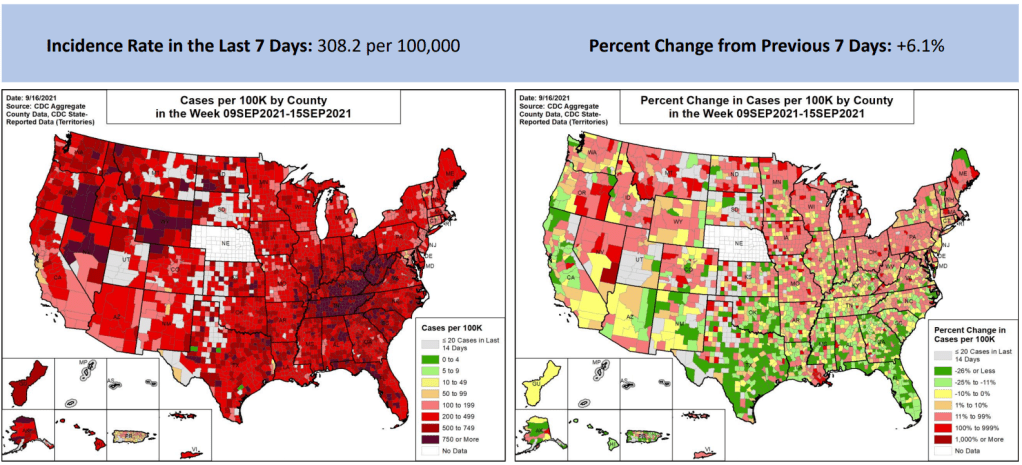
    Some previous Delta hotspots are seeing case numbers decrease, while others are now seeing their highest cases yet. Charts from the September 16 Community Profile Report.

    In the past week (September 11 through 17), the U.S. reported about one million new cases, according to the CDC. This amounts to:

    • An average of 146,000 new cases each day
    • 312 total new cases for every 100,000 Americans
    • 6% more new cases than last week (September 4-10)

    Last week, America also saw:

    • 78,000 new COVID-19 patients admitted to hospitals (24 for every 100,000 people)
    • 10,000 new COVID-19 deaths (3.1 for every 100,000 people)
    • 100% of new cases now Delta-caused (as of September 11)
    • An average of 800,000 vaccinations per day (per Bloomberg)

    Last week, national case numbers appeared to be in a decline, with a 13% decrease from the prior week. This week, cases bumped back up slightly—most likely due to delayed reporting driven by the Labor Day weekend, as I predicted in last week’s issue.

    Still, this week’s daily new case average is lower than it was a couple of weeks ago. And the number of COVID-19 patients newly admitted to hospitals, a crucial metric that’s less susceptible to holiday reporting interruptions, has continued to drop: from about 12,000 new patients a day last week to 11,000 new patients a day this week.

    But we can’t say the same thing for death numbers, unfortunately. Over 10,000 COVID-19 deaths were reported in the U.S. last week, the highest number since March 2021 (at the tail end of the winter surge.)

    The country reached a sad milestone this week: one in 500 Americans have died of COVID-19, according to a Washington Post analysis. For Black, Hispanic, and Native Americans, as well as states that have been harder-hit by the pandemic, that number is lower. In Brooklyn, where I live, COVID-19 has killed one in every 240 residents.

    In some parts of the country, the Delta surge appears to be letting up. Florida saw an 18% decrease in cases from last week to this week, according to the September 16 Community Profile Report, while Texas saw an 8% decrease. California—where residents just voted to keep harsh-on-COVID-19 Governor Gavin Newsom in power—saw a whopping 23% decrease in cases, week over week.

    Meanwhile, other parts of the South and West are seeing their highest case numbers yet. Both Tennessee and West Virginia have recorded over 700 new cases for every 100,000 residents in the past week. (For context: the CDC says that over 100 new cases per 100,000 constitutes high transmission.) In West Virginia, hospitals are “overwhelmingly inundated” with COVID-19 patients. And in Alabama, though case numbers are coming down, a whopping 50% of hospital ICU patients have COVID-19.

    According to the latest CDC variant estimates, 99.7% of new cases in the country are now caused by Delta. Delta has been causing over 99% of cases for a few weeks now. Has the variant run its course here? Could it mutate into something even more transmissible, or more deadly? Or is the CDC even collecting data comprehensively enough for us to tell? Many different scenarios seem plausible as we head into the colder months.

  • National numbers, September 12

    National numbers, September 12

    COVID-19 cases appear to be going down in the U.S., though some of that drop may be due to Labor Day reporting delays. Chart from the CDC, retrieved September 12.

    In the past week (September 4 through 10), the U.S. reported about 960,000 new cases, according to the CDC. This amounts to:

    • An average of 137,000 new cases each day
    • 291 total new cases for every 100,000 Americans
    • 13% fewer new cases than last week (August 29-September 3)

    Last week, America also saw:

    • 82,000 new COVID-19 patients admitted to hospitals (25 for every 100,000 people)
    • 7,500 new COVID-19 deaths (2.3 for every 100,000 people)
    • 99% of new cases now Delta-caused (as of September 4)
    • An average of 700,000 vaccinations per day (per Bloomberg)

    Last week, I wrote that national U.S. COVID-19 cases were in a plateau. The pattern has continued this week: cases are down 13% from last week, new hospitalized patients are down 4%, and deaths are down 11%.

    It’s important to note here, though, that Labor Day likely skewed these numbers. As is typical of COVID-19 reporting on holidays, many local public health agencies—the initial source of case counts and other metrics—took the weekend off, leading those counts to get delayed. We may see higher numbers next week as reports catch up.

    Even as the national numbers drop, though, some states are seeing record case counts and overwhelmed hospitals. South Carolina is one example: this state is now seeing the highest case rate in the U.S., with 680 new cases for every 100,000 residents in the past week, per Community Profile Report data. Kentucky and West Virginia are ranking highly too, with 625 and 586 new cases for every 100,000 people in the past week, respectively.

    Both South Carolina and Kentucky have record numbers of COVID-19 patients in hospitals right now, while West Virginia is approaching its winter 2020 numbers. In Idaho, another state seeing record hospitalizations, state public health leadership placed several northern hospitals under “crisis standards of care,” meaning that clinicians could ration limited resources and prioritize those patients who are deemed most likely to survive.

    All of these states, of course, have low vaccination rates—under 50% of their populations are fully vaccinated. While vaccination rates rose nationally in August, dose counts now seem to be going down again: from a daily average of one million last week to 700,000 now.

    The Delta variant continues to dominate America’s COVID-19 surge. For several weeks now, this variant has been causing over 99% of new cases. And, while the Mu (or B.1.621) variant has made headlines, this variant appears not transmissible enough to compete with Delta. The CDC COVID Data Tracker Weekly Review noted this week that the Mu variant “reached its [U.S.] peak in late June,” causing under 5% of cases, and “has steadily decreased since.” It’s currently causing just 0.1% of cases, the CDC estimates.

    Also, we still aren’t doing enough testing. The overall national PCR test positivity rate is 9.1%, while rapid tests—increasingly popular during the Delta surge—are difficult to find in many settings. A lack of testing makes it difficult to identify all breakthrough cases and look out for future variants that may arise.

  • National numbers, September 5

    National numbers, September 5

    About 90,000 Americans are currently in the hospital with COVID-19; this has been the daily average for the past two weeks. Chart via the CDC, screenshot taken on September 4.

    In the past week (August 28 through September 3), the U.S. reported about one million new cases, according to the CDC. This amounts to:

    • An average of 153,000 new cases each day
    • 327 total new cases for every 100,000 Americans
    • 5% more new cases than last week (August 21-27)

    Last week, America also saw:

    • 85,000 new COVID-19 patients admitted to hospitals (26 for every 100,000 people)
    • 7,300 new COVID-19 deaths (2.2 for every 100,000 people)
    • 99% of new cases now Delta-caused (as of August 28)
    • An average of one million vaccinations per day (per Bloomberg)

    Nationally, the current COVID-19 surge appears to be in a plateau. The number of new cases rose by just 5% this week, after a 3% rise last week. Hospitalizations are in a similar position: the number of patients in the hospital with COVID-19 has held steady at about 90,000 for the past two weeks.

    Among the COVID-19 experts I follow, I’ve seen some speculation that this could be the start of a Delta decline—similar to what we’ve seen in other countries, like India and the U.K. At the same time, others are noting that the U.K. saw a brief case decline followed by another rebound. If Delta does the same thing here, it would coincide with more schools starting their fall semesters and colder weather, neither of which bode well for transmission.

    And there are already a lot of children in hospitals right now. According to the COVID-NET surveillance system, there were about 14 children (under age 18) hospitalized with COVID-19 for every one million kids in the U.S. during the week ending August 28. For children under age 5, that number is 20 for every million—higher than at any other point in the pandemic.

    Thanks to COVID-19 and other diseases (like RSV, another virus that’s impacting many kids right now), pediatric intensive care units are overwhelmed, especially in the South. To understand what that means, I recommend this powerful op-ed by health equity expert Dr. Uché Blackstock. (Recent CDC research suggests that higher child hospitalization numbers are due to Delta’s high transmission, not because it impacts children more intensely. More on that later in the issue.)

    Meanwhile, high test positivity rates indicate that many COVID-19 cases are probably not being caught—especially those breakthrough cases in vaccinated people which may be mild, but can still spread the virus to others. At the national level, our test positivity rate is about 10% right now. In several states—South Dakota, Tennessee, Oklahoma, Alabama—positivity is over 20%, meaning we probably are not getting a clear picture of the surges in these locations.

    The U.S. is now seeing over 1,000 COVID-19 deaths a day, a level that we had not hit since the winter surge. Almost all of these deaths are preventable. This will continue, for as long as the Delta surge lasts.

  • National numbers, August 29

    National numbers, August 29

    Delta is causing 99% or a higher share of new cases in every region of the U.S., according to CDC estimates.

    In the past week (August 21 through 27), the U.S. reported about one million new cases, according to the CDC. This amounts to:

    • An average of 142,000 new cases each day
    • 303 total new cases for every 100,000 Americans
    • 3% more new cases than last week (August 14-20)

    Last week, America also saw:

    • 86,000 new COVID-19 patients admitted to hospitals (26 for every 100,000 people)
    • 6,000 new COVID-19 deaths (1.8 for every 100,000 people)
    • 99% of new cases now Delta-caused (as of August 21)
    • An average of 900,000 vaccinations per day (per Bloomberg)

    COVID-19 cases in the U.S. just keep rising, approaching 150,000 new cases a day. Case numbers have not been this high since January, during the winter surge. The case rise does seem to be decelerating, however: cases are only up 3% this week compared to last week, after much higher jumps in late July and early August.

    It’s worth emphasizing here that, per the CDC’s latest estimates, a full 99% of new COVID-19 cases in the U.S. are driven by Delta. Alpha, the variant we were all so worried about back in the spring, is down to just 0.2% of cases. On a practical level, that means anywhere you may encounter the coronavirus—at a restaurant, on the train, at an elementary school—this virus is highly transmissible, capable of spreading between unvaccinated people in just a few seconds.

    Florida and Louisiana continue to be major COVID-19 hotspots, but Mississippi is now seeing the country’s highest case numbers—753 cases per 100,000 residents in the past week, per Friday’s Community Profile Report. Kentucky, South Carolina, Georgia, Alabama, and Arkansas all recorded over 500 cases per 100,000 last week as well. Hurricane Ida, now on track to hit New Orleans, is sure to complicate COVID-19 prevention efforts in Louisiana and other coastal states.

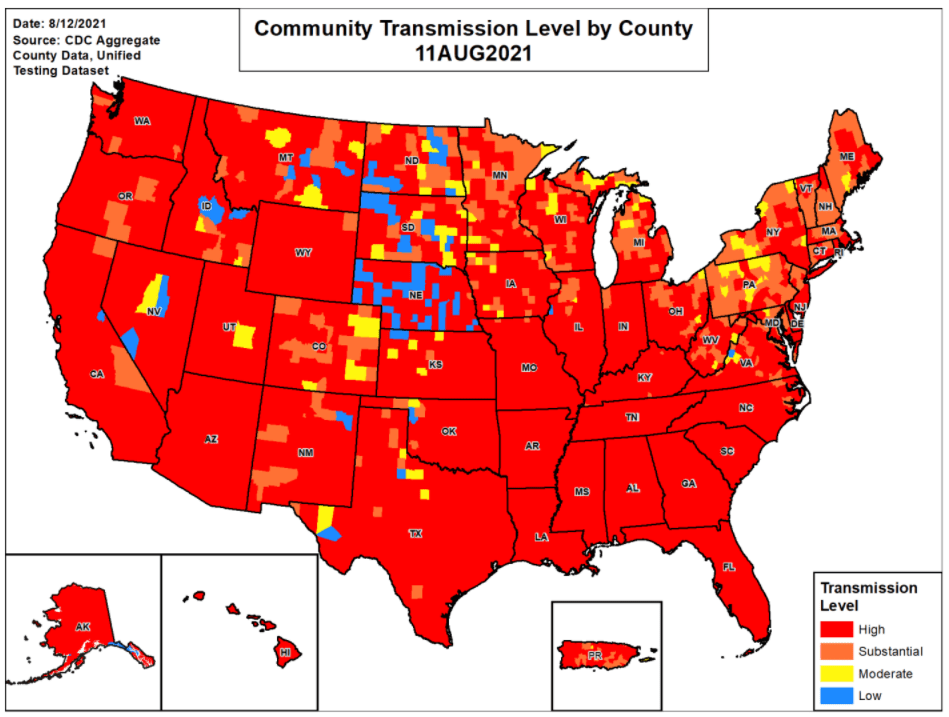
    While the South lights up with record cases and hospitalizations, every single state is currently seeing high coronavirus transmission, according to the CDC’s categories (over 100 new cases per 100,000 in the past week and/or test positivity over 10%). Almost every county is in the red as well.

    Almost 90,000 Americans are in the hospital with COVID-19 right now, about three-quarters of the way to last winter’s peak. While vaccinations continue to increase, we’ll need more mitigation than just shots in arms to control this current surge.

  • National numbers, August 22

    National numbers, August 22

    Every state in the country has high community transmission except for Maine and Vermont, which have substantial transmission. Chart from the CDC.

    In the past week (August 14 through 20), the U.S. reported about 930,000 new cases, according to the CDC. This amounts to:

    • An average of 133,000 new cases each day
    • 284 total new cases for every 100,000 Americans
    • 14% more new cases than last week (August 7-13)

    Last week, America also saw:

    • 81,000 new COVID-19 patients admitted to hospitals (25 for every 100,000 people)
    • 4,500 new COVID-19 deaths (1.4 for every 100,000 people)
    • 99% of new cases now Delta-caused (as of August 14)
    • An average of 840,000 vaccinations per day (per Bloomberg)

    COVID-19 cases continue to rise, with the U.S. seeing almost one million new cases this week (or more than one million, according to some non-CDC trackers). Deaths are also increasing, up 11% from last week and up almost 200% from late July. The vast majority of these deaths continue to occur in unvaccinated Americans.

    In the South, hospitals are becoming overwhelmed—to a degree reminiscent of March 2020 in New York City. Seven states have seen more than 20 new COVID-19 patients entering the hospital for every 100,000 residents in the past week: Florida, Georgia, Alabama, Louisiana, Kentucky, Oklahoma, and Texas. In Florida, that number is over 30 new patients for every 100,000.

    Children are accounting for a higher share of COVID-19 hospitalizations than at any previous point in the pandemic. Overall, last week, the U.S. saw four new COVID-19 patients under age 17 enter the hospital for every million children. In Florida, that number is about 12 for every million.

    Still, even parts of the country without overflowing hospitals are seeing concerning case rises. The CDC now designates almost every state as “high transmission,” with over 100 new cases for every 100,000 residents and/or over a 10% test positivity rate. The only two states that don’t fit this category, Maine and Vermont, both have “substantial transmission.”

    Vaccinations continue to slowly tick up: more than one million Americans were vaccinated for three days in a row this week, and 60% of the eligible population is now fully vaccinated. But we would still have a long way to go at this current pace to be fully protected against Delta—which now comprises 99% of U.S. cases, per the CDC.

  • National numbers, August 15

    National numbers, August 15

    County-level community transmission map from the August 12 Community Profile Report. The vast majority of the country is in the red zone.

    In the past week (August 7 through 13), the U.S. reported about 800,000 new cases, according to the CDC. This amounts to:

    • An average of 114,000 new cases each day
    • 244 total new cases for every 100,000 Americans
    • 18% more new cases than last week (July 31-August 6)

    Last week, America also saw:

    • 71,000 new COVID-19 patients admitted to hospitals (21.5 for every 100,000 people)
    • 3,400 new COVID-19 deaths (1.1 for every 100,000 people)
    • 97% of new cases now Delta-caused (as of August 7)
    • An average of 740,000 vaccinations per day (per Bloomberg)

    COVID-19 cases in the U.S. are now solidly over 100,000 new cases a day, a benchmark not hit since early February. And, per the latest CDC estimates, 97% of those cases are Delta.

    It cannot be overstated how dire the COVID-19 situation has become in southern hotspots. If one is to calculate the cases per capita in all U.S. states and countries of the world, three states make the top five: Louisiana, Florida, and Mississippi.

    In these states, hospitals are filling to a degree not seen since New York City at the beginning of the pandemic. For example, in Brevard County, Florida, local officials are asking residents to avoid calling 911 unless the situation is truly dire. “Leave emergency room and ambulance trips for those with life-threatening or serious emergencies,” the county’s fire chief told CBS News.

    Florida as a whole now has about 14,000 patients in state hospitals, per HHS data. During the winter surge, the state peaked at under 8,000. And more than half of patients in state ICUs are sick with COVID-19. Florida and Texas combined account for over 40% of COVID-19 hospitalizations in the country.

    As this Delta surge progresses, one major challenge may be that not enough Americans are getting tested—especially those who are vaccinated. While the vaccines are very good at protecting against severe disease and death, including from Delta, breakthrough infections have become more common; if these cases are not caught, they can fuel coronavirus spread among the unvaccinated. Overall test positivity in the U.S. has been about 10% for the past two weeks, per HHS data, indicating that we’re missing a lot of those infections. In some southern counties, it’s well above 20%.

    This surge’s silver lining continues: vaccinations are still going up. Almost one million new doses were reported in a single day on Saturday. But vaccination alone is not enough to completely stop COVID-19’s spread, especially when a variant as contagious as Delta has taken the reins.

  • National numbers, August 8

    National numbers, August 8

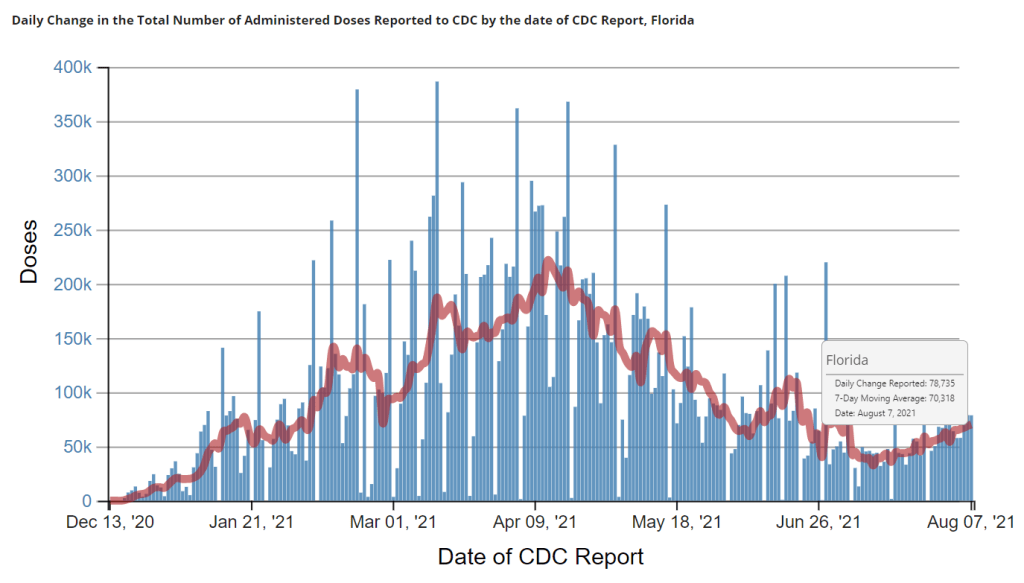
    Daily vaccinations in Florida are rising as the state’s hospitals become overwhelmed with COVID-19 patients. Source: CDC Vaccination Trends.

    In the past week (July 31 through August 6), the U.S. reported about 630,000 new cases, according to the CDC. This amounts to:

    • An average of 90,000 new cases each day
    • 192 total new cases for every 100,000 Americans
    • 34% more new cases than last week (July 24-30)

    Last week, America also saw:

    • 54,000 new COVID-19 patients admitted to hospitals (16.4 for every 100,000 people)
    • 2,600 new COVID-19 deaths (0.8 for every 100,000 people)
    • 93% of new cases now Delta-caused (as of July 31)
    • An average of 700,000 vaccinations per day (per Bloomberg)

    Delta continues to dominate COVID-19 cases in the U.S. The CDC updated its variant estimates this week, reporting that Delta made up 93% of U.S. cases at the end of July.

    This variant has now solidly beat out pretty much every other COVID-19 strain—even the Gamma (or P.1) variant is now down to just 1.3%—reflecting its highly contagious properties. If you missed it, I highly recommend checking out last week’s CDD rundown of key Delta facts and figures.

    COVID-19 hospitalizations and deaths are taking a serious toll on under-vaccinated hotspots in the south. Seven states—Florida, Texas, Missouri, Arkansas, Louisiana, Alabama, and Mississippi—make up about half of recent U.S. cases and hospitalizations, even though they reflect less than a quarter of the country’s total population, White House COVID-19 coordinator Jeff Zients said at a briefing on Thursday. Many hospitals in these states are turning away patients and canceling elective surgeries, as though we’re back in spring 2020.

    Still, there’s some good news in this crisis. As we noted last week, vaccination numbers are rising again, with the states hardest hit by Delta leading the pack. In Florida, for example, average daily vaccinations are up from 40,000 on July 7 to 70,000 on August 7. CVS and Walgreens are reporting vaccination upticks as well. And, as of Friday, over half of the U.S. population is now fully vaccinated.

    According to new polling data from KFF’s COVID-19 Vaccine Monitor, Delta is indeed a vaccination motivator. About one in five unvaccinated adults surveyed in KFF’s July poll said that COVID-19 variant news “has made them more likely to get vaccinated for COVID-19.” Still, many more people need convincing: the poll found that over half of vaccinated adults erroneously believe a COVID-19 vaccine poses a higher health risk than the virus itself.

    It’s tragic that thousands more would need to die for many Americans to finally get their shots. But every vaccination may potentially be a life saved.

  • National numbers, August 1

    National numbers, August 1

    In the past week (July 24 through 30), the U.S. reported about 466,000 new cases, according to the CDC. This amounts to:

    • An average of 66,600 new cases each day
    • 142 total new cases for every 100,000 Americans
    • 64% more new cases than last week (July 17-23)

    Last week, America also saw:

    • 38,300 new COVID-19 patients admitted to hospitals (11.7 for every 100,000 people)
    • 2,100 new COVID-19 deaths (0.6 for every 100,000 people)
    • 82% of new cases now Delta-caused (as of July 17)
    • An average of 660,000 vaccinations per day (per Bloomberg)

    Not only is the Delta variant driving a case rise, it’s driving an exponential case rise. This week, about 466,000 new COVID-19 cases were reported; that number is more than five times higher than what we saw during the week ending July 2.

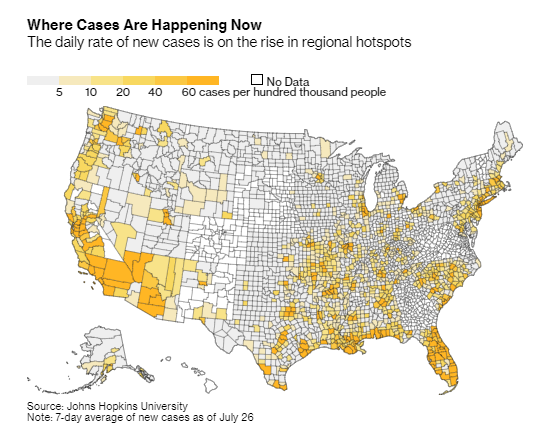
    Parts of the country with lower vaccination rates are more vulnerable to Delta, of course. Current hotspots include Louisiana, Florida, Arkansas, Mississippi, and Alabama, all of which reported at least 300 new cases for every 100,000 people in the past week and all of which have under half of their populations fully vaccinated.

    But Delta is now entirely dominant—causing at least 82% of cases in the country, per the most recent (yet two weeks old) CDC estimate—and every single state is seeing case surges right now. Hospitalizations are also up, 46% higher than last week, and deaths are up 33%. About 300 Americans are dying from COVID-19 every day—and almost all of those deaths are entirely preventable.

    The CDC is now recommending that vaccinated people wear masks in indoor settings, if they live in high-transmission areas, have young children, or fit other criteria. While you can use the CDC’s county-level data to find your community’s COVID-19 status, it’s important to note that everyone’s risk levels are elevated right now.

    Katherine J. Wu said it well in The Atlantic on Friday:

    Some 70 percent of American counties are, according to the map, currently on fire; that percentage will probably tick up before it drops again. For now, I am tracking my pandemic circumstances. But my boundaries for my “community” are bigger than what the map says they are. They don’t stop at my county line, or my state line. They go as far as the virus treads—everywhere. Right now, I’m masking for as many people as I can.

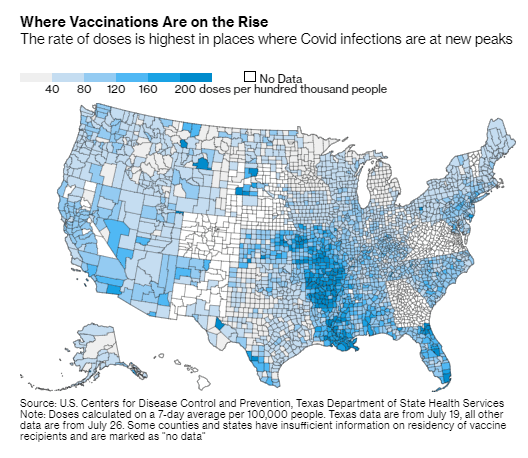
    All that said, there’s one silver lining to this new surge: vaccination numbers are ticking up again, with the highest daily rates now in states like Louisiana, Arkansas, and Missouri where the new COVID-19 wave is hitting the hardest. The vaccines are still our best protection against Delta and other variants; more on that later in the issue.

  • National numbers, July 18

    National numbers, July 18

    Image
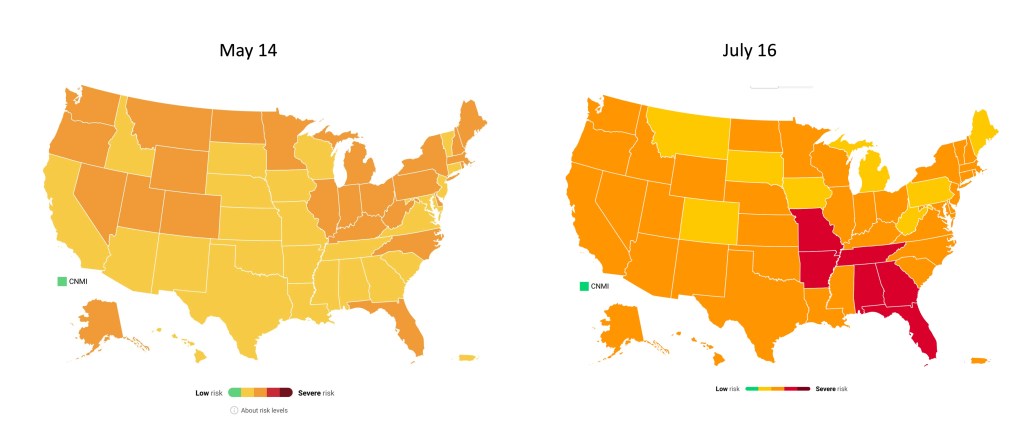
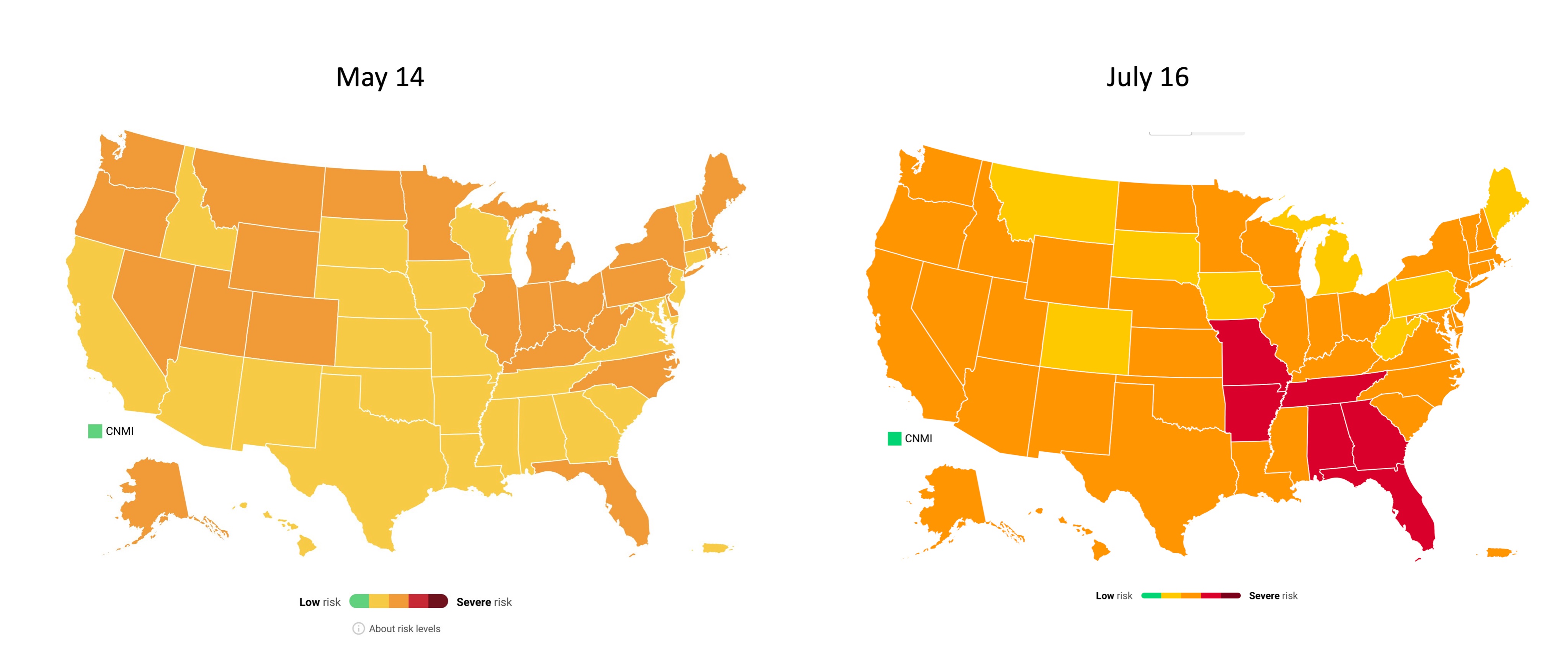
    COVID-19 risk levels by state in May and July. Data from Covid Act Now, posted on Twitter by Eric Topol.

    In the past week (July 10 through 16), the U.S. reported about 184,000 new cases, according to the CDC. This amounts to:

    • An average of 26,300 new cases each day
    • 56 total new cases for every 100,000 Americans
    • 69% more new cases than last week (July 3-9)

    Last week, America also saw:

    • 19,600 new COVID-19 patients admitted to hospitals (6.0 for every 100,000 people)
    • 1,500 new COVID-19 deaths (0.5 for every 100,000 people)
    • 58% of new cases now Delta-caused (as of July 3)
    • An average of 500,000 vaccinations per day (per Bloomberg)

    Cases have been rising for a couple of weeks now, but we’re now seeing the sharpest increase since fall 2020. Between July 9 and July 16, we went from an average of 15,000 new cases a day to an average of 26,000 new cases a day.

    Hospitalizations and deaths are also increasing. We’re now seeing about 26% more new COVID-19 patients in hospitals every day and 36% more new deaths—it’s the first time that deaths have increased since the winter.

    “There is a clear message that is coming through: this is becoming a pandemic of the unvaccinated,” CDC Director Dr. Rochelle Walensky said at a press briefing on Friday. As I’ve continually emphasized in recent issues, states and counties with lower vaccination rates are more vulnerable to the Delta variant.

    Missouri continues to be a hotspot, as does Arkansas, with other states in the Midwest and South also seeing major surges. Florida is of particular concern: one in five U.S. cases in the last week were reported in this state, and Florida has seen a 109% case increase from the first to the second week of July.

    The under-vaccinated hotspots are more likely to see hospitals become overwhelmed with COVID-19 patients (see: this great data visualization by Conor Kelly). But even areas with high vaccination rates are seeing Delta take over. In New York City, Delta now causes 69% of new cases—and case numbers have doubled in the past two weeks. In San Francisco, where a full three-quarters of the eligible population is fully vaccinated, cases and test positivity rates have jumped in July.

    Despite the clear dangers of Delta, millions of Americans still refuse to get vaccinated. As Ed Yong put it in a recent piece on Missouri’s surge: “Vaccines were meant to be the end of the pandemic. If people don’t get them, the actual end will look more like Springfield’s present: a succession of COVID-19 waves that will break unevenly across the country until everyone has either been vaccinated or infected.”