Tag: National numbers

  • National numbers, December 5

    National numbers, December 5

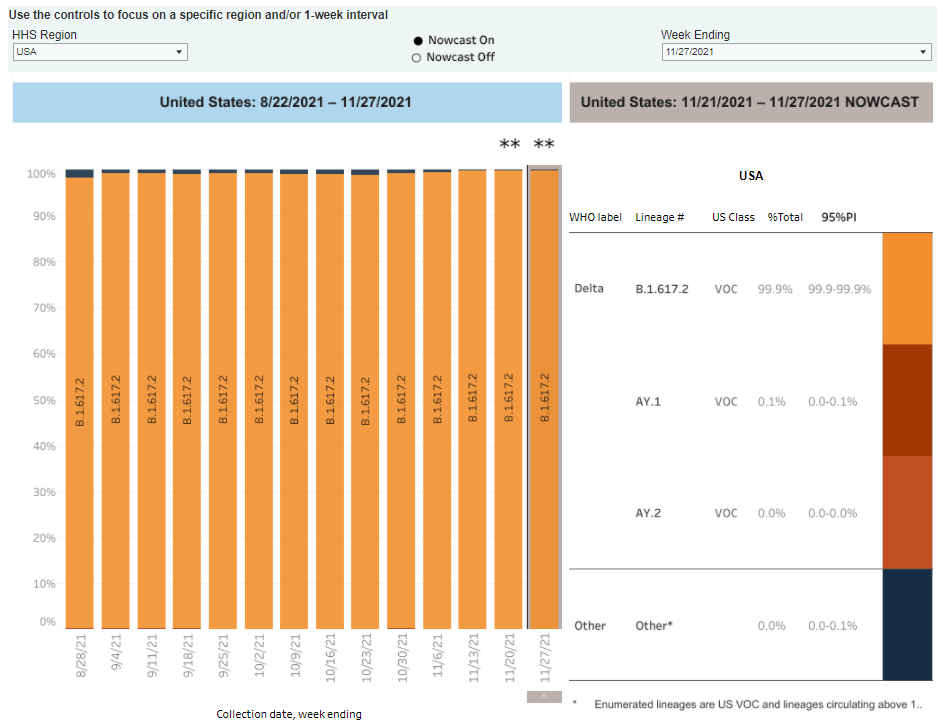
    Though Omicron is making headlines, Delta is still causing 100% of COVID-19 cases in the U.S. Chart via the CDC, screenshot taken on December 5.

    In the past week (November 27 through December 3), the U.S. reported about 600,000 new cases, according to the CDC. This amounts to:

    • An average of 86,000 new cases each day
    • 184 total new cases for every 100,000 Americans
    • 8% fewer new cases than last week (November 20-26)

    Last week, America also saw:

    • 45,000 new COVID-19 patients admitted to hospitals (14 for every 100,000 people)
    • 6,000 new COVID-19 deaths (1.8 for every 100,000 people)
    • 100% of new cases are Delta-caused (as of November 27)
    • An average of one million vaccinations per day (including booster shots; per Bloomberg)

    Don’t be fooled by the apparent case decline in the CDC’s numbers: the U.S. is still in the midst of a new surge. The agency reported fewer cases last week due to Thanksgiving holiday delays, but we can expect cases to shoot up next week as delayed cases are added to the data.

    I use the CDC for these updates because I find the national agency’s data reliable and easy to access, but the CDC does tend to be more heavily impacted by reporting delays than other sources which compile numbers from U.S. states or counties. For example, the New York Times is reporting a daily new case average of 108,000 as of December 4, while BNO Newsroom has reported over 100,000 new cases for five days in a row.

    Meanwhile, hospitalizations are ticking up: with 45,000 new COVID-19 patients admitted to U.S. hospitals last week and almost 50,000 people currently hospitalized, as of December 2. Hospitalizations are one COVID-19 metric that tends to be less impacted by holidays, as the hospitals collecting these data don’t take days off.

    Northern states continue to lead the country in new cases per capita. According to the latest Community Profile Report, top hotspots are New Hampshire, Michigan, Minnesota, North Dakota, and Wisconsin. New Hampshire reported over 500 new cases for every 100,000 people in the last week, and is continually setting new COVID-19 records.

    Michigan is seeing more cases now than it has in any previous surge, and the state’s hospital systems—like many others—are facing dire staff shortages, along with increased numbers of flu patients. The state has almost 900 fewer staffed hospital beds now than in November 2020, according to ABC News.

    While the Omicron variant has now been identified in more than ten U.S. states (more on that below), the Delta variant is still driving this current surge. According to the CDC’s latest variant data, 100% of new cases in the country are caused by Delta. In the coming weeks, we’ll see how much Omicron is able to compete.
  • National numbers, November 28

    National numbers, November 28

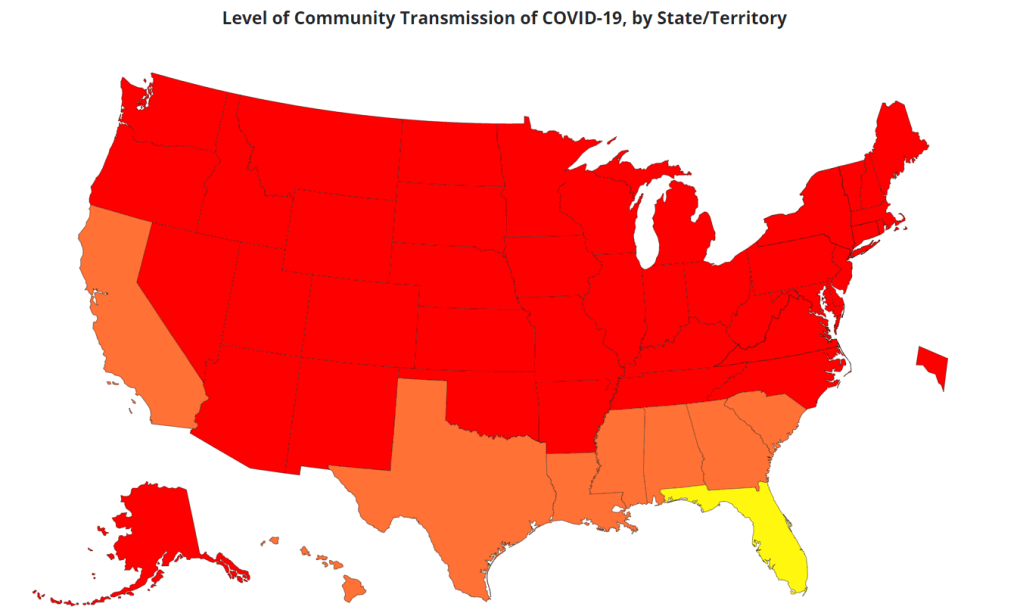
    Community transmission levels by state, as of November 24. Florida is the only state with “moderate” transmission, while several other Southern states have “substantial” transmission. Chart via the CDC.

    In the past week (November 18 through 24), the U.S. reported about 660,000 new cases, according to the CDC.* This amounts to:

    • An average of 94,000 new cases each day
    • 201 total new cases for every 100,000 Americans

    Last week, America also saw:

    • 41,000 new COVID-19 patients admitted to hospitals (12 for every 100,000 people)
    • 6,900 new COVID-19 deaths (2.1 for every 100,000 people)
    • 100% of new cases are Delta-caused (as of November 20)
    • An average of 1.8 million vaccinations per day (including booster shots; per Bloomberg)

    *Note: This week, the CDC did not provide COVID-19 data updates for most metrics on Thursday, Friday, or Saturday due to the holiday, so my update is based on Wednesday’s data.

    As is typically the case on holidays, Thanksgiving has made COVID-19 reporting a bit wonky. The CDC didn’t update its dashboard at all from Thursday through Saturday, and it is not updating vaccination data all weekend. At the same time, public health workers at many state and local agencies are taking a well-deserved long weekend off—leading to delayed reports of cases that will show up in the next couple of weeks. 

    Still, cases seem to continue trending up at the national level. The U.S. is now reporting close to 100,000 new cases a day, and holiday travel is likely to push this number up further. Michigan, Minnesota, and New Hampshire are the country’s three biggest hotspots, per the latest Community Profile Report (released Wednesday), all with over 500 total new cases per 100,000 people in the past week.

    Other Northern states—Wisconsin, Maine, Colorado, Vermont—are also reporting high case rates, while Southern states continue to see lower numbers. Florida actually has the lowest case rate in the country, at 49 new cases per 100,000 people in the past week. This state is likely benefitting from COVID-19’s seasonal nature, combined with a lot of built-up immunity from the region’s summer Delta surge.

    Nationally, the number of COVID-19 deaths in the U.S. in 2021 has surpassed the total deaths from the virus in 2020. Even though vaccines have been widely available for most of this year. The 2020 number is likely a significant undercount, as many people who contracted the coronavirus in spring 2020 were unable to get tested—but still, this milestone is disheartening.

    Vaccination numbers have increased dramatically in the U.S. in recent weeks with well over one million shots given a day, thanks to booster shot availability and new eligibility for children under age 12. About 38 million people have now received their third doses, according to the CDC. But whether this will be enough to blunt the coming winter surge remains to be seen.

  • National numbers, November 21

    National numbers, November 21

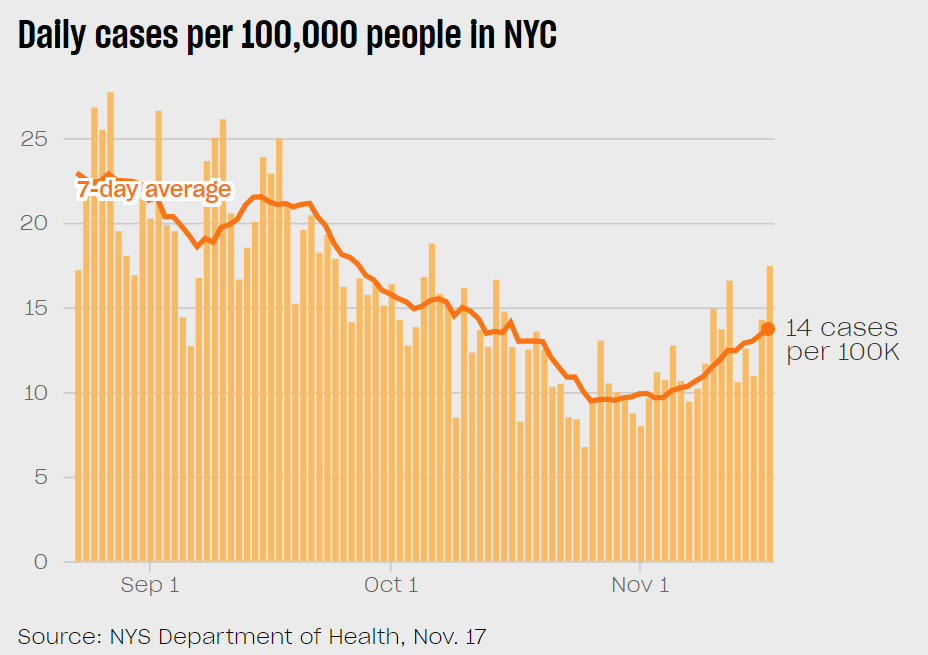
    New York City is now seeing about 14 new cases for every 100,000 people each day. Chart via THE CITY’s COVID-19 dashboard.

    In the past week (November 13 through 19), the U.S. reported about 620,000 new cases, according to the CDC. This amounts to:

    • An average of 88,000 new cases each day
    • 189 total new cases for every 100,000 Americans
    • 16% more new cases than last week (November 6-12)

    Last week, America also saw:

    • 38,000 new COVID-19 patients admitted to hospitals (12 for every 100,000 people)
    • 7,200 new COVID-19 deaths (2.2 for every 100,000 people)
    • 100% of new cases are Delta-caused (as of November 13)
    • An average of 1.3 million vaccinations per day (including booster shots; per Bloomberg)

    Last week, I wrote that the U.S. was at the start of a winter surge; this week, the surge is beginning to take off. Nationwide, cases are up 16% from last week to this week, and up 24% from two weeks ago. It’s not as sharp of an increase as what we saw during the first Delta surge in the summer, but it’s still concerning. New hospitalizations are also rising, up about 5% from last week.

    Michigan and Minnesota are now the country’s top hotspots, with 589 and 524 new cases for every 100,000 people in the past week, respectively, per the latest Community Profile Report. Other hotspots include more northern states: New Hampshire, North Dakota, Wisconsin, Vermont. After being a success story for most of the pandemic, Vermont is now seeing its highest case numbers yet.

    Meanwhile, in Europe, the ongoing surge has prompted increasingly strict COVID-19 safety measures. The government of Austria, which is also seeing record-high case numbers, announced on Friday that COVID-19 vaccination is now mandatory for the entire adult population. This follows a lockdown for unvaccinated Austrians only.

    Nearly 80% of Austrian adults are vaccinated, according to the New York Times; the U.S. is in a similar position. But here, all the attention is on booster shots—more than 33 million Americans have now received boosters—and on shots for kids in the recently eligible 5 to 11 age group. About 10% of kids in that age group have now received their first doses, which may seem less impressive when one considers that the U.S. had enough doses for the entire eligible population ready to go when the FDA and CDC approved the shots.

    In NYC, where I live, the case rate is now up at about 14 new cases for every 100,000 people, every day. That adds up to almost 100 new cases for every 100,000 people in the last week, meeting the CDC’s threshold for high transmission. About three in every four residents are vaccinated.

    To combat this increase, city leaders announced on Monday that all adults were eligible for a booster shot—a few days before the FDA and CDC made the same decision for all adults in the U.S. (More on that eligibility later in this issue.) But no efforts have been made to cut down on indoor dining, curb the crowds in Times Square, or actually enforce mask-wearing on the subway. In this new surge, it truly feels like everyone is out here fending for themselves.

  • National numbers, November 14

    National numbers, November 14

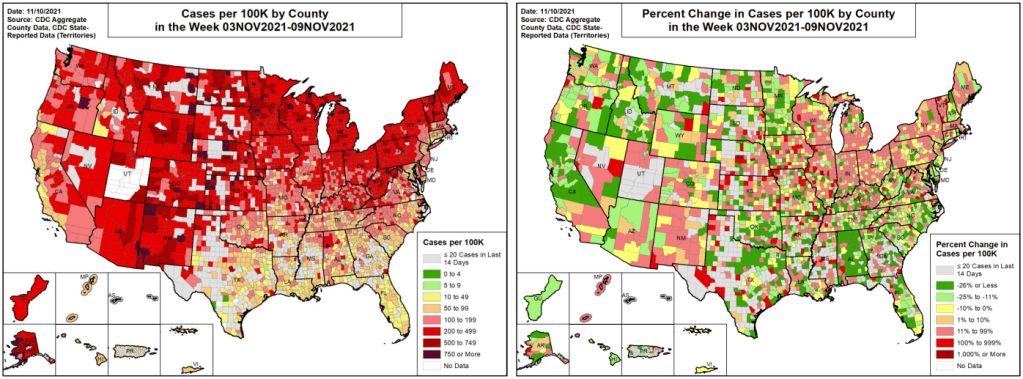
    Many Northern states are seeing cases increase right now as Southern states have lower transmission levels. Charts from the November 10 Community Profile Report.

    In the past week (November 6 through 12), the U.S. reported about 510,000 new cases, according to the CDC. This amounts to:

    • An average of 73,000 new cases each day
    • 156 total new cases for every 100,000 Americans
    • 3% more new cases than last week (October 30-November 5)

    Last week, America also saw:

    • 36,000 new COVID-19 patients admitted to hospitals (11 for every 100,000 people)
    • 7,000 new COVID-19 deaths (2.1 for every 100,000 people)
    • 100% of new cases are Delta-caused (as of November 6)
    • An average of 1.4 million vaccinations per day (including booster shots; per Bloomberg)

    It may be happening slowly, but the U.S. is clearly at the start of a winter COVID-19 surge. The number of newly reported cases rose this week for the first time since early September, while the number of COVID-19 patients in hospitals has plateaued.

    Delta is still causing practically 100% of COVID-19 cases in the country, so a new variant is probably not to blame for this potential surge. Instead, it’s a consequence of the cold weather, combined with less-stringent safety behaviors among many Americans as we approach the holiday season. One epidemiologist told NBC that a surge may be “inevitable” at this time of year.

    In line with COVID-19’s cold-weather advantage, many Northern states are seeing cases increase right now as Southern states—which were hit harder by the summer Delta surge—have lower transmission levels. Alaska, North Dakota, New Mexico, Montana, and Wyoming had the highest case rates last week, per the latest Community Profile Report.

    Cases are also rapidly increasing in Maine, Vermont, Minnesota, Michigan, Colorado, and other chillier states. At Vermont’s St. Michael’s College, Halloween parties were a major source of new COVID-19 cases—even though 98% of people on campus are vaccinated, according to local outlet WCAX3.

    Still, it’s important to point out here that the U.S. is in a far better spot now than we were at this time last year. As Dr. Ashish Jha pointed out on Twitter recently, we have winter coming and the vast majority of schools in the country are open, but cases are flat rather than rising sharply as they did last November.

    Of course, we have vaccines to thank for this improved position. More than two-thirds of the U.S. population has received at least one vaccine dose; as of this week, that number includes over one million children under age 12, according to the CDC. Vaccinating more children and other people who are currently unvaccinated, booster shots for seniors, and continued use of masks and testing can help keep case numbers (relatively) low as we head into the coldest months.

  • National numbers, November 7

    National numbers, November 7

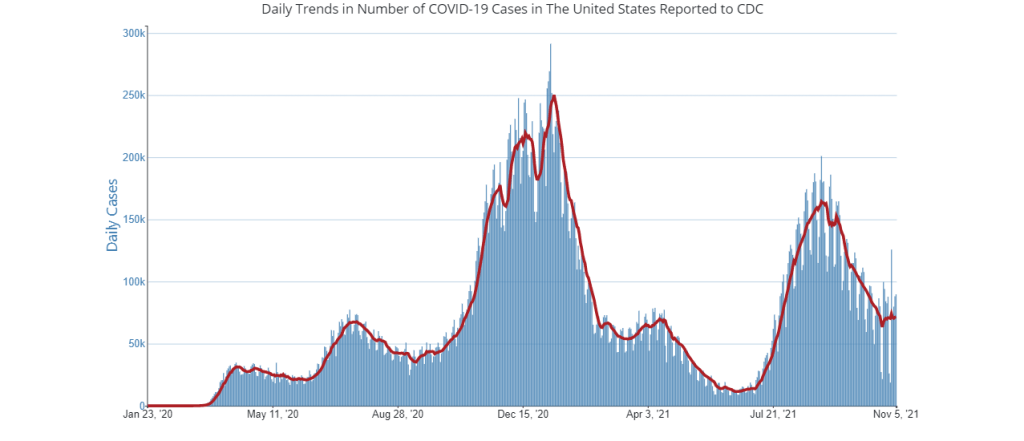
    U.S. COVID-19 cases are in a clear plateau. Chart via the CDC, downloaded on November 7.

    In the past week (October 30 through November 5), the U.S. reported about 490,000 new cases, according to the CDC. This amounts to:

    • An average of 70,000 new cases each day
    • 150 total new cases for every 100,000 Americans
    • 1% fewer new cases than last week (October 23-29)

    Last week, America also saw:

    • 36,000 new COVID-19 patients admitted to hospitals (11 for every 100,000 people)
    • 8,000 new COVID-19 deaths (2.4 for every 100,000 people)
    • 99% of new cases are Delta-caused (as of October 30)
    • An average of 1.8 million vaccinations per day (including booster shots; per Bloomberg)

    At the national level, new COVID-19 cases seem to have entered a plateau. The U.S. has reported about 70,000 new cases a day for the past three weeks; while hospitalization and death numbers continue to go down, those drops are rather slight compared to what we saw earlier this fall.

    Cold-weather states continue to see the highest case rates: Alaska, Montana, North Dakota, and Wyoming are at the top this week, with over 400 new cases for every 100,000 people as of the latest Community Profile Report.

    New Hampshire is now a concerning hotspot as well—the state saw almost a 200% increase in cases from last week to this week. Colorado, Minnesota, New Mexico, and Michigan are also reporting significant increases.

    Throughout the pandemic, trends in the U.S. have often followed trends in Europe, with this country seeing new surges a few weeks after they happen across the Atlantic. And right now, Europe is “at the epicentre” of the pandemic, according to the World Health Organization. Russia and Germany have recently recorded record cases, while other European countries are reinstating safety restrictions. 

    This week, the world marked five million COVID-19 deaths, while the U.S. marked 750,000. Both numbers are almost certainly undercounts, due to under-testing, limited medical record-keeping in some places, and other issues. In the U.S., over 1,000 people continue to die each day despite widely available vaccines.

    Vaccination numbers are going up, though—driven largely by booster shots and by shots for the 5 to 11 age group, now officially eligible. The federal vaccines.gov site has been updated to include vaccination sites for these kids.

    But as we celebrate kids getting vaccinated, it’s important to recognize the global inequities at play here:

  • National numbers, October 31

    National numbers, October 31

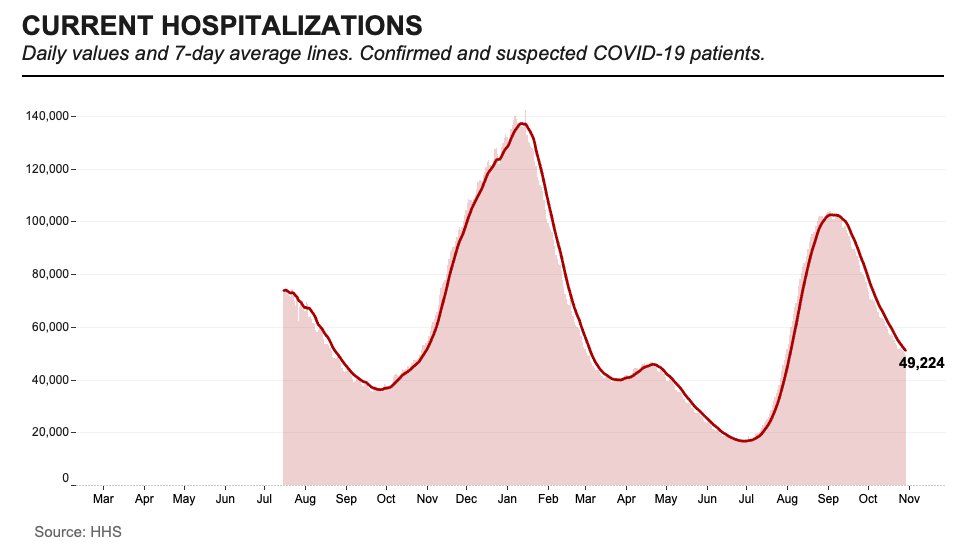
    Nationwide COVID-19 hospitalizations have fallen below 50,000 for the first time since July. Chart via Conor Kelly, posted on Twitter on October 30.

    In the past week (October 23 through 29), the U.S. reported about 480,000 new cases, according to the CDC.* This amounts to:

    • An average of 69,000 new cases each day
    • 147 total new cases for every 100,000 Americans
    • 7% fewer new cases than last week (October 16-22)

    Last week, America also saw:

    • 38,000 new COVID-19 patients admitted to hospitals (12 for every 100,000 people)
    • 8,000 new COVID-19 deaths (2.4 for every 100,000 people)
    • 100% of new cases are Delta-caused (as of October 23)
    • An average of 900,000 vaccinations per day (including booster shots; per Bloomberg)

    *Note: we are back to our usual schedule (utilizing data as of Friday) after last week’s hiccup.

    Nationally, new COVID-19 cases continue to drop—though the decrease is slowing a bit from previous weeks. The number of new cases fell by about 7% this week, after falling by about 12% for the two weeks prior.

    Still, a downward trend is a positive trend. The U.S. now has fewer than 50,000 COVID-19 patients in hospitals nationwide, for the first time since July—before the Delta surge started. The number of new deaths is also slowly falling, though the country is still seeing over 1,000 people die from COVID-19 each day.

    The country’s current hotspots continue to be the same group of colder-weather states I called out last week: Alaska, Montana, Wyoming, North Dakota, and Idaho. All five have recorded over 400 new cases for every 100,000 people in the last week, per the latest Community Profile Report, with Alaska at the top (657 cases per 100,000).

    It’s hard to say whether these high numbers are a product of cold weather driving people inside, low vaccination rates—all five states have about half or less of their populations fully vaccinated—or both. Continuing trends in these states may provide an indicator of how other parts of the country may fare this winter.

    Meanwhile, more states are seeing their COVID-19 numbers drop below “high transmission” levels, including Louisiana, D.C., Georgia, Maryland, Texas, and New Jersey. In New Orleans, a Delta epicenter in the summer, case numbers are low enough that the mayor has loosened the city’s mask mandate and other COVID-19 restrictions.

    Vaccinations are up nationally, but booster shots—not previously unvaccinated Americans getting their first doses—are comprising the bulk of the trend. Yesterday, out of 1.6 million doses reported by the CDC, a record one million were booster shots. Just 361,000 were new first doses.

  • National numbers, October 24

    National numbers, October 24

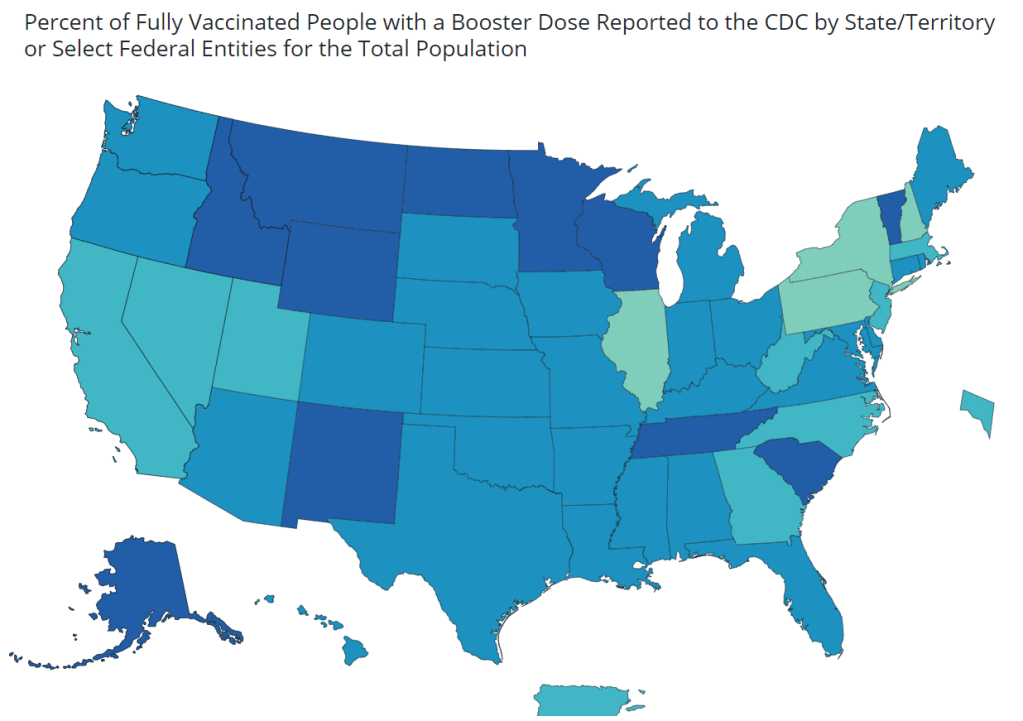
    As of October 22, the CDC is reporting booster doses administered by state. Darker blue corresponds to a higher share of the fully vaccinated population in the state that has received a booster; lighter blue/green corresponds to a lower share of the population.

    In the past week (October 15 through 21), the U.S. reported about 510,000 new cases, according to the CDC.* This amounts to:

    • An average of 73,000 new cases each day
    • 156 total new cases for every 100,000 Americans
    • 14% fewer new cases than last week (October 9-15)

    Last week, America also saw:

    • 42,000 new COVID-19 patients admitted to hospitals (13 for every 100,000 people)
    • 9,000 new COVID-19 deaths (2.7 for every 100,000 people)
    • 100% of new cases are Delta-caused (as of October 16)
    • An average of 800,000 vaccinations per day (including booster shots; per Bloomberg)

    *Note: This week’s update relies on data as of Thursday, October 21. I usually use Friday data (via the COVID Data Tracker Weekly Review), but was unable to do so this week because I headed offline for a hiking trip before the Friday data were posted. We’ll be back to the usual sourcing next week!

    Nationwide, COVID-19 cases continue to go down—slowly but surely. We’re now seeing roughly 70,000 new cases a day, comparable to case counts when the Delta surge started to really pick up at the end of July. It’s worth noting, though, that this is still higher than the peaks of both the spring and summer 2020 surges.

    At the state level, more parts of the country are approaching lower coronavirus transmission levels. As of Thursday, eight jurisdictions have dropped below 100 new cases per 100,000 people in the past week. From lowest case counts to highest, these are: California, Hawaii, Florida, Louisiana, Washington D.C., New Jersey, Maryland, and Mississippi.

    Alaska, Montana, and Wyoming remain the states with the highest COVID-19 rates, followed by Idaho and North Dakota. These states are all in northern parts of the U.S.—and their recent case increases have coincided with cold weather—the Washington Post and other outlets have noted. Other states may see similar COVID-19 upticks as it becomes too cold to socialize outdoors.

    Booster shots continue to inflate vaccination numbers, as these third doses comprise between one-third and one-half of doses administered in the U.S. each day. Over 11 million people have already received a booster dose—more than the total doses administered in a number of low-income countries.

  • National numbers, October 17

    National numbers, October 17

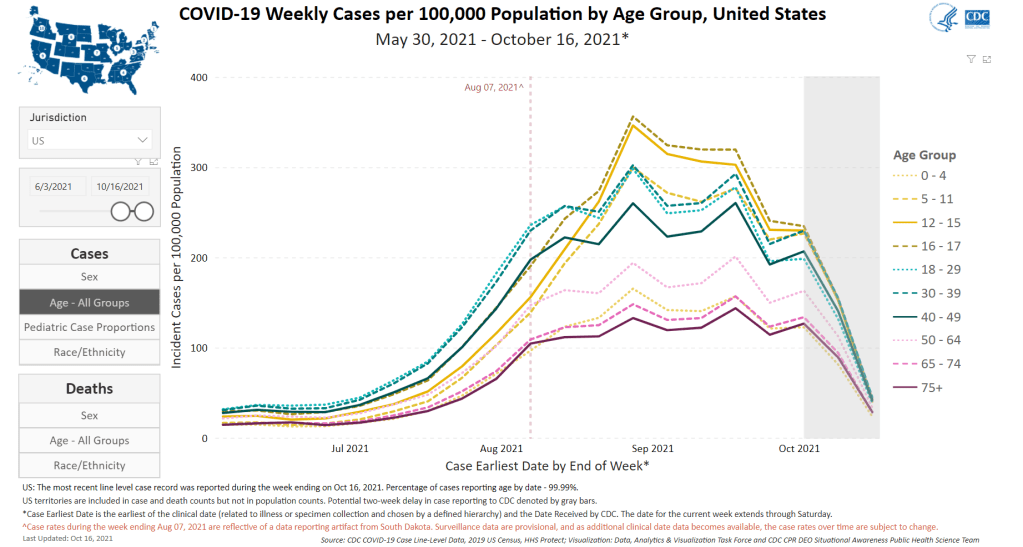
    Cases are going down for all age groups, but children continue to have high COVID-19 rates. Chart from the CDC.

    In the past week (October 9 through 15), the U.S. reported about 600,000 new cases, according to the CDC. This amounts to:

    • An average of 85,000 new cases each day
    • 180 total new cases for every 100,000 Americans
    • 13% fewer new cases than last week (October 2-8)

    Last week, America also saw:

    • 47,000 new COVID-19 patients admitted to hospitals (14 for every 100,000 people)
    • 9,000 new COVID-19 deaths (2.7 for every 100,000 people)
    • 100% of new cases are Delta-caused (as of October 9)
    • An average of 700,000 vaccinations per day (including booster shots; per Bloomberg)

    COVID-19 cases continue to drop across the U.S., slowly but surely. We’re now reporting about 85,000 new cases a day, down from 97,000 new cases a day last week, down from 108,000 new cases a day the week before last.

    Hospitalizations and deaths are falling nationwide as well. About 57,000 Americans are currently hospitalized with COVID-19, down 12% from last week. And about 1,200 people are dying from the disease each day, the vast majority of them unvaccinated.

    Still, most states continue to experience “high transmission,” per the CDC’s categories. Hawaii, Florida, and Alabama, three states that saw intense Delta surges in recent months, have now joined California and Connecticut in crossing the threshold to “substantial transmission”—with under 100 new cases for every 100,000 people in the past week, according to the latest Community Profile Report.

    Alaska, Montana, and Wyoming remain the most intense hotspots, with over 500 new cases for every 100,000 people in the past week. In Alaska, hospitals are still in crisis mode, with doctors forced to choose which patients they must prioritize for care. All three states are seeing case rates decrease, though, indicating that they may be past the peak of their surges.

    While cases among children are trending slightly downward as well, the number remains much higher than at other points in the pandemic. In the week ending October 7, cases among children represented about one in four COVID-19 cases reported in the U.S., according to the American Academy of Pediatrics.

    Vaccinations continue to be dominated by booster shots, with boosters making up between one-third and half of the doses administered each day this week. Already, 14% of U.S. seniors have received a booster dose, according to the CDC. 5% of the US population overall has received a booster dose. These numbers will only increase as Moderna and J&J boosters are authorized, following FDA advisory committee recommendations. (More on that later in today’s issue.)

  • National numbers, October 10

    National numbers, October 10

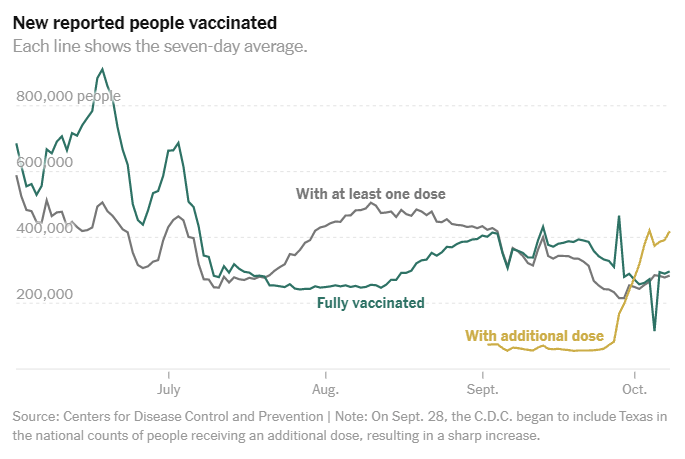
    The U.S. is now administering about one million vaccine doses a day, largely thanks to eligible Americans receiving their booster shots. Chart via the New York Times.

    In the past week (October 2 through 8), the U.S. reported about 670,000 new cases, according to the CDC. This amounts to:

    • An average of 95,000 new cases each day
    • 204 total new cases for every 100,000 Americans
    • 12% fewer new cases than last week (September 25-October 1)

    Last week, America also saw:

    • 52,000 new COVID-19 patients admitted to hospitals (16 for every 100,000 people)
    • 10,000 new COVID-19 deaths (3.1 for every 100,000 people)
    • 100% of new cases are Delta-caused (as of October 2)
    • An average of one million vaccinations per day (including booster shots; per Bloomberg)

    At the national level, COVID-19 cases continue to go down. The U.S. is now seeing fewer than 100,000 new cases a day, and about 62,000 Americans are currently hospitalized with COVID-19—a 14% drop from last week. 

    It may feel like the Delta surge is now “over,” but case rates are still incredibly high across the country compared to what we saw earlier this summer. California and Connecticut continue to be the only two states with “substantial” transmission, according to the CDC. Every other state has “high” transmission, meaning over 100 new cases for every 100,000 people in the past week.

    Alaska remains the country’s biggest hotspot, with over 800 new cases for every 100,000 people in the past week, per the latest Community Profile Report. Case numbers have dropped a bit since last week—when Alaska hit the highest per-capita COVID-19 case rate of any state during the entire pandemic thus far—but the state’s hospitals are still incredibly overwhelmed. Doctors are rationing care, unable to send most patients on hours-long trips to Washington state.

    Other Midwestern states continue to face Delta surges, including Montana, North Dakota, Wyoming, West Virginia, and Idaho. All five states have COVID-19 case rates over 500 new cases per 100,000 people in the past week.

    Vaccination numbers are going up nationwide, with over one million doses administered each day in the past week. But there’s a key caveat here: many of these doses are booster shots. On Saturday, for example, the CDC reported 1.15 million new doses—including over 500,000 booster shots. The number of people receiving their first doses is the lowest it’s been in months.

  • National numbers, October 3

    National numbers, October 3

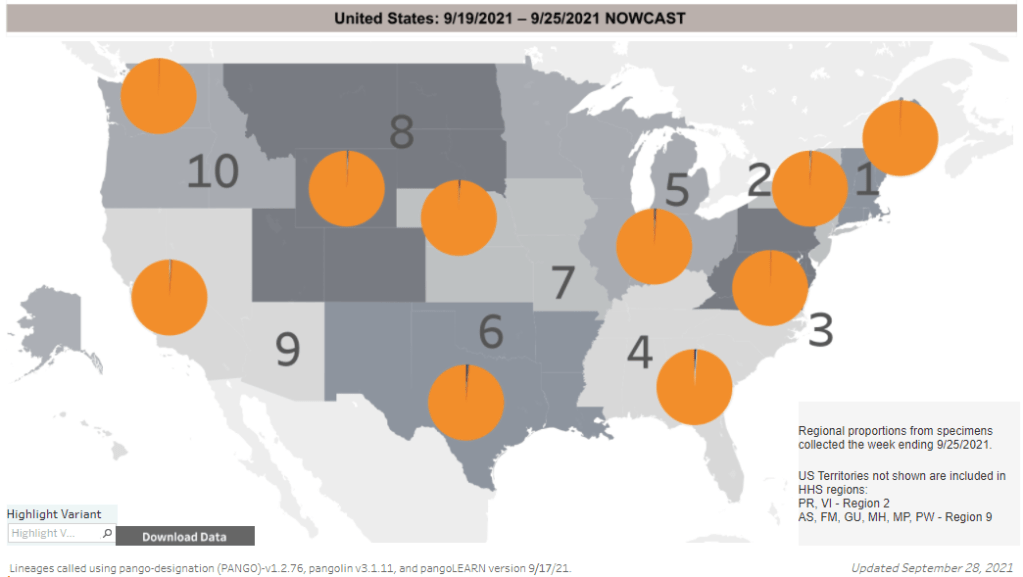
    Delta dominates throughout the U.S. The CDC’s variant map has looked like this for a few weeks now.

    In the past week (September 25 through October 1), the U.S. reported about 750,000 new cases, according to the CDC. This amounts to:

    • An average of 106,000 new cases each day
    • 227 total new cases for every 100,000 Americans
    • 13% fewer new cases than last week (September 18-24)

    Last week, America also saw:

    • 58,000 new COVID-19 patients admitted to hospitals (18 for every 100,000 people)
    • 10,000 new COVID-19 deaths (3.2 for every 100,000 people)
    • 99% of new cases are Delta-caused (as of September 25)
    • An average of 800,000 vaccinations per day (including booster shots; per Bloomberg)

    COVID-19 cases continue to go down in the U.S.; by next week, the country will likely be back under 100,000 new cases a day. Hospitalizations are also dropping: this week, the number of COVID-19 patients currently hospitalized across the U.S. dropped about 12%, to 72,000.

    But over 10,000 COVID-19 deaths were reported this week, for the third week in a row. Many of these deaths likely occurred earlier in the Delta surge, but showed up in the numbers more recently due to reporting lags.

    The U.S. passed 700,000 COVID-19 deaths this week, many of them unvaccinated. To quote Ed Yong’s latest feature: “Every adult in the U.S. has been eligible for vaccines since mid-April; in that time, more Americans have died of COVID-19 per capita than people in Germany, Canada, Rwanda, Vietnam, or more than 130 other countries did in the pre-vaccine era.”

    Alaska is now the number one COVID-19 hotspot in the country. According to Friday’s Community Profile Report, the state saw almost 1,200 new COVID-19 cases for every 100,000 residents in the week ending September 29. That’s twelve times higher than the CDC’s threshold for “high transmission,” 100 new cases for every 100,000 people in a week.

    Hospitals in Alaska are completely overwhelmed. The state currently has about 40% more COVID-19 patients in hospitals than it did at the peak of the winter surge. In a recent video posted to Facebook and shared with local leaders, a nurse at Fairbanks Medical Hospital describes the dire process of dying from COVID-19—something that has become incredibly common in her workplace. About 50% of Alaska’s population is fully vaccinated.

    On the other side of the spectrum, Connecticut has joined California in the “substantial transmission” range. Connecticut saw 98 new cases for every 100,000 people in the past week, while California saw 73 new cases for every 100,000.

    Over 99% of new cases in the U.S. are caused by Delta, as has been the case for over a month. Delta has solidly outcompeted the Mu variant, and remains dominant across the country. Will this variant peter out as the surge slowly wanes, or will Delta evolve into another more-dangerous variant? The CDC’s current data makes it hard to look for signals.