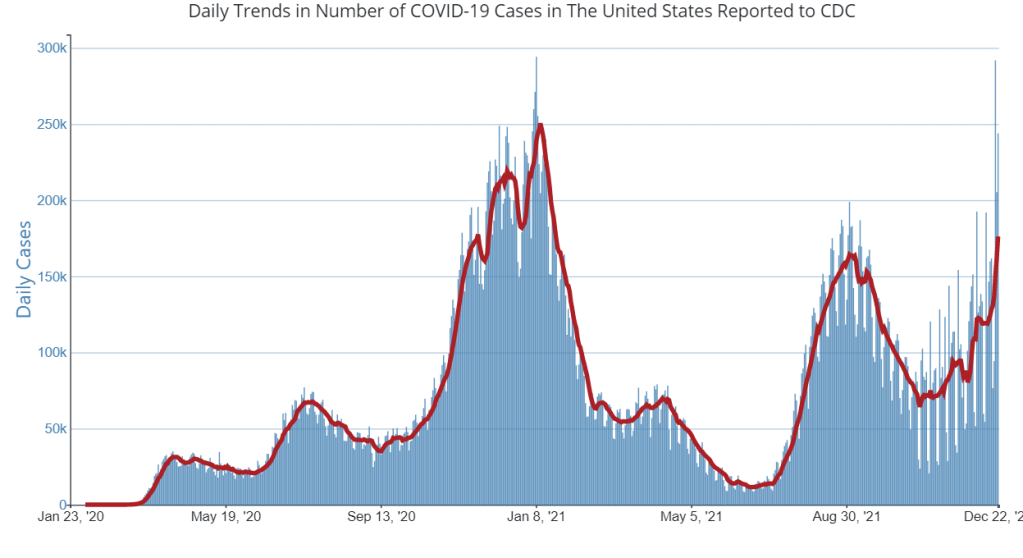
In the past week (December 17 through 23), the U.S. reported about 1.2 million new cases, according to the CDC.* This amounts to:
- An average of 176,000 new cases each day
- 376 total new cases for every 100,000 Americans
- 42% more new cases than last week (December 10-16)
Last week, America also saw:
- 55,000 new COVID-19 patients admitted to hospitals (17 for every 100,000 people)
- 8,500 new COVID-19 deaths (2.6 for every 100,000 people)
- 73% of new cases are Omicron-caused (as of December 18)
- An average of 1.4 million vaccinations per day (including booster shots; per Bloomberg)
*This week’s update is based on data as of Thursday, December 23; I typically utilize the CDC’s Friday updates, but the agency is not updating any data from Friday through Sunday this week due to the Christmas holiday.
Last week, the Omicron surge had clearly arrived; this week, it’s picking up steam. Nationwide, the U.S. reported well over one million new cases this week—more than a 40% increase from last week. 244,000 cases were reported on Thursday alone, and the daily new case average is now higher than at any point during the Delta surge.
Hospitalization and death numbers have yet to increase so sharply: the number of new COVID-19 patients admitted to hospitals this week is up less than 1%, and the number of new COVID-19 deaths is up by about 4%.
But when Omicron reaches those Americans who are more vulnerable to COVID-19, they’ll arrive at hospitals already overwhelmed from Delta, the flu, and nearly two years of pandemic burnout. At the same time, Omicron’s incredible capacity to spread will likely cause staffing shortages for many hospitals, as workers get breakthrough cases. On Thursday, the CDC announced that healthcare workers who get sick may shorten their quarantines if their facilities are facing shortages.
New York City continues to be a major Omicron hotspot: according to city data, one in every 100 New Yorkers has tested positive for COVID-19 in the last week. In Manhattan, the number is one in 60. And these numbers don’t include people who tested positive on rapid at-home tests and weren’t able to confirm it with PCR. The city’s test positivity rate is over 10%, indicating that a lot of cases are going unreported in official data.
Washington, D.C. has also emerged as a Omicron hotspot this week, with an average of over 1,000 new cases reported daily in the week ending December 22. That’s more than three times higher than the city’s case record at any other point during the pandemic. Meanwhile, several states have seen their case rates more than double in the past week, according to the latest Community Profile Report: Hawaii, Florida, Louisiana, Georgia, and Maryland.
As Omicron sweeps across the country—aided by holiday travel and gatherings—we are about to face the reporting delays that come with every holiday. Public health workers from local agencies to the CDC are taking time off, while testing sites close for Christmas and millions of rapid tests go unreported.
Erin Kissane, co-founder of the COVID Tracking Project, wrote about holiday data issues in The Atlantic this week. Her piece concludes:
In this information vacuum, some of us will tend toward caution and others toward risk. By the time Americans find out the results of our collective actions, the country will have weeks of new cases—an unknown proportion of which will turn into hospitalizations and deaths—baked in. In the meantime, the CDC’s COVID Data Tracker Weekly Review has wished us all a safe and happy holiday and gone on break until January 7, 2022.
 COVID-19 Data Dispatch