Tag: February data

  • National numbers, February 26

    National numbers, February 26

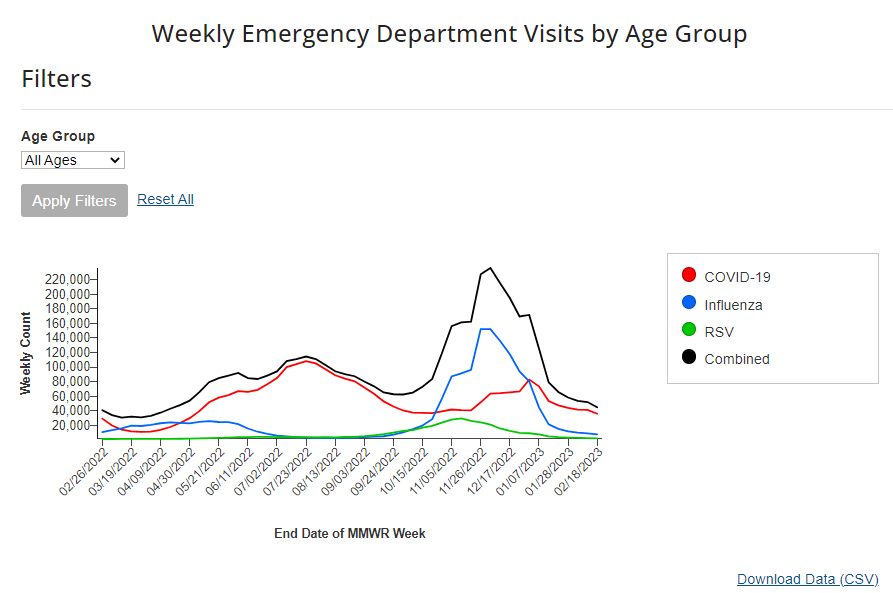
    According to the CDC’s data on hospital emergency department visits for respiratory viruses, COVID-19 visits have plateaued while flu and RSV have returned to low levels.

    In the past week (February 16 through 22), the U.S. officially reported about 240,000 new COVID-19 cases, according to the CDC. This amounts to:

    • An average of 34,000 new cases each day
    • 72 total new cases for every 100,000 Americans
    • 9% fewer new cases than last week (February 9-15)

    In the past week, the U.S. also reported about 25,000 new COVID-19 patients admitted to hospitals. This amounts to:

    • An average of 3,500 new admissions each day
    • 7.5 total admissions for every 100,000 Americans
    • 5% fewer new admissions than last week

    Additionally, the U.S. reported:

    • 2,400 new COVID-19 deaths (350 per day)
    • 85% of new cases are caused by Omicron XBB.1.5; 12% by BQ.1 and BQ.1.1; 1% by CH.1.1 (as of February 25)
    • An average of 60,000 vaccinations per day

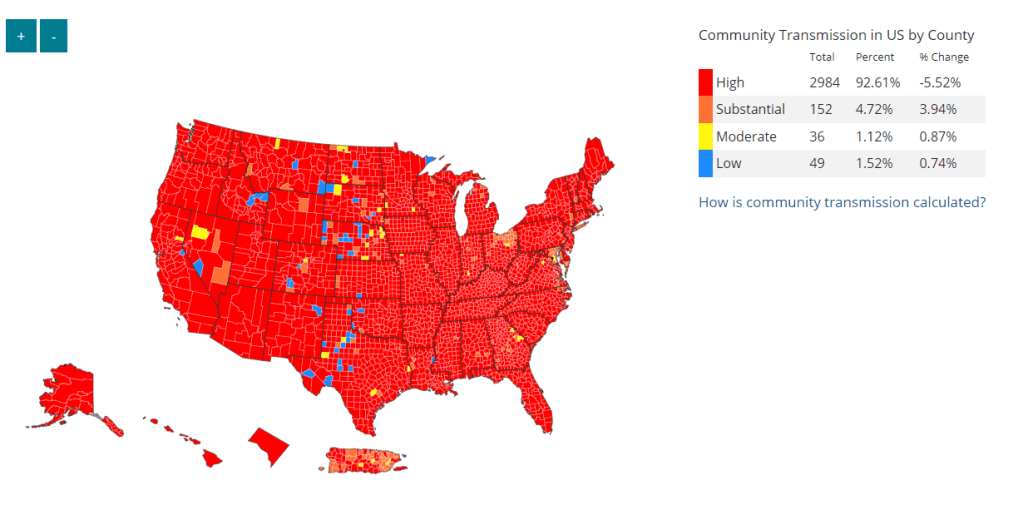
    The national COVID-19 plateau continues. As I’ve been saying for a few weeks now, COVID-19 spread has dropped significantly from its high during the winter holidays, but it has not fallen to the low levels we’ve previously seen this time of year due to a combination of lax precautions and the latest Omicron variant, XBB.1.5.

    Case and hospitalization data from the CDC, along with wastewater surveillance data, all show COVID-19 spread declining—but very slowly. Cases declined by 9% this week compared to the week prior, while new hospital admissions declined by 5%. Biobot’s wastewater surveillance dashboard shows slight declines or plateaus in all four major regions of the country.

    Respiratory virus season is clearly waning in the U.S., according to hospital emergency room visit data from the CDC’s National Syndromic Surveillance Program. ER visits for the flu and RSV have pretty much returned to baseline after their winter peaks. But COVID-19 ER visits have plateaued at a higher level, close to the visit numbers reported in September and October—another sign of the elevated “low tide” we’ve now been dealing with since spring 2022.

    On the variant front: Omicron XBB.1.5 continues to dominate in the U.S. It caused an estimated 85% of new cases nationwide in the week ending February 25, according to the CDC, and is the main variant circulating in every region. After several months of “variant soup” with a number of Omicron subvariants competing, XBB.1.5 has emerged as the clear victor; no other single lineage is causing more than 10% of new cases in the country, per the CDC’s estimates.

    I continue to write about COVID-19 case numbers from the CDC here, mostly because A) the directional patterns (i.e. upticks and downturns) of these data are still a decent representation of actual directional patterns in infections, and B) the CDC’s case numbers are more nationally representative (when it comes to geography) than data from the National Wastewater Surveillance System.

    But I have to stress that these case numbers are increasingly undercounting actual infections. The last decent estimates I’ve seen comparing cases to infections, dated from last fall, suggested that case numbers are undercounted by a factor of 10 to 20. These days, I expect we’re likely closer to a factor of 20, if not higher. As evidence, test positivity for the entire U.S. has been at 10% for a couple of weeks now.

    Other evidence for this continued undercounting comes from wastewater data. From resources like the Biobot dashboard, which compares wastewater surveillance trends to case trends, it’s abundantly clear that these two metrics used to align closely—but now coronavirus levels in wastewater are consistently much higher. In New York City, for example, wastewater data show that the city experienced one of its greatest COVID-19 surges this winter.

    Speaking of unreliable numbers: the team behind the CDC’s COVID Data Tracker Weekly Review has begun to update its readers on how the end of the federal public health emergency will impact COVID-19 data. The first update, published on Friday, explains that some data, including hospitalization and vaccination numbers, “may be reported less frequently” or with new gaps. I anticipate we’ll get more details about this in the coming weeks, as the CDC negotiates new data-sharing requirements with other health agencies.

    The CDC’s data tracking newsletter is also shifting from a weekly newsletter to biweekly, starting March 3. It continues to boggle my mind how I, a single freelance journalist writing this publication in my spare time, am able to keep up more regular data updates than a massive federal agency.
  • National numbers, February 19

    National numbers, February 19

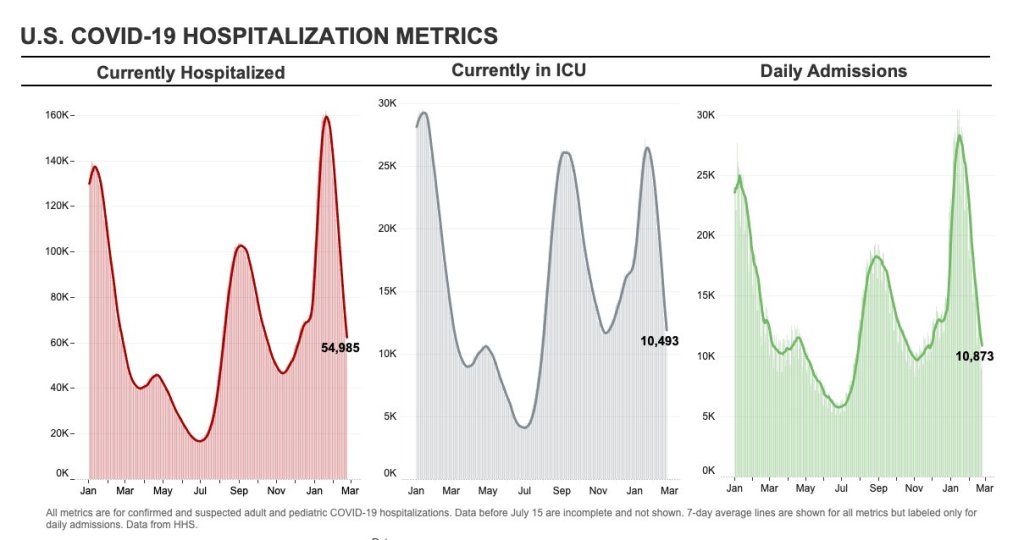
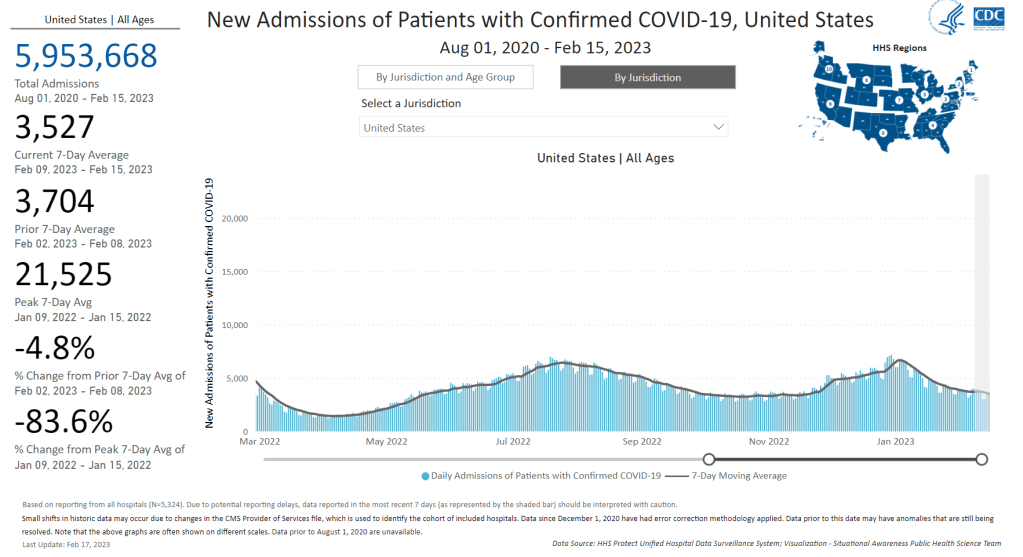
    COVID-19 hospitalization data from the CDC suggest that new hospital admissions haven’t really dipped below a high baseline since spring 2022.

    In the past week (February 9 through 15), the U.S. officially reported about 260,000 new COVID-19 cases, according to the CDC. This amounts to:

    • An average of 37,000 new cases each day
    • 79 total new cases for every 100,000 Americans
    • 8% fewer new cases than last week (February 2-8)

    In the past week, the U.S. also reported about 25,000 new COVID-19 patients admitted to hospitals. This amounts to:

    • An average of 3,500 new admissions each day
    • 7.5 total admissions for every 100,000 Americans
    • 5% fewer new admissions than last week

    Additionally, the U.S. reported:

    • 2,800 new COVID-19 deaths (400 per day)
    • 80% of new cases are caused by Omicron XBB.1.5; 16% by BQ.1 and BQ.1.1; 1% by CH.1.1 (as of February 18)
    • An average of 70,000 vaccinations per day

    Nationally, official COVID-19 cases and hospitalizations continue to trend slowly downward, suggesting that we’re in a high plateau of consistent virus spread. Reported cases have only declined by about 18% in the last month, while new hospital admissions have declined by 28%.

    Wastewater surveillance data from Biobot also continue to indicate that COVID-19 spread has plateaued nationally, with slightly different trends at the regional level: a potential uptick in the Northeast, a trend back down in the Midwest, and slight declines in the West and South.

    At the state level, some Midwest states continue to report increases in their COVID-19 cases and hospitalizations. These states include: Wyoming, Alaska, Montana, Utah, Nebraska, Michigan, and Missouri. (Though the wastewater decline could indicate that these trends in clinical case data may turn around soon.)

    As I pointed out last week, the current COVID-19 plateau is unique from what the U.S. experienced around this time in 2022 and 2021. In both of those years, virus spread declined significantly after a winter surge, leading to relatively low levels in the spring. But this year, the decline has been shorter and has stopped earlier, leaving us with continued high COVID-19.

    Biobot’s communications team pointed out on Twitter recently that the national average of coronavirus concentrations in wastewater is “about 60% higher than it was at this time in 2022” and “almost two times what it was at this time in 2021.”

    Why isn’t transmission declining more? The XBB.1.5 could be playing a role here, as it spreads further across the country. This highly-contagious version of Omicron accounted for about 80% of new cases in the U.S. last week, according to the CDC’s estimates, and is now heavily dominant in almost every region of the country.

    But I suspect a bigger culprit here is likely the complete lack of COVID-19 safety protocols right now. In spring 2021, first-round vaccines and continued non-pharmaceutical interventions played a big role in preventing disease, while in 2022, the U.S. had a lot of immunity from vaccinations and the recent, massive Omicron BA.1 surge, combined with some continuation of other measures. (Though that immunity quickly faded when BA.2 came on the scene.)

    Now, we have less population immunity, less non-pharmaceutical interventions, and less overall awareness of the continued problems posed by COVID-19. This broad apathy towards the coronavirus hides the fact that over 400 people are still dying from this disease every day.

  • National numbers, February 12

    National numbers, February 12

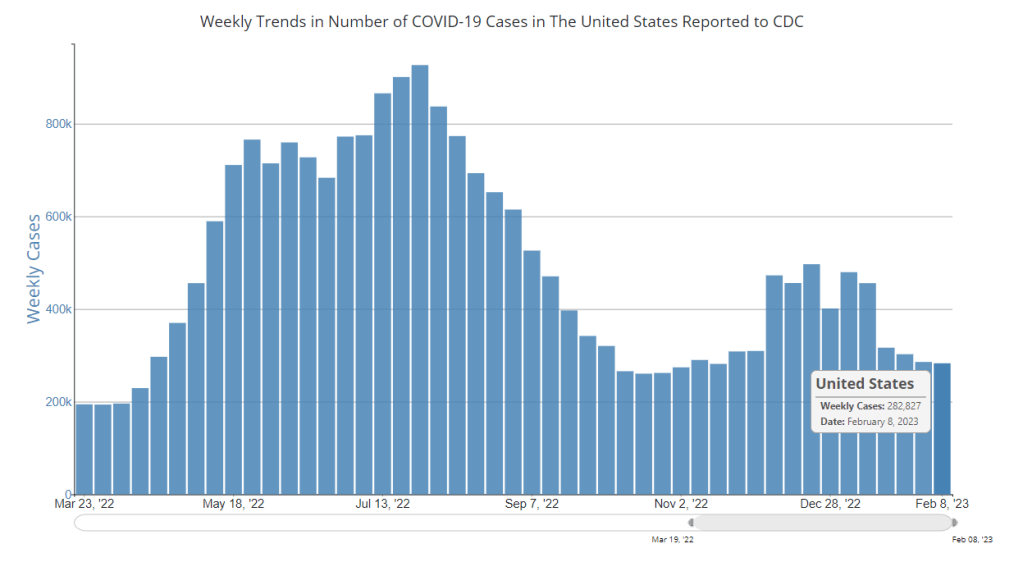
    National COVID-19 cases have reached a plateau. Note that the cases reported to the CDC are a significant undercount of actual infections.

    In the past week (February 2 through 8), the U.S. officially reported about 280,000 new COVID-19 cases, according to the CDC. This amounts to:

    • An average of 40,000 new cases each day
    • 86 total new cases for every 100,000 Americans
    • 1% fewer new cases than last week (January 26-February 1)

    In the past week, the U.S. also reported about 26,000 new COVID-19 patients admitted to hospitals. This amounts to:

    • An average of 3,700 new admissions each day
    • 7.8 total admissions for every 100,000 Americans
    • 6% fewer new admissions than last week

    Additionally, the U.S. reported:

    • 3,200 new COVID-19 deaths (450 per day)
    • 75% of new cases are caused by Omicron XBB.1.5; 20% by BQ.1 and BQ.1.1; 1% by CH.1.1 (as of February 11)
    • An average of 80,000 vaccinations per day

    Nationwide, COVID-19 spread appears to be in a plateau: not substantially increasing, but not substantially decreasing, either. Officially-reported cases dropped by only 1% this week compared to the week prior, while wastewater data shows that the coronavirus concentration in our sewage hasn’t changed significantly for the last month.

    Hospitalizations continue to decline for flu and RSV as well as COVID-19, according to the CDC’s data from emergency departments. But the COVID-19 decline has slowed, remaining consistent at a higher level than the flu and RSV declines. About 3,700 people were newly hospitalized for COVID-19 every day last week.

    At the regional level, COVID-19 spread is still declining (from a relatively higher winter peak) in the Northeast, and is solidly in a plateau in the South and West, per Biobot’s regional data. The Midwest reported a slight uptick this past week, continuing a trend that I noted in last weekend’s National Numbers.

    Some of the highest case, wastewater, and hospitalization increases reported right now are coming from the upper Midwest: Montana, North Dakota, South Dakota, and Idaho. COVID-19 spread is also trending up in Alabama, Kansas, New Hampshire, and West Virginia, along with other states in the Midwest and South, per the latest Community Profile Report.

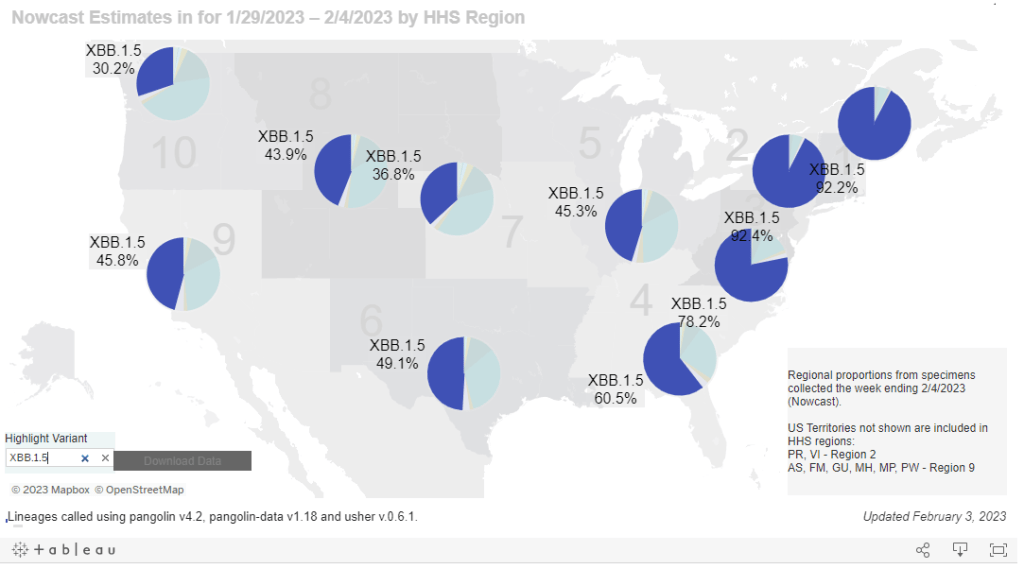
    Omicron XBB.1.5, the latest and most contagious version of the virus, is spreading across these regions and may be contributing to increased cases. According to the CDC’s latest estimates, XBB.1.5 now accounts for more than half of new cases in every region of the country, and about 75% of new cases nationwide.

    No other variants are trending up right now; XBB.1.5 has solidly outcompeted the rest of the “variant soup” in the U.S. Experts will doubtless be watching for this subvariant to further evolve, while we also look out for any new variants from other parts of the world.

    Meanwhile, the daily average of new COVID-19 vaccinations in the U.S. has dropped under 100,000 for the first time since the country’s vaccination campaign started in winter 2020. New booster doses continue to be heavily underutilized.

  • National numbers, February 5

    National numbers, February 5

    XBB.1.5, the Omicron lineage that’s been dominant in the Northeast for several weeks now, is spreading through the rest of the country. Chart from the CDC, estimates as of February 3.

    In the past week (January 26 through February 1), the U.S. officially reported about 280,000 new COVID-19 cases, according to the CDC. This amounts to:

    • An average of 40,000 new cases each day
    • 86 total new cases for every 100,000 Americans
    • 7% fewer new cases than last week (January 19-25)

    In the past week, the U.S. also reported about 27,000 new COVID-19 patients admitted to hospitals. This amounts to:

    • An average of 3,900 new admissions each day
    • 8.4 total admissions for every 100,000 Americans
    • 8% fewer new admissions than last week

    Additionally, the U.S. reported:

    • 3,500 new COVID-19 deaths (500 per day)
    • 66% of new cases are caused by Omicron XBB.1.5; 27% by BQ.1 and BQ.1.1; 2% by CH.1.1 (as of February 4)
    • An average of 100,000 vaccinations per day

    COVID-19 spread in the U.S. continues to decline—but the decline continues to get slower, following the trend that I wrote about last week. Official COVID-19 cases, hospital admissions, and wastewater surveillance all indicate decreased transmission, leading into potential plateaus.

    New hospital admissions for COVID-19, for example, decreased by 8% this week (ending February 1) compared to the prior week (ending January 25). This is a smaller decrease than the prior two weeks, when admissions went down by 13% and 18%. Overall, new hospitalizations are at a similar level to what the U.S. faced in early summer 2022, as BA.5 started spreading across the country.

    Wastewater surveillance from Biobot suggests that COVID-19 spread is decreasing in all four major regions. But the decrease is steeper in the Northeast and South than it is in the Midwest and West coast, suggesting potential plateaus in the latter regions. Wastewater data from the CDC continues to show decreased transmission in about half of sites reporting to the agency and increased transmission in the other half.

    Where is COVID-19 spread increasing right now? Some northern Midwest states are reporting the most significant upticks. According to the latest Community Profile Report, new COVID-19 hospitalizations went up last week in South Dakota, Idaho, and Minnesota. Wastewater monitoring sites in Idaho and Minnesota also reported increased coronavirus concentrations, according to the WastewaterSCAN project.

    In the Midwest and West coast, Omicron subvariant XBB.1.5 continues to outcompete other versions of the virus. Per the CDC’s estimates, it accounted for about 44% of new cases in the region including the Dakotas and Minnesota this week, compared to 32% last week. XBB.1.5 already dominates the East coast, so its rise in the rest of the country could be one reason why COVID-19 is starting to go up again.

    Nationally, XBB.1.5 caused about two-thirds of new COVID-19 cases in the U.S. last week, according to the CDC’s estimates. It’s the only variant on the rise right now, as it drives out the BQ lineage and others. CH.1.1, the subvariant currently spreading fast in the U.K. and other countries, is less of a threat in the U.S. so far (at under 2% of new cases).

    While XBB.1.5 contributes to new infections across the country, the number of Americans who’ve received an updated booster shot remains stubbornly low. Only 52 million people have received the Omicron-specific booster, representing just 20% of the eligible population, according to CDC data.

  • National numbers, February 27

    National numbers, February 27

    COVID-19 metrics are dropping across the board. Chart via Conor Kelly, posted on Twitter on February 23.

    In the past week (February 19 through 25), the U.S. reported about 526,000 new COVID-19 cases, according to the CDC. This amounts to:

    • An average of 75,000 new cases each day
    • 160 total new cases for every 100,000 Americans
    • 38% fewer new cases than last week (February 12-18)

    Last week, America also saw:

    • 42,000 new COVID-19 patients admitted to hospitals (13 for every 100,000 people)
    • 12,000 new COVID-19 deaths (3.6 for every 100,000 people)
    • 100% of new cases are Omicron-caused (as of February 19)
    • An average of 200,000 vaccinations per day (per Bloomberg)

    The U.S. is now on week six of falling COVID-19 case numbers nationwide. New cases fell 38% from last week to this week, and are down 87% from one month ago. This is also the first week that the country has reported a daily new case average under 100,000 since early December.

    Hospitalizations also continue to fall, with about 30% fewer new COVID-19 patients entering U.S. hospitals this week compared to last week. And death numbers have also begun to come down—though they are still high, with over 1,500 people dying of COVID-19 each day.

    Case numbers are falling in every single U.S. state; five states and D.C. reported fewer than 100 new cases for every 100,000 residents in the past week, according to the latest Community Profile Report: Washington, Nebraska, Maryland, Nevada, and Ohio. Last week, Maryland was the first state to report case numbers below the CDC’s old high transmission threshold. (The new threshold is higher, which I’ll get into later this issue.)

    To quote prolific COVID-19 data commentator (and my former COVID Tracking Project colleague) Conor Kelly, whose chart is featured above: “There’s not all that much interesting to report on with COVID data right now. Things are getting better fast everywhere. It’s just a question of how long it continues.”

    That continuation depends largely on variants. As the Omicron surge recedes, how long will we see these decreases (or a plateau at low numbers) before a new variant drives another surge? 

    One key factor here is BA.2, the Omicron sub-lineage that has been slowly gaining ground in the U.S. over the past month as it is more transmissible than original Omicron. And I do mean slowly: according to CDC estimates, BA.2 went from causing an estimated 2% of new cases in the week ending February 12 to 4% in the week ending February 19. It seems to be having a limited impact on the country’s case decrease right now, but we’ll see if that changes in the coming weeks.

    Meanwhile, America’s vaccination campaign is stalling. According to the Associated Press: “The average number of Americans getting their first shot is down to about 90,000 a day, the lowest point since the first few days of the U.S. vaccination campaign, in December 2020.” More investment into reaching people who remain unvaccinated (and unboosted) is necessary if we want to be prepared for potential future surges.

  • National numbers, February 20

    National numbers, February 20

    The majority of U.S. counties are still seeing high transmission, according to the CDC, but a few places like Maryland and New York City are starting to fall below this threshold.

    In the past week (February 12 through 18), the U.S. reported about 850,000 new COVID-19 cases, according to the CDC. This amounts to:

    • An average of 122,000 new cases each day
    • 259 total new cases for every 100,000 Americans
    • 43% fewer new cases than last week (February 5-11)

    Last week, America also saw:

    • 60,000 new COVID-19 patients admitted to hospitals (18 for every 100,000 people)
    • 14,000 new COVID-19 deaths (4.3 for every 100,000 people)
    • 100% of new cases are Omicron-caused (as of February 12)
    • An average of 200,000 vaccinations per day (per Bloomberg)

    New COVID-19 cases continue to drop in the U.S. as the country slowly comes down from its Omicron wave. This week, the country reported a total of 850,000 new cases, according to the CDC; it’s the first week under one million new cases have been reported since early December, though we are still seeing over 100,000 new cases a day.

    Hospitalizations are also going down, with the Department of Health and Human Services reporting about 65,000 beds in use for confirmed and suspected COVID-19 patients as of Saturday. The hospital circuit breaker dashboard (by Jeremy Faust et al.) shows that the vast majority of U.S. hospitals have capacity, as of this week. Still, over 2,000 Americans continue to die of COVID-19 each day.

    At the state level, we continue to see case decreases across the country. The one exception is Maine: this state saw a 350% increase in cases from last week to this week, according to the February 17 Community Profile Report. However, local reports suggest that a number of the new cases reported this week were backlogged—meaning the cases occurred weeks ago and were belatedly added to state tallies.

    After over a month of falling case numbers nationwide, some parts of the country are finally dropping below the CDC’s high transmission threshold (100 new cases for every 100,000 residents reported in a week). Maryland is the first state to do this, with 92 new cases for every 100,000 residents reported in the week ending February 17.

    New York City, where I live, also fell below the high transmission threshold this week, with 83 new cases for every 100,000 residents reported in the week ending February 15, according to city data. Both New York City and Maryland were early Omicron hotspots and have reported falling case numbers since early January.

    While Omicron overall continues to cause 100% of new COVID-19 cases in the country, BA.2, the slightly-more-transmissible sister lineage, is starting to gain ground. The CDC estimates that BA.2 caused 3.9% of new cases in the week ending February 12, compared to 1.5% of new cases in the previous week. As BA.2 continues replacing original Omicron, we’ll see if this subvariant has an impact on the U.S.’s downward case trends.

  • National numbers, February 13

    National numbers, February 13

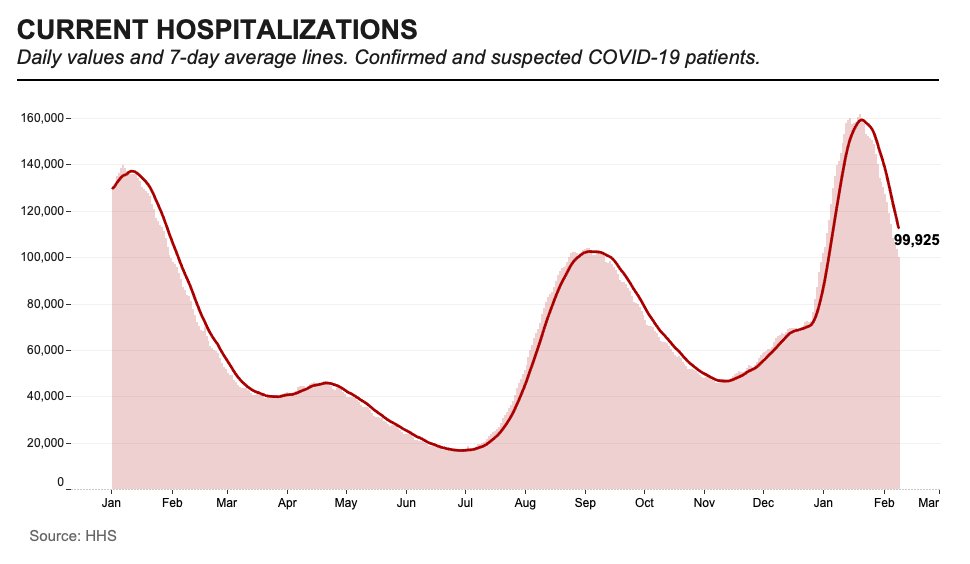
    Current COVID-19 hospitalizations in the U.S. have fallen under 100,000 for the first time since the Omicron surge started. Chart by Conor Kelly, posted on Twitter on February 9.

    In the past week (February 5 through 11), the U.S. reported about 1.5 million new COVID-19 cases, according to the CDC. This amounts to:

    • An average of 215,000 new cases each day
    • 459 total new cases for every 100,000 Americans
    • One in 218 Americans testing positive for COVID-19
    • 43% fewer new cases than last week (January 29-February 4)

    Last week, America also saw:

    • 85,000 new COVID-19 patients admitted to hospitals (26 for every 100,000 people)
    • 16,000 new COVID-19 deaths (4.9 for every 100,000 people)
    • 100% of new cases are Omicron-caused (as of February 5)
    • An average of 300,000 vaccinations per day (per Bloomberg)

    COVID-19 cases continue to decline across the U.S. as the country comes out of its Omicron surge. Nationwide, the U.S. reported an average of 215,000 new cases a day last week—a drop of about 75% from the peak of the Omicron surge, when nearly 800,000 new cases were reported each day.

    Hospitalizations are also decreasing: this week, the number of confirmed and suspected COVID-19 patients in U.S. hospitals dropped under 100,000 for the first time since the surge started in December. Deaths are decreasing as well, but are still at high levels: over 2,000 Americans are dying of COVID-19 each day.

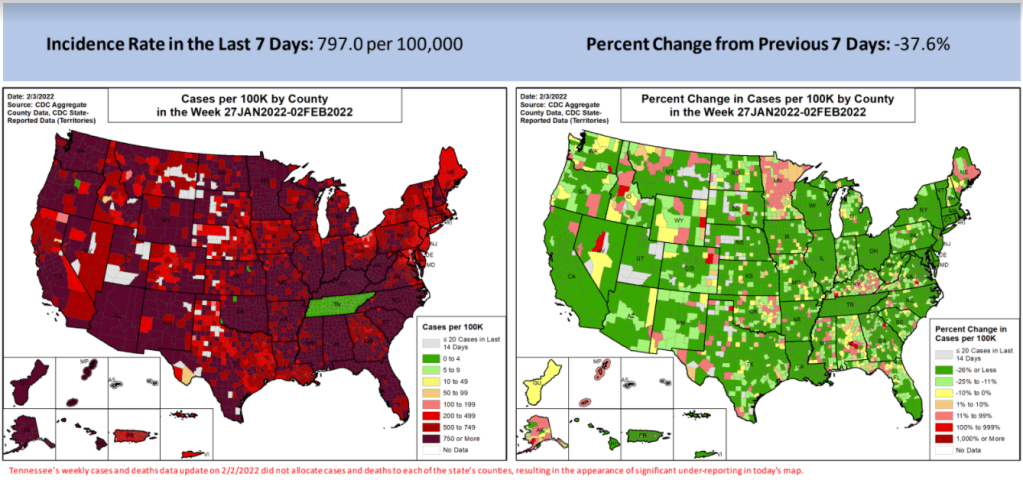
    All 50 states and the majority of counties continue to report case declines, according to the latest Community Profile Report. But case rates are still very high across the country, well above the CDC’s threshold for high transmission (more on this later in the issue).

    States with high case rates this week include Alaska, Kentucky, West Virginia, Montana, Mississippi, North Dakota, California, and Idaho; all reported over 700 new cases for every 100,000 residents in the week ending February 9.

    Omicron is still causing 100% of new cases in the country, according to CDC estimates. But the agency is now splitting its estimates into the original Omicron and its sister strain BA.2: BA.2 caused between 2% and 7% of new cases nationwide in the week ending February 5, the CDC says. In the coming weeks, we’ll see whether this strain—which is even more transmissible than original Omicron—has an impact on U.S. case numbers.

    New vaccination numbers have been fairly low for the past couple of weeks, with an average of under 300,000 shots given each day (including boosters). And the FDA is now delaying vaccine authorization for children under age 5: the agency has decided to wait for Pfizer to provide data on how well a three-dose series performs in this age group, after initially considering authorization based on data about two doses.

  • National numbers, February 6

    National numbers, February 6

    COVID-19 cases are now on the decline almost everywhere in the U.S. (right), though they are still incredibly high throughout the country (left). Note that Tennessee appears (incorrectly) green on the left because of a data error. Chart from the February 3 Community Profile Report.

    In the past week (January 29 through February 4), the U.S. reported about 2.6 million new cases, according to the CDC. This amounts to:

    • An average of 378,000 new cases each day
    • 806 total new cases for every 100,000 Americans
    • One in 124 Americans testing positive for COVID-19
    • 38% fewer new cases than last week (January 22-28)

    Last week, America also saw:

    • 112,000 new COVID-19 patients admitted to hospitals (34 for every 100,000 people)
    • 17,000 new COVID-19 deaths (5.1 for every 100,000 people)
    • 100% of new cases are Omicron-caused (as of January 29)
    • An average of 300,000 vaccinations per day (per Bloomberg)

    Nationwide, new COVID-19 case numbers have decreased for the third week in a row. The country reported an average of 378,000 new cases each day last week—about half the daily case number reported at the peak of the Omicron surge three weeks ago.

    Hospitalizations are also decreasing, with the HHS reporting about 115,000 inpatient beds used for COVID-19 patients as of February 5—down from a peak of over 150,000. Still, hospitals across the country continue to be overwhelmed as they deal with staffing shortages and limited drugs that work against Omicron compared to past variants.

    National COVID-19 deaths passed 900,000 this week, according to the New York Times and other trackers. More than 2,000 Americans are dying of COVID-19 every day, and this trend is likely to continue as the Omicron surge wanes; as always, patterns in death data follow patterns in case data by several weeks.

    New case rates are dropping in all 50 states and almost all territories, according to the latest Community Profile Report. States with the highest case rates this week include Alaska, North Dakota, Washington, West Virginia, Wyoming, and Tennessee: all reported at or above 1,200 new cases for every 100,000 people in the week ending February 2.

    Remember, even though cases are going down, many parts of the country are still seeing far higher numbers than they did in previous surges. Even in New York City, now about a month past the peak of its Omicron surge, the city health department reported about 220 new cases for every 100,000 people last week—more than double the CDC threshold for high transmission. It’s important that we remain cautious until the numbers are truly low.

    As Omicron continues to spread—and as the U.S. reported record cases in children this past January—Pfizer has announced it plans to ask the FDA to authorize its vaccine for children under age 5. The problem is: Pfizer’s clinical trial data have, so far, demonstrated that a two-dose vaccine series with a very small dosage is effective in the youngest kids (6 months to 2 years), but not in kids ages 2 to 5. COVID-19 experts are split on this rather complicated situation; you can find more details at Your Local Epidemiologist and at STAT News.

  • National numbers, Feb. 28

    National numbers, Feb. 28

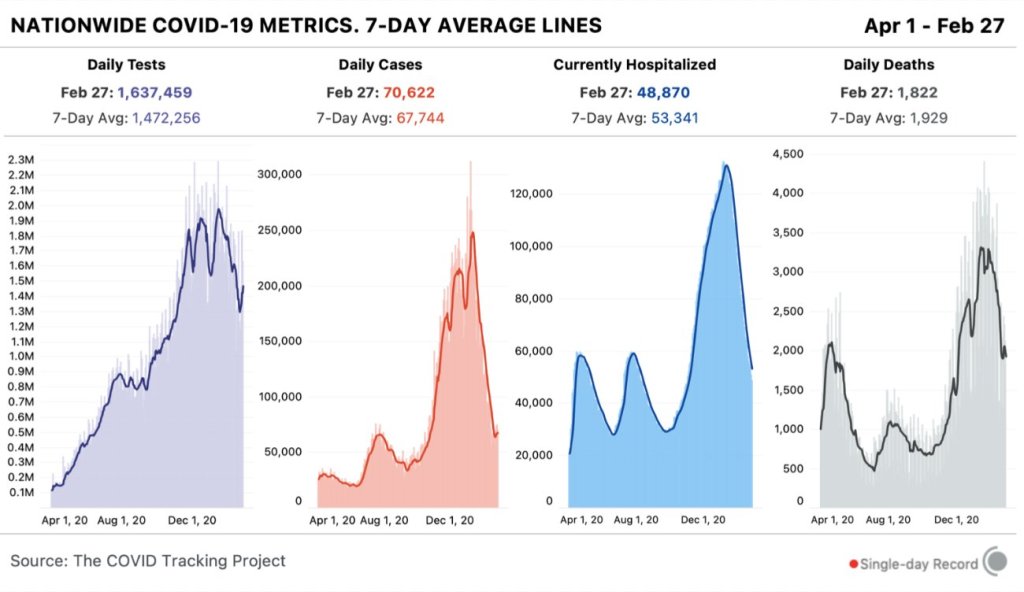
    In the past week (February 21 through 27), the U.S. reported about 475,000 new cases, according to the COVID Tracking Project. This amounts to:

    • An average of 68,000 new cases each day—about 2,000 more cases than the seven-day average on July 27, near the peak of the summer surge
    • 145 total new cases for every 100,000 Americans
    • 1 in 692 Americans getting diagnosed with COVID-19 in the past week
    Nationwide COVID-19 metrics published in the COVID Tracking Project’s daily update on February 27. New daily cases are now at a level similar to the summer peak.

    Last week, America also saw:

    • 48,900 people now hospitalized with COVID-19 (15 for every 100,000 people)
    • 14,300 new COVID-19 deaths (4.4 for every 100,000 people)
    • An average of 1.65 million vaccinations per day (per Bloomberg)

    After several weeks of declines, cases now appear to be in a plateau. But the COVID Tracking Project cautions that these numbers may also be the aftershocks of President’s Day and the winter storm, which led to artificially low numbers last week and delayed reporting arriving this week.

    One thing is for certain, though: vaccinations are recovering from the storm. We had two record vaccination days Friday and yesterday, with 2.2 million doses and 2.4 million doses reported, respectively. Nearly one in five adults and half of American seniors have received their first shot, White House advisor Andy Slavitt said in a COVID-19 briefing on Friday.

    Last week, we noted that vaccinations were already having an impact in nursing homes and other long-term care facilities. The Kaiser Family Foundation picked up that trend this week, with an analysis showing that deaths in these facilities have declined at the same time as residents have received vaccine doses. In the first month of America’s vaccine rollout, long-term care deaths decreased by 66%, while all other U.S. deaths increased by 61%.

    We can’t get complacent, though. The U.S. has now reported over 2,100 cases of the B.1.1.7 variant, up from 1,500 last week. Homegrown variants that originated in California and New York aren’t yet reported on the CDC’s variant cases dashboard, but I recommend reading up on them. B.1.526, the New York variant, may now account for one in four cases in NYC, per the New York Times; this variant has acquired a mutation that may make it less susceptible to vaccines.

    Federal public health leadership cited variant cases in COVID-19 briefings this week, advising Americans to keep up all the public health measures that have become so familiar by now: wear a mask, avoid crowds and travel, and get a vaccine when it’s available to you.

  • National numbers, Feb. 21

    National numbers, Feb. 21

    In the past week (February 14 through 20), the U.S. reported about 464,000 new cases, according to the COVID Tracking Project. This amounts to:

    • An average of 66,000 new cases each day
    • 141 total new cases for every 100,000 Americans
    • 1 in 708 Americans getting diagnosed with COVID-19 in the past week
    • About two-fifths of the new cases reported in the week of January 23
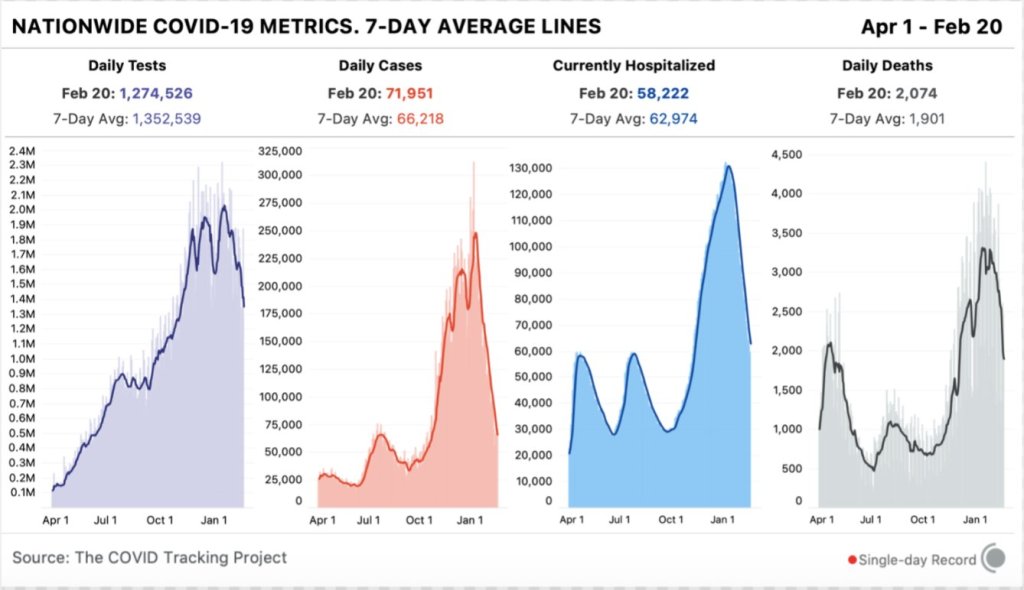
    Nationwide COVID-19 metrics published in the COVID Tracking Project’s daily update on February 20. Hospitalizations are now dropping below the spring and summer peaks.

    Last week, America also saw:

    • 58,200 people now hospitalized with COVID-19 (18 for every 100,000 people)
    • 13,300 new COVID-19 deaths (4.1 for every 100,000 people)
    • An average of 1.49 million vaccinations per day (per Bloomberg)

    The number of COVID-19 patients in U.S. hospitals is now the lowest it’s been since early November. About 7,000 new patients were admitted each day this week—while this is still a huge number, it’s a notable drop from the peak (18,000 per day) we saw earlier in the winter.

    I got those new hospital admission numbers from the COVID Data Tracker Weekly Review, a new report that the CDC recently started publishing in conjunction with its COVID-19 dashboard. It’s kind-of like a longer, more numbers-heavy, less snarky version of this newsletter segment.

    The Weekly Review this past Friday also highlighted the progression of coronavirus variants in the U.S. We’ve now detected over 1,500 cases of B.1.1.7 (the variant originating in the U.K.), as well as 21 cases of B.1.351 (originated in South Africa) and 5 cases of P.1 (originated in Brazil). While sequencing efforts have increased significantly in the past few weeks, these numbers are likely still massive undercounts. The CDC encourages Americans to “stop variants by stopping the spread.” In other words, all the behaviors we’ve been using to keep ourselves and our communities safe from spreading the virus will also help reduce its opportunities to mutate.

    One more piece of good news from this week’s COVID-19 data: vaccinations may already be having an impact in nursing homes and other long-term facilities. The share of deaths occurring in these facilities dropped under 20% this week, for the first time since the COVID Tracking Project started collecting these data.

    The pace of vaccinations was slowed this week thanks to winter storms across the South and Midwest. But this news from LTC facilities is a hopeful note of how elderly Americans may be more protected in the weeks to come.