Tag: fall surge?

  • National numbers, November 12

    National numbers, November 12

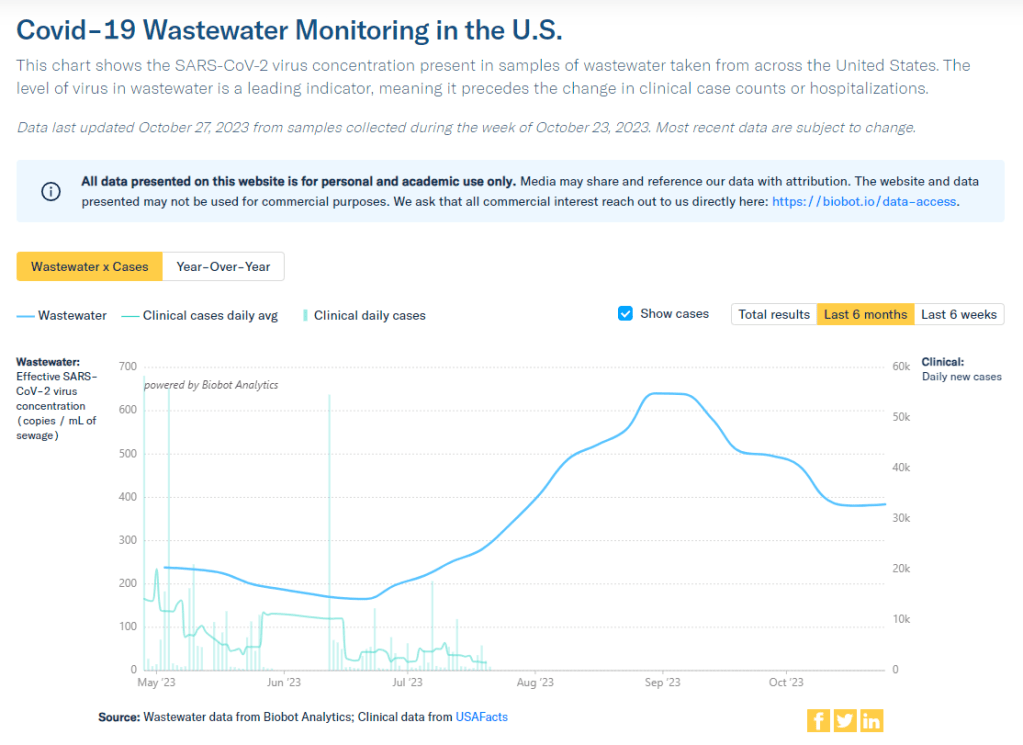
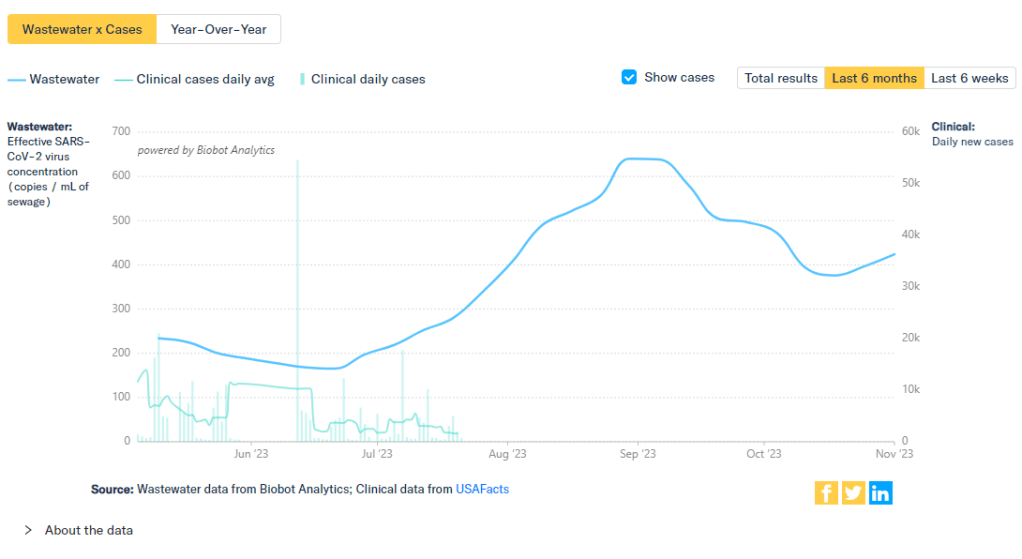
    Biobot’s COVID-19 dashboard shows that coronavirus levels in wastewater have increased over the last two weeks.

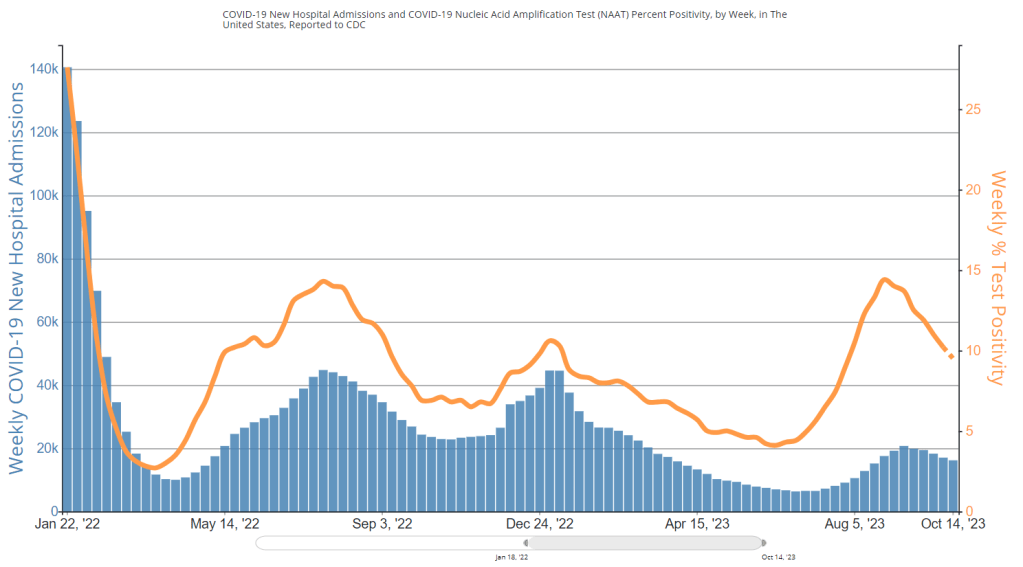
    During the most recent week of data available (October 22-28), the U.S. reported about 15,700 new COVID-19 patients admitted to hospitals, according to the CDC. This amounts to:

    • An average of 2,200 new admissions each day
    • 4.8 total admissions for every 100,000 Americans
    • 0.1% more new admissions than the prior week (October 15-21)

    Additionally, the U.S. reported:

    • 9% of tests in the CDC’s surveillance network came back positive
    • A 7% higher concentration of SARS-CoV-2 in wastewater than the prior week (as of November 1, per Biobot’s dashboard)
    • 25% of new cases are caused by Omicron HV.1, 22% by EG.5, 17% by XBB.1.6, 12% by FL.1.5.1 (as of October 28)

    Most of the numbers above are exactly copied from last week’s National Numbers post, as the CDC didn’t update its COVID-19 dashboard this week. Honestly, I have no idea why a single-day holiday (i.e. Veteran’s Day yesterday) might lead a national health agency to postpone its data updates for an entire week, but I’m sure this won’t be the last time it happens.

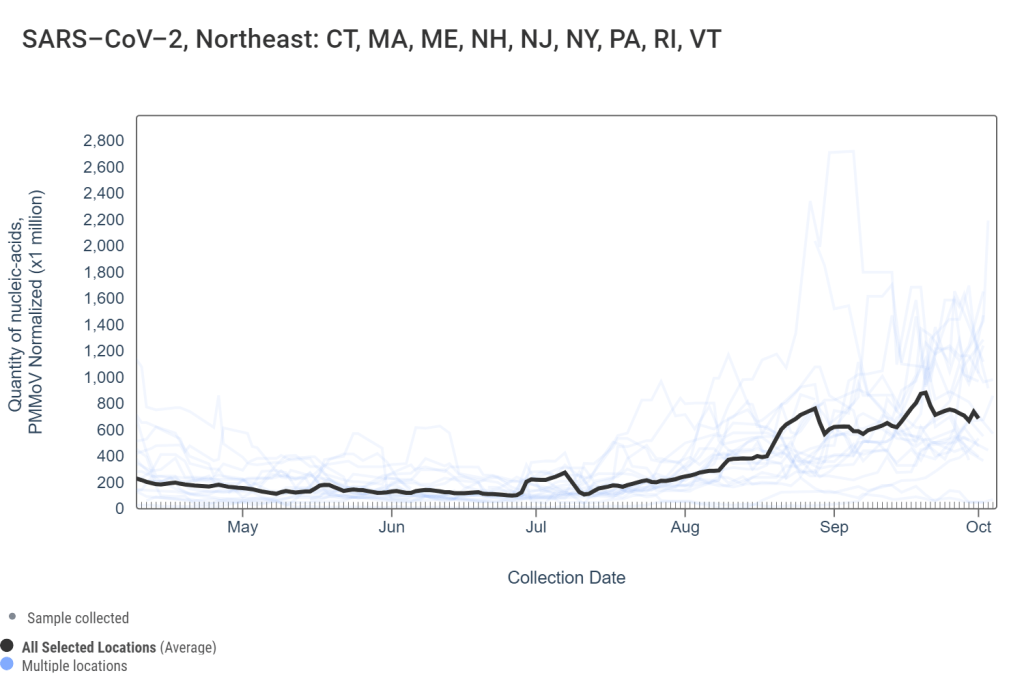
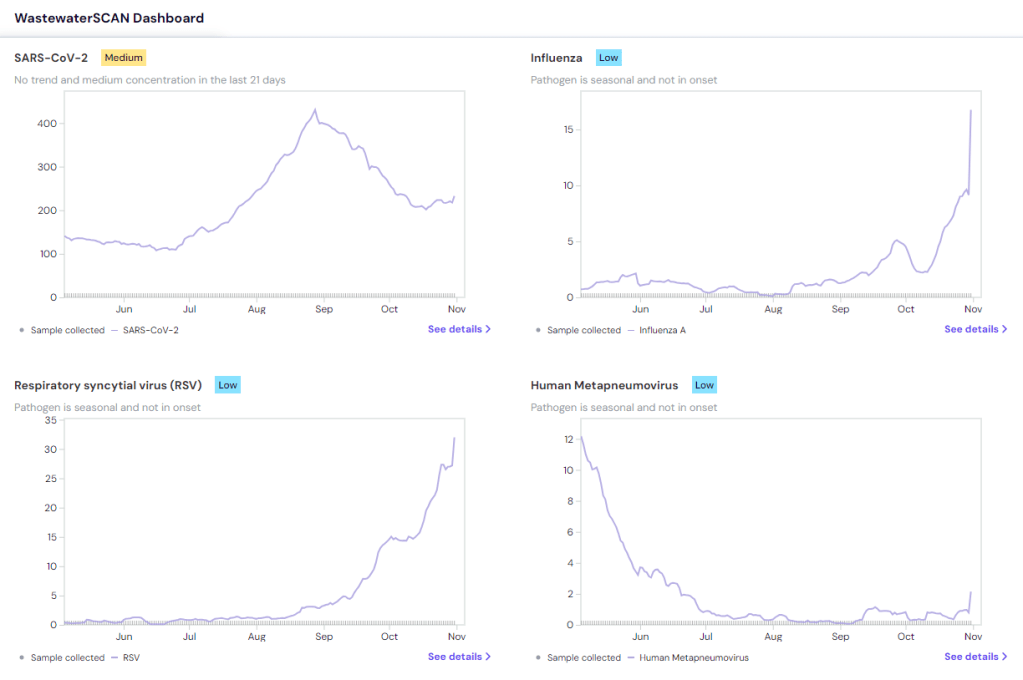
    The new data we do have this week, mainly from wastewater dashboards, suggest that COVID-19 spread is increasing slightly along with other respiratory viruses. Data from Biobot and WastewaterSCAN show upticks in the last two weeks, following the declining spread from September through the end of October.

    Biobot’s dashboard shows that the concentration of coronavirus in U.S. sewersheds has gone up about 13% on average nationally, from October 18 through November 1. Coronavirus levels are currently highest in the Midwest, with the West Coast and South showing signs of increasing spread while the Northeast is in a plateau.

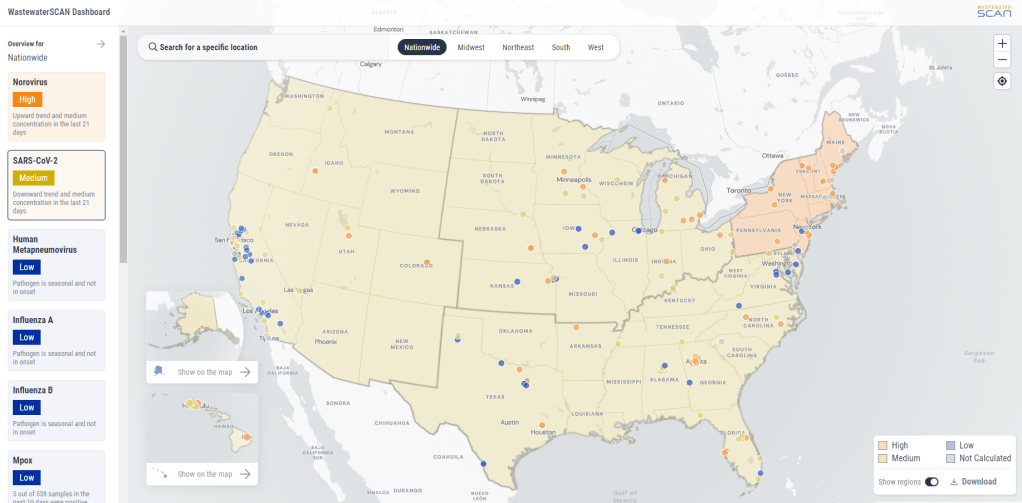
    WastewaterSCAN’s dashboard presents a similar picture: the Midwest currently has high coronavirus levels, according to WWSCAN’s thresholds, while the other regions have moderate levels. This dashboard shows rising COVID-19 transmission in the Midwest and South as well, with cities like Warren, Michigan, Lincoln, Nebraska, and Arkon, Ohio reporting significant increases in recent weeks.

    COVID-19 isn’t the only virus spreading a lot right now, according to WWSCAN and the CDC. The CDC said in its most recent flu surveillance report that this seasonal virus is increasing throughout the country, though it hasn’t yet reached typical flu season levels. This report was published over a week ago, on November 3, but it seems likely that the trend has continued this week.

    Both wastewater surveillance and the CDC’s influenza-like activity surveillance, which tracks doctors’ visits for respiratory symptoms, suggest that the South is seeing increased spread of several viruses: COVID-19, flu, RSV, norovirus. Norovirus and RSV in particular are at high levels nationwide, according to WWSCAN.

    Similar safety measures—masks, testing, improved ventilation, getting vaccinated—protect against many common diseases. Recent data from the CDC show that many people are, at least, getting vaccinated, though vaccination rates are currently much higher for flu than COVID-19 among both adults and children. (Public health agencies clearly have some work to do there.)
  • National numbers, November 5

    National numbers, November 5

    National maps from WastewaterSCAN, showing recent trends in COVID-19 and other viruses.

    During the most recent week of data available (October 22-28), the U.S. reported about 15,700 new COVID-19 patients admitted to hospitals, according to the CDC. This amounts to:

    • An average of 2,200 new admissions each day
    • 4.8 total admissions for every 100,000 Americans
    • 0.1% more new admissions than the prior week (October 15-21)

    Additionally, the U.S. reported:

    • 9% of tests in the CDC’s surveillance network came back positive
    • A 6% higher concentration of SARS-CoV-2 in wastewater than the prior week (as of October 25, per Biobot’s dashboard)
    • 25% of new cases are caused by Omicron HV.1, 22% by EG.5, 17% by XBB.1.6, 12% by FL.1.5.1 (as of October 28)

    After an early-fall lull in COVID-19 transmission, there are now signs that the coronavirus is starting to spread more as we head into winter (or, respiratory virus season). This slight uptick is expected, but could still be prevented if we had better public health measures in place.

    Wastewater surveillance data from both Biobot Analytics and WastewaterSCAN suggest that COVID-19 spread might be increasing again. Biobot’s dashboard shows a 6% increase in sewage coronavirus levels nationally between October 18 and October 25, the most recent week of data available.

    WastewaterSCAN’s dashboard similarly shows a slight increase in coronavirus levels, as of October 30. Regional data from both sources suggest that the Northeast and Midwest are seeing more COVID-19 spread than other regions at the moment, though the South might catch up in the coming weeks.

    As I’ve discussed over the last couple of weeks, we are currently working with limited wastewater surveillance data: 400 sewage testing sites, about one-quarter of the CDC’s wastewater network, are currently in limbo while government officials navigate a potential switch between testing contractors. (See last week’s National Numbers and my original coverage of the new contract.) Still, we have enough information to identify national trends from wastewater.

    Along with the wastewater surveillance data, hospitalization data reported by the CDC show a very slight increase in COVID-19 patients as of October 28. Test positivity and emergency department visits have plateaued after declines over the course of October, as seen in both the CDC’s data and the Walgreens dashboard (which provides data from testing done at this pharmacy chain).

    COVID-19 isn’t the only respiratory disease spreading right now. RSV transmission has picked up, according to the CDC’s surveillance: hospitalization rates for this disease have risen sharply over the last month. Similarly to last year, RSV appears to be reaching its peak earlier in the fall than health officials typically expect.

    WastewaterSCAN’s data show RSV and flu spread ticking up, particularly in the South. This project’s data align with the CDC’s reports of influenza-like illness, which suggest southern states, Washington D.C., and Alaska now have moderate to high levels of people with flu-like symptoms, compared to low levels in the rest of the country.

    While health experts are expecting a lot of respiratory virus spread this winter, these trends aren’t inevitable. All individual and collective measures towards public health—getting vaccinated, wearing masks, testing, prioritizing ventilation—help mitigate these diseases.

  • National numbers, October 29

    National numbers, October 29

    Biobot Analytics resumed weekly updates to its COVID-19 wastewater dashboard this week.

    During the most recent week of data available (October 15-21), the U.S. reported about 16,200 new COVID-19 patients admitted to hospitals, according to the CDC. This amounts to:

    • An average of 2,300 new admissions each day
    • 4.9 total admissions for every 100,000 Americans
    • 0% fewer new admissions than the prior week (October 8-14)

    Additionally, the U.S. reported:

    • 8.7% of tests in the CDC’s surveillance network came back positive
    • A 1% higher concentration of SARS-CoV-2 in wastewater than the prior week (as of October 25, per Biobot’s dashboard)
    • 25% of new cases are caused by Omicron HV.1, 22% by EG.5, 17% by XBB.1.6, 12% by FL.1.5.1 (as of October 28)

    Our mid-fall COVID-19 lull continues in the U.S., with major metrics showing plateaus in disease spread nationally. A disruption in wastewater surveillance may make it harder to follow these trends in the coming weeks.

    Biobot Analytics has resumed weekly updates to its COVID-19 dashboard as of this Friday. While the company is no longer testing about 400 sites in the CDC’s surveillance network due to a contract switch, its independent network still represents more than 100 counties across the U.S., according to Biobot’s Twitter.

    Meanwhile, Biobot has filed a formal protest about the CDC contract change. According to reporting by POLITICO, the new contractor, Verily, cannot start testing at those 400 wastewater treatment sites while the Government Accountability Office (GAO) evaluates Biobot’s appeal. The protest will extend the data gap that I described in my previous posts about this contract, possibly delaying surveillance for months as we head into the winter respiratory virus season.

    With these gaps in mind, here’s what the limited wastewater surveillance data tell us. Biobot’s national dashboard shows declines in coronavirus spread from mid-September through mid-October, followed by a very slight (1%) increase in the week ending October 25. Regionally, spread is down in the Northeast and West Coast and up slightly in the South and Midwest.

    WastewaterSCAN’s latest update shows similar trends: a decline nationally in the last month, and recent upticks in the Midwest, South, and possibly West as well. There’s not a clear pattern as to which states are seeing more increases right now; it’s more of a slight uptick across the board, as the WWSCAN team describes the trend.

    Test positivity and hospitalization data from the CDC also suggest lulls. New hospitalizations for COVID-19 have not changed significantly in the last couple of weeks, staying at about 2,300 per day. The variant picture is still dominated by versions of XBB; more on this below.

    As we get further into respiratory virus season, COVID-19 is likely to join forces with other common pathogens to put pressure on the healthcare system, just like we saw last year. But the tools needed to control those viruses’ spread are less available than ever, with masks, tests, vaccines, and surveillance data all harder to find.

    So far, just 12 million people have received this year’s COVID-19 vaccines, per CDC estimates. POLITICO reports that CDC Director Dr. Mandy Cohen considers this number “on track” for the year, suggesting the agency is unlikely to put more resources into making the shots accessible.

  • National numbers, October 22

    National numbers, October 22

    Test positivity has dipped below 10% for the first time since July, per CDC data.

    During the most recent week of data available (October 8-14), the U.S. reported about 16,200 new COVID-19 patients admitted to hospitals, according to the CDC. This amounts to:

    • An average of 2,300 new admissions each day
    • 4.9 total admissions for every 100,000 Americans
    • 5% fewer new admissions than the prior week (October 1-7)

    Additionally, the U.S. reported:

    • 9.5% of tests in the CDC’s surveillance network came back positive
    • A 14% lower concentration of SARS-CoV-2 in wastewater than the prior week (as of October 11, per Biobot’s dashboard)
    • 24% of new cases are caused by Omicron EG.5, 20% by XBB.1.6, 20% by HV.1, 14% by FL.1.5.1 (as of October 14)

    Major metrics suggest the U.S. is still in a lull of COVID-19 spread, as we’ve seen decreases in wastewater levels and test positivity for several weeks. Transmission is still high, though, and it seems likely that cold weather will drive up COVID-19 as well as other respiratory viruses in the coming weeks. 

    Biobot updated its COVID-19 wastewater dashboard this week, showing a continued decline in national coronavirus levels (with a decrease of about 35% from early September through October 11). Regionally, the company reports an increase in transmission in the Midwest and decreases in other regions, though the Northeast still has the highest coronavirus levels.

    WastewaterSCAN’s dashboard similarly shows a national decline in recent weeks, and higher coronavirus levels in the Northeast and Midwest compared to the West and South. Some Northeast and Midwest sewersheds in SCAN’s network, including those in Maine, New Hampshire, Iowa, and Michigan, have reported significant recent increases.

    As we discuss wastewater data, it’s worth a reminder that the CDC’s new contract with Verily has disrupted the existing surveillance landscape. Verily is working on onboarding CDC contract sites, leading to data gaps on the CDC dashboard, while Biobot’s network of sites for its national visualizations has become less comprehensive.

    COVID-19 test positivity, reported by the CDC’s respiratory virus testing network, is under 10% nationally for the first time since July. Northeast and Midwest regions report higher test positivity than the West and South. Hospital admissions for COVID-19 have plateaued as well.

    Influenza-like activity is mostly low across the U.S., according to the CDC’s FluView network. Only Alaska and the Northern Mariana Islands report high levels as of the week ending October 14.

    COVID-19 spread so far this fall is in line with the transmission levels we saw in fall 2021, during that year’s Delta surge, and a bit below last year’s levels, per Biobot. If we continue following these trends, we will be due for increased spread in November through the end of 2023.

  • National numbers, October 15

    National numbers, October 15

    Coronavirus levels are high in the Northeast and medium in other regions, according to WastewaterSCAN.

    During the most recent week of data available (October 1-7), the U.S. reported about 16,800 new COVID-19 patients admitted to hospitals, according to the CDC. This amounts to:

    • An average of 2,400 new admissions each day
    • 5.1 total admissions for every 100,000 Americans
    • 8% fewer new admissions than the prior week (September 24-30)

    Additionally, the U.S. reported:

    • 10.1% of tests in the CDC’s surveillance network came back positive
    • 24% of new cases are caused by Omicron EG.5, 20% by XBB.1.6, 20% by HV.1, 14% by FL.1.5.1 (as of October 14)

    COVID-19 data signals point to a continued lull in transmission across the U.S., ahead of likely increases as the weather gets colder. The Northeast is still reporting higher COVID-19 levels than other regions, according to wastewater and test positivity data.

    National wastewater surveillance patterns suggest that coronavirus spread is trending slightly downward, according to WastewaterSCAN’s dashboard. Viral levels are high in the Northeast and medium in the other major regions, per WastewaterSCAN’s metrics, with sites in Massachusetts, New York, Vermont, New Hampshire, and Maine reporting upticks.

    Wastewater data from Boston and New York City similarly show recent coronavirus increases. As I noted last week, these Northeast cities are frequently the first sites of late fall/winter surges, as colder temperatures contribute to more indoor gatherings.

    Biobot Analytics, typically one of my main sources of wastewater data, hasn’t updated its COVID-19 dashboard since October 2. The company is currently “making some improvements to [its] data infrastructure,” leading to less frequent updates at this time, a representative from Biobot wrote on Twitter last week. Data updates are planned on October 20 and November 3.

    Biobot’s data infrastructure updates might be related to the CDC contract change (which I covered last week), though the Twitter post didn’t mention this specifically. The CDC’s wastewater dashboard, while missing updates from a couple hundred sites as they switch contractors, also shows higher COVID-19 spread in the Northeast.

    The CDC’s test positivity data similarly report a continued lull at the national level: about 10% of tests in the agency’s lab testing network reported positive results in the week ending October 7, compared to a high of 15% in late August. Test positivity, like wastewater data, suggests higher spread in New England states and New York/New Jersey, as well as in some Midwest states, compared to other regions.

    Variant surveillance by the CDC suggests that most cases in the U.S. are still caused by a variety of XBB.1.5 relatives: EG.5, HV.1, XBB.1.6, etc. This is a good time to get one of the updated COVID-19 vaccines, which are designed to target XBB.1.5, if you haven’t already. BA.2.86, a variant of interest that emerged a few weeks ago, hasn’t shown up in major numbers yet, but is beginning to appear in the CDC’s data and may drive more spread later in the fall.

    Flu season has officially started, as of this week. Influenza-like illness (i.e. numbers of patients who go to their doctors’ offices with respiratory symptoms) is currently at lower levels than it was at this time last year, but is starting to “creep up,” Dr. Katelyn Jetelina wrote in a recent newsletter. Last year’s respiratory virus season “hit early and hard,” she said; we’ll see what happens this year.

  • National numbers, October 8

    National numbers, October 8

    Data from WastewaterSCAN’s network of testing sites suggest a recent increase in coronavirus in Northeast states’ wastewater.

    During the most recent week of data available (September 24-30), the U.S. reported about 18,100 new COVID-19 patients admitted to hospitals, according to the CDC. This amounts to:

    • An average of 2,600 new admissions each day
    • 5.5 total admissions for every 100,000 Americans
    • 6% fewer new admissions than the prior week (September 17-23)

    Additionally, the U.S. reported:

    • 10.9% of tests in the CDC’s surveillance network came back positive
    • A 1% higher concentration of SARS-CoV-2 in wastewater than the prior week (as of September 27, per Biobot’s dashboard)
    • 29% of new cases are caused by Omicron EG.5, 23% by XBB.1.6, 14% by FL.1.5.1 (as of September 30)

    After a couple of weeks’ decline, COVID-19 spread in the U.S. may be leveling off ahead of more increases in late fall and winter. We’re seeing plateaus in wastewater data, paired with slight declines in test positivity and hospital indicators.

    Biobot’s COVID-19 wastewater dashboard suggests that national COVID-19 spread reached a plateau last week, increasing very slightly from September 20 to September 27. The company’s regional data suggest that this plateau is consistent in all four regions, but the Northeast has significantly higher (and potentially rising) viral levels. It’s worth noting Biobot’s data may have become less comprehensive recently; see below for more details.

    The WastewaterSCAN project similarly shows that COVID-19 spread hasn’t changed much at the national level in recent weeks: it is high with no significant trend up or down, according to the project’s assessment. Per WastewaterSCAN, the Northeast and Midwest continue to have more coronavirus transmission than the West and South.

    Some Northeast cities are reporting significant upticks in the last week, including South Boston, Portland, Maine, and Montpelier, Vermont (the latter two report to WastewaterSCAN). In past years, late fall/winter surges have started in the Northeast and Midwest, as these regions see colder weather earlier, sometimes paired with the introduction of new variants. It seems likely that a similar trend will occur this year.

    In non-wastewater indicators: test positivity from the CDC’s laboratory network continues to trend slightly down, reported at 10.9% for the week ending September 30. Hospitalizations have also dipped slightly, though more than 2,500 people have still been hospitalized daily with COVID-19 in recent weeks.

    I wish I could update you about the fall vaccine rollout, but we literally don’t have national data on it, thanks to the end of CDC vaccination reporting requirements tied to the federal public health emergency. The CDC’s last vaccination data update occurred on May 11.

    Respiratory virus season is about to start, meaning that other common viruses (flu, RSV, etc.) will join COVID-19 in causing easily preventable illnesses. Remember that masks, ventilation, and shifting activities outdoors help reduce risks of all these viruses, not just SARS-CoV-2.

  • National numbers, December 11

    National numbers, December 11

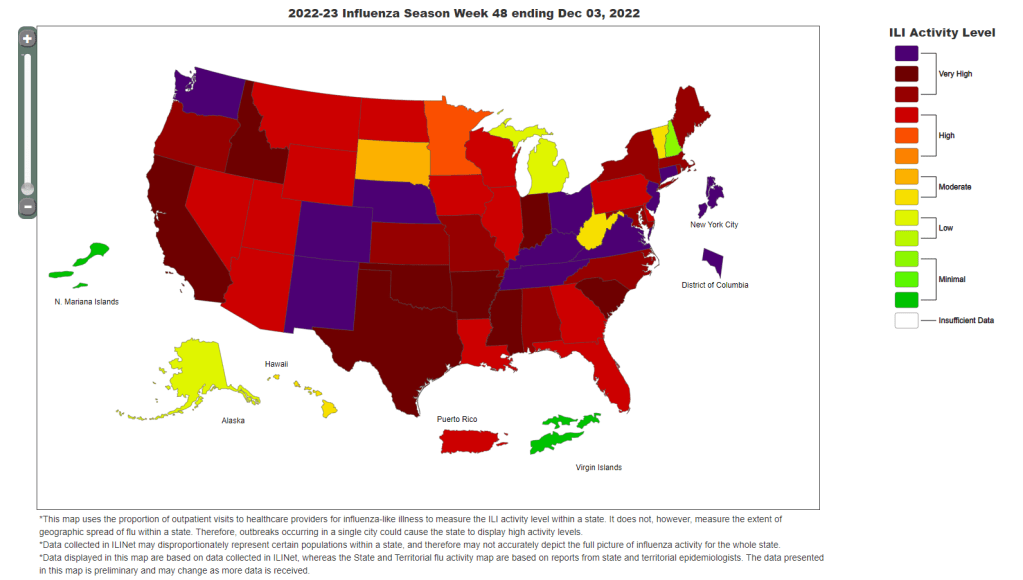
    The CDC’s influenza-like illness map shows that the vast majority of the country is facing either high or very high levels of respiratory disease.

    In the past week (December 1 through 7), the U.S. reported about 460,000 new COVID-19 cases, according to the CDC. This amounts to:

    • An average of 66,000 new cases each day
    • 140 total new cases for every 100,000 Americans
    • 50% more new cases than last week (November 24-30)

    In the past week, the U.S. also reported about 34,000 new COVID-19 patients admitted to hospitals. This amounts to:

    • An average of 4,800 new admissions each day
    • 10.3 total admissions for every 100,000 Americans
    • 14% more new admissions than last week

    Additionally, the U.S. reported:

    • 3,000 new COVID-19 deaths (430 per day)
    • 68% of new cases are caused by Omicron BQ.1 and BQ.1.1; 6% by BF.7; 4% by BN.1;  5% by XBB (as of December 10)
    • An average of 300,000 vaccinations per day

    It’s now undeniable that Thanksgiving led to a jump in COVID-19 spread: officially-reported cases went up 50% this past week compared to the week of the holiday, following the trend that we first saw in wastewater data. Hospital admissions for COVID-19 also continue to go up.

    As always, it’s important to remember that official case counts are significantly underreported, due to dwindling access to (and interest in) PCR testing. So, the CDC’s estimate of 66,000 new COVID-19 cases each day likely amounts to over a million actual new infections each day. And that’s adding to the surges of flu, RSV, and other respiratory viruses already going strong.

    “Levels of flu-like illness, which includes people going to the doctor with a fever and a cough or sore throat, are at either high or very high levels in 47 jurisdictions,” CDC Director Dr. Rochelle Walensky said at a media briefing last Monday. That “flu-like illness” metric, shown on the CDC’s flu dashboard, is primarily used as an estimate of flu cases, but in our era of under-testing it likely includes COVID-19 and other viruses with similar symptoms.

    Dr. Walensky said that current hospitalizations for flu are the highest they’ve been in a decade for this time of year, indicating that the U.S. is having a bad flu season earlier in the winter than usual. According to Inside Medicine, flu hospitalizations actually overtook COVID-19 hospitalizations for the first time in the pandemic recently; though this trend could reverse as COVID-19 spreads more.

    The flu surge could peak and give us a milder January, or it could continue to go up from here—it’s currently hard to say. Flu vaccination rates have been low this year, which doesn’t help. CDC officials highlighted the benefits of both the flu vaccine and the updated COVID-19 booster shots at their briefing on Monday.

    Those updated COVID-19 boosters offer better protection against Omicron infection than prior vaccines, as real-world data has demonstrated. That should include protection against BQ.1 and BQ.1.1, the descendants of Omicron BA.5 that are currently causing the majority of cases in the U.S.—about 68% of new cases in the week ending December 10, per the CDC. XBB, the BA.2 subvariant that led to surges in Asian countries, is on the rise.

    Last week, wastewater data from Biobot showed a steep increase in COVID-19 spread. This week, the company’s dashboard suggests that this surge may have already peaked in some parts of the country. Was Thanksgiving the start of a major winter wave, or was it more of a holiday blip? Future weeks of data will help answer this.

  • National numbers, December 4

    National numbers, December 4

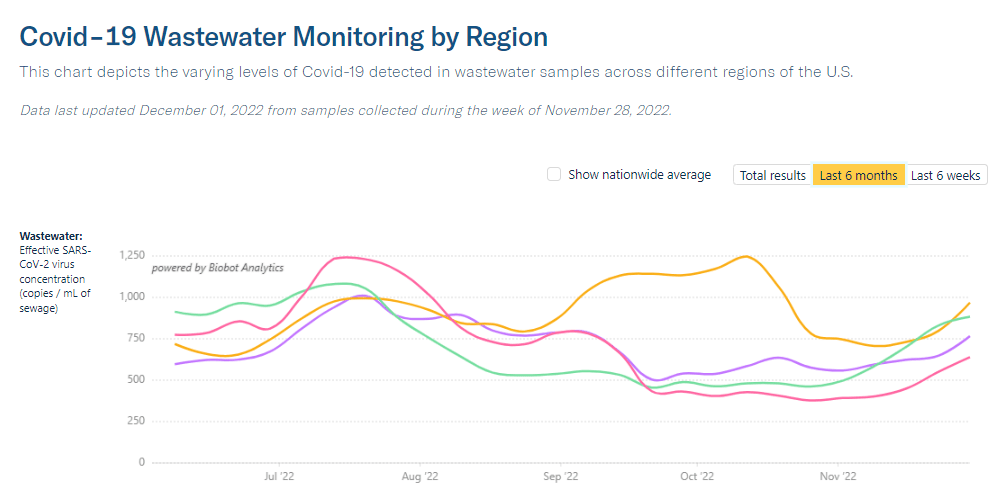
    All four major regions of the country are reporting increased coronavirus levels in their wastewater, per Biobot. Data as of November 28.

    In the past week (November 24 through 30), the U.S. reported about 303,000 new COVID-19 cases, according to the CDC. This amounts to:

    • An average of 43,000 new cases each day
    • 92 total new cases for every 100,000 Americans
    • 1% fewer new cases than last week (November 17-23)

    In the past week, the U.S. also reported about 29,000 new COVID-19 patients admitted to hospitals. This amounts to:

    • An average of 4,200 new admissions each day
    • 9.0 total admissions for every 100,000 Americans
    • 18% more new admissions than last week

    Additionally, the U.S. reported:

    • 1,800 new COVID-19 deaths (250 per day)
    • 63% of new cases are caused by Omicron BQ.1 and BQ.1.1; 6% by BF.7; 5% by BN.1;  6% by XBB (as of December 3)
    • An average of 200,000 vaccinations per day

    If the U.S. wasn’t at the start of a COVID-19 surge before Thanksgiving, we’re certainly in one now. While official case counts have stagnated, wastewater surveillance indicates that the country is seeing about 1.5 times the coronavirus transmission that we had three weeks ago, according to data from Biobot.

    All four major regions of the country are experiencing clear upward trends in COVID-19 spread, per Biobot, with no sign of peaking; this is the first time there’s been a unified national increase since mid-summer. Individual metropolitan areas from Boston, to the Twin Cities in Minnesota, to Los Angeles, are reporting major upticks.

    The current difference between wastewater surveillance trends and case trends further confirms what I’ve been saying for months: case data simply are no longer that helpful for seeing early warnings of surges, as few people seek out PCR testing compared to earlier points in the pandemic. If you don’t already have a good place to see wastewater data for your community, put some pressure on your local officials to make this information available.

    The U.S.’s new increase in transmission can likely be attributed to travel and gatherings over the Thanksgiving holiday, combined with newer, more-transmissible versions of Omicron. Lineages BQ.1 and BQ.1.1 caused almost two-thirds of new cases in the week ending December 3, according to CDC estimates, while XBB caused about 6% of new cases.

    XBB has been spreading intensely in some Asian countries, and experts are watching to see how it competes with the alphabet soup of subvariants already circulating in the U.S. So far, it is most prevalent in the Northeast, per the CDC.

    In addition to wastewater trends, new hospital admissions for COVID-19 went up this week: about 18% more patients were admitted to hospitals around the country in the week ending November 30 compared to the prior week. These patients are entering a hospital system already overwhelmed by flu, RSV, and other respiratory viruses.

    As epidemiologist Caitlin Rivers noted in her newsletter last week: “The cumulative hospitalization rate for influenza is already on par with where we would expect to be in December or January.” And that virus continues to spread further, with most of the country experiencing high or very high levels of influenza-like activity.

    COVID-19 and these other viruses might not seem like a big deal thanks to vaccines and treatments, but they can still have very severe consequences. For example, New York City just reported that three children died of COVID-19 in recent weeks. And the risk of Long COVID remains, too.

  • National numbers, November 27

    National numbers, November 27

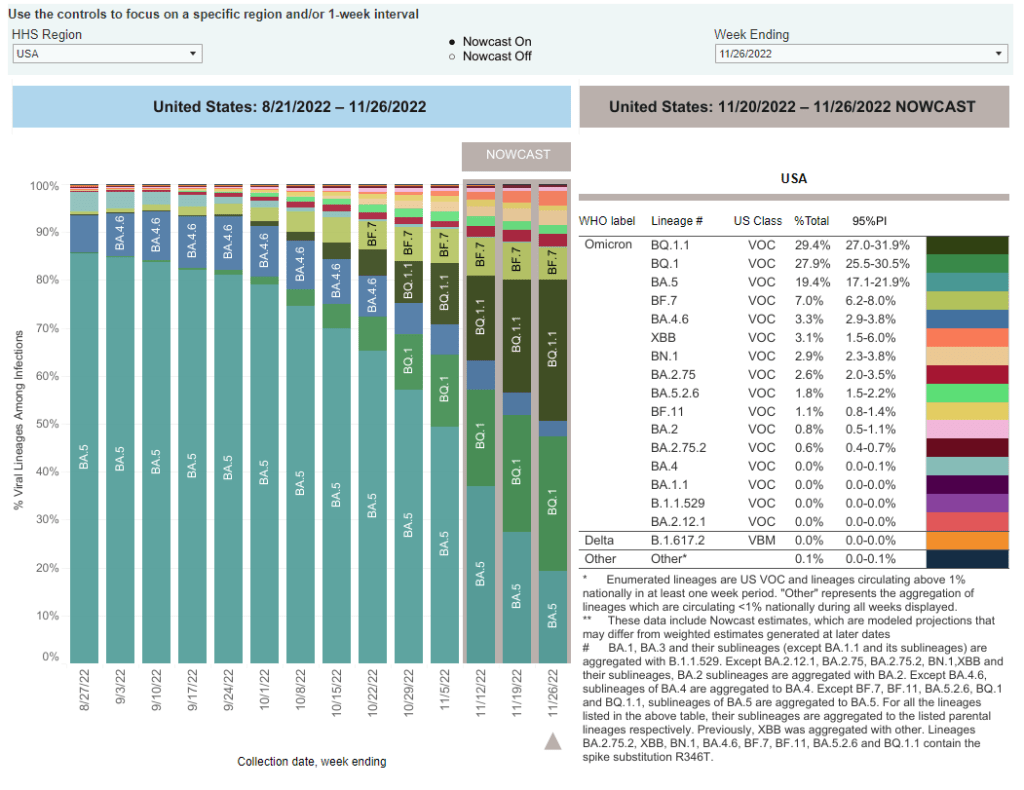
    BA.5 sublineages BQ.1 and BQ.1.1 are now the dominant variants in the U.S., while newer lineage XBB has made an appearance. Chart via the CDC.

    In the past week (November 17 through 23), the U.S. reported about 310,000 new COVID-19 cases, according to the CDC. This amounts to:

    • An average of 44,000 new cases each day
    • 93 total new cases for every 100,000 Americans
    • 8% more new cases than last week (November 10-16)

    In the past week, the U.S. also reported about 24,000 new COVID-19 patients admitted to hospitals. This amounts to:

    • An average of 3,400 new admissions each day
    • 7.2 total admissions for every 100,000 Americans
    • 0.2% more new admissions than last week

    Additionally, the U.S. reported:

    • 2,600 new COVID-19 deaths (380 per day)
    • 57% of new cases are caused by Omicron BQ.1 and BQ.1.1; 7% by BF.7; 3% by BN.1;  3% by XBB (as of November 26)
    • An average of 300,000 vaccinations per day

    Nationwide, reported COVID-19 cases went up last week: the CDC reports 8% more cases in the week ending November 23 than in the week ending November 16. Wastewater monitoring also suggests a pre-Thanksgiving uptick, according to Biobot, while new hospitalizations have been at a plateau.

    All eyes will be on wastewater data in the next couple of weeks, to look for potential spread after Thanksgiving travel and gatherings. We likely won’t see any immediate spikes in case data thanks to the data delays that always happen after holidays, but wastewater surveillance is less susceptible to these delays (and less biased by behavioral patterns). To look for wastewater data in your community, see the COVID-19 Data Dispatch’s resource page.

    Any outbreaks we see in the coming weeks will likely be driven by newer coronavirus variants, combining forces with holiday behavior. Omicron subvariants BQ.1 and BQ.1.1 caused about 57% of new COVID-19 cases in the week ending November 26, according to CDC estimates; the BQ lineage is more transmissible than its parent variant, BA.5, though it has not caused major case spikes in the U.S. yet.

    The CDC’s latest variant update also provides estimates on XBB, a subvariant that evolved from BA.2 and that has caused new surges in some Asian countries. XBB caused about 3% of new cases in the last week, the agency estimates, with higher prevalence in the Northeast and West coast. Health officials are closely watching XBB due to the many mutations on its spike protein, but it’s unclear whether this subvariant alone could cause a new surge.

    As we watch for new COVID-19 outbreaks, healthcare systems—especially children’s hospitals— across the country are already facing intense pressure from the flu, RSV, and other respiratory viruses. Many states, particularly on the East coast and in the South, continue to report very high levels of influenza-like activity, according to the CDC

    If you took part in a Thanksgiving gathering over the last few days: this week, you should look out for any respiratory symptoms and consider getting a PCR test, if you can. If possible, get a test that will check for COVID-19, the flu, and RSV at once. Make sure any disease spread stops with you!

  • National numbers, November 20

    National numbers, November 20

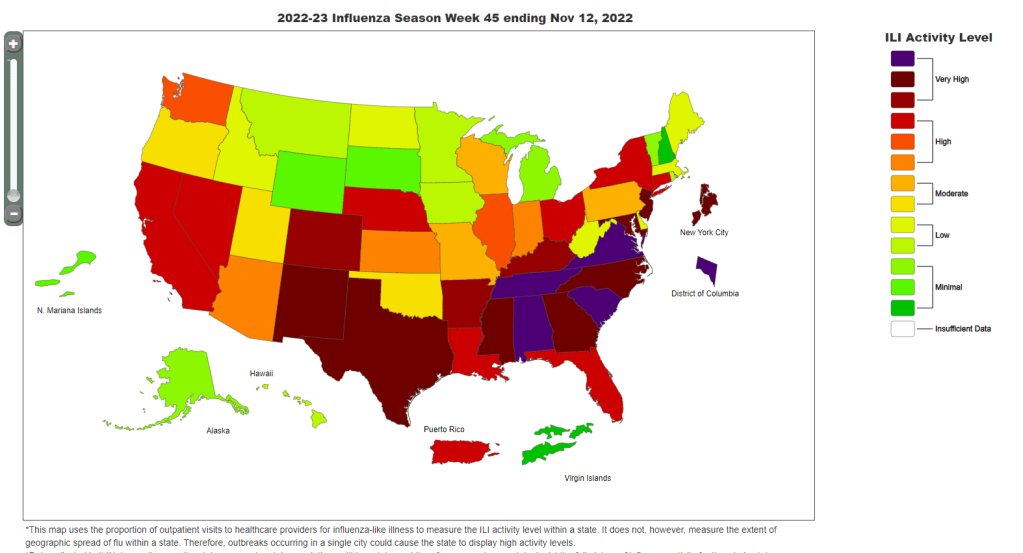
    Data from the CDC indicate that much of the country is seeing high flu levels. Chart as of November 12.

    In the past week (November 10 through 16), the U.S. reported about 280,000 new COVID-19 cases, according to the CDC. This amounts to:

    • An average of 40,000 new cases each day
    • 86 total new cases for every 100,000 Americans
    • 3% fewer new cases than last week (November 3-9)

    In the past week, the U.S. also reported about 24,000 new COVID-19 patients admitted to hospitals. This amounts to:

    • An average of 3,400 new admissions each day
    • 7.3 total admissions for every 100,000 Americans
    • 1% fewer new admissions than last week

    Additionally, the U.S. reported:

    • 2,200 new COVID-19 deaths (320 per day)
    • 50% of new cases are caused by Omicron BQ.1 and BQ.1.1; 8% by BF.7; 5% by BN.1;  2% by BA.2.75 and BA.2.75.2 (as of November 19)
    • An average of 400,000 vaccinations per day

    Nationwide, reported COVID-19 cases and new hospital admissions are still in a plateau; both metrics declined very slightly this week after rising slightly last week (declining by 3% and 1%, respectively).

    While we have yet to see as clear of a fall/winter surge as we did in the last two years, infection levels are still quite high. Evidence for this comes from wastewater data, which doesn’t rely on people getting PCR tests; trends from Biobot suggest that viral transmission is at a similar level to late October/early November of last year, when Delta was still the dominant variant.

    Biobot’s data also indicate that the West coast region is now seeing a notable uptick in COVID-19 spread, taking over from the Northeast (which has been a regional hotspot since September). Wastewater testing sites in cities like Los Angeles is reporting significant transmission spikes in the last couple of weeks.

    The West coast, like the Northeast, has been a hotspot for newer Omicron subvariants BQ.1 and BQ.1.1, according to CDC estimates. Nationwide, the BQ lineage caused about half of new cases in the last week—solidly outcompeting its parent lineage, BA.5. And there are several other Omicron subvariants spreading, including two lineages from BA.2, BF.7 and BN.1.

    With all these new variants circulating and colder weather throughout the country, why haven’t we seen a significant jump in COVID-19 spread? It’s possible that the U.S. has enough prior immunity from vaccinations and past infections to prevent a big surge, White House COVID-19 coordinator Ashish Jha said at the STAT Summit last week.

    I hope Jha is right, but I personally remain skeptical. Way too few people have received the new booster shots that protect against Omicron variants, while we’re heading into several weeks of holiday travel and gatherings—with fewer COVID-19 protections than in the last two years.

    At the same time, the U.S. is dealing with flu and RSV surges. About a dozen states, plus New York City and Washington, D.C., reported “very high” levels of influenza-like activity in the week ending November 12, according to the CDC. And the country’s RSV wave continues at high intensity, though it might be reaching its peak.

    These two respiratory diseases may be less severe than COVID-19 at an individual level (especially accounting for the burden of Long COVID), but they can still put intense pressure on healthcare systems—especially those focused on treating children. Wearing a mask, avoiding indoor crowds, improving ventilation, and other measures can protect against all three diseases.