Tag: BF.7

  • National numbers, November 20

    National numbers, November 20

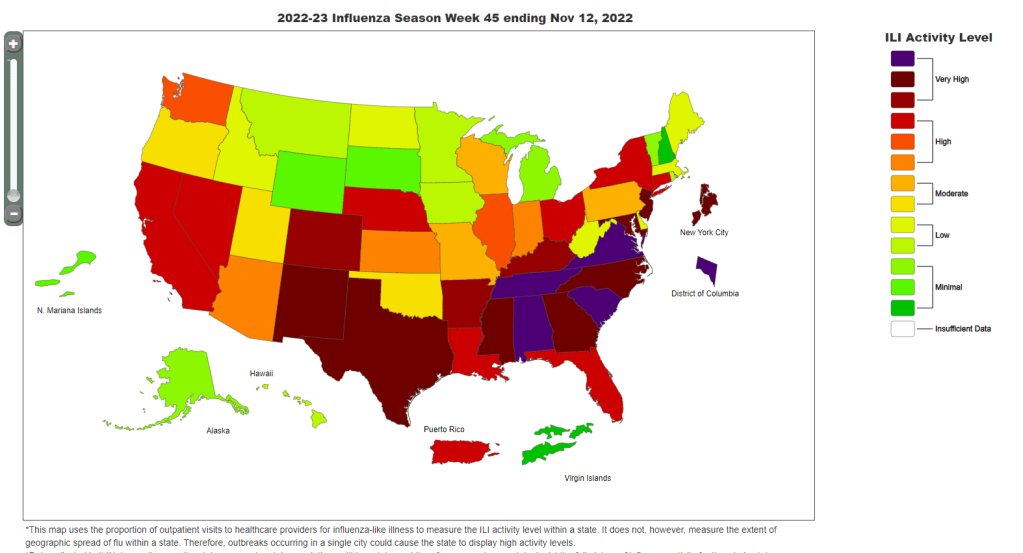
    Data from the CDC indicate that much of the country is seeing high flu levels. Chart as of November 12.

    In the past week (November 10 through 16), the U.S. reported about 280,000 new COVID-19 cases, according to the CDC. This amounts to:

    • An average of 40,000 new cases each day
    • 86 total new cases for every 100,000 Americans
    • 3% fewer new cases than last week (November 3-9)

    In the past week, the U.S. also reported about 24,000 new COVID-19 patients admitted to hospitals. This amounts to:

    • An average of 3,400 new admissions each day
    • 7.3 total admissions for every 100,000 Americans
    • 1% fewer new admissions than last week

    Additionally, the U.S. reported:

    • 2,200 new COVID-19 deaths (320 per day)
    • 50% of new cases are caused by Omicron BQ.1 and BQ.1.1; 8% by BF.7; 5% by BN.1;  2% by BA.2.75 and BA.2.75.2 (as of November 19)
    • An average of 400,000 vaccinations per day

    Nationwide, reported COVID-19 cases and new hospital admissions are still in a plateau; both metrics declined very slightly this week after rising slightly last week (declining by 3% and 1%, respectively).

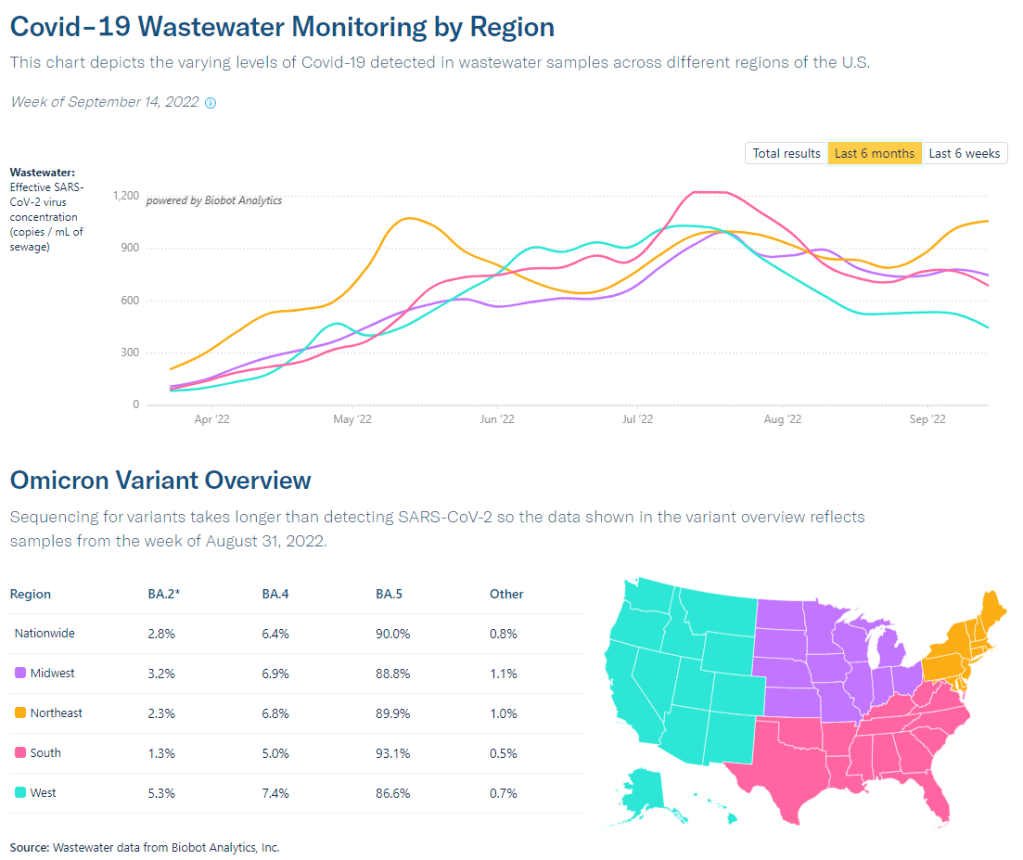
    While we have yet to see as clear of a fall/winter surge as we did in the last two years, infection levels are still quite high. Evidence for this comes from wastewater data, which doesn’t rely on people getting PCR tests; trends from Biobot suggest that viral transmission is at a similar level to late October/early November of last year, when Delta was still the dominant variant.

    Biobot’s data also indicate that the West coast region is now seeing a notable uptick in COVID-19 spread, taking over from the Northeast (which has been a regional hotspot since September). Wastewater testing sites in cities like Los Angeles is reporting significant transmission spikes in the last couple of weeks.

    The West coast, like the Northeast, has been a hotspot for newer Omicron subvariants BQ.1 and BQ.1.1, according to CDC estimates. Nationwide, the BQ lineage caused about half of new cases in the last week—solidly outcompeting its parent lineage, BA.5. And there are several other Omicron subvariants spreading, including two lineages from BA.2, BF.7 and BN.1.

    With all these new variants circulating and colder weather throughout the country, why haven’t we seen a significant jump in COVID-19 spread? It’s possible that the U.S. has enough prior immunity from vaccinations and past infections to prevent a big surge, White House COVID-19 coordinator Ashish Jha said at the STAT Summit last week.

    I hope Jha is right, but I personally remain skeptical. Way too few people have received the new booster shots that protect against Omicron variants, while we’re heading into several weeks of holiday travel and gatherings—with fewer COVID-19 protections than in the last two years.

    At the same time, the U.S. is dealing with flu and RSV surges. About a dozen states, plus New York City and Washington, D.C., reported “very high” levels of influenza-like activity in the week ending November 12, according to the CDC. And the country’s RSV wave continues at high intensity, though it might be reaching its peak.

    These two respiratory diseases may be less severe than COVID-19 at an individual level (especially accounting for the burden of Long COVID), but they can still put intense pressure on healthcare systems—especially those focused on treating children. Wearing a mask, avoiding indoor crowds, improving ventilation, and other measures can protect against all three diseases.
  • The Omicron subvariants start coming and they don’t stop coming

    The Omicron subvariants start coming and they don’t stop coming

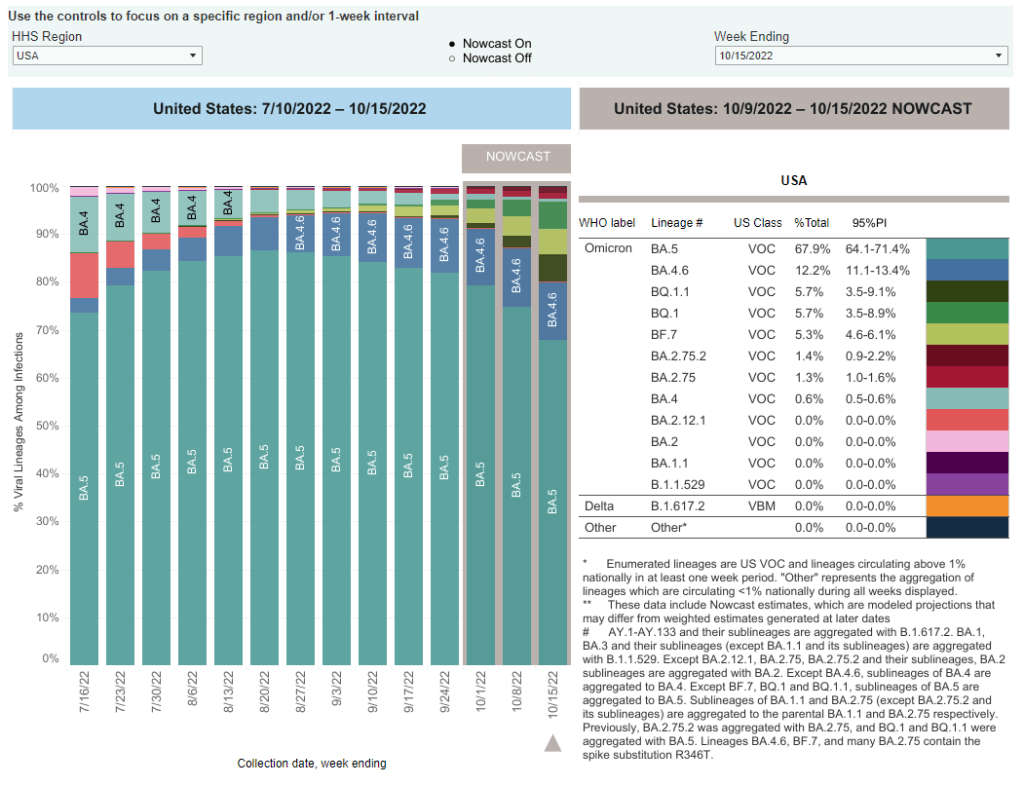
    A veritable alphabet soup of subvariants. Chart from the CDC, data as of October 15.

    When the CDC updated its variant prevalence estimates this week, the agency added new versions of Omicron to the dashboard. In the U.S., COVID-19 cases are now driven by: BA.5, BA.4.6, BQ.1, BQ.1.1, BF.7, BA.2.75, and BA.2.75.2. And possibly more subvariants that we aren’t tracking yet.

    As evolutionary biology expert T. Ryan Gregory pointed out on Twitter recently, Omicron’s evolution is “off the chart.” 

    Or, to parody Smash Mouth: the Omicron variants start coming and they don’t stop coming and they don’t stop coming and they don’t stop coming…

    Let’s go over the veritable alphabet soup of variants we’re dealing with right now, as well as one newer variant identified in east Asia that experts are closely watching.

    BA.5, BA.4, BA.4.6

    BA.5 is currently the dominant Omicron lineage in the U.S., causing about two-thirds of new COVID-19 cases in the week ending October 15. Along with BA.4, BA.5 split off from the original Omicron lineage and was first identified by South African scientists over the summer.

    As these two subvariants spread around the world, it quickly became clear that they could spread faster than other versions of Omicron and reinfect people who’d previously gotten sick with those prior lineages. For more details, see this post from June. BA.5 later pulled out from BA.4 as the most competitive lineage.

    BA.4.6 evolved out of BA.4. It appears to have a small advantage over BA.5, but can’t really compete with the newer subvariants we’re seeing now; according to the CDC’s estimates, it’s been causing around 10% to 12% of new cases nationwide for the last few weeks (without much growth).

    BQ.1 and BQ.1.1

    BQ.1 and its descendant BQ.1.1 are the two newest subvariants to show up in the CDC’s prevalence estimates, both causing about 5.7% of new cases nationwide in the last week. They actually evolved out of BA.5: BQ.1 is shorthand for a much longer, more unwieldy variant name that nobody wants to type out on Twitter.

    In the U.S., BQ.1 and BQ.1.1 are starting to outcompete their parent lineage, BA.5. They’ve grown from causing less than 1% of new cases to over 10% of new cases in the last month. These subvariants are also now outcompeting other strains in the U.K. and other European countries.

    As CBS News’s Alexander Tin explains, health experts are concerned that COVID-19 treatments like monoclonal antibodies might work less well against BQ.1 and BQ.1.1. We don’t have clear data on this yet, but pharmaceutical companies will test out the newer variants in the weeks to come. The Omicron bivalent boosters, at least, are expected to continue working against this lineage.

    BF.7

    BF.7 is another offshoot of BA.5 (again, this is shorthand for a longer name). I dedicated a post to it in late September, and the subvariant’s position hasn’t changed significantly since then: it seems to be a bit more transmissible than BA.5, but not so much that it is quickly outcompeting the parent lineage. BF.7 caused about 5% of new cases nationwide in the last week.

    Similarly to BQ.1 and BQ.1.1, there are some concerns that COVID-19 treatments will be less effective against BF.7 than other versions of Omicron based on the subvariant’s spike protein mutations, but we do not have clinical data at this point.

    BA.2.75 and BA.2.75.2

    BA.2.75, as you might guess from the notation, evolved out of BA.2—the same original Omicron lineage that produced BA.2.12.1 and drove surges in places like New York City over the summer. It has also remained present at fairly low levels across the U.S. recently, causing just 1.3% of new cases in the last week, according to the CDC’s estimates.

    But BA.2.75 now has its own offshoot, called BA.2.75.2, that appears to be a bit more competitive. The CDC recently started splitting BA.2.75.2 out of its parent lineage in its prevalence estimates, showing that it’s growing a bit faster (from 0.4% to 1.4% in the last month). Of course, this growth rate pales in comparison to what we’re seeing from the BA.5 sublineages described above.

    XBB

    XBB is the latest international subvariant of concern, identified this week in several east Asian countries. It has spread particularly quickly in Singapore, as described in this article by David Axe at the Daily Beast.

    Like BA.2.75, XBB descended from Omicron BA.2—though it’s gone through more rounds of spike protein mutation; this is why experts are calling it XBB, rather than a long string attached to BA.2. Data so far indicate its growth advantage over BA.5 is similar to what we’re seeing from BQ.1.1. XBB has also raised concerns about treatment and vaccine efficacy, since the bivalent boosters were developed from BA.4 and BA.5. 

    The CDC and other health agencies have yet to identify XBB in the U.S.; experts are closely watching how this new subvariant might be able to compete with our current variations on BA.5.

    Overall takeaways

    Overall, both in the U.S. and around the world, we’re seeing a lot of competition between these subvariants. All of them have small growth advantages over BA.5—which is currently dominant in the U.S.—but none are so different that they’re completely pulling ahead.

    As I wrote last weekend, many experts are anticipating a surge this fall and winter, driven by both new subvariants and less-cautious beavior. We likely won’t see a huge spike at the level of last winter’s massive Omicron surge, but this season will still have plenty of infections (and reinfections).

    We will need more data on how all these newer variants respond to vaccines and treatments, especially the antiviral Paxlovid. But it’s at least promising that many of the circulating variants right now evolved from BA.5, against which our bivalent boosters were specifically designed. It’s a great time to get that booster!

    More variant data

  • National numbers, October 2

    National numbers, October 2

    Coronavirus levels in Boston, Mass. wastewater spiked intensely last week. Chart via MWRA/Biobot.

    In the past week (September 24 through 30), the U.S. reported about 330,000 new COVID-19 cases, according to the CDC. This amounts to:

    • An average of 47,000 new cases each day
    • 100 total new cases for every 100,000 Americans
    • 13% fewer new cases than last week (September 17-23)

    In the past week, the U.S. also reported about 26,000 new COVID-19 patients admitted to hospitals. This amounts to:

    • An average of 3,800 new admissions each day
    • 8.0 total admissions for every 100,000 Americans
    • 6% fewer new admissions than last week

    Additionally, the U.S. reported:

    • 2,400 new COVID-19 deaths (350 per day)
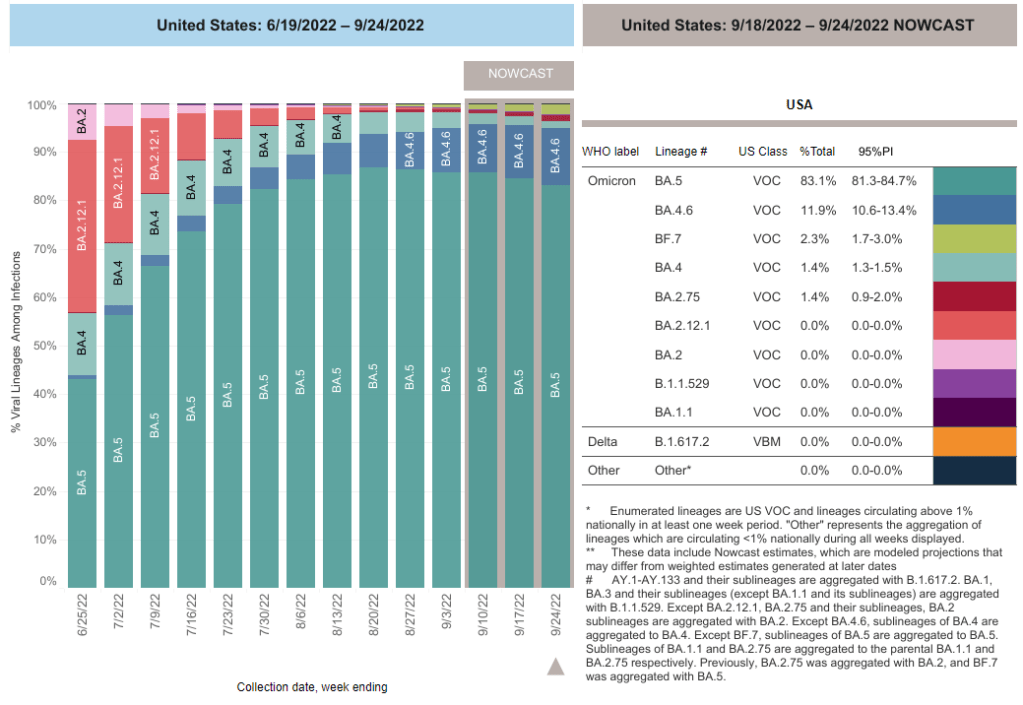
    • 81% of new cases are caused by Omicron BA.5; 13% by BA.4.6; 3% by BF.7;  1% by BA.2.75 (as of October 1)
    • An average of 400,000 vaccinations per day

    Official COVID-19 numbers continue to drop nationwide, with case counts down 13% and new hospital admissions down 6% this week compared to the prior week. Still, signals from wastewater suggest this is no time to let our guard down, especially if you live in the Northeast.

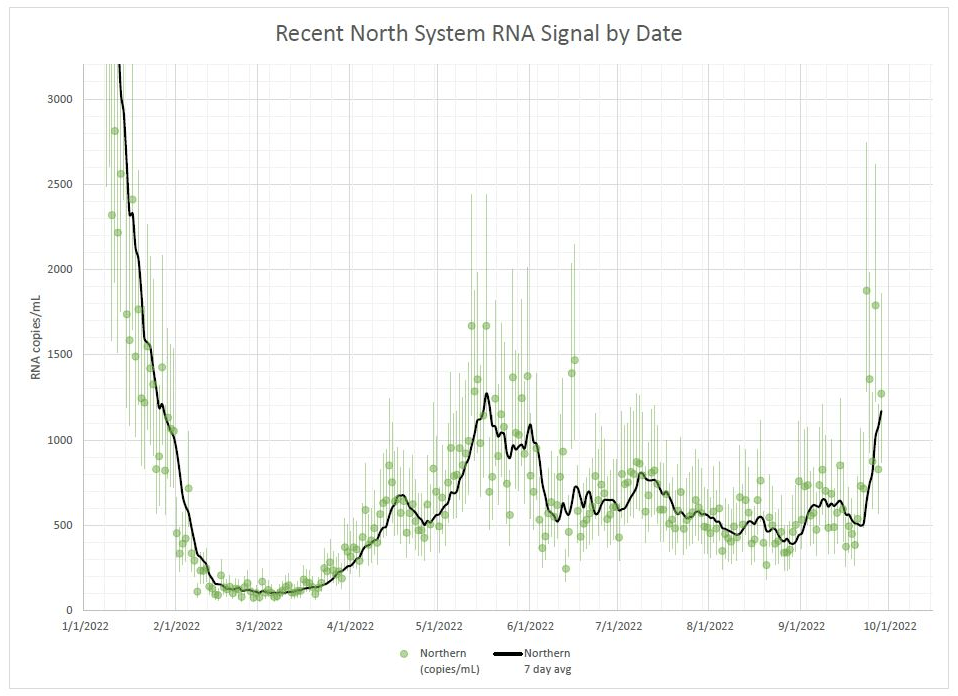
    Biobot’s wastewater surveillance dashboard is back this week (after a one-week hiatus). Nationally, this surveillance suggests coronavirus transmission is at a high plateau close to what we saw during early fall of last year, before Omicron hit. The Northeast is driving that recent trend, with an overall coronavirus concentration twice as high as the concentrations reported in other regions.

    This region remains a hotspot for Omicron BF.7, the subvariant of BA.5 that could be the U.S.’s next dominant lineage. Nationwide, BF.7 is slowly competing with BA.5: it’s grown from causing about 1% of new cases to 3.4% over the last month, according to CDC estimates. BA.4.6 also continues to grow, while BA.2.75 has remained relatively constant.

    Within the Northeast region, Boston stands out: the city’s wastewater surveillance program (run by Biobot) reported a major spike last week. And by major spike, I mean an increase of more than 100% week-over-week, according to the city’s public health department. “This spike in our wastewater concentration is of great concern and another reminder that the pandemic is far from over,” said Dr. Bisola Ojikutu, Boston’s public health commissioner, in a press release.

    Wastewater spikes typically precede case spikes by a couple of weeks, though we’ll have to see whether the significant drop in PCR testing in recent months changes this pattern. Either way, this is a good time to get a booster shot (more on boosters below), stock up on masks and rapid tests, and start planning safety measures for the holidays.

    Boston is running vaccine clinics in response to this potential new surge, and the city public health department “recommends” masking indoors. But any further mitigations are likely out of the question, even though they could have a huge impact.

  • BF.7, yet another Omicron subvariant of concern

    BF.7, yet another Omicron subvariant of concern

    BF.7 (shown here in light green) is among the Omicron subvariants starting to push out BA.5. Chart via the CDC.

    Omicron BF.7, an offshoot of BA.5, is the latest subvariant to raise red flags among experts tracking COVID-19 in the U.S.

    This week, BF.7 passed BA.2.75, another worrying lineage, in the CDC’s prevalence estimates: the CDC found that it caused about 2.3% of new cases nationwide in the week ending September 24. It’s most prevalent in the Northeast right now: in New England, it caused almost 4% of new cases last week, the CDC estimates.

    BF.7 has an additional spike protein mutation compared to BA.5, CDC spokesperson Jasmine Reed told CBS News last week. The agency is concerned that this “genetic change” could lead to Evusheld, an antibody drug used by immunocompromised people, becoming less effective. It could also contribute to a new wave of reinfections, as we’ve seen with other Omicron subvariants in the last few months.

    Here’s a quote from Dr. Stuart Ray, a data expert at John Hopkins’ Department of Medicine, in a Fortune article about BF.7:

    “The same growth advantage in multiple countries makes it reasonable to think that BF.7 is gaining a foothold,” and that it’s potentially more transmissible than parent BA.5, Ray said. Children of variants “don’t grow relative to their parent unless they have an advantage.”

    We have relatively little data on BF.7 so far, but it’s worth monitoring closely in the coming weeks.

    More on variants

  • National numbers, September 18

    National numbers, September 18

    Wastewater trends in the past couple of weeks are looking a bit messy, with a potential new surge in the Northeast and plateaus in other regions. Chart via Biobot, retrieved on September 18.

    In the past week (September 10 through 16), the U.S. reported about 420,000 new COVID-19 cases, according to the CDC. This amounts to:

    • An average of 60,000 new cases each day
    • 128 total new cases for every 100,000 Americans
    • 16% fewer new cases than last week (September 3-9)

    In the past week, the U.S. also reported about 31,000 new COVID-19 patients admitted to hospitals. This amounts to:

    • An average of 4,400 new admissions each day
    • 9.3 total admissions for every 100,000 Americans
    • 6% fewer new admissions than last week

    Additionally, the U.S. reported:

    • 2,500 new COVID-19 deaths (0.8 for every 100,000 people)
    • 85% of new cases are caused by Omicron BA.5; 10% by BA.4.6; 1% by BA.2.75 (as of September 17)
    • An average of 25,000 vaccinations per day (per Bloomberg)

    Officially-reported COVID-19 cases are still on the decline nationwide this week, as are newly hospitalized patients (a more reliable metric). About 4,400 people with COVID-19 were admitted to hospitals across the country, compared to over 6,000 a day in late July.

    These declines may be short-lived, as reopened schools and increased indoor gatherings contribute to new outbreaks this fall. Last week, I warned that Biobot’s wastewater data showed a slight uptick in coronavirus levels across the country; this week’s update shows a continued increase in the Northeast while other regions are in plateaus.

    Will the Northeast be the first region to experience a new surge again? It seems feasible, based on data from both Biobot and the CDC—though this region also has better wastewater surveillance coverage than other parts of the country, ABC News reporter Arielle Mitropoulos points out. Boston, one long-running wastewater surveillance location, is reporting high coronavirus concentrations at a level not observed since earlier in the summer.

    Nationwide, BA.5 continues to be the dominant variant, causing about 85% of new cases in the week ending September 17 per CDC estimates. But it’s facing competition from newer Omicron subvariants, including BA.4.6 (10% of new cases this week), BA.2.75 (1.3% of cases), and BF.7 (1.7% of cases). As of this week, the CDC is now reporting BA.2.75 and BF.7 separately rather than combining them with other lineages.

    BA.2.75, also called Centaurus, is a subvariant from BA.2 that evolved some additional mutations. BF.7 actually evolved from BA.5; its longer name is BA.5.2.1.X. There hasn’t been much reporting yet on BF.7, but it appears to be present in the Northeast—particularly in New England—at higher levels than in other regions. (Possibly another driver of a new surge in this area.)

    Overall, while COVID-19 spread in the U.S. is occurring less right now than it did earlier in the summer, the risk of encountering this virus is still pretty high across the country. According to the CDC’s “Community Transmission Level” guidance (pre-February), more than 90% of U.S. counties should require masks indoors.

    Instead, we have no masking requirements, increasingly-limited testing, and a booster shot campaign that many Americans do not even know is happening. Between 300 and 400 Americans still die of COVID-19 every day—a number that should be unacceptable—and I fear this number will only go up as we head into winter.