Category: Wastewater

  • National numbers, September 24

    National numbers, September 24

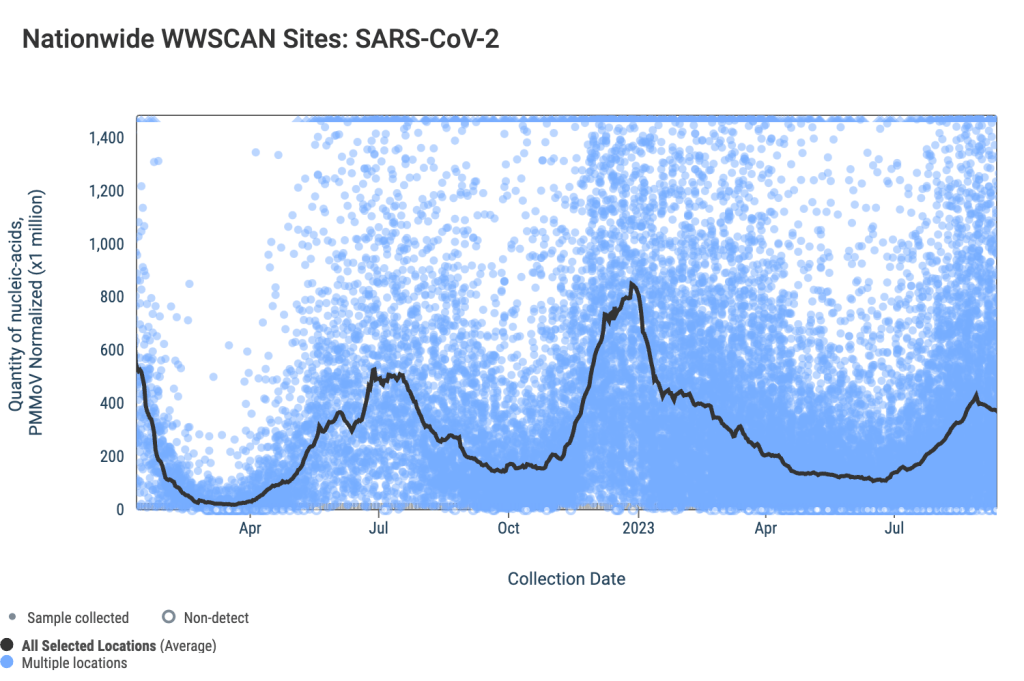
    Data from the WastewaterSCAN network suggests that COVID-19 spread has leveled off somewhat after this summer’s increase.

    During the most recent week of data available (September 3-9), the U.S. reported about 20,500 new COVID-19 patients admitted to hospitals, according to the CDC. This amounts to:

    • An average of 2,900 new admissions each day
    • 6.3 total admissions for every 100,000 Americans
    • 8% more new admissions than the prior week (August 27-September 2)

    Additionally, the U.S. reported:

    • 12.5% of tests in the CDC’s surveillance network came back positive
    • A 5% lower concentration of SARS-CoV-2 in wastewater than last week (as of September 13, per Biobot’s dashboard)
    • 25% of new cases are caused by Omicron EG.5, 24% by XBB.1.6, 14% by FL.1.5.1 (as of September 16)

    The COVID-19 plateau that I’ve described over the last couple of weeks continues, with wastewater and test positivity data showing that viral spread has slowed in much of the U.S. However, this is likely just a lull before respiratory virus season starts in earnest.

    National wastewater data from the WastewaterSCAN project suggest that COVID-19 spread has leveled off in recent weeks, after rising throughout July and August. Biobot Analytics’ data present a similar picture, though the company didn’t update its data this past Thursday (so the most recent numbers are as of September 13).

    SCAN and Biobot’s data both show plateaus or declines in all four major regions. But the Northeast and Midwest are reporting more coronavirus in their wastewater sites (at least, in aggregate) than the South and West Coast.

    Some sewersheds in the Northeast and Midwest regions have reported increases in recent weeks, while others are leveling off. In Boston and New York City, for example, most sewersheds report declines or plateaus; while sewersheds in Kansas City and Lawrence, Kansas report upward trends.

    To find wastewater data for your region, check the Biobot, WastewaterSCAN, and CDC dashboards. I maintain a list of national, state, and a few local wastewater surveillance dashboards on the COVID-19 Data Dispatch website.

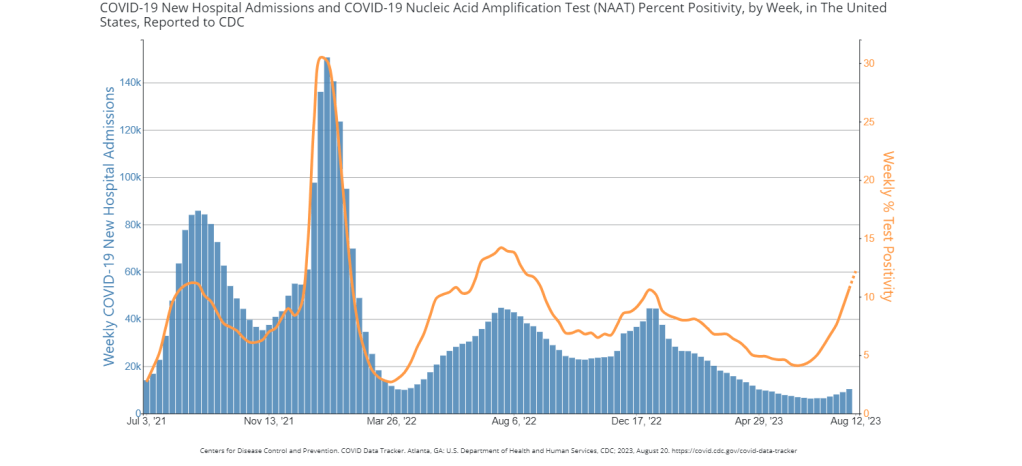
    National COVID-19 test positivity is also trending slightly down, according to the CDC’s surveillance network. Test positivity fell slightly to 12.5% in the week ending September 16, from over 14% in the prior three weeks. Walgreens’ testing data show a continued decline in positivity as well.

    Hospital admissions for COVID-19 are still going up, according to the CDC—though these data are reported with a significant delay. More than 20,000 people were hospitalized with COVID-19 during the week ending September 9, demonstrating that this disease can still cause severe symptoms. And the CDC has no surveillance data on Long COVID, making that similarly-harmful outcome less visible.

    It’s now officially fall, and October marks the start of the respiratory virus season—meaning we can expect more spread of the flu, RSV, and other pathogens along with COVID-19. This is a good time to stock up on high-quality masks, air filters, and other tools that help protect against multiple diseases.
  • COVID source shout-out: Wastewater surveillance in Wyoming

    Wastewater surveillance is re-starting in some Wyoming sewersheds after an earlier iteration of the program ended in December 2021, according to local news reports. This monitoring is a good sign for expanded coverage across more rural parts of the U.S.

    Researchers at the University of Wyoming, working with the state health department, first started testing wastewater for SARS-CoV-2 in fall 2020. The program included about 50 testing sites across the state, according to public data shared by the researchers online.

    In December 2021, however, the testing program ran out of funding and had to scale back. The CDC’s wastewater dashboard includes just four sites in Wyoming that have reported to the National Wastewater Surveillance System in 2023. Data from these sites also appear on the Biobot dashboard, suggesting that they’re being monitored by the company in partnership with local health agencies.

    Now, the state’s surveillance program is getting renewed funding, according to a report by Caitlin Tan for Wyoming Public Radio. Tan writes that “some of the larger communities in Wyoming” will soon be testing their wastewater for the coronavirus and other viruses. Data will be posted by the CDC, and the surveillance will continue through at least July 2024, Tan reports.

    While the article doesn’t specify how many sites will participate, this is still good news for a state that’s had limited wastewater monitoring over the last two years. I hope to see other more rural states follow Wyoming’s lead.

  • Wastewater surveillance is crucial for tracking new variants, BA.2.86 shows us

    Wastewater surveillance is crucial for tracking new variants, BA.2.86 shows us

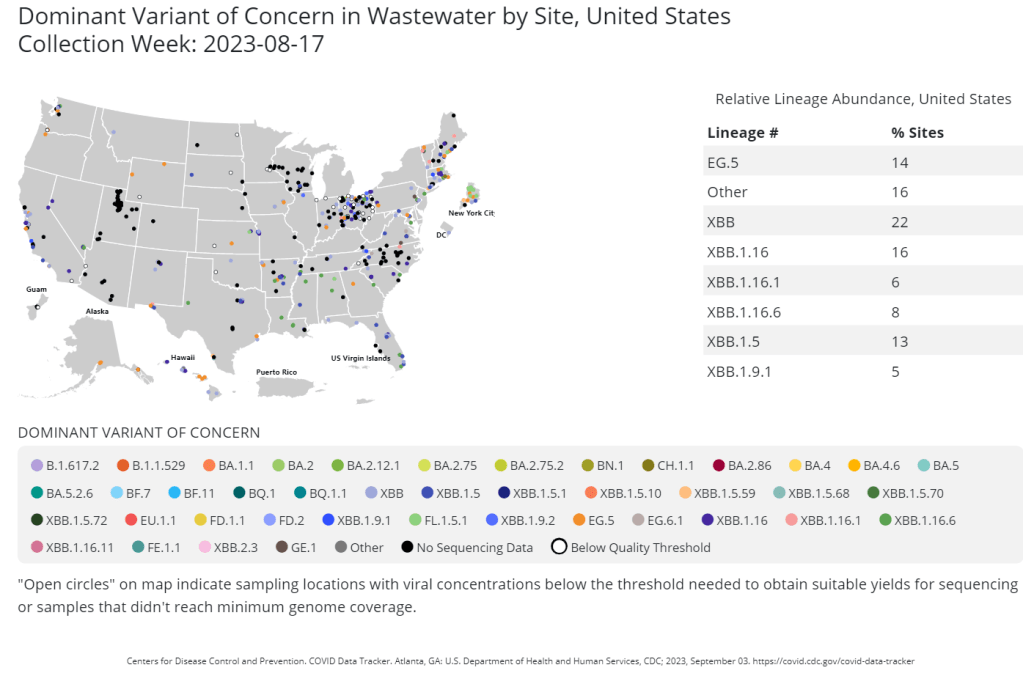
    The CDC publishes data from about 400 wastewater testing sites that are sequencing their samples. Chart shows data from the week of August 17.

    This week, the health department in New York City, where I live, announced that they’d identified new variant BA.2.86 in the city’s wastewater. (For more details about BA.2.86, see last week’s Q&A post.)

    I covered the news for local outlet Gothamist/WNYC, and the story got me thinking about how important wastewater surveillance has become for tracking variants. With less clinical testing, sewage is now a crucial source for understanding how the coronavirus is mutating and what impacts those mutations have. But there are continued barriers to obtaining and interpreting wastewater data.

    Quoting from the story:

    The declaration of the end of the public health emergency in May made COVID-19 tests less available in health care settings, and sewage monitoring has since emerged as an important way to identify new variants.

    “As the wastewater testing has gotten better, the patient surveillance has decreased,” [said Marc Johnson, a virologist at the University of Missouri]. Several variants have been found in sewage before cases were confirmed, he said.

    That list now includes BA.2.86, in New York City as well as Ohio and other countries. The CDC publishes variant data from about 400 wastewater testing sites, including the city’s.

    But wastewater data from New York City is reported unevenly, with significant delays between when samples are collected and when data is published on dashboards run by the CDC and New York state.

    Wastewater surveillance has some distinct advantages, when it comes to variant monitoring:

    • It covers thousands of people—the entire population of a sewershed—with one sample. In big cities like NYC, one sample can include data from more than one million residents.
    • Through sewage samples, scientists can look for multiple variants at once, rather than compiling data over many PCR test results. They can also track population-level trends over time.
    • Unlike traditional case data, wastewater data don’t rely on how many people are getting tested or where. This lack of testing bias is important, as people typically use rapid tests—which are not reported to health systems—over PCR these days (rapid tests are easier to access, PCR sites have closed following the end of the federal public health emergency, etc.).

    But there are also some problems, as the NYC detection this week demonstrated:

    • Public health officials are still getting used to using and sharing wastewater data, as this is a relatively novel source with novel pipelines for transmitting data. While the CDC and other organizations are working to compile these data in a standardized way, it’s still a work in progress.
    • Discrepancies and delays can sometimes occur as a result. For example, in New York, the governor’s office put out a press release on Tuesday morning claiming that BA.2.86 hadn’t been detected in the state yet—then, just hours later, the city health department announced they’d found it. State health officials weren’t aware of the detection before the city made its public announcement, I learned for my news story.
    • Health officials are also still learning how to interpret and act on wastewater data. The NYC health department failed to answer my questions about in which sewershed or from which sampling date they found BA.2.86; it’s unclear if they’re using the detection to take any specific actions, besides simply warning the public that this variant is present.
    • As wastewater surveillance captures such broad samples, it’s difficult to tie new variant detections to clinical data, such as whether an infected person went to the hospital due to their symptoms. Officials can’t contact trace from these detections, making it hard to answer questions like whether BA.2.86 causes more severe symptoms.

    For more reading on this topic, I recommend my feature for Gothamist/WNYC and MuckRock last fall about NYC’s wastewater surveillance program, as well as other past posts at the COVID-19 Data Dispatch.

    More about wastewater surveillance

  • National numbers, August 27

    National numbers, August 27

    Biobot’s wastewater surveillance data suggest a potential plateau in COVID-19 spread, though future weeks of data will be needed to say for sure.

    During the most recent week of data available (August 6-12), the U.S. reported about 12,600 new COVID-19 patients admitted to hospitals, according to the CDC. This amounts to:

    • An average of 1,800 new admissions each day
    • 3.8 total admissions for every 100,000 Americans
    • 22% more new admissions than the prior week (July 30-August 5)

    Additionally, the U.S. reported:

    • 13.4% of tests in the CDC’s surveillance network came back positive
    • A 1% lower concentration of SARS-CoV-2 in wastewater than last week (as of August 23, per Biobot’s dashboard)
    • 25% of new cases are caused by Omicron XBB.1.6; 21% by EG.5; 11% by XBB.2.3; 13% by FL.1.5.1 (as of August 19)

    This week, our limited COVID-19 data picture suggests that transmission may be starting to level off. But if BA.2.86 or another newer variant enters this high-spread environment, the outlook could get less rosy.

    One sign of a possible plateau: Biobot’s national wastewater surveillance dashboard shows a very slight downward trend, with SARS-CoV-2 levels dropping by about 1% from August 16 to August 23. This is based on just one week of data, though, so we’ll have to see what further updates show.

    Biobot’s regional data similarly show potential good trends: the Midwest appears to have passed the peak during this surge, as of the last two weeks, while the South and Northeast also show slight plateaus. Coronavirus levels are still trending up in the West, but less intensely.

    Data from both Biobot and WastewaterSCAN suggest that COVID-19 spread has turned a corner in some Midwest sewersheds, such as Johnson County, Kansas; Lawrence, Kansas; Lonoke County, Arkansas; Lincoln, Nebraska; and Warren, Michigan. Still, more data are needed to see if these trends hold.

    Test positivity data from the CDC’s respiratory surveillance network also suggest that COVID-19 spread may be slowing. After a rapid rise through July, test positivity increased by just 8% in the most recent week of data (ending August 19), from 12.4% to 13.4%. This is still a high overall positivity rate, though, especially considering how difficult PCR tests are to access these days.

    Hospitalizations continue to rise as well: the CDC reported a 22% increase in new COVID-19 patients from the week ending August 5 to the week ending August 12. While hospitalizations are significantly delayed compared to other metrics, these data show one of the surge’s severe impacts. We have even less data about Long COVID, the other main severe impact.

    BA.2.86, a new variant that scientists are watching closely, isn’t yet impacting transmission in the U.S. based on our current data. But it could lead to another increase in cases, if it proves able to outcompete the now-dominant group of XBB variants. (More on BA.2.86 later in today’s issue.)

    Remember: new variants don’t appear magically out of nowhere. People encourage their evolution, by allowing the virus to continue spreading unchecked. In addition to protecting ourselves and our communities, COVID-19 safety measures help to prevent further mutation.

  • COVID source callout: Nebraska stops reporting wastewater data

    The Nebraska state health department has discontinued its wastewater surveillance data page, depriving residents of important COVID-19 updates at a time when cases are rising.

    Multiple local news outlets in the state (including the Omaha World-Herald, the Lincoln Journal-Star, and the radio station KIOS) reported the removal. Nebraska’s health department previously shared wastewater updates through PDF reports, published every two weeks; these reports included recent COVID-19 trends along with data about variants sequenced in the state’s sewage.

    Now, the health department’s wastewater surveillance page redirects to an error message, reading: “This page is currently unavailable.” The change came as wastewater data in Nebraska and across the country were showing an increase in coronavirus spread, local reporters covering the story have pointed out.

    Nebraska’s health department discontinued this webpage due to the federal public health emergency’s end in May, a spokesperson for the agency told the World-Herald and Journal-Star. The agency is still tracking wastewater data, the spokesperson said. But it’s apparently redesigning its public website to include as little information as possible.

    “Data continues to be tracked for that program and is available upon request,” the agency spokesperson told local reporters. Nebraska’s wastewater data still appear to be available on the CDC’s dashboard, as well. But new data for Nebraska sites were most recently added to that dashboard in early August, so it’s unclear whether CDC updates will continue after the local page’s end.

    Even if the Nebraska health department does continue sending data to the CDC, the national dashboard is less accessible to residents hoping to keep track of COVID-19 trends than the state’s reports were. As I’ve written before, local dashboards and alert systems are always better when it comes to tailoring updates for a specific community.

  • National numbers, August 20

    National numbers, August 20

    While the rise in hospitalizations has been modest, test positivity is on a similar level to the last couple of surges, per the CDC. Data as of August 18.

    During the most recent week of data available (July 30 through August 5), the U.S. reported about 10,300 new COVID-19 patients admitted to hospitals, according to the CDC. This amounts to:

    • An average of 1,500 new admissions each day
    • 3.1 total admissions for every 100,000 Americans
    • 14% more new admissions than the prior week (July 23-29)

    Additionally, the U.S. reported:

    • 12.2% of tests in the CDC’s surveillance network came back positive
    • A 10% higher concentration of SARS-CoV-2 in wastewater than last week (as of August 16, per Biobot’s dashboard)
    • 25% of new cases are caused by Omicron XBB.1.6; 21% by EG.5; 11% by XBB.2.3; 13% by FL.1.5.1 (as of August 19)

    The summer COVID-19 surge continues. While wastewater surveillance data suggest that transmission trends may be turning around in some places, the virus is largely still increasing across the U.S. New variants are on the horizon, too.

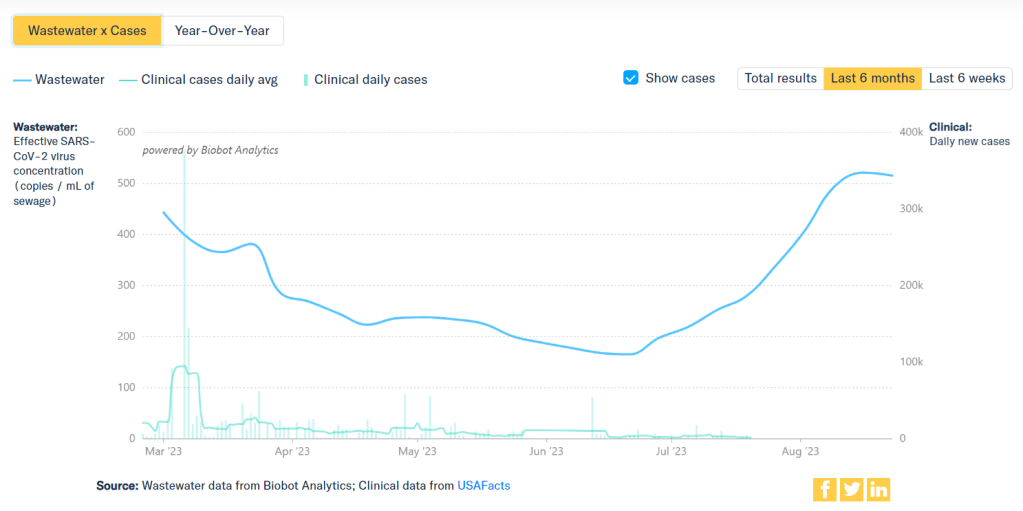
    Nationally, coronavirus levels in wastewater are the highest they’ve been since last winter’s holiday surge, according to data from Biobot Analytics. Viral concentrations have tripled since mid-June, and continue to follow a similar pattern to the Delta surge that we experienced at about the same time in summer 2021.

    Biobot’s regional data suggest that the Midwest—which reported a serious spike last week—may have turned a corner in this surge, with viral levels going into a plateau. This pattern is based on just one week of data, though, so we’ll have to see what next week’s numbers show.

    Wastewater data from the CDC and WastewaterSCAN similarly show continued increases in COVID-19 spread. Some counties in Southern states, such as Florida, Georgia, and Alabama, are reporting particularly large upticks. Hawaii may be a state to watch, too, as residents face health access challenges following the recent wildfires.

    Test positivity also continues to increase, with the CDC reporting that about 12% of COVID-19 tests reported to its respiratory network returned positive results in the week ending August 16. Hospital admissions and emergency department visits are still going up as well, though these metrics are reported with two-week delays.

    The CDC updated its variant data this week, reporting that Omicron EG.5 continues to outcompete other XBB lineages. EG.5 doesn’t have a huge advantage in transmission, though, so it’s increasing relatively slowly amid a sea of other similar variants.

    But a new variant, called BA.2.86, may be one to watch more closely. Health officials are on the alert after seeing just a few cases in the U.S., Israel, and Denmark due to a number of mutations in this variant’s spike protein, which diverge significantly from other strains. (More on this variant later in today’s issue.)

    While the CDC says it’s monitoring this new variant, the agency’s genomic surveillance is far sparser than it was a year or two ago. The agency and its research partners are now sequencing under 5,000 coronavirus samples a week, compared to almost 100,000 a week at the height of Omicron. With this small sample pool, the CDC is less equipped to catch BA.2.86, or any other variants that may arise.

  • Sources and updates, July 30

    • New papers show wastewater’s predictive value: This week, I noted three recently-published papers that all demonstrate wastewater surveillance’s value for flagging changes in COVID-19 trends before other metrics, such as hospitalizations. One paper, in Nature, found that wastewater trends preempted hospitalization trends by one to four weeks, in 150 U.S. counties. Another paper, in JAMA Network Open, found that wastewater trends tracked with case trends in 268 U.S. counties from January through September 2022; however, the correlation became weaker with reduced clinical testing over time. And a third paper, in PNAS, shares an algorithm that can flag community-level COVID-19 surges before they show up in other metrics, using data from North Carolina’s wastewater surveillance.
    • Long COVID’s impact on employment: The Urban Institute, a think tank focused on economic and social policy research, published a report exploring employment challenges and related hardships among people with Long COVID. The researchers (a group that included Lisa McCorkell from the Patient-Led Research Collaborative) analyzed results from Long COVID questions included in an Urban Institute survey, conducted among more than 7,500 American adults across the country in December 2022. Among the findings: 10% of adults with Long COVID stopped working for a period due to their symptoms while another 5% reduced their work hours; 24% limited activities outside of work; 42% reported food insecurity in the last year; 20% reported difficulty paying their rent or mortgage.
    • Characterizing potential Long COVID phenotypes: Another Long COVID study from this week, published in The Lancet: a research consortium including several medical centers across Europe tracked patients over time, seeking to better understand different subtypes of the condition. The study included about 1,000 people with at least one Long COVID symptom, tracked over one year from their initial COVID-19 diagnosis. Researchers found four potential subtypes: one similar to ME/CFS (including fatigue and cognitive symptoms), one with respiratory symptoms, one with chronic pain, and one with changes to taste and smell. The researchers also noted some patient characteristics and aspects of acute illness that may contribute to increased risk of different subtypes.
    • Outdoor transmission at a night market: One more notable new paper: researchers at local health agencies in China’s Zhejiang province reported on coronavirus transmission at an outdoor night market, in Frontiers in Public Health. In one day at the night market, three infected visitors led to 131 secondary cases, the researchers found. Based on samples from both people at the market and surfaces, the researchers estimated that particles of an Omicron BA.5 strain could linger for over an hour and still be contagious. The study suggests that, even in outdoor settings, transmission is still possible when other precautions aren’t taken.
    • Acute Hospital at Home data: The Data Liberation Project, which collects and shares data from public records requests, recently published a dataset from a COVID-era program by the Centers for Medicare and Medicaid Services (CMS) which allowed hospitals to treat patients in their homes. Early this year, the project filed a FOIA request for data indicating which hospitals applied to participate in the program and how their patients fared. CMS completed the request in June, and DLP is working to process and understand the resulting data. If you’re interested in using the data, you can check out the documentation and sign up for updates.
    • Diagnosis challenges with alpha-gal syndrome: Finally, a bit of non-COVID public health news: the CDC recently released some data showing challenges with diagnosing alpha-gal syndrome—a disease transmitted by tick bites that leads to new allergies—despite recent increases in its spread. The CDC estimates that up to 450,000 people in the U.S. may have been impacted by this disease, potentially developing new allergies to meat and other animal products. Yet in one CDC study, the majority of health providers surveyed were not confident in their ability to diagnose the syndrome. This trend reflects similar challenges for other chronic diseases that might be new or unfamiliar to providers, such as Long COVID.

  • National numbers, July 30

    National numbers, July 30

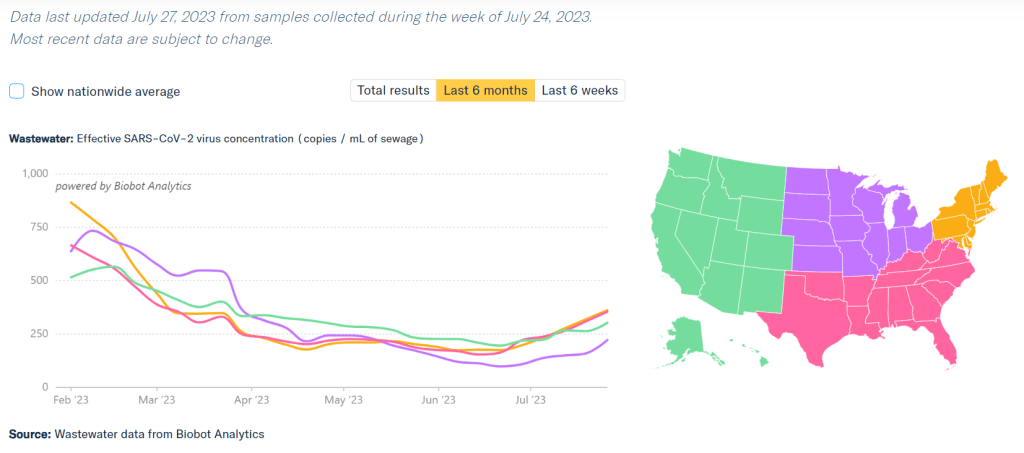
    COVID-19 is spreading more in all regions of the country, according to Biobot’s data. Data as of July 27, based on samples collected the week of July 24.

    During the most recent week of data available (July 9 through 15), the U.S. reported about 7,100 new COVID-19 patients admitted to hospitals, according to the CDC. This amounts to:

    • An average of 1,000 new admissions each day
    • 2.2 total admissions for every 100,000 Americans
    • 10% more new admissions than the prior week (July 2-8)

      Additionally, the U.S. reported:

    • 7.6% of tests in the CDC’s surveillance network came back positive
    • A 17% higher concentration of SARS-CoV-2 in wastewater than last week (as of July 26, per Biobot’s dashboard)
    • 24% of new cases are caused by Omicron XBB.1.6; 19% by XBB.1.9; 13% by XBB.2.3 (as of July 22)

    Several major metrics continue to point to a summer increase in COVID-19 spread. Coronavirus levels in wastewater are up in all major regions, as is test positivity from the CDC’s network. Hospitalizations have started ticking up as well.

    Nationally, coronavirus levels in wastewater have doubled in the last month, according to Biobot Analytics. Viral levels are on par with this period in summer 2021, at the start of that year’s Delta surge, and are the highest they’ve been since this year’s holiday surge concluded.

    Data from the WastewaterSCAN network similarly shows COVID-19 upticks in the last month, though the team’s latest national update notes that current levels are still low compared to the start of 2023. WastewaterSCAN recently added national wastewater levels to its dashboard, making it easier to track broad trends from this sewage testing network.

    Test positivity data from the CDC’s respiratory lab network are still increasing as well. National test positivity was 7.6% in the week ending July 22, compared to 4.5% about a month ago, an increase of about 70%.

    The CDC’s hospitalization data are also showing an increase now: new COVID-19 patients admitted to hospitals went up by about 10% from the week ending July 8 to the week ending July 15. These are the most recent hospitalization numbers available, as the CDC is still reporting this metric with a delay.

    Wastewater and positivity data suggest that COVID-19 spread is increasing in all major regions of the country. All regions are also dealing with the virus’ continued evolution, as a variety of XBB lineages circulate and compete with each other.

    Several national publications reported on these COVID-19 increases in the last week, pointing to the potential for a summer surge. I personally liked this article from Dylan Scott at Vox, which also covers implications for COVID-19 this winter.

    But the COVID-19 Data Dispatch was on this potential surge weeks before any mainstream media news site. If you appreciate our early warnings, please donate to support this work!

  • National numbers, July 16

    National numbers, July 16

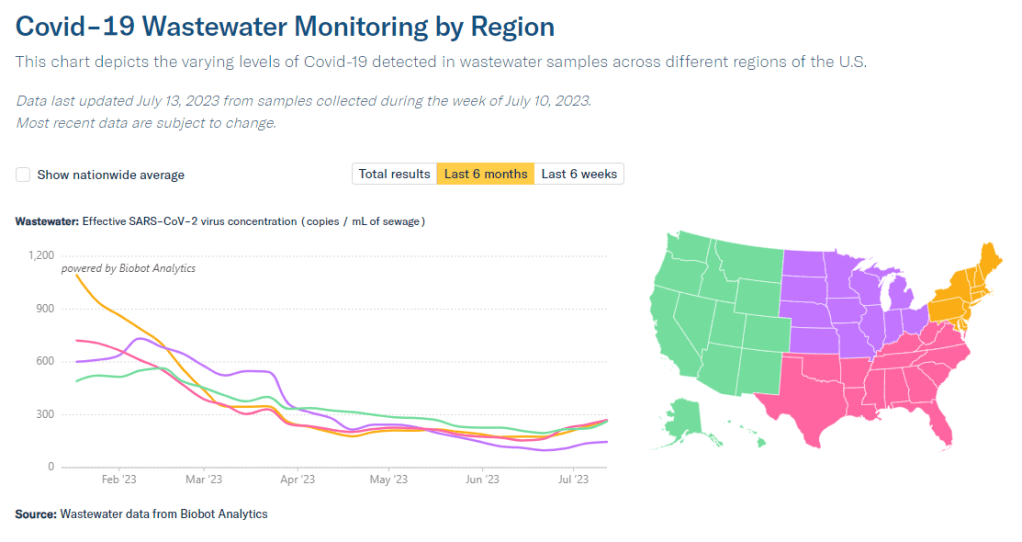
    Wastewater surveillance data from Biobot indicate that three out of four major U.S. regions are experiencing increased COVID-19 spread.

    In the past week (July 2 through 8), the CDC did not update COVID-19 hospitalization data for unclear reasons. During the most recent week of data available (June 25 through July 1), the U.S. reported about 6,200 new COVID-19 patients admitted to hospitals, according to the CDC. This amounts to:

    • An average of 900 new admissions each day
    • 1.9 total admissions for every 100,000 Americans
    • 1% fewer new admissions than the prior week (June 18-24)

    Additionally, the U.S. reported:

    • 5.5% of tests in the CDC’s surveillance network came back positive
    • A 13% higher concentration of SARS-CoV-2 in wastewater than last week (as of July 12, per Biobot’s dashboard)
    • 32% of new cases are caused by Omicron XBB.1.6; 15% by XBB.1.9; 13% by XBB.2.3 (as of July 8)

    National COVID-19 data are showing signs of a summer uptick in infections across multiple regions. Newer variants, summer travel, and holidays are likely contributing to this increase, though it’s hard to say if we will see a real surge or a continued shifting of the U.S.’s high COVID-19 baseline.

    Wastewater surveillance data from Biobot Analytics show a significant uptick in coronavirus levels over the last month, with an increase of about 50% from June 14 to July 12. Three out of four major U.S. regions (the Northeast, South, and West Coast) report notable increases, while the Midwest reports a slower uptick.

    The CDC’s National Wastewater Surveillance System (NWSS) is not yet showing a pronounced increase. Of the testing sites in this network that reported data in the last two weeks, about half reported upticks while the others reported declines or plateaus. However, NWSS data tend to be updated on a more delayed schedule than Biobot’s dashboard, since the CDC compiles information from a number of state and local health agencies.

    As epidemiologist Caitlin Rivers points out in her Substack post describing the wastewater trend, COVID-19 summer waves in the U.S. tend to start in the South. Some experts attribute this to more indoor summer activities in the region, but there’s little data to back this up, Rivers writes. Plus, this year, the summer uptick has appeared to start in multiple regions of the country at the same time.

    In addition to the wastewater data, test positivity data from the CDCs National Respiratory and Enteric Virus Surveillance System (NREVSS) show a similar uptick in the last month: from 4.1% of COVID-19 tests returning positive results in the week ending June 10 to 5.5% in the week ending July 8. Remember, this NREVSS doesn’t share data from all PCR tests done in the U.S. (as the CDC no longer has authority to collect this information); but it is set up to provide national and regional estimates.

    According to NREVSS, COVID-19 test positivity is going up in several major regions, including New York and New Jersey, the Mid-Atlantic, the South, the Gulf Coast, and the Northwest. All of these regions are dealing with the Omicron XBB variant’s continued evolution; in the CDC’s most recent variant update on July 8, the agency listed 12 different XBB subvariants competing for hosts.

    The CDC failed to update its COVID-19 hospitalization data this week, so the most recent available data are from the week ending July 1. Typically, the agency’s data scientists will add notes to their dashboard explaining update delays or errors, but this week, I couldn’t find anything.

    As I wrote on June 25: sometimes, I wonder if the CDC doesn’t think anyone is checking their dashboard anymore. But we are! COVID-19 data may be more limited than ever, but we still have enough information to know when cases are ticking up again—and we know the measures needed to protect ourselves and our communities.

  • National numbers, June 25

    National numbers, June 25

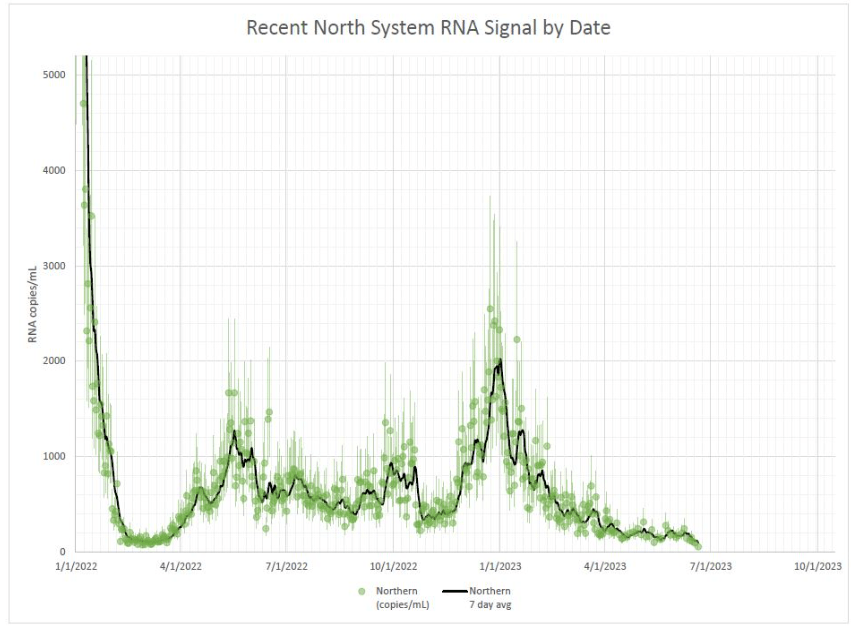
    Wastewater data from Boston show some small increases and decreases in transmission this spring, reflecting our uncertain baseline.

    In the past week (June 11 through 17), the CDC did not update COVID-19 hospitalization data due to changes in its reporting process.

    During the most recent week of data available (June 4 through 10), the U.S. reported about 6,600 new COVID-19 patients admitted to hospitals, according to the CDC. This amounts to:

    • An average of 950 new admissions each day
    • 2.0 total admissions for every 100,000 Americans
    • 8% fewer new admissions than the prior week (May 28-June 3)

    Additionally, the U.S. reported:

    • 4.0% of tests in the CDC’s surveillance network came back positive
    • A 16% lower concentration of SARS-CoV-2 in wastewater than last week (as of June 21, per Biobot’s dashboard)
    • 30% of new cases are caused by Omicron XBB.1.6; 24% by XBB.1.9; 11% by XBB.2.3 (as of June 24)

    The CDC failed to update its primary COVID-19 metrics this week, so I have no national updates to share about hospital admissions, deaths, or test positivity. The most recent available data from the agency and wastewater surveillance sources suggest that the U.S. is still experiencing a transmission plateau.

    According to the CDC’s dashboard, the agency didn’t update its hospitalization data “due to a change in required reporting cadence from daily to weekly,” following the end of the public health emergency in May. The dashboard note is a bit unclear, but I’m assuming this refers to a change in requirements for state public health departments reporting to the CDC, as the national agency lost its authority to require daily data reporting when the PHE ended.

    Still, it’s confusing to me that the CDC’s dashboard note only refers to hospitalization data, because deaths, test positivity, and other metrics also weren’t updated this week. These data points don’t rely on state reporting systems, so they shouldn’t be impacted by the reporting change.

    Either the note is incomplete, or the CDC staff in charge of this dashboard took an issue with one metric as an excuse not to update several metrics. I don’t love the outcome either way. Like, do they think nobody is checking this dashboard? Because we still are.

    Anyway, the CDC’s most recent data (from the week of June 10, now about three weeks ago), suggested that the U.S. was in a continued COVID-19 plateau, with hospital admissions and test positivity from the CDC’s surveillance network declining very slightly. 

    Wastewater data from Biobot Analytics indicates a similar plateau at the national level. Regionally, the Northeast and West coast experienced slight upticks in COVID-19 spread in the last few weeks, but the coronavirus levels in their wastewater now appear to be trending back down. (These are small changes, though, compared to what we’ve seen in past surges.)

    The sewage in Boston and New York City, two large Northeast cities that are often bellwethers for larger COVID-19 trends, similarly slow slight viral increases in May followed by downturns in June. NYC data are delayed by up to two weeks, though, so take this with a grain of salt.

    The CDC did update its variant estimates this week, showing that XBB.1.5 is now causing less than one-third of cases nationwide. XBB.1.6 and its relatives are now the most popular lineages in the U.S., causing a combined 30% of new cases in the two weeks ending June 24. Other XBB variants, including XBB.1.6 and XBB.2.3, are also on the rise.

    As health agencies put fewer and fewer resources into tracking COVID-19, the data we still have show continued severe ramifications for this disease’s unchecked spread. This disease still kills over 100 people per day.