Category: Source spotlight

  • COVID source shout-out: Bloomberg’s vaccine tracker

    Last week, the team behind Bloomberg’s COVID-19 vaccine tracker announced that the dashboard will stop updating on October 5.

    Drew Armstrong, senior health care editor and leader of the tracking effort, provided the motivations for this decision in an update post. New rounds of booster shots around the world, including bivalent shots in some countries, have made it harder to track and present data: “There are more categories of data to collect and fewer simple comparisons among the more than 100 countries we’ve been tracking,” Armstrong wrote.

    Armstrong also explained that the vaccine tracker has been a huge lift for Bloomberg, and the company is only able to put so many resources into a dashboard that really should be provided by government or academic institutions. (The COVID Tracking Project’s leaders said something similar when that project stopped data collection in spring 2021.)

    While I’m sad to see this tracker go, I understand the decision and remain very grateful for all the work that’s gone into it since vaccination campaigns started in winter 2020. Congratulations to all of the Bloomberg journalists who contributed to this valuable resource!
  • COVID source callout: Wastewater data on a break

    If you went to check Biobot’s COVID-19 wastewater dashboard this week, you may have noticed that the company hasn’t updated its data since September 14.

    Biobot’s website doesn’t provide an explanation for the lack of updates, but you can find one on another source: the wastewater data page run by the Massachusetts Water Resources Authority (MWRA), covering the greater Boston area. As Biobot was founded in Boston (by scientists at the Massachusetts Institute of Technology), the city is one of Biobot’s longest-running COVID-19 sampling sites.

    As of September 25, a note on the MWRA page reads: “Biobot will be closing their lab next week for a company retreat. We don’t expect any data updates between 9/18/2022 and 9/25/2022. They expect to catch up to the normal posting schedule by 9/27/2022.”

    It seems logical to assume this lab closure also applies to the company’s national dashboard. 

    Now, to be clear, I have nothing against Biobot for taking a company retreat; anyone working in public health deserves a break sometimes, and I hope the retreat is productive for the company’s staff. But when a private company represents the best source for a crucial pandemic-tracking metric—as Biobot is able to provide unified, national and regional estimates better than the CDC can—even a week-long break can be a problem for people who rely on these data.

    Ideally, there should be enough public health funding going around that everyone working in wastewater surveillance can take all the breaks they need without disrupting data systems. This is just a small example of a much bigger issue.

  • COVID source shout-out: Millions Missing protest

    COVID source shout-out: Millions Missing protest

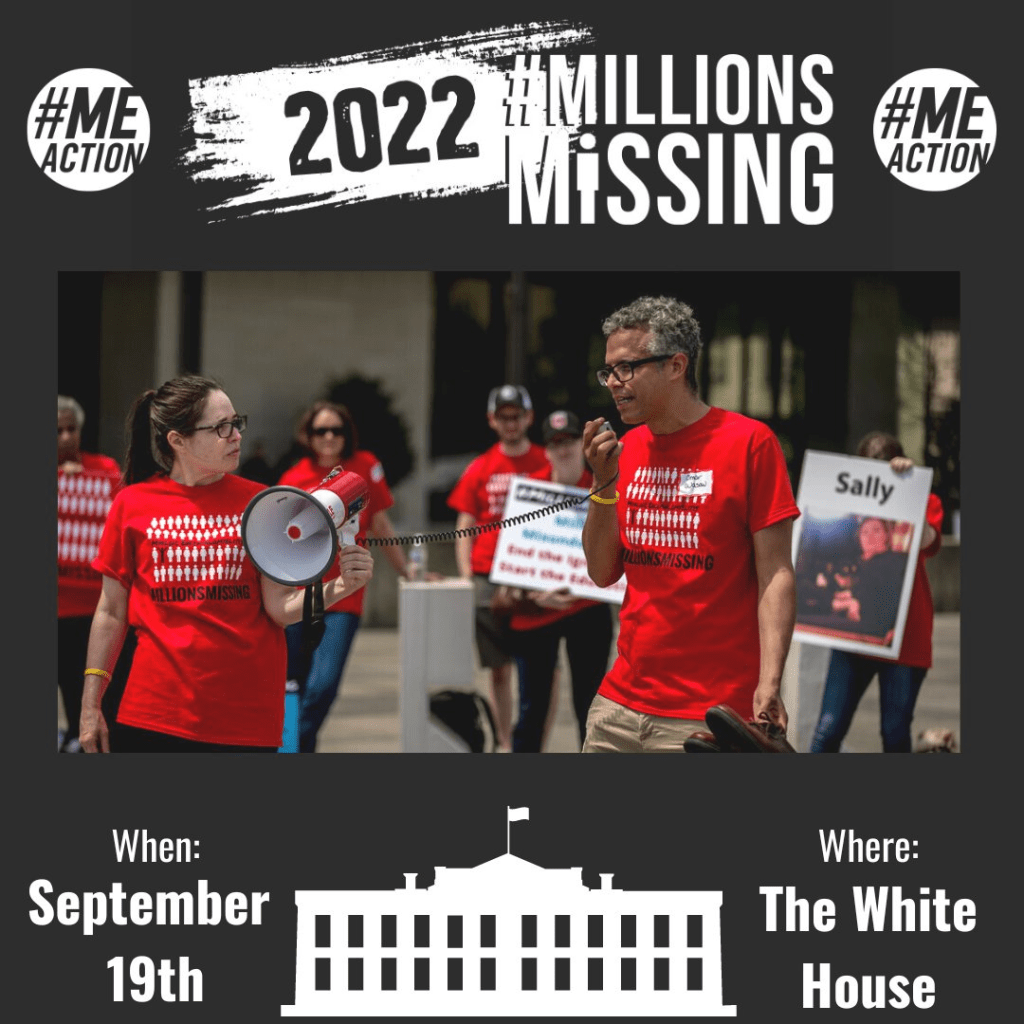
    Flyer for the Long COVID and ME/CFS-led protest, happening tomorrow at the White House. Image via ME Action.

    Tomorrow afternoon, patient-advocates living with Long COVID and other chronic diseases will be at the White House demanding that the federal government act urgently to address these conditions. ME Action, an advocacy group focused on myalgic encephalomyelitis or chronic fatigue syndrome (ME/CFS), is the leading organization behind the protest.

    The protest’s demands include nationwide education on ME/CFS and Long COVID, education specifically for doctors in diagnosing these conditions, funding for research and potential treatments, and economic support for patients.

    While the main event will take place in Washington, D.C., organizers are also encouraging people from other parts of the country to participate online. You can learn more about the event here. (I personally plan to watch and cover the protest remotely.)

    Patient advocacy around Long COVID and related conditions like ME/CFS has grown mostly remotely over the last two years, so it’s a major milestone for patient groups to converge on the White House in an event like this one. For any journalists interested in covering the protest, feel free to email or DM me for background info, connections to organizers, etc!

  • COVID source callout: Masks on public transportation

    COVID source callout: Masks on public transportation

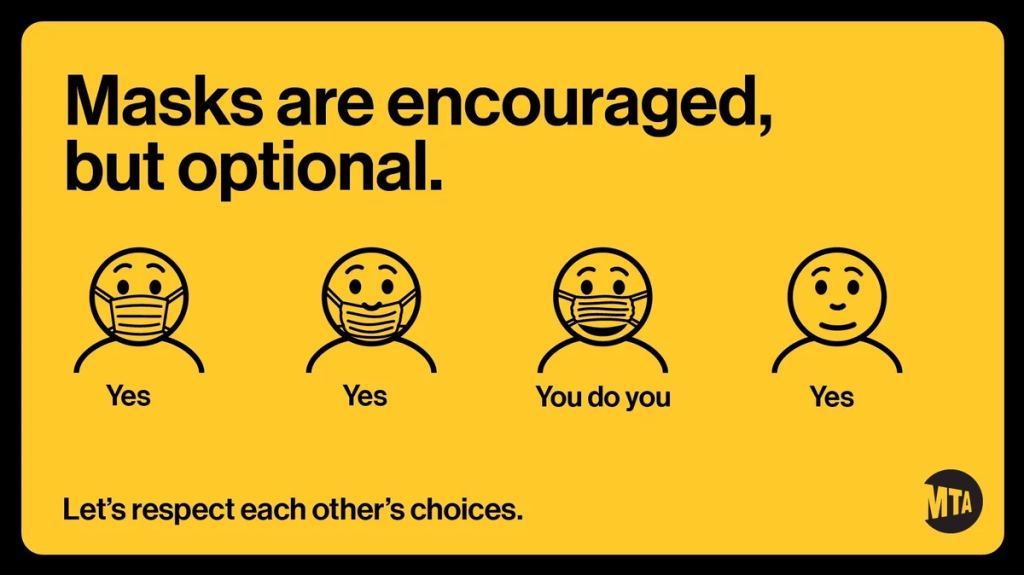
    The COVID-19 Data Dispatch does not endorse the new MTA mask guidance.

    Anyone who regularly rides the New York City subway knows that the city’s mask requirement for public transportation has been unenforced and loosely followed—especially in the months following last winter’s Omicron surge.

    But last week, even the requirement itself was struck down. New York Governor Kathy Hochul (who oversees the Metropolitan Transportation Authority, as it’s a state-controlled agency) announced that masks are now optional on trains and buses. And she introduced the policy with a new version of the MTA’s masking graphic that felt like a slap in the face to higher-risk New Yorkers who now feel unsafe using the transit system.

    NPR has a good article explaining why health experts have criticized the new graphic. Personally, I think it discourages people from thinking about how their COVID-19 safety choices impact a broader community—something that’s especially important in a dense, diverse city like NYC. Telling New Yorkers, “You do you,” when “doing you” could mean posing an immense risk to your neighbors, is a dangerous message.

    The one silver lining here is, I’ve seen a few excellent posters parodying the MTA’s new mask graphic. Here’s one of my favorites:

  • COVID source shout-out: Household Pulse Survey

    A lot of COVID-19 data sources have become decidedly less reliable since the beginning of 2022, through a combination of official case counts becoming poorer reflections of prevalence (thanks to less PCR testing) and fewer resources devoted to data tracking at public health departments from local agencies up to the CDC.

    But one federal source has remained fairly consistent: the Household Pulse Survey. This project, run by the Census in collaboration with a variety of other government agencies, started in spring 2020 as a way to track how the pandemic was impacting Americans’ daily lives. Every two weeks, government researchers randomly survey U.S. adults with questions ranging from their employment status to mental health. As of this summer, the Household Pulse Survey also includes data on Long COVID prevalence.

    For every question asked by the Household Pulse Survey, you can find results over time, by state, and for a variety of other demographics: race, ethnicity, age, gender, sexuality, etc. I appreciate that this source has continued measuring the pandemic’s impact, and I think journalists (myself included!) could be referencing it a lot more.

  • COVID source callout: Misinformation from the White House

    You might have seen this statistic from President Biden or other White House officials: “COVID deaths are down nearly 90%.” The statistic is misleading and incorrect, to the point that I’d consider it misinformation—especially right now, as the U.S. faces a largely-ignored surge.

    Let me explain where this number comes from. The White House is comparing average daily deaths from COVID-19 in recent weeks to this metric during the peak of the winter 2020-2021 surge, when Biden took office.

    On January 20, 2021, the day of Biden’s inauguration, about 3,200 people were dying from COVID-19 each day, according to CDC data. This past week, as Biden battled COVID-19, about 400 people were dying each day. The percent change between 3,200 and 400 is about 88%, or “nearly 90%.”

    But it’s misleading to just compare daily averages, as Biden has presided over several COVID-19 surges since he took office: the Delta surge last summer and fall, the first Omicron surge in the winter, and the Omicron subvariant surge this spring and summer. In fact, the number of COVID-19 deaths that occurred in the last year (July 2021 to July 2022) is pretty close to what it was in the prior year, and that’s not even accounting for thousands of excess deaths linked to the pandemic.

    While Biden’s administration has contributed to COVID-19 vaccines, treatments, testing, and other safety measures, it’s far from eliminating our collective risk from the coronavirus. Always question when you see a percent change without context!

  • COVID source callout: Failures in the U.S. monkeypox response

    This is not a direct COVID-19 callout, but I wanted to acknowledge that many of the public health failures we saw early in the COVID-19 crisis are now being repeated with monkeypox—which the WHO just declared a global health emergency.

    One major issue is a shortage of tests, leading public health experts to suggest that the true number of cases is much higher than what’s been reported. Also, while vaccines are available for monkeypox, the rollout has been inaccessible and inequitable, with very limited appointments in hotspots like NYC. ACT UP actually held a protest in the city last week to criticize local and federal officials for these issues.

    According to BuzzFeed News coverage of the ACT UP protest, their demands included: “an ‘emergency safety net fund’ for those testing positive, increased access to vaccines, language-inclusive educational resources, and adequate staffing for both vaccination sites and quarantine locations.” All of which sounds familiar!

  • COVID source callout: CDC takes weekends off

    If you went to pretty much any page on the CDC’s COVID Data Tracker this week, you might have noticed a new alert at the top of the page:

    Beginning July 4, 2022, COVID Data Tracker will discontinue daily data refreshes 7 days per week, and will instead refresh data Monday through Friday.

    In other words, the CDC is following in the footsteps of many state and local health departments across the country in taking weekends off from COVID-19 updates. This is pretty unsurprising, considering how many long weekends the agency’s COVID-19 tracking team has taken recently (see: last week’s callout post).

    Indeed, only five states are still updating their COVID-19 dashboards daily, according to the Johns Hopkins University Coronavirus Resource Center. But the CDC’s move is still disappointing, as it represents yet another step away from this national public health agency fulfilling its responsibilities to inform Americans about the pandemic.

  • COVID source callout: CDC Weekly Review

    I frequently rely on the CDC’s Weekly Review, a weekly newsletter that provides COVID-19 data updates, as a source for my own National Numbers updates. The CDC newsletter is usually posted on Friday afternoons. But this summer, the schedule has become far less regular.

    This week, for example, there has been no Weekly Review update, even though the CDC’s long weekend didn’t start until Saturday. The same thing happened over Juneteenth weekend: no report that Friday, either.

    I understand, of course, that the CDC data scientists who work on these updates deserve time off like everyone else. But these data summaries remain important for the millions of Americans relying on the CDC to track the pandemic. When the schedule of a “weekly” report becomes less regular, it demonstrates how the agency has deprioritized COVID-19.

  • COVID source callout: Dr. Fauci, please take a week off

    This past Wednesday, the NIH announced that Dr. Anthony Fauci has tested positive for COVID-19. Dr. Fauci has been leading the U.S. COVID-19 response since early days of the pandemic, and this appears to be his first time getting personal experience with the virus.

    According to the NIH, Dr. Fauci is “fully vaccinated and has been boosted twice,” and was experiencing mild symptoms as of his positive antigen test. This is great news, and I hope that his symptoms remain mild (truly mild, not just non-hospitalized mild), and he has a swift recovery.

    But then we get to a more concerning line in the press release: “Dr. Fauci will isolate and continue to work from his home.” Why is he continuing to work? By all accounts, rest is important for recovering from COVID-19 and avoiding long-term symptoms. This is especially crucial for Dr. Fauci, as someone who’s older (and therefore at higher risk).

    When top-tier government health officials work through COVID-19, they set a dangerous precedent for all the people looking to them for guidance. Anne Helen Peterson wrote about this in Culture Study recently; it’s a good read, especially for those who hold positions of power in their workplaces.

    I hope Dr. Fauci gets some rest—he would deserve a break even if he didn’t have COVID-19.