Author: Betsy Ladyzhets

  • COVID source callout: Medicaid unwinding

    The Biden administration has recently boasted that the number of Americans without health insurance hit a “record low” earlier this year. But that statement rings hollow when you consider how millions of people will lose their insurance in the coming months, thanks to the end of the federal COVID-19 emergency.

    Early in the pandemic, the federal government gave states more funding for Medicaid programs, under the condition that they kept people enrolled in insurance rather than reevaluating their eligibility every year. This change led more people to be covered under Medicaid than ever before: about 94 million in total.

    Now, however, the COVID-19 emergency has ended and states are able to reevaluate who qualifies for Medicaid, in a process called “Medicaid unwinding.” Every state has a different evaluation process, many of them involving a lot of bureaucratic hassle (waiting for paperwork in the mail, finding the right forms to fill out online, enrolling in different health insurance if you no longer qualify for Medicaid, etc.).

    The Centers for Medicare & Medicaid Services (CMS) released new data this week about people losing access to Medicaid. About 700,000 people lost their health insurance in April 2023 alone, CMS reports. That accounts for just 18 states that had started their reevaluation process in April; experts estimate that millions more will lose coverage in the coming months.

    Losing health insurance during the ongoing pandemic means losing access to COVID-19 tests, vaccines, treatments, and care for Long COVID, not to mention all the routine health services that people need. Doesn’t really seem like something the Biden administration should be bragging about.
  • Sources and updates, August 6

    • Novavax vaccine safety: This week, the CDC published new data in its Morbidity and Mortality Weekly Report (MMWR) affirming the safety of Novavax’s COVID-19 vaccine. Unlike the Pfizer and Moderna vaccines (which use the virus’ genetic information), the Novavax vaccine works by inserting direct copies of the coronavirus spike protein into the body. It was authorized in summer 2022 as a primary series or booster for people who may be unable or unwilling to receive an mRNA vaccine. The CDC found that, among 70,000 Novavax vaccine doses administered between July 2022 and March 2023, no new safety concerns emerged.
    • Insurance coverage for COVID-19 tests: Insurance companies have covered COVID-19 tests very unevenly since the federal health emergency ended this spring. But that could change, if an advisory panel called the U.S. Preventive Services Task Force recommends that the federal government require insurers to cover COVID-19 testing. The panel is exploring this option, reports Sarah Owermohle at STAT News, though it could face legal challenges.
    • Breath test for COVID-19: A couple of weeks ago, I shared a new tool for detecting SARS-CoV-2 particles in the air, developed by researchers at Washington University in St. Louis. The same team has just published another paper, in ACS Sensors, about a similar tool that can diagnose a coronavirus infection using a patient’s breath. This breath test can detect the virus with as few as two breaths and in under 60 seconds, and is close in accuracy to a PCR test. The research team is working to continue testing this device and potentially manufacture it more broadly, according to a press release.
    • COVID-19 spread among white-tailed deer: A recent paper in Nature Communications describes how SARS-CoV-2 has circulated widely among white-tailed deer across the U.S. The research team (which includes scienitsts at the CDC, U.S. Department of Agriculture, and the University of Missouri) collected about 9,000 respiratory samples from deer in 26 states and Washington D.C. between fall 2021 and spring 2022. Hundreds of the samples were positive for SARS-CoV-2, leading the team to study genetic sequences and study how the virus had evolved in this population. The team’s full data are available online. (H/t Data Is Plural.)

  • This summer, COVID-19 safety is more individualized than ever

    This summer, COVID-19 safety is more individualized than ever

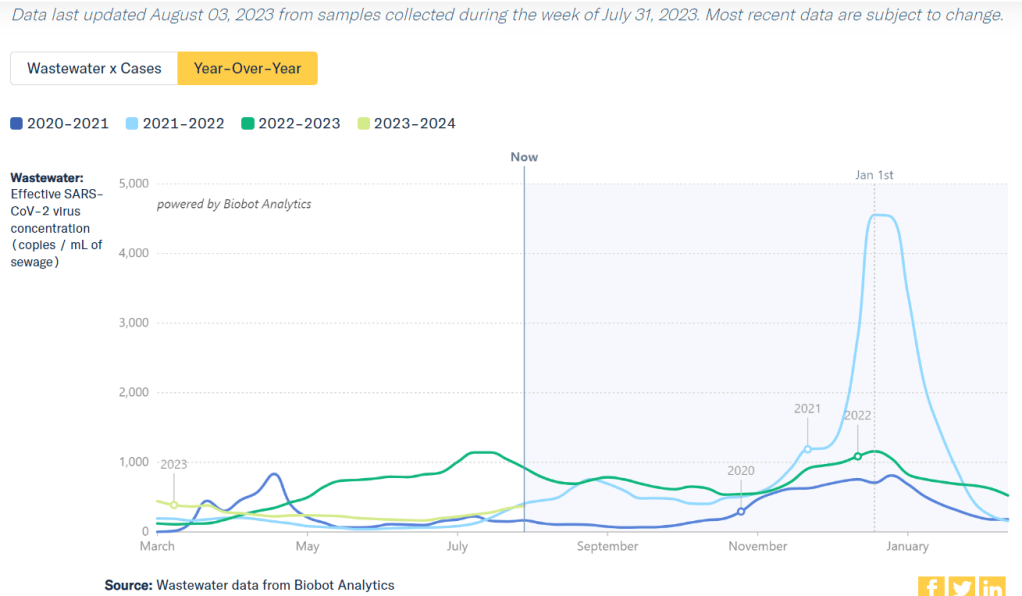
    Current coronavirus levels in wastewater are close to the summer 2021 Delta surge, according to Biobot.

    COVID-19 metrics have been on the rise in the U.S. for about a month now, indicating that we’re experiencing a summer surge. This is pretty unsurprising for many public health experts, as the country has experienced increased transmission during the last three summers.

    Unlike past years, though, this summer’s surge comes after the end of the federal public health emergency. We now have less data than ever to follow COVID-19 trends, combined with less access to health measures than ever.

    We’re also dealing with continued minimization of the problem. Coverage of the current surge in mainstream media sources tends to downplay any concerns, suggesting that hospitalizations are low (even though those data are delayed), or that masking isn’t necessary (even though this tool works best as a preventative measure), or that all infections are now mild (even though Long COVID remains a risk for any case). The People’s CDC offers more critique here.

    Despite these challenges, enough information is out there that anyone committed to safety can keep up with COVID-19 news and protect themselves. Unfortunately, this practice now requires much more individual effort—a far cry from the collective measures that we took back in 2020. But we still have opportunities to show leadership, by sharing information and resources with our communities.

    Here are a few things I’m doing in the current surge, and recommendations to consider sharing:

    • Assume all data are delayed and undercounted. COVID-19 data sources are sparser than ever, so the trends we see are likely to be small reflections of larger issues. Biobot’s wastewater dashboard, for example, provides results from a sample of sewersheds across the U.S.; the same increases are likely happening in places where we aren’t tracking them.
    • Watch your local wastewater numbers. Despite the uneven coverage of wastewater surveillance, this is still the best tool for advanced warnings on COVID-19 now that case data are no longer available. If your city or county doesn’t have a wastewater testing site, you can likely find a nearby one to follow for trends. See the CDD’s resource page for links to dashboards.
    • Stock up on high-quality masks. N95s and KN95s are really necessary to protect yourself from the ever-evolving Omicron variants. There are a lot of places to buy these online; Project N95 is my personal favorite, as you can get masks directly from their manufacturers and contribute to mask donations for less-resourced communities.
    • Consider a higher-value respirator for riskier activities. If you’re traveling or going to a higher-risk event this summer, a reusable respirator might be helpful. I wrote more about why I bought one in this post last summer.
    • Stock up on rapid tests. Most health insurance plans no longer cover these (following the end of the federal health emergency), but some local governments are still giving them out for free in public spaces, like libraries in NYC. You might also buy tests in bulk online. I personally use iHealth Labs, because they sell packs of five tests that are easy to bring while traveling and frequently run sales.
    • Make a plan for isolation/quarantine. In case you or a member of your household gets sick, it can be helpful to have an advance plan on where you might isolate, how to keep air clean in shared spaces, where to get Paxlovid, etc. Your Local Epidemiologist has more tips on how to deal with a positive test.
    • Share information and resources. Surveys have suggested that many Americans would mask and take other public health measures during surges, but those people might not know about the current rise in transmission. Sharing information with your community (along with masks, rapid tests, and other tools, if you have surplus) can help broaden safety measures.
    • Remember why you’re taking precautions. During increased social pressures against COVID-19 safety, I personally find it helpful to remember why I find these behaviors important. Some reasons are selfish (for example, taking a week or two off work would be difficult) while others are more philosophical (such as a dedication to the principles of broader public health)—but all of them are valuable.

    If you have questions or additional suggestions, please share them below.

  • National numbers, August 6

    National numbers, August 6

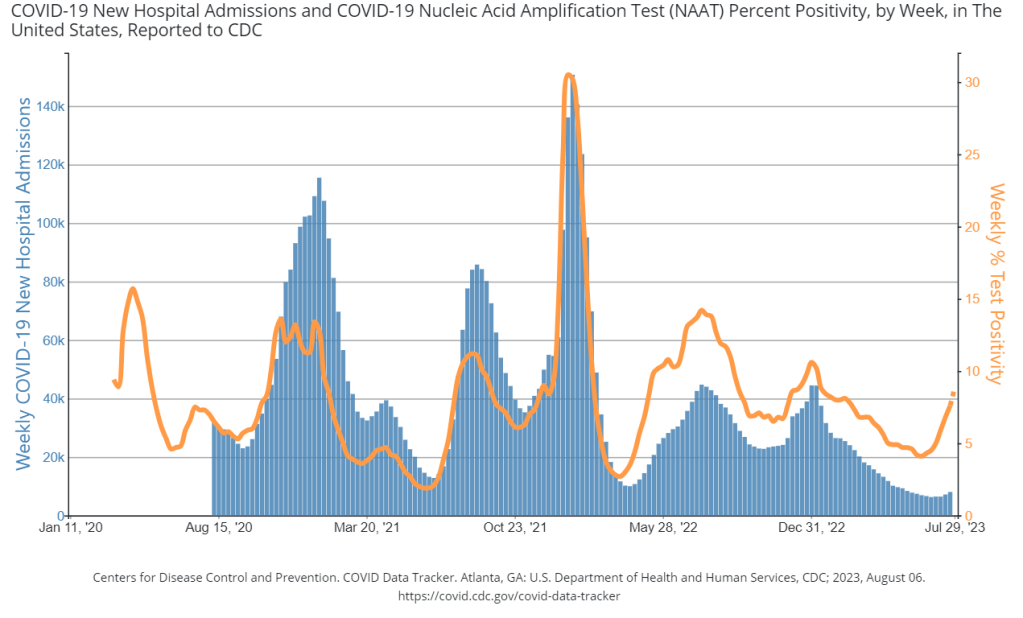
    Test positivity is way up in the U.S., while hospitalizations are starting to follow this trend. Chart via the CDC.

    During the most recent week of data available (July 16 through 22), the U.S. reported about 8,000 new COVID-19 patients admitted to hospitals, according to the CDC. This amounts to:

    • An average of 1,150 new admissions each day
    • 2.4 total admissions for every 100,000 Americans
    • 12% more new admissions than the prior week (July 9-15)

    Additionally, the U.S. reported:

    • 8.9% of tests in the CDC’s surveillance network came back positive
    • A 10% higher concentration of SARS-CoV-2 in wastewater than last week (as of August 2, per Biobot’s dashboard)
    • 31% of new cases are caused by Omicron XBB.1.6; 17% by EG.5; 11% by XBB.2.3; 10% by XBB.1.9 (as of August 5)

    Over the last few weeks, the signals of a summer COVID-19 surge in the U.S. have grown steadily clearer. Viral levels in wastewater, test positivity, and hospitalizations are all climbing across the country.

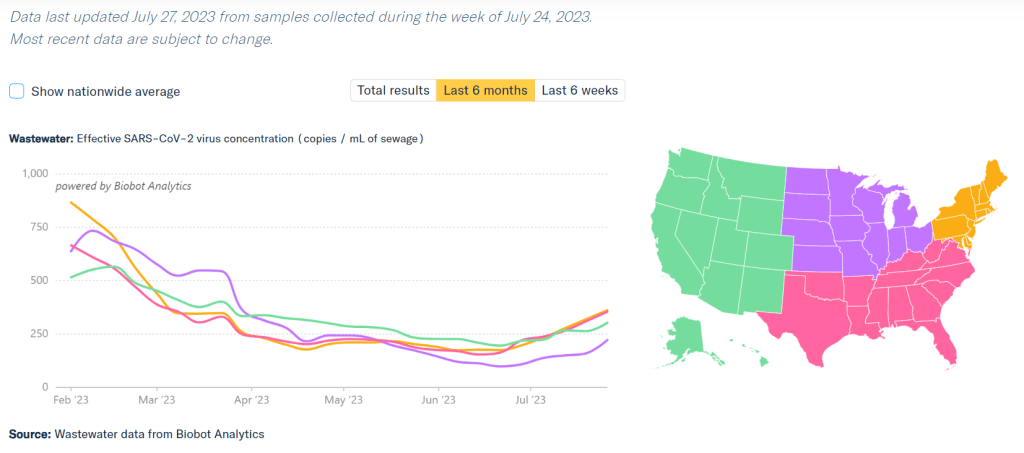
    Wastewater surveillance data from Biobot suggest that coronavirus levels have doubled nationally in the last month. The surge is impacting all major regions of the country; the Northeast and South saw earlier increases, but the Midwest and West Coast are now catching up.

    The CDC’s wastewater surveillance network also points to increasing COVID-19 spread, with sites across the country reporting higher viral levels. While wastewater surveillance remains uneven (some states are testing in every county, others in just a handful of locations), it still gives us enough information to identify a widespread surge.

    Test positivity from the CDC’s lab testing network shows continued increases as well. About 8.9% of COVID-19 tests reported to the agency returned positive results in the week ending July 29, compared to 4.5% in the week ending June 24. This increase, too, is consistent across regions.

    Hospitalizations for COVID-19 are also going up, according to the CDC. These data are significantly delayed, with the most recent numbers dating to about two weeks ago. So, while overall patient numbers remain low right now, I expect they will continue to rise as the surge goes on.

    The coronavirus’ continued evolution is likely playing a role in this summer’s increased spread, as are summer travel and waning immunity from past vaccinations. Omicron EG.5, a descendant of the XBB.1.9 lineage, is the latest variant to spread widely, according to the CDC’s estimates.

    No one version of XBB has yet shown a significant ability to spread much faster or cause more severe symptoms than other variants. Rather, many iterations of this Omicron lineage are spreading in tandem, continuing to mutate with every infection. And with fewer PCR tests happening, it’s harder for health agencies to keep track.

    This summer’s surge may be less visible than ever. But wastewater data suggest we’re seeing similar levels of COVID-19 spread as we saw with Delta in summer 2021. Precautions are still important!

  • COVID source shout-out: Ed Yong’s Long COVID coverage

    Ed Yong, a widely-admired science journalist, recently announced that he’s leaving his position at The Atlantic after eight years at the publication. He also published the latest in a series of articles explaining the challenges of Long COVID, a subject that he’s become well-known for covering.

    I have been a big fan of Yong’s for a long time; reading his work when I was in college was one of my inspirations for getting into science writing. But his COVID-19 coverage has been especially informative and inspirational. In particular, he was one of the first journalists to write about Long COVID back in 2020 and has remained a leading writer on the topic since then. His work has brought wider recognition to the long-haulers seeking research and support.

    His latest story, like his others, is a master class in weaving together patient experiences and scientific insights. It covers fatigue and post-exertional malaise, two of the most common—and most debilitating—symptoms of Long COVID and myalgic encephalomyelitis/chronic fatigue syndrome (ME/CFS). As people with those conditions have shared the article on social media, I’ve seen many say that it offers poignant descriptions of these symptoms and insightful understanding of their experiences.

    If you haven’t read this article yet, please check it out. (Feel free to email me if you have a hard time accessing it through the paywall.) And I think I can speak for many readers here when I express gratitude for Ed Yong’s COVID-19 work over the last three years, and excitement for what he’ll do next!  

  • Sources and updates, July 30

    • New papers show wastewater’s predictive value: This week, I noted three recently-published papers that all demonstrate wastewater surveillance’s value for flagging changes in COVID-19 trends before other metrics, such as hospitalizations. One paper, in Nature, found that wastewater trends preempted hospitalization trends by one to four weeks, in 150 U.S. counties. Another paper, in JAMA Network Open, found that wastewater trends tracked with case trends in 268 U.S. counties from January through September 2022; however, the correlation became weaker with reduced clinical testing over time. And a third paper, in PNAS, shares an algorithm that can flag community-level COVID-19 surges before they show up in other metrics, using data from North Carolina’s wastewater surveillance.
    • Long COVID’s impact on employment: The Urban Institute, a think tank focused on economic and social policy research, published a report exploring employment challenges and related hardships among people with Long COVID. The researchers (a group that included Lisa McCorkell from the Patient-Led Research Collaborative) analyzed results from Long COVID questions included in an Urban Institute survey, conducted among more than 7,500 American adults across the country in December 2022. Among the findings: 10% of adults with Long COVID stopped working for a period due to their symptoms while another 5% reduced their work hours; 24% limited activities outside of work; 42% reported food insecurity in the last year; 20% reported difficulty paying their rent or mortgage.
    • Characterizing potential Long COVID phenotypes: Another Long COVID study from this week, published in The Lancet: a research consortium including several medical centers across Europe tracked patients over time, seeking to better understand different subtypes of the condition. The study included about 1,000 people with at least one Long COVID symptom, tracked over one year from their initial COVID-19 diagnosis. Researchers found four potential subtypes: one similar to ME/CFS (including fatigue and cognitive symptoms), one with respiratory symptoms, one with chronic pain, and one with changes to taste and smell. The researchers also noted some patient characteristics and aspects of acute illness that may contribute to increased risk of different subtypes.
    • Outdoor transmission at a night market: One more notable new paper: researchers at local health agencies in China’s Zhejiang province reported on coronavirus transmission at an outdoor night market, in Frontiers in Public Health. In one day at the night market, three infected visitors led to 131 secondary cases, the researchers found. Based on samples from both people at the market and surfaces, the researchers estimated that particles of an Omicron BA.5 strain could linger for over an hour and still be contagious. The study suggests that, even in outdoor settings, transmission is still possible when other precautions aren’t taken.
    • Acute Hospital at Home data: The Data Liberation Project, which collects and shares data from public records requests, recently published a dataset from a COVID-era program by the Centers for Medicare and Medicaid Services (CMS) which allowed hospitals to treat patients in their homes. Early this year, the project filed a FOIA request for data indicating which hospitals applied to participate in the program and how their patients fared. CMS completed the request in June, and DLP is working to process and understand the resulting data. If you’re interested in using the data, you can check out the documentation and sign up for updates.
    • Diagnosis challenges with alpha-gal syndrome: Finally, a bit of non-COVID public health news: the CDC recently released some data showing challenges with diagnosing alpha-gal syndrome—a disease transmitted by tick bites that leads to new allergies—despite recent increases in its spread. The CDC estimates that up to 450,000 people in the U.S. may have been impacted by this disease, potentially developing new allergies to meat and other animal products. Yet in one CDC study, the majority of health providers surveyed were not confident in their ability to diagnose the syndrome. This trend reflects similar challenges for other chronic diseases that might be new or unfamiliar to providers, such as Long COVID.

  • New resource site for science journalists, communicators

    New resource site for science journalists, communicators

    Screenshot of the CASW Connector homepage.

    For the last few months, I’ve been working with the Council for the Advancement of Science Writing (CASW) on a new resource website for science journalists and communicators. The site launched this past week, and I’m sharing it here because I think it might be useful for a lot of COVID-19 Data Dispatch readers.

    Here’s a bit of info about the new website:

    CASW Connector is a curated library of resources on science journalism and communication, including articles, guides, training programs, conferences, fellowships, career advice, and more.

    The site aims to bring together resources from organizations, centers, and disciplines from around the internet that all serve the same goal: promoting excellence in communication about science to the public.

    CASW Connector is for journalists, scientists, communicators, educators, students, and anyone interested in sharing science with the public. You can search or browse resources handpicked by our team and suggested by our readers, and you can keep tabs on upcoming events and deadlines. You can even submit your own suggestions of events and resources you would like us to include.

    Later this summer, CASW Connector will launch a newsletter featuring short articles, announcements and updates; subscribe now to receive the first issues. And later this year we’ll launch a webinar series that is, like Connector itself, devoted to excellence in science writing and communication.

    We hope you’ll check Connector out, and share it with friends and colleagues! We welcome any feedback or suggestions you may have; drop us a line at connector@casw.org to tell us what you think!

  • National numbers, July 30

    National numbers, July 30

    COVID-19 is spreading more in all regions of the country, according to Biobot’s data. Data as of July 27, based on samples collected the week of July 24.

    During the most recent week of data available (July 9 through 15), the U.S. reported about 7,100 new COVID-19 patients admitted to hospitals, according to the CDC. This amounts to:

    • An average of 1,000 new admissions each day
    • 2.2 total admissions for every 100,000 Americans
    • 10% more new admissions than the prior week (July 2-8)

      Additionally, the U.S. reported:

    • 7.6% of tests in the CDC’s surveillance network came back positive
    • A 17% higher concentration of SARS-CoV-2 in wastewater than last week (as of July 26, per Biobot’s dashboard)
    • 24% of new cases are caused by Omicron XBB.1.6; 19% by XBB.1.9; 13% by XBB.2.3 (as of July 22)

    Several major metrics continue to point to a summer increase in COVID-19 spread. Coronavirus levels in wastewater are up in all major regions, as is test positivity from the CDC’s network. Hospitalizations have started ticking up as well.

    Nationally, coronavirus levels in wastewater have doubled in the last month, according to Biobot Analytics. Viral levels are on par with this period in summer 2021, at the start of that year’s Delta surge, and are the highest they’ve been since this year’s holiday surge concluded.

    Data from the WastewaterSCAN network similarly shows COVID-19 upticks in the last month, though the team’s latest national update notes that current levels are still low compared to the start of 2023. WastewaterSCAN recently added national wastewater levels to its dashboard, making it easier to track broad trends from this sewage testing network.

    Test positivity data from the CDC’s respiratory lab network are still increasing as well. National test positivity was 7.6% in the week ending July 22, compared to 4.5% about a month ago, an increase of about 70%.

    The CDC’s hospitalization data are also showing an increase now: new COVID-19 patients admitted to hospitals went up by about 10% from the week ending July 8 to the week ending July 15. These are the most recent hospitalization numbers available, as the CDC is still reporting this metric with a delay.

    Wastewater and positivity data suggest that COVID-19 spread is increasing in all major regions of the country. All regions are also dealing with the virus’ continued evolution, as a variety of XBB lineages circulate and compete with each other.

    Several national publications reported on these COVID-19 increases in the last week, pointing to the potential for a summer surge. I personally liked this article from Dylan Scott at Vox, which also covers implications for COVID-19 this winter.

    But the COVID-19 Data Dispatch was on this potential surge weeks before any mainstream media news site. If you appreciate our early warnings, please donate to support this work!

  • COVID source callout: NYT continues to push misleading information

    Longtime readers may remember that I am no fan of “The Morning,” a daily newsletter from the New York Times that has frequently downplayed COVID-19 in recent years. Last summer, for example, I called out the newsletter for misleading reporting about who was dying most from COVID-19.

    Well, this week, the newsletter’s primary author, David Leonhardt, has done it again. Leonhardt wrote on Monday that “the pandemic really is over.” As evidence, he pointed to excess deaths (i.e. deaths above expected norms from past years), writing that this metric has returned to a pre-COVID-19 baseline.

    It is true that excess deaths have been low since early 2023, when the country’s holiday COVID-19 surge concluded. And sure, this is good news about COVID-19’s current impact on mortality. You can see the CDC’s estimates here. However, Leonhardt’s newsletter fails to mention several caveats:

    • If the pandemic were truly “over,” excess deaths would actually be below historical averages, not at them, to reflect people who had died prematurely of COVID-19 in the last three years. (Health law scholar Blake Murdoch pointed this out on Twitter.)
    • Current death data are seriously undercounting COVID-19 deaths, thanks to the now-very-limited availability of COVID-19 tests combined with limited surveillance following the end of the federal public health emergency. The CDC revises up its estimates every week.
    • Excess death data, in general, are typically considered preliminary estimates for about a year. So, the data Leonhardt sites are preliminary and likely to be revised up once the CDC compiles more information from death certificates.
    • The pandemic has disproportionately impacted people of color and other vulnerable groups. Analysis from APM Research Lab shows that this pattern has continued through the first half of 2023.
    • Plenty of other metrics (including wastewater surveillance, hospitalizations, and the virus’ continued evolution) suggest that COVID-19 is still circulating and still making people sick. The U.S. is likely heading into a summer surge right now, in fact.
    • Leonhardt fails to mention Long COVID, one of the most dire outcomes of COVID-19. Even though millions of people are still dealing with prolonged symptoms.

    So, for whom is the pandemic really “over”?  It might be over for Leonhardt himself, but it’s not over for people with Long COVID, people still mourning lost loved ones, high-risk people still taking every precaution, people who will get infected this summer, and so many more. All of these people challenge the NYT’s misleading narrative.

  • Sources and updates, July 23

    • Grants to help with global pandemic preparedness: This week, the World Bank’s Pandemic Fund announced the recipients of its first round of grants. The fund is a finance initiative to “strengthen pandemic prevention, preparedness, and response capacities,” particularly for low- and middle-income countries. Its first round of grants will go to 37 countries across 6 global regions, distributing $338 million in funding. The full list of awards is available on the World Bank’s website.
    • Genetic marker of asymptomatic COVID-19: A new paper published in Nature this week reports on a common genetic marker that may lead people to have symptom-free COVID-19 cases. The researchers (a team from the University of California San Francisco and other institutions) searched for genetic patterns among 30,000 people who shared their COVID-19 symptom information through a smartphone app. They found a correlation between asymptomatic infection and a specific version of a gene related to T cells. As Eric Topol notes in his newsletter, this study follows two others that examined genetic markers of Long COVID.
    • Quantifying cognitive symptoms of Long COVID: Speaking of Long COVID: researchers at Kings College London studied the condition’s cognitive symptoms (also called brain fog) by measuring patients’ performance in different mental tasks. The study included over 3,000 participants, more than half of whom completed two rounds of testing over two years. Overall, the researchers found that cognitive symptoms persisted for nearly two years after patients’ initial infections, and most severe for patients with the longest-lasting Long COVID impacts. For these patients, “the effect of COVID-19 on test accuracy was comparable in size to the effect of a 10-year increase in age,” per a press release by Kings College London.
    • Long COVID is common in children: Another Long COVID study published this week: researchers at a hospital in Toronto compiled a review paper examining the condition’s prevalence among children. Their review included 30 studies including about 15,000 total pediatric patients. Across all the studies, researchers reported that about 16% of children experienced at least one Long COVID symptom three or more months after their COVID-19 infections. However, compiling these data was a challenging task because different studies used different definitions of Long COVID, different methods of following up with patients over time, and other inconsistencies, the authors wrote.
    • Dogs detecting COVID-19 through scent: One more paper that stuck out to me this week: a pair of researchers (one at the University of California, Santa Barbara and one at a biotech company focused on sniffing for COVID-19) examined how well dogs can detect the coronavirus. This was also a review paper, including 29 studies and 31,000 COVID-19 test samples. Overall, the dogs performed with similar accuracy to PCR tests, researchers found. “We believe that scent dogs deserve their place as a serious diagnostic methodology that could be particularly useful during pandemics,” one of the authors said in a statement.
    • Monoclonal antibody to protect babies from RSV: Finally, a bit of good news for combatting another common respiratory virus: the FDA has approved a new monoclonal antibody treatment to protect infants and young children against RSV. The therapy is likely to be recommended by the CDC and manufactured in time for respiratory virus season this fall. In clinical trials, it lowered the risk of an RSV infection requiring medical care by about 76%—which is a big deal for a disease that leads to more babies in hospitals than any other in the U.S., reports Helen Branswell at STAT.