The CDC’s isolation guidance is not based on data

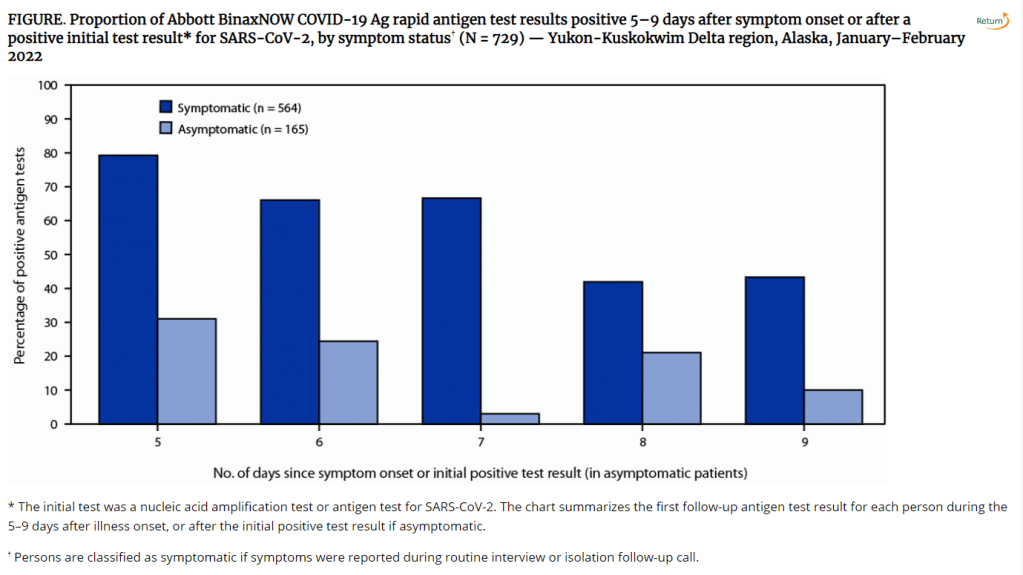
A study published in the CDC’s own journal indicated that about half of people infected with Omicron are still contagious 5-10 days after their isolation period starts. Chart via CDC MMWR.

Maybe it’s because I’m a twenty-something living in the Northeast, but: quite a few of my friends have gotten COVID-19 in the last couple of weeks. The number of messages and social media posts I’m seeing about positive rapid tests isn’t at the level it was during the Omicron surge, but it’s notable enough to inspire today’s review of the CDC’s isolation guidance.

Remember how, in December, the CDC changed its recommendations for people who’d tested positive for COVID-19 to isolating for only five days instead of ten? And a bunch of experts were like, “Wait a second, I’m not sure if that’s sound science?” Well, studies since this guidance was changed have shown that, actually, a lot of people with COVID-19 are still contagious after five days. Yet the CDC has not revised its guidance at all.

(Also, to make sure we’re clear on the terms: isolation means avoiding all other human beings because you know that you have a contagious disease and don’t want to infect others. Quarantine means avoiding other humans because you might have the disease, due to close contact with someone who does or another reason for suspicion.)

The current CDC guidance still says that, if you test positive: “Stay home for 5 days and isolate from others in your home.” Yet, in recent weeks, I’ve had a couple of friends ask me: “Hey, so it’s been five days, but… I’m not sure I’m ready to rejoin society. Should I take a rapid test or something?”

Yes. The answer is yes. Let’s unpack this.

Studies indicating contagiousness after five days

As this NPR article on isolating with Omicron points out, the CDC guidance was “largely based on data from prior variants.” At the time of this five-day recommendation, in late December, scientists were still learning about how Omicron compared to Delta, Alpha, and so on, particularly examining the mechanisms for its faster spread and lower severity.

But now, almost four months later, we know more about Omicron. This version of the coronavirus, research suggests, is more capable of multiplying in the upper respiratory tract than other variants. People infected with Omicron are able to spread the virus within a shorter time compared to past strains, and they are able to spread it for a higher number of days—even if their symptoms are mild.

One study that demonstrates this pattern is a preprint describing Omicron infections among National Basketball Association (NBA) players, compared to cases earlier in 2021. Researchers at Harvard’s and Yale’s public health schools, along with other collaborators, compared 97 Omicron cases to 107 Delta cases. NBA players are a great study subject for this type of research, because their association mandates frequent testing (including multiple tests over the course of a player’s infection).

The big finding: five days after their Omicron infections started, about half of the basketball players were still testing positive with a PCR test—and showing significant viral load, indicating contagiousness. 25% were still contagious on day six, and 13% were still contagious on day seven. These patients also saw less of a consistent pattern in the time it took to reach their peak contagiousness than the players infected with Delta.

From the NPR article:

“For some people with omicron, it happens very, very fast. They turn positive and then they hit their peak very quickly. For others, it takes many days” – up to eight or even 10 days after turning positive, says the study’s senior author, Dr. Yonatan Grad, an associate professor of immunology and infectious diseases at the Harvard T.H. Chan School of Public Health.

While this NBA study is a preprint, other research has backed up its findings. One study from Japan, shared as a “preliminary report” in January, found that people infected with Omicron had the highest levels of viral RNA—indicating their highest levels of contagiousness—between three and six days after their symptoms started. The researchers saw a “marked decrease” in viral RNA only after ten days.

Another preprint, from researchers at the University of Chicago (and antigen test proponent Michael Mina), examined Omicron infections among healthcare workers at the university medical center. Out of 309 rapid antigen tests performed on 260 healthcare workers, 134 (or about 43%) were positive results received five to ten days after these workers started experiencing symptoms.

The highest test positivity rate for these workers, according to the study, was “among HCW returning for their first test on day 6 (58%).” In other words, more than half of the workers were still infectious six days after their infection began, even though the CDC guidance would’ve allowed them to return to work.

Later in February, a study in the CDC’s Morbidity and Mortality Weekly Report (MMWR)—or, the CDC’s own journal—shared similar results. The report, authored by CDC researchers and practitioners at a healthcare system in rural Alaska, looked at antigen test results from hundreds of infections reported to this health system during the Omicron wave.

The main finding: between five and nine days after patients were diagnosed with COVID-19, 54% (396 out of 729 patients) tested positive on rapid antigen tests. “Antigen tests might be a useful tool to guide recommendations for isolation after SARS-CoV-2 infection,” the authors wrote.

Following this, an early March preprint from researchers at Massachusetts General Hospital, MIT, Harvard, and other collaborators analyzed infections among 56 people during the Delta and Omicron waves. This study used viral cultures to examine contagiousness directly, rather than simply looking at test results.

Like past research, this study found that over half of patients (with both Omicron and Delta) were still contagious five days into their infections. About one-fourth were still contagious at day eight.

Guidance for people testing positive

All of the above studies suggest similar conclusions: about half of people infected with Omicron will still be contagious five days after their positive test results or the start of their symptoms, despite what the CDC’s guidance says. If you get infected with BA.2 in the coming surge, the best way to figure out whether you’re contagious after day five is by taking a rapid antigen test.

In fact, for the highest accuracy (and peace of mind), I’d recommend taking two antigen tests, two days in a row. If both are negative, then you’re probably good to return to society—but maybe don’t travel to visit an elderly relative just yet.

This two-rapid-test guidance comes from the U.K. Health Security Agency, which recommended in December that Brits could isolate for seven days instead of ten if they tested negative on days six and seven of their isolation. (The U.K.’s guidance has since become more lenient, but this is still a good rule for reference—more based in science than the CDC’s guidance.)

What else should you do if you test positive? Here are a few recommendations that I’ve been giving friends and family:

  • Be prepared to isolate for a week or two, even if you may be able to leave isolation after a shorter period (with rapid tests).
  • After leaving isolation, wear a good mask (i.e. an N95 or KN95) in all public spaces.
  • Look into treatment options near you. The HHS has a database of publicly available COVID-19 therapeutics, while some localities (like New York City) have set up free delivery systems for these drugs.
  • There’s also the HHS Test to Treat program, which allows people to get tested for COVID-19 and receive treatment in one pharmacy visit. This program has faced a pretty uneven rollout so far, though.
  • Rest as much as possible, even if you have mild symptoms; patient advocates and researchers say that this reduces risk for developing Long COVID.

More testing data

Comments

54 responses to “The CDC’s isolation guidance is not based on data”

  1. […] without a mask on the 10th day after my symptoms started. But I learned from Mina that you can still be contagious after 10 days. So how do I know if I can still infect […]

    Like

  2. […] without a mask on the 10th day after my symptoms started. But I learned from Mina that you can still be contagious after 10 days. So how do I know if I can still infect […]

    Like

  3. What experts told me to do after my positive COVID-19 at-home test - The Exquisite Post Avatar

    […] world without a mask on the tenth day after my symptoms began. But I learned from Mina that you can remain contagious after 10 days. So how do I know if I can still infect […]

    Like

  4. […] world with no masks on the tenth day after my signs began. But I discovered from Mina that you may nonetheless be contagious after 10 days. So how do I do know if I can nonetheless infect […]

    Like

  5. […] without a mask on the 10th day after my symptoms started. But I learned from Mina that you can still be contagious after 10 days. So how do I know if I can still infect […]

    Like

  6. What experts told me to do after my positive COVID-19 at-home test » The Shastra Phoenixbioinfosys Avatar

    […] without a mask on the 10th day after my symptoms started. But I learned from Mina that you can still be contagious after 10 days. So how do I know if I can still infect […]

    Like

  7. […] without a mask on the 10th day after my symptoms started. But I learned from Mina that you can still be contagious after 10 days. So how do I know if I can still infect […]

    Like

  8. […] without a mask on the 10th day after my symptoms started. But I learned from Mina that you can still be contagious after 10 days. So how do I know if I can still infect […]

    Like

  9. […] without a mask on the 10th day after my symptoms started. But I learned from Mina that you can still be contagious after 10 days. So how do I know if I can still infect […]

    Like

  10. […] without a mask on the 10th day after my symptoms started. But I learned from Mina that you can still be contagious after 10 days. So how do I know if I can still infect […]

    Like

  11. […] without a mask on the 10th day after my symptoms started. But I learned from Mina that you can still be contagious after 10 days. So how do I know if I can still infect […]

    Like

  12. […] without a mask on the 10th day after my symptoms started. But I learned from Mina that you can still be contagious after 10 days. So how do I know if I can still infect […]

    Like

  13. […] with out a masks on the tenth day after my signs began. However I realized from Mina that you could nonetheless be contagious after 10 days. So how do I do know if I can nonetheless infect […]

    Like

  14. […] without a mask on the 10th day after my symptoms started. But I learned from Mina that you can still be contagious after 10 days. So how do I know if I can still infect […]

    Like

  15. […] without a mask on the 10th day after my symptoms started. But I learned from Mina that you can still be contagious after 10 days. So how do I know if I can still infect […]

    Like

  16. […] without a mask on the 10th day after my symptoms started. But I learned from Mina that you can still be contagious after 10 days. So how do I know if I can still infect […]

    Like

  17. […] without a mask on the 10th day after my symptoms started. But I learned from Mina that you can still be contagious after 10 days. So how do I know if I can still infect […]

    Like

  18. […] the tenth next day of my signs and symptoms began. However I learned from Mina that you could be contagious after ten days. So how do you determine if I’m able to still infect […]

    Like

  19. […] without a mask on the 10th day after my symptoms started. But I learned from Mina that you can still be contagious after 10 days. So how do I know if I can still infect others? Turns out it’s a complicated […]

    Like

  20. […] without a mask on the 10th day after my symptoms started. But I learned from Mina that you can still be contagious after 10 days. So how do I know if I can still infect […]

    Like

  21. […] without a mask on the 10th day after my symptoms started. But I learned from Mina that you can still be contagious after 10 days. So how do I know if I can still infect […]

    Like

  22. What experts told me to do after my positive COVID-19 at-home test – Science News Magazine – Auto Robot Demo Avatar

    […] without a mask on the 10th day after my symptoms started. But I learned from Mina that you can still be contagious after 10 days. So how do I know if I can still infect others? Turns out it’s a complicated […]

    Like

  23. […] without a mask on the 10th day after my symptoms started. But I learned from Mina that you can still be contagious after 10 days. So how do I know if I can still infect […]

    Like

  24. […] without a mask on the 10th day after my symptoms started. But I learned from Mina that you can still be contagious after 10 days. So how do I know if I can still infect others? Turns out it’s a complicated […]

    Like

  25. […] without a mask on the 10th day after my symptoms started. But I learned from Mina that you can still be contagious after 10 days. So how do I know if I can still infect […]

    Like

  26. […] at the tenth day after my signs began. However I discovered from Mina that you’ll be able to still be contagious after 10 days. So how do I do know if I will be able to nonetheless infect […]

    Like

  27. […] without a mask on the 10th day after my symptoms started. But I learned from Mina that you can still be contagious after 10 days. So how do I know if I can still infect […]

    Like

  28. […] without a mask on the 10th day after my symptoms started. But I learned from Mina that you can still be contagious after 10 days. So how do I know if I can still infect […]

    Like

  29. […] masque le 10e jour après le début de mes symptômes. Mais j’ai appris de Mina que tu peux être encore contagieux après 10 jours. Alors, comment savoir si je peux encore infecter les autres […]

    Like

  30. […] without a mask on the 10th day after my symptoms started. But I learned from Mina that you can still be contagious after 10 days. So how do I know if I can still infect […]

    Like

  31. […] without a mask on the 10th day after my symptoms started. But I learned from Mina that you can still be contagious after 10 days. So how do I know if I can still infect […]

    Like

  32. […] without a mask on the 10th day after my symptoms started. But I learned from Mina that you can still be contagious after 10 days. So how do I know if I can still infect […]

    Like

  33. […] without a mask on the 10th day after my symptoms started. But I learned from Mina that you can still be contagious after 10 days. So how do I know if I can still infect […]

    Like

  34. […] a result, the CDC’s five-day isolation guidance is arguably too short to prevent transmission. But some parents have reported that the DOE encourages COVID-positive students to return to class […]

    Like

  35. […] a result, the CDC’s five-day isolation guidance is arguably too short to prevent transmission. But some parents have reported that the DOE encourages COVID-positive students to return to class […]

    Like

  36. […] consequence, the CDC’s five-day isolation steerage is arguably too brief to stop transmission. However some mother and father have reported that the DOE encourages COVID-positive college […]

    Like

  37. […] the CDC’s five-day isolation steerage is arguably too brief to stop transmission. However some mother and father have reported that the DOE encourages COVID-positive college […]

    Like

  38. […] the CDC’s five-day isolation steerage is arguably too quick to forestall transmission. However some dad and mom have reported that the DOE encourages COVID-positive college students to […]

    Like

  39. […] consequence, the CDC’s five-day isolation steering is arguably too brief to stop transmission. However some mother and father have reported that the DOE encourages COVID-positive college […]

    Like

  40. […] and safety of our students and staff first. As a result, the CDC’s five-day isolation guidance is arguably too short to prevent transmission. But some parents have reported that the DOE encourages COVID-positive students to return to class […]

    Like

  41. […] might be extra helpful in some eventualities, reminiscent of if a COVID-positive particular person needs to keep away from exposing others and is making an attempt to find out whether or not they’re nonetheless […]

    Like

  42. […] out that home testing may be more helpful in some scenarios, such as if a COVID-positive person want to avoid exposing others and trying to determine if they are still […]

    Like

  43. […] at-home tests could be more helpful in certain scenarios, for example if your COVID-positive person really wants to avoid exposing others and it is attempting to see whether they’re still […]

    Like

  44. […] out that at-home tests can be more useful in some scenarios, such as if a COVID-positive person wants to avoid exposing others and is trying to determine whether they are still […]

    Like

  45. […] out that at-home tests can be more useful in some scenarios, such as if a COVID-positive person wants to avoid exposing others and is trying to determine whether they are still […]

    Like

  46. […] out that at-home tests can be more useful in some scenarios, such as if a COVID-positive person wants to avoid exposing others and is trying to determine whether they are still […]

    Like

  47. […] out that at-home tests can be more useful in some scenarios, such as if a COVID-positive person wants to avoid exposing others and is trying to determine whether they are still […]

    Like

  48. […] out that at-home tests can be more useful in some scenarios, such as if a COVID-positive person wants to avoid exposing others and is trying to determine whether they are still […]

    Like

  49. […] exams could be extra helpful in some situations, equivalent to if a COVID-positive individual desires to keep away from exposing others and is attempting to find out whether or not they’re nonetheless […]

    Like

  50. […] out that at-home tests can be more useful in some scenarios, such as if a COVID-positive person wants to avoid exposing others and is trying to determine whether they are still […]

    Like

Leave a comment